Showing posts with label London. Show all posts

Friday, February 13, 2026

The Seers by Suleiman Addonia

A throaty voice somewhere inside me--and I can't remember when or why I had labelled the voices I held inside me as a way of distinguishing between them, as if to give the multitude of my identity a voice--rose from a long slumber, ready to hurl accusations of selfishness at me. But that voice of reason soon incinerated between my thighs, pulsating, pumping out a sensation. I opened the window and invited the London night into my room. And London arrived carrying conversations of people on the verge of being born, dying, creating, singing, seducing, of killing and being killed, speaking in hundreds of different languages, and of Anne about to fuck someone somewhere.

Suleiman Addonia's novel The Seers begins with its narrator, an Eritrean refugee in London named Hannah, fucking a man in the ass with a strap-on in a public park. I'm not sure, but it the whole novel might take place mid-thrust, as Hannah looks back on her difficult and solitary journey from her war-torn country, and reflects on the self-awakening she's had since coming to London. That self-awakening, as she describes it, is pointedly sexual: it begins with a crush on a fellow refugee living at a halfway house, Anne, who scorns and humiliates her (something which, as it turns out, turns Hannah on). Hannah is guided--but also repulsed--by the diary of her mother, who describes her own predilection for men's butts and assholes, something which Hannah herself pursues with a similar gusto. As we see her in flagrante delicto with her lover in the park, she is as happy and whole as she's ever been, having learned to pursue her desires in this country as a way of being truly herself.

That description might make The Seers sounds a little silly, overwrought, or even gratuitous, but I was genuinely impressed by it. Addonia relates the whole story as a single long paragraph that stretches for 120 pages--which doesn't make it easy to find a place to pause between readings, but which effectively gives the sense of an orgasmic stream-of-conscious. Addonia makes good use of a few strange flourishes, as when he has certain sections narrated by (not through, by) Hannah's eyes, or when she describes some of the great English writers she has come to embrace get up and walk around from their graves at night and talk to her. As with anything, I suppose, the proof is in the pudding; these flourishes work because Addonia treats them with sincerity and skill. The Seers is a novel that carries you away on a flood of ecstasy, with pain and struggle mixed in equal measure, and I thought it was ultimately very affecting and convincing.

With the addition of Eritrea, my "Countries Read" list is up to 116!

Monday, May 27, 2024

Caught by Henry Green

In night clubs, it has been described, or wherever the young danced, couples passed the last goodbye hours abandoned to each other and, so Richard felt, when these girls were left behind alone as train after train went out loaded with men to fight, the pretty creatures must be hunting for more farewells. As they were driven to create memories to compare, and thus to compensate for the loss each had suffered, he saw them hungrily seeking another man, oh they were sorry for men and they pitied themselves, for yet another man with whom they could spend last hours, to whom they would murmur darling, darling, darling it will be you always; the phrase till death do us part being, for them, the short ride next morning to a railway station; the active death, for them, to be left alone on a platform; the I-have-given-all-before-we-die, their dying breath.

Richard Roe is a London aristocrat who, on the evening of World War II, does what he feels his duty: he joins the Auxiliary Fire Service, a hastily cobbled-together organization whose mission is to put out the fires started by German bombs. By a strange coincidence, his superior in the Auxiliaries is Albert Pye, whose sister has been placed in an insane asylum for having abducted a young boy from a department store--that is, Roe's child, Christopher.

The incident forms a strange, mostly unspoken relationship between the two men that colors their experience of the Auxiliaries. Neither man has initiated it, and both would be happy to divest themselves of it, but it's there, totally unlike any other relationship that might be recognizable--friend, authority, or enemy. For Richard, it's an unwelcome reminder of a life from which he has temporarily excused himself; Christopher and his wife Dy have been sent down to their country estate while he lives it up in the local and carries on an affair with a woman volunteer. For Pye, it's a threat to the authority that his been thrust upon him unwanted by the war.

Most of Caught, interestingly, takes place during the year before the Blitz, when the Auxiliary Fire Service existed only in preparation for the war to come. The firemen's day is taken up with drills and idleness. Some even stop them, who will later be considered heroes, in the street to accuse them of having joined to shirk their duty in the army. Green is less interested in war than he is the social politics of idle institutions; the firemen fight their boredom by engaging in petty gossip, of which Pye's sister's abduction of Roe's child will become of course an essential part. The ad hoc culture of the Auxiliaries is a backdrop for Green to explore the class politics of London: Roe responds to the discomfort of his aristocratic background among the Cockney firemen by standing everyone's drinks at the pub. Minor skirmishes of personality and class are circumscribed by bureaucracy; the worst possible sin is to be "adrift," that is, away without permission--a sin of which Pye, besotted with a pair of local girls, bears the greatest guilt. To be found out would be, like his sister was, the "caught" of the title.

Green is so slippery; Caught seems like many novels at once. It's a comedy of manners, rich in Cockney slang and speech, about how the war brings a collision between the upper and lower classes. Perhaps none of Green's other novels so perfectly illustrated the intense tension between his earthy ear for dialogue and his own spiked, serpentine prose. It's a war novel, too, as flash-forwards to the conflagrations of the Blitz show, written in a way that only Green could accomplish. And at times it's a novel of penetrating psychology and sexual repression that seems straight out of Green's American contemporary, William Faulkner. Pye, incensed by his sister's institutionalization (and the demand that he help pay for her upkeep), driven to instability by the pressure of his new position, forms a conviction that her impropriety is rooted in his own incest with her--something that he seems to have invented from a collection of muddled memories:

Without any warning, and with a shock that took all his breath, Pye saw the dry wood shaving creep, bent in the moonlight, the back ways to their cottage. He saw it again as though it was before his eyes, which he now tried to draw away from the doctor's. He had never before thought of his sister's creeping separate from his own with Mrs. Lane's little girl. In a surge of blood, it was made clear, false, that it might have been his own sister he was with that night. So it might have been her voice, thick with excitement and fright and disgust, that said "Will it hurt?" So in the blind moonlight, eyes warped by his need, he must have forced his own sister.

Caught's final chapter finds Roe back with his wife, having been incapacitated by a falling bomb. He tries in vain to tell her about the single night's experience in the Blitz, but he can't find the words and gets frustrated with her disinterest. (Green interrupts him from time to time to inform us that, despite his best attempts at description, the blaze was really "not like that at all.") Richard, we understand, has finally had the transformative experience that war and heroism have promised, and come back home only to find that not only can he not explain it, he barely seems to understand it himself. What makes him angriest, interestingly, is his wife's continued distrust of the (now-dead) Pye, brother to Christopher's abductor. What is it that makes him speak up in Pye's defense? Is it the bonds forged in war? Or the bonds formed in some other way, in the crucible of bureaucracy, of the institution, of the firehouse?

Thursday, October 14, 2021

The Old Man and Me by Elaine Dundy

There is a time for asterisks and a time for speaking out. I don't know--will all this morbid introspection into my terrible itch for that randy old man reveal itself merely as an exercise in self-indulgence, a senseless waste of time? Or will it be that, having put down clearly and to my own satisfaction once and for all what it was like sleeping with foxy grampa, I may finally come to understand what was going on in me? Maybe not. We must hope for the best. But it's so hard. I write three words and at the fourth memory seizes me. I waste hours mooning over a situation that play it as I may could only have been resolved by disaster.

A young American turns up in one of London's seediest and hippest Soho bars. She is waiting for a man of minor renown named C.D. McKee, once a poet, then an academic, then a Brigadier General during World War II, and now one of those people who is mostly famous for being famous, and of course, independently wealthy. She tells people her name is Honey Flood, but this is a lie--we know because she's the narrator, and she tells us that she's nicked it off her old roommate back in the States, a roommate whose mental breakdown of which she may have been the cause. We get the sense that we are in the presence of a psychopath, or at least a determined young woman with ulterior motives, but it's not until well into the book that we learn the truth: McKee's money is inherited from his dead wife, who inherited it from her husband, who was "Honey Flood's" father. Believing McKee's money to be rightfully hers, she plans to extract it from via seduction, and possibly murder.

What The Old Man and Me has in common with Dundy's equally terrific novel The Dud Avocado is a riotous voice: though the narrator here is cunning and manipulative where Avocado was naive, they share a blazing verbal wit and the powerful fanfare of common speech. C.D.--she calls him Seedy--praises not-Honey for her mockingbird-like reproduction of the mannerisms of the stuffy English manor house set to which he subjects her, and the praise could just as well be directed at Dundy herself. The Old Man and Me is, among other things, a culture clash novel: the priggish Brit vs. the faddish American. It explores dense layers of snobbery, lying along axes of nationality, age, wealth and class, and all this is reflected in the freewheeling precision of language.

What happens is, well, what you might expect to happen: Despite her intentions, not-Honey begins to fall for the old man. She begins to feel parallel emotions, love and anger, attachment and revulsion, tenderness and spite. She wheels unpredictably between wanting to murder him in various extremely literal ways and desiring him intensely, and the instability of her feelings forces her to confront the instability of her identity:

I really love him, I thought. I really love this bad old man, though of course, I checked myself, remembering the money, I wish him dead as well. For there it was: C.D. stood in the way of my getting my money but--and here was the catch--my money stood eternally in the way of my getting C.D. For sooner or later he must find out who I was and then--And then what?

Dundy plays this really well; the problem is convincing because the character is so convincing. We even feel, as she feels, a growing empathy toward C.D., an irascible and essentially unhappy man whose better qualities have languished simply because they have not been lately requested. The pair are terrible for each other, needy and mendacious and injurious to the other's health, but it's not hard to see how they are perfect for each other, too. I have no doubt a male writer could never have pulled it off so well: distracted by the banal kind of attraction the C.D.s of the world have for the "Honeys," they could not have understood the attraction the "Honeys" have for the C.D.s. The novel, as the narrator says it must, hurtles toward a crisis that will put things to a kind of rights, but somehow it manages to wrest a sweet and happy conclusion, of a kind, from the wreckage.

Friday, June 25, 2021

Angelica's Grotto by Russell Hoban

He went to where Pesage Noir hung and stood before it. 'The strangeness of things,' he said to Redon -- 'I know it was always in your mind and it's always with me too; I used to think of it as a question that had no answer but now it seems to me that it's an answer for which no one can imagine the question. The world is full of strange answers and missing questions; each of us is an answer to some unknown question that we have to guess at and get wrong as often as not. Right now I'm the answer to the question, "Who will play Old Fool in a geriatric sex-farce?'"

Harold Klein is a 72-year old art critic, twice widowed, in poor health. Besides bouts of angina he's recently lost his "inner voice"--that unregulated part of ourselves that our conscious brain filters before speaking. He finds himself saying things without thinking, and getting himself punched in the face for it. He's shuffled from one psychiatrist to another, but he finds himself looking elsewhere to soothe his psyche: a porno website called Angelica's Grotto, where not only can you browse photographs of women engaged in sexual acts of all stripes, but chat with Angelica herself. Klein strikes up a relationship with Angelica--who turns out to be a sex researcher with the ridiculous name of Melissa Bottomley--insinuating himself into her life and her research.

I think a novel like Angelica's Grotto would be a hard sell for a lot of contemporary readers. There are few topics I think people are less apt to find interesting in 2021 than the sexual proclivities of old men. When Klein meets Melissa for the first time and she puts her tongue in his mouth, it's hard not to roll your eyes. Oh, you might find yourself saying, as I did, this is just another one of those books by an old writer who wants to bed young women. But what happens after that doesn't fit quite neatly into idea of the novel as wish-fulfillment, or if it does, it does so in an especially candid way: Melissa whips out a strap-on and sodomizes the less-than-willing Klein. In doing so, she compels Klein to undergo what thrilled him so much in the photographs that enthralled him.

Angelica's Grotto is filled with those Hoban-like details: lots of references, perhaps too many, to cultural and artistic artifacts, from Expressionist painter Odilon Redon to Orlando Furioso to the band Garbage. In Hoban's novels, these artifacts, especially paintings, tend to take on a kind of anthropomorphic quality, manifesting as strange physical presences. Klein intends to sell his priceless Redon to fund Melissa's research, hoping perhaps to exchange the representation of the id on the wall for mastery over the real thing. The id, that inner voice, Klein begins to associate with the Sumerian god Oannes, a half-man, half-fish who existed before forms were made but who carries with him the world's wisdom. Angelica's Grotto is an exploration of how the sex drive, too, is an expression of that inner voice, a part of ourselves which we can filter, but neither control nor understand. 

Monday, November 30, 2020

Our Spoons Came From Woolworths by Barbara Comyns

This book does not seem to be growing very large although I have got to Chapter Nine. I think this is partly because there isn't any conversation. I could just fill pages like this:

'I am sure it is true,' said Phyllida.

'I cannot agree with you,' answered Norman.

'Oh, but I know I am right," she replied.

'I beg to differ,' said Norman sternly. That is the kind of stuff that appears in real people's books. I know this will never be a real book that business men in trains will read, the kind of business men that wear stiff hats with curly brims and little breathing holes let in the side. I wish I knew more about words. Also I wish so much I had learnt my lessons at school. I never did, and have found this such a disadvantage ever since. All the same, I am going on writing this book even if business men scorn it.

Sophia Fairclough, the narrator of Barbara Comyns' Our Spoons Came From Woolworths, seems entirely guileless. She begins her marriage to a commercial artist, at 21 with no guidance or model; Charles' family seems to hate her, in fact. She has a childlike innocence that seems rather foreboding for a woman embarking on an adult marriage: she keeps newts, for example, in her pockets. Her husband, Charles, is equally unprepared for marriage, but he has a malicious streak that allows the burden of their poverty and ignorance to fall entirely on Sophia.

Sophia's narration has such a light touch that the Faircloughs' poverty seems, at first, rather picturesque, even comic. The spoons may come from Woolworths, but the second-hand furniture is all painted sea-green, a symbol, maybe, of need transformed into domestic coziness. But the light touch is a feint; Our Spoons Came From Woolworths actually has a razor-sharp idea of what poverty does. Never is that clearer than, a third of the way through the novel, Sophia delivers her first child, in a public hospital, described in sinister and bewildering detail. Charles' family blames her for having the child, and even as Sophia grows older, she never seems able to eradicate this internalized guilt, even as future pregnancies unfold in even more grotesque permutations, including an abortion that the penniless Charles pressures her into having. "I knew men hate women when they are unhappy," Sophia writes, excusing Charles' cruelty. If this seems like the final intersection of poverty and misogyny, just wait until the moment where Sophia, cast out of her home, spends the night in a cold alley with her infant in her arms.

One thing I teach my fiction writing students is that tone and mood ought to contrast, or be different. Our Spoons Came From Woolworths is the perfect illustration of that rule: though its depiction of poverty is horrifying, it never loses the whimsical and slightly befuddled tone of Sophia's worldview. She comes off as a sort of holy fool, an ingenue who has been profoundly tricked and mistreated. The reader's expectation that someone will see and reward her earnestness and honesty is answered by Comyns, who contrives at the end for Sophia and her son to end up with the kind of husband that she has deserved; anything else would have seemed far too cruel for such a sympathetic heroine. I like the passage at the top of this review because it suggests that, at last, Sophia has found a way to tell her own story without the mediation of a husband figure at all: she's going to share it no matter whether the "business men" like it or not.

Thursday, October 15, 2020

Margaret the First by Danielle Dutton

Rumors swirled. Servants talk, of course. The floorboards creaked as I paced and spoke alone. The hallway went sharp with the scent of burning ink. Did I cook up incantations? They sounded half afraid. Pacing, yes, reciting my favorite lines. My mind was elsewhere, halfway to the moon. If atoms are so small, why not worlds inside our own? A world inside a peach pit? Inside a ball of snow? And so I conjured one inside a lady's earring, where seasons pass, and life and death, without the lady's hearing.

Danielle Dutton's Margaret the First is a biographical novel about Margaret Cavendish, a 17th century polymath and author who was the first woman permitted to speak before the Royal Society of London. Cavendish's The Blazing World is often considered one of the first works of science fiction, and she published several natural philosophy books that were admired and condemned--largely because she was a woman--in equal measure. She was famous for her eccentric outfits and what was perceived as strange behavior; diarist Samuel Pepys noted that obsessed crowds called her "Mad Madge."

How does one become "Mad Madge?" In Dutton's novel, Margaret's character is produced by several species of exile: a literal exile on the continent for Margaret and her husband William Cavendish, a royalist, during Cromwell's Protectorate, and a figurative exile from the company of learned men like Robert Boyle, Christian Huygens, and Robert Hooke, whose scientific and philosophical debates Margaret longs to enter. Margaret has a sensitive mind and a powerful imagination; as a child she dreams of "Bubble-worlds" filled with "Bubble-people" who "fell in love, bore children, and died, their bodies decomposing into a fine foamy substance that was then reintegrated into the foamy infrastructure of the world as the Bubble-children grew up and bore children of their own and died and were integrated into the sky and air and water." It's the fantasy of a child who wants the world to be livelier, more fantastic, than it really is; is it any wonder that the adult Margaret, expelled from home and locked out of the world of men, still relies on these fantasy worlds?

You can imagine a version of this book written in a simulacrum of Margaret's voice, with its winding 17th century sentences and non-standard spelling, but what Dutton does here, I think, is find a modern analog that perfectly captures the perspective of a brilliant, disaffected woman: sharp short sentences, flitting from one thought to the next, and intensely metaphorical. Margaret wears a hat, for instance, "like petals falling through empty space." It allows her, too, to move effortlessly at the book's halfway point from the first-person point of view to the third, as if Margaret's mind itself becomes a thing enclosed, an exiled world.

Dutton manages to puncture the "Mad Madge" myth: yes, Margaret can be unusual, as when she attaches a pair of black velvet stars to her face, but it's easy to see how these "eccentricities" develop from a sense of placelessness. (To make things worse, Margaret and William are unable to have children, robbing Margaret of the one socially sanctioned identity that might be left to her.) But Restoration society, like our own, is not kind to women who stand out. Despising Margaret is an activity that cuts through class lines, from the Queen, enraged at Margaret's audacity to show up to a ball with a dress with a train, to the crowds that scream "Mad Madge." But a select few, like Huygens and a portion at least of the Royal Society, are able to see Margaret for the brilliance of her imagination and the power of her ideas. As Margaret writes in the prologue to The Blazing World, if her writing has satisfied any reader, "I shall count myself a Happy Creatoress; if not, I must be content to live a melancholly Life."

Thursday, July 30, 2020

The Last Samurai by Helen DeWitt

I thought that I was beginning to get the hang of this. I had started by picking the wrong kind of father, but now I knew what to look for I could build up a collection of 20 or so. I felt ashamed, really ashamed of all the years I'd spent trying to identify the father who happened to be mine, instead of simply claiming the best on offer.

Sibylla is an American living in England. She's Oxford-educated, but her education has done very little for her in practical terms: she's got a job typing up periodicals like Carpworld and Tropical Fish Hobbyist while trying to manage her son Ludo. Ludo is what is typically called a prodigy: he begs Sibylla to teach him Latin and Greek at age 4, and soon he's learning Japanese, Icelandic, Arabic. Bored and poor, Sibylla and Ludo ride London's Circle Line with their stack of books, and the reactions they receive neatly trace our social expectations and anxieties about talented children:

Still he has been reading the Odyssey enough for a straw poll of Circle Line opinion on the subject of small children & Greek. 
Amazing: 7
Far too young: 10
Only pretending to read it: 6
Excellent idea as etymology so helpful for spelling: 19
Excellent idea as inflected languages so helpful for computer programming: 8
Excellent idea as classics indispensable for understanding English literature: 7
Excellent idea as Greek so helpful for reading New Testament, camel through eye of needle for example mistranslation of very similar word for rope: 3
Terrible idea as study of classical languages embedded in educational system productive of divisive society: 5
Terrible idea as overemphasis on study of dead languages directly and responsible for neglect of sciences and industrial decline and uncompetitiveness of Britain: 10
Stupid idea as he should be playing football: 1
Stupid idea as he should be studying Hebrew & learning about his Jewish heritage: 1
Marvellous idea as spelling and grammar not taught in schools: 24

The first half of the book is all Sibylla's; Ludo's thirst for knowledge prevents her from getting on the menial drudgework she needs to survive, even as she finds herself starved for the kind of invigorating mental work that she came to London to pursue. She drags a six-year old Ludo to a concert by a piano prodigy that goes on all night and is so absorbed in it that she doesn't realize he's gone home on his own until the concert ends. She forgets to take him to school for a whole year, and when she does, it becomes clear that school is a soul-killing process for the little genius; how can a single impoverished mother give a kid like Ludo what he needs?

The second half of the book is Ludo's. Literally, the novel switches from Sibylla's first person point of view to Ludo's, now 11 and possessing a working knowledge of two dozen languages, aerodynamics, Lagrangian transformation, and why not, judo. But what Ludo really wants to know is the name of his father, something the reader already knows can only be disappointing--Ludo's the result of a baffled one-night stand with a shallow hack writer.

Ludo finds it out relatively quickly, too, and goes to visit his father, now a famous (and terrible) travel writer. The visit is so enervating he hatches a scheme born from watching Kurosawa's The Seven Samurai over and over--literally hundreds or thousands of times--with Sibylla. He goes around visiting a half dozen exceptional men--a brilliant painter, a warzone journalist, a T. E. Lawrence-style adventurer--telling them he's their son. Most of them have a vivid enough memory of a long-gone affair that they believe him, but not all. In this way Ludo searches among several candidates for a father--in literary criticism, we call this a "Mamma Mia"--who will help him make sense of himself. I

The way I see it, The Last Samurai asks a question like, What is all this knowledge for? If Ludo's real father had been a genius, would it have proven that Ludo's exceptionalism is an innate quality, genetically inherited? (Of course, that begs the question, isn't Sibylla's clearly exceptional intelligence proof enough?) But Ludo's search for a spiritual father shows that what he needs is something else. The men he confronts are not merely intelligent but courageous and active, each in their own way, they've done incredible things. What Ludo searches for is a kind of fatherly guidance that will show him what all this learning can lead to, how to transform intelligence into moral living or public good.

DeWitt's novel, which I believe has gotten a lot of renewed attention after being republished a few years ago, was called the greatest novel of the 21st century so far in a Vulture piece. You can see why: it's both funny and brainy, pleasingly postmodern and playful with form, and much more complex than my flattening version above. It's a little saggy for me, a little too enamored with long passages of translation from Greek or descriptions of Bernoulli's principle, and I bristle a little at what might just be my own misreading that the book believes any kid can be like Ludo, if only they're allowed to be. They can't, and that's OK; clearly The Last Samurai believes that reading The Iliad is unquestionably good because The Iliad is beautiful, but the capability to do so does not by itself confer value on a person.

I found Sibylla's chapters rather chilly and Ludo's much more persuasive and warm. The best thing about The Last Samurai is that it's a brainy novel that's deeply concerned with why our brains matter at all, and locates the emotional drama in what we might call a life of the mind.

Tuesday, July 21, 2020

Transit by Rachel Cusk

I said that my current feelings of powerlessness had changed the way I looked at what happens and why, to the extent that I was beginning to see what other people called fate in the unfolding of events, as though living were merely an act of reading to find out what happens next. That idea--of one's own life as something that had already been dictated--was strangely seductive, until you realised that it reduced other people to the moral status of characters and camouflaged their capacity to destroy. Yet the illusion of meaning recurred, as much as you tried to resist it: like childhood, I said, which we treat as an explanatory text rather than merely as a formative experience of powerlessness. For a long time, I said, I believed that it was only through absolute passivity that you could learn to see what was really there. But my decision to create a disturbance by renovating my house had awoken a different reality, as though I had disturbed a beast sleeping in its lair. I had started to desire power, because what I now realised was that other people had had it all along, that what I called fate was merely the reverberation of their will, a tale scripted not by some universal storyteller but by people who would elude justice for as long as their actions were met with resignation rather than outrage.

In these sequel to Rachel Cusk's Outline, the narrator Faye--who you'd be forgiven for thinking has no name at all, being mentioned only once here and maybe that many times in Outline--has moved back to London with her two children. This is part of the rebuilding of her life after the catastrophe of divorce only alluded to in Outline, and she begins to rebuild quite literally, buying a shitty house in a good street and paying to have it renovated. The title Transit alludes both to the inexorable passing of time and the possibility of change, of being in one place and arriving at another, as well as the "transit" of planets and stars in the horoscope that might tell her what the future holds. The house, in a way that is obvious but compelling, becomes the symbol of change and its possibility: can you really make a good house out of a bad one, or is it a lost cause? And what do you do with the couple in the basement, who are so enraged by the sound of your transformation they threaten to spit in your face?

Transit is no less thoughtful, touching, or funny than Outline, but it's such a carbon copy in style and reasoning that it's hard not to feel a little let down. The methods that seemed so revolutionary and engaging in Outline seem a little more contrived and farcical here, for no other reason than they lack freshness. It's frustrating, for one, to see the narrator Faye receding again from the narrative. Like Outline, Transit is mostly made up of other peoples' stories, and Faye is so reticent to respond that the connections between other people and herself always seem oblique. And in Transit I also began to wonder what it is that makes people spill their guts to Faye, and how she only encounters people who are so philosophical and abstract. "I had found out more," Faye says, "by listening than I had ever thought possible." But when listening goes on so long it begins to seem pathological.

Cusk does throw in some interesting variations. I was struck how, in this novel, Faye is forced to "listen" through interpretive barriers, first with her Albanian builder Tony and then with his Polish assistant Pavel, whose English is even worse than Tony's. She gets a story out of both Tony and Pavel, but the tension--is she really getting the story, or is the process of translation (another suggestion of "trans-it") mucking it up--puts the narrative mode in sudden tension. Cusk underlines this moment by having Faye gift Pavel a Polish translation of her work, one that she mistrusts: "sometimes," she says about working with the translator, "talking about certain passages in the book, I would feel her creation begin to supersede mine, not in the sense that she violated what I had written but that it was now living through her, not me." And the couple in the basement flat flout the narrative mode most of all, because their unvarnished hatred for the narrator precludes them from telling any story at all.

Transit is a funny kind of sequel. Despite the suggestions of its title, it's hard to recognize any kind of growth or change at all, or even a forward narrative. No sooner is the house finished than Cusk whisks the narrative off to someone else's country home for the final forty pages, in a way that seems designed to frustrate our sense of the symbol's inevitability. The conversations are all about ways in which the characters have changed, but they themselves don't constitute change; I'm not sure the novel really believes in change as a meaningful concept at all.

Saturday, June 27, 2020

Party Going by Henry Green

Looking down then on thousands of Smiths, thousands of Alberts, hundreds of Marys, woven tight as any office carpet or, more elegantly made, the holy Kaaba soon to set out for Mecca, with some kind of design made out of bookstalls and kiosks seen from above and through one part of that crowd having turned towards those who were singing, thus lightening the dark mass with their pale lozenged faces; observing how this design moved and was alive where in few lanes or areas people swayed forward or back like a pattern writhing; coughing as fog caught their two throats or perhaps it was smoke from those below who had put on cigarettes or pipes, because tobacco smoke was coming up in drifts; leaning out then, so secure, from their window up above and left by their argument on terms of companionship unalloyed, Julia and Max could not but feel infinitely remote, although at the same time Julia could not fail to be remotely excited at themselves.

The first sentence of Henry Green's Party Going is such a classic Greenism: "Fog was so dense, bird that had been disturbed went flat into a balustrade and slowly fell, dead at her feet." Of all the sentences in the books assembled together in this collection (which also contains Loving and Living), that one might be the most characteristic of Green: the tension between obscurity and simplicity, the chopped articles mimicking the immediacy of experience, the careful positioning of past and present (notice we never see the bird being disturbed, only in the state of having been disturbed).

The bird-watcher here is May Fellowes, a middle-aged woman here to see off her niece Evelyn as she heads off on a train trip with her friends to the south of France. Miss Fellowes picks up the dead bird, washes it in the ladies' room, and wraps it neatly in brown paper, a kind of memorial rite that looks strange from the outside, and does to us too until the carefully controlled Green lets Miss Fellowes account for her feelings later on in the text. The bird's death establishes, too, the novel's central problem: the dense fog isn't letting any trains leave, and so the traveling party of Evelyn and a half-dozen of her friends is stuck in the station until something changes. All of the novel's action takes place in the station or the hotel above it, where the party is sequestered away from the regular commuters.

Party Going is a strange novel. It seems like it's going to be a "bottle episode," where a set of people are thrown together in a room where their conflicts will come to kindling. But as a matter of fact, all the characters in Party Going are almost never in the room together. Max Adey, the wealthy but capricious "leader" of the group pays for three rooms: one for the group, one for Miss Fellowes to lie down in--she takes suddenly ill in what they speculate is a pigeon-related illness--and one for him to escape to, with or without one of the women he's hooking up with.

The others come in and out of these various rooms, going to search for each other or check on luggage or go down to the hotel bar: the selfish Alex, the group outsider Angela, her jealous fiance Robin, the tensely married Claire and Robert, and helpless Julia, desperately in love with Max. Julia's hoping that the trip will cement her relationship with Max, but she hasn't counted on the unexpected arrival of Amabel, the stunningly beautiful and sort of malicious social climber who considers Max her right.

One of the interesting tensions I've noticed in Green's writing is this: Party Going is a novel written on a very human scale, and the dramas are all quite small, and entirely interior: this person wants to be liked by the group, this person wants to be loved by Max, this person wants to make her husband jealous, etc., etc. But at the same time, Green's famous for obscuring the motivations behind dialogue; he hardly ever explains the tone of voice someone uses or the face they make when they say something. It's supposed to mirror the actual experience of conversation, where nothing is ever clear, but when the entire drama of the novel centers on what people are thinking and feeling, it makes the whole thing a frustrating shell game.

The characters in Party Going are like the negative image of the characters in Loving, a novel about the Irish servants of a British castle, and Living, a novel about ironworkers in the north of England. In those novels, people struggle to make their lives meaningful within the structures that capital has created for them, but the characters in Party Going are the idle rich. When they escape to the hotel, a great steel barrier is set down in front of the door to keep the ordinary rabble from entering. The hotel is a cloistered space where the "party" can literally look down on the "thousands of Smiths" below and worry about the possibility that they'll break down the door. Almost without exception, the characters are awful: though Miss Fellowes goes out of her way to administer last rites to a pigeon, her niece and the others treat her sudden illness as a bother that might keep them from boarding the train when it finally runs. When they're not engaged in petty emotional games with each other, the whole group can't stop talking about a gossipy scandal about a socialite who may or may not have written a letter to the newspaper saying he wasn't invited to an embassy party. (This story was mostly inscrutable to me, honestly.)

Which means that, though finely wrought and impressively controlled, there's little to love in Party Going. It's a novel about bad people, and I found myself mostly hoping the train would finally depart, only to roll over all of their shins. As an expression of the way that money and class poison people's brains, it works tremendously well. But I'd rather spend time with the servants and the ironworkers.

Saturday, April 18, 2020

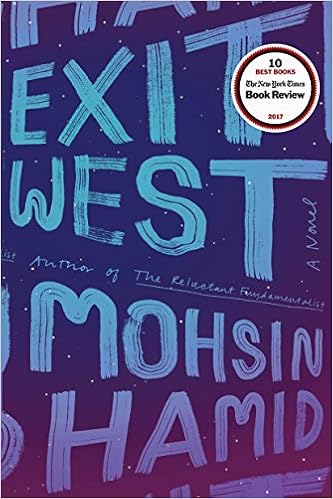
Exit West by Mohsin Hamid

The agent shrugged as though it was of no consequence to him, and Nadia, who had not considered the order of their departure until that moment, and realized there was no good option for either of them, that there were risks to each, to going first and going second, did not argue, but approached the door, and drawing close she was struck by its darkness, its opacity, the way that it did not reveal what was on the other side, and also did not reflect what was on this side, and so felt equally like a beginning and an end, and she turned to Saeed and found him staring at her, and his face was full of worry, and sorrow, and she took his hands in hers and held them tight, and then, releasing them, and without a word, she stepped through.

Saeed--quiet, pious, thoughtful--meets Nadia--brash, rebellious, adventurous--in an unnamed city where a violent crisis is unfolding.  Hamid pointedly keeps the city and the country unnamed, even in a novel where other geographical markers are quite explicit, to turn Saeed and Nadia into Middle Eastern everymen, but rightly or wrongly, I read them as Syrians.  Their budding relationship is slow and uncertain, but slowness and uncertainty are luxuries that war zones cannot afford, and soon Nadia has moved into Saeed's house with his father, filling the space left by his mother, who has died in the violence.  Saeed and Nadia love their familiar city, but it is changing, disappearing, and soon they find themselves with no other choice than to do what thousands of others have already done: make use of the mysterious black doors opening up all around the city that lead to other places in the world.

The doors inject a bit of magical realism into the story of the refugee.  The pair finds themselves transported immediately to Mykonos, where they struggle in a refugee camp, then through another door to London, and finally to San Francisco.  It's tempting to say, the conceit of the doors is actually sort of useless: it brings the refugees to their next stop instantly, but it doesn't actually change the progression of their travel or the alienation they feel when they get there.  (This is at least in part the way I felt about the literal train in Colson Whitehead's The Underground Railroad.)  But I appreciated the interstitial passages where Hamid breaks away from Saeed and Nadia's story to give vignettes about how other people have used the doors.  A suicidal man escapes the drudgery of his life; two elderly men from different sides of the world fall in love.  (I found these stories honestly more interesting than the couple, who bear too much of a burden to be an avatar for all refugees.)  The doors are not just a symbol for refugeeism, but for all the ways the world is shrinking in the 21st century.  Hamid imagines a world where refugees and migrants make up even larger percentages of cities like London than they do now, and provoke greater backlash and unrest, but it seems likely that this vision is less a fantasy or an exaggeration than an image of a near future.

It was interesting to read Exit West alongside Event Factory, which use very different strategies, neither very realistic, to capture something about the alienation of moving from place to place.  Both are good reminders that it is the alien who is truly alienated, and that the nativist fear of a changing home is never comparable to the migrant's sense of loss.  "We are all refugees in time," Hamid says, encouraging us to accept the changing demographics of the places in which we live and he is, of course, right.

Billy said he thinks that Hamid's writing is beautiful and deliberate, and I think deliberate is just the right word: Hamid spins out long but careful sentences, like the one I quoted above, that are tiny marvels in that you never get lost in them.  Combined with the deliberate vagueness around Saeed and Nadia's particular cultural position, and the bird's eye view perspective that avoids immediate action and dialogue in favor of descriptions of longer periods of time, I felt like the writing became aloof, and turned the story into something of a fable.  I found myself skating across the surface of it, wanting to get inside and not quite being able to.  But I did think Exit West was both imaginative and vital to the present moment in a way that few books are able to accomplish.

Thursday, June 13, 2019

St. Urbain's Horseman by Mordecai Richler

Sitting with the Hershes, day and night, a bottle of Remy parked between his feet, such was Jake's astonishment, commingled with pleasure, in their responses, that he could not properly mourn for his father.  He felt cradled, not deprived.  He also felt like Rip Van Winkle returned to an innocent and ordered world he had mistakenly believed long extinct.  Where God watched over all, doing His sums.  Where everything fit.  Even the holocaust, which, after all, had yielded the state of Israel.  Where to say, "Gentleman, the Queen," was to offer an obligatory toast to Elizabeth II at an affair, not to begin a discussion on Andy Warhol.  Where smack was not habit-forming, but what a disrespectful child deserved; pot was what you simmered the chicken soup in; and camp was where you sent the boys for the summer.  It was astounding, Jake was incredulous, that after so many years and fevers, after Dachau, after Hiroshima, revolution, rockets in space, DNA, bestiality in the streets, assassinations in and out of season, there were still brides with shining faces who married in white gowns, posing in the Star social pages with their prizes, pear-shaped boys in evening clothes.  There were aunts who sold raffles and uncles who swore by the Reader's Digest.  French Canadians, like overflying airplanes distorting the TV picture, were only tolerated.  DO NOT ADJUST YOUR SET, THE TROUBLE IS TEMPORARY... They were ignorant of the arts, they were overdressed, they were overstuffed, and their taste was appallingly bad.  But within their self-contained world, there was order.  It worked.

Jake Hersh is a successful television director living in London.  He's an outsider twice over, as a Canadian and a Jew, both a colonial and a stranger, but despite that, he's risen to wealth and comfort.  He has a tony house, a beautiful shiksa wife, several children.  In fact, if he hasn't achieved more, it's because he has an irritable streak and a chip on his shoulder, and often looks at his comfortable life with a kind of suspicion.  That is, until he finds himself accused of raping a young woman while his wife is out of town.  His co-defendant in the case is Harry Stein, an accountant from London's lower classes, who is like Jake's shoulder-chip personified, and mirrored by Mother England.  He's crass and perverse; he makes prank calls to starlets because he seethes with incel-ish anger that they reject, or would reject, him.  What attracts Jake to Harry may be that familiar resentment, write comically large, or perhaps there's something sobering about the way that Harry looks with jealous rage at Jake's life.  Either way, Richler implies that it's this attraction that has caused Jake's legal and marital troubles.

Harry's not the only foil that Jake has in the novel.  Jake spends much of his spare time trying to track down his cousin Joey, a charismatic ne'er-do-well who disappeared from Montreal's St. Urbain Street Jake was very young.  In Jake's memory, Joey is the only one who stood up to the escalating racial hatred of the French Canadians who boxed them in.  In his search, he's always narrowly missing him, in Israel, in Germany.  Reports of Joey differ--is he a gambler and a criminal, or the avenger of Jake's memory?  Jake believes he's tracked him to the jungles of Paraguay, where he believes that Joey--St. Urbain's horseman, tracking through the banks of the Parana River--is searching for the Nazi doctor Josef Mengele in order to exact revenge on behalf of the Jews of the world.  Like Harry, the Horseman is a foil for Jake: he is the thing Jake wishes he could be, the alternative to his pampered life of ordinary compromises.  He is another manifestation of resentment, channeled into righteous anger--the opposite of Harry's bootless pranks.

St. Urbain's Horseman has something sophisticated to say about the position of Jewish folks in the 20th century.  Clearly they have a lot to be resentful about, but is there a way to channel that resentment and make it useful?  If it is to be released, how is that done?  When a person from an oppressed group achieves success, or even bourgeois satisfaction, should they feel joy?  Guilt?  Is his father right to rage about his marriage to the gentile Nancy?  Jake has difficulty with these questions: he largely separates himself from his Jewish Canadian family, and invents another kind of family--the Horseman--in his head.

On the other hand, I cringed a little reading about the trumped-up accusations against Jake.  The "victim," a would-be starlet named Ingrid, is a character vacuum, briefly seen through a drunken haze and then sequestered behind the dais of a courtroom.  In the novel, it works, but I always feel squeamish about the way false rape narratives bolster, in even small ways, real-world suspicions about rape.  Put it alongside the joky anti-feminism of Barney's Version, and the Borscht Belt-comedian schtick of Richler's novels begins to seem hoary.

That said, St. Urbain's Horseman is very funny.  It is the most frenetic of the three Richler novels I have read, to the point of dizziness.  I was amazed by the relentlessness of the satire; I feel like most "funny" novels get credit for getting around to a joke every few pages, but in St. Urbain's Horseman, every paragraph has some incisive cutting remark or character beat.  (One of my favorite characters is a recurring cousin who's in the toilet business, and spends his whole visit to London examining, and praising, the commodes at places like Harrod's.)  I didn't think it had quite the same human element as Duddy Kravitz or Barney's Version, possibly because at heart those novels are tragedies, and St. Urbain's Horseman is about the ways in which a good tragedy can end up spoiled.  In the end, Jake gets off, his marriage a little dented, but his happy home intact--and that's something he'll have to learn to live with.

Tuesday, August 14, 2018

Henry and Cato by Iris Murdoch

Cato coming from the church back to the Mission, had seen a sign in a clothes shop window which said, in neon lights, TROUSERAMA.  He felt a piercing desire to laugh and cry.  There was no God and the world was damned and everyone had quietly gone mad only they were carrying on as usual.  The universe was funny brittle awful momentary.  Human life was the pointless wandering of insects.  TROUSERAMA.  That's what it was.  Life was simply a trouserama.

Henry Marshalson is the second son of wealthy British gentry, living in America as a second-rate art professor.  When he finds out that his older brother, Sandy, has died, he's overjoyed--not because he now will inherit the massive estate, Laxlinden, but because he regards Sandy, along with his parents, as the chief tormentors of his life.  The estate, in fact, he plans to sell, and give all the money away to charity.  This plan is not well received by his mother, who's been living there, and in fact it's made in a sort of frenzy of feeling of which idealism actually plays a little part.  There's a little revenge in there, but mostly, there's a feeling that if he can divest himself of Laxlinden, his mother, his money, then he can return to America unencumbered by his past:

Why had he got to get rid of his inheritance?  He did not even any more know why.  He just had to transform all these objects, these things and spaces, into clean easily disposable money, and then to get rid of the money and be--what--free, good?  Even these names were too flimsy for what god-possessed Henry had to achieve.

Cato, Henry's old friend and neighbor, is the son of a deeply secular man who is bitterly disappointed that Cato has become a priest.  Cato's conversion was sudden, rooted in feeling rather than intellect.  But where once he felt the divine presence of Christ, he feels nothing but absence, and a sinking feeling that there is no God.  Even in his process of deconversion, his priest friends tell him to stick it out, and try to remind him that a life of faith is more complex than a feeling of the divine presence.  But Cato's decision is complicated: he has fallen in love with a young criminal drifter who goes by the name Beautiful Joe.  Joe hangs on to Cato with a puppy-like love, but refuses to be reformed or remade, and talks up his own vicious wickedness.  When Henry returns from America, chattering about his desire to give his money away, Joe wonders if he himself might not be the best recipient of Henry's largesse.

Like Cato, Henry has a love-object: Stephanie, a woman he discovers in a secret flat kept by his brother, and who claims to have been Sandy's lover.  Stephanie is older, she's not very attractive, and in fact she's irritatingly needy, but that's exactly what Henry desires: a woman he can possess.  Stephanie is the one thing of Sandy's he inherits but won't divest himself of.  In both of these relationships there is a warning about the dangers of one of the many things we call love.  Henry is driven to Stephanie, and Cato to Joe, by rote compulsion, and both justify their high-handedness with an intent to remold their love objects into better people.  Whether they are captives or captors isn't quite clear, and this dynamic is reflected a third time in the relationship between Henry's insightful mother, Gerda, and Lucius Lamb, the pathetic aging poet she keeps around like a dog to be kicked beneath the table.

Like all of Murdoch's novels, Henry and Cato is philosophically rich.  Among other things, she asks: what does it mean to be good?  Henry approaches goodness at times despite being selfish and amoral; Cato, the caring priest, seems only to do damage.  What does it mean to believe in God?  Can one call themselves a Christian in the absence of both intellectual assurance and the feeling of divine presence?  What is suffering?  That's a question that the novel is deeply concerned with:

Supposing one lacked the concept of suffering, thought Cato, sitting in the bedroom waiting for Beautiful Joe to arrive.  Supposing one just suffered like an animal without thinking all the time: I'm suffering.  Is it a sophisticated concept?  He was not sure.  Christianity hands it out even to peasants.  Christ suffered, that is the whole point.  But what a pointless point.  It's such a selfish activity, suffering.  Buddhism treats it with contempt.

Cato, Henry, Stephanie, even Lucius and Gerda, all choose a kind of suffering and call it by the name of love.  (What is passion, after all, but a word for the suffering of Jesus?)  A few characters seem cognizant that they could choose happiness, like Cato's sister Colette, who assures Henry that they are destined to be married.  And then there's Joe, whose plan to kidnap Cato, ransom money from Henry, and defile Colette, seems to be a kind of blissful ignorance, the product of an id unshackled from the suffering superego.  Not that you'd want to be like Joe.

The kidnapping episode, in which Cato and Colette are trapped in an underground air raid shelter, plays like a section imported in from a dimestore thriller.  But Joe is so compelling in his childish will to violence that it doesn't matter.  In fact, the most compelling characters in the novel are the minor ones--canny Gerda, sad Lucius, and the mysterious bird-headed inscrutable servant of the Marshalson family named Rhoda.  They're more palatable perhaps because we don't have to sit so long with their mania, like Henry, or their melancholy, like Cato.  I'm not one of those people who thinks that novels need likeable characters, but the sour myopia possessed by every person in Henry and Cato can make it into a grind.

Menaced and slashed a little by Beautiful Joe, Henry runs to the National Gallery to sit before a painting of Diana and Actaeon.  That's just the kind of thing people do in Iris Murdoch novels: they combat existential horror by sitting in front of paintings.  The violence in the painting is nothing, Henry remarks to us, compared to the real thing, or even the premonition of it.  (Chill out, Henry.  It's only a flesh wound.)  But there's Murdoch, too, reminding us that the picaresque novel points toward real terrors, that are only glimpsed in the pages of art.  Enjoy the rest of your summer!

Wednesday, August 20, 2014

At Freddie's by Penelope Fitzgerald

'If you choose to go on the stage,' he said, still pondering, 'you pass your life in a series of impersonations, some of them quite unsuccessful.'

'Of course they're bound to fail sometimes.'

'They earn their money that way, and in fact they want to earn it that way.  Do you know Hannah that causes me some astonishment.  It seems to me a sufficient achievement to be an individual at all, what you might call a real person.'

Man, I love Penelope Fitzgerald.  She draws characters so minutely but so perfectly.  At Freddie's barely cracks 150 pages but in that space it manages to pack in five or six really memorable, quite human characters and the complex relationships between them.  Ford Madox Ford called it "getting a character in," and I can think of few writers who do it better.  There's Freddie, the proprietor of the Temple School that provides the theaters of London with a steady supply of child actors.  A charismatic older woman, she's one of those people who somehow always get what they want:

Certainly she could create her own warmth, a glow like the very first effects of alcohol.  As to what she wanted, no mystery was made.  She wanted to get the advantage, but on the other hand human beings interested her so much that it must always be an advantage to meet another one.  When she smiled there was a certain lopsidedness, the shade of a deformity, or, it could be, the aftermath of a slight stroke.  Freddie never tried to conceal this -- Take a good look -- she advised her pupils -- I'm not nearly so amusing as you're going to be when you imitate me. -- But the smile itself was priceless in its benevolence, and in its amusement that benevolence could still exist.  One had to smile with her, perhaps regretting it later.

There are the child actors themselves, especially Mattie and Jonathan, who Freddie points out as the difference between talent and genius.  Mattie is highly successful, snagging several high profile roles, but is fascinated by and obsessed with Jonathan's mercurial genius.  Their relationship is defined by Mattie's mix of love and resentment, and Jonathan's indifference:

He could not be satisfied until Jonathan had got into some sort of trouble.  Then would be the moment to rush luxuriously to his assistance.  But there were so few opportunities, one must be continually on the watch.  Prompting, for instance, was never needed.  If Jonathan didn't know his lines (and he was not a quick study) he smiled, and read them from the book.  If he had no dinner money, the girls gave him Fruity Snack.s  Once or twice, however, he complained of a stomach ache, although in a detached way, as though the pain was the responsibility of someone else.  Then Mattie was in his glory.  Lay him down near the radiator, Miss, and keep him warm.  I know just what he has to have, I'll go down to Miss Belwett for the Bisodol, you want to be careful, he might get a lot worse quite suddenly, we had to get a stomach pump to one of the cast on Saturday. -- He was thanked, of course, but never enough.  He could not master the half-sleepy mysterious gum-chewing little rat of a Jonathan, or exact the word of approval he wanted.  Later he rolled him over on the washroom floor and banged his round head on the concrete as though cracking a nut.  'Has that cured your bellyache?' -- Jonathan considered, and said he would tell him later.  Mattie was outraged.  And yet his dissatisfaction showed that he was not quite lost.  It was the tribute of a human being to the changeling, or talent to genius.

I especially liked reading about these two, and the other child actors, because I have a lot of students who fancy themselves actors, and though mine are much older than Mattie and Jonathan, I recognized a lot of them here: their habit of breaking into impressions, or song, and the frequent theatrical air that suggests they are not being quite sincere.

Then there are the teachers: Hannah, who is attracted to the glamor of the theater world, and Pierce, who is utterly aware of his lack of talent, sociability, or sheer competence, but who approaches his own shortcomings with stolid resignation.  He is a bad teacher, cannot understand or relate to the children, though Jonathan takes a liking to him.  He is, of course, in love with Hannah.  That's him at the top of the review, struggling to make sense of those who can act like any number of people when he is so profoundly bad at being himself.

These characters are so interesting and vibrant that it feels as if, rather than devising a plot, Fitzgerald merely put them together so she might record what happens.  And indeed, there's not much of a plot--Hannah falls for a roguish actor, breaking Pierce's heart; Mattie tortures Jonathan; Freddie charms her way through the financial insolubility of the school.  And yet At Freddie's is always surprising, because people are surprising.  The novel resolves in a way that feels deeply sad, though in such a low-key way that it's hard to pinpoint where the sadness comes from, wringing more pathos out of the everyday than even the final paragraph of The Bookshop, when Florence Green boards a bus carrying the burden of her shop's failure.

The central idea of At Freddie's is a well-worn one: our selves are theatrical performances of a kind, and to be an actor is to master the self in a way.  Pierce doesn't understand it, but is naturally himself in a way that other characters in the book cannot be; perhaps that's why he appeals to the enigmatic Jonathan, whose acting genius is tied up with his aloofness and detachment.  Freddie's charm is a kind of bravura performance, a more comprehensive and assured one than any of her students can conjure.  In the end, she makes a surprising move--deciding to dedicate the school to training students to act in commercials--that seems out of character, but suggests that like any performance, it can be stopped, or changed, if the performer knows what he or she is doing.

Saturday, July 28, 2012

Offshore by Penelope Fitzgerald

The Thames barges, built of living wood that gave and sprang back in the face of the wind, were as much at home as anything on the river.  To their creaking and grumbling was added a new note, comparable to music.  As the tide rose, the wind shredded the clouds above them and pushed a mighty swell across the water, so that they began to roll as they had once rolled at sea.

Nenna James lives on a houseboat, the Grace, docked at Battersea Reach, London, purchased without the knowledge of her husband, who refuses to come and live on it, too.  Her children, Tilda and Martha, are there, growing up amid the strange and motley collection of people who decide to live on houseboats: Willis, the old painter, who lives on the Dreadnought; Richard, who lives on the Lord Jim; Maurice, the prostitute who lives on the Maurice.

Their lives, like their boats, are in various states of disrepair.  Some, like Nenna's husband Edward and Richard's wife Laura, cannot understand the appeal of living on a houseboat, especially those which never sail.  They are a kind of liminal place, existing between worlds, which perhaps explains the motivations of those who love them as well as those who don't:


[Nenna said,] 'But, you know, by myself I can't make my mind up.'

'You shouldn't do it at all.'

'Why not, Maurice?'

'Why should you think it's a good thing to do?  Why should it make you any happier?  There isn't one kind of happiness, there's all kinds.  Decision is torment for anyone with imagination.  When you decide, you multiply the things you might have done and now never can.  If there's even one person who might be hurt by a decision, you should never make it.  They tell you, make up your mind or it will be too late, but if it's really too late, we should be grateful.  You know very well that we're two of the same kind, Nenna.  It's right for us to live where we do, between land and water.  You, my dear, you're half in love with your husband, then there's Martha who's half a child and half a girl, Richard who can't give up being half in the Navy, Willis who's half an artist and half a longshoreman, a cat who's half alive and half dead...'

He stopped before describing himself, if, indeed, he had been going to do so.


Fitzgerald's work has such an elegant simplicity; that's one of the things I like best about her.  (Offshore clocks in under 50,000 words.)  The other things I like about her: One, she didn't publish her first novel until she was 60, and won the Booker Prize for Offshore when she was 63.  Nice to know not everyone has to be Ned Beauman.

Two, she has a real knack for detail; Offshore, like The Blue Flower, slim as it is, offers up a couple dozen minor but wonderfully expressive, crystalline moments.  There is, for example, the moment when Nenna goes to see her estranged husband, accidentally announcing herself at the door as Grace.  Or when she, lost in the rain miles from Battersea without her purse for busfare, is accosted by a man as she leans over to fix her shoe.  For a moment it seems as if we are going to witness a sexual assault; instead he takes her shoe and throws it into the road.  Or when Maurice adorns the deck of his boat with flagstones and an antique lamp to make it look like a Venetian street corner.  Such details are minor, and often silly, but together they manage to create a vital sense of reality with a minimum of fuss.

It's a testament to Fitzgerald's skill and restraint that she grew up in a houseboat community like the one in the novel, and yet decided not to pile everything she knew about it into one massive tome.  Offshore lacks the rounded totality of The Blue Flower, and seems more like a single slice, randomly chosen, of the life of a peculiar community.  My greatest misgiving, then, is that I wish it had been a little longer.

Wednesday, September 23, 2009

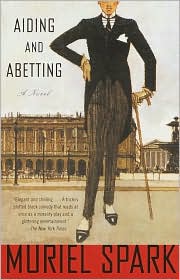
Aiding and Abetting by Muriel Spark

The good Dr. Wolf looked at her patient and let the above facts run through her head. Was this man sitting in front of her, the claimant to be Lord Lucan, in fact the missing murder suspect? He was smiling, smiling away at her thoughtfulness. And what had he to smile about?

She could ring Interpol, but had private reasons not to.

She said, "There is another real one? 'Lord Lucan' in Paris at the moment. I wonder which of you is the real one? Anyway, our time is up. I will be away tomorrow. Come on Friday."

"Another
Lucan?"

"I will see you on Friday."


The story of Lord Lucan is particularly grizzly: the London socialite disappeared after a bungled attempt to murder his wife, which instead left the Lucans' nanny dead, bludgeoned to death in a case of mistaken identity. A fugitive, he appears in Paris and walks into the psychiatric offices of Dr. Hildegard Wolf, who is happy to help but for the complicating fact that she already has a patient who says that he is Lucan.

I loved Spark's The Prime of Miss Jean Brodie, which was small but remarkably solid, building believable and fascinating characters from very few blocks. I wish I could say the same for Aiding and Abetting, which is written in the same typical style, and has a really fascinating premise to boot, but can't escape feeling slight. There simply isn't enough space to pull the usual mystery tricks; Dr. Wolf has a notion of which of her patients is the real Lucan from the very beginning and seems to care only slightly if she is correct. Spark, it seems, is equally disinterested.

What she does concern herself with is the idea of identity, what is it that makes a person who they are. Is it mutable, or static? Lucan has long been nagged by the sheer amount of blood that came out of his nanny, and Spark uses that blood as the novel's central conceit--do we carry ourselves inside our bodies, as we do our blood? Or are they something we adopt and fashion, as the fake Lucan does, and Dr. Wolf herself, who is hiding her own shady past?

But that message is, strangely enough for an author whose hallmark is succinctness, muddled and incongruent; piecing together what exactly it is Spark wants to say is difficult and probably wouldn't be satisfying. The elements of social satire that abound here--the aiders and abetters of the title are, by-and-large, Lucan's fellow blueblood aristocrats who help him for seemingly no other reason than he is one of them--are either toothless or so markedly British in focus that they seem so to me.

I suppose I shouldn't complain; after all, I've read books that take an hour and a half to read that are much less engaging (see future entry: Tears of a Tiger). All in all, I would have traded the incredible tightness of Jean Brodie for a fuller, more detailed novel.

Thursday, July 2, 2009

Ludmila's Broken English by DBC Pierre

Blair's eyes cut into slices. He drew back his finger like an arrow, and fired it at the keyboard.

'www.kuzhniskgirls.com.ru.'

Women leapt on to the screen. Women with hairstyles and poses unseen since the days of sheiks and flappers, against lurid studio backdrops of lakesides, beaches, and boudoirs.

And in the lower right-hand corner of that self-conscious assortment, one face shone out from the thick of a genuine life.

One wild, beautiful face.

Blair's penis twitched up to his hand.


I was a big fan of DBC Pierre's first novel, Vernon God Little, which was despised by many critics but I felt succeeded on the virtue of its cojones alone, along with a skewed but evocative sense of language. That book was a dark comedy about a school shooting in Texas; it was amazingly distasteful but cut deeply into the insecurities of the American psyche in this century, and had quite a bit to say about how our superconsumptive and obsessive culture abets great violence. Ludmila's Broken English, by contrast, is a book written for some other audience, in some other time.

The titular character is Ludmila Derev, a young girl living in a war-torn Caucasian wasteland, who, in the opening scenes of the novel, kills her grandfather after he makes a drunken attempt at raping her. Without his pension check to keep their family afloat, Ludmila must journey to the nearest town to find work, and eventually--after many of what I can only describe as hijinks--her face ends up on a website advertising Russian brides.

The other half of the book follows Blair and Bunny Heath, a pair of recently separated conjoined twins who have been released from their group home and find themselves in London, a cosmopolitan world that they don't understand, where alcohol and sex--or at least the suggestion of sex--are readily available. Though Bunny wishes for nothing more than to return to the home, Blair is fascinated by this new world, and the prospect of getting laid, and finds Ludmila on the internet, bringing both stories together when he and Blair travel to the Caucasus to meet her.

What is the point? Vernon God Little seemed urgently relevant, but writing about Eastern Europe seems, without being condescending to those who live there, so twenty years ago. As far as I know, with the exception of the revolutions in Moldova and the Ukraine (both of which resulted in improved governments), and the Russia-Georgia conflict, Eastern Europe has been relatively conflict-free since the Clinton era. The rest of the world has turned its eyes to the Middle East; as a satire isn't this a case of beating a dead horse? Perhaps, as he did for American culture in Vernon God Little, Pierre wishes to show us how the endless pleasure gratification of the London lifestyle can corrupt the innocent in the case of Bunny and Blair, but Blair is assuredly not, like Vernon, an innocent caught up in chaos. Vernon is a child; Blair brings the horrific events of the novel's final chapters squarely upon himself.

Ultimately, Vernon God Little is composed of the grotesque and the baroque; Ludmila's Broken English is simply made up of ugliness. There is nothing really likeable or redemptive about it; when these characters fail I find myself without sympathy. It is as if, sadly, Pierre willfully took on the role that his critics tried to foist upon him after his first novel.

Monday, January 19, 2009

A Spectacle of Corruption by David Liss


Events of the past few days had happened so quickly and so strangely, I felt I understood almost nothing, but I now knew two things with absolute certainty. I knew that someone desperately wanted to see me convicted and sentenced to hang, to which end the law had been cruelly abused.

And, just as surely, someone wanted me free.


A Spectacle of Corruption is the story of Benjamin Weaver, a jewish thieftaker, and his struggle for justice after being convicted of a crime he did not commit. Set in 18th century London, amidst a backdrop of heated Parliamentary elections, Spectacle provides a glimpse into the seedy world of British politics in the colonial age.

The story opens with Weaver's murder trial, overseen by a judge who seems intent on a conviction, no matter how feeble the prosecution's arguments. After being convicted and sentenced to death, Weaver escapes his incarceration thanks to the efforts of a mysterious young woman who slips him a lockpick and file before he is escorted from the courtroom. In an effort to clear his name, Weaver creates a new identity so that he may freely roam the streets of London gathering information. As Matthew Evans, a gentile tobacco farmer returned to Britain from Jamaica, Weaver is able to penetrate the high-class, political circles that seem to want him dead. The story takes a number of twists and turns, eventually unveiling plots involving far more than the life of Benjamin Weaver... Plots that could dismantle the entire British Government.

I've never really been one for mystery stories, but I suppose I enjoyed A Spectacle of Corruption. Benjamin Weaver is a wildly likeable character. His narration and dialogue remind me of a less pretentious version of Frasier. Not simply a man of eloquence, Weaver is a former boxer unafraid to use pugilistic persuasion on those unmoved by his verbal arguments. I suppose you could imagine Weaver as a hybrid of Oscar Wilde and Jack Bauer. Aside from Weaver's character, this story didn't strike me as anything remarkable. I enjoyed it a bit, but I don't know that I'd recommend it to anyone (unless I know they adore foppish historical fiction). The story's mystery fell flat on its face. With clues pointing Weaver to dead end after dead end eventually leading to a climax that hardly felt satisfying. And the most interesting aspect of the story, Weaver's inadvertent involvement in a Jacobite uprising, seemed underutilized.

I will say, that while the book didn't blow me away, I really respect the amount of research and work Liss must have put into making this book. From what I've read, Spectacle is a very accurate portrayal of 18th century British politics and a number of characters in the story are actual historical figures. Jonathan Wild, for example, is one of Weaver's rivals as a thieftaker and was, in fact, considered the most famous P.I./criminals of his time. Also, Liss's use of racism was delicately done. I think its easy for writers to go overboard when trying to make a character seem racist or ignorant. Its a more complex task to accurately portray how racist, ignorant people actually act. The anti-semitism in Spectacle, I thought, was very well done. The snooty, high-class, talking wigs that Weaver encounters do not keep their disdain for the Jewish community under wraps, but nor do they spend entire dinner parties spouting anti-semitic remarks. Liss was able to convey the anti-semitism of 18th century London as a pervasive undertone, instead hitting the reader over the head with it every other page.

So I suppose long story short, A Spectacle of Corruption is an excellently written (but somewhat boring) story about a very likeable character. Spectacle is the sequel to A Conspiracy of Paper, also starring Benjamin Weaver, so perhaps that story finds Weaver in more arresting circumstances.

Highlights: The use of the word "bubbies" instead of breasts, Weaver is pretty B.A.
Lowlights: All of the useless red-herrings and dead ends that add nothing to the mystery's solution.

Monday, February 26, 2007

Last Orders by Graham Swift

Last Orders is the second winner of the Booker Prize I've read in a row, after Disgrace, and later this year for my English class I'll have to read Kashuo Ishiguro's Never Let Me Go. It's about the death of Jack Dodds, the local butcher in Bermondsey, London, and his last request: that his three best friends and his son carry his ashes to the British beach of Margate and scatter them to the sea.

The book tells the story of Jack and his family and friends via flashback. Each of the characters, plus a couple of others, including his wife Amy, gets a series of short chapters in which they tell their version of events, so to speak. If a book about transporting someone's remains told with a shifting point of view sounds familiar to you, it should: That's As I Lay Dying.


But whatever. Swift doesn't crib from Faulkner directly, though he has pretty clearly lifted the plot. He does all right by it, though: the characters, who at first seem to run together like any trio of old strangers sitting in a London pub might, eventually separate themselves into quite convincing portrayals. Peculiarly, Jack is the main character of the book (while Faulkner's matriarch almost certainly wasn't), even though he is dead, because the format allows us to see him from every angle: his faults, his assets, his passions and character. Swift seems to imply that the line between existence and non-existence is not death but memory; once you are forgotten you truly cease to exist. This explains why Jack's wife Amy continues to see her mentally retarded daughter June in an institution every week, though Jack refuses to come: it's as if when Amy stops coming to see her, June will cease to exist because she is completely out of mind. Last Orders is a book keenly interested in what it means to exist at all.


This is the second book in a row I've read that dealt heavily with the theme of aging (and, by extension, death). That may be all well and good for my professor, but it seems as if the course is missing out on literature that deals with my own problems and questions. Surely these books are worth reading at any age, but I can't help but feeling that I won't be able to understand them on the deepest level for some time now. Hopefully, a very long time.


There was a movie made of this with Michael Caine. It's probably pretty boring.