Showing posts with label politics. Show all posts

Sunday, June 23, 2013

The Geneva Option by Adam Lebor

Yael Azoulay is a fixer for the UN Secretary General. She is not the kind of fixer whose primary tool is a gun. She relies on her wits, her intuition, and her ability to negotiate with anyone, whether warlords, genocidal dictators, and unscrupulous businessmen. When she is sent to the eastern Congo to negotiate with a Hutu warlord, something goes wrong, and she realizes that she's in serious danger, a danger with roots that snake there way back to the United Nations Headquarters.

Lebor writes action as well as just about any author I have read, and he sets scene quickly and vividly, sometimes with little more than a sentence or a phrase. One such sentence read, "Yael was drenched in seconds as the wet gusts hit her." This came in the middle of a fist-and-foot-fight between Yael and her captor in a car, shortly after the passenger-side windows shattered. At its core, the sentence is pretty basic, but it provides readers with a vivid setting for this scene in a mere eleven words. Brevity is hard to do.

Lebor includes a near perfect amount of detail in his writing, enough to immerse readers in a city, in a culture, or in an ornate 19th century building, but still well short of the overly-detailed writing of authors like Tom Clancy.

Although the preponderance of characters in The Geneva Option are fictitious, Lebor lends some verisimilitude to his international thriller, by referencing real-life events, situations, and in some instances even political figures. This, no doubt, stems from Lebor's investigative journalism background.

Although I really enjoyed The Geneva Option, I have one slight caveat. While I liked Lebor's Yael Azoulay character, there were a number of instances where it was obvious that this strong female lead was the creation of a male mind.

Friday, June 25, 2010

Game Change: Obama and the Clinton's, McCain and Palin, and the Race of a Lifetime by John Heilemann


After reading this, I've learned something about myself...I love reading about other people's problems, especially famous, super rich people. I lap it up like a dog attached to a soup bone. I don't want to know what that says about me..

Some suspicions that were confirmed by this book:

- Bill Clinton is just as gross as I assumed he was. Smart, but ew. Ew. Eeewwww!

- Hillary swears like a f%$#^&king sailor. You rock,#^^$&#@*&, Hillary! And surprise, surprise, she may actually love her husband! Go figure!

- McCain had an affair in the 90's with someone my age.. oh.my. gosh. Can you imagine? Probably you shouldn't. That gag reflex is a hard one to control.

- Biden didn't get along too well during the campaign. Really?? By the way, where is Joe Biden? Sounds like a book name doesn't it. Has anyone seen Joe Biden on the news lately? What, he fall of the face of the Earth?

- My biggest surprise of the book?? I actually came off feeling slightly bad for Sarah Palin.. Yes, I know, I'm currently clutching my chest and breathing heavily at the thought of it.

Ah, you poor, poor multi-millionaires. Life would be rough without you for entertainment. As for me, I'd rather have my feet scraped than run for office...and I'll mail anyone a pretend dollar if anyone knows what movie that last line is from.
A must read for any political junkie..
4 stars.

Monday, June 22, 2009

Our Endangered Values by Jimmy Carter

A couple of weeks ago I signed onto Facebook and saw that one of my friends had voted in some poll as to who was the worst president in recent history. My friend had cast his voted for George W. Bush. Now my friend grew up in the same conservative Christian circles that I did, but much like myself, finds himself somewhere outside these circles. The first comment came from an unbelievably opinionated and obnoxious person--who we both know: "Are you kidding me Josh? What about the peanut farmer from Georgia?" Josh unsuccessfully tried to brush this off with a bit of a joke. Twenty comments later people are referring to Carter as a "disaster," and some crazy man who inexplicably capitalizes the first letter of every word is ranting about Obama and the end of the United States as we know it. These are Christian people...I suppose. Carter is a Christian. How is it that these people could harbor such negative feelings toward arguably the most active ex-President? Well, as luck would have it, this book offers at least a partial answer to this question.

The first thing to note about this book is its overtly Christian perspective. As he has for most of his life, Carter speaks candidly about his religious beliefs in this book. He does not shy away from the fact that he is a Christian (a Baptist, to be more precise) or that Christian values inform much of his thinking. You would think this would appeal to Christians.

Our Endangered Values addresses the rise of fundamentalism and the threat that it poses to our values. That's right, Facebook wackjobs: you are the insidious threat to our nation! Ex-President Carter and I say so, so it has to be true. Carter is a good person to address this, since his personal life was directly affected by it. In the book he talks about how in 1979, fundamentalists essentially took control of the Southern Baptist Convention. Their "with us or against us" approach drove many thinking people away, while at the same time it bolstered their prominence on the political scene. Their intransigence no doubt informed the definition of fundamentalism that Carter uses in this book. "Fundamentalists tend to make their self-definition increasingly narrow and restricted, to isolate themselves, to demagogue emotional issues, and to view change, cooperation, negotiation, and other efforts to resolve differences as signs of weakness."

This book begins in the late 1970s, with the rise of such religious zealots as Pat Robertson, James Dobson, and Jerry Fallwell. But Carter levels criticism at those who were in positions of power at the time when this book was written (2006). He criticizes Bush II on issues such a "faith-based" initiatives, torture, his economic policies, and the war in Iraq. His criticisms rest on sound Christian and American principles, such as the Separation of Church and State (I can capitalize first letters too), Christ-like love, and the redistribution of wealth that runs like a current through the New Testament. However, Values does not devolve into some Olbermann-esque screed against Bush, or a listing of his blunders. Far from it, Carter is composed and cool in his criticisms. (But does he set them to a sweet Coldplay song?)

While not its intent or purpose, this book provides a two-fold answer for why fundamentalist Christians dislike President Carter so much. Firstly, they are as he describes them: openly hostile toward negotiation, alternative ideas, and entire groups of people (I am paraphrasing). Secondly, he calls them out on it. Why would a Christian support the invasion of Iraqi? How could a Christian possibly be okay with torture? Should not Christians be good stewards of the planet? But fundamentalist are not about self-reflection. They are not about loving others. They are about attacking those who do not believe exactly like they do. So it doesn't matter that Jimmy Carter worked to reduce the need for abortions, what mattered was that he did not attack the judiciary for the decision in Roe v. Wade. The religious right loves attacking the Judiciary. Separation of church and state be damned! And while were at it, let's get rid of the separation of the powers of government as well. It doesn't matter that he was awarded the Nobel Peace Prize in 2002. To these religious ideologues, Carter is a total sellout, a lukewarm Christian that will ultimately be spewed out of God's mouth.

It is comforting to know that amongst all the Christian wackos out there, Christians like President Carter exist. Principled people who use their lives to effect positive change on the world are much preferred to people who wake up every morning, pull on their waxy costume of Christianity, plaster a televangelist smile over their cesspool of hatred, and start shouting.
_________________________

The Private Faith of Jimmy on American Public Media
"Just War -- or a Just War?" by Jimmy Carter
Interview about this book with Mother Jones

Monday, January 19, 2009

A Spectacle of Corruption by David Liss


Events of the past few days had happened so quickly and so strangely, I felt I understood almost nothing, but I now knew two things with absolute certainty. I knew that someone desperately wanted to see me convicted and sentenced to hang, to which end the law had been cruelly abused.

And, just as surely, someone wanted me free.


A Spectacle of Corruption is the story of Benjamin Weaver, a jewish thieftaker, and his struggle for justice after being convicted of a crime he did not commit. Set in 18th century London, amidst a backdrop of heated Parliamentary elections, Spectacle provides a glimpse into the seedy world of British politics in the colonial age.

The story opens with Weaver's murder trial, overseen by a judge who seems intent on a conviction, no matter how feeble the prosecution's arguments. After being convicted and sentenced to death, Weaver escapes his incarceration thanks to the efforts of a mysterious young woman who slips him a lockpick and file before he is escorted from the courtroom. In an effort to clear his name, Weaver creates a new identity so that he may freely roam the streets of London gathering information. As Matthew Evans, a gentile tobacco farmer returned to Britain from Jamaica, Weaver is able to penetrate the high-class, political circles that seem to want him dead. The story takes a number of twists and turns, eventually unveiling plots involving far more than the life of Benjamin Weaver... Plots that could dismantle the entire British Government.

I've never really been one for mystery stories, but I suppose I enjoyed A Spectacle of Corruption. Benjamin Weaver is a wildly likeable character. His narration and dialogue remind me of a less pretentious version of Frasier. Not simply a man of eloquence, Weaver is a former boxer unafraid to use pugilistic persuasion on those unmoved by his verbal arguments. I suppose you could imagine Weaver as a hybrid of Oscar Wilde and Jack Bauer. Aside from Weaver's character, this story didn't strike me as anything remarkable. I enjoyed it a bit, but I don't know that I'd recommend it to anyone (unless I know they adore foppish historical fiction). The story's mystery fell flat on its face. With clues pointing Weaver to dead end after dead end eventually leading to a climax that hardly felt satisfying. And the most interesting aspect of the story, Weaver's inadvertent involvement in a Jacobite uprising, seemed underutilized.

I will say, that while the book didn't blow me away, I really respect the amount of research and work Liss must have put into making this book. From what I've read, Spectacle is a very accurate portrayal of 18th century British politics and a number of characters in the story are actual historical figures. Jonathan Wild, for example, is one of Weaver's rivals as a thieftaker and was, in fact, considered the most famous P.I./criminals of his time. Also, Liss's use of racism was delicately done. I think its easy for writers to go overboard when trying to make a character seem racist or ignorant. Its a more complex task to accurately portray how racist, ignorant people actually act. The anti-semitism in Spectacle, I thought, was very well done. The snooty, high-class, talking wigs that Weaver encounters do not keep their disdain for the Jewish community under wraps, but nor do they spend entire dinner parties spouting anti-semitic remarks. Liss was able to convey the anti-semitism of 18th century London as a pervasive undertone, instead hitting the reader over the head with it every other page.

So I suppose long story short, A Spectacle of Corruption is an excellently written (but somewhat boring) story about a very likeable character. Spectacle is the sequel to A Conspiracy of Paper, also starring Benjamin Weaver, so perhaps that story finds Weaver in more arresting circumstances.

Highlights: The use of the word "bubbies" instead of breasts, Weaver is pretty B.A.
Lowlights: All of the useless red-herrings and dead ends that add nothing to the mystery's solution.

Thursday, January 15, 2009

Miracleman by Alan Moore and Neil Gaiman

Although Alan Moore is best known for his work on Watchmen, he had already spent several years as a comics visionary by the time he wrote it. Moore's stories, even pre-Watchmen, used superhero tropes and cliches to tell mature, adult stories, full of literary references and philosophical under(and over)tones.


Miracleman can, in some ways, be seen as a parallel to Watchmen, in that it takes several of the same concepts but extrapolates them in a different direction. The responsibilities of being a godlike being, the superhuman as an object of terror rather than redemption, and whether superheroes should be seen as good or evil all pop up in Miracleman as in Watchmen.


Miracleman was Moore's reinvention of a comic from his youth, Marvelman. Due to issues with a certain comic book company, the name of the book was changed to Miracleman before making it over to the States. The story begins with a reprint of the original Miracleman series, featuring Miracleman himself, Young Miracleman, a younger version of Miracleman, and Kid Miracleman, an even younger doppelganger. Together they defeat some rather silly alien invaders in a rather silly way. While the Miracleman family is celebrating, the reader is treated to a quote from Nietzsche's Thus Spoke Zarathustra. Then things get really weird.


Mike Moran, Miracleman's alter ego, wakes up in 1983, having forgotten all about his previous life as Miracleman. He's a married, freelance reporter suffering from migraines, hounded by memories he can't quite bring into focus. During a terrorist attack at the opening of nuclear power plant, Moran turns, almost accidentally, into Miracleman. From that point on, the series becomes an exploration of mortality vs immortality, humanity vs godhood, and free will vs predetermination. It's heady stuff, sometimes too heady, but always surprising and entertaining.


Moore doesn't shy away from the sillier aspects of Mircleman's past, dealing with the Miracleman Family and their crazy adventures in a novel way. The reactions of Miracleman himself and of the rest of the family (once they're re-introduced) seem realistic, particularly Liz Moran, Miracleman's painfully human wife. I hesitate to say too much about the storyline because Chris is reading it and I don't want to spoil anything.


If I have any complaints about Miracleman, it's the way it ends. Alan Moore handpicked Neil Gaiman, of Sandman fame, to finish the storyline. Unfortunately, Eclipse comics went bankrupt 6 issues into Neil Gaiman's intended 12-issue run, and the rights to the character have been tied up in litigation ever since. I don't know if we'll ever see the end of Miracleman, but regardless, it's worth a read. A thought-provoking, mature comic book that work because of the format, not in spite of it.

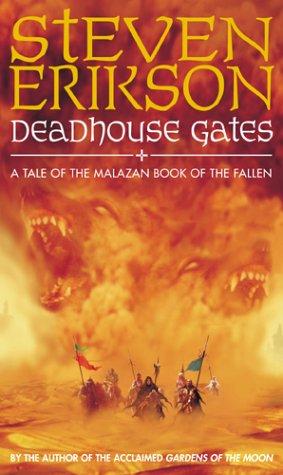
Deadhouse Gates by Steven Erikson

"I killed him," Squint moaned. "... Who took the man's life? A broken old soldier of the High Fist's arm-- Oh, Beru, have mercy on my soul..."

Duiker wrapped the old man in his arms and held him fiercely. The bow clattered on the platform's wooden slats. The historian felt the man crumpling against him as if his bones had turned to dust, as if centuries stole into him with each ragged breath.

Commander Blistig gripped the bowman bu the back of the collar and yanked him upright. "Before the day's through, you bastard," he hissed, "ten thousand soldiers will be voicing your name." The words shook. "Like a prayer, Squint, like a Hood-damned prayer."


Well, I'm officially a fan of Erikson's absurdly ambitious epic. The scene above is from the intense climax of one of the book's five main storylines. I can tell you that just retyping the passage gave me goosebumps. Erikson is brutal with the fates of his characters, and this scene was particularly heart-wrenching.

Deadhouse Gates' plot is a bit more simple to explain than Gardens of the Moon. The book takes place immediately after the events of Gardens, and follows five main archs that occasional interweave with one another. The storylines are as follows: Kalam is an assassin with plans to strike at the very heart of the Malazan Empire. Crokus, Fiddler, and Apsalar are on a journey to return the latter from wartorn Genabackis to her quiet fishing village. Icarium and Mappo are non-human companions of incredible power on an endless journey to escape their own pasts. Felisin, Heboric, and Baudin are escapees from an Imperial mining camp simply struggling to stay alive. Duiker is the Imperial Historian, following the Malazan Army's death march through the wastelands of the Seven Cities. All of these storylines take place amidst the backdrop of Dhryjhna, the Apocalypse. A whirlwind of rebellion, both figuratively and literally. And that's not even to mention the Path of Hands, a background storyline in which shape-shifting demigod's battle against one another in a misguided attempt to ascend to full Godhood.

I have a hard time picking which of the story archs I enjoyed the most. Icarium and Mappo's relationship is deeply complex and surprisingly compelling. The more you learn about the pasts of these two companions, the more attached to them you become, the more you want them to win out in the end. Which is bizarre, considering their secret is one of unimaginable violence, capable of wiping out entire civilizations. All in all, though, I think Duiker's arch is the most interesting. The Historian follows the Imperial Army's escort of tens of thousands of refugees escaping cities torn apart by revolution. Coltaine is the leader of this army, a man feared by enemies and revered by allies. His will to survive and move forward is staggering and in many ways, he alone is responsible for saving the the lives of the horde of refugees. Coltaine's eventual betrayal by his superiors and many of the refugees he delivered to safety is a tragedy of much greater depth than you might expect to find in a fantasy story such as this one.

Erikson continues to amaze me with his ability to create genuinely memorable characters. High Priest of Shadow Iskaral Pust, for example, is perhaps one of my all-time favorite minor literary characters. Pust is a mischievous little man, completely incapable of internal monologue. This failing is apparently unbeknownst to him, but knownst to us*, as he consistently and inadvertently describes his deepest, darkest motives to the very people he is trying to hoodwink. Even with his cast of hundreds, it's hard to think of even a single, insignificant character to which Erikson doesn't give some sort of depth and soul.

All in all, Deadhouse Gates surpasses Gardens of the Moon in just about every way, which is saying something. The characters are richly painted, the dialogue is fresh and believable, and once again, the mythology of this series continues to blow my mind. Magic (thankfully) plays a smaller role in this book than Gardens but Gods and demigods still play a very important role in the story. I compared the Malazan series to a Homeric epic in the way its Gods interfere with the lives of mortals and Deadhouse only further strengthens that comparison. One scene, in particular, involving a lonely demon, the God of Shadow, and the re-animation of the bodies of thirteen hundred horribly mutilated children was simultaneously grotesque and touching. I again recommend everyone goes out and reads Gardens of the Moon, if only so it will lead them to Deadhouse Gates. After you read Deadhouse, you won't need my recommendation to want to continue the series.

Highlights: The entire "Chain of Dogs" storyline, Gesler and his crew, Apt and "her" adopted son
Lowlights: The meaninglessness of death in this series, Felisin's bitchery, not enough Quick Ben

* A cookie to anyone who can tell me what this reference is from without using google.

Thursday, January 8, 2009

The Wind-Up Bird Chronicle by Haruki Murakami

"As you are well aware," the man continued, his voice soft but penetrating, "in the course of life we experience many kinds of pain. Pains of the body and pains of the heart. I know I have experienced pain in many different forms in my life, and I'm sure you have too. In most cases, though, I'm sure you've found it very difficult to convey the truth of that pain to another person: to explain it in words. People say that only they themselves can understand the pain they are feeling. But is this true? I for one do not believe that it is. If, before our eyes, we see someone who is truly suffering, we do sometimes feel his suffering and pain as our own. This is the power of empathy. Am I making myself clear?"

I wish I knew where to start to talk about The Wind-Up Bird Chronicle. It is, at least in my opinion, incredibly hard to wrap my mind around this story. I told Chris, when I had about 100 pages left to read, that Wind-Up might just become my favorite book. I can say now that this did not turn out to be the case. The ending left too many mysteries unsolved, even unaddressed. Although looking back, I don't know how I could have imagined the story to play out any other way.

Wind-Up's plot is far too complex for me to do any justice here, but I'll try to give the the briefest description possible for a tale this intricate. Our hero, Toru Okada, isliving in Japan with his wife, Kumiko. Toru learns from Kumiko that their house cat has gone missing. Toru, now left with little to occupy himself after quitting his job, goes looking for the beloved pet. Upon commencing the search, however, Toru finds himself trapped in a series of bizarre events involving his wife, their cat, his brother-in law, psychic prostitution, forgotten war crimes, a slightly demented 16-year-old girl, and a strange bird with a bizarre call that no one can actually see. Without giving anything away, the story quicky jumps from the tale of a man searching for his missing cat to that of a man searching for answers to riddles he can hardly comprehend.

As I said, I have a real hard time explaining this book. While it has achieved critical acclaim almost everywhere, there are some that say the story contains hundreds of unnecessary pages filled with anecdotes completely unrelated to the main plot. As I read the story, however, I felt that Wind-Up was essentially a stream of consciousness. Not the stream of consciousness of Haruki Murakami, a professional writer who could more finely tune the story and target its scope on the only matters of conseuence. To me, Wind-Up seemed to be Toru Okada's stream of consciousness, set to type after all the events had transpired. Hardly a novelist himself, it seems logical that Toru's work would be somewhat misguided and dense.

Toru's adventure has the feel of Theseus' journey through the labyrinth. Perhaps more precisely, the book itself has the feel of a labyrinth. Chapters upon chapters are spent taking wrong turns leading to brick walls, forcing the reader to turn around, forget what they just saw. It becomes a struggle to simply search your way back to the point at which you made the wrong turn. This labyrinthal motif is touched upon by Toru himself near the end of the book. Additionally, one of the story's antagonist's name partially translates in english as "Bull." We encounter Bull, or Ushikawa, once Toru finally begins to approach the center of his dark, twisted labyrinth. Perhaps it's a bit too simplistic to describe Wind-Up as a maze, though. Mazes usually have an exit. Wind-Up's maze seems to only have more entrances. More devices to trick you into thinking that escape is just around the corner, when it is actually far out of reach. In hindsight, maybe Toru's adventure is less like Theseus' and more like one of the innocent Athenians who met their end in the harsh maze.

I certainly enjoyed The Wind-Up Bird Chronicle, although I have a hard time explaining why. Murakami's writing style is addictive in his ability to write about extremely complex and bizarre concepts in an unbelievably accessible way. The book has a heavy, dense feel to it at 600 pages. But there's something about the way Murakami strings together words into sentences, sentences into paragraphs, and paragraphs into chapters. The pages simply melt together and before you know it, you're halfway through the book. This may sound like I'm trying to describe it as "A real page turner!" or saying "I couldn't put it down!" but its more than that. For example, Murakami goes from describing a sub attack on a passenger liner to a massacre at a Manchurian zoo in a single chapter that flows together so perfectly its as if the entire tale was told on a single page. Coupling that together with the fact that neither the sub attack or the zoo massacre have much to do with the general plot (if there even is one at all) makes Murakami's pacing all the more impressive.

I find myself sitting here with no idea how to tie this up. I feel like I've written 500 words without even saying anything. But then maybe thats exactly the kind of review that The Wind-Up Bird Chronicle warrants. Or maybe that's a copout. "I wonder."

Highlights: Murakami has without a doubt, one of the most readable writing styles I've ever been lucky enough to encounter
Lowlights: So many doors left unopened, so many riddles left unsolved. Also it makes me genuinely sad that I don't own a cat named Noburo Wataya.

Wednesday, September 10, 2008

The Assault on Reason by Al Gore

Should we amend all of the test books in America to explain to school children that what has been taught for more than two centuries about checks and balances in no longer valid? Should we teach them instead that the United States Congress and the Courts are merely advisory groups that make suggestions to the President on what the laws should be, but that the President is all powerful and now has the final say on everything? Should we teach them that we are a government of men, not laws? Should we teach them that we used to be a democracy but now only pretend to be?

The above quote should get you a little fired up. Now I know that all the blame for the inflation of the executive branch of our government can not be laid at the feet of the current resident of the White House, but this administration has increased the power of the executive more than any administration in recent history. However, Gore does not just use this book to attack Bush. He discusses a wide range of topics that directly influence American politics and life. The book is chalked full of quotes to further bolster the case that Gore is making. The man is well read.

He begins the book by addressing the loss of public interest in democracy, the general lack of public knowledge about our nation's history and system of government. If you don't take ownership of your history, you run the risk of your future being stolen out from under you. Gore details the change that came with television taking the role of primary source of information away from the printed press. The printing press allowed people without wealth, such as Thomas Paine, to contribute to public discourse, and even, as is the case with Paine, change the course of history. An extremely lucid and thought-provoking chapter.

This is easily the most important book that I have read this year (I am currently reading Dianetics, so watch out Assault on Reason!). It helped me solidify some of the ideas that I already had about the current administration and the current state of politics. The detailed description of the imprisonment of "enemy combatants" was eye-opening. If Bush labels anyone, even an U.S. citizen, an "enemy combatant" than that person can be imprisoned for an indefinite amount of time, without being told what crime they are being accused of. That should make any American citizen worth their salt livid, if not that, than at least a little nervous. As to the "enemy combatants" who are not U.S. citizens (the majority of those being held), I personally I feel that if you were serious about spreading democracy, you would start with Article One of the Constitution. This quote sums up my feelings quite nicely:
"Israel's highest court was asked to balance the rights of individual prisoners against dire threats to the security of its people. Here's what the court declared, 'This is the destiny of democracy. It's not all means are acceptable to it, and not all practices employed by its enemy are open before it. Although democracy must often fight with one hand tied behind its back, it nonetheless has the upper hand. Preserving the rule of law and recognition of an individual's liberty constitutes and important component in its understanding of security. At the end of the day they strengthen its spirit and allow it to overcome its difficulties.'"

I cannot do justice to the many important topics Gore addresses in this book. I would advise you to read it. It did not take me long to finish. I will leave you with this quote:
"The accretion of dangerous power does not come in a day. It does come, however slowly, from the generative force of unchecked disregard of the restrictions that fence in even the most disinterested assertion of authority."

Sunday, August 3, 2008

Homegrown Democrat by Garrison Keillor

I am a liberal and liberalism is the politics of kindness. Liberals stand for tolerance, magnanimity, community spirit, the defense of the weak against the powerful, love of learning, freedom of belief, art and poetry, city life, the very things that make America worth dying for.

The above quote perfectly sums up this book. Keillor, of Prairie Home Companion and Lake Wobegon fame, sets out to explain why he is a Democrat, by interweaving stories from his life and the history of the Democratic party. He writes about his parents and how the WPA helped them pull themselves up after the depression, his going to college on a government grant, and his encounters with average people in Minnesota.

The book amounts to nothing more than the ruminations of an old man, but the thing is this old man is a writer and a thinker. He is someone worth listening to. He has great thoughts about what it means to be a citizen of the United States and insights into the psyche of a Democrat. Keillor even attempts to figure out what goes on in the minds of Republicans, with comic effect. Keillor was raised in a religious home. This upbringing left an indelible mark on him, one that guides his actions and informs who is is to this day. This early imprint can be seen all throughout this book. And of course, Keillor's unmistakable wit is present, making Homegrown Democrat a thoroughly enjoyable read.

Homegrown Democrat is not a diatribe against the Republican party, although Keillor is never reluctant to take them to task. It is an impassioned celebration of old-time democratic (lowercase D) values.

Monday, April 28, 2008

Assassination Vacation by Sarah Vowell

In Assassination Vacation, Sarah Vowell lets you tag along with her as she traipses across the United States, experiencing the various places connected with the assassination of Presidents Lincoln, Garfield, and McKinley. There is really nothing to connect these three murders, except for the fact that Robert Todd Linlcon was in close proximity to all three men when they were killed -- prompting Vowell to saddle him with nicknames, such as Jinxy McDeath and Robert "tod" Lincoln. (Tod is the German word for death.) I guess maybe the reason that Vowell chose to group these three murders together is that they were the first three presidential assassinations, but I'm not sure. What I am sure of is that I love Sarah Vowell's writing. She is like a historically minded David Sedaris.

I read Manhunt a couple of years ago, so a lot of the interesting, relatively-unknown facts that Vowell presented about Lincoln's assassination were not new to me. However, the section about James Garfield was full of stuff that I had never heard. Really interesting stuff. For instance, Garfield's assassin, Charles Guiteau, was most likely criminally insane. To start with, he claimed that God told him to kill the president. His trial was like a circus, with Guiteau repeatedly interrupting everyone from the prosecutor, to the judge, to his own attorney. At one point he stated, "No one wants to shoot or hang me save a few cranks, who are so ignorant they can hardly read or write. High-toned people are saying, 'Well, if the Lord did it, let it go.'" You gotta admit, it's a strong defense.

Four days before his execution, Guiteau wrote a bizarre little play, in which God Almighty damns to hell those who sided against Guiteau. When God asks President Arthur why he did not pardon Guiteau, Arthur says that he thought that a pardon would cost him the presidential nomination in 1884. God's response: "No excuse, you ingrate! Go to hell. Heat up Mr. Devil!" Guiteau was also part of Oneida, some weird, religious, free love commune in upstate New York for a number of years -- now simply known for its dinnerware. Nearly everything about Guiteau was humorously bizarre. As Vowell says, "Except for the dead-serious details of his assassinating President Garfield and being in all likelihood clinically insane, Charles Guiteau might be the funniest man in American History."

Assassination Vacation is equal parts travelogue and history lesson. Vowell has a good grasp on American history, and an equally strong grasp on humor. She provides a unique perspective on a wide variety of events, as she invites you to accompany her on these trips that she takes with accommodating friends and family members. A great book.

Thursday, February 28, 2008

Animal Farm by George Orwell

Okay, so I am one of the few people in America, perhaps the world, who hasn't read this book. I think it is normal high school fair, but then I didn't go to a normal high school. At my school, if we wanted to read poetry, we read Genesis. If we wanted to read history, we read Genesis. If wanted to read about science...well you get the idea.

Orwell said that he never wrote anything good that was not about politics. He also said, "Animal Farm was the first book in which I tried, with full consciousness of what I was doing, to fuse political purpose and artistic purpose into one whole." Animal Farm was written as a political indictment of the Soviet Union. In the preface to this edition, Russell Baker points out that given the political climate of the time, Orwell had trouble getting this book published. In fact, it was not published until 1945 after the end of World War II. Criticizing the Soviet Union in the early 40s was nearly heretical. After all, the Red Army had just beat back Hitler and his "invincible" army. But Orwell cautioned that the political system that was evolving in the USSR was not really socialism, but a "hierarchical society, in which the rulers would have no more reason to give up their power than any other ruling class."

This is precisely the type of society that Orwell depicts in Animal Farm. The animals revolt against the farmer who has oppressed them for years. They set up a farm where all animals are equal and they work for the betterment of themselves, not for the prosperity of some despotic ruler. The pigs, who are clearly the smartest animals on the farm lead the rebellion and are instrumental in setting up their utopian farm. Two pigs fall into leadership roles: Snowball and Napoleon. Eventually Napoleon runs Snowball off the farm, and it is not long before Napoleon and his cronies are running the farm in the same fashion that Farmer Jones did.

I really enjoyed this book, especially having recently read Finding George Orwell in Burma. As usual, I saved both the preface and introduction until after I had finished the book, and was a little disappointed to find out that neither of them was written by Orwell. In the preface, Russell Baker alludes on more than one occasion to a preface to Animal Farm written by George Orwell. I wonder why they didn't include that in this edition. It would no doubt have been interesting. While the preface was interesting and worth reading, I found the introduction by C. M. Woodhouse to be rather stuffy and pretentious.

Wednesday, January 16, 2008

Harry Potter and the Prisoner of Azkaban by JK Rowling

A few thoughts on the political system in the Harry Potter books:

I think one of the most interesting things about Rowling's Potter books is the government that's in charge of the Wizard world, the Ministry of Magic. It certainly seems to be a peculiar system: First of all, it seems to have little to no relationship with the Muggle government of Britain, though in Harry Potter and the Prisoner of Azkaban we first find out that the Muggle Prime Minister is aware of its existence and can communicate with the Minister of Magic (or Minister for Magic, if you're reading in Britain). However, it does not seem that the Prime Minister holds any authority over the Minister or the Ministry of Magic; mostly the relationship consists of the Minister of Magic informing the Prime Minister of important goings-on in the Wizard world that affect Muggles, such as the importation of dragons for the Triwizard Tournament, or, in this case, the escape of Sirius Black, about whom Harry first learns from his Muggle television set. This reminds me of other certain political systems that divide government not just by region but by ethnicity or identity; such governments have recently been in the news because of the controversy over Sen. Akaka's bill to reorganize the Hawaiian government creating a branch of government solely for native Hawaiians. If I were a Harry Potter fanfic writer (and who knows, maybe one day I will be), I would be interested in situations in which these two governments overlap--what happens if a Muggle murders a Wizard, or vice versa? Would the Muggle Prime Minister cover up for the Ministry of Magic if the Ministry decided to send a Muggle to Azkaban for murdering a Wizard? And if a Wizard killed a Muggle, would the Prime Minister push for the harshest penalty under Wizard law (since, after all, holding a Wizard in a muggle prison seems impractical)? Have the two sides ever come close to civil war?

But besides that, as fanciful as Rowling paints the Wizard world, its political system is clearly in need of reform. The system is Sovietesque in its densely organized bureaucracy: In this book we have the example of the trial of Buckbeack, the hippogriff that Draco Malfoy goads into attacking him. The council which decides Buckbeack's fate is unfortunately under the sway of Draco's father and all-around git Lucius Malfoy, and passes a death sentence on Buckbeack (this is an animal, though, so really I guess it's "putting it down"). After an appeal that seems to have been forced through a kangaroo court (who moves the appeal up in a very insidious attempt to block the trio's efforts to research their defense), Buckbeack is SPOILER executed. Another example that comes to mind is Ron's father Arthur Weasley, who works for the Misuse of Muggle Artefacts Office--but in the second book, it expressly states that Weasley is the author of a law that is being directly opposed by the Malfoys. Why is Weasley, a bureaucrat, making laws? Where is the Parliament in the Wizard world? Where is the independent judiciary which exists for Buckbeak's appeal? Quite simply, there aren't any; the Ministry of Magic is an oligarchy which is presided over by a number of closed (and unelected?) councils which create, pass, and execute laws, and also have complete power over the appeals process. There is no separation of powers--this is not a government, it is a junta. (Side note: you might say this is like the British House of Lords, who are both a lawmaking body and in effect an appeals court, but the House of Lords is nothing like it used to be and has few lawmaking powers, and certainly the Ministry of Magic is much, much more extreme in its monolithicness.)

Is it any wonder that this system leads to the unchecked power of unsavory elements in Wizard society: The Malfoys, the Crouches, Cornelius Fudge? These men are, at best, incompetent, and at worst corrupt and evil. Voldemort's forces have infiltrated the Wizard government to extremely high levels. The resulting policy is disastrous, and this part really does contain spoilers if you haven't read it: Harry's godfather, Sirius Black, escapes from Azkaban prison to exact revenge on Peter Pettigrew, who actually betrayed James and Lily Potter, the crime of which Black was convicted. When his plan for revenge goes a bit haywire, he is accused of trying to kill Harry (which everyone believed he was doing anyhow), and taken into Hogwarts to have his soul sucked out by Dementors. Talk about cruel and unusual punishment! Not only does Black not receive a trial for this new charge, his "execution" (and, let's face it, that's what having your soul sucked out is) is scheduled for less than an hour after his crime. Executions don't even happen like that in Saudi Arabia, people.

On the other side of the equation is Hogwarts, Wizard Britain's preeminent social institution. It is unclear to me whether it is a public or private school: The students don't seem to pay for it but for books and supplies, and the Ministry of Magic surely exerts a great power over it (going so far as to removed Dumbledore as headmaster in one book), but on the other hand the history suggests that it was privately founded by the four namesakes of the houses. Its similarity to Eton, Britain's most famous public school, certainly suggests it's public, but I tend to think its connection to the Ministry of Magic is not necessarily indicative of Hogwarts being run by the Ministry but indicative of the Ministry's absolute unchecked power over the Wizard world. But in any case, repeatedly Hogwarts acts as a foil for the Ministry of Magic, and this is the lynchpin of what can be seen as a libertarian streak in the Potter books: a corrupt and all-powerful government balanced out by a wise, tradition-bound, but not bureaucratic social institution. The relationship between the two is clearly contentious--from my understanding, much of Minister Fudge's blindness to the Voldemort issue in the latter books hinges on his paranoia of being replaced by Dumbledore, an immensely powerful and popular wizard. The fact that Dumbledore--who Rowling suggests is the greatest wizard of his age--is toiling away as a school principal strongly suggests that Hogwarts, to a degree unlike any school in Britain or America, is a huge pillar of Wizard society.

So what to make of this? Here is a suggestion: Rowling depicts magic as similar to technology in that the things Muggles do through technology Wizards do by magic. But magic is a highly traditional institution; there is no evidence in Rowling that it changes. That is to say, while Muggle technology expands at an ever-growing late, magic has no innovation. Are we surprised, then, that the Wizard government lags sharply behind in its political systems? It is Arthur Weasley, with his strong interest in Muggle technology and life that provides the examplar which will save Wizard society from its own baser instincts. Only by embracing the Muggle system of change and continual growth can Wizards create political reform. The solution: It's time to come out of the closet, Wizards. Reveal your existence to the Muggle world and create a unified society.

A few thoughts on Harry Potter and the Prisoner of Azkaban, with spoilers:

The main plotline in this book has to do with Sirius Black, a famous Wizard murderer in Azkaban for betraying Lily and James Potter, effectively handing them over to Voldemort. Throughout the book, Black seems to be getting closer to Harry, and the consensus is Black wants to kill him. The truth is that Black is Harry's godfather, come to find the real traitor: Peter Pettigrew, hiding out as Ron's pet rat Scabbers. Oh, and there's a new teacher who turns out to be a werewolf. And Hermione can turn back time because she wants to take more classes. Plus, Gryffindor wins the house cup for the first time in seven years!

Once again, the common contrivances are here. The books continue to grow stylistically and developmentally, but if you didn't follow the last few chapters, you're not alone. (Though Alfonso Cuaron seems to make pretty good sense out of it for the film.) These books, for whatever their virtues, have some serious ending problems.