Showing posts with label Comic. Show all posts

Thursday, April 30, 2009

The Long Halloween by Jeph Loeb and Tim sale

I don't read to many comic books and this is the first graphic novel I have ever read, but I recently married this guy who loves both mediums of literature. This fact combined with seeing The Dark Knight got me interested in reading The Long Halloween.

Batman has a lot more going on and a lot more bad guys to watch out for than I would have thought. I like the dynamics of his relationship with Selena Kyle/Catwoman and the artwork is beautifully drawn.

The Long Halloween follows the crimes of Holiday, known for his gag of killing people only on holidays, for the duration of a year. During this year Batman also contends with the Joker, and Harvey Dent is scarred with acid, transforming into the infamous Two-face.

Honestly, I had a hard time getting into a graphic novel. Being so dialog and art driven, I found it difficult to follow. For my underdeveloped palate, I'll just continue to wait for the next film.

Sunday, March 8, 2009

Watchmen by Alan Moore and Dave Gibbons

Nathan started his review of Watchmen by stating that he didn't think he would be able to write a review that did the book justice. I share that sentiment. I should start by saying that I am not really a comic book fan. When I was a kid I read Ducktales and Rescue Rangers comics, but I never made the jump to "grown-up comics" (see 1 Corinthians 13:11).

Over the years, it has come to the attention of some of my friends and acquaintances that I don't really like comics. Somewhere in the course of their trying to convince me that I should read this comic or that comic, Watchmen invariably comes up. I just kind of wrote it off as just another comic -- excuse me...graphic novel -- that comic fans love. Then a couple of years ago, Time named it one of 100 best English-language novels from 1923 to the present. Watchmen was the only graphic novel to make the list. I started thinking that maybe I should pick it up. I heard that they were making it into a film (the ultimate marker of whether something is worthwhile) and decided that I should read it before I saw the film.

The story, set in 1985 but of an alternate reality (not completely unlike Back to the Future II) follows a group of superheroes as they uncover a sinister plot that affects the stability of the world. So, that doesn't sound all that ground-breaking. Well, there people aren't really superheroes, because all but one of them are just regular people. They are essentially vigilantes, fighting against what they see as societies ills. And there are plenty of societal ills in the Cold War era reality that Moore creates. But these real people have "real people" problems -- more abundant in some than in others. What is it that drove them to a life of fighting crime? What do they see as crime? These masked vigilantes have biases, opinions, and prejudices just like the next guy. So, the question is raised, "Sure the Watchmen are watching us, but who's watching the Watchmen?"

The storyline was rather simply, but it unfolded in patchwork form. The credit really goes to Moore for his ability to weave together storyline and dialogue. Like Nathan, I enjoyed Moore's proclivity to flesh out two storylines as the same time using on line of dialogue. This happened most often during flashback sequences, of which there were many. Moore supplied his readers with a wealth of background information about each of the Watchmen. Much of it was supplied by means of short interstitials between the chapters. These were things that have been mentioned or featured in some way in the graphic portions of the novel. For instance, one of the Watchmen wrote a tell-all after retiring, and the book comes up a number of times in various conversations. So a few of these interstitials were excepts from that memoir, while others were newspaper clippings, or selections from a police file.

The realism of the novel fades as Watchmen comes nears its end. It is slowly usurped by an tone that is over-the-top. The plot that seemed so simple morphs into something that is much larger than the story of a league of crime fighters. As Christopher points out in his review, the novel is chalked full of symbolism and meta-narratives. By the end, the seemingly concrete aspects of the story have given away to something much more abstract. In this respect, it put me in mind of The Man Who Was Thursday. That is to say that I was impressed by Watchmen. It's no Rescue Rangers...but what is?

Sunday, January 25, 2009

Miracleman by Alan Moore

I avoided reading Watchmen for a long time, skeptical of its reputation as a thinking man's comic book, which is something like the "jumbo shrimp" of literature. I'm glad I did, in the end, because it pleased me with its serious treatment of what superheroism might actually mean for the world. In particular I was fascinated by Dr. Manhattan, once a mild-mannered everyman but who, after his origin-accident, found himself increasingly alienated from human society.

I decided to read Miracleman for these reasons: First, Brent recommended it, and second, it's a comic book so it didn't take that long and I'm not going to let Jim beat me. But mostly, it seemed as if it would take the story of Dr. Manhattan and reimagine it; as Brent says, "Miracleman can... be seen as a parallel to Watchmen." Like Dr. Manhattan, Michael Moran is a pretty ordinary guy who discovers one day--or rather, rediscovers--that he has powers beyond even the most powerful of comic book heroes.

In comparison to Watchmen, I'll admit Miracleman suffers greatly. It lacks the same unity of vision, and Moore's penchant for simultaneous narratives, used to such great effect in Watchman, only muddies the water here. The later issues, penned by Neil Gaiman, are fascinating vignettes that seek to flesh out a world dominated by Miracleman, and yet they represent a full-stop to the overall plot and contain too little of Miracleman himself to be engaging. Brent asks for a proper ending to Miracleman, I suggest that the series as a whole might be more successful if Moore had never handed it over to Gaiman and simply let it end with Miracleman's dominion over Earth.

And yet, despite its flaws, there is something present in Miracleman that piques my curiosity more than Watchmen, which, despite its novelty and inventiveness, never quite hits a personal note. This is essentially the Citizen Kane story, but Kane's power seems irrelevant compared to Miracleman's. This tale has been told time and time again, but never on a scale this large with the possible exception of the story of Lucifer in the Bible. I like that about comic books; the suspense of disbelief required means that you can get away with things that simply couldn't work in novels; they possess an immensity that written fiction doesn't and, even if it could, would hardly be well-respected.

I found myself wishing that Moore and Gaiman give us a little more insight into what the psyche of Miracleman must be thinking as he molds the world into his image, but then I reversed position--how much really, can we understand of God? He exists on a higher plane, and cannot be comprehended by us, neither his abilities nor his feelings.

There is a moment, however, in Gaiman's chapter Carnival which gives us some glimpse into Miracleman's inner workings: After a cataclysmic battle in which Miracleman defeats another super-being (I'm being as vague as I can because, Jim, you ought to read this), he is basically free to remodel the entire social structure of the world and one result is that what we would call insane junkies are revered as "spacemen" who present the universe's wisdom. At the yearly Carnival to celebrate Miracleman's victory, all the disparate characters whom Gaiman has created approach a spaceman to ask them about their problems. Toward the end, a man in a cap and white t-shirt approaches and asks, "Am I... am I doing the right thing? Have I done right?"

The crowd cannot tell, but we can: It's Miracleman, mingling unnoticed. The spaceman's advice, crouched in gobbledygook, can be reduced to "just be"--perhaps responding, "What else could you have done? This is your destiny." But it isn't the answer that is interesting so much as the question.

Thursday, January 15, 2009

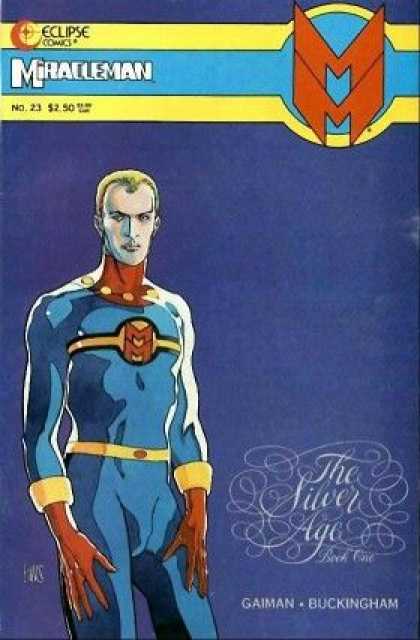
Miracleman by Alan Moore and Neil Gaiman

Although Alan Moore is best known for his work on Watchmen, he had already spent several years as a comics visionary by the time he wrote it. Moore's stories, even pre-Watchmen, used superhero tropes and cliches to tell mature, adult stories, full of literary references and philosophical under(and over)tones.


Miracleman can, in some ways, be seen as a parallel to Watchmen, in that it takes several of the same concepts but extrapolates them in a different direction. The responsibilities of being a godlike being, the superhuman as an object of terror rather than redemption, and whether superheroes should be seen as good or evil all pop up in Miracleman as in Watchmen.


Miracleman was Moore's reinvention of a comic from his youth, Marvelman. Due to issues with a certain comic book company, the name of the book was changed to Miracleman before making it over to the States. The story begins with a reprint of the original Miracleman series, featuring Miracleman himself, Young Miracleman, a younger version of Miracleman, and Kid Miracleman, an even younger doppelganger. Together they defeat some rather silly alien invaders in a rather silly way. While the Miracleman family is celebrating, the reader is treated to a quote from Nietzsche's Thus Spoke Zarathustra. Then things get really weird.


Mike Moran, Miracleman's alter ego, wakes up in 1983, having forgotten all about his previous life as Miracleman. He's a married, freelance reporter suffering from migraines, hounded by memories he can't quite bring into focus. During a terrorist attack at the opening of nuclear power plant, Moran turns, almost accidentally, into Miracleman. From that point on, the series becomes an exploration of mortality vs immortality, humanity vs godhood, and free will vs predetermination. It's heady stuff, sometimes too heady, but always surprising and entertaining.


Moore doesn't shy away from the sillier aspects of Mircleman's past, dealing with the Miracleman Family and their crazy adventures in a novel way. The reactions of Miracleman himself and of the rest of the family (once they're re-introduced) seem realistic, particularly Liz Moran, Miracleman's painfully human wife. I hesitate to say too much about the storyline because Chris is reading it and I don't want to spoil anything.


If I have any complaints about Miracleman, it's the way it ends. Alan Moore handpicked Neil Gaiman, of Sandman fame, to finish the storyline. Unfortunately, Eclipse comics went bankrupt 6 issues into Neil Gaiman's intended 12-issue run, and the rights to the character have been tied up in litigation ever since. I don't know if we'll ever see the end of Miracleman, but regardless, it's worth a read. A thought-provoking, mature comic book that work because of the format, not in spite of it.

Thursday, December 11, 2008

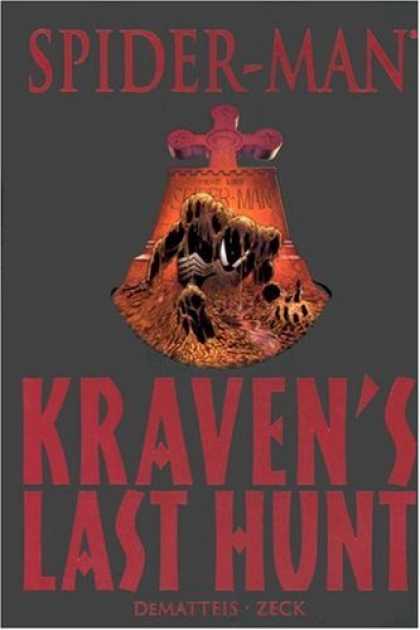
Kraven's Last Hunt by J. M. DeMattis

Spyder, spyder burning bright!
In the forests of the night
What immortal hand or eye
Could frame thy fearful symmetry?

As far as I know, I'm the only comic book reader on the blog. By comic book, I mean monthlies normally featuring superheroes like Spider-Man and Batman, not graphic novels like Watchmen or that weird Japanese thing Nathan read last year. Owning around a thousand comic books (and having read most of them) I realize that the medium tends toward adolescent wish-fulfillment rather than substance, but occasionally a storyline, even one featuring an established character like Spider-Man, will provide a little food for thought.

The story is set up thusly: Kraven the Hunter, the world's greatest, uh, hunter, is old and near death. He ruminates on his life and realizes he cannot die happily until he conquers the one beast which has so far eluded him: Spider-Man, of course. Taking Spider-Man by surprise during on of his nightly patrols, Kraven shoots him with some sort of hallucinogen, throws a net over him, and, while Spidey is struggling to escape, shoots him with a rifle and buries his body. Kraven then steals the Spider-Man costume an goes on a quest to prove that not only can he defeat Spider-Man, he can defeat the only villain to best Spidey (at least recently), a half-human, half-animal creature named, naturally, Vermin. Kraven finds Vermin and captures him.


Of course, Spider-Man isn't actually dead. He's in a comatose state induced by whatever he was shot with, and he awakens (and crawls dramatically from his grave) to find that two weeks have passed, during which Kraven has been impersonating Spider-Man, albeit a much more violent version. Spider-Man, still in his weakened state, tracks down Kraven who refuses to fight him, instead releasing Vermin for a rematch. Spider-Man incapacitates Vermin, and Kraven, always a bloodthirsty hunter of his word, says his unting days are over now that he's defeated Spider-Man. Spidey leaves to deliver his captive to the police, and, while he's gone, Kraven blows his head off with a shotgun, leaving a note absolving Spider-Man of all crimes committed during Kraven's time beneath the mask.


When I was reading comics more regularly, I knew that J. M. DeMattis' work tended to delve deeper than most mainstream comic scribes'. The comics he helmed tended toward a lot of metaphysical navel-gazing that sometimes worked (as in most of his Spider-Man run) and sometimes didn't (Dr. Fate). Kraven's Last Hunt is DeMattis at his best. He draws Kraven, normally a silly, shallow villain, as a sad disturbed man who sees Spider-Man much as Ahab saw Moby-Dick, as an embodiment of everything wrong with the world. To him, Peter Parker represents the forces that brought down his homeland, Russia, and killed his mother. In contrast to Spider-Man, who distances himself from the evil fights both by refusing to kill and by making light of even the most dire situation, Kraven's response to his demons is to become one with them, to try and embody, understand, and destroy them. Kraven becomes, temporarily, Spider-Man, but Spider-Man never allows himself to become Kraven, always standing just across the threshold from his animalistic instincts. Kraven's madness is ended when he sees Spider-Man post-resurrection and realizes that he is, after all, only a man, and a good one at that, one that fights against the same forces that Kraven abhors. Ultimately, however, it makes no difference—Kraven's fate is sealed as soon as he defeats Spider-Man. Without the thrill of the hunt, the natural predator has no reason to live.

Monday, January 8, 2007

Watchmen by Alan Moore and Dave Gibbons

I don't think I can write a review that does this book justice. Watchmen is a Cold War era graphical novel that follows the complicated lives of six self-made super-heroes, from their upbringing to present events. These six, however, aren't your typical supermen or women; save one, the "costumed vigilantes," "masked adventurers," or whatever else they choose to call themselves, are just as human as the next person. Each character's motivations for fighting crime in costume are explored through excerpts of written documents that Moore sandwiches in between chapters. He fills in the background of his story not by awkward, forced dialogue, but through a few chapters of an autobiography, newspaper articles, all things that we see in the story and read for ourselves later, as if we happened to pick them up on our way out. By about the third chapter, through this and other devices, we realize that some of the main characters, far from being perfect super-humans, have serious psychological problems, and others that we thought were for or against us might be much more complicated.

Dave Gibbons' artwork is fine, and gets the job done, but it's very clear that Alan Moore's writing makes this story what it is. He's fond of narrating two events at once, in alternating frames, using the same text for each. For instance (one of my favorites): a man is fumbling through sex, for what we assume is the first time in many years, while a television in the background narrates a gymnastics competition, all the way through the "dismount." I could flip to any page in the book and find more of the same, some funny, some serious, all very, very well-done.

Nothing in this book seems overblown, as you might expect from some comics. Moore writes an mostly realistic (albeit exaggerated) story up until the final chapters. One of only a few stretches was my favorite character, Dr. Manhattan, the once nuclear physicist turned god-like glowing blue man when his "ionic field" was removed, and he had to rebuild himself. His character provides a very different perspective in the face of worldwide nuclear destruction, and an obstacle in one particular debate over the world's future. This book was written in the mid-1980's in a series of installments, and clearly plays off WWIII paranoia, but the only thing in each chapter that might be dated (save words like "devo" and people talking about taking Katies) is the art. Moore's super-hero/political/historical satire tells the stories that comic books have been known for since the 1950's, but in a completely different, more human light. If there's one book that can lend legitimacy to graphic novels as a literary medium, I think this is it.