Showing posts with label neil gaiman. Show all posts

Friday, March 2, 2012

Stardust by Neil Gaiman

I read my first Gaiman book last year--American Gods. It is one of the better books I've read in a while. I had seen the movie adaptation of Stardust, and figured I would like the book.

Like most of Gaiman's work, Stardust is fantasy adventure. The story takes place in the small village of Wall, in the fields of England. The village is named after the high stone wall that runs beside it. Tristran Thorn, a young man who lives in the village, makes a impetuous promise to a young girl one night. Upon seeing a falling star, he vows to go find it and return it to her. Tristran finds out that he is not the only seeker of the fallen star. Others seeking the star include three princes vying to take control of their ailing father's kingdom and a witch-queen.

There was a portentous tone to American Gods. The tone of Stardust was the complete opposite: everything was a lark. One could almost hear Gaiman saying, "Isn't this book just crazy?" as the pages turned. There were a few points where this whimsical nature broke down somewhat, where things got "real," gritty, adult even. I think this is what Gaiman intended. Stardust is a fairytale, but one that has grown up.

_____

As a side note, reading this book gave me a perfect example of why I love books--actual books. I took this from a bookshelf in my girlfriend's parents' house. It appears the last person to have read it was her younger sister. She left post-it notes with comments on the writing and some with seemingly random thoughts and doodles. This is a kind of tangible link that books can create between people.

Friday, March 27, 2009

American Gods by Neil Gaiman

The best thing - in Shadow's opinion, perhaps the only good thing - about being in prison was a feeling of relief. The feeling that he'd plunged as low as he could plunge and he'd hit bottom. He didn't worry that the man was going to get hurt, because the man had got him. He was no longer scared of what tomorrow might bring, because yesterday had brought it.

As soon as I saw heard that Neil Gaiman had written a book called American Gods, I knew I had to read it. I'm not a particularly rabid Gaiman fan. In fact, aside from this novel the only work of his I'd read was the sinister short story "Snow, Glass, Apples" (which I highly recommend, you can find it online and read it in about 15 minutes). But I really like Gaiman's writing style and I'm obsessed with all things mythology. American Gods did not disappoint.

The story follows Shadow, a man recently released from prison after three years of incarceration. Shadow is released a day early after being informed of the death of his wife. On his way home back to Indiana, Shadow meets Wednesday, a man that would throw Shadow headfirst into a battle between the Gods of old and the Gods of new. When I say 'the Gods of New,' I mean modern society's deities. Our worship of the internet, of fast food, of highways, of television, etc. Essentially, American Gods is a story about America, a land of immigrants. Immigrants who brought with them tales and legends of Leprechauns and Ifrits. American Gods asks the question: "If every time a new people came to the New Land they brought their pantheon of Gods with them, what would happen to those relocated deities in a time and a place without faith?"

I thought the idea of foreign Gods wandering around America trying to make lives for themselves after losing all their worshippers was a brilliant idea. I often wonder what it's like for a country like Egypt, where thousands of years ago polytheism ruled the land but now the Bast's and the Osiris's have fallen from worship to become tall tales like Paul Bunyan or Pecos Bill.

I really enjoyed this book from start to finish. Gaiman introduces Gods from all different regions in interesting, often appropriate fashions. Shiva as a prostitute, Anubis as a mortician, Loki as a con-man. The dialogue is clever and sharp. It's a very trippy plot, bouncing back and forth between POVs and timelines, dealing with deaths and resurrections and reincarnations. Gaiman manages to keep things on an even keel, however, and the conclusion is more or less satisfying in tying up the two dozen or so loose ends created in the narrative. I should mention also that there's a really well done murder mystery subplot set in the all-too-peaceful town of Silver Lake, Michigan. A small girl disappears and Shadow is asked to help in the search. That's about all I can say without giving too much away, but its a really interesting subplot with a satisfying ending.

Like I said, I'm a mythology nut, so this book was almost tailor-made for me. I'll still recommend it to anyone who'll listen though because its a well put together story with interesting characters and a memorable plot.

Highlights: Odin, Mad Sweeney, the Silver Lake subplot, murder by vaginal mastication
Lowlights: No Greek/Roman gods, a little too much Deus Ex Machina... But I suppose that makes sense all things considered.

Sunday, January 25, 2009

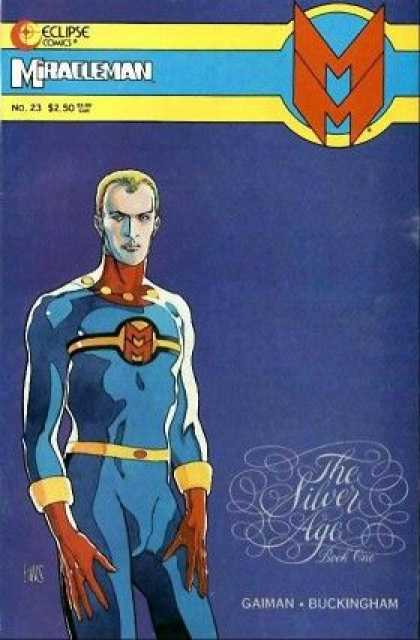
Miracleman by Alan Moore

I avoided reading Watchmen for a long time, skeptical of its reputation as a thinking man's comic book, which is something like the "jumbo shrimp" of literature. I'm glad I did, in the end, because it pleased me with its serious treatment of what superheroism might actually mean for the world. In particular I was fascinated by Dr. Manhattan, once a mild-mannered everyman but who, after his origin-accident, found himself increasingly alienated from human society.

I decided to read Miracleman for these reasons: First, Brent recommended it, and second, it's a comic book so it didn't take that long and I'm not going to let Jim beat me. But mostly, it seemed as if it would take the story of Dr. Manhattan and reimagine it; as Brent says, "Miracleman can... be seen as a parallel to Watchmen." Like Dr. Manhattan, Michael Moran is a pretty ordinary guy who discovers one day--or rather, rediscovers--that he has powers beyond even the most powerful of comic book heroes.

In comparison to Watchmen, I'll admit Miracleman suffers greatly. It lacks the same unity of vision, and Moore's penchant for simultaneous narratives, used to such great effect in Watchman, only muddies the water here. The later issues, penned by Neil Gaiman, are fascinating vignettes that seek to flesh out a world dominated by Miracleman, and yet they represent a full-stop to the overall plot and contain too little of Miracleman himself to be engaging. Brent asks for a proper ending to Miracleman, I suggest that the series as a whole might be more successful if Moore had never handed it over to Gaiman and simply let it end with Miracleman's dominion over Earth.

And yet, despite its flaws, there is something present in Miracleman that piques my curiosity more than Watchmen, which, despite its novelty and inventiveness, never quite hits a personal note. This is essentially the Citizen Kane story, but Kane's power seems irrelevant compared to Miracleman's. This tale has been told time and time again, but never on a scale this large with the possible exception of the story of Lucifer in the Bible. I like that about comic books; the suspense of disbelief required means that you can get away with things that simply couldn't work in novels; they possess an immensity that written fiction doesn't and, even if it could, would hardly be well-respected.

I found myself wishing that Moore and Gaiman give us a little more insight into what the psyche of Miracleman must be thinking as he molds the world into his image, but then I reversed position--how much really, can we understand of God? He exists on a higher plane, and cannot be comprehended by us, neither his abilities nor his feelings.

There is a moment, however, in Gaiman's chapter Carnival which gives us some glimpse into Miracleman's inner workings: After a cataclysmic battle in which Miracleman defeats another super-being (I'm being as vague as I can because, Jim, you ought to read this), he is basically free to remodel the entire social structure of the world and one result is that what we would call insane junkies are revered as "spacemen" who present the universe's wisdom. At the yearly Carnival to celebrate Miracleman's victory, all the disparate characters whom Gaiman has created approach a spaceman to ask them about their problems. Toward the end, a man in a cap and white t-shirt approaches and asks, "Am I... am I doing the right thing? Have I done right?"

The crowd cannot tell, but we can: It's Miracleman, mingling unnoticed. The spaceman's advice, crouched in gobbledygook, can be reduced to "just be"--perhaps responding, "What else could you have done? This is your destiny." But it isn't the answer that is interesting so much as the question.

Thursday, January 15, 2009

Miracleman by Alan Moore and Neil Gaiman

Although Alan Moore is best known for his work on Watchmen, he had already spent several years as a comics visionary by the time he wrote it. Moore's stories, even pre-Watchmen, used superhero tropes and cliches to tell mature, adult stories, full of literary references and philosophical under(and over)tones.


Miracleman can, in some ways, be seen as a parallel to Watchmen, in that it takes several of the same concepts but extrapolates them in a different direction. The responsibilities of being a godlike being, the superhuman as an object of terror rather than redemption, and whether superheroes should be seen as good or evil all pop up in Miracleman as in Watchmen.


Miracleman was Moore's reinvention of a comic from his youth, Marvelman. Due to issues with a certain comic book company, the name of the book was changed to Miracleman before making it over to the States. The story begins with a reprint of the original Miracleman series, featuring Miracleman himself, Young Miracleman, a younger version of Miracleman, and Kid Miracleman, an even younger doppelganger. Together they defeat some rather silly alien invaders in a rather silly way. While the Miracleman family is celebrating, the reader is treated to a quote from Nietzsche's Thus Spoke Zarathustra. Then things get really weird.


Mike Moran, Miracleman's alter ego, wakes up in 1983, having forgotten all about his previous life as Miracleman. He's a married, freelance reporter suffering from migraines, hounded by memories he can't quite bring into focus. During a terrorist attack at the opening of nuclear power plant, Moran turns, almost accidentally, into Miracleman. From that point on, the series becomes an exploration of mortality vs immortality, humanity vs godhood, and free will vs predetermination. It's heady stuff, sometimes too heady, but always surprising and entertaining.


Moore doesn't shy away from the sillier aspects of Mircleman's past, dealing with the Miracleman Family and their crazy adventures in a novel way. The reactions of Miracleman himself and of the rest of the family (once they're re-introduced) seem realistic, particularly Liz Moran, Miracleman's painfully human wife. I hesitate to say too much about the storyline because Chris is reading it and I don't want to spoil anything.


If I have any complaints about Miracleman, it's the way it ends. Alan Moore handpicked Neil Gaiman, of Sandman fame, to finish the storyline. Unfortunately, Eclipse comics went bankrupt 6 issues into Neil Gaiman's intended 12-issue run, and the rights to the character have been tied up in litigation ever since. I don't know if we'll ever see the end of Miracleman, but regardless, it's worth a read. A thought-provoking, mature comic book that work because of the format, not in spite of it.

Thursday, December 13, 2007

Anansi Boys by Neil Gaiman

I enjoyed this book very much. Had I not stopped for a lunch break, I probably would have finished it in one sitting. Read Brent's review for a plot summary.

The plot reveals itself gradually throughout the book, with characters and events becoming more and more connected along the way. He hints that stories mimic spiderwebs, which describes his own story well. Is metanarrative the right word? It's all done really cleverly, but it's not disposable in the way that M Night Shyamalan movies are. Not a one-time use. The ending is nothing special. The real entertainment is in how the story is put together. I give it an A.

Monday, August 27, 2007

Anansi Boys by Neil Gaiman

The first book I ever read of Neil Gaiman's was Good Omens, the one he cowrote with Terry Pratchett. My feelings pretty much mirrored Nathan's. I'm a big fan of Pratchett, and after reading Anansi Boys, I'm guessing that Good Omens' shortcomings were a case of too many cooks in the word processor, because Anansi tops it in every way.

The protagonist is Fat Charlie, who is not particularly fat. He is leading a relatively normal, boring life, engaged to a girl who doesn't seem to like him much, stuck in a job under a weaselly boss, and basically spending life in as average a way as possible. However, things are about to change.

Charlie's father dies, and, surprise, he learns that he has a brother and that his father was the god Anansi, a sort of Loki for the Indian set. Hijinks ensue.

This book is very funny and well-plotted, and worth reading if you like light fantasy. And this review sucks. It is not recommended to anyone.

Sunday, July 8, 2007

Good Omens by Neil Gaiman and Terry Pratchett

So I've been on vacation the last two weeks, or "vacay" as the kids say. I've got four more books under my belt and four more reviews to write. This one's my second--actually, the only other--birthday present (thanks, Kelly).

Good Omens is older than I thought it was at first. I read Neil Gaiman's Anansi Boys, which was published in 2005, and really enjoyed it, but this was a lot different. He wrote the introduction to The Ultimate Hitchhiker's Guide to the Galaxy, and made it very clear that he's got a thing for Douglas Adams. Reading Good Omens, you can kind of tell. A lot of it feels like it's in the same style. The writing is clever, but the plot feels a little bit haphazard, like all the loose ends were tied together at the last minute, no matter how much of a stretch they needed.

I read somewhere that it was written as a loose parody on the movie The Omen, but, not having seen the movie, I felt like it was more of a spoof on the apocalypse in general. Events are set in motion to usher in the reign of the Antichrist and the great war between Heaven and Hell, but problems keep popping up. What really sets things in motion is that someone (a member of the Chattering Order of Satanic nuns) misplaces the baby Antichrist, who ends up growing into a normal boy with some serious persuasive abilities. The two characters who I thought would be most important actually ended up fading to the background for the most part by about the middle of the book, so it was hard to feel much interest towards them when they popped back up at the end. The demon Crowley and the angel Aziraphale, having been on Earth since it began, decide that they kind of like it here, and do what they can do thwart the oncoming end of said planet. A lot of other subplots show up for a few pages, then disappear, then take on more importance towards the end.

It was a fun read, but I had the same problems with it that I did with The Hitchhiker's Guide to the Galaxy series. A lot of it seem kind of haphazard, characters and plots added for no apparent reason, just kind of made the book seem to busy. However, there are two covers you can choose from, so it's got that going for it: