Saturday, February 2, 2013
Shardik by Richard Adams
Richard Adams has a knack for creating immersive fantasy worlds. He draws you in with created languages, detailed maps, and elaborate traditions. Watership Down, his first novel, is an excellent example of this cultivated veracity. The story centers around a group of rabbits, with their own culture, language, and mythology. These details help to root the reader within Adams' fantasy world.
Two years after Adams published Watership Down, he published Shardik, his follow-up to the international bestseller. He relied on many of the same elements that made Watership Down work so well: a fantasy world rooted in a real-world epoch (in this case, early Medieval), different groups of people with detailed mythologies and traditions, and animals.
While the book is titled after Shardik, an enormous bear, the main character is a man, a hunter from a small, island village. While out hunting, Kelderek comes across a bear larger than any he has ever seen, prompting him to report back to the head of the Ortelgans that he has seen their bear god Shardik in the flesh. This sets off a series of events, culminating with the Ortelgans, emboldened by the power of Shardik, making their way into the mainland, and overthrowing cities and villages. Kelderek, thought of as a simpleton prior to his encounter with Shardik, see his standing rise among his fellow Ortelgans. Before too long, things begin to unravel for Kelderek and the Ortelgans.
Perhaps the main theme of Shardik is the creation and power of myths and religious beliefs. The myth of Shardik evolves and adapts throughout the story. The myth of Shardik at the close of the novel is quite different from Ortelgan beliefs at the novel's opening. But the cult of Shardik remains.
This is the third novel by Richard Adams that I have read. While I enjoyed it much more than The Girl in a Swing, it did not come close to rivaling Watership Down. Shardik opened well and kept my attention for the first 400 pages, but it started to drag around two-thirds of the way through and did not really pick back up until the last 50 pages. Unlike Kelderek, many of the supporting characters lacked definition and because of this were rather easy to confuse. I did not dislike Shardik, but would hesitate to recommend it to anyone who had not yet read other works by Adams.
Sunday, May 23, 2010
The Merry Adventures of Robin Hood by Howard Pyle
In merry England, in the time of old, when good King Henry the Second ruled the land, there lived within the green glades of Sherwood Forest, near Nottingham Town, a famous outlaw whose name was Robin Hood. No archer ever lived that could speed a gray goose shaft with such skill and cunning as his, nor were there ever such yeomen as the sevenscore merry men that roamed with him through the greenwood shades.We all know the story of Robin Hood, the sober, humorless soldier, hardened by his battles during the Crusades, rounds up a band of sober, humorless men to fight beside him and, in a psychic flash, discovers the Magna Carta and brings Democracy to Medieval England after fighting an epic battle against the French. And now that we’ve covered the 2010 movie, whose authors apparently didn’t realize that there’s already a fictional character named Robin Hood, let’s talk about this book.
I admit it: although I’ve read Robin Hood before, I was inspired to read it again after seeing the essentially unrelated and joyless film. I knew the basic outline and I knew the source material was much lighter and more humorous, but I had forgotten how much. The Merry Adventures of Robin Hood is really a comic novel, written as a series of inter-related vignettes, which collects various folk tales of Robin Hood and put them into a coherent framework, codifying Robin and his Merry Men into something like an Anglo-Saxon mythology—but this misses the point. Robin Hood isn’t a dull academic exercise, and it doesn’t read, aside from the poetic King’s English, like it was written over a century ago. It moves quickly—I read the entire 350pp book in a little over a day—and rarely missteps.
What was surprising to me is how much of my idea of Robin Hood was missing from the book. Maid Marian warrants exactly two mentions, both times as passing thoughts in Robin’s head. Prince John, immortalized as a lion cub in Disney’s retelling, appears only at the tail end. And what’s included is sometimes surprising as well. Close to a quarter of the book recounts adventures in which Robin himself doesn’t appear at all, focusing on the Merry Men and, in one case, a knight given assistance by Robin’s band.
But, onto the stories themselves. They largely follow the same structure—Robin and his men get bored, hatch an elaborate prank, execute it, and improvise. This leads to Robin’s merry band getting their butts kicked a lot, and it’s this element of “Will it work or not?” that gives the book most of its narrative thrust. However, just when the repetition threatens to grow stale, Pyle switches formats, focusing on a side character or a more involved adventure, such as the elaborate plot to help newfound Merry Man Alan a Dale reclaim his love at her wedding ceremony. The final third of the book, however, abandons the format almost entirely and takes some surprisingly dark and affecting turns.
Ultimately though, Robin isn’t a gloomy slog. It’s joyous and raucous and funny, and the characters, thinly sketched as they sometimes are, are really likable. Like Sherlock Holmes (which also got a terrible movie adaptation recently), Robin Hood is well worth revisiting.
Friday, March 27, 2009
American Gods by Neil Gaiman
The best thing - in Shadow's opinion, perhaps the only good thing - about being in prison was a feeling of relief. The feeling that he'd plunged as low as he could plunge and he'd hit bottom. He didn't worry that the man was going to get hurt, because the man had got him. He was no longer scared of what tomorrow might bring, because yesterday had brought it.As soon as I saw heard that Neil Gaiman had written a book called American Gods, I knew I had to read it. I'm not a particularly rabid Gaiman fan. In fact, aside from this novel the only work of his I'd read was the sinister short story "Snow, Glass, Apples" (which I highly recommend, you can find it online and read it in about 15 minutes). But I really like Gaiman's writing style and I'm obsessed with all things mythology. American Gods did not disappoint.
The story follows Shadow, a man recently released from prison after three years of incarceration. Shadow is released a day early after being informed of the death of his wife. On his way home back to Indiana, Shadow meets Wednesday, a man that would throw Shadow headfirst into a battle between the Gods of old and the Gods of new. When I say 'the Gods of New,' I mean modern society's deities. Our worship of the internet, of fast food, of highways, of television, etc. Essentially, American Gods is a story about America, a land of immigrants. Immigrants who brought with them tales and legends of Leprechauns and Ifrits. American Gods asks the question: "If every time a new people came to the New Land they brought their pantheon of Gods with them, what would happen to those relocated deities in a time and a place without faith?"
I thought the idea of foreign Gods wandering around America trying to make lives for themselves after losing all their worshippers was a brilliant idea. I often wonder what it's like for a country like Egypt, where thousands of years ago polytheism ruled the land but now the Bast's and the Osiris's have fallen from worship to become tall tales like Paul Bunyan or Pecos Bill.
I really enjoyed this book from start to finish. Gaiman introduces Gods from all different regions in interesting, often appropriate fashions. Shiva as a prostitute, Anubis as a mortician, Loki as a con-man. The dialogue is clever and sharp. It's a very trippy plot, bouncing back and forth between POVs and timelines, dealing with deaths and resurrections and reincarnations. Gaiman manages to keep things on an even keel, however, and the conclusion is more or less satisfying in tying up the two dozen or so loose ends created in the narrative. I should mention also that there's a really well done murder mystery subplot set in the all-too-peaceful town of Silver Lake, Michigan. A small girl disappears and Shadow is asked to help in the search. That's about all I can say without giving too much away, but its a really interesting subplot with a satisfying ending.
Like I said, I'm a mythology nut, so this book was almost tailor-made for me. I'll still recommend it to anyone who'll listen though because its a well put together story with interesting characters and a memorable plot.
Highlights: Odin, Mad Sweeney, the Silver Lake subplot, murder by vaginal mastication
Lowlights: No Greek/Roman gods, a little too much Deus Ex Machina... But I suppose that makes sense all things considered.
Friday, January 23, 2009
Memories of Ice by Steven Erikson
Outside the city's west wall, close to the shoreline's broken, jagged edge, a lazy swirl of dust rose from the ground, took form. Tool slowly settled the flint sword into its shoulder hook, his depthless gaze ignoring the abandoned shacks to either side and fixing on the massive stone barrier before him.Dust on the wind could rise and sweep high over this wall. Dust could run in the streams through the rubble fill beneath the foundation stones. The T'lan Imass could make his arrival unknown.
But the Pannion Seer had taken Aral Fayle. Toc the Younger. A mortal man... who had called Tool friend. He strode forward, hide-wrapped feet kicking through scattered bones.
The time had come for the First Sword of the T'lan Imass to announce himself.
Holy crap, this book was awesome. One of the most exciting, action packed stories I've ever come across. This is the third tale of the Malazan Book of the Fallen and each story has been better than the last. It hasn't yet knocked "A Song of Ice and Fire" off its perch as my favorite series, but with 7 stories left, it's got a chance.
A bare-bones summary: A Malazan army, commanded by Dujek Onearm (guess how many arms he has), has been outlawed by the Empress herself for sedition. Finding themselves outside the imperial embrace, Onearm's host joins forces with former foes to face a new evil, the Pannion Domin. The Pannion Domin is a newly formed regime rebelling against the Malazan's imperial yoke. Ruled by a man known simply as the Seer, the Domin is essentially a band of religious zealots. Each citizen of the Domin worships the Seer above all else and would give their life to exercise his will. The Seer has an elite army comprised of professional soldiers and skilled mages, much like any other army in the Malazan universe. However, the Seer holds an ace up his sleeve... the Tenescowri.
Let me say now that I think the story of the Tenescowri is one of the most novel and horrific I've ever read. Novel because I've never before seen its like, horrific because of its cold practicality. The Tenescowri is a huge, unarmed peasant army. The Seer and his forces are a swarm, sieging one city after the next. At each city, all inhabitants are forced to convert to the Pannion faith or be executed. Men, women, or children... it makes no matter. From this tactic, the Tenescowri ranks have swollen to the hundreds of thousands. The Seer uses this huge force in the initial attacks on his targets, throwing wave after wave of Tenescowri to break the ranks of defending armies. Such a huge, peasant army is a great asset, but it should also be a great burden to supply. Therein lies the genius of the Tenescowri. The Seer doesn't supply his peasant forces. They receive no rations whatsover, besides the flesh of all those they conquer. The Seer has produced a seemingly endless supply of soldiers who fight ravenously at every turn... to feed themselves.
Oh yeah, did I mention the Tenescowri are led by a small band of elites known as Children of the Dead Seed? These "children" come to be when the female Pannions rape those defending soldiers they find dying or dead on the battlefield.
I love this book.
Okay, so aside from the unbelievable badassery that is the Tenescowri, just about everything in this book was well executed. The role of the Gods and the turmoil in their pantheon reaches a fever pitch, further complicating events of the mortal realm. The new characters are masterfully developed, sometimes heartbreakingly so. In fact, Memories of Ice, managed to form a bond between its characters and the reader that Gardens of the Moon and Deadhouse Gates did not. This was my main criticism about the first two books. I really enjoyed what I was reading... But I never really cared about any of the players as I do about the principals of "A Song of Ice and Fire," for example. This book changed that. There are 2-3 deaths in Memories that really struck home with me, as I'd finally come to feel a connection with Erikson's characters.
I could write about 10 more pages on how much I love this book, but I'll leave it at that. This series is god-damned excellent and I think if you like this genre in the slightest you need to check it out. Memories of Ice was enthralling, ensuring that I will be finishing the journey and the remaining seven books.
Oh yeah! - I've completely forgotten to mention a character from Memories of Ice and Gardens of the Moon who needs to be noted. Anomander Rake, aside from a laughable name, is one bad mother &*%$er. He's a couple thousand years old, essentially immortal, can shapeshift into a huge dragon, and he carries a sword called Dragnipur. Not only does this sword kill you so dead, but it then traps your soul inside itself, where you spend the rest of eternity in chains, dragging an inconceivably huge wagon burdened with Chaos itself. So yeah, that sucks.
Highlights: The Tenescowri, Toc the Younger, The Mortal Swords, The Sword Anvil, Quick Ben, the Crippled God.
Lowlights: Overuse of the following words: Countenance, preternatural, bells. Also this book used the tiniest typeface I've ever seen. Miniscule.
Thursday, January 15, 2009
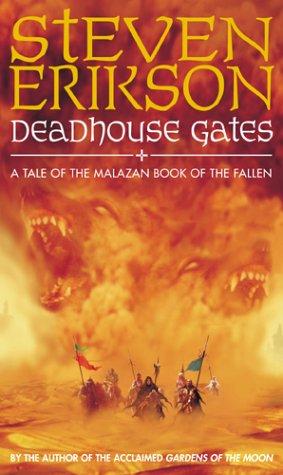
Deadhouse Gates by Steven Erikson
"I killed him," Squint moaned. "... Who took the man's life? A broken old soldier of the High Fist's arm-- Oh, Beru, have mercy on my soul..."Duiker wrapped the old man in his arms and held him fiercely. The bow clattered on the platform's wooden slats. The historian felt the man crumpling against him as if his bones had turned to dust, as if centuries stole into him with each ragged breath.
Commander Blistig gripped the bowman bu the back of the collar and yanked him upright. "Before the day's through, you bastard," he hissed, "ten thousand soldiers will be voicing your name." The words shook. "Like a prayer, Squint, like a Hood-damned prayer."
Well, I'm officially a fan of Erikson's absurdly ambitious epic. The scene above is from the intense climax of one of the book's five main storylines. I can tell you that just retyping the passage gave me goosebumps. Erikson is brutal with the fates of his characters, and this scene was particularly heart-wrenching.
Deadhouse Gates' plot is a bit more simple to explain than Gardens of the Moon. The book takes place immediately after the events of Gardens, and follows five main archs that occasional interweave with one another. The storylines are as follows: Kalam is an assassin with plans to strike at the very heart of the Malazan Empire. Crokus, Fiddler, and Apsalar are on a journey to return the latter from wartorn Genabackis to her quiet fishing village. Icarium and Mappo are non-human companions of incredible power on an endless journey to escape their own pasts. Felisin, Heboric, and Baudin are escapees from an Imperial mining camp simply struggling to stay alive. Duiker is the Imperial Historian, following the Malazan Army's death march through the wastelands of the Seven Cities. All of these storylines take place amidst the backdrop of Dhryjhna, the Apocalypse. A whirlwind of rebellion, both figuratively and literally. And that's not even to mention the Path of Hands, a background storyline in which shape-shifting demigod's battle against one another in a misguided attempt to ascend to full Godhood.
I have a hard time picking which of the story archs I enjoyed the most. Icarium and Mappo's relationship is deeply complex and surprisingly compelling. The more you learn about the pasts of these two companions, the more attached to them you become, the more you want them to win out in the end. Which is bizarre, considering their secret is one of unimaginable violence, capable of wiping out entire civilizations. All in all, though, I think Duiker's arch is the most interesting. The Historian follows the Imperial Army's escort of tens of thousands of refugees escaping cities torn apart by revolution. Coltaine is the leader of this army, a man feared by enemies and revered by allies. His will to survive and move forward is staggering and in many ways, he alone is responsible for saving the the lives of the horde of refugees. Coltaine's eventual betrayal by his superiors and many of the refugees he delivered to safety is a tragedy of much greater depth than you might expect to find in a fantasy story such as this one.
Erikson continues to amaze me with his ability to create genuinely memorable characters. High Priest of Shadow Iskaral Pust, for example, is perhaps one of my all-time favorite minor literary characters. Pust is a mischievous little man, completely incapable of internal monologue. This failing is apparently unbeknownst to him, but knownst to us*, as he consistently and inadvertently describes his deepest, darkest motives to the very people he is trying to hoodwink. Even with his cast of hundreds, it's hard to think of even a single, insignificant character to which Erikson doesn't give some sort of depth and soul.
All in all, Deadhouse Gates surpasses Gardens of the Moon in just about every way, which is saying something. The characters are richly painted, the dialogue is fresh and believable, and once again, the mythology of this series continues to blow my mind. Magic (thankfully) plays a smaller role in this book than Gardens but Gods and demigods still play a very important role in the story. I compared the Malazan series to a Homeric epic in the way its Gods interfere with the lives of mortals and Deadhouse only further strengthens that comparison. One scene, in particular, involving a lonely demon, the God of Shadow, and the re-animation of the bodies of thirteen hundred horribly mutilated children was simultaneously grotesque and touching. I again recommend everyone goes out and reads Gardens of the Moon, if only so it will lead them to Deadhouse Gates. After you read Deadhouse, you won't need my recommendation to want to continue the series.
Highlights: The entire "Chain of Dogs" storyline, Gesler and his crew, Apt and "her" adopted son
Lowlights: The meaninglessness of death in this series, Felisin's bitchery, not enough Quick Ben
* A cookie to anyone who can tell me what this reference is from without using google.
Thursday, January 8, 2009
Gardens of the Moon by Steven Erikson

have rung with iron
black-shod hoofs and drums
where I saw him walking
up from the sea between hills soaked red
in sunset he came, a boy among the echoes
sons and brothers all in ranks
of warrior ghosts he came to pass
where I sat on the worn final
league-stone at day's end--
his stride spoke loud all I needed
know of him on this road of stone--
the boy walks
another solder, another one
bright heart not yet cooled
to hard iron
Mother's Lament
Anonymous
I should preface this review by saying I'm not much of a fantasy reader. Aside from Erikson's The Malazan Book of the Fallen, the only other fantasy series I've ever followed is George R.R. Martin's A Song of Ice and Fire. That said, I like to think I can recognize good fantasy when I see it. The Malazan series is not like anything else I've ever read. Erikson uses metafiction, like the poem I've used to open this review, as well as a number of citations from fabricated histories to create a living, breathing world for his characters to inhabit. A world that geniuinely feels old.
Gardens of the Moon begins what is planned to be the ten part epic, The Malazan Book of the Fallen, chronicling the events of a brewing civil unrest threatening to tear the Malazan Empire asunder. As much as I wholeheartedly recommend this book, it's far from easily accessible. Erikson employs a third person narration that jumps back and forth among dozens of characters across any number of parallel timelines. This is not a book that holds your hand. Erikson throws the reader into a maelstrom of political intrigue and sorcery. I had to read Gardens much more intently than I'm used to in order to fully grasp all the events of the narrative. Understanding those events' repercussions and the motives of those that carry them out is even more befuddling. In the end, the density of the book only makes its finale more rewarding. I think anyone who completes this undeniably arduous journey will find themselves extremely eager to get started on part two, Deadhouse Gates.
I'll only touch on the plot, as it is too intricate to give an accurate summary. Gardens starts the series on the continent of Genabackis, across the ocean from the Malazan Empire's capital. It tells the tale of the Empire's seige of the last two Free Cities of Genabackis, Pale and Darujhistan. By the end of the novel, however, events much grander than simple imperialism have been set into motion, with the world itself hanging in the balance. I highly recommend Gardens of the Moon to anyone who loves good storytelling and being swept up in an epic. I plan to start Deadhouse Gates soon, and a review is forthcoming
In terms of writing style, it's hard for me to compare Erikson to anyone else, as I'm not well read in the fantasy genre. I can say that Erikson's ruthlessness with his own central characters fates' is similar to George R.R. Martin's. You really never know how is going to be killed or when. No one is safe, no matter how important you perceive them to the story. In the Erikson's universe, though, death is not always final. Gardens' narration of epic battles and single combat are excellently done, and Erikson's narration of violence reminds me a lot of Clive Barker. One particular scene describing a demon ripping a sorceress limb from limb in the opening chapter was reminiscent of Barker's occasionally grisly Weave World.
I'd like to make a note here about the supernatural aspect of this series. Part of the reason I'm not a big fan of fantasy (also largely why I enjoy Martin's A Song of Ice and Fire) is that I'm not crazy about magic and the supernatural. I'd much prefer to see a character taken down by a clever plot than a "focused wave of blue flame") That said, Gardens of the Moon is loaded with ageless warlocks, dragons, zombies, and hocus pocus... And I loved every page of it. I think why Gardens is so successful, and so appealing to me personally, is that all of the potentially-cringe-inducing, magicians-in-a-magical-world stuff comes across less like something out of Harry Potter and more like something out of Homer. With his clever use of faux-history and incredibly rich character development, Erikson mananges to create his own Malazan mythology. I suppose the comparisons to Homer are strengthened when you start to see Malazan's Gods (or Ascendants) becoming involved in human affairs to suit their own mysterious desires.
Highlights: The intense character development, the mythology of the series
Lowlights: The names are hilariously dorky (Sergeant Whiskeyjack? Honestly?), The way that Erikson assumes you to figure out some (ridiculously complex) things on your own. Also it inspired me to write a review where I use the word "asunder."
*I should note that Gardens of the Moon, while the first book of the series chronologically, is only one of three recommended entry points into the Malazan series. Deadhouse Gates runs on an effectively parallel timeline to Gardens and can also be used for an entry point. The fifth novel, Midnight Tides is another. Each of these novels introduces one of Erikson's three main storylines, which are expected to converge by the series' finale.
Sunday, September 2, 2007
To a God Unknown by John Steinbeck
I have not read much by Steinbeck. I read Of Mice and Men three or four years ago, and I am fairly certain that I was assigned The Grapes of Wrath in high school, although I am not certain that I actually read it. The cover of this book caught my eye, before I noticed anything else. It was a painting of a man approaching a large gnarled tree, which stood at the top of a hill. (The picture to the left is the only one on the official Penguin Classics website. I was unable to find the correct cover.) Seeing that it was written by Steinbeck, but not recognizing the title, I flipped the book over and read the first sentence of the summary on the back. It read, “Ancient pagan beliefs, the great Greek epics, and the Bible all inform this extraordinary novel, which occupied Steinbeck for more than five difficult years.” After reading this, I had to read the book.That one sentence summarizes To a God Unknown very well. Set in the early 20th century, it is a story of four brothers who move from Vermont to California to homestead the land. Joseph Wayne is not the oldest, but he is the leader of the brothers since their father gave him his blessing before he died. Joseph becomes convinced that the spirit of his father inhabits a large tree on his farm. He secretly communes with the tree, talking to it, seeking advice, and even offering sacrifices.
Amongst his brothers and their wives, opinions about Joseph vary. Thomas puts up with it, seemingly amused. Rama, the wife of the oldest brother, reveres Joseph. She tells Joseph’s new wife, “I do not know whether there are men born outside humanity, or whether some men are so human as to make other seem unreal. Perhaps a godling lives on earth now and then. Joseph has strength beyond vision of shattering, he has the calm of mountains, and his emotion is as wild and fierce and sharp as the lightning and just as reasonless as far as I can see or know. I tell you this man is not a man, unless he is all men.” Later the priest of a nearby town mirrors her thinking. As Joseph leaves, the priest thinks, “Thank God this man has no message. Thank God he has no will to be remembered, to be believed in, else there might be a new Christ here in the West.” However others feel about Joseph, Burton, a staunch Christian, thinks that his brother is practicing a kind of devil worship. He fears that he is allowing evil to take root in their land, and voices his disapproval to Joseph on a number of occasions.
Whether as a result of Joseph's actions or not, the Wayne family does prosper. Their crops are bountiful, their livestock reproduce at an alarming rate, and there is never any want for wild game on their property. But it is not long before the ground begins to dry up and the animals begin to die and leave the land. Joseph is certain that he knows what brought on this change, and he knows what he must do.
All throughout To a God Unknown, Steinbeck alludes to and borrows from Greek mythology and a wide range of religious traditions. In so doing, Steinbeck creates a mystical tale of his own, adding to his mythology of California.