Showing posts with label california. Show all posts

Thursday, July 16, 2026

Slouching Towards Bethlehem by Joan Didion

Later, when I was living in New York, I would make the trip back to Sacramento four and five times a year (the more comfortable the flight, the more obscurely miserable I would be, for it weighs heavily upon my kind that we could perhaps not make it by wagon), trying to prove that I had not meant to leave at all, because in at least one respect California--the California we are talking about--resembles Eden: it is assumed that those who absent themselves from its blessings have been banished, exiled by some perversity of the heart. Did not the Donner-Reed Party, after all, eat its own dead to reach Sacramento?

The title essay in Joan Didion's Slouching Towards Bethlehem precedes itself. About the hippie convergence on the Haight-Asbury neighborhood of San Francisco, it stands in for a popular recognition of the era's failures, and its curdling into something more dissolute and sinister. A step on the road from Woodstock to Altamont. And before reading it I had a general idea that it reflected in some way Didion's own brand of conservatism, which in turn reflected the nation's rightward turn as the ideals of the 60's petered out. But reading it, it must be said that what is most remarkable about it is the way that Didion absents herself from the narrative, declining to pass judgment or evaluation on the hippies with whom she's embedded, as if San Francisco were Fallujah. It is the hippies, instead, who implicate themselves, as with one couple whose faith in psychedelic drugs extends to doping up their toddler. Of course, this is all a kind of feint, a maneuver that reveals just how good a writer Didion really was--a way of hiding her hand. One must admit that, when some of the Haight-Asbury "Diggers" refuse to share information because they fear Didion to be a "media poisoner," that they have something of a point.

One point that Didion makes--or perhaps suggests by assemblage and arrangement, because she often demurs from making points as we typically think of them--is that the hippie movement was a children's movement. A considerable number of the people who converged on Haight-Asbury were literal runaways, and in Didion's telling, it seems to be this that gives the movement is sense of hope and energy, like a children's crusade. But Didion also depicts it as a children's world, bereft of adult pragmatism and sagacity. Even those adults who appear in "Slouching Toward Bethlehem," like the couple that give acid to their toddler, have a kind of childlike innocence, which is to say stupidity. "We were seeing the desperate attempt," Didion writes, "of a handful of pathetically unequipped children to create a community in a social vacuum. Once we had seen these children, we could no longer overlook the vacuum ,no longer pretend that the society's atomization could be reversed." Which is to say, yes, these people are idiot kids, but who let them out of the house?

One way of reading "Slouching Toward Bethlehem" is one vignette in a series of essays about California, along with "Some Dreamers of the Golden Dream," about a woman who may or may not have set her husband on fire in San Bernardino, and "Notes From a Native Daughter," an exploration of growing up and leaving Sacramento that is, I think, the collection's best piece. "John Wayne: A Love Song," another of the collection's highlights, is also a California story, though about the California that infiltrates our dreams through the engines of Hollywood. (Like the hippies, Didion gives Wayne and his hangers-on the rope to hang themselves; the image is of an aging star surrounded by sclerotic yes-men.) No doubt Didion writes best about California because it's what she knows best, but I think her best pieces are all about place, including "Letter From Paradise," which explores the way that the burgeoning tourist vision of Hawaii conceals a Hawaii that is deeply entangled with the military and the prospect of war. I also really enjoyed a typically acerbic essay called "Seacoast of Despair," about the grand mansions of Newport, Rhode Island. Didion's sense of place isn't unimpeachable--I thought her essays about the Southern U.S. in North and South were a strange misfire--but it must be said that she has a way of peeling back one understanding of a place to reveal something else underneath, whether it's California, Hawaii, Rhode Island, or Sonora, Mexico.

That said, I am developing an annoying and contrarian take on Didion that I think few will agree with: her fiction is better than her non-fiction.

Saturday, January 31, 2026

Indian Tales by Jaime de Angulo

In a few days they started again, tras... tras... tras.... The trail wound in and out through slowly rising foothills. There were many outcroppings of rock, jutting out everywhere. Soon the party was strung out in a long straggling line. Coyote Old Man and Antelope were taking their time and bringing up the rear. The Bears were way ahead of them. And way way ahead of the Bears were the Antelope men and women, almost running in their fast electric stride. This seemed to be the only way they could travel, because they were desert people. At intervals they would sit down and wait patiently for the rest of the party to catch up. They just didn't know how to travel slowly. The Antelope children were the same, and Fox Boy and Oriole Girl had work to keep up with them, abut they were too proud to be left behind.

Jamie de Angulo was a linguist and ethnologist who spent time among the Indian tribes of California in the beginning of the 20th century. He was, apparently, an eccentric autodidact who went west to become, and did become, a cowboy, before turning his attention to the languages and folk tales of the area. Indian Tales is his version of the "Coyote Tales" that he heard among these tribes, sewn together into a single narrative that begins when the family of Bear, Antelope, Fox Boy, and the baby Quail set off to visit some relatives. Along the way they meet various figures from Californian legend, including Old Man Coyote, but also the Grass and Flint People, a Grizzly Bear, some hawks, Doctor Loon, and Oriole Girl, on whom Fox Boy nurses an obvious and impossible crush.

The tales themselves are a great deal of fun. They are recognizable to anyone who has heard Indigenous creation stories, which are often long, circuitous, and unpredictable. They've always struck me as different somehow, perhaps more episodic, than stories in European mythic traditions, and more humorous. People die and come back to life, animals perform strange and courageous feats, people are transformed into monsters, that sort of stuff. I was interested in the way De Angulo nests the stories, having Bear, Coyote, and others tell them to each other around the campfire. Are they telling legend, or in their world, history? I suppose both.

What's most interesting, though, is the way that De Angulo manages to seamlessly combine the traditions of Indigenous storytelling and modernist "Western" literature. You can see it, I think, in the romantic tension between Fox Boy and Oriole Girl, who keeps telling Fox Boy (who of course does not listen) that she's not interested in men. You can see it in the beautiful evocations of the thin Grass People or their enemies, the Fire People. You can see it, I think, in the skillful sketching of the characters whose personalities emerge through repetition and gesture: Grumpy Bear, secretive Old Man Coyote, petulant Fox Boy--who, true to the novel form, comes of age in the process of the family's long excursion. At the end, there's even some metafictional flourishes when Fox Boy and Oriole Girl discuss perhaps getting rid of "the author," and what might happen to them if they do. That shows, of course, that what we are reading has been crafted by a single craftsman, rather than the shared or repeated mode of the Indian legends. And it forces us to remember to take the whole thing with a grain of salt, too: Indian Tales is more fiction than ethnography, more novel than myth.

Sunday, November 2, 2025

The Nenoquich by Henry Bean

Now we are together nearly every day except weekends, which she says are torture, and gradually she arrives earlier and leaves later until it seems she goes home only to eat, sleep and sign in. How could Joshua not know? One morning she appeared at ten-thirty with a picnic lunch in a wicker basket, and I thought, my God, this woman is going to eat me, she will eat my entire life, doesn't she have anything else to do with herself? She was disappointed when I said I had to work until noon. Had to? She didn't think I had to, and couldn't today be an exception? It could not. Angry and hurt, this was Joshua all over again, said she'd wait downstairs. I stared at the page for fifteen minutes, weighing the discipline of work against the discipline of flexibility, found the latter more difficult, and, in this instance, truer to an ethic that, if I could not practice in my life, I would not be able to depict in my work--so that ultimately both principles led one way, and I turned off the lamp.

Writer Harold Raab begins an obsession with Charlotte Cobin, a married woman, in an unusual way, not by meeting her or even seeing her, but by hearing her briefly discussed on the telephone. His roommate says to someone else: "Well, she's mad about him isn't she? At least in the physical sense..." This remark intrigues him so intensely that he maneuvers himself into a parting where Charlotte will be, and slowly peels away her affection from her husband, a doctor. It's almost Machiavellian, and yet Harold's need comes from, we sense, a deep sense of disaffection and alienation from the world. The title, the Nenoquich, refers to an Aztec belief about children born during a handful of intercalendrical days, without purpose or use in life. Harold feels as if he is one of these useless people, different from others somehow, unable to relate to Charlotte in a normal way, but still obsessed with her. It's no surprise that, as soon as he manages to pry her away from her husband, she becomes a burden, as repulsive as once she was attractive.

The Nenoquich is the debut novel of Henry Bean, better known as a screenwriter of movies like Internal Affairs and Basic Instinct 2. His filmography, it must be said, is not really an indicator of the quality of The Nenoquich, which is nuanced and unsettling, and often remarkable in its prose. You get the sense that Bean is not entirely in control; my patience flagged a little bit with the middle of the novel, which is talky and murky. I got the sense that we're supposed to sympathize a little more than Harold than we do, Harold who is, it must be said, a real piece of shit, no matter the depths of his social dysfunction. And the attempts to place his relationship with Charlotte in a larger context of the life of young people in Berkeley, California's post-hippie era made the novel at times too diffuse. But when the novel focuses on the relationship between Harold and Charlotte, it's captivating: sinister, magnetic, and deeply troubling.

It was the novel's last section that really sold me. The novel is framed as a kind of diary-cum-writing-project, and as Harold's relationship with Charlotte finally crumbles, he comes to the symbolic end of a first notebook. The "second notebook" becomes necessary when Harold finds that Charlotte has been in the hospital for an infection that began as a venereal disease. He's had it, too, and it's not clear which of them gave it to the other--a consequence, perhaps, of the permissive approach to sexuality practiced by Henry's generation--but whereas for him it is a regimen of pills and creams, for Charlotte, it becomes a death sentence. Harold is forced to reconnect with Charlotte in her hospital bed, where it becomes increasingly clear that the infection cannot, and that Charlotte is living out the last days of her life. What could have been mawkish or didactic is handled with surprising insight; Bean captures in a really fascinating and tragic way how sickness and death transform us and lead us to new and unexpected states of being. And similarly, I thought this "second notebook" allowed the novel to find its own altered state, to rise above a murky tawdriness and really capture something true.

Saturday, October 4, 2025

River of Shadows: Eadweard Muybridge and the Technological Wild West by Rebecca Solnit

Cinema can be imagined as a hybrid of railroad and photography, an outgrowth of those two definitive nineteenth century inventions, the technologies Stanford and Muybridge represented, in which case fatherhood is too simple a metaphor for it. After all, zootropes, photography, and magic lanterns are also key aspects of it, and Muybridge only initiated and did not complete the invention of cinema. The railroad had in so many ways changed the real landscape and the human experience of it, had changed the perception of time and space and the nature of vision and embodiment. The sight out the railroad window had prepared viewers for the kind of vision that cinema would make ordinary; it had adjusted people to a pure visual experience stripped of smell, sound, threat, tactility, and adjusted them to a new speed of encounter, the world rushing by the windows; had taken them farther into that world than they would have ever gone before; broadening many horizons at the same time it made the world itself a theater of sorts, a spectacle.

The movies, it can be argued, were born with a photographer named Eadweard Muybridge took a snapshot of a horse. Under the patronage of California railroad magnate Leland Stanford, Muybridge was trying to discern what happened when a horse galloped. Equestrians and scientists couldn't even agree at the time whether a horse always had one hoof on the ground or not. Muybridge's innovations allowed for a photograph to be taken with an exposure time short enough to capture the horse mid-stride. (It turns out that a horse does not have a hoof on the ground at all times.) As a revolution in sight, this was huge; as Solnit points out in her book River of Shadows, the nation's most accomplished painters of horses had to go back and rethink all the work of their careers. But more was to come, because when Muybridge put such snapshots together later in a sequence, the "motion picture" was born.

I found Solnit's biography of Muybridge to be incredibly fascinating. She captures some of what has made Muybridge himself a subject of fascination: he was an English weirdo who changed his name a half-dozen times and ended up killing his wife's lover in cold blood. But the strength of the book is in the way Solnit connects Muybridge's innovations to the changing technological landscape of the Western United States and the world as a whole. The motion picture, she shows, is deeply connected to the way that the railroad--that technology pioneered by Leland Stanford--transformed the lives of Americans. It's true, there's something about looking out a railroad window that is replicated in the experience of the frames being pulled hastily over the projector. But more convincingly, Solnit connects both technologies to the nineteenth century attempt to "annihilate space and time," to break down the barriers that separated people by time and distance.

Muybridge's achievements weren't only in motion photography; he was also known for pioneering large-scale landscape and cityscape photography, taking, for example, some of the earliest panorama shots of the city of San Francisco. Solnit takes these in, too, connecting Muybridge's time photographing the Modoc War in northern California to the rapidly shifting face of the West. (I chuckled a little at the academic attitude toward the word technology, which takes in both horses and the "Ghost Dance" of the nineteenth century West, and which certainly made making these connections easier.) Solnit does a good job, too, of making the case that Muybridge shows the centrality of California in the emergence of the modern world. It's the reason the railroads were built, after all, and Muybridge was at the center of the innovations by which California changed the world: Hollywood and Silicon Valley.

I don't know much about Solnit; I associate her with the book Men Explain Things to Me and a cultural flashpoint over stuff like "mansplaining." This book is, I'm pretty sure, much earlier, and perhaps a relic of a time when Solnit was less of a well-known name, but I thought it was really insightful and erudite, and I can easily imagine why such an intelligent and thoughtful writer would bristle at being spoken down to by male chauvinists. Really enjoyed this one.

Saturday, April 5, 2025

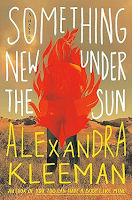
Something New Under the Sun by Alexandra Kleeman

"Yes," Patrick says with audible relief. "I want to come all the way back, Alison. I want to crawl back into the old life with you and grow small in its belly, like a baby. A man needs a woman, he needs it like a water needs duck. I've been out west now, to see what I can see, and what I discovered is that it's all on fire and giving off a dark-blue smoke. I saw the palm trees and the bathing-suit beach and the surf-whitened sea, and I looked until my eyes burned down to the nub. There's no paradise here unless you're a bird of paradise. There isn't enough ocean to put out all the flames."

Patrick Hamlin is a writer whose semiautobiographical novel has been picked up for adaptation into a movie. He's been invited to Los Angeles to work on the film, but it isn't quite what he expected. His book has been mangled beyond comprehension, and instead of working on the script, he's been tasked with chauffeuring the movie's star, a tempestuous and troubled former child star named Cassidy Carter. Cassidy is cynical but shrewd; she's the first to notice that the movie doesn't really seem to be a movie, that the crew keeps getting smaller and more patched together, and that the producers' disinterest in the filming itself may be connected to the frequent pickups of cash-filled briefcases that are part of Patrick's workload. The transparently fake production is related, too, somehow, to the advent of a commercial brand called WAT-R that has recently replaced natural water in California. Cassidy never drinks the stuff, correctly intuiting that it's connected to the rise of a debilitating form of dementia that ends with people being whisked away, vegetative, to mysterious "care" facilities.

I wanted an L.A. novel for my trip to California, and Something New Under the Sun delivered. Kleeman's Los Angeles is a Los Angeles of about five minutes into the future. Everywhere it's on fire, and the water has disappeared. Public goods have been replaced by private enterprise, which is more interested in short-term profits than keeping its customers alive. It's a state in crisis, but it hardly seems to know it's in crisis. "But it's not really an emergency," Patrick thinks when driving around a brush fire, "putting on his signal and shifting into the fast lane, if you can drive around it. An emergency would be everywhere you looked, inescapable; some long-submerged animal intelligence would recognize it with fierce instinct. In an emergency, the mind would not drift aimlessly from daydream to distraction as his did now, in search of something to grasp." But of course, Patrick's got it all wrong; daydream and distraction are the prerequisites of disaster, they dominate until its too late, and even afterward. Something New Under the Sun is a novel about a state at the crossroads of all our modern crises: ecological, climatological, epidemiological, technological, capitalist.

I really enjoyed the character of Cassidy Carter, the former child star. Her shrewdness and intelligence are in violation of both her tabloid image and typical ideas of vapid celebrity. It means something that only she, as someone who has navigated the exploitative bone-crushing systems of Hollywood, can see what's going on. There's something, too, about the way that pop culture gives us a kind of buried insight into the real world that's very DeLillo. The whole book is DeLillo, maybe more DeLillo than any other book I've ever read, though it can't capture DeLillo's effortlessness (who can?). I loved the sections where Patrick combs through the Reddit boards devoted to interpretation of Cassidy's old kid's show, a Veronica Mars knockoff called Kassi Keene: Teen Detective. The message board community has splintered into schools of interpretation like rival cabbalists, building a division between those who believe the grand designs of the show are only textual (like those who spend hours inventing internally consistent interpretations of Twin Peaks) and those who believe a grander symbology is at play that points to social, even mystical truths. Again, this is all about the actress who starred in Happy Birthday, Miss Teen President!, a movie in which she exclaims, "This land is our land, and now this skateboard is your skateboard." (She tells this to the "crabby, wizened Senate minority whip, as she teaches him how to do an ollie on the somber white steps of the Lincoln Memorial.")

Patrick begins to lose it in California, an effect of the WAT-R along with his own personal fragilities. In his absence, his wife and daughter have disappeared to a summer camp-like commune in upstate New York. He worries and frets, thinking that he's lost them to a kind of cult, unable to understand that it is he himself who has landed into the lap of America's cult culture. Perhaps, in Hollywood, he's become enmeshed with the country's biggest cult of all. Patrick and Cassidy team up to investigate the evils of WAT-R, and for a while, we think we're being offered something much more conventional, a legal thriller, an Erin Brockovich. But this isn't an episode of Kassi Keene: Teen Detective, and the pair's abortive investigations are no match for the urgent logic of crisis, nor for their own needs and insecurities. If you're looking for a novel that tells us the end of the climate crisis will be a renewal of hope--or that we might find our own personal end somewhere else but within it--look somewhere else.

Monday, March 31, 2025

Zoot-Suit Murders by Thomas Sanchez

Younger saw it. A huge sign rolling through clumps of sage and spikes of yucca near the mountaintop. Nine wooden letters, each high as four men atop one another's shoulders, each letter painted white, sprawled improbably across the natural shoulder of the mountain. the letters seemed a tenuous but monstrous joke that could blow down in any retributary wind. But there the stood, naked as the last advertisement for a feeble civilization, dwarfing the simple beauty of the natural terrain, idiotic and splendid, washed in the ethereal glow of the dying sun sinking blood red into the ocean to the west:

HOLLYWOOD

The relationship between noir and Los Angeles is so funny. The city's famous for its endless summer, and in the mind's eye, it must always be daytime there--and yet, every L.A. noir seems to be set at night, or even in cold and rain. There's a relationship between the two, of course: the noirish night is the shadow of the L.A. day. It's not so much that the celluloid world of Hollywood conceals the brutality and violence of the nighttime as it's predicated on it, as if what happens at night is the engine of churning blood and bodies that make the daytime possible. It reflects a belief, I think, that any kind of pleasure or leisure requires some kind of blood sacrifice.

Thomas Sanchez's noir Zoot-Suit Murders takes its relationship to Los Angeles seriously. It begins with Nathan Younger, a Catholic social worker and amateur baseball coach (and secretly, a spy for something like the House Un-American Activities Committee) witnessing a movie star screaming for help in the barrio, the Mexican neighborhood of Los Angeles. A pair of shots ring out, hitting two of the stars' pursuers, we presume, who turn out to be undercover cops. The investigation pins the murders on the Mexican youths whose zoot suits--flashy, voluminous, and colorful--have taken on an unsavory political valence during wartime rationing. But Younger, of course, thinks that the real story is more complicated, and related somehow to Kathleen, the spokesperson for a utopian cult, who was at the scene of the crime. Kathleen is beautiful, waifish, red-headed, and chronically sick; as he gets closer to her, Younger begins to fall in love, as demanded by the genre--which also demands that love be dangerous and cruel.

Zoot-Suit Murders does a great job bringing together disparate threads of Los Angeles culture and history. There's Hollywood, of course, although the starlet in crisis turns out to be kind of a red herring. But there's aspects of Los Angeles here that are often left out of the genre, beginning with the racial and class tensions of the 1940s that infamously resulted in the Zoot Suit Riots, when a bunch of Navy soldiers went around brutalizing the young Mexicans. For Sanchez, the barrio is the site of collision between Spanish fascists and communist subversion; both forces see in the disaffection of the Zoot Suiters a kind of powerful, perhaps primeval force which can be leveraged. The novel works in the city's history as the home of evangelical fervor and woo-woo spirituality. In Kathleen--who is hard at work preparing for the arrival of "The Voice of the Right Idea." It's half Aimee Semple Macpherson, and half Scientology. Around the city, a mysterious phone number--DIALGOD--is graffitied on the walls. And Sanchez does a great job filling the cult out with a lot of very persuasive utopian nonsense, while still suggesting that the cult's true aims are more legible, while more secretive.

Sometimes, the book strains to convince us that this is Los Angeles in the 1940s. At one point, a characters says, "Yah, well they'll give Emperor Hirohito an honorary degree at UCLA before that happens." Is a final showdown at the Hollywood sign inspired, or cheesy and too-familiar? Still, I really enjoyed the way the novel takes the historical and cultural moment seriously, and situates its noirishness in time and place. It's a very different novel than Rabbit Boss, about several generations of California Indians (and which I loved), but I see in Zoot-Suit Murders a similar eagerness to grapple with the way in which California and Californian identity are fashioned in the crucible of history.

Friday, November 1, 2024

Fire by George R. Stewart

He slapped at a spark, and in new panic at the thought of spot-fires, stood up to look ahead. Smoke was rising from a spot-fire well in front of him, to the left. But he felt sudden relief when he saw that the closest fir tree was scarcely a hundred feet away. Energetic again with the thought of safety and rest, he plunged ahead, just as a white sheet of searing-hot flame went up from a bush not thirty feet behind him. He burst through the bushes, climbed and walked across them, crawled beneath them. His face and hands, and his bare arm, were crisscrossed with bleeding scratches. He kept his eyes half-closed  to protect them from smoke and from twigs. Almost blindly, in an animal-like intensity to live, he struggled on, keeping direction by the drift of the smoke.

George R. Stewart's Fire is, in obvious ways, a companion book to his novel Storm. Both deal with enormous, large scale natural disasters; Fire only replaces the water with, well, fire. Both take an ultra-wide view, taking as subject hundreds of people whose jobs are to manage the impacts of the disaster. In Fire, that means fire-spotters, foresters, firefighters, weathermen, pilots, ranchers, and more. But there are certain differences that make Fire an interesting contrast to Storm, largely downstream of the nature of a forest fire vs. a storm. The view, which is only as wide as the disaster, is necessarily shrunken, down to a few thousand acres, rather than hundreds of square miles and several states. The result is that the human drama comes to the forefront more easily; instead of distant figures working independently--Storm's linemen and weathermen have nothing to do with each other except the fact that they are working to respond to the same storm--the crew arrayed against the forest fire must work together, in concert and in close quarters.

I really enjoyed, for instance, the tension between the young Supervisor and the section chief, Bart. "The Super" is intelligent and capable but anxious about how he's perceived by his subordinates; he tells people to call him "Slim" but the nickname never takes. Bart is an experienced old hand responsible for the section of the Lassen National Forest that is burned. The Super astutely wonders if Bart is too close to the forest, too sentimental, to exert his judgment properly, but he knows that if he removes the popular man as fire chief, his authority and respect will be undermined. I thought that Fire did a good job of illuminating the ways that disasters are helped along by human limitations: the fire is contained until one of the fire fighters gets spooked and runs, starting a general panic that allows the line to be broken and grow out of control. It's a stark reminder that the systems we rely on are actually made up of people, with all their human flaws.

The book doesn't do very well by one of its more interesting characters, Judith, a young woman who takes a lonely job as a fire lookout for the summer. Judith is a woman in a man's world, and in one sense this makes her thoughtful and interesting, quoting literature to herself in her lonely outpost, but it also means that every male Forest Service employee who comes across her has to remark on how hot she is. There's an interesting connection between the way the novel makes use of Judith's femininity and the paranoid fantasies of Bart, who imagines his section of the forest as a virginal young woman being preyed on by the lascivious fire. In the end, Judith is married off, paired to a shy young man who literally carries her out of harm's way when the fire approaches her lookout. So much for the independent woman in her tower.

But for the most part, I really enjoyed Fire. It's an old book, written in 1948, presumably before much of modern fire suppression technique was created--no one, for instance, thinks about doing a controlled burn anywhere in the forest. But to my understanding, much of the job is the same: people dig big ditches around a fire to keep it from spreading. As in 1948, the coordination and spur-of-the-moment planning must be enormous. The "Spitcat Fire" of the novel ends up burning something like 13,000 acres, a number that seems almost quaint in the climate change era. The Park Fire that burned through the Lassen area this summer torched over 400,000 acres. So perhaps it would do well for us to remember the book's lesson about the human courage, and the human toll, that disasters demand.

Saturday, September 7, 2024

Rabbit Boss by Thomas Sanchez

I know of your Ancestors. The blood of your blood saw the Whites eat of their own flesh on yonder lake, Donner. Captain Rex gambled the money of the people away and lost his way in a blizzard, he came into a cabin and slept, when he awoke white bodies were lying dead all around him with the blood they had coughed up splattered on their clothes. he took their White death back to the people, that was the year all the Washo were burned to the ground at Elephant Head, one was saved, Ayas, the Antelope, who was sent into the valley of clouds to warm his sightless grandmother who wove flowing streams into her baskets... I can see into all the days past. I can see into all the days coming. Along the Big Lake of the Sky your son shall walk in a new Rabbit robe. Sparling his image on the quiet waters. The forest shall grow thick and free. The Birds return. The fences fall. In their shadow the openness will find its home once more.

Thomas Sanchez's Rabbit Boss begins with Gayabuc, a member of the Washo tribe of Nevada and Northern California, looking down at the infamous Donner Party. He watches them attack and eat each other, and he knows immediately that something evil has arrived in their lands. Rabbit Boss traces the history of this evil over four generations, beginning with Gayabuc, and continuing on with his son, Captain Rex, a gambler and petty criminal who makes money by recruiting other Indians to pick pigweed along the side of the transcontinental railroad. Captain Rex's son, a preacher named Hallelujah Bob, grows up among whites after all the other Washo are decimated by tuberculosis, and then burned in their huts by whites who fear the spread of the disease. Bob grows up knowing little about his background until he is taken to an Indian School (a real place in Carson City where, somewhat coincidentally, we were able to tour a small museum last week) and learns about his true identity. Hallelujah Bob's son is Joe Birdsong, who ekes out a proud but simple existence as a rabbit-hunter for large ranches during the Depression.

In Sanchez's telling, the Washo have always been a small tribe. They identify with the rabbit, whose medicine, or power, is small, but who gets by through tenacity and cleverness. They are few in comparison with the Shoshone or the Paiutes. Leaders of the Washo are said to wear the "Rabbit robe," and despite the designs that white settlers have on the land, it's exactly this identity and power that is passed down, perhaps unknowingly, to Birdsong. The stories of the four men resemble each other in certain important ways: the latter three are all, at times, hunted by white forces who want to destroy them or drive them out. For Captain Rex, it's marshals and bounty hunters that pursue him, in scenes that often provide the novel some of its blackest humor, as when the representatives of the federal and territorial government bicker over just who it is that's going to hang him, or when they realize they can't hang him, because the Nevada desert is short on trees. For Birdsong, it's a shadowy land company that has begun to make inquiries with all the landowners in the Lake Tahoe region. They begin by offering enormous sums, but when Birdsong refuses, they move against him with legal force, claiming that because Hallelujah Bob was not a U.S. citizen when he purchased the land (Native Americans were made citizens in the 1920s), his claim is null and void. They seize upon a murder and frame him for it, and Birdsong ends the novel like his grandfather: on the run.

As far as I know, the author, Thomas Sanchez, is not Native American, and I have to say, outside of perhaps Vollmann, I don't think I've ever read a fictional account of Indigenous history by a non-Indigenous writer that seems so scrupulously researched or knowledgeable. It was really something to be able to visit the actual residential school where Hallelujah Bob ends up, and where Birdsong must travel to search for the documents that prove his ownership of the land--I hadn't imagined such verisimilitude was necessary. It's especially impressive, I think, because the story is about the Washo, a small tribe whose history is not so popularly known as the Lakota or Cherokee, or even the larger local tribes like the Shoshone.

At the climax of his story, Hallelujah Bob has a vision of the Ghost Dance leader Wovoka (a member of the Paiutes, another Nevada tribe) who recognizes him as Ayas, the personification of the Antelope. Wovoka helpfully summarizes the novel for anyone who has missed it--Guyabuc has witnessed the arrival of a great evil, and Captain Rex has carried it along by unwittingly spreading the disease among his people, but Bob and his son Joe will oversee a rebirth of the Washo and the return of trees and animals. I found myself wondering, how does this novel think about the real-life prophecies of Wovoka? To me, it seems like there's a bitter irony here: Joe Birdsong ends up on the run just like his grandfather and his father did, hunted and dispossessed again. But then again there is the resilience of the rabbit power within Joe, and even when he is chased away by the predatory speculators, he ends up having a vision of ambiguous power on the shores of Lake Tahoe, the "Big Lake in the Sky." Is Joe the culmination of the rebirth of the Washo, as Bob hears from Wovoka--the one who wears the "Rabbit robe?" What does it mean to write such a book in the 1980s, and stop short of the next 50 years of the American Indian and environmental movements? I found Rabbit Boss troubling and ambiguous, but often very moving, even funny, and powerful.

Tuesday, August 27, 2024

South and West by Joan Didion

At the center of this story there is a terrible secret, a kernel of cyanide, and the secret is that the story doesn't matter, doesn't make any difference, doesn't figure. The snow still falls in the Sierra. The Pacific still trembles in its bowl. The great tectonic plates strain against each other while we sleep and wake. Rattlers in the dry grass. Sharks beneath the Golden Gate. In the South they are convinced they have bloodied their place with history. In the West we do not believe that anything we do can bloody the land, or change it, or touch it.

How could it have come to this?

I am trying to place myself in history.

Joan Didion's South and West isn't really a book, or if it is, it's a failed book, the scaffolding to a book. Published in 2017, it was taken from her notes, and mostly about a trip that Didion took throughout the deep South in the 1970s, followed by a brief collection of memories of California occasioned by the abduction of Patty Hearst. Whether Didion meant to contrast the two, I have no idea, but the contrast is there from the beginning of her journey through the South, which she writes attracted her because it seemed to be "for America what people were still saying California was, and what California seemed to me not to be: the future, the secret source of malevolent and benevolent energy, the psychic center." It was also a kind of return for Didion, who spent a few turbid years in Durham, North Carolina. Never mind the vast difference between Durham and Birmingham; the South may be, for Didion, a kind of shadow life not lived.

It's clear enough to me why the manuscript of the "South" section of South and West, at least, waited years to be published: Didion has no idea what to do with the South. She applies her journalistic eye, her withering eye, everywhere, but what she sees lies only at the surface of things: signs, gravestones, the front porches of houses. The language that Didion uses to describe the South is the language of mystery; the kudzu and tropical greenery seem, at every vantage point, to conceal an essential impenetrability. Uncharacteristically, Didion seems to shrink from the South. She seems to spend much of the trip in hotel swimming pools. She even tells us that she finds these pools, with their familiar interchangeability, comforting.

The greatest insights of the South instead come from the mouths of the few people that Didion interviews--all of whom seem to be known acquaintances from the world of writing and the academy. Like the white southerners of V. S. Naipaul's A Turn in the South, they offer up a fear of change and integration dressed up in the language of moderation. One interviewee laments how he has been forced by integration to send his kids to private school, and somehow manages to make it sound like a tragedy for the Black kids, too. (Didion interviews no Black Southerners, though they linger at the margins of the scrupulously reported scenery.) Is this the dark heart that Didion gestures at? It seems to me that these cultural dynamics, while vile, are not particular difficult to understand, and do not amount to any kind of essential mystery. But Didion has no interest in probing further into this or anything else, and it seems to me that in the place of insight she offers a number of Gothic metaphors, chief among them that of the snake pit. The still brown waters of the Mississippi provides a "sense of water moccasins." An anecdote tells of dripping gasoline down a snake hole to make the snake emerge, "drunk" and easy to kill. Over and over again--in a way she might have toned down, I think, if she'd ever fashioned these notes into something more--she imagines snakes lurking in the greenery. No wonder she doesn't want to touch.

We get Didion's tremendous power of noticing, but no understanding. At a movie theater in Meridian--another fungible place and easy escape from the part of the world she supposedly wanted to discover--she describes the crowd as gazing at the screen "as if the movie were Czech." But how does a Mississippian watch a movie any differently than a Californian? And why should they understand it any less? It seems like a rich comment, to me, from someone so obviously stymied by her own choice of subject. Better to say that Joan Didion looked at the audience as if they were Czech.

The "West" part of South and West is even less polished, more partial. It's slapdash in a way that reveals the true nature of the book as "notes"; "South," by contrast, seems to have gone through at least some process of arrangement and shaping. And yet, it has a richness to it that "South" never manages, especially with regards to the effusive material culture of the Californian upper middle class: the "Lilly Dache and Mr. John hats, the vicuna coats, the hand-milled soap and the &60-an-ounce perfume." In these shop-items Didion gets deeper into the identity and culture of the Californian West than she ever allows herself to do in "South"--or, at least, that's how it seems to me as a Southerner. Maybe a Californian would feel differently. But I don't think so. "West" reads like a quickly abortive attempt by Didion to find her own place in the world, her "place in history," as she writes, and though she quickly hits a wall--it's not easy to write about yourself--it made me go back and think about "South" as an attempt to do the same thing by contrast, to discover the Californian Didion by discovering the Didion-that-was-not in the South. Perhaps it's not the South that Didion was shrinking away from in those hotel pools--maybe it was herself.

Wednesday, July 12, 2023

Gardens in the Dunes by Leslie Marmon Silko

I have a sister too, but this ship and you, Ocean, are taking me farther from here, Indigo whispered. She imagined Sister Salt on the depot platform in Needles, searching for her among the boarding school students returning home for the summer. Now the great ocean lay between them. Her plan for an easy way home had taken her much farther away. Tears filled her eyes and she cried softly into her pillow: Please help me, Ocean! Send your rainy wind to my sister with this message: I took the long way home, but I'm on my way. Please don't worry.

Indigo is a young girl of the (presumably) fictional Sand Lizard tribe, living in the Colorado River region where Arizona, California, and Nevada meet. When her family is swept up by soldiers during a Ghost Dance ceremony, she's separated from her mother, grandmother, and sister, and placed in a brutally repressive Indian school. She escapes, and finds a place to hide near the home of Hattie, a clever young woman expelled from graduate school for her unorthodox ideas about the early Christian church, and her husband Edward, an older naturalist living with the disgrace of a failed commercial expedition to South America. They take Indigo in to prevent her from being reabsorbed by the Indian school, and soon Indigo finds herself on a train bound to New York, and from there, a steamer to Europe.

Gardens in the Dunes is an interesting contrast to Leslie Marmon Silko's most famous novel, Ceremony, about a Laguna man suffering from PTSD after World War II. In that novel, Tayo learns that healing can be found in reconnecting with the rituals of his Laguna culture. Gardens in the Dunes is a more outward-looking novel, a global one, in which Indigo grows by being exposed to the wider cultures of the world--though like Ceremony it suggests that there is a power and safety in return. Indigo makes friends with a monkey and a parrot, and wherever she goes, there are gardens, from which she quietly takes seeds for her collection. When, at last, she returns to the "gardens in the dunes" of her Grandmother's country, she plants these new seeds, it is perhaps a symbolic expression of Indigo's going out and return. She brings the best things of the world back with her, and integrates them into her homeland. This is in contrast, maybe, with the rapacious pursuits of Edward, who sees in the natural resources of the world--orchids, citrus trees, iron meteorites--things to be purchased and sold for profit.

What I found most interesting about Gardens in the Dunes was the connections it draws between the Ghost Dance religion that developed in the 19th century and other unorthodox forms of Christianity. Wherever Hattie, Edward, and Indigo go, they are confronted by signs and symbols of repressed religion, including, in England, mysterious Druidic artifacts. Hattie has been dismissed because of her thesis, which emphasized the primary role of Jesus's female followers over the male disciples. Silko draws a direct line between beliefs and practices like these and the Ghost Dance, which was popularized by a "Messiah" figure named Wovoka in the late 19th century. Indigo has been taught to associate Wovoka explicitly with Jesus Christ, and in the great churches and chapel gardens of Europe, she insists again and again to Hattie and Edward that Jesus Christ was not crucified as the stories say, but traveling with his followers in the Americas. The Ghost Dance legend is another story of return and restoration: Wovoka, the Messiah, promised that the dance would bring back the many dead and lost who perished in American wars of conquest. It's no wonder that Indigo, torn from her family, holds tight to this belief--as meaningful in its way as any orthodox form of Christian theology.

I didn't quite expect a book like Gardens in the Dunes, having only read Ceremony. Ceremony is an inward book, a complexly layered story of memory and inward healing, but Gardens in the Dunes is a kind of adventure story. Its suggestions of erudition, its wide-ranging scope, and its 19th century setting, reminded me most of A. S. Byatt. Like Ceremony, it's more complex than it looks, introducing several minor characters--a Black cowboy cook, a thieving Mexican radical who operates a dog circus--whose presence make the book shaggy and strange. I'm not sure how I feel about the novel's final chapters, which feel somehow both anticlimactic and too pointedly dramatic--but it left me a lot to think about.

Sunday, April 30, 2023

Birth of a Bridge by Maylis de Kerangal

All kinds of people set out in the violet night and converged in the city whose soda pop name jangled like thousands of corrosive little pins in their dry mouths. The wanted ads that popped up on the web called for cable riggers, ironworkers, welders, concrete form setters, asphalt paving crews, crane operators, scaffolding builders, heavy-lifting contractors, excavators--these skilled workers packed their bags in a single movement, synchronised, a tight manoeuvre, and set off by any means they could. A first wave stuffed themselves into cargo planes chartered by subcontractors who specialised in recruiting skilled laborers--these companies worked fast and with cliched racism: preferring the strong Turk, the industrious Korean, the aesthetic Tunisian, the Finnish carpenter, the Austrian cabinetmaker, and the Kenyan geometrician; avoiding the dancing Greek and the stormy Spaniard, the Japanese hypocrite and the impulsive Slav. The chosen ones, poor terrified guys dealing with their baptism by air, barfed up their guts at the back of the cabin.

An ambitious politician, recently elected the mayor of the city of Coca in Southern California, decides that his legacy will be to build an immense bridge that crosses the city's wide river. The project brings together thousands upon thousands of people, from architects and engineers to day laborers: an immense undertaking that, as much as the mayor wishes it were otherwise, cannot be credited to anyone person. In a way, Maylis de Kerangal's Birth of a Bridge, which tells the story of the bridge's rise from conception to completion, suggests a novel like William Goldman's The Spire, about the foolhardy construction of a giant spire in a medieval cathedral. Such grand projects emerge only from a kind of hubris, a belief--perhaps justified--that we can create things more lasting than bronze.

I really liked De Kerangal's novel Painting Time; I felt that her unique style--long sentences stacked with clipped phrases, separated only by speedy commas--reflected the meticulous nature of the decorative painter at its center. Birth of a Bridge is similar to Painting Time in that it takes as its subject an effort requiring great meticulousness from people whose efforts are not usually heralded: the concrete scientists, the laborers moving enormous girders, the divers and excavators who dig trenches beneath the river for the bridge's great pylons. By contrast, I was surprised by the novel's moments of grand, almost comic violence. The project engineer, stabbed by an anthropologist who's rowed for days down the river in protest of the threat the bridge poses to traditional native communities in the jungle. The laborer fleeing a life in Anchorage, where he murdered his girlfriend by drawing a bear into their apartment. The same laborer, being blackmailed by Coca's underground into blowing up the bridge.

Sometimes these moments worked, sometimes they didn't. My principal feeling about Birth of a Bridge is something that I've been feeling a lot of lately: that the focus on so many characters at the expense of a single, strong point of view keeps it from being truly engaging. The closest we have to a central character in Birth of a Bridge is Georges Diderot, the no-nonsense project engineer tasked with bringing the bridge to completion. It is Diderot, rather than the ambitious mayor, who comes closest to being the father of the bridge, the one person without whom it would not rise.

In the end, unlike in The Spire, the bridge does rise, and the world is forever changed. Change will come to the native communities in the forest, whether the anthropologist likes it or not, and change comes to the lives of Diderot and the thousands of others who take part in the "birth of the bridge."

Friday, September 2, 2022

Devil House by John Darnielle

How, in this age, are grown-ups still afraid of a witch? Spells, curses, bloody sacrifices: none of them really believe in any of that, do they? It's just for fun, that stuff. You had assumed everybody knew that. It seemed obvious, self-evident. There aren't any witches. There are just the stories people tell each other, who knows why. But when you finally go to trial, almost a whole year from now, you'll learn better, and feel trapped. Four days from now you'll do what you have to do, and, when your story is assembled by the powers that have agreed to do the telling, meaningless details will be woven into a tale that will seem absurd to everyone if they weren't all proceeding backward from its bloody end.

Gage Chandler is a moderately successful true crime writer: a few years ago, he optioned one of his books, The White Witch of Morro Bay, into a film, which has set him up comfortably. He hasn't had that kind of success since, but his editor nudges him into purchasing a house in the small California town of Milpitas where, in its former life as a porn outlet, two people were killed by sword. Chandler's method is both scrupulous and based entirely on vibes: he moves into the house, tracks down boxes of paraphernalia from the crime on eBay, and laboriously absorbs every detail of the house and the lives of the three high school boys accused of the crime.

The middle section of Devil House presents a version of the book-in-progress. Its protagonists are the three teens: Derrick, an ambitious and intelligent senior who works part-time in the porn shop without his parent's knowledge; Seth, a class-clown type without Derrick's prospects; and Alex, a homeless friend who has recently returned to Milpitas. After the shop closes, Derrick sees it as a place to spend a few daily hours with Seth, but Seth becomes even more attached to it as a kind of refuge. And for Alex, it's a place to sleep. Without Derek's knowledge, the two other boys--tipped off that the owner is trying to sell it to an investor--turn the shop into an elaborate painted and decorated "Devil House," naively thinking it might scare them away. In Chandler's telling, it's Alex, fatigued from sleeplessness and oppressed by the desperation of homelessness, who kills the two. Chandler's method, we learn late in the book, involves recreating the gruesome house, with its angel sculpted from porno video cases and its broken mirrors glued to the walls, bit by bit.

Devil House is a complicated, perhaps overly complicated book. The main story of the Devil House murders, and Chandler's investigation of it, is complimented by sections from his big hit, The White Witch of Morro Bay. In some ways, this story is a mirror of the Devil House story, in which the teenagers are the victims rather than the murderers. In Chandler's telling, a troubled teen named Gene, accompanied by an impressionable friend named Jesse, tried to rob their teacher at home. (We're meant to read Gene-Jesse and Derrick-Seth as reflections of one another, I think, versions of Cyrus and Jeff from The Mountain Goats' "The Best Ever Death Metal Band in Denton," a pairing of two lonely and codependent boys.) The teacher, freaking out, stabbed the teens to death and tried to dispose of their bodies by cutting them to pieces. Later, the media frenzy turned this teacher into a monster, a Satanist who beguiled the two boys. Chandler's book, we're told, is an attempt to recover the "truth" of that teacher's story, the kernel beyond the hysteria. And so perhaps he might do the same for the Devil House killers, though unlike the teacher, they were never formally accused, much less convicted.

But Chandler's belief in his methods is rocked when he receives a long letter from the mother of Jesse, one of the boys murdered at Morro Bay, who has nursed a long anger about the way her son was depicted in the book. (I think one indication of the fact that this book is just too complicated is how long I'm spending just trying to get the basic summary of it down.) So what does this say about the true crime genre? Chandler seems more conscientious than most, less interested in luridness; his method is scrupulous to a fault. But perhaps he's only comforting himself by telling himself that one can tell a full story simply by being methodical; Jesse's mother wants him to see how he slighted her son, shrunk him to a few facts on a page. The story she tells--which is told to us by Chandler--is a story of a hard life under an abusive father, and a dream of escape. These details, I'm almost certain, are inspired by Darnielle's similarly difficult childhood, which he's explored in his music with the Mountain Goats. They have a great pathos, but I found myself wondering what it is they really had to say, and why they seem to affect Chandler so greatly. Isn't it clear to anyone who's written a story that it's not the same as telling the "whole truth?" Was Chandler really under the impression that he'd told Jesse's story in full? Or that such a thing was possible?

In the end--big spoiler alert here--the story about the three teens at Devil House turns out to be a complete fabrication. Chandler's made it up. The "real story," such as it is, is about a group of homeless men who had been using the porno shop as a place to live. By turning them into teens, with ambitions and futures, perhaps, not yet calcified into identities that are assigned permanent value, Chandler provides them with sympathy, and shelters the real killers from the ignominy of seeing their lives flattened in the way that Jesse's was. I guess. In the end, I'm not totally sure why he did it, or why it's better than telling a flawed version of "the truth." (Additional references to a separate kid, a recent immigrant named Siraj on whom suspicion falls--but who is also made up--felt really baffling to me.) There's a nuance here that keeps Devil House from being Life of Pi, but I wouldn't say it's much more interesting.

So Devil House is, on a surface reading, a sort of muddled book about the true crime genre. But I want to suggest an alternative understanding that makes the book more interesting, and I think, a little more successful: Devil House is about real estate. I mean it: when Chandler purchases the Devil House, his first feeling is one of satisfaction. Even though it's for a job, he really does own a home, and the sense of security and rootedness that comes with it. By contrast, the unhoused men who killed the slumlord did so because they were afraid of losing the little bit of housing security they had scrounged up. In Chandler's fictionalized version, that impulse is assigned to the homeless Alex and the troubled Seth, two kids who have few places to call their own in the world. There's a strange little section, written in difficult Gothic font, that tells the story of a prince named Gorbonian, which many readers have wondered about. I think this section makes sense when paired with the courtly language that the book-within-a-book sometimes indulges in; both are representations of Alex's perception of himself as a knight defending a realm. Later on, this is made explicit when Chandler discusses the "Castle Doctrine," which says a man has a right to defend his home by any means necessary.

Devil House is a pretty flawed book, I think. But focusing more on the House and less on the Devil makes it more coherent and more compelling. And I do think it's the best of Darnielle's three books, which include Wolf in White Van and Universal Harvester. The prose itself is more accomplished, and the story--even if it's too complex, and too clever--is more effective.

Monday, August 1, 2022

Run River by Joan Didion

She, her mother, Everett, Martha, the whole family gallery: they carried the same blood, come down through twelve generations of circuit riders, county sheriffs, Indian fighters, country lawyers, Bible readers, one obscure United States Senator from a frontier state a long time ago; two hundred years of clearings in Virginia and Kentucky and Tennessee and then the break, the void into which they gave their rosewood chests, their silver brushes; the cutting clean which was to have redeemed them all. They had been a particular kind of people, their particular virtues called up by a particular situation, their particular flaws waiting there through all those years, unperceived, unsuspected, glimpsed only by a wife whose bewildered eyes wanted to look not upon Eldorado but upon her mother's dogwood, by a blue-eyed boy who was at sixteen the best shot in the county and who when there was nothing left to shoot rode out one day and shot his brother, an accident. It had been above all a history of accidents: a moving on and of accidents. What is it you want, she had asked Everett tonight. It was a question she might have asked them all.

Joan Didion's first novel kept her close to home: Run River is about the wealthy families along the Sacramento River who can trace their ancestry back to California's pioneers, who braved a new land, tamed it, and then settled down to work it. The married couple at the heart of the novel are Everett and Lily McClellan, distant cousins who are both descendants of these people. Their attraction toward each other is based on this explicitly; when a young Everett looks at Lily, he knows that she is the kind of woman who he can "bring back to the ranch," who will anchor him and tie him to the place that is his inheritance. But the marriage is a poor one: the two cling desperately to each other and then push each other away. Everett abandons Lily and their young children to join the army when World War II breaks out and Lily, feeling abandoned, has a brief affair with a man she hates. The pregnancy and ensuing abortion sent the marriage hurtling headlong into ruin. When the book opens, an older Everett has just shot and killed Lily's lover, Ryder Channing; the novel then backtracks to fill in the gaps and tell us how they found themselves in such a violent place.

What is Run River's conception of those California pioneers? The blurb for Elaine Castillo's upcoming book of essays (which I'd like to read) encourages us to, among other things, reject the "settler colonialism" of Didion. Certainly, being the sons and daughters of pioneers have done Lily and Everett no good. There's a hollowness at the heart of their inheritance, a sense that they have not deserved what they have received because they don't know how to keep it, though Everett is, at heart, a farmer who knows how to work his hops crops from the ground. The passage I quoted above makes me wonder if Didion is suggesting that the virtues of the pioneers--I don't know, adventurousness, bravery, a longing for new things--curdle into vices when they become bound to one place, and that Lily and Everett might have been better, happier people in another time and place.

It's actually Martha, Everett's sister and Ryder's initial lover, who seems the most wrecked; her desperate attachment to the uncouth man seems like a consequence, sometimes, of having nothing better to do, no other purpose or desire. When he leaves her, she--spoiler alert--goes out to the river in a boat during a flood and drowns, dying in the very place she should have known better (and perhaps she did). Martha's death reverberates with the death of her and Everett's father, drowned in the same river in a car accident that kills him and his lover, another scion of a river family. In a way, California kills them. Ryder himself is a charming lout and grifter from Tennessee always trying to get in on the ground floor of some money-making scheme. Is he a representation of some non-Californian value, a capitalist who runs in on the heels of the people who made California great? Or is he a representation of those pioneers, who came in from the East as well, certain they could make the valley a Paradise for themselves, and then shut the gate?

Run River is just okay as a novel. The most extraordinary thing it does, I think, is make Didion seem sort of human. The qualities that make her later fiction--especially the crackle of dialogue between people who both hate and need each other--are here, but the Sacramento story clearly has a special resonance for Didion herself that doesn't quite make it to the page. In the end, River Run is a familiar kind of mid-century novel, one about rich people doing bad things to each other. (Why are rich people always so sad?)

Monday, May 2, 2022

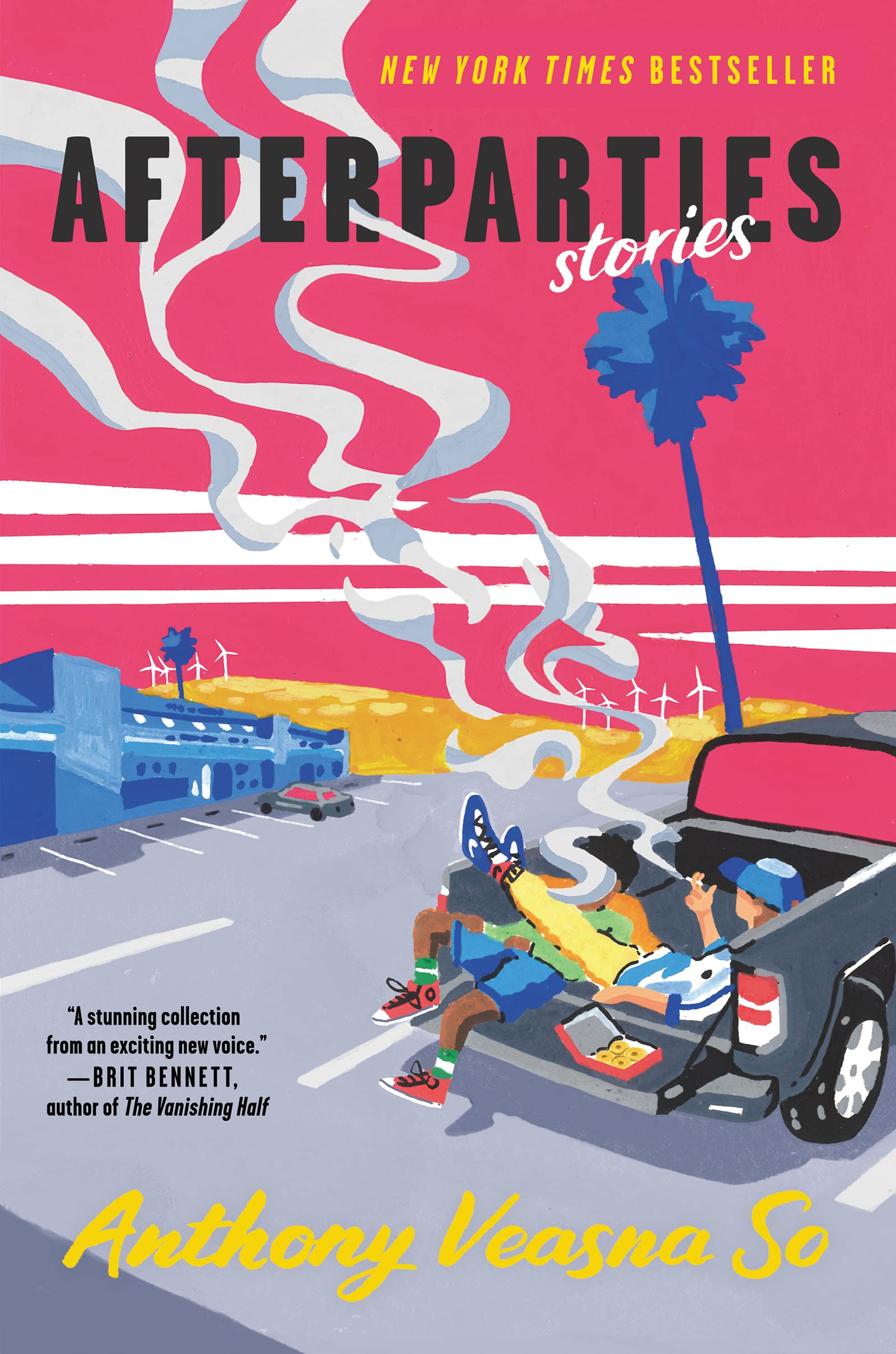
Afterparties by Anthony Veasna So

The train came to my stop, so I stepped off and started walking. A dense fog from the ocean had crawled through the neighborhood, pulled in by the valley heat of my childhood and Ben's prior life. I couldn't see far ahead, but I knew where I was going, and I was reminded of Ishmael "working" on the masthead of the Pequod, Ishmael dozing to the cadence of his dazed reflections, diffused into the clear sky, the total opposite of my current waking moment. As I waded through the fog, I wondered, then, at the impossibility of my existence. Here I was! Living in a district that echoed a dead San Francisco. Gay, Cambodian, and not even twenty-six, carrying in my body the aftermath of war, genocide, colonialism. And yet, my task was to teach kids a decade younger, existing across an oceanic difference, what it meant to be human. How absurd, I admitted. How fucking hilarious. I was actually excited.

The nine stories in Anthony Veasna So's collection Afterparties are all lightly related accounts of first- and second-generation Cambodian immigrants living in California's Central Valley: three women who run a donut shop (this is, I infer, a rather common thing for Cambodian immigrants here to do), a young man whose father's mechanic shop is failing, a group of high school badminton players who pass around legends of their coach, a badminton star now working as the manager of a grocery. Partly, I think, because they are rich portrayals of an American community not before seen in fiction (can you think of any other books about Cambodian immigrants in the Central Valley, or anywhere else?) Afterparties was one of the buzziest books from the last couple years, and that buzz was amplified by the sudden death of author Anthony Veasna So by a drug overdose in 2020.

So's death hangs over these stories, and when his obvious stand-in writes about "carrying in [his] body the aftermath of war, genocide, colonialism," it's hard not to hear tragic echoes of So's future. But of course So's untimely death can also get in the way of the stories themselves, which are fraught with recognizable conflicts about the difficult balancing act demanded of immigrant communities in the United States, but which are also very warm and even quite optimistic ("I was actually excited").

One theme, specific to the Cambodian immigrant experience, that emerges is the way Pol Pot's genocide hangs heavy in the memory of those now living in the United States. It informs the older characters' sense of gratitude, and their dedication to making a new life in a new place, but it also divides them from the younger characters whose division and alienation from their parents seems like a recognizable aspect of immigrant stories of all kinds. I was struck by a pair of stories that depict a Cambodian belief that children can be the reincarnation of family members and the pressure this places on younger generations. When your mother commits suicide, unable to shake the memories of the Killing Fields, how do you move on when your new niece is believed to be her reincarnation? One of these stories, "Somaly Serey, Serey Somaly," about a hospice nurse who must care for her own dying aunt, is one of the strongest stories, and I'm going to use it in my class.

There is a richness to the stories, a kind of complexity that avoids easy plotlines that might underscore the generational conflicts that are their underpinning. In the opener, "Three Women of Chuck's Donuts," a mother and her two daughters watch a Cambodian man come in every night to buy an apple fritter he doesn't eat. The daughters suspect he may be a half-sibling, a child of the father who abandoned them for his second family; the mother fears he may be a cousin come to violently take back the money her absent husband borrowed from his gangster family to establish the donut shop. But the man proves to be someone else entirely; his secret fails to wrap the story up neatly but manages, in a way, to enrich it.

Stylistically, the stories are--well, fine. One of my favorites was "We Would've Been Princes!," about a pair of brothers who are determined to discover how much a successful cousin has given to the bride at a wedding--suspecting him of being stingy. The story is a fast-paced mess, but it has a kind of stylistic energy and verve that the other stories lack. Afterparties is most engaging, I think, when it breaks out of a kind of traditionally realist mode; another example is the story "Superking Son Scores Again," which uses a collective first person narrator (those breathless badminton fiends of the local high school) to great effect.

Finally, I ought to mention that these stories are deeply interested in queer themes also. "Human Development," one of the strongest stories, focuses on a narrator I suspect is the closest we get to So himself (not least because his name is Anthony) who is living in San Francisco and becomes involved with an older gay man who is also Cambodian and from the same town. The relationship is sexually and mentally thrilling for them both, but the narrator can't shake the suspicion that his new lover is interested in him specifically because he is also Cambodian, and that traditionalist expectations about reproduction and the sustaining of their small and embattled community have been transposed even into an ostensibly queer relationship. In "The Shop," a gay narrator endures the harangues of an older Cambodian woman who encourages him to marry a Cambodian woman to provide one of their own with a green card--his sexual orientation being almost irrelevant. In this way the stories often find a rich area of exploration in the overlap between immigrant stories and queer ones; sex and sexuality become, as of course they are, a battleground between more traditional first-generation immigrants and their Americanized children.

Sunday, April 24, 2022

Gods Without Men by Hari Kunzru

Lisa stood up and ran a few paces, shouting Raj's name. Then she turned and ran in the opposite direction. Jaz couldn't see her eyes behind her sunglasses. A sick feeling descended over him like a shroud. Something had happened, something that wasn't going to come right.

They walked and shouted and walked and shouted, turning wider and wider circles around the rocks until their voices were hoarse in their parched throats and their clothes were coated in fine white dust. Even as his head spun and sweat soaked his back, Jaz felt as if an IV were pumping cold gel through his veins. The world was far away; he was trapped somewhere else, somewhere dead and bone-white, outside time and space. He thought perhaps he should look for prints, the ridged soles of a child's sneaker, but any trace had been obliterated by his own tracks, crossing and recrossing the same ground.

Lisa and Jaz's son Raj is a terror: non-verbally autistic, he screams and throws tantrums on an hourly basis. Though Jaz's finance job has made them quite wealthy, they avoid most hotels, choosing to stay at cheap motels when traveling--which of course they do infrequently. Though they avoid saying it to each other directly, Raj has destroyed their relationship with each other, already strained by the cultural differences between their Jewish and Punjabi families. When visiting the Mojave Desert in California, Raj suddenly disappears, thrusting Lisa and Jaz into the national spotlight. And when Raj suddenly reappears, he has become patient, calm, and even begins to speak. What happened to him in the desert? Jaz wonders, is this really his son at all?

Lisa and Jaz's story is the main narrative of Hari Kunzru's God Without Men, but it's only one thread among many: Kunzru weaves in stories of the desert going back to the 19th century. A Spanish Jesuit and explorer encounters mysterious Indian practices; an obsessive anthropologist seeks revenge on the Indian man who stole his wife; a cult calling itself the Ashtar Galactic Command springs up there, claiming to be able to contact an advanced alien race who wish to bring peace to mankind. It's strongly suggested--I think--that, when the anthropologist in the 1920's spots a "glowing child" walking with his Indian rival in the desert, that the child is Raj, having slipped through some sort of time portal, but then again, Raj is not the only child to have disappeared in this place. A cult leader's daughter also disappears, only to reappear years later--though whether it is really her or just someone willing to play the part of a long lost daughter is unclear.

I recently wrote a book that shares a lot of qualities with Gods Without Men. (A book needing representation, if you happen to be an agent, wink wink!) It revolves around the disappearance of a young child, and it's told in a multivocalic way, through several rotating third person points-of-view. So when I say this book doesn't quite work on a fundamental basis, I wonder if that feeling is something of an anxious projection on my part. But Gods Without Men just has too many parts. When Raj is rediscovered, for example, it's by a young Iraqi refugee girl who has moved to the desert to take part in a training program for US soldiers in a pretend Iraqi village. The story itself is fascinating, but it lacks any strong connection to the main narrative. Similarly, the book sets up as important early on a washed-up British rocker who has come to the desert to record a Laurel Canyon-type album with his band, but this character ends up being more or less irrelevant to the book as a whole. Each of these pieces is engaging on its own, but taken together, the main thing I felt was impatience: Come on, get back to Lisa, Jaz, and Raj. The danger with these types of novels--and I feel this in my own book, too--is that they make it so any empathy you might for any specific character or conflict is incredibly slow to develop.

The slightly-too-complex structure of Gods Without Men, I think, conceals a vacuity at its heart. There is a pleasing mystery to what is going on, exactly, in the Mojave (He doesn't say it, but contextually Kunzru seems to be writing about a remote section of Joshua tree National park), but the novel essentially waves a hand at it as if to say, isn't this all so mysterious? I don't need the novel to give me any hard science-fiction version of what happens to Raj when he disappears, or what the cult members are actually doing when they think they're talking to the "Ascended Masters," but in the place of possibilities Kunzu provides what is, essentially, a vibe.

I don't want to get too negative; I actually enjoyed this book, though it failed to come together for me. Kunzru is an excellent writer on a sentence level, and he does a good job with the Mojave, a truly alien and forbidding landscape if there ever was one. And like I said, each piece itself is engaging--but I wanted them actually to come together, rather than seeming as if they came together.

Sunday, July 25, 2021

How Much of These Hills is Gold by C. Pam Zhang

There is claiming the land, which Ba wanted to do, which Sam refused--and then there is being claimed by it. The quiet way. A kind of gift in never knowing how much of these hills might be gold. Because maybe if you only went far enough, waited long enough, held enough sadness pooled in your veins, soon you might come upon a path you knew, the shapes of rocks would look like familiar faces, the trees would greet you, buds and birdsong lilting up, and because this land has gouged in you an animal's kind of claiming, senseless to words and laws--dry grass drawing blood, a tiger's mark in a ruined leg, ticks and torn blisters, wind-coarsened hair, sun burned in patterns to leave skin striped or spotted--then, if you ran, you might hear on the wind, or welling up in your own parched mouth, something like and unlike an echo, coming from before or behind, the sound of a voice you've always known calling your name--

Lucy is a young Chinese-American girl living in the gold rush region of the American West in the nineteenth century. Since the death of her mother, her little sister Samantha has cut her hair short and taken to calling herself Sam, posing as a boy. When Lucy and Sam's father--known as "Ba"--dies suddenly in the night, the pair end up alone in this frontier land, and without a way to stay in their house, they set out into the wilderness to find a place to bury Ba's putrefying body.

How Much of These Hills is Gold wrenches the reader through several chronological shifts: no sooner is Ba's body buried than Zhang winds back the clock several years to illuminate the kind of hardscrabble life the family lived before the death of Ma and Ba. Ba, it turns out, was one of the very first to discover gold in the California hills, a secret he has been keeping--and mining--for years, but when the secret gets out, it's only a matter of time until white men find a way to use his race to lock him out of the munificence of the gold rush.

There's even an As I Lay Dying-style section written from the point of view of Ba's corpse as he rides on back of Lucy and Sam's horse, written as a farewell to Lucy in which he fills in the history of his own relationship with their mother and his first experiences in what the Chinese called, appropriately enough, Gold Mountain. This section, I thought, was one of the most successful of the novel--despite its fancifulness, Ba's voice grounds the narrative; I found the third-person present-tense mode of the rest of the novel to be a little too precious at times.

From there, the novel zooms forward again five years, when Lucy and Sam meet again for the first time after splitting up in the wilderness. Lucy has found safety and comfort in a frontier town, attaching herself to a vain, rich white girl; Sam has been an adventurer in the hills, in the spirit of long-dead Ba. The two are foils in many ways: civilized and wild, assimilating and proudly Chinese, feminine and masculine, Ma and Ba. Against the backdrop of the Wild West, Zhang explores these themes of race, gender, and identity with a great deal of subtlety and complexity. But the story never quite recovers from the time jump, I thought, and tries to fill in too much. Still, How Much of These Hills is Gold offers a new and welcome perspective on the familiar myths of the West.

Sunday, June 14, 2020

Nobody Move by Denis Johnson

He put his fingers around the phone in his lap. The phone slipped away with a clatter that echoed in the concrete cylinder, and he let himself collapse toward it. He had his mouth by the phone. He had a finger on the button. He needed to make his finger press it. He couldn't make it happen.

No problem. If he could keep his eyes open, he wasn't dead. Lying on his belly he stared at the red spectacle of his life as it traveled past his face and headed away from him through the dust. That's all he needed to do now. He needed to keep seeing his blood.

Jimmy Luntz is competing with his barbershop chorus in the city of Alhambra outside Los Angeles when Gambol, a stooge working for a man who holds Luntz's gambling debts, picks him up and drives him far out of town. The plan is to break one of his legs or arms but in the woods seven hours north Luntz manages to overtake Gambol and shoot him in the leg. While tossing the gun into a river, he encounters Anita Desilvera, a woman who's recently been framed by her husband and a corrupt judge for embezzling two million dollars. The pair gravitate toward each other, both on the run, and together they might be able to make off with the stolen money and escape from Gambol and his associates.

Nobody Move is a love letter to the hard-boiled fiction of Raymond Chandler and Dashiell Hammett. The prose is brisk and filled with quips, and the story is violent: one of the best moments comes when Anita rips out the wheelchair-bound judge's colostomy bag and hits him in the face with it. (In case you're wondering, it does, in fact, burst.) To me, it was most reminiscent of No Country for Old Men, a book about ordinary people whose mixup with criminal elements thrusts them into a race against time, against violence, and for a great deal of money, and which is equally indebted to Chandler and Hammett. And like No Country for Old Men, I only had an approximate sense of the causality behind the various twists and turns. To his credit, Johnson knows that sometimes even hapless Luntzes get the better of wizened criminals like Gambol; violence is difficult to control and luck more likely to run out than remain.

The main thing a book like this has to do is be fun, and it is. It just zips by; I read the whole thing yesterday. But the pared-down prose robs you of some of the expected joys of reading a Denis Johnson book, and I liked the novel best when there were flashes of Johnsonian weirdness, as when Anita--having, spoiler alert, just killed her husband--sees his apparition copying her movements across a river. Or the fact that one of the goons is, without explanation, called "the Tall Man" for pages before you find out he's five-foot-eight.

The thing that connects it best to books like Angels or Jesus' Son is that it's about a couple of real down and out losers. Luntz is a loser because he has a gambling addict (and a member of a barbershop chorus), and Anita is made a loser by her husband (although she's also clearly an alcoholic), but Nobody Move is driven by the tantalizingly equivalent possibilities that they'll make off with a million dollars or be unceremoniously shot. You might even read the title, which might as well be the title of an Elmore Leonard novel, as a subtle hint at the explosive possibilities of crime to punish and reward.

Saturday, January 11, 2020

There There by Tommy Orange

The trickster spider, Veho, her mom used to tell her and Opal about, he was always stealing eyes to see better.  Veho was the white man who came and made the old world watch with his eyes.  Look.  See here, the way it's gonna be is, first you're gonna give me all your land, then your attention, until you forget how to give it.  Until your eyes are drained and you can't see behind you and there's nothing ahead, and the needle, the bottle, or the pipe is the only thing in sight that makes any sense.

I'm going to make Cheyenne author Tommy Orange's There There the first book we read in my Contemporary Native Fiction class, which starts next week.  I think kids will like it: it's readable, accessible, and hypermodern.  It namechecks Madlib and Radiohead; a drone makes a starring appearance.  And the drama--long lost parents, grand scale robberies, alcoholism and sexual assault--is pitched at exactly the right level for teenagers, who crave, I think, a high-intensity version of the world because they are waiting on that intensity to appear in their own lives.

Reading it for the second time, I'm struck by a motif I think I missed the first time around: each of the major characters is caught staring for a moment at their own face in a reflective surface.  A mirror, a television set.  It's not the most original motif in the world, but it's effective here because, to varying degrees, the characters are all struggling with their own relationship to their indigeneity.  Some, like Edwin, know they're Native but don't know which tribal nation their heritage belongs to, thanks to their father's disappearance.  Others are told they are Native, but nothing more; they have Hispanic names.  So many of these characters stress about whether they have any right to claim indigeneity at all.  Some, like Orvil Red Feather, seek to embrace it headlong by dancing at the Oakland Pow Wow; others run from the claim on themselves.

Honestly, the second time through confirmed to me that the book doesn't work on a fundamental level.  I stumbled on the same two obstacles: First, there's just too many characters.  The climax of the novel (spoiler alert!) is a robbery at the Pow Wow that devolves into a mass shooting; there are four point of view characters involved in the robbery, and even having read through the book once it's difficult for me to separate them, psychologically and thematically, in my mind.  The other problem is the end itself, which seems gratuitously violent.  I was dreading it while reading, and encountering it again was almost physically repulsive.  Orange gives us, again and again, first-person perspectives on what it's like to be torn apart by a bullet, but no good reason that we should have to hear it again and again.  Violence is always gratuitous, you might say, always senseless, but I can't shake the idea that Orange is grasping at some kind of final statement and whiffing.

But that doesn't make it the wrong book for my class; in fact, sometimes books with big problems are better than books with few flaws.  I'm looking forward to having my students figure out why There There had to end in such a bloody way; maybe they'll have a perspective that persuades me I've been reading it all wrong.

Wednesday, September 25, 2019

Dr. Bloodmoney by Philip K. Dick

He struggled up, disconnected himself from the straps, saw through the port the world below.  Clouds, and the ocean, the globe itself.  Here and there on it matches were lit; he saw the puffs, the flares.  Fright overcame him, as he sailed silently through space, looking down at the pinches of burning scattered about; he knew what they were.

It's death, he though.  Death lighting up spots, burning up the world's life, second by second.

He continued to watch.

The people of the world, and San Francisco Bay specifically, thought the first bomb would be the last.  Not consciously, of course, and there's always the fear, but they organized their lives and minds around it, speaking of it as an inflection point in time, but it wasn't the last bomb, and worse was to come: a series of nuclear explosions that left the world, all of it, in a state of near-ruin.  In the Bay, communities are starting again; people are driving around in horse-driven cars and trying to reinvent combinations of spices that taste like tobacco.  Dogs have learned to talk, but not very well.  In West Marin, a strong and resilient community forms, distinct from faraway neighbors in Oakland and Bolinas, places that before the bomb dropped were only minutes away, not days.  Dick casts this world with an unusually large cast of people, many of whom are worth enumerating, because this is a real ensemble affair:

Hoppy Harrington is a phocomelus, born with tiny flipper-like hands and legs, not because of the first bomb or the later ones, but because of the very not-fictional effects of thalidomide.  Before the bombs go off, he's an outcast, having to beg for a menial job as a TV repairman, but with special powers: a system of electrical extensors makes him quite "handy," and he can see the future.  In a trancelike state, he sees the aftermath of the bombs--a gray wasteland his onlookers take not as a wordly future but a vision of the afterlife--an afterlife in which he wields a kinglike power.  And in truth, in the wrecked world of Marin after the bombs, he becomes nearly all-powerful; he alone possesses the know-how to build and operate a radio tower, and enlarges his physical power by tweaking the electric field of his extensors.

Stuart McConchie is a black TV repairman who works briefly with Hoppy, and who is deeply suspicious of him when others find him weird but harmless.  Hoppy has a vision of him in the afterlife gnawing on a dead rat--which, lo, comes to pass.  Food is scarce, after all, after the bombs.  Stuart's role in the plot is pretty inconsequential, I think, but he brings in themes of race in a way that is unusual for PKD; will the new world be any different for black people in America?  Hoppy Harrington uses society's upheaval to move from the margins of the world into the center, but for Stuart, depressingly, such a move seems not possible; when he arrives in Marin from Oakland, some community members make it clear they don't want black people--coded, again, as "urban"--in their town.

Bruno Bluthgeld is the "Dr. Bloodmoney" of the title.  He is a researcher of some kind who is considered directly responsible for the initial bomb, and is perhaps connected to the later bombs also.  He certainly thinks he is: he both believes that everyone in the world would like to murder him if they could, and that he can manifest nuclear bombs out of thin air with his mind any time he wants.  Both of those things, it turns out, might be true.  He's hiding out in Marin under an assumed name, living as a toothless shepherd, but his kind of power, if it exists, may not be the way of the world anymore, and puts him at odds with the ambitious and megalomaniacal Hoppy.

Walt Dangerfield is an astronaut who, along with his wife, is going to be the first human to live on Mars.  His ship is launched shortly before the bombs go off, and so he finds himself stranded in orbit without anyway to return.  His wife has died.  Over the years, he acts as a kind of world radio, beaming music and conversation, down to those with working radio towers.  He's a pretty obvious stand-in for God.  Hoppy's plan is to use his radio tower to kill Dangerfield--with a kind of sonic beam or something?--and then to replace him with a practiced imitation, to become God.

Finally, there's Edie and Bill Keller.  Edie is a normal seven-year old girl, and Bill, of course, is the shrunken homunculus of her twin brother who lives inside of her body.  Everyone thinks Bill is imaginary, but he's not; he's "a terribly old, wizened thing," "hard and small, floating... [l]ips overgrown with downy hair that hung trailing, streamers of it, wispy and dry."  He can swap bodies with other creatures if Edie presses her side to them, and obviously, he can talk to the dead.

One of my favorite parts of Dr. Bloodmoney is so silly I can barely believe it's in there: Bill Keller, correctly identified by Hoppy as a threat, is torn out of his sister by Hoppy's electrical powers and launched into the sky, where he is devoured by an owl.  He flies around as an owl for a little while, and then vomited out like a pellet.  It seems impossible, but Dr. Bloodmoney might be the most unshakably weird book of Dick's that I've ever read.  Dick never could write a book about one weirdo in a normal universe; there always have to be two or three at least, and this novel really takes that dictum to its maximum.  It's made of such disparate parts all stitched together that it seems like it should be a horrible mess, but it all holds together.

And what keeps it together is the frank terror of the idea of a post-nuclear world.  As Dick writes in his afterword (how awesome to have a window into the thinking behind gonzo books like these), it's actually an "extremely hopeful novel."  Society is not murdered by nuclear war; it remains in the form of small communities, banded together.  Industry and technology are not obliterated but merely retarded; this is not The Road, where the best people can do is stack rocks and make fire.  There is even the impartial suggestion that worldwide crisis can help spur society to reorganize itself.  While Hoppy is clearly a monster, we're told that other phocomeli are also prized as "handymen" by their communities.  Dick points to Bluthgeld as the real villain of the story: the kind of person who believes they have the right to provoke catastrophe in the world of others merely because they have the ability.  Bluthgeld's ability to create bombs out of nowhere seems to me like a representation of the egos of Cold War leaders, who had the audacity to believe that they were capable of administering nuclear arsenals.  Human decency is better represented in the figure of Stuart McConchie, who opens the book by humbly sweeping the stoop of the TV repair shop.