Showing posts with label Leslie Marmon Silko. Show all posts

Wednesday, July 12, 2023

Gardens in the Dunes by Leslie Marmon Silko

I have a sister too, but this ship and you, Ocean, are taking me farther from here, Indigo whispered. She imagined Sister Salt on the depot platform in Needles, searching for her among the boarding school students returning home for the summer. Now the great ocean lay between them. Her plan for an easy way home had taken her much farther away. Tears filled her eyes and she cried softly into her pillow: Please help me, Ocean! Send your rainy wind to my sister with this message: I took the long way home, but I'm on my way. Please don't worry.

Indigo is a young girl of the (presumably) fictional Sand Lizard tribe, living in the Colorado River region where Arizona, California, and Nevada meet. When her family is swept up by soldiers during a Ghost Dance ceremony, she's separated from her mother, grandmother, and sister, and placed in a brutally repressive Indian school. She escapes, and finds a place to hide near the home of Hattie, a clever young woman expelled from graduate school for her unorthodox ideas about the early Christian church, and her husband Edward, an older naturalist living with the disgrace of a failed commercial expedition to South America. They take Indigo in to prevent her from being reabsorbed by the Indian school, and soon Indigo finds herself on a train bound to New York, and from there, a steamer to Europe.

Gardens in the Dunes is an interesting contrast to Leslie Marmon Silko's most famous novel, Ceremony, about a Laguna man suffering from PTSD after World War II. In that novel, Tayo learns that healing can be found in reconnecting with the rituals of his Laguna culture. Gardens in the Dunes is a more outward-looking novel, a global one, in which Indigo grows by being exposed to the wider cultures of the world--though like Ceremony it suggests that there is a power and safety in return. Indigo makes friends with a monkey and a parrot, and wherever she goes, there are gardens, from which she quietly takes seeds for her collection. When, at last, she returns to the "gardens in the dunes" of her Grandmother's country, she plants these new seeds, it is perhaps a symbolic expression of Indigo's going out and return. She brings the best things of the world back with her, and integrates them into her homeland. This is in contrast, maybe, with the rapacious pursuits of Edward, who sees in the natural resources of the world--orchids, citrus trees, iron meteorites--things to be purchased and sold for profit.

What I found most interesting about Gardens in the Dunes was the connections it draws between the Ghost Dance religion that developed in the 19th century and other unorthodox forms of Christianity. Wherever Hattie, Edward, and Indigo go, they are confronted by signs and symbols of repressed religion, including, in England, mysterious Druidic artifacts. Hattie has been dismissed because of her thesis, which emphasized the primary role of Jesus's female followers over the male disciples. Silko draws a direct line between beliefs and practices like these and the Ghost Dance, which was popularized by a "Messiah" figure named Wovoka in the late 19th century. Indigo has been taught to associate Wovoka explicitly with Jesus Christ, and in the great churches and chapel gardens of Europe, she insists again and again to Hattie and Edward that Jesus Christ was not crucified as the stories say, but traveling with his followers in the Americas. The Ghost Dance legend is another story of return and restoration: Wovoka, the Messiah, promised that the dance would bring back the many dead and lost who perished in American wars of conquest. It's no wonder that Indigo, torn from her family, holds tight to this belief--as meaningful in its way as any orthodox form of Christian theology.

I didn't quite expect a book like Gardens in the Dunes, having only read Ceremony. Ceremony is an inward book, a complexly layered story of memory and inward healing, but Gardens in the Dunes is a kind of adventure story. Its suggestions of erudition, its wide-ranging scope, and its 19th century setting, reminded me most of A. S. Byatt. Like Ceremony, it's more complex than it looks, introducing several minor characters--a Black cowboy cook, a thieving Mexican radical who operates a dog circus--whose presence make the book shaggy and strange. I'm not sure how I feel about the novel's final chapters, which feel somehow both anticlimactic and too pointedly dramatic--but it left me a lot to think about.

Saturday, January 8, 2022

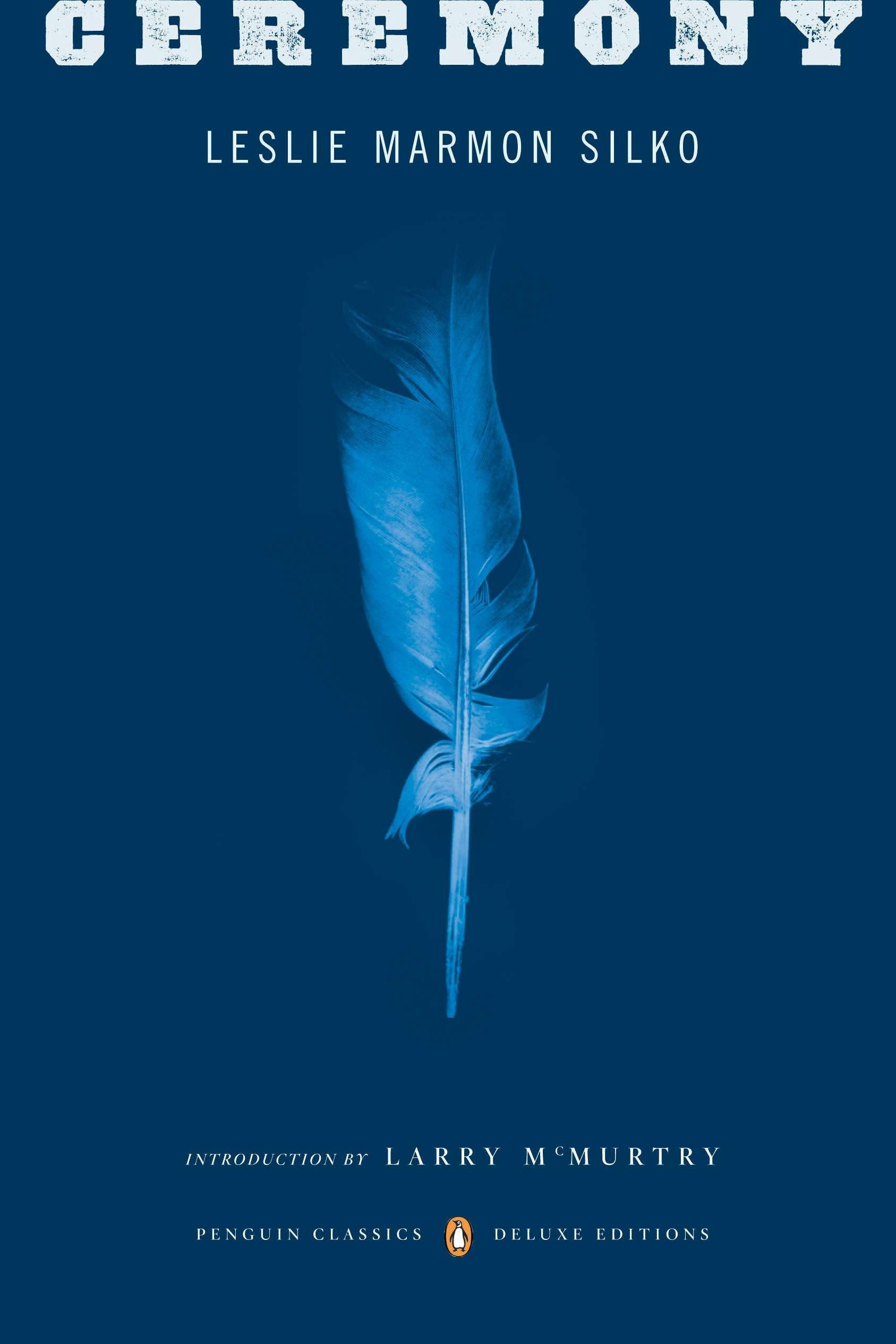
Ceremony by Leslie Marmon Silko

The dreams had been terror at loss, at something lost forever; but nothing was lost, all was retained between the sky and the earth, and within himself. He had lost nothing. The snow-covered mountain remained, without regard to titles of ownership or the white ranchers who thought they possessed it. They logged the trees, they killed the deer, bear, and mountain lions, they built their fences high; but the mountain was far greater than any or all of these things. The mountain outdistanced their destruction, just as love had outdistanced death. The mountain could not be lost to them, because it was in their bones; Josiah and Rocky were not far away. They were close; they had always been close.

I re-read Ceremony because, for the first time ever, I'm going to teach it in class this year. I'm looking forward to that but also I have a little trepidation; much of the time I spent re-reading it I spent trying to figure out what about the novel seems so difficult and enigmatic. The language is measured and plain, but the structure can be a little deceiving: it's the story of Tayo, a Laguna Pueblo man who has returned from World War II and the Baatan Death March with extreme PTSD, and who returns to mental and spiritual health by the aid of a ceremony rooted in Laguna and Navajo storytelling. The beginning is fractured, as is fitting for the narrative of Tayo's inability to move on from the horrors of war and death, but the process of healing, too, is strange, jumping from time to place and from person to person elliptically. Of course, perhaps it is a mistake to think that healing is a process that take something crooked and makes it straight.

I appreciated more, this time, the fine distinctions that Silko makes in her description of "witchery," an enigmatic evil force that is responsible for the creation of white people and European cultures. I can imagine this would be quite an unsafe book to teach in one of those states where anti-"CRT" bills have passed: ALABAMA TEACHER ASSIGNS BOOK THAT CALLS WHITE PEOPLE EVIL DEMONS, that sort of thing. But Silko is always quite clear that "witchery" victimizes indigenous and white people alike, and perhaps even that white people are in the most danger because they refuse to wake up and see it for what it is. "Witchery" is a destructive force; it loves death--it has something to do with capital in the Marxist sense, and the "love of money" in the Biblical sense, but Silko's formulation places it even further back, a black impulse in the human heart that is the root cause of these things. And a reactionary response might fail to see that it is actually invented by indigenous people, according to Silko's rendition of legend; in fact, this is the novel's central and strangest irony.

Once you see this, the outlines of the novel's racial and cultural outlook get both clearer and more complex: you see, for instance, how important to the novel it is that Tayo is of mixed race. Is his Aunt's resentment and neglect, so different than the love she heaped on his "purer" and now-dead cousin Rocky, a kind of witchery? Witchery's avatar in Ceremony is not a white person but an indigenous one: Emo, a sinister drunk who resents Tayo's white heritage as strongly as he yearns for the things that white people have. Silko shows sharply how tribalism and oppression are two sides of the same coin. You notice, too, what it means that Tayo's guide in his ceremony is a Navajo, and not a Pueblo man, despite suspicion on both sides; Ceremony manages to articulate the importance of returning to one's geographic and cultural roots while also showing the power of synthesis and syncretism. It's a subtle message and an unfamiliar one, but one I hope my students will welcome.

Ceremony is the first novel in what I'm calling "Indijanuary," despite it being nearly unpronounceable. I did this last year, too, reading eight books by indigenous North American authors in a row, and I'm excited to try it again.

Sunday, April 8, 2018

Ceremony by Leslie Marmon Silko

He could get no rest as long as the memories were tangled with the present, tangled up like colored threads from Grandma's wicker sewing basket when he was a child, and he had carried them outside to play and they had spilled out of his arms into the summer weeds and rolled away in all directions, and then he had hurried to pick them up before Auntie found him.  He could feel it inside his skull--the tension of little threads being pulled and how it was with tangled things, things tied together, and as he tried to pull them apart and rewind them into their places, they snagged and tangled even more.  So Tayo had to sweat through those nights then thoughts became entangled; he had to sweat to think of something that wasn't unraveled or tied in knots to the past--something that existed by itself, standing alone like a deer.

One thing I learned on my recent trip to New Mexico is that the Bataan Death March--the deadly forced evacuation of American and Filipino prisoners of war from a Japanese camp in the Philippines--was disproportionately suffered by soldiers from New Mexico.  There are Bataan memorials in Santa Fe and Las Cruces.  Consequently, the veterans of Bataan include a disproportionate number of Native Americans, since New Mexico has the largest population of indigenous persons per capita in the U.S. outside of Alaska.

Ceremony is about the experience of Tayo, a man of white, Hispanic, and Laguna Pueblo ancestry who returns to New Mexico from Bataan with a severe case of PTSD.  Army hospitals and psychiatrist have done nothing to chase away the demons of guilt: watching his half-brother Rocky die in the jungle, or being absent for the death of his beloved uncle Josiah.  At home, Tayo is scorned by his Aunt, who loved the full-blooded Laguna Rocky more, and codependent in his alcoholism with a group of down-and-out vets, some white, some Native.  Tayo turns to traditional Laguna practices--or rather, his family turns hmi toward them--in order to do what Western medicine cannot.  One medicine man fails, but another, who has adapted his practices in the face of the cruelty of the 21st century, takes Tayo through a ceremony which offers the possibility of returning to Tayo a sense of wholeness.

Why does the traditional ceremony work when Western medicine does not?  Because what ails Tayo is not, as the Army doctors maintain, a problem within Tayo, but a problem with the world as a whole.  As Silko writes, "His sickness was only part of something larger, and his cure would be found only in something great and inclusive of everything."  Silko argues that it's impossible to treat Tayo's PTSD without treating the historical and cultural pressures that force a Native man into fighting for a nation that has abused and deprived him in the first places.  The traditional ceremony, on the other hand, offers promise because it promises to integrate Tayo with a life he has been cut off from.

Silko blames the war on an impersonal force called "witchery," a malevolent force that seeks to destroy the world.  Whites are implicated in witchery, though they are variously depicted as its dupes and its victims:

If the white people never looked beyond the lie, then they would never be able to understand how they had been used by the witchery; they would never know that they were still being manipulated by those who knew how to stir the ingredients together: white thievery and injustice boiling up the anger and hatred that would finally destroy the world: the starving against the fat, the colored against the white.  The destroyers had only to set in into motion, and sit back to count the casualties.  But it was more than a body count; the lies devoured white hearts, and for more than two hundred years white people had worked to fill their emptiness; they tried to glut the hollowness with patriotic wars and with great technology and the wealth it bought.  And always they had been fooling themselves, and they knew it.

There's a lot that's sobering here, like the reminder that to be white is to be implicated, not necessarily by choice, in the historical theft of native lands and lives.  It doesn't feel good to think that one is or has been the tool of an evil spanning centuries.  But--and I am aware of the need to choose my words carefully here--is it helpful to deny the agency of political leaders by diverting blame from individual people to "witchery?"  How can that help us grapple with, for instance, Truman's decision to drop atomic bombs on Hiroshima and Nagasaki?  And how does it help us to balance the exploitation of young men of color, Native Americans included, in the armed forces with the moral imperative to resist imperialism in Germany and Japan?  How does it help us understand the Death March, which was perpetrated by the Japanese?  Silko's articulation of witchery presents a problem for me because it seems to paradoxically implicate whiteness in historical evil while denying that evil operates through the conscious choices of specific (yes, white) people.  Yet it also seems to capture the way in which whites become victim of their own dominant narratives.

Sometimes I think Silko lets this idea lead her into facile places:

...only a few people knew that the lie was destroying the white people faster than it was destroying the Indian people.  But the effects were hidden, evident only in the sterility of their art, which continued to feed off the vitality of other cultures, and in the dissolution of their consciousness into dead objects: the plastic and neon, the concrete and steel.  Hollow and lifeless as a witchery clay figure.

The "plastic and neon, the concrete and steel": this critique rings particularly hollow to me.  It sounds too much like conservative fuddy-duddyism.  The references to Tayo's high school science teacher who openly mocks Native religion seem like they're imported from God's Not Dead 3.  And I rolled my eyes when I read: "White people selling Indians junk cars and trucks reminded Tayo of the Army captain in the 1860s who made a gift of wool blankets to the Apaches: the entire stack of blankets was infected with smallpox."  Maybe this reference point seemed more fresh or shocking in 1977, but here it sounds like a schoolteachery intrusion of the author's voice into Tayo's consciousness.

Obviously, I read Ceremony like a white person: its ideas about whiteness stand out to me because they are about me.  I have to force myself to read it another way.  It discomfits me to think that part of Tayo's ceremony necessitates the suppression of his "white side," but of course it's the Laguna side of his identity that's been suppressed by whiteness and is need of recovery.  This is the heart of the ceremony: these traditional practices reconnect Tayo to his Laguna heritage but they are oriented toward a wholeness that encompasses all people against the anti-human forces of witchery.

The avatar of witchery in the novel is a white vet named Emo who hangs out in the same circles as Tayo.  At one point Tayo, enraged by something Emo says, stabs him in the stomach.  The climax--spoiler alert--comes when Emo, trying to find and fight Tayo, tortures and kills Tayo's friends.  Tayo's choice not to emerge and fight is both fascinating and troubling.  It's certainly contrary to what we expect from the narrative of a literary hero; what Tayo must find is the courage and confidence that lead to inaction, to rejecting the call of witchery to fight Emo.  But then again... he just lets those guys die.  I don't know how to account for that as a moral act.  Is that an aspect of the novel's radicalism, or an artistic failure?  If Ceremony is difficult to figure out, how much of that is the novel itself and how much of it is me?