Showing posts with label Graphic novel. Show all posts

Thursday, March 23, 2023

Why Comics? / Outside the Box by Hillary L. Chute

“One thing my mother did say about [Fun Home] was that I didn’t get the wallpaper pattern right. And she’s right... There was a point early on when she read one chapter and she said, Wow, this is really good. That was pretty astonishing. But since the book came out, she hasn’t said anything about the content of the book itself. But you know, how could she? This memoir is in many ways a huge violation of my family. I can’t expect them to give me strokes on my style, you know?” - Alison Bechdel, Outside the Box

Chris started the year by attending a seminar about comics and graphic novels, and as a result, I’ve read a number of them this year. I’ve been interested in the form since I was a kid, when I spent hours reading stacks of Archie digests and drawing my own comics starring a turtle-like humanoid named, uh, Josh. Then, when the first Spider-Man movie came out, I bought a bunch of black and white Marvel Essentials and got into superhero comics. Concurrently, I started visiting the bookstore near my college and reading--in the coffeeshop there--lots of indie books by many of the creators in these two books--Daniel Clowes (Ghost World), Chris Ware (Jimmy Corrigan), Art Spiegelman (Maus), and even a little R. Crumb.

I’ve read a couple books about comics history, but always within the context of mainstream, usually superhero, books. While Chute does mention them occasionally, superheroes stay on the periphery--even a chapter called Why Superheroes? Why Comics? spends more time on the sci-fi aspects of the Hernandez Bros’ Love and Rockets than it does on Superman--as she discusses the form, history, and structure of comic books as a medium. Outside the Box, the contents of which are often excerpted in Why Comics? Is a collection of interviews with various creators and made a great companion piece, which is why I combined these two reviews. They cover a great deal of similar ground so reviewing them separately seemed superfluous.

Why Comics? Is structured around a series of Why questions--why disaster, why superheroes, why women, why sex, etc--using them to push off into discussions of how comics, especially indie comics, moved out of the newspapers, onto the newsstands, and eventually, deep into the heart of the 60s and 70s counterculture. A few creators figure very, very large; not a single interview in Outside the Box fails to mention R. Crumb’s Zap or Spiegelman’s Raw and Maus. And those two, along with editor and publisher Francoise Mouly and Justin Green, creator of Binky Brown Meets the Virgin Mary, a book I’d never heard of that has a strong claim to being the first graphic novel, truly are the cornerstones of the comix movement. As someone says in their interview, “Everyone had their R. Crumb phase”. And, as a result, most of the works discussed in these two volumes aren’t family friendly, putting it mildly. The topics are dark, the motives hard to suss out, the perspectives unflinching. From Justin Green’s compulsive masturbation and religious guilt, to Crumb’s strips about incestuous families, to Phoebe Gloeckner’s chronicles of childhood molestation, to Joe Sacco’s incredibly disturbing scenes of real life war, to Spiegelman’s Holocaust, well. I had to make sure I kept this book well away from the kids lest they open up to the double-page spread of Popeye and Wimpy, um, pleasuring Olive Oyl in a reprint of a Tijuana Bible and have to deal with that in therapy.

Chute writes dispassionately in Why Comics? and makes a strong case for the wildly free expression underground comics provided creators, and draws lines from Crumb to The Simpsons, and it’s not hard to see the influence on later comics and animation like Adventure Time and Spongebob that emerged from this anarchistic movement. And of course, it’s not all adult content either. While most of the cartoonists here target adults primarily, I was charmed by Lynda Barry’s painted strips, Alison Bechdel’s Dykes to Watch Out For (and of course, Fun House). There’s a joy to even the bleakest of these works (well, maybe not Gloeckner), and in Outside the Box, the artists opine about the physicality of creating the artwork. As Bechdel says, “A novelist may never touch his words at all, but my fingers touch every part of the page.” There’s a lot of interesting stuff in both books about structure and what comics do well, some of which I stole pretty much wholesale for my review of Hostage. The control of time and space, the density that’s possible, the postmodern aspects of signifier and signified (which Chris Ware goes on about to such length that he gets embarrassed and stops). 

Most people, even most of the people here, don’t get rich or particularly famous by drawing comics, so why do it? That’s a “why” that doesn’t get its own chapter header, but it’s evident reading these interviews, and Chute’s criticism that it’s a labor of love. A love for the artform, a love of the process, a love of the art itself. Cumulatively, these two books are a love letter to the form and I’d recommend them to anyone who loves comics--as long as they’re over 18. 


Saturday, February 25, 2023

Hostage by Guy Delisle

It was in the early morning hours of July 2 that I was kidnapped. I had been working for three months in the town of Nazran, in Ingushetia, a small Russian republic west of Chechnya. I was responsible for the  finances and administration of a medical N60 established in the North Caucasus. It was my first job in the humanitarian sector.

So begins the story of Christian Andre, a French humanitarian worker whisked away in the middle of the night by Chechen rebels, taken to an unknown location and chained to a radiator. Initially he assumes he’s been kidnapped because he’s the organization’s treasurer, the only person with a key to the safe in his house; as the days, weeks, and months go by, it becomes clear that they don’t know about the safe at all--he’s been held for ransom. As told to graphic journalist Guy Delisle, Hostage recounts his experience.

Graphic novels provide unique presentational opportunities. Anything goes and a cartoonist with some time can draw a story as large-scale as any blockbuster, be it a superhero apocalypse, a sprawling period piece, cosmic horror, whatever. But the elevator pitch for Hostage sounds like a poor fit. Most of it takes place in one room, with one character. There’s very little dialogue, since Christian can’t understand or communicate with his captors. Many of the panels recur over and over, as Christian studies his feet, tries to escape the handcuffs, sleeps in uncomfortable positions, counts the days, speculates on when and if he’ll be released. He’s moved to a few different locations, but none of them are much more visually complex. Aside from the ten or so pages where he entertains himself by replaying military history in his head, Hostage is a long, repetitious nightmare.

Thankfully, it all works perfectly. Comics excel at working with time, able to stretch a single second over pages and pages or elide years in the gutter between panels. They can also, crucially, communicate repetition with drawings instead of prose, which means that the reader who tires of being imprisoned with Christian can speed quickly through the book, but for me, I found the repetitive rhythms of the days drew me in, affecting a real sense of melancholy or hopelessness where a prose presentation might instead have brought boredom and irritation.

In the last 40 pages or so, the story picks up as Christian manages to escape(!) when his captors forget to lock his door when they leave. With the help of a family he reluctantly trusts, he eventually makes it back, safe and sound. And according to the afterword, he returned to continue his humanitarian work a year later. Hostage is an affecting work, a masterful use of the form, and I’m going to be seeking out more of Delisle’s work.

Sunday, February 19, 2023

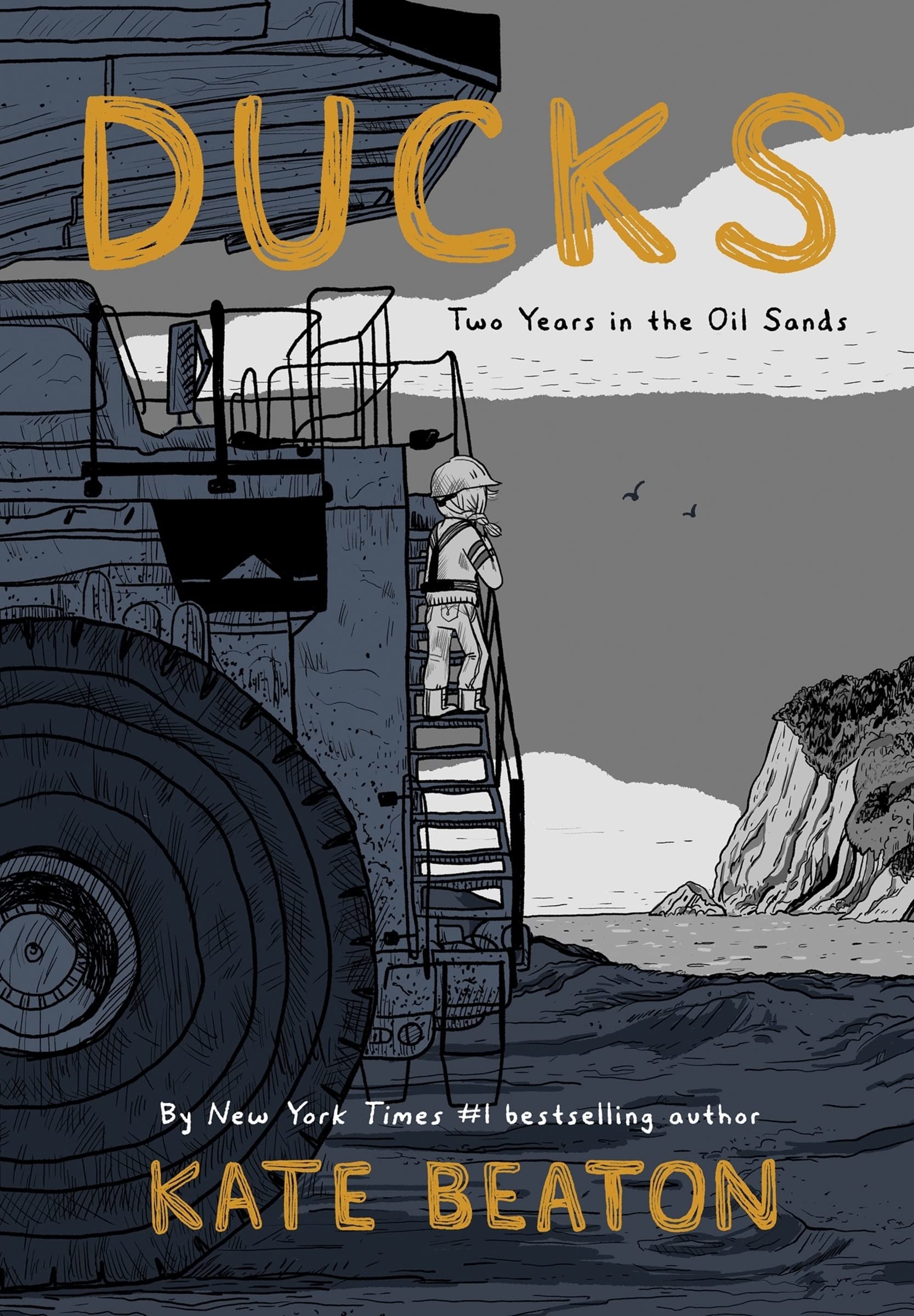
Ducks by Kate Beaton

I’ve waited too long to review Ducks, one of my favorite books of the year. I know this because I’ve already returned it to the library so I don’t have it on hand to consult. In my defense, Chris’s review is so good, I didn’t feel like I had much to add. But in the interest of reviewing everything this year, and not wanting to leave something that will likely make my year end list without a review, here goes.

Ducks is a graphic memoir, recounting the two years cartoonist and writer Kate Beaton spent working in the oil sands of Alberta, Canada. This is, I learned, a common rite of passage for young Canadians, and so, in spite of her family’s concerns, the book opens with Kate at the airport with her mother, about to leave her hometown of Cape Breton for the wild North.

The story is structured around the various camps at which Kate works plus one brief period at a museum in Victoria, and, within those sections, the story is broken up into a series of moments, interactions, and small scale events. The larger narrative emerges as the characters recur throughout various vignettes in different settings, as do the larger thematic concerns, most of which revolve around what it’s like to be one of the only women surrounded by hundreds of men who have largely been freed from the constraints of society.

And it must be said, the picture that emerges of the men here is not flattering. From her first moments in the sands, Kate finds herself being stared at, accosted, insulted, treated as inferior or, worse, as a prize, by seemingly every man she encounters. There are a few exceptions, characters whose names I can’t look up because I don’t have the book handy, and to Beaton’s credit, the portraits that emerge of the men are nuanced and complex--what are we to make of the men who are here working for their families, who gushingly share photos of wives and daughters and then make gross advances? Or of Kate’s boss who makes constant sexist remarks but also acts protectively? Or the hundreds of men with whom she never interacts, the silent majority, perhaps, who keep their heads down, make their money and go home? Beaton confronts this question head on, in a great conversation she has with her sister late in the narrative, but even there, no answers are forthcoming. Something about the isolation, the freedom from censure, the loneliness, the constant stress, causes breakdowns both internal and external, and, like the Safety Pyramid from the repetitive introductory seminars at each camp, these small disintegrations lead to larger disintegrations. Kate asks explicitly the question that the #NotAllMen contingent presumes the answer to: if our dad, our brother, our cousin were here, would they be any different?

The threat of sexual violence hangs heavy over the narrative; even before its explicitly mentioned we, the readers, can feel the looming threat, simply from the ratio of men to women. Later, it’s made more explicit, particularly when Kate visits a strip club with some of the men and learns about the practice of heating a quarter and tossing it at the dancer, with the intent that it hit and burn her genital area. Kate doesn’t know what to say to this; neither do I. But the darkest and boldest moment in the book comes when Kate, drunk at a party after being plied all night with drinks is taken to a back room and raped. And then, mere pages later, it happens again. The second time, Beaton illustrates her dissociation in a way that could exist only here, in the realm of graphic art, as she leaves her body, lets it happen, then tries to forget.

Beaton’s uncanny skill for capturing faces and expression with a few scratchy strokes pays big dividends as the cast grows. Her environments reflect the sameness and repetition of life on the sands, lulling the reading into the same cyclical rhythms without ever becoming visually boring. And the large illustrations, used sparingly, are both beautiful and imbued with meaning: the aurora borealis, the final group photo.

She leaves the sands only twice. Once to work at the aforementioned museum in Victoria, where we witness the birth of Beaton’s famous horse and, implicitly, Hark a Vagrant, her most famous work. And, at the end, when she returns from the sands and reunites with her family. In town, still with her family, she’s seen by a man she worked with on the sands, who says hello then tells her that, while she was stationed at his site, the men had a bet going about who would sleep with her first. She laughs it off, to the shock of her family, who ask why. And, like this book, she doesn’t offer them any answers.

Saturday, January 28, 2023

Ducks by Kate Beaton

I loved Kate Beaton's webcomic series, Hark! A Vagrant. It was erudite without being smug or obscure, consisting of rapid-fire riffs on literature and history, drawn in a charismatic pen-line style. It's funny to learn, from Beaton's graphic memoir Ducks, that the series began while she was toiling in the remote Alberta oil sands, a place where men--almost entirely men--come to pad their bank accounts by working under hard conditions, far away from home. For Beaton, the oil sands were a way to quickly pay down student debt, a brief but difficult experience meant to allow her to pursue her dream of being a cartoonist, as opposed, perhaps, to taking a job as a teacher or in a museum, where she might be more comfortable but never get out from under the debt, or follow her dreams.

For Beaton, the worst thing about the oil sands turns out not to be how remote they are, nor the spartan conditions of "camp" living, nor even the brutal physical ugliness of the tailing ponds. It's the men. The oil sands, like North Dakota's oil towns here in the U.S., are overwhelmingly masculine places, and they are difficult for women. Beaton immediately finds herself the object of unwanted attention: stares and leers, crude jokes, sexual propositions and harassment. Ducks shows well just how wearisome such a life can be, how it can wear one down. Each joke or crude suggestion in and of itself can be written off as men being men, or not a big deal, but they never stop, and they come from every man, even the "nice" ones. These crudities culminate in rape--twice. Writing such a thing into your own memoir, especially when you must actually draw it, and not just write about it, seems to me an act of remarkable authorial bravery. The rapes, we come to understand, are like the "safety pyramid" that illustrates how fatalities and injuries are the consequences of thousands of small negligences: they are inextricable from the larger culture of sexism and unaccountability that pervades the oil sands.

There's an interesting resonance, I thought, between Ducks and Alistair MacLeod's No Great Mischief, which I recently read. Both Beaton and MacLeod are Nova Scotians, Cape Bretoners, and both write about the way western resource extraction peels Atlantic Canadians, many of whom live in generational poverty, away from their homes. For MacLeod, it's the coal mines of western Ontario; as someone explains to Beaton in Ducks, those opportunities have all dried up and Nova Scotians and Newfoundlanders have had to move west, to the oil sands. But both depict the pain and uncertainty of leaving home, and the physically and mentally demanding conditions of this unlovely work. The ducks of the title are those who land in the oil sands' tailing ponds and become stuck in the oil, drowning and being poisoned. In a literal sense, the ducks awaken Beaton to a new understanding the environmental and social catastrophe that the oil sands represent--amplified by watching a local First Nations leader on YouTube--but in another sense, they are a symbol for the Canadians who are drawn to the oil sands' beguiling economic promise.

Beaton's style isn't much changed from the Hark! A Vagrant days: she still has a knack for creating charismatic expressions with a few simple lines only. The workers in the oil sands are cartoonish but wholly human. I liked especially how Beaton uses a simple three-by-three grid, reminiscent of the stacked "episodes" of the old webcomic, which every know and then opens up into a full page scene of massive scope: the Northern Lights over a frozen field, or a "photo" taken from a crane of all the workers at the camp. The oil sands are somehow both immense and confining, a vast landscape and a cramped cage.

Monday, January 23, 2023

Black Hole by Charles Burns

It's the bad place I always come back to in my dreams.

A strange disease, one that afflicts only teenagers and is spread by primarily sexual activity, arrives in a small town somewhere. The symptoms, strange and inexplicable mutations, vary from person to person--some kids end up with horribly deformed faces, lumps of tissue on their necks, strange orifices in places they shouldn’t be. For some teens, the mutations are severe enough that they leave town and join an outsider community in the woods nearby. No adults ever visit--there are very few adults in the book at all, and the ones that do show up seem curiously unconcerned with the disease, whatever it is.

A sense of surrealism suffuses the whole work, created over a decade by cartoonist Charles Burns. Lynchian is such an easy, overused descriptor, but how else to quickly evoke the atmosphere of a graphic novel where teenagers shed their (entire) skin, grow lizard-like tails, and participate in a strange and sometimes violent community in the woods, while the world around them goes on as if nothing is happening?

We spend most of our time with four teenagers: Chris, a model student who contracts the virus after a liaison in the woods and consequently begins periodically shedding her entire skin, kinda like a snake; Rob, the other participant in said liason, whose mutation exhibits as a tiny mouth in his neck that can’t stop saying disturbing things at the wrong time; Eliza, who has a lizard-like tail that breaks off periodically and regrows; and Keith, who contracts the virus from Eliza, and whose infection causes vivid hallucinations. The relationship between the four and the group of mutated exiles who live in the woods form the book’s narrative backbone and drive the murder mystery that propels the plot, such as it is.

The specifics of the storyline are as strange as you might expect from the premise, but much of that strangeness comes not from the twists and turns of the story itself, most of which are about what you’d expect--there’s a love triangle and plenty of teenage angst, sex, and drug use--but from Burns’ artwork, built out of thick black lines and monochrome inks. There are no colors or shades of gray here, literally. Whether this is a thematic comment on the ways teenagers tend to see the world, one can only speculate. But it’s quite striking and the detail and composition of almost every page is breathtakingly intricate, extremely creepy, and filled with recurrent visual motifs. as in the spread below:

This is a story about the body--the way it changes, the way it wrests control away especially in the teenage years, about the alienation that comes from being different/other and everything that comes with it. Interestingly, reading up on the book after I finished it, I learned that this collected edition doesn’t include various in-story letters and yearbook entries that the individual issues contained, extra content which includes something crucial to interpreting the story, and one that makes it bleaker than it appears on first read--that after some time, the virus runs its course and most of the infected return to normal. In light of the paths taken by the teenagers here, many of which end up homeless, messed up, or dead, it would’ve been nice to have included that information here.

That said, I did find a few things frustrating. The characters can be difficult to distinguish, particularly Rob and Keith, and there’s little humor or tonal variation here. As a whole, it works--it even has an ambiguously hopeful ending--but I had to take it in pieces and flip back and forth a few times to figure out who was doing what, especially in the last book when all the plotlines are playing out together.

There were a few plot developments I never really did understand, but perhaps that’s a feature in a world like this one, where the characters live their whole lives without ever understanding what’s happening to them. The obscurity of what’s given to the reader mirrors the confusion of the kids involved without using that as an excuse to be fully inscrutable--a neat trick that most books like this don’t pull off. It’s hard to know what to make of Black Hole as a total work, but that seems fine. It’s not like anyone living it is able to put it all together either.

Saturday, January 14, 2023

All the Answers by Michael Kupperman

When you avoid talking about one conspicuous thing in a family, soon you stop talking about any conspicuous things in the family. It’s like a form of rot. My father’s early stardom became a piece of trivia. An odd fact that didn’t really mean anything, even as it influenced every aspect of our lives.


All the Answers opens in June 2015, with Michael Kupperman alone, staring out the window of his parents’ house, where his wife has dropped him off so he can do some work. Kupperman is a cartoonist, researching for his newest project, a memoir about his father, the once-famous Joel Kupperman--the Quiz Kid.

Quiz Kids, in case you don’t know--I didn’t--was a wildly popular radio and television program that ran from roughly 1940 -1956. It was, as the name indicates, a quiz show populated by children, albeit unusually intelligent ones, who answered trivia questions sent in by the listening (and later viewing) audience. Of the contestants, the most famous by far was Joel Kupperman, a six-year-old math prodigy who’s adorable lisp and precocious intelligence turned him, overnight, into a national sensation. There were books, poems, cameo appearances, and even a movie, and Joel met with many of the biggest stars of the era--he was everywhere. But like most child stars, Joel’s draw eventually waned, as he stayed on the show well past the normal 15 year old cut off, and, as Kupperman puts it he was “a contestant on a never-ending game show with no prizes. And he was overstaying his welcome.”

Finally, Joel left Quiz Kids, no one knows quite why or when, and found that, as a teenager known for being smart and compliant, he’d become a laughingstock among his peer group. Bullying and ostracism followed until he finally left the country, returned (narrowly avoiding disgrace amid the $64,000 Pyramid scandal, and reinvented himself as a philosopher, and a well-regarded one--dozens of his books are still in print and active use.

Alongside the history of Quiz Kids and Joel himself, Kupperman is examining a second, more pressing subject, the impact of his father’s history on his own life. Joel refused to speak about those years at all for most of Kupperman’s life, and it’s only when Kupperman is reestablishing his relationship with Joel, who is now falling into dementia, that he begins to piece together the puzzle of his father’s disconnection and how it relates to his exploitation as one of the original child stars.

The conversations between Kupperman and his father are the real backbone of the book, as interesting as the history is, providing answers that Kupperman manages to assemble into something coherent but which Joel, in spite of his quiz kid acumen,can’t quite put together himself. Kupperman, in the end, recognizes the irony that must have inspired the title--there is no secret chest where all the answers can be found, unless that chest is found in excavating ourselves and moving forward. Kupperman has this realization on the subway, just before entering a dark tunnel, having released the hope of finding answers and speeding, willingly or not, into the darkness to see what’s next.

With these graphic novels I’ve reviewed, I’ve spent little time on the art, not because I don’t think it’s important or meaningful, but because I feel like I lack the ability to really analyze the visuals the way they deserve. However, I’ve been a fan of Kupperman’s comics for a while, and the art here is a masterclass in adapting a style that looks simple on the surface to the situation. The conversations between Kupperman and Joel are rendered starkly, mostly tight drawings of faces against empty backgrounds, while the Quiz Kid years are busy, full of detail and historical color. But even in these years, Joel himself is often presented in small panels by himself, rarely with other faces present, emphasizing his isolation. All the Answers is rarely funny--most of Kupperman’s work is--but there’s a joy to the draftsmanship here in spite of the complex subject matter.

Kupperman has a Patreon, which I support, so I’m adding a link to that here as well. It’s a real treasure trove of his work, including a great piece about his years working for the New Yorker.

Sunday, January 8, 2023

My Friend Dahmer by Derf Backderf

Ya know what? Dahmer is probably a serial killer by now!


Serial killers are having a moment. Of course, in a sense, they’re always having a moment--American culture has been fascinated with them since they Ted Bundy lured the first woman into his murder van--but they’re extra hot right now, thanks in no small part to Monster, Netflix’s dramatization of the life and deaths of Jeffrey Dahmer, the most famous cannibal in American history.


I haven’t watched Monster (and won’t be, fwiw) but I’ve seen enough clips to know that My Friend Dahmer takes a much different, more distant approach. John “Derf” Backderf went to middle and high school with Dahmer, and witnessed, at only a slight remove, his progression from slightly weird kid to, well, extremely weird kid. The book ends right after Dahmer’s first murder, but Backderf doesn’t recount the murder itself. In fact, aside from a very unfortunate fish, Backderf eschews illustration of any of Dahmer’s violence, focusing instead on Dahmer’s family life, most of which, we learn in the extensive endnotes, he knew of only secondhand, and a handful of notable interaction between Derf and his circle of friends.


The art calls to mind the comix movement of the 60s and 70s, and the influence of Crumb is especially evident; but where Crumb’s art is anarchic and wobbly, Backderf’s is more static, a series of thick-lined snapshots. It’s very effective and genuinely unsettling, especially when depicting something that’s badly “off”.


I learned a lot about Dahmer I didn’t know. His father and mother fought constantly and his mother had seizures and episodes that caused her to shake and produce only incoherent sounds, shakes and sounds Dahmer incorporated into the strange public demonstrations that served as his only real claim to fame in high school. He didn’t really kill animals, by his own account, except for one dog. And his murders and their macabre aftermath were driven by his (sometimes erotic, sometimes seemingly not) desire for “complete control”.


That said, as Chris mentioned when we discussed the book, I’m not sure how much insight there really is into Dahmer himself in this book, possibly even by design. Of more note is the way the interactions between Derf and his friends play out, and what it says about the disturbing and othering ways we tend to treat “freaks”. Derf and his friends spearheaded a group call the Dahmer Fan Club, which mostly consisted of doodling pictures of Dahmer all around the school, trying to sneak him into high school photos where he didn’t belong, and, later, encouraging him to do his spastic character in public so they could laugh at the reactions. The overall impression one gets is that Dahmer was a genuine weirdo, but the group of “friends” treated him as little more than a mascot or sideshow. My Friend Dahmer is, in fact, a very generous title--there’s not much here to suggest that anyone saw Dahmer as a friend. They all saw his drinking, his antisocial behavior, and his offensive odor growing worse but, at least as recorded here, no one so much as asked, “How’s it going, Jeff?” Derf does approach the question a few times, but it seems to me that while he recognizes that no one reached out, he never mentions the ways that he and his friend group exploited Dahmer’s tics for their own amusement.


Does My Friend Dahmer make a cannibal into a sympathetic character? No, it does not, and it’s hard to imagine a story told like this attracting the same sort of the fanfic “I can fix him” crowd that I saw all over Twitter when Monster premiered. Like most narratives about serial killers, this one offers no answers, because really, what could those answers possibly be?


Thursday, January 5, 2023

The Best We Could Do by Thi Bui

Have our parents ever looked at us and felt slightly... disappointed? Such high hopes, so much possibility, to fall short. And though my parents took us far away from the site of their grief, certain shadows stretched far, casting a gray stillness over our childhood, hinting at a darkness we could not understand but could always feel.


We open in a hospital. Thi, the protagonist and author, is having her first child. Her mother, Má, has traveled across the country to be there for her first grandchild’s birth but can’t bear to stay in the room. Her father, Bố, is nowhere to be found, nor are any of her three siblings. A doctor is assisting with the birth, but she’s brusque and implacable. Her husband, Travis, is nearby, but Thi is--or at least feels--alone.


The Best We Can Do is, at heart, is about family--the way our parents, grandparents, and siblings shape us, either by their direct action or, more often and persistently, by the ways their actions shaped others. But it’s more than that too. It’s beautiful to look at, with clean but energetic linework counterbalanced by earthy pastel watercolors varying in hue and presence as the emotional beats of the story ebb and flow.


Although the story always comes back around to Thi, a first generation Vietnamese immigrant who came over on a boat, as a child, during the Vietnam War, the lion’s share of the narrative is given to her parents, Bố and Má, tracing their lives through childhood, college, marriage, exile, and eventually separation. Má, bookish and ambitious, comes from wealth; Bố, street smart and booksmart, grows up beneath a piece of cardboard nailed between two buildings. They meet at college as the war is beginning. Má, in spite of earlier proclamations that she wouldn’t marry, does so anyway, less for love than because she assumes she doesn’t have long to live with the county crumbling around her. Bố, on the other hand, falls for Má right away, but finds himself mostly unable to connect with Má or, for that matter, anyone else. At the beginning of the story, they’re separated and what happened in the intervening years becomes the story, as Thi slowly draws their story out so it can be told.


The middle section, where Má and Bố watch as their lives and their country are ripped apart by the Vietcong and, it must be said, the Americans who treat them scarcely better and tell the story of the war in ways that incense Bố. In one of the most memorable scenes, Bố defends the general from the famous photo, you know the one, taken just before a VC gets his brains blown out. We also learn that the general, after the war, came to the US and spent his last years working at a pizza parlor. And these sorts of details, the straggling conclusions of lives ripped to shreds by circumstances beyond their control, are the controlling throughline.


Yes, Thi builds a good life, but she’s haunted by the sense of otherness she feels, by the ugliness she sees in the American landscape, and, more ominously, the specter of becoming like her parents, of breaking her beautiful baby the way she was broken. The other side of the coin, though, is water--the water coming through Bố’s childhood roof, the lake where Thi learns to swim, the river that carried the “boat people”, the rain when they arrive on the peaceful beach--with its cool implacability, bringing (and taking) with it both the good and the bad. When Má’s third child, Queyen (River in Vietnamese), dies soon after being born, it feels like a repudiation of water as cleansing, lifegiving. But on the final page, the image is redeemed (or maybe just shaded) with a full page spread of Thi’s child, at ten, swimming joyously, unstoppable, as Thi narrates:


What has worried me since having my own child was whether I would pass along some gene for sorrow or unintentionally inflict damage I could never undo. But when I look at my son, I don’t see war and loss or even Travis and me. I see a new life, bound with mine quite by coincidence, and I think maybe he can be free.


Saturday, December 12, 2015

Fun Home by Alison Bechdel


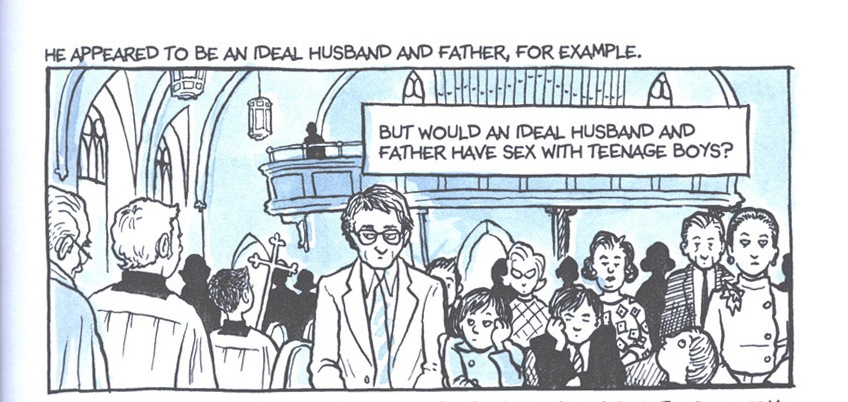
Alison Bechdel's memoir Fun Home must be one of the most lauded graphic novels of all time, and with good reason: it's incredibly complex and incredibly moving.  I resisted the urge to add "for a graphic novel" to the end of that last sentence, because I think that it stands on its own as a piece of great literature, rather than relative to the quality of graphic novels in general.  In fact, Fun Home seems vital in a way that very few novels from the last ten years really can claim.

Bechdel's memoir describes her experience coming out as a lesbian, while at the same time learning that her father had been having affairs with men for decades.  He dies, hit by a car, shortly after these revelations.  Bechdel wonders in Fun Home if he stepped in front of the car intentionally, but there's no way to be sure, and she must grapple with the pain of that uncertainty.  Either way, his death is the catalyst for the novel, which seeks to do the work of reconciliation and understanding that her father's absence made impossible to do face-to-face.

One thing that surprised me about Fun Home was how literary it was.  Bechdel's father was an English teacher (in addition to running the funeral home which gives the novel its title), and Bechdel turns to numerous literary sources in search of a narrative that will make her relationship with her father meaningful.  Camus, Fitzgerald, Proust, Joyce, and Wilde all make appearances.  But these narratives never seem to quite be enough to help Bechdel pin her father down in a way that provides consolation or closure.  The choice to write the memoir as a graphic novel seems significant in this way, as an attempt to break with the insufficient narratives of the past and make something new--without abandoning or dismissing the authors of the past.


That's a really academic way of looking at it, I guess.  But essentially, Fun Home is a very human, very moving story.  Bechdel's relationship with her parents is very troubled--she describes her father as cold and aloof for most of her life--and as soon as it looks like they might have something to bring them together, he dies.  As beautiful a story as it is, there's a fundamental and ineradicable sadness about the impossibility of recovering that lost opportunity.

Saturday, November 15, 2014

A Contract with God by Will Eisner

A Contract with God is Will Eisner's first graphic novel, and, in fact, is commonly considered to be the first "graphic novel" ever written. The introduction in my copy made it sound like Eisner or his agent coined the term to gain some respectability, since Eisner was coming from a long career in comic books, with his iconic superhero, The Spirit.

Reading Contract now, decades after its publication and the sea change it helped usher in regarding how the literary establishment views sequential art, it's hard to believe that it was ever necessary to dress it up in special phrases. A Contract with God holds up beautifully both as a work of visual art and concise, thematically-heavy storytelling.

So with that out of the way, what's it all about? There's a little irony in the label "graphic novel" as applied here, since the volume is really a short story collection, comprised of four narratives related primarily, maybe only, by their protagonists' shared neighborhood, the fictional Dropsie Ave. in New York City in the 20s and 30s. Eisner based the stories on people he had known--he claims in the introduction that all four stories are true, even though he has heavily fictionalized them--and you can feel the grit coming through, although the artwork isn't exactly Frank Miller... but more on that in a moment.

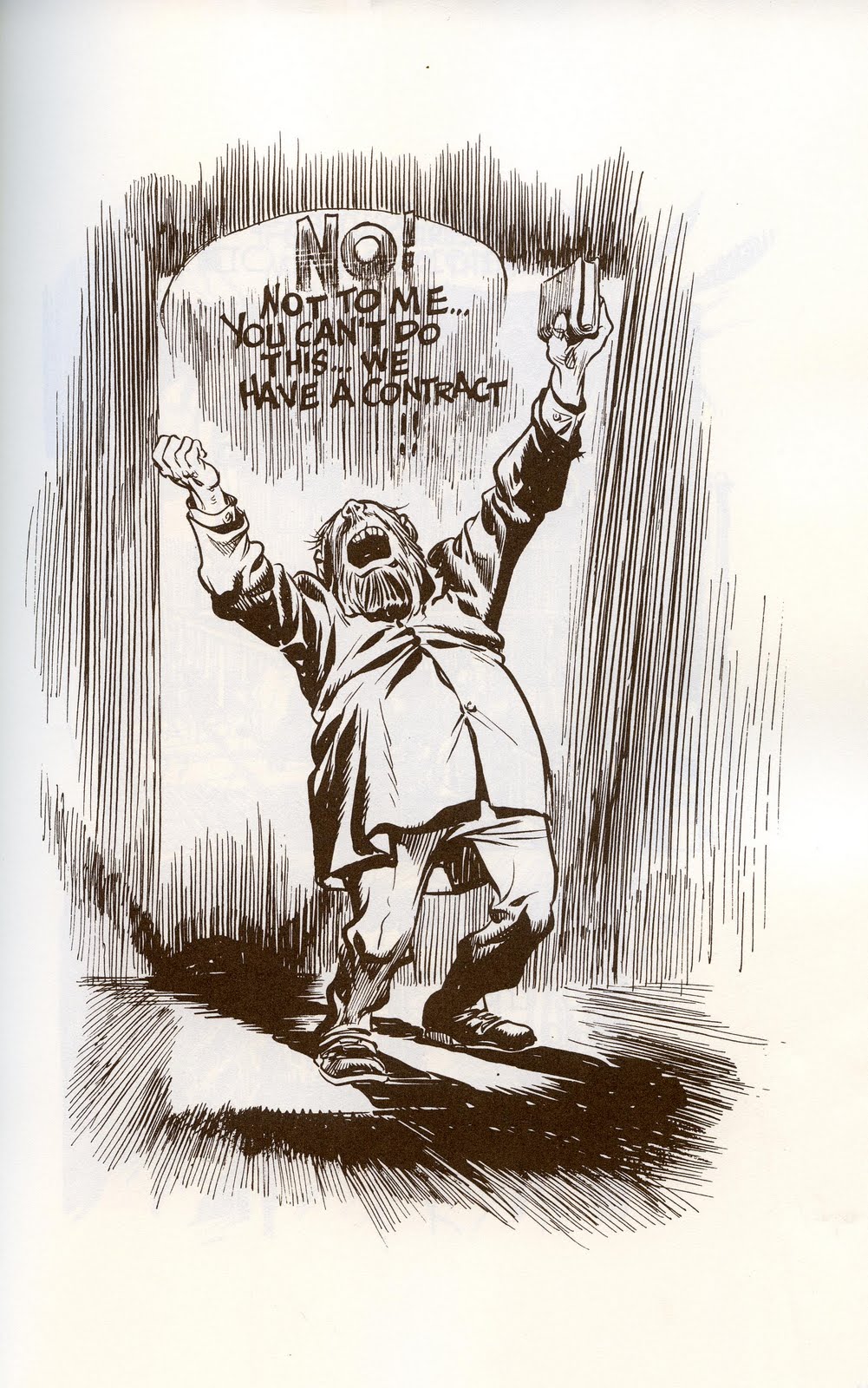
The stories within aren't lighthearted romps. More often tan not, they deal with pitch black thematic material and pitiful, desperate people. The eponymous story opens the collection, and by page three, Frimme Hirsh is walking home from his preteen daughter's funeral in the pouring rain. The story concerns the titular contract, made by the saintly Fremmie when he was young, and plays out like the story of Job if Job had turned on God during his trials. Screaming, "We had a contract!' you can almost see Fremmie's faith collapse, as he goes from saint to shyster to successfully exploitative businessman in a few evocative panels. Eisner was working out his rage at God on the page--his own seventeen year old daughter had recently died when he wrote the story--and every ounce of it is there on the page, from Fremmie's slumped shoulders to the dead rage in his eyes.

The story ends, as do the other three, with a Twilight Zone-like twist, albeit nothing supernatural, but unlike many stories of this nature, the power in the stories isn't from the sudden veer--it's from the finely sketched characters who are being put through the ringer and, more than often, emerging badly damaged.

A quick word on the art: Eisner let the story dictate the art, so, as that approach might indicate, page layouts vary from a dozen panels to pages with one central image and a lot of text. But the text is good, and those images... I am not qualified to critique the visual arts, but Eisner's drawing are some of the best I've seen. Not photorealistic, but real, loose but disciplined, and, most importantly, communicative. There's no confusing Eisner's character with each other--from their faces to their clothes to their posture and body language, the man was a master of the form and it shows on every page.

Saturday, February 18, 2012

Potter's Field by Mark Waid (Author) and Paul Azaceta (Illustrator)

A potter's field is a term for burial places for unknown persons. The term has it's roots in the 27th chapter of Matthew. The basic premise of this graphic novel centers around a potter's field outside of New York City. An anti-hero going by the name John Doe aims to solve the murders of the unknown. He does not work alone, but has a loose network of people helping him, including members of the New York City Police Department.

I was immediately taken with the premise of Potter's Field. There were great storylines that intertwined in interesting ways. The artwork was... cool, for lack of a better word. The problem for me was that there was not nearly enough character development. There is never any explanation of why all these various people work for Doe or what made him commit himself to bringing a measure of justice to the unknown dead. To me, there were the most interesting mysteries of this novel, and they went unsolved.

Sunday, November 22, 2009

Sloth by Gilbert Hernandez

Sloth is an original graphic novel by Gilbert Hernandez, one of the Hernandez Brothers behind Love and Rockets, possibly the longest running and most influential indie comic going. I haven't been able to track down a collection of L&R yet, but wanted to sample some of the Hernandez's work.

Sloth is short, easily the shortest book I've read this year, but what it lacks in size, it makes up in sheer bizarreness. The story follows three Hispanic teens, Miguel, Lita, and Romeo. When the story opens, Miguel has just awoken from a year long coma and is trying to restart his life. The coma itself is a mystery, mostly because no medical reason for it can be found. To all appearances, Miguel willed himself into the coma out of boredom and a general malaise. He returns to Lita, his girlfriend who may or may not have developed an attraction to Romeo during his year MIA. He also can't help but notice that trying to move at any speed besides "slow" causes his joints to burn.

To this point, the story is quirky but not exactly surreal. The strangeness starts when the three go to an orchard where a mysterious goatman is said to reside, coming out only at night. According to legend, the goatman offers those who see it a chance to change places. If they agree, they become the goatman and have to find someone to switch with.

The story only gets stranger from there, as the three encounter the goatman, Miguel finds that he may or may not be able to fly, and a major and completely unexpected twist at the 2/3rds point when (spoiler) Miguel actually becomes Lita in some alternate universe featuring all the same characters (except Miguel) in drastically different roles.

As far as conclusions, that's tough. The primary theme seems to be identity, but the specific applications Hernandez is making are unclear, as is the narrative arc. Is the implication that one of the three switched places with the goatman changing the fabric of reality? Is it all a dream inside of a still comatose teen's head? By the end of the story, all three teens have switched identities and willed themselves into comas, although not simultaneously. There's something beautifully tragic about the dreamworlds of the protgaonists, if that's what they are: the worlds aren't perfect, but they are realities where things happen, where there are rockstars, goatmen, and adventures.

Sunday, June 14, 2009

Watchmen by Alan Moore and Dave Gibbons

Dog carcass in alley this morning, tire tread on burst stomach. This city is afraid of me. I have seen its true face. The streets are extended gutters and the gutters are full of blood and when the drains finally scab over, all the vermin will drown. The accumulated filth of all their sex and murder will foam up about their waists and all the whores and politicians will look up and shout "Save Us!" and I'll look down, and whisper, "No" - Roschach

A live body and a dead body contain the same number of particles. Structurally, there's no discernible difference. Life and death are unquantifiable abstracts. Why should I be concerned? - Dr. Manhattan

I read Watchmen just in time. I finished it about a week before the movie came out. I wanted to read it first partially because I wanted to be able to compare the book and the movie, but, more importantly, it's a little embarrassing to be the last comic book fan who hasn't read Watchmen.

With all the hype surrounding Watchmen—only graphic novel in Time Magazine's 100 Best List, widely acclaimed as the best graphic novel of all time, praised and damned for helping bring about the darkening of comic books in general—I had my doubts that it would live it up to its reputation. After all, The Dark Knight Returns, another, similarly acclaimed graphic novel, was a huge disappointment when I finally read it. But, after putting it off for so long (and rambling about it for nearly as long) I've reached a conclusion: Watchmen deserves the praise.

It follows the lives of several “superheroes,” regular Joes and Janes who have no superpowers but want to help make the world a better place, at least ostensibly. In reality, they all have their own reasons, complex, human reasons that don't often show up in the pages of mainstream comics. The only truly super-powered being is Dr. Manhattan, a being with literally godlike powers, able to do everything from the standard flying and making things explode to creating entire universes out of nothing.

To me, the most interesting character in the book was Dr. Manhattan. A soft-spoken, humanitarian scientist who receives his powers through the Silver Age standby of gamma radiation, his progression throughout the book is an interesting case. When the extent of his powers is discovered, the government sends him to Vietnam as a soldier and also uses him as the ultimate failsafe against a steadily more aggressive Russia. Dr. Manhattan, on the other hand, grows more and more disconnected from the human race, gradually dissolving all ties except to the woman he loves. When he loses her, he completely severs all connections to earth and moves to the moon, preferring the solace and the undemanding company of the rocks and stars to that of humans, who think themselves something special but who, to Dr. Manhattan, are no more interesting or unique than anything else in the universe. It's a deconstruction not only of the omnipotent superhero (of whom Superman is the prime example), but also of the idea of God. Why would a being whose powers allow him ultimate freedom of action choose to spend his time interacting with a populace who largely don't appreciate him and see him only as a means to an end?

Every character in the book, from the borderline-sociopath Rorschach to the twisted humanitarian Ozymandias, could be given an extensive treatment, but I'm not going to do that. If' you haven't read Watchmen, check it out.

Thursday, April 30, 2009

The Long Halloween by Jeph Loeb and Tim sale

I don't read to many comic books and this is the first graphic novel I have ever read, but I recently married this guy who loves both mediums of literature. This fact combined with seeing The Dark Knight got me interested in reading The Long Halloween.

Batman has a lot more going on and a lot more bad guys to watch out for than I would have thought. I like the dynamics of his relationship with Selena Kyle/Catwoman and the artwork is beautifully drawn.

The Long Halloween follows the crimes of Holiday, known for his gag of killing people only on holidays, for the duration of a year. During this year Batman also contends with the Joker, and Harvey Dent is scarred with acid, transforming into the infamous Two-face.

Honestly, I had a hard time getting into a graphic novel. Being so dialog and art driven, I found it difficult to follow. For my underdeveloped palate, I'll just continue to wait for the next film.

Sunday, March 8, 2009

Watchmen by Alan Moore and Dave Gibbons

Nathan started his review of Watchmen by stating that he didn't think he would be able to write a review that did the book justice. I share that sentiment. I should start by saying that I am not really a comic book fan. When I was a kid I read Ducktales and Rescue Rangers comics, but I never made the jump to "grown-up comics" (see 1 Corinthians 13:11).

Over the years, it has come to the attention of some of my friends and acquaintances that I don't really like comics. Somewhere in the course of their trying to convince me that I should read this comic or that comic, Watchmen invariably comes up. I just kind of wrote it off as just another comic -- excuse me...graphic novel -- that comic fans love. Then a couple of years ago, Time named it one of 100 best English-language novels from 1923 to the present. Watchmen was the only graphic novel to make the list. I started thinking that maybe I should pick it up. I heard that they were making it into a film (the ultimate marker of whether something is worthwhile) and decided that I should read it before I saw the film.

The story, set in 1985 but of an alternate reality (not completely unlike Back to the Future II) follows a group of superheroes as they uncover a sinister plot that affects the stability of the world. So, that doesn't sound all that ground-breaking. Well, there people aren't really superheroes, because all but one of them are just regular people. They are essentially vigilantes, fighting against what they see as societies ills. And there are plenty of societal ills in the Cold War era reality that Moore creates. But these real people have "real people" problems -- more abundant in some than in others. What is it that drove them to a life of fighting crime? What do they see as crime? These masked vigilantes have biases, opinions, and prejudices just like the next guy. So, the question is raised, "Sure the Watchmen are watching us, but who's watching the Watchmen?"

The storyline was rather simply, but it unfolded in patchwork form. The credit really goes to Moore for his ability to weave together storyline and dialogue. Like Nathan, I enjoyed Moore's proclivity to flesh out two storylines as the same time using on line of dialogue. This happened most often during flashback sequences, of which there were many. Moore supplied his readers with a wealth of background information about each of the Watchmen. Much of it was supplied by means of short interstitials between the chapters. These were things that have been mentioned or featured in some way in the graphic portions of the novel. For instance, one of the Watchmen wrote a tell-all after retiring, and the book comes up a number of times in various conversations. So a few of these interstitials were excepts from that memoir, while others were newspaper clippings, or selections from a police file.

The realism of the novel fades as Watchmen comes nears its end. It is slowly usurped by an tone that is over-the-top. The plot that seemed so simple morphs into something that is much larger than the story of a league of crime fighters. As Christopher points out in his review, the novel is chalked full of symbolism and meta-narratives. By the end, the seemingly concrete aspects of the story have given away to something much more abstract. In this respect, it put me in mind of The Man Who Was Thursday. That is to say that I was impressed by Watchmen. It's no Rescue Rangers...but what is?

Sunday, January 25, 2009

Miracleman by Alan Moore

I avoided reading Watchmen for a long time, skeptical of its reputation as a thinking man's comic book, which is something like the "jumbo shrimp" of literature. I'm glad I did, in the end, because it pleased me with its serious treatment of what superheroism might actually mean for the world. In particular I was fascinated by Dr. Manhattan, once a mild-mannered everyman but who, after his origin-accident, found himself increasingly alienated from human society.

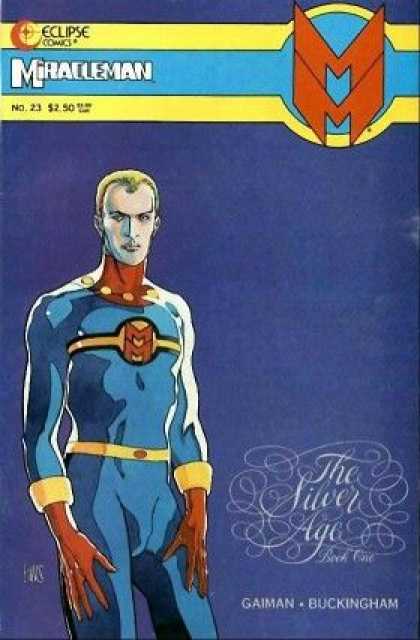
I decided to read Miracleman for these reasons: First, Brent recommended it, and second, it's a comic book so it didn't take that long and I'm not going to let Jim beat me. But mostly, it seemed as if it would take the story of Dr. Manhattan and reimagine it; as Brent says, "Miracleman can... be seen as a parallel to Watchmen." Like Dr. Manhattan, Michael Moran is a pretty ordinary guy who discovers one day--or rather, rediscovers--that he has powers beyond even the most powerful of comic book heroes.

In comparison to Watchmen, I'll admit Miracleman suffers greatly. It lacks the same unity of vision, and Moore's penchant for simultaneous narratives, used to such great effect in Watchman, only muddies the water here. The later issues, penned by Neil Gaiman, are fascinating vignettes that seek to flesh out a world dominated by Miracleman, and yet they represent a full-stop to the overall plot and contain too little of Miracleman himself to be engaging. Brent asks for a proper ending to Miracleman, I suggest that the series as a whole might be more successful if Moore had never handed it over to Gaiman and simply let it end with Miracleman's dominion over Earth.

And yet, despite its flaws, there is something present in Miracleman that piques my curiosity more than Watchmen, which, despite its novelty and inventiveness, never quite hits a personal note. This is essentially the Citizen Kane story, but Kane's power seems irrelevant compared to Miracleman's. This tale has been told time and time again, but never on a scale this large with the possible exception of the story of Lucifer in the Bible. I like that about comic books; the suspense of disbelief required means that you can get away with things that simply couldn't work in novels; they possess an immensity that written fiction doesn't and, even if it could, would hardly be well-respected.

I found myself wishing that Moore and Gaiman give us a little more insight into what the psyche of Miracleman must be thinking as he molds the world into his image, but then I reversed position--how much really, can we understand of God? He exists on a higher plane, and cannot be comprehended by us, neither his abilities nor his feelings.

There is a moment, however, in Gaiman's chapter Carnival which gives us some glimpse into Miracleman's inner workings: After a cataclysmic battle in which Miracleman defeats another super-being (I'm being as vague as I can because, Jim, you ought to read this), he is basically free to remodel the entire social structure of the world and one result is that what we would call insane junkies are revered as "spacemen" who present the universe's wisdom. At the yearly Carnival to celebrate Miracleman's victory, all the disparate characters whom Gaiman has created approach a spaceman to ask them about their problems. Toward the end, a man in a cap and white t-shirt approaches and asks, "Am I... am I doing the right thing? Have I done right?"

The crowd cannot tell, but we can: It's Miracleman, mingling unnoticed. The spaceman's advice, crouched in gobbledygook, can be reduced to "just be"--perhaps responding, "What else could you have done? This is your destiny." But it isn't the answer that is interesting so much as the question.

Thursday, December 11, 2008

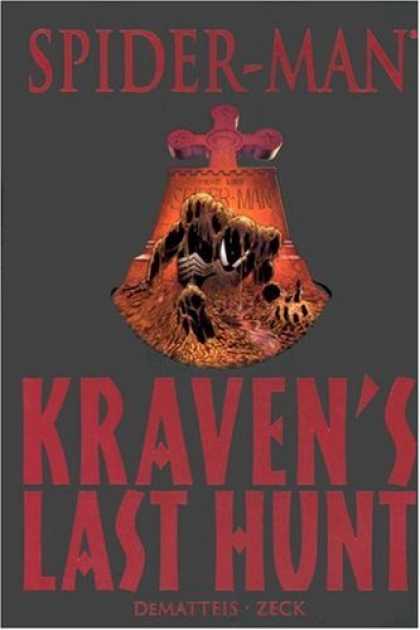
Kraven's Last Hunt by J. M. DeMattis

Spyder, spyder burning bright!
In the forests of the night
What immortal hand or eye
Could frame thy fearful symmetry?

As far as I know, I'm the only comic book reader on the blog. By comic book, I mean monthlies normally featuring superheroes like Spider-Man and Batman, not graphic novels like Watchmen or that weird Japanese thing Nathan read last year. Owning around a thousand comic books (and having read most of them) I realize that the medium tends toward adolescent wish-fulfillment rather than substance, but occasionally a storyline, even one featuring an established character like Spider-Man, will provide a little food for thought.

The story is set up thusly: Kraven the Hunter, the world's greatest, uh, hunter, is old and near death. He ruminates on his life and realizes he cannot die happily until he conquers the one beast which has so far eluded him: Spider-Man, of course. Taking Spider-Man by surprise during on of his nightly patrols, Kraven shoots him with some sort of hallucinogen, throws a net over him, and, while Spidey is struggling to escape, shoots him with a rifle and buries his body. Kraven then steals the Spider-Man costume an goes on a quest to prove that not only can he defeat Spider-Man, he can defeat the only villain to best Spidey (at least recently), a half-human, half-animal creature named, naturally, Vermin. Kraven finds Vermin and captures him.


Of course, Spider-Man isn't actually dead. He's in a comatose state induced by whatever he was shot with, and he awakens (and crawls dramatically from his grave) to find that two weeks have passed, during which Kraven has been impersonating Spider-Man, albeit a much more violent version. Spider-Man, still in his weakened state, tracks down Kraven who refuses to fight him, instead releasing Vermin for a rematch. Spider-Man incapacitates Vermin, and Kraven, always a bloodthirsty hunter of his word, says his unting days are over now that he's defeated Spider-Man. Spidey leaves to deliver his captive to the police, and, while he's gone, Kraven blows his head off with a shotgun, leaving a note absolving Spider-Man of all crimes committed during Kraven's time beneath the mask.


When I was reading comics more regularly, I knew that J. M. DeMattis' work tended to delve deeper than most mainstream comic scribes'. The comics he helmed tended toward a lot of metaphysical navel-gazing that sometimes worked (as in most of his Spider-Man run) and sometimes didn't (Dr. Fate). Kraven's Last Hunt is DeMattis at his best. He draws Kraven, normally a silly, shallow villain, as a sad disturbed man who sees Spider-Man much as Ahab saw Moby-Dick, as an embodiment of everything wrong with the world. To him, Peter Parker represents the forces that brought down his homeland, Russia, and killed his mother. In contrast to Spider-Man, who distances himself from the evil fights both by refusing to kill and by making light of even the most dire situation, Kraven's response to his demons is to become one with them, to try and embody, understand, and destroy them. Kraven becomes, temporarily, Spider-Man, but Spider-Man never allows himself to become Kraven, always standing just across the threshold from his animalistic instincts. Kraven's madness is ended when he sees Spider-Man post-resurrection and realizes that he is, after all, only a man, and a good one at that, one that fights against the same forces that Kraven abhors. Ultimately, however, it makes no difference—Kraven's fate is sealed as soon as he defeats Spider-Man. Without the thrill of the hunt, the natural predator has no reason to live.

Tuesday, April 15, 2008

Watchmen by Alan Moore and Dave Gibbons

In 2005, for the twentieth anniversary of Alan Moore's landmark graphic novel Watchmen, Tom Shone wrote an article written for Slate entitled, "Did the comic book really need to grow up?" "Reading Watchmen today," he writes, "is a distinctly underwhelming experience. Its fans would say that's appropriate: The world's first anti-heroic comic book is supposed to be, well, anti-heroic. The mode is pyrrhic, deflationary, its tone deadpan, spent." This is a kind of loop-around argument that is impossible to defend against; it raises the opposition's point and then dismisses it summarily without comment. It is, in essence, a roundabout way of saying, "So what?"

So what? What is it about Watchmen that makes it so special? What makes it one of Time's 100 Greatest Books of the 20th century, and the only graphic novel on the list? Shone's article does a fair job of encapsualting the plot, but I'll try my own hand at it here: In the universe of Watchmen, it is 1985 and tensions with Russia are at a fever pitch. Nixon, having assassinated Woodward and Bernstein, is in his sixth term and Americans deal with the daily threat of nuclear annihilation--the hand at "five minutes to midnight," as a newspaper headline reads. The main cast of characters exist on this backdrop as the second generation of "masked adventurers"--superpower-less vigilantes modeled after now unpopular comic books--deals with middle age and the specter of personal failure. Vigilantism has been outlawed for some years. When the book opens, a famous "mask" has been thrown from a window and killed, and Rorschach--the only hero to have not given up in the wake of the 1977 Keene Act--believes that the act is part of a murderous rampage against their kind. His investigation, in which he collides with his old allies and enemies, leads to a conspiracy much more sinister (and in grand comic tradition, contrived) than any had anticipated. "Such is the inverted central conceit of the book," Shone writes, "in which superheroes are far too busy defending themselves from the world to contemplate saving it."

So what? Well, isn't it refreshing to see a comic book where the characters are actually, you know, characters? The plot of Watchmen borders on sheer nonsense at time--especially the end, which is as silly and indulgent as anything in the old comics Shone thinks don't "need to grow up"--but at it's heart it's about character. One of Moore's chief concerns, I think, is mapping the world of superheroes onto our own. Instead of living in comic book world, where every hero acts out of his commitment to justice, what would happen if being a superhero were possible in our world? Of course, no one's motivation would be the same--some, like Rorschach, would be drawn to such a profession because of their obsessiveness and pathology. Others, like Dan Dreiberg, the second Nite Owl, would do it because they idolized the first generation of heroes; many, like Laurie Juspeczyk, the second Silk Spectre, would be born into it. Watchmen is a world where superheroes have petty jealousies and difficult relationships; they're not Charles Atlas cookie-cutters in blue spandex. Furthermore, Moore's graphic novel is crammed full of more symbols and meta-narratives than a Thomas Pynchon novel.

Ultimately, the answer to the question "Why did the comic book need to grow up?" is the same as the reason we all must grow up--it isn't a choice. All genres must be constantly rethought, reenvisioned, and retooled to remain vibrant and alive. I recall my professor once making what seemed to me a very fatuous rhetorical question--"Why are some of the earliest known works of literature the best?" He was referring to the epics of Homer, of course, but if you ask me, I have difficulty appreciating the epics without later writers who took those conventions and turned them on their head, from Vergil to Petronius to Milton. You might as well ask Cormac McCarthy and Larry McMurtry why the Western had to grow up. Growing up is what we do as human beings, and in this postmodern world of ours there is no low art anymore. The comic book had to grow up, because otherwise the world would move on without it.

Shone writes, "One gets the feeling that Moore wanted to make us feel guilty for enjoying this—to take in the episode as one would a guilty pleasure. 'See apathy! Everybody escapin' into comic books and TV! Makes me sick,' shouts a news vendor, peddling comics while the streets around him run red with blood." He suggests that this is "self-hatred tricked out as superiority," and suggests it is--ironically, given the title of his article--an "old adolescent standby." But in taking the vendor's word as gospel he misses the complexity of the dialogue completely. The vendor's words are meant for us, surely, but they're also meant for the characters of the novel, who have literally "escaped into comic books," chastizing them for the hubris that is required for a person to put on a pair of tights and fight crime. And though it's meant for us, too, it doesn't seem like Moore--whose entire life is wrapped up in comic books and graphic novels--to insult his reader in such a way. But it could as well be a sign that Moore knew that Watchmen would symbolize a changing of the guard in his business; interviews show that he certainly has that sort of ego. But what Moore is doing here is not presenting an escape at all; by injecting a long-lacking realism into the comic book genre, he is taking the escape and turning it into a loop so that we end up where we begin. If the world of comic book heroes looks scarily like our own at times, where do we turn for comfort?

When Shone calls it "a comic book that wants to let the air out of your tires," he is precisely right. If, like Shone does, you go into it looking for that sense of wonder and escapism that we associate with comic books, you will surely be underwhelmed, as he is, and you too may say "so what?" But this comic book isn't about those things; it's about failure, loneliness, regret, death, and unstoppable tragedy. I don't want to give away too many plot points, but if you look at the page reprinted with Shone's article--with the extended white space, marked "Comics, grown up"--you will understand that Watchmen is not a book where the heroes, validated at last, swoop in at the last second to avert disaster. In their world, like ours, that sort of thing simply doesn't happen.

Friday, February 16, 2007

Berlin, City of Stones by Jason Lutes


(Yes, Alsyon, I did read another comic book. And there's nothing you can do about it!)

It’s hard not to be moved by something written about the holocaust, or simply about war, especially something very well-written. Jason Lutes' Berlin: City of Stones, however, was something surprisingly powerful. Rather than focusing on the plight of Jewish families in war-torn Germany, Lutes writes (and draws) about the tensions between opposing factions in the years leading up to the Second World War. This is one of probably a very small selection of historical graphic novels, and I would wager that it’s easily the best.

If nothing else, Jason Lutes can certainly draw. His grasp of human anatomy and emotion isn’t the best I’ve seen, but all of his figures are stylistically pleasing, and his attention to detail in faces, dress and gestures does a lot in terms of advancing the plot without a narrator. I was impressed by his ability to draw (as far as I can tell) a completely believable 1920’s German cityscape, down to each stone in the road. His bird’s-eye-view opening or closing scenes alternatively give a strong feeling of the city’s European beauty and then of its decrepitude. I found myself lingering over panorama landscapes, picking out individual faces in Lute’s carefully drawn crowds. But it was his impressive ability to pack so much into an image without making it to busy that I found most pleasing about his style.

The story itself follows the dialogue of a few main characters, internal monologues of complete strangers, and first-person narration through journals. The beauty of Lute’s Berlin was that he didn’t have to explicitly guide the reader to conclusions about public discontent, rising discrimination against the Jews, and tensions between National Socialist and Communist worker parties that all come to the point of erupting by the end of the book. But Lutes doesn’t have to show all of this coming to a head; his reader clearly knows how the story ends. I was surprisingly moved by the personal narratives mixed into the story and was made to view the effects of such a grotesque war from a new, very human perspective. I forget which publication rated this as one of the top 10 graphic novels of all time, but I would suggest it to anyone with an interest in a wide range of subjects from the war itself to European architecture. Overall, an unexpectedly strong book, visually and in its plot; Lutes’ drawing and writing style complement each other perfectly to make a powerful end product. I found myself reading it so quickly that I was worried I wouldn’t fully appreciate it, but I couldn’t slow myself down.

Monday, January 8, 2007

Watchmen by Alan Moore and Dave Gibbons

I don't think I can write a review that does this book justice. Watchmen is a Cold War era graphical novel that follows the complicated lives of six self-made super-heroes, from their upbringing to present events. These six, however, aren't your typical supermen or women; save one, the "costumed vigilantes," "masked adventurers," or whatever else they choose to call themselves, are just as human as the next person. Each character's motivations for fighting crime in costume are explored through excerpts of written documents that Moore sandwiches in between chapters. He fills in the background of his story not by awkward, forced dialogue, but through a few chapters of an autobiography, newspaper articles, all things that we see in the story and read for ourselves later, as if we happened to pick them up on our way out. By about the third chapter, through this and other devices, we realize that some of the main characters, far from being perfect super-humans, have serious psychological problems, and others that we thought were for or against us might be much more complicated.

Dave Gibbons' artwork is fine, and gets the job done, but it's very clear that Alan Moore's writing makes this story what it is. He's fond of narrating two events at once, in alternating frames, using the same text for each. For instance (one of my favorites): a man is fumbling through sex, for what we assume is the first time in many years, while a television in the background narrates a gymnastics competition, all the way through the "dismount." I could flip to any page in the book and find more of the same, some funny, some serious, all very, very well-done.

Nothing in this book seems overblown, as you might expect from some comics. Moore writes an mostly realistic (albeit exaggerated) story up until the final chapters. One of only a few stretches was my favorite character, Dr. Manhattan, the once nuclear physicist turned god-like glowing blue man when his "ionic field" was removed, and he had to rebuild himself. His character provides a very different perspective in the face of worldwide nuclear destruction, and an obstacle in one particular debate over the world's future. This book was written in the mid-1980's in a series of installments, and clearly plays off WWIII paranoia, but the only thing in each chapter that might be dated (save words like "devo" and people talking about taking Katies) is the art. Moore's super-hero/political/historical satire tells the stories that comic books have been known for since the 1950's, but in a completely different, more human light. If there's one book that can lend legitimacy to graphic novels as a literary medium, I think this is it.