Showing posts with label vietnam. Show all posts

Monday, March 11, 2024

The Sea Wall by Marguerite Duras

The dikes built by Ma in the plain, her "barriers against the Ocean," the whole thing was either a huge misfortune or a huge joke, depending upon the way you looked at it. It was a huge joke and a huge misfortune. It was terrible and it was screamingly funny. It depended on which side you took: the side of the Ocean which had knocked down everything, every stick and stone of the sea wall, at one blow, one single blow; the side of the crabs, which had made sieves of them; or, on the contrary, the side of the people who had taken six months to build that sea wall, in total forgetfulness of the certain damage that would be wrought by the crabs and the Ocean.

The title sea wall of The Sea Wall is, at the beginning of the novel, already no more. Constructed at great expense by the Frenchwoman known only as "Ma" on her concession land along the coast of Vietnam, it has crumbled away and the saltwater tide has ruined all hope of a successful crop. The misfortune defines Ma's life, and it comes to define the lives of her two children: Joseph, a brash young man whose passions are his jalopy and hunting dangerous panthers, and Suzanne, whose beauty and resentment both are incandescent. Neither Joseph nor Suzanne have ever been to France, where Ma was born; they are second-generation Colonials who must live in universe of ruin that Ma has created for herself, and they occupy a kind of degenerate middle ground between the "Natives" in the jungle and the pampered elite who live in the colony's principal city.

It's one of these, Monsieur Jo, who happens upon Suzanne at a canteen one day and falls madly in love with her. Monsieur Jo is a pathetic figure, both ugly and oblivious, who is utterly wrecked against Suzanne's beauty. He visits everyday, offering his attention as well as lavish gifts, enduring the condescension of all the members of the house, who accurately assess that he will endure all the resentment they bear against their lot simply to be near Suzanne. "He was not a person," Suzanne remarks about him inwardly, "he was only a misfortune." Monsieur Jo offers Suzanne a diamond ring if she'll go away with him and then, when she refuses, gives it to her anyway; Ma's farcical attempts to sell the ring in the colonial capital are the driving force of the book's middle section. Even when she does manage to sell it, the money goes to pay the debt on the construction of the sea walls. The money flows out like the tide, and leaves the family no better off; even their fortunes are misfortunes.

The Sea Wall is just the kind of book I really love: mean-spirited, funny, and deeply sad. It is, in Duras' words, "terrible" and "screamingly funny." I didn't know that Duras could be funny. The other two books of hers I've read, The Lover and L'Amante Anglais, are also quite sad, but they are not funny. Ma is a great comic creation, emblematic of the bourgeois failures of a certain kind of colonial, for whom the promise of new land is a kind of cruel grift. Whether it reflects Duras' own upbringing in French Indochina I have no idea. One of the best sections of the book comes when Ma is allowed to speak for herself, in a long letter written to the cadastral agents who enforce the mortgage on her concession:

And for the savings I put aside every day for fifteen years of my life, of my youth, what did you give me? A desert of salt and water. And you let me give you my money. That money I religiously carried to you one morning, seven years ago, in an envelope. It was all I had. I gave you all I had that morning, all, as if I brought you my own body as a sacrifice, as if from my sacrificed body would blossom an entire future of happiness for my children.

When Ma writes off-handedly about killing the agents, we half-believe her. Or we believe, perhaps, that she has the will but not the power. But Joseph, the walls of his room laden with guns, might have both, might be exactly the kind of avenging spirit that Ma requires. And yet, we know that whatever happens, there is no hope for Ma, because hopelessness is written into her character. The diamond will sold, but the money will not satisfy; the sea walls will be built but they will only crumble again, and the sea will take what is theirs. In a way, Duras suggests, it may be better to be like the "Natives" whose children die at alarming rates, killed by Frenchmen's cars or lice or starvation, and who are quickly buried and replaced. But the colonial's fate is to never be at home, to have every hope dashed, and in that sense Ma is colonialism's perfect image.

Thursday, January 5, 2023

The Best We Could Do by Thi Bui

Have our parents ever looked at us and felt slightly... disappointed? Such high hopes, so much possibility, to fall short. And though my parents took us far away from the site of their grief, certain shadows stretched far, casting a gray stillness over our childhood, hinting at a darkness we could not understand but could always feel.


We open in a hospital. Thi, the protagonist and author, is having her first child. Her mother, Má, has traveled across the country to be there for her first grandchild’s birth but can’t bear to stay in the room. Her father, Bố, is nowhere to be found, nor are any of her three siblings. A doctor is assisting with the birth, but she’s brusque and implacable. Her husband, Travis, is nearby, but Thi is--or at least feels--alone.


The Best We Can Do is, at heart, is about family--the way our parents, grandparents, and siblings shape us, either by their direct action or, more often and persistently, by the ways their actions shaped others. But it’s more than that too. It’s beautiful to look at, with clean but energetic linework counterbalanced by earthy pastel watercolors varying in hue and presence as the emotional beats of the story ebb and flow.


Although the story always comes back around to Thi, a first generation Vietnamese immigrant who came over on a boat, as a child, during the Vietnam War, the lion’s share of the narrative is given to her parents, Bố and Má, tracing their lives through childhood, college, marriage, exile, and eventually separation. Má, bookish and ambitious, comes from wealth; Bố, street smart and booksmart, grows up beneath a piece of cardboard nailed between two buildings. They meet at college as the war is beginning. Má, in spite of earlier proclamations that she wouldn’t marry, does so anyway, less for love than because she assumes she doesn’t have long to live with the county crumbling around her. Bố, on the other hand, falls for Má right away, but finds himself mostly unable to connect with Má or, for that matter, anyone else. At the beginning of the story, they’re separated and what happened in the intervening years becomes the story, as Thi slowly draws their story out so it can be told.


The middle section, where Má and Bố watch as their lives and their country are ripped apart by the Vietcong and, it must be said, the Americans who treat them scarcely better and tell the story of the war in ways that incense Bố. In one of the most memorable scenes, Bố defends the general from the famous photo, you know the one, taken just before a VC gets his brains blown out. We also learn that the general, after the war, came to the US and spent his last years working at a pizza parlor. And these sorts of details, the straggling conclusions of lives ripped to shreds by circumstances beyond their control, are the controlling throughline.


Yes, Thi builds a good life, but she’s haunted by the sense of otherness she feels, by the ugliness she sees in the American landscape, and, more ominously, the specter of becoming like her parents, of breaking her beautiful baby the way she was broken. The other side of the coin, though, is water--the water coming through Bố’s childhood roof, the lake where Thi learns to swim, the river that carried the “boat people”, the rain when they arrive on the peaceful beach--with its cool implacability, bringing (and taking) with it both the good and the bad. When Má’s third child, Queyen (River in Vietnamese), dies soon after being born, it feels like a repudiation of water as cleansing, lifegiving. But on the final page, the image is redeemed (or maybe just shaded) with a full page spread of Thi’s child, at ten, swimming joyously, unstoppable, as Thi narrates:


What has worried me since having my own child was whether I would pass along some gene for sorrow or unintentionally inflict damage I could never undo. But when I look at my son, I don’t see war and loss or even Travis and me. I see a new life, bound with mine quite by coincidence, and I think maybe he can be free.


Monday, June 13, 2022

The Lover by Marguerite Duras

In the books I've written about my childhood I can't remember, suddenly, what I left out, what I said. I think I wrote about our love for our mother, but I don't know if I wrote about how we hated her too, or about or love for one another, and our terrible hatred too, in that common family history of ruin and death which was ours whatever happened, in love or in hate, and which I still can't understand however hard I try, which is still beyond my reach, hidden in teh very depths of my flesh, blind as a newborn child. It's the area on whose brink silence begins. What happens there is silence, the slow travail of my whole life. I'm still there, watching those possessed children, as far away from the mystery now as I was then. I've never written, thought I thought I wrote, never loved, though I thought I loved, never done anything but wait outside the closed door.

A fifteen year old French girl, traveling by ferry from her home in Sadec, Vietnam, to her boarding school in Saigon, meets a Chinese man being driven in a black town car. She is wearing a man's fedora and gold high-heeled shoes. Instead of returning to the school, she goes with him to his home, where she has sex for the first time. The affair they have hastens the mental and physical deterioration of her recently widowed mother, and somewhere in China, in the city of Cholon, the Chinese man's father isn't too happy, either. Their relationship, both troublesome and doomed, emerges from a deep sadness they share, and the adult writer--a narrator, perhaps, but one that seems very close to the real life Duras, writing in her 70's--imagines the whole of her troubled childhood balanced on the pinhead of these moments.

I thought The Lover was a remarkable book. Remarkable in one sense, because you couldn't write it today. I know hack writers and comedians say stuff like that all the time, because they can't handle any kind social progress, but in this case it strikes me as being true. You couldn't write about a relationship between a 27-year old man and a 15-year old girl without making certain ethical prefaces, and you certainly couldn't explore the extent to which she desired the relationship, or how it develops in tandem with a desire for self-annihilation. Nor could you see him, as Duras does, as inherently pathetic, as squashed and bruised by a suffocating family life as the teenager he seduces. It has the benefit of likely being true, and being published after Duras was a known quantity (she was nominated for an Oscar!) and the things that make such a book unlikely are worth the price, in my opinion, but still, such a book seems to speak from a different era.

But remarkable, more importantly, for the quality of the writing, which possesses a superficial simplicity that's quickly complicated by a deeper intricacy that unfolds as the novel unfolds. Duras writes as one remembering a story from long ago, one in which what remains is not the narrative but the images. She lingers on these images--the man's hat, the gold high-heeled shoes, the black town car--layered over one another like transparencies, still moments that come forward and recede, but don't really move. At times I felt like the titular "lover" is really a distraction, only a moment to look through and see what Duras is really interested in, the tortured relationship she had with her mother and two brothers after their father's death, stranded in a strange and foreign country.

In her brothers, Duras describes a Manichaean division of good and evil. You know, like Goofus and Gallant, but with psychic and violent stakes. Her elder brother is a gambler, an amoral thief and destroyer. She describes him as a murderer, though it wasn't ever clear to me if she meant this in a literal or metaphorical sense. She blames the death of her younger brother, the pure and guileless one, on this older brother, even many years after they went their separate ways in life. It's this relationship, really, which hovers just beyond the scene of The Lover, and somehow the relationship between the young Marguerite and the Chinese millionaire's son is a way of looking past it, or not looking at it, or looking at it obliquely. Her younger brother's death, the image held till the end of the book, like something kept at the edge of the mind, gives Duras the chance to write some of the book's finest prose:

It was a mistake, and that momentary error filled the universe. The outrage was on the scale of God. My younger brother was immortal and they hadn't noticed. Immortality had been concealed in my brother's body when he was alive, and we hadn't noticed that it dwelt there. Now my brother's body was dead, and immortality with it. And the world went on without that visited body, and without its visitation. It was a complete mistake. And the error, the outrage, filled the whole universe.

There's a wonderful universality to that, the feeling of grief as an immortality being stolen from the world. One of those feelings that good writing reveals to exist, when you hadn't realized it existed before. But it has a specificity, too, a sense of truth, that reveals the writer behind the images, and which seems like it can hardly be invented. The Lover sits in that uncomfortable space, perhaps, between novel and memoir, and it's not like anything else I've ever read.

Saturday, January 12, 2019

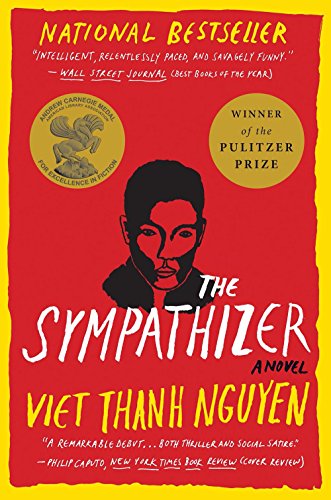
The Sympathizer by Viet Thanh Nguyen

Thank you, dear Commandant, for the notes that you and the commissar have given me on my confession.  You have asked me what I mean when I say "we" or "us," as in those moments when I identify with the southern soldiers and evacuees on whom I was sent to spy.  Should I not refer to those people, my enemies, as "them"?  I confess that after having spent almost my whole life in their company I cannot help but sympathize with them, as I do with many others.  My weakness for sympathizing with others has much to do with my status as a bastard, which is not to say that being a bastard naturally predisposes one to sympathy.  Many bastards behave like bastards, and I credit my gentle mother with teaching me the idea that blurring the lines between us and them can be a worthy behavior.  After all, if she had not blurred the lines between maid and priest, or allowed them to be blurred, I would not exist.

I wanted to read Viet Thanh Nguyen's The Sympathizer as a complement to Tree of Smoke.  Denis Johnson's novel is about the bewildered American in Vietnam, and Nguyen's is about the bewildered Vietnamese in America: specifically, an unnamed narrator working for an exiled South Vietnamese general in Los Angeles after the fall of Saigon.  The narrator has a secret, though: he's really a committed communist, sending reports back to his North Vietnamese handlers.  His unique position allows him to sympathize with both sides of the conflict, his northern colleagues and his southern friends.  The dominant imagery in the novel all points to a split identity: Northern vs. Southern Vietnam, the East and the West, his French father and his Vietnamese mother.

Like Tree of Smoke, The Sympathizer makes explicit references to Graham Greene.  The highly educated narrator, we learn, wrote his masters' thesis on the novelist's depiction of Vietnam; he's an expert in the way that the Western eye looks at his home country.  It mimics Greene in its reliance on intrigue and spy stuff, as well as its interest in the psyche of a double agent.  Its moral questions are very Greene-like: How can the murder of a communist by a communist be considered the right thing?  If it helps the narrator keep his cover, is that enough?

But The Sympathizer is at its best when it's in high satire mode, like when the narrator reminisces about how he learned to masturbate with his mother's fresh squid as a child, or when a pompous Orientalist professor encourages him to write down and compare his "Oriental" and "Occidental" qualities.  (There's a lot of satisfying tension in the way Nguyen mocks the reductive nature of binaries, while acknowledging that they have a real impact on the narrator's psyche.)  A big chunk of the book is taken up the narrator's experience advising a movie production about the Vietnam War in the Philippines that is a clear analogue of Apocalypse Now.  He wants to chip away at such propaganda from the inside, making a space for Vietnamese actors and tinkering with the script.  He advises the director, called only the Auteur, that Vietnamese people don't go AIIIEEEE!!! when they scream, but AIEY-AAHHH!!!  His efforts amount to very little; the Vietnamese Potemkin village mocks the absence of his home, and he ends up, in characteristic fashion, becoming part of the very machine he wants to work against.

It's not The Sympathizer's fault, but I found myself missing Johnson's anarchic prose style.  The language in The Sympathizer is very staid and prim.  It's a way for the narrator to exert control over the warring factions of his mind, and to assert an essential dignity in the face of Americans who would reduce him to ethnic stereotypes.  Sometimes it works toward satirical ends, as when he tells us, "Perhaps I went too far when I invited him to perform fellatio on me," or when he calls sex the "oldest dialectic," but at other times it feels stilted or forced.

Ultimately, The Sympathizer is a book I respected more than enjoyed.  I liked it most when it was at its silliest, and less when it was in its more serious mode.  I thought that the end, which details the narrator's capture and torture by his own northern colleagues and is clearly inspired by the end of 1984, to be unfortunately muddled when the narrative needed clarity most.  But the larger tragedy of the book is inescapable: the narrator has been exactly what his colleagues wanted, a convincing spy, but his strength becomes his weakness.  His sympathy must be cleansed out of him; there is no room in the world for someone who can see both sides.

Wednesday, January 2, 2019

Tree of Smoke by Denis Johnson

...Kathy reflected, certainly not for the first time, that the war hadn't been only and exclusively terrible.  It had delivered a sense, at first dreadful, eventually intoxicating, that something wild, magical, stunning might come from the next moment, death itself might erupt from the fabric of this very breath, unmasked as a friend...

Why did the U.S. bother itself in Vietnam?  Tens of thousands of Americans dead, ten times as many Vietnamese, the great waste of life and money and time, for what?  To say that it was to stem the tide of Communism sounds right in a high school history sort of way, and the protagonist of Tree of Smoke, CIA op William "Skip" Sands, sure seems keen on beating Communism.  But the line between the ideology and the great material fact of war seems to have a gap in it somewhere, not at all like the great war of the previous generation.  Tree of Smoke is a novel that presents the Vietnam War as a kind of immense fever dream, not just in the confusion of the jungle, but in the bungled ethos of the war itself.

At first, Tree of Smoke seems like a loving homage to Graham Greene.  Kathy Jones, a Canadian missionary, makes the allusion explicit by comparing Skip, masquerading in the Philippines as a corporate stooge for Del Monte, to the Quiet American.  Skip bristles at the comparison, his motives are not so rigid and his methods, he'd like to think, not so brash.  Skip is part of CIA's Psy Ops--psychological operations, that is--under the tutelage of his uncle, Colonel F. X. Sands.

The Colonel is a living legend, a former POW and war hero who has developed unconventional ideas about how to wage war.  "War is ninety percent myth anyway, isn't it?" he says.  "In order to prosecute our own wars we raise them to the level of human sacrifice, don't we, and we constantly invoke our God.  It's got to be about something bigger than dying, or we'd all turn deserter."  The Colonel advocates complete immersion into local culture and turning myth, "the other fellow's gods," into a psychological tool.  He also advocates a philosophical separation from the CIA chain of command, with predictably problematic results.  For the Colonel, myth and mystery, enemies of clarity, are the only way to wage war:

He woke from an hour's nap and went to the veranda to drink hot, strong coffee less reviving than his thrilling vertigo before the vista of his mistakes, all the wrongness he'd wandered into on the tails of his uncle, the aboriginal Man of Action.  Neanderthal, had been Rick Voss's term.  Mr. Tho came out with a burning mosquito coil in a dish and set it on the arm of the opposite chair, and there you are, simplicity itself, the ember of the foul-smelling incense bead, orange bead tunneling along its spiral path toward extinction and nonentity.  He felt surrounded, assailed, inhabited by such serpentine imagery--the tunnels, Project Labyrinth, the curling catacombs of the human ear... But over all loomed the central and quite different image: the Tree of Smoke.  Yes, his uncle meant to unfold himself like a dark wraith and take on the whole Intelligence service, the very way of it, subvert its unturnable tides.  Or assault it on the handball court.

The Greene pastiche halts early on; the whiskey priest-figure, a Catholic gun-runner for the Communists, is murdered by a blowgun.  If Skip is assigned to keep tabs on the priest, who kills him and why?  Another faction of the CIA?  The Filipinos?  Like Greene, Johnson's warriors are self-defeating, but it's not at all clear that what happens is a mistake rather than a grand mystery.  Johnson's language, with its touches of Beatnik mysticism and high prophecy, are far from Greene's deflating realism.

All of that is prologue.  When the action moves to Vietnam, things get worse and worse.  The project that the Colonel has Sands working on--cultivating a double agent to infiltrate the North Vietnamese--never really gets off the ground, which is impressive in a book that stretches to 700 pages.  It blows up, the Colonel dies under mysterious circumstances, but becomes a kind of myth himself, rumored to have let himself be captured in order to promulgate false info to the Viet Cong.  What info?  Does it matter?  As one character says, "I'd venture the truth is in the legend."  In a different book, that would be a platitude.

Tree of Smoke fills out its considerable bulk with several minor characters.  Besides the Colonel, Skip, and Kathy Jones, there's Bill and James Houston, a pair of down-and-out Arizona brothers who bring the desolation of their lives to the jungle and then bring the madness of the jungle back to Arizona.  Both are petty criminals, frightened children, irresponsible addicts, and while Tree of Smoke doesn't argue that Vietnam ruined them--they were pretty fucked up in the first place--it does want us to see that the war provides no better way.  Johnson, with his loving attention toward junkies and lowlifes, refuses to give us a Vietnam novel without the grunts.  Their connection to the main narrative is tenuous, but they remind us that the Colonel's spooky mythologizing engenders true violence.  But neither does Johnson ignore the Vietnamese: several locals, all of whom are mixed up with the Colonel's double agent scheme, get their turn in the narrative.  And while not all of these are worthwhile (I didn't need to linger so long with the mysterious German assassin, who returns to muse about his Nazi father), the scope of the novel mimics the way the war grows and spins out of control.

I can't tell you what I'd give to be able to write like Johnson.  He's one of those rare writers whose every word seems perfectly considered.  Every now and then, out of the morass of war, a perfect phrase emerges: A bowling ball "traveling away like a son, beyond hope of influence."  James' fear that a man caught by an exploding grenade would "splash around him like paint."  A corpse is described--horribly, but memorably--with its "rag of brain."  And the dialogue zips, right at the edge of sense, as really good dialogue often does.  It's hard to find a book of this immensity where the writing seems so precise and sharp, especially one whose big theme is confusion and mystery.

Monday, May 4, 2015

The Quiet American by Graham Greene

Wouldn't we all do better not trying to understand, accepting the fact that no human being will ever understand another, not a wife a husband, a lover a mistress, nor a parent a child?  Perhaps that's why men have invented God -- a being capable of understanding.  Perhaps if I wanted to be understood or to understand I would bamboozle myself into belief, but I am a reporter; God only exists for leader-writers.

It seems now that Graham Greene's The Quiet American had a kind of prescience.  I'm told it wasn't very popular in America, because it made us seem like meddlers and dilettantes in world affairs, but if Aldon Pyle, the "Quiet American" of the title is meant as a stand-in for the nation as a whole, it couldn't be much more accurate.  Pyle is an American in Vietnam before the war, when it was a French problem, and he arrives with no more knowledge than his textbooks have given him, but with an unwavering certainty that the way to solve the "Vietnam problem" is to fund a third force of rebels who will destabilize the conflict between French colonialists and Communists.  Greene wrote about Pyle in 1955, and a decade later, there we were, meddling and dilettanting on a much more tragic scale.

The narrator of the novel, Thomas Fowler, is classically Greene: a cynic, a realist, and an atheist.  He and Pyle become fond of each other, but Fowler sees Pyle for what he is, a man who has "punted down into Phat Diem in a kind of schoolboy dream."  Fowler, a journalist, holds to a fierce neutrality:

'You can rule me out,' I said.  'I'm not involved,' I repeated.  It had been an article of my creed.  The human condition being what it was, let them fight, let them love, let them murder, I would not be involved.  My fellow journalists called themselves correspondents; I preferred the title of reporter.  I wrote what I saw.  I took no action--even an opinion is a kind of action.

Fowler suffers from the same delusion as Nick Carraway, a delusion that Heisenberg destroyed in the twenties, the belief that you can be a mere observer, and not affect what happens around you.  Greene's books are always true to their novelistic staging, and when Fowler insists that he is "not involved," we can be assured that by the end of the novel he will be very involved indeed.  In this case, what drags Fowler into involvement is Phuong, a beautiful Vietnamese woman who has been Fowler's lover for a long time, and with whom Pyle falls deeply in love.  Like a boy scout, Pyle insists on taking Phuong from Fowler in the honorable way, even going so far as being air-dropped into a battle zone to find Fowler and ask his permission.  Fowler, older and married, knows that he cannot compete with Pyle, who will bring Phuong to the United States, and yet his fondness for Pyle never wavers.


Like Fowler, we like Pyle, though he is kind of a genial monster.  To his surprise but not our own, the rebels he has armed kill dozens of innocent civilians.  On a political level, he ought to have served as a stark warning against mucking around in world affairs where our idealism counts for very little--a lesson you might argue we seem not to have learned.  On a literary level, he's a powerful portrait of misguided rectitude, and a sour criticism of modern virtue.  The Quiet American is Greene at his most cynical and least redemptive, but perhaps his most troubling.

Thursday, August 21, 2014

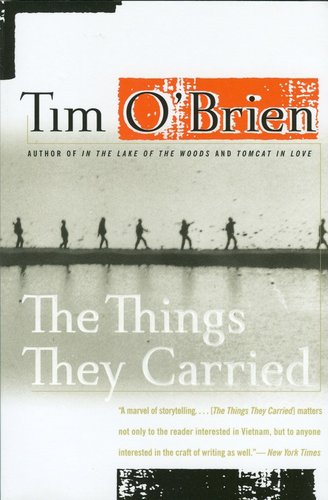
The Things They Carried by Tim O'Brien

They carried USO stationery and pencils and pens.  They carried Sterno, safety pins, trip flares, signal flares, spools of wire, razor blades, chewing tobacco, liberated joss sticks and statuettes of the smiling Buddha, candles, grease pencils, The Stars and Stripes, fingernail clippers, Psy Ops leaflets, bush hats, bolos, and much more.  Twice a week, when the resupply choppers came in, they carried hot chow in green mermite cans and large canvas bags filled with ice beer and soda pop.  They carried plastic water containers, each with a 2-gallon capacity... They shared the weight of memory.  They took up what others could no longer bear.  Often, they carried each other, the wounded and the weak.  They carried infections.  They carried chess sets, basketballs, Vietnamese-English dictionaries, insignia of rank, Bronze Stars and Purple Hearts, plastic cards, imprinted with the Code of Conduct.  They carried diseases, among them malaria and dysentery.  They carried lice and ringworm and leeches and paddy algae and various rots and molds.  They carried the land itself--Vietnam, the place, the soil--a powdery orange-red dust that covered their boots and fatigues and faces.  They carried the sky.

Tim O'Brien's The Things They Carried is probably the most famous literary book about the Vietnam War, of which there are surprisingly few.  (Robert Stone's Dog Soldiers, a vastly different book, comes to mind.)  Is it that the Vietnam War was so psychologically injurious to so many that it became difficult to write or talk about?  O'Brien is clear throughout this series of connected, semi-fictional stories, that he feels as if writing about his experiences in Vietnam saved him from the kind of rootless madness that destroyed so many of his friends after the war--like Norman Bowker, whom he describes driving around his Iowa hometown, wanting but unable to tell his story to anyone he sees.  Bowker, we learn in a subsequent chapter, hanged himself shortly after.  But we also learn that one of the linchpin moments of Bowker's story--his inability to save his friend who is dragged down and suffocated in a feces-filled river, where they had mistakenly set up camp--is O'Brien's own, grafted onto Bowker's experiences.

So what's the deal?  Are these stories fiction, or non-fiction?  O'Brien writes:

Forty-three years old, and the war occurred half a life-time ago, and yet the remembering makes it now.  And sometimes remembering will lead to a story, which makes it forever.  That's what stories are for.  Stories are for joining the past to the future.  Stories are for those late hours in the night when you can't remember how you got from where you were to where you are.  Stories are for eternity, when memory is erased, when there is nothing to remember except the story.

Norman Bowker is no more, but O'Brien's appropriation of him, in a way, I think, is meant to keep him alive, to subsume his own story into O'Brien's in a way that justifies what he must have felt was the sad wastefulness of his life.  In other places, O'Brien is cagey about what "really happened," as when he hedges on whether or not he was actually responsible for the death of a young Vietnamese man.  The death rattles him; he sits in shock over the man's body and imagines a life in which he has a girlfriend, wants to teach math--not a true story, of course, he knows nothing of the man, but a story which serves an important purpose amid the abject purposelessness of war and death.  In the same way, O'Brien suggests that it doesn't matter if he pulled the pin on the grenade which killed the man; he must take responsibility for his death in the same way that, writing his story, he takes responsibility for his life.  (It reminds me also of the scene in All Quiet on the Western Front when Paul Baumer kills a man in his foxhole, and then has to stare at him for hours until he goes nearly mad with regret.)

Still, there's no doubt the details are rooted in fact.  The Vietnamese who died died, the man who drowned in shit drowned in shit.  The bullet in O'Brien's rear was real.  Even in their slipperiness, these stories make the reader face the really awful reality of war, as well as any book I've ever read (with the exception perhaps of The Red Badge of Courage and All Quiet on the Western Front).

This, like the next few books I'm going to review, I read because I'm supposed to teach it next year.  That's going to be hard.  Partly because it is graphic, and so horrific, but I expect my students will be frustrated also by its anti-realistic elements, too.  It'll probably be good for them.

Saturday, April 26, 2014

The Frangipani Hotel by Violet Kupersmith

The shadow of the Vietnam war hangs heavy over The Frangipani Hotel, although the war itself is rarely mentioned. However, the exodus of the Vietnamese “boat people” opens the book, as the narrator asks her grandmother to tell the story of the day she left. The story begins as you’d expect, with the grandmother on a boat, but ends with the first supernatural occurrence in the book--although, Life of Pi style, we’re not really sure, as readers to what extent this is literally what happened.

SOME SPOILERS IN THE FOLLOWING PARAGRAPH

This is not the case throughout; As alluded to above, all but one or two of the stories in The Frangipani Hotel have explicit supernatural elements. Sometimes they’re subtle, sometimes they carry the story, but they’re always there, and after the first couple stories, I found myself waiting, during the seemingly mundane moments, for the other shoe to drop. There’s the creepiest hitchhiker ever, who lives off the life and memories of others, the girl who visits Vietnam and just might have accidentally eaten her grandmother, the old men who sit in a room every night and wait for a memory from the past to knock on their door, and so it goes. There are two stories with no obviously supernatural elements, but even there, the supernal and the mundane feel as though they are separated by a thread.

I’m not at all familiar with Vietnamese folklore, but most of the stories in the collection feel like updated versions of campfire stories, universal fears made current by transposition into modern times. If the creatures and stories Kupersmith shares aren’t myths, they feel like they are. Aside from the supernatural through-line, there are other common threads pulling the collection together--remembrance of the past, acceptance of mistakes, questions of identity, the Vietnam war, of course--so these stories, in spite of their eldritch trappings, maintain their humanity.

Highly recommended.

This book was sent to me by TLC book tours, who thought that I might enjoy it. They were right, but I never would have guessed, looking at the cover. It’s a nice image, but the bright pink lettering and fluorescent pink spine seemed to indicate a much different, much more romantic type of book. I can’t help but wonder if a book that is mostly made up of supernaturally-tinged tales building on Vietnamese folklore would have been given the same cover if it were written by a man--but I digress.