Showing posts with label vietnam war. Show all posts

Saturday, January 12, 2019

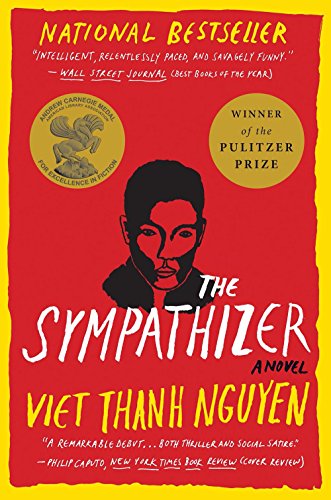
The Sympathizer by Viet Thanh Nguyen

Thank you, dear Commandant, for the notes that you and the commissar have given me on my confession.  You have asked me what I mean when I say "we" or "us," as in those moments when I identify with the southern soldiers and evacuees on whom I was sent to spy.  Should I not refer to those people, my enemies, as "them"?  I confess that after having spent almost my whole life in their company I cannot help but sympathize with them, as I do with many others.  My weakness for sympathizing with others has much to do with my status as a bastard, which is not to say that being a bastard naturally predisposes one to sympathy.  Many bastards behave like bastards, and I credit my gentle mother with teaching me the idea that blurring the lines between us and them can be a worthy behavior.  After all, if she had not blurred the lines between maid and priest, or allowed them to be blurred, I would not exist.

I wanted to read Viet Thanh Nguyen's The Sympathizer as a complement to Tree of Smoke.  Denis Johnson's novel is about the bewildered American in Vietnam, and Nguyen's is about the bewildered Vietnamese in America: specifically, an unnamed narrator working for an exiled South Vietnamese general in Los Angeles after the fall of Saigon.  The narrator has a secret, though: he's really a committed communist, sending reports back to his North Vietnamese handlers.  His unique position allows him to sympathize with both sides of the conflict, his northern colleagues and his southern friends.  The dominant imagery in the novel all points to a split identity: Northern vs. Southern Vietnam, the East and the West, his French father and his Vietnamese mother.

Like Tree of Smoke, The Sympathizer makes explicit references to Graham Greene.  The highly educated narrator, we learn, wrote his masters' thesis on the novelist's depiction of Vietnam; he's an expert in the way that the Western eye looks at his home country.  It mimics Greene in its reliance on intrigue and spy stuff, as well as its interest in the psyche of a double agent.  Its moral questions are very Greene-like: How can the murder of a communist by a communist be considered the right thing?  If it helps the narrator keep his cover, is that enough?

But The Sympathizer is at its best when it's in high satire mode, like when the narrator reminisces about how he learned to masturbate with his mother's fresh squid as a child, or when a pompous Orientalist professor encourages him to write down and compare his "Oriental" and "Occidental" qualities.  (There's a lot of satisfying tension in the way Nguyen mocks the reductive nature of binaries, while acknowledging that they have a real impact on the narrator's psyche.)  A big chunk of the book is taken up the narrator's experience advising a movie production about the Vietnam War in the Philippines that is a clear analogue of Apocalypse Now.  He wants to chip away at such propaganda from the inside, making a space for Vietnamese actors and tinkering with the script.  He advises the director, called only the Auteur, that Vietnamese people don't go AIIIEEEE!!! when they scream, but AIEY-AAHHH!!!  His efforts amount to very little; the Vietnamese Potemkin village mocks the absence of his home, and he ends up, in characteristic fashion, becoming part of the very machine he wants to work against.

It's not The Sympathizer's fault, but I found myself missing Johnson's anarchic prose style.  The language in The Sympathizer is very staid and prim.  It's a way for the narrator to exert control over the warring factions of his mind, and to assert an essential dignity in the face of Americans who would reduce him to ethnic stereotypes.  Sometimes it works toward satirical ends, as when he tells us, "Perhaps I went too far when I invited him to perform fellatio on me," or when he calls sex the "oldest dialectic," but at other times it feels stilted or forced.

Ultimately, The Sympathizer is a book I respected more than enjoyed.  I liked it most when it was at its silliest, and less when it was in its more serious mode.  I thought that the end, which details the narrator's capture and torture by his own northern colleagues and is clearly inspired by the end of 1984, to be unfortunately muddled when the narrative needed clarity most.  But the larger tragedy of the book is inescapable: the narrator has been exactly what his colleagues wanted, a convincing spy, but his strength becomes his weakness.  His sympathy must be cleansed out of him; there is no room in the world for someone who can see both sides.

Wednesday, January 2, 2019

Tree of Smoke by Denis Johnson

...Kathy reflected, certainly not for the first time, that the war hadn't been only and exclusively terrible.  It had delivered a sense, at first dreadful, eventually intoxicating, that something wild, magical, stunning might come from the next moment, death itself might erupt from the fabric of this very breath, unmasked as a friend...

Why did the U.S. bother itself in Vietnam?  Tens of thousands of Americans dead, ten times as many Vietnamese, the great waste of life and money and time, for what?  To say that it was to stem the tide of Communism sounds right in a high school history sort of way, and the protagonist of Tree of Smoke, CIA op William "Skip" Sands, sure seems keen on beating Communism.  But the line between the ideology and the great material fact of war seems to have a gap in it somewhere, not at all like the great war of the previous generation.  Tree of Smoke is a novel that presents the Vietnam War as a kind of immense fever dream, not just in the confusion of the jungle, but in the bungled ethos of the war itself.

At first, Tree of Smoke seems like a loving homage to Graham Greene.  Kathy Jones, a Canadian missionary, makes the allusion explicit by comparing Skip, masquerading in the Philippines as a corporate stooge for Del Monte, to the Quiet American.  Skip bristles at the comparison, his motives are not so rigid and his methods, he'd like to think, not so brash.  Skip is part of CIA's Psy Ops--psychological operations, that is--under the tutelage of his uncle, Colonel F. X. Sands.

The Colonel is a living legend, a former POW and war hero who has developed unconventional ideas about how to wage war.  "War is ninety percent myth anyway, isn't it?" he says.  "In order to prosecute our own wars we raise them to the level of human sacrifice, don't we, and we constantly invoke our God.  It's got to be about something bigger than dying, or we'd all turn deserter."  The Colonel advocates complete immersion into local culture and turning myth, "the other fellow's gods," into a psychological tool.  He also advocates a philosophical separation from the CIA chain of command, with predictably problematic results.  For the Colonel, myth and mystery, enemies of clarity, are the only way to wage war:

He woke from an hour's nap and went to the veranda to drink hot, strong coffee less reviving than his thrilling vertigo before the vista of his mistakes, all the wrongness he'd wandered into on the tails of his uncle, the aboriginal Man of Action.  Neanderthal, had been Rick Voss's term.  Mr. Tho came out with a burning mosquito coil in a dish and set it on the arm of the opposite chair, and there you are, simplicity itself, the ember of the foul-smelling incense bead, orange bead tunneling along its spiral path toward extinction and nonentity.  He felt surrounded, assailed, inhabited by such serpentine imagery--the tunnels, Project Labyrinth, the curling catacombs of the human ear... But over all loomed the central and quite different image: the Tree of Smoke.  Yes, his uncle meant to unfold himself like a dark wraith and take on the whole Intelligence service, the very way of it, subvert its unturnable tides.  Or assault it on the handball court.

The Greene pastiche halts early on; the whiskey priest-figure, a Catholic gun-runner for the Communists, is murdered by a blowgun.  If Skip is assigned to keep tabs on the priest, who kills him and why?  Another faction of the CIA?  The Filipinos?  Like Greene, Johnson's warriors are self-defeating, but it's not at all clear that what happens is a mistake rather than a grand mystery.  Johnson's language, with its touches of Beatnik mysticism and high prophecy, are far from Greene's deflating realism.

All of that is prologue.  When the action moves to Vietnam, things get worse and worse.  The project that the Colonel has Sands working on--cultivating a double agent to infiltrate the North Vietnamese--never really gets off the ground, which is impressive in a book that stretches to 700 pages.  It blows up, the Colonel dies under mysterious circumstances, but becomes a kind of myth himself, rumored to have let himself be captured in order to promulgate false info to the Viet Cong.  What info?  Does it matter?  As one character says, "I'd venture the truth is in the legend."  In a different book, that would be a platitude.

Tree of Smoke fills out its considerable bulk with several minor characters.  Besides the Colonel, Skip, and Kathy Jones, there's Bill and James Houston, a pair of down-and-out Arizona brothers who bring the desolation of their lives to the jungle and then bring the madness of the jungle back to Arizona.  Both are petty criminals, frightened children, irresponsible addicts, and while Tree of Smoke doesn't argue that Vietnam ruined them--they were pretty fucked up in the first place--it does want us to see that the war provides no better way.  Johnson, with his loving attention toward junkies and lowlifes, refuses to give us a Vietnam novel without the grunts.  Their connection to the main narrative is tenuous, but they remind us that the Colonel's spooky mythologizing engenders true violence.  But neither does Johnson ignore the Vietnamese: several locals, all of whom are mixed up with the Colonel's double agent scheme, get their turn in the narrative.  And while not all of these are worthwhile (I didn't need to linger so long with the mysterious German assassin, who returns to muse about his Nazi father), the scope of the novel mimics the way the war grows and spins out of control.

I can't tell you what I'd give to be able to write like Johnson.  He's one of those rare writers whose every word seems perfectly considered.  Every now and then, out of the morass of war, a perfect phrase emerges: A bowling ball "traveling away like a son, beyond hope of influence."  James' fear that a man caught by an exploding grenade would "splash around him like paint."  A corpse is described--horribly, but memorably--with its "rag of brain."  And the dialogue zips, right at the edge of sense, as really good dialogue often does.  It's hard to find a book of this immensity where the writing seems so precise and sharp, especially one whose big theme is confusion and mystery.

Thursday, August 21, 2014

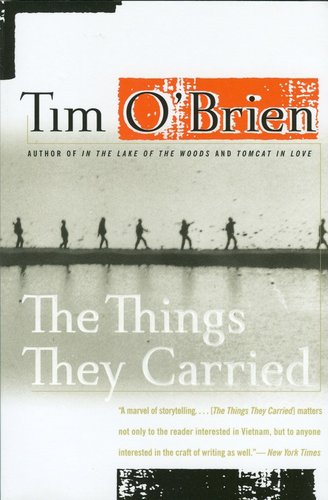
The Things They Carried by Tim O'Brien

They carried USO stationery and pencils and pens.  They carried Sterno, safety pins, trip flares, signal flares, spools of wire, razor blades, chewing tobacco, liberated joss sticks and statuettes of the smiling Buddha, candles, grease pencils, The Stars and Stripes, fingernail clippers, Psy Ops leaflets, bush hats, bolos, and much more.  Twice a week, when the resupply choppers came in, they carried hot chow in green mermite cans and large canvas bags filled with ice beer and soda pop.  They carried plastic water containers, each with a 2-gallon capacity... They shared the weight of memory.  They took up what others could no longer bear.  Often, they carried each other, the wounded and the weak.  They carried infections.  They carried chess sets, basketballs, Vietnamese-English dictionaries, insignia of rank, Bronze Stars and Purple Hearts, plastic cards, imprinted with the Code of Conduct.  They carried diseases, among them malaria and dysentery.  They carried lice and ringworm and leeches and paddy algae and various rots and molds.  They carried the land itself--Vietnam, the place, the soil--a powdery orange-red dust that covered their boots and fatigues and faces.  They carried the sky.

Tim O'Brien's The Things They Carried is probably the most famous literary book about the Vietnam War, of which there are surprisingly few.  (Robert Stone's Dog Soldiers, a vastly different book, comes to mind.)  Is it that the Vietnam War was so psychologically injurious to so many that it became difficult to write or talk about?  O'Brien is clear throughout this series of connected, semi-fictional stories, that he feels as if writing about his experiences in Vietnam saved him from the kind of rootless madness that destroyed so many of his friends after the war--like Norman Bowker, whom he describes driving around his Iowa hometown, wanting but unable to tell his story to anyone he sees.  Bowker, we learn in a subsequent chapter, hanged himself shortly after.  But we also learn that one of the linchpin moments of Bowker's story--his inability to save his friend who is dragged down and suffocated in a feces-filled river, where they had mistakenly set up camp--is O'Brien's own, grafted onto Bowker's experiences.

So what's the deal?  Are these stories fiction, or non-fiction?  O'Brien writes:

Forty-three years old, and the war occurred half a life-time ago, and yet the remembering makes it now.  And sometimes remembering will lead to a story, which makes it forever.  That's what stories are for.  Stories are for joining the past to the future.  Stories are for those late hours in the night when you can't remember how you got from where you were to where you are.  Stories are for eternity, when memory is erased, when there is nothing to remember except the story.

Norman Bowker is no more, but O'Brien's appropriation of him, in a way, I think, is meant to keep him alive, to subsume his own story into O'Brien's in a way that justifies what he must have felt was the sad wastefulness of his life.  In other places, O'Brien is cagey about what "really happened," as when he hedges on whether or not he was actually responsible for the death of a young Vietnamese man.  The death rattles him; he sits in shock over the man's body and imagines a life in which he has a girlfriend, wants to teach math--not a true story, of course, he knows nothing of the man, but a story which serves an important purpose amid the abject purposelessness of war and death.  In the same way, O'Brien suggests that it doesn't matter if he pulled the pin on the grenade which killed the man; he must take responsibility for his death in the same way that, writing his story, he takes responsibility for his life.  (It reminds me also of the scene in All Quiet on the Western Front when Paul Baumer kills a man in his foxhole, and then has to stare at him for hours until he goes nearly mad with regret.)

Still, there's no doubt the details are rooted in fact.  The Vietnamese who died died, the man who drowned in shit drowned in shit.  The bullet in O'Brien's rear was real.  Even in their slipperiness, these stories make the reader face the really awful reality of war, as well as any book I've ever read (with the exception perhaps of The Red Badge of Courage and All Quiet on the Western Front).

This, like the next few books I'm going to review, I read because I'm supposed to teach it next year.  That's going to be hard.  Partly because it is graphic, and so horrific, but I expect my students will be frustrated also by its anti-realistic elements, too.  It'll probably be good for them.

Sunday, January 4, 2009

Dog Soldiers by Robert Stone

In the course of being fragmentation-bombed by the South Vietnamese Air Force, Converse experienced several thoughts; he did not welcome them although they came as no surprise.

One insight was that the ordinary physical world through which one shuffled heedless and half-assed toward nonentity was capable of composing itself, at any time and without notice, into a massive instrument of agonizing death. Existence was a trap; the testy patience of things as they are might be exhausted at any moment.

Another was that in the single moment when the breathing world had hurled itself screeching and murderous at his throat, he had recognized the absolute correctness of its move. In those seconds, it seemed absurd that he had been allowed to go his foolish way, pursuing notions and small joys. He was ashamed of the casual arrogance with which he had presumed to scurry about creation. From the bottom of his heart, he concurred in the moral necessity of his annihilation.

He had lain there -- a funny little fucker -- a little stingless quiver on the earth. That was all there was of him, and all there had ever been... He was the celebrated living dog, preferred over dead lions.


Sorry for the long excerpt, hope you made it through unscathed. I just think that it's a passage of great power and insight, and it encapsulates perfectly what this book is about: the dissolution of life as a moral force, the transformative effects of war, and incorrigible cowardice.

Dog Soldiers opens up on the mid-Seventies, pissing on the era's grave. As the Vietnam War fades into irrelevance, so does the Bohemian ideal that pressed against it, leaving behind a skeleton of impotence and junkieism. John Converse, a journalist languishing in boredom in Vietnam, decides to engineer the transit and sale of three kilos of heroin to the United States, asking his friend Merchant Marine Ray Hicks to courier it to his wife Marge in San Francisco. The deal comes under the eye of a murderous regulatory official who wants the heroin for himself, and sets off a lengthy chase in which Hicks runs off with Marge and the corrupt Feds force Converse to help them pursue the drugs.

I am reminded of the way Odysseus struggles with his return from Troy, having to leave behind the madness of war before he can be permitted to return home to Ithaca. In the same way Stone's America has descended into ruin as the Vietnam War has become irrelevant; Converse notes that things make much less sense in the States than they do in Vietnam. In a desperate attempt to sell off the heroin, Ray and Marge encounter a number of warped hippie sterotypes, like the spiritualist roshi who lives on a distant mountaintop who has long since entropied into being little more than a drug dealer. Even Ray himself, a devotee of Eastern philosophy, is deranged and murderous.

There is a big hole here for me, and that is why exactly the corrupt Feds want the heroin so badly that they spend such effort tracking down Marge and Hicks. I suppose that three kilos of heroin would go for quite a bit, but the effort--and the ruthlessness--seem out of proportion (This Slate article gives a pretty good picture of what it might be worth--$300,000-$525,000 in today's dollars). But then again, Dog Soldiers is about madness, and their pursuit is doggedly fanatical. Stone also has a tendency to write around immediate action and fuzzy up the plot, encouraging confusion in anything but the most careful reader, so I may have missed something.

Still, I must admit great affection for this book. The writing is aggressively brusque, and when it takes a step back from the action can show a lot of wisdom written plainly--like in the excerpt above. It's the kind of book I adore: eventful without being vapid, colorful without being quirky, visceral and suspenseful. Highly recommended.

Saturday, January 12, 2008

Rabbit Redux by John Updike

When Updike published Rabbit, Run, his protagonist Harry "Rabbit" Angstrom was only two years his junior; at intervals of almost exactly ten years he wrote the next three Rabbit books, wherein Rabbit ages at exactly the same rate. This is, I think, an achievement of unparalleled ambition. Rabbit is Updike's everyman, and it seems as if Updike spends each of his ten years gathering material for Rabbit; for this reason Updike's legacy is tied to his character just as Updike's life is. The effect is like meeting an old friend--ten years have passed since you've last seen each other, but life has not stalled since then, and Rabbit grew with the rest of his generation in real time.

Rabbit Redux finds Rabbit back with his wife Janice, living in a small starter home in the suburbs of Brewer, Pa. with their now 12-year old son Nelson. Harry's infidelity and the tragedies of the first book (which I will not recount because Brent is going to read it) have been pushed to the corners of the Angstroms' consciousness, but not forgotten; they inform much of what the characters do or think. When Janice leaves Rabbit to stay with her lover, Greek car salesman Charlie Stavros, Rabbit, through a strange series of plot turns, takes in a rich young runaway from Connecticut named Jill, who pays her rent in nookie. It isn't long before a friend of hers, a young black radical named Skeeter, ends up at Rabbit's house on the lam from the cops.

What this sets up is a strange chunk of the novel in which Rabbit, Nelson, Jill, and Skeeter live in Rabbit's house in a peculiar commune-type situation: Skeeter, who styles himself as a "Black Jesus," spreads his dogma to the other three during nightly discussions. I looked for a passage from these discussions to quote, but I got lost and exhausted really quick; they're dense and full of odd anger and mishmash radicalism. It is this section that didn't feel quite right to me--Rabbit, despite his frequent escapes from domesticity, is a conservative man who believes strongly in the Vietnam war and is suspicious of blacks. In some way I think that Rabbit clings to this life because it is peculiar and perverse, and refreshing after a stagnant and not particularly satisfying twelve years of marriage, but I find some scenes (especially those in which Rabbit does not rebuke Skeeter for his savageness toward Jill or Nelson) to not quite jibe with Rabbit's character. The culmination of this is a scene in which Rabbit and Skeeter very nearly double-team Jill in the living room--what the fuck? It's Updike's prose that is the saving grace here, turning the ridiculous into the believable.

The other thing I didn't like quite so much about Rabbit Redux is that Updike seems to keen to turn Rabbit into a reflection of the American psyche. In Rabbit, Run, Rabbit was just Rabbit, and didn't need to be anymore--we could identify in him the human desires to be loved and to be free, and all the mess and complications that result from them. But in making Rabbit the prototypical American--and not the prototypical human being--Updike actually narrows his focus and Rabbit's relevance. Updike places Rabbit Redux squarely against a backdrop of social and political change and upheaval: the moon landing, Vietnam, race riots. At one point, Rabbit has a lengthy argument about Vietnam with his Stavros, his wife's paramour (who is a dove). And then, of course, the Skeeter sections. These all have their charms and their positives, but forty years later, I find this aspect of the book to be the least appealing.

Of course, I still recommend this book strongly, if only not quite as strongly as I do Rabbit, Run. Up next: Rabbit is Rich!