Showing posts with label History. Show all posts

Sunday, February 1, 2026

America, América by Greg Grandin

It is a maxim in both electrical engineering and international relations theory that power needs a ground. For a long many years, Latin America to the lightning-like United States: its persistent opposition to intervention and conquest, and its unwavering demand for the recognition of absolute national sovereignty, obliged Washington to learn how to discipline itself, to control its energies, letting its power flow more efficiently and evenly.

America, América, Greg Grandin's new history of the "New World," traces the history of both Anglo-America and Latin America together, instead of as separate histories. What would we learn, Grandin suggests, if we were to understand the forces that shaped the United States (and Canada) alongside the forces that shaped the rest of the Americas, from Mexico down to the tip of Patagonia? Should we understand the Spanish and English processes of colonizing the Americas as separate and distinct, or do they share certain important qualities that continue to tie their successor states together?

First of all, I appreciated the way that Grandin laid out the differences between English and Spanish colonization in ways that I have sensed but not been able to articulate. As Grandin describes it, as horrible and violent as the Spanish were--and they were very violent--Spanish colonial society identified a place for the Indigenous in its hierarchy, at the bottom, whereas English and later American colonies conceived of Indigenous people as outside the political order, thus needing to be either ignored or eliminated. You can trace a direct line from this distinction to the idea of mestizaje that dominates the self-conception of Mexico, in contrast with the reservation-and-sovereignty model of the United States. I was also very interested to read about how Spanish colonial society birthed the New World's first civil rights movement, spearheaded by Bartolome Las Casas and other Dominican priests. I had long heard of Las Casas as a kind of contrast to Columbus, and proof that it was possible even at the time to conceive of Indigenous rights, but I had no idea how powerful or influential, or, truly, courageous, he really was.

Las Casas' conception of Indigenous, even equal rights, were later picked up on by social reformers in the colonial Americas, like Marti and Bolivar. America, América does an amazing job showing how ideas of liberty and social change were shared by revolutionaries and thinkers on both sides of the Anglo-Latin divide--the book even opens by focusing on Francisco de Miranda, a Venezuelan who fought in the American Revolutionary War. In the crucible of the revolutionary 18th and 19th centuries, it was possible for people on both sides to imagine a transcontinental republic that would stand in opposition to the old ways of European monarchy. Sometimes that looked like Americans imagining a United States that encompassed Mexico, Central America, and the Caribbean, but sometimes it looked like a "Pan-American" republic that would be for all people. It's hard, reading America, América, to shake the idea that it was Miranda, Bolivar, and Marti who best epitomized the "Sons of Liberty" that we imagine in guys like George Washington.

Such Pan-Americanism failed to prosper in the United States, but it seems to never have really died in Latin America. In the latter portion of the book, Grandin describes how Latin America acted as a counterweight to the United States, birthing International Law and ideas of non-intervention and collaboration that would come to define 20th century. Grandin never quite spells it out, but it's easy to read a direct line from Las Casas to Bolivar to the Pan-Americans of the 20th century, who time and again did their best to force the United States to come to to the bargaining table and submit to treaties of peace and collaboration. Grandin puts heavy emphasis on a series of Pan-American conferences in the early 20th century that found brief success with Wilson and FDR, but later reaction produced the American-backed right-wing dictatorships of Pinochet, Somoza, and countless others.

One thing I liked best about America, América: Grandin skips over the stuff he thinks we already knows. The Cuban revolution, for example, gets basically skipped over as a footnote. Instead, we're treated to the story of Jorge Eliécer Gaitán, the Colombian socialist leader whose strange assassination (reminiscent, in its breeding of conspiracy theories, of JFK's) set off a violent reaction called El Bogotazo. I, of course, had never heard of that. Grandin does this again and again, treating lightly things he thinks his audience may know a little about already--the Civil War, the Republic of Texas, etc.--to focus on the things we don't. It's a bold strategy that asks a lot of his audience, but I thought it really made the book worth reading. 

Sunday, July 6, 2025

Scotland: A History from Earliest Times by Alistair Moffat

Reflecting on the immense journey that is our history, many competing interim conclusions crowd the landscape. But at least one theme is clear. Scotland was never an inevitable destination. As we approached several crossroads, our destiny might easily have turned in different directions. Scotland could have become Pictland, Alba, Norseland or Northern England. This recurring sequence of uncertainties, real enough at the time, is a useful corrective to the temptation to read history backwards.

On my recent trip to Scotland I saw many famous names: Stirling Bridge. Bannockburn. Culloden. William Wallace. Robert the Bruce. Rob Roy. Mary, Queen of Scots. John Knox. Loch Ness. Loch Lomond. Glen Coe. Iona. But at the same time they were arranged for me in a kind of mental geography, I needed a book like Alistair Moffat's Scotland: A History from Earliest Times to help me arrange them into chronology and narrative--a big fat history of this beautiful country. 

Moffat's history does indeed begin from earliest times, with the geological forces that created this landscape, with its volcanic islands and deep glacial lochs, and the prehistoric peoples whose mysterious "standing stones" still dot that landscape today. As Moffat moves forward through history, identifiable kingdoms begin to emerge: the Picts, the westerly Gaelic kingdom of Dal Riata, Northumbria, etc. Moffat shows how what we think of as Scotland and the Scottish people really emerge from a series of converging migrations and conquests: the indigenous Picts, the conquering Gaels, Romans, Norse, and Normans. (I found Moffat's reliance on DNA markers to trace this heritage a little tedious and suspicious, but I don't really know anything about it.) Scottish identity emerges only later on, with the battle of the Wars of Scottish Independence when William Wallace and Robert the Bruce fought to shake off English power and influence.

Scotland's relationship with its powerful neighbor to the south is a big theme in this history. To me, it seems as if the story goes something like this: after fending off English encroachment (and at times, direct control) for several hundred years, Scotland ends up sort of like the mouse that catches the cat when James VI becomes James I of England, bringing the two nations closer together than ever. But far from exerting a Scottish power over England, James' accession only further entrenches the entanglement that lasts all the way through the Acts of Union that create Great Britain in 1707 through the Jacobite uprisings, where forces loyal to the deposed line of James II tried to take the throne back from William of Orange, to the present day, when Scotland extracted the right to the reestablishment of its own parliament at the turn of the 21st century.

I knew some of that already, but there was much of it that was new to me, especially the line of hapless Stewarts that lead up, somehow, to the powerful reign of James VI and I, a narrative that's filled the expected gory and macabre details of medieval jockeying for power. I also enjoyed understanding better the internal conflict between Lowland and Highland Scots, which sometimes, but not always and never perfectly, maps to other conflicts: Protestant vs. Catholic, Scots vs. Gaelic, elite power vs. the hinterlands. Moffat makes a late point that really stuck with me, claiming that many of the symbols we associate with Scotland, like the kilt and the bagpipes, are cultural elements appropriated by a Lowland Scottish culture from a Highland culture where they're basically not found anymore--the irony of this being, of course, that through the Highland Clearances and the 19th century, these symbols were thought to be indicative of a primitive, savage backwardness.

To me, Moffat's book gets often too caught up in the details, the this-then-that, and misses the opportunity for a larger thematic understanding that might have helped a novice to Scottish history like me. I actually found the brief explanation of the Stewart line delivered by our tour bus driver on the Isle of Skye to be more digestible and understandable, though it must also be said that he illuminated the more detailed history of Moffat's I was already reading. I thought this was especially true of the military history, which gets bogged down in troop movements and strategies that I often felt myself straining to understand the larger importance of Stirling Bridge, or Bannockburn, or the massacre at Glen Coe. I actually found the most interesting and entertaining part of the book the little capsules Moffat includes about people, moments, and details that don't fit neatly into the overarching history. Scotland: A History from the Earliest Times is a big tome--I had to finish it on the 7-hour plane ride--but it ended up really enriching and elevating my exploration of this beautiful country.

Monday, February 24, 2025

Ornament of the World by Rosa Maria Menocal

The old Arabic word for palace, al-qasr, was what the Castilians called their splendid new royal homes. The elaborate plasterwork that decorated nearly every inch of the Alcazar's interior walls was barely dry, and the Muslim emissary from Granada found himself in rooms that in every way echoed the freshly finished palaces of this Islamic city he had just left. Peter, a son of Alfonso XI and the heir to his great-great-grandfather Alfonso X (the Learned), who had died in this city, was justifiably proud of this example of his wealth, taste, and vision. All three were on display in this Sevillian tribute to the very latest architectural style of Spain. Ibn Khaldun could hardly have avoided the realization that Peter's new palaces, with their multilobed latticework arches and their pure-white arabesque ornamentation on every spare surface, were an unstinting homage to the style of the Nasrids, whose envoy he was. There, on the open and sunny plain, sitting next to the giant old Almohad mosque in Seville--the mosque had been reconsecrated more than a hundred years before and was the cathedral of the Christian capital--was an unabashed evocation of the fortlike palaces at the top of the rocky mountain retreat of Granada, the last and lonely Islamic state on the Iberian peninsula.

I had the great fortune last week to visit two of Spain's most striking and important landmarks: the Alcazar of Spain, a royal palace that is still the sometime home of the King and his family, and the Alhambra, an enormous palace complex built by the Muslim Nasrids of Granada. The Alcazar is a Christian edifice, done in what's known as the "Mudejar" style, meaning Christian architecture with Muslim edifices. It really does look a lot like the Alhambra, and visiting the two, someone who didn't know exactly what to look for might get the impression that they were built by the same people for the same purposes. The two structures are, to author Maria Rosa Menocal, powerful symbols of one of history's true golden eras: medieval Spain, when Muslims, Christians, and Jews existed side by side in a culture of tolerance and cultural exchange. A Christian ruler might, even after the reconquest of much of the Iberian peninsula, in which Muslim rule in Spain was shrunken down to just the city-state of Granada, recognize Islamic art and culture as part of his own powerful patrimony, and built a palace worthy of such creative and intellectual forebears.

Menocal frames her book as a series of biographical sketches of figures who typified the 750-year-ish era that constituted the golden age of al-Andalus. Among them are Samuel the Nagid, an influential Jewish poet and leader who served as a general in Muslim Granada; prolific Islamic writers like Ibn Hazm and Averroes; the Christian warrior known as El Cid; even apostates who rejected the world of philosophical tolerance like Jewish thinker Judah Halevi. This format made it a little hard to grasp some of the overarching historical narratives at play, but I think I more or less got the gist: survivors of the fall of the Umayyad dynasty in Baghdad arrived in al-Andalus around 750 CE, where they created a Muslim state centered on Cordoba that incorporated Christians and Jews but also cemented Arabic as the primary language of both knowledge and art. These Umayyads were eventually conquered by a pair of strict invading Islamic states, the Almohads and Almoravids, who were supplanted by a system of individual city-states known as taifas. The taifas lasted until the reconquest, ending with the loss of Granada and the edict of Isabella and Ferdinand--a pair of history's great villains, no doubt--expelling the Jews from Spain, cementing the entire peninsula as a Christian polity.

I had a vague idea, of course, that Muslim thinkers protected and progressed the traditions of Greek philosophy during the time that much of these sources were lost to Christian Europe. What I didn't know is just how much of that happened in Spain. It was Averroes, the Latinized name of Ibn Rushd, for example, whose commentaries on Aristotle kept the Greek philosopher's legacy alive, later to be integrated into the Christian philosophy of Thomas Aquinas. Nor did I realize that Chaucer's The Canterbury Tales has its roots in the writings of Petrus Alfonsi, a Spanish convert from Judaism to Christianity, whose "Priestly Tales" held little interest for his own countrymen but which Englishmen had never seen. Nor had I ever really thought about the fact that, as must be true, even the Jewish and Christian thinkers of the time period wrote in Arabic, a language that had come to supplant Latin as a lingua franca. Even the great Jewish writer Maimonides, for example, wrote his commentaries on the Mishna in Arabic. One of the great, perhaps even tragic, turning points for Menocal, is when King Alfonso the Wise chooses to elevate the vernacular romance language of Castile to official status.

It's clear that Menocal sees the story, or perhaps stories, of medieval al-Andalus as not just history, but a model for the way society could be. A postscript notes that she finished the book shortly after 9/11, when the book's pleas for tolerance--especially in relation to the contributions of Muslim and Arabic thinkers--became especially ignored, and especially needed. As Menocal shows, much of the great philosophy, poetry, art, and architecture--the Alcazar of Seville and Alhambra of Grenada among them--were only able to exist because a culture of tolerance and free exchange allowed them to exist. 25 years later, it's hard to see that a society like this remains a probability for us, though the book shows quite effectively that such worlds are possible.

Wednesday, February 12, 2025

Christendom by Peter Heather

Christendom, then, is a response to what seems to me the pressing intellectual challenge of reassessing Christianity's rise to pre-eminence in the light of its modern eclipse, by re-examining the historical processes that first generated the defining coincidence between Europe and the cultural dominance of the Christian religion. It aims to give full weight to contingency, to Christianity's almost limitless capacity for self-reinvention, and to the potential of past populations to have made alternative choices. My aim here is not to produce another total history of Christianity, but to explore afresh exactly how Europe became Christendom: that part of the planet dominated by Christian rulers and overwhelmingly Christian populations.

Peter Heather takes two points in European history as the beginning and end of Christendom, his massive history of the growth of the Christian religion throughout Europe: first, the 4th century conversion of Constantine, which brought official Christianity to the Roman Empire for the first time, and then the 14th century conversion of the Lithuanians, the last major polity in Europe to be Christianized. It took about a thousand years, then, for Christianity to conquer the continent, which seems like a long time, but maybe isn't so much when you consider what historical undertakings must have taken place for a single continent to become so religiously homogenous. What happened in between is the subject of Heather's book.

One of the main theses of Christendom is that Christianity's rise was not foreordained. Before Christianity began to wane as a social force in Europe, Heather explains, it was easy to look at the religion's success and determine that it was simply built different. Now, in a post-Christian era, it's easier to appreciate how things might have been otherwise, and Heather shows us meticulously how this was true: Constantine's conversion, for example, eventually drew in much of the landowning Roman elite, but left the pagan public untouched, requiring an early medieval campaign of temple-busting to spread throughout the Eastern empire. The orthodox Nicene Christianity that we take for granted today was closer, Heather argues, to being defeated by its rivals than we really appreciate; the Gothic successor states of the Roman Empire were split between different forms of Christianity that might easily have led to vastly historical paths. And of course, Heather reminds us, Christianity's traditional strongholds in the Near East and North Africa were swallowed wholesale by Islam in a process of elite capture that remarkably resembled the rise of Christianity among the same groups; if Islam could capture the places where Christianity was born, why not the rest of Europe? Heather calls this contingency, and an awareness of the way things might have been different alerts us to the fact that history is made up of positive actors, not merely those swept up in inevitable tides of change.

Christianity thrived, Heather argues, because of its adaptability. The Christianity adopted by Constantine and the Roman elite was not much like the rusticism of the Desert Fathers and the Jesus Movement of early Palestine. Roman intellectual and literary traditions helped provide an infrastructure for a Christian empire, which all but fell apart after the dissolution of the Roman Empire, giving way to a collection of largely autonomous communities held loosely together by missionary and monastic traditions. In the middle of the middle ages--say, 600 to 1100--most Europeans would not have gone to church regularly, and only a few would have been exposed to regular preaching. Religious authority lay not in the pope but in divinely appointed kings--especially the Carolingians, whose strong hand and interest in religious control did much to resurrect Christianity as an institutional practice--who used it as a tool to build alliances and cement their own legitimacy. The end of Heather's story begins with the "Twelfth Century Renaissance" and the gradual assertion of the papacy as a singular Christian authority, which mutually reinforced a set of social institutions that renewed a particular orthodoxy. It's interesting to reflect on how young the idea of papal supremacy is, and certain associated theological positions, like notions of sin, penitence, and purgatory, which only come into their own alongside the rise of the Holy See. When the Lithuanians completed the puzzle of European Christianity, Heather argues, they did so in the context of an institutional Christianity that was much stronger than it had been since the days of Constantine, and which looked much different even from the Christianity of a century or two before.

I really enjoyed reading this. Even as a relatively curious and knowledgeable person (I hope), the long middle ages really seem like a single mashed up period to me. It's hard to conceptualize a period in which, say, Charlemagne and St. Francis are as far apart as me and George Washington, and even this is is only a fraction of the long history of Christianity's growth to the ends of the continent. It confirmed for me something I long suspected: that today's "trads" are largely bullshit artists who have no idea, or perhaps simply no interest, in whether or not the traditions they seem to value actually represent unbroken strands of Christian practice at all. Christianity's adaptability, we see, is its great strength, but it also means that there is and was an immense diversity as to what the religion meant in both concept and practice.  

Saturday, July 6, 2024

Shoal of Time by Gavin Daws

History came to Hawaii by way of the sea, and traces of the past are still visible in the water as well as on the land. At Lahaina, close to the harbor, skin divers prospecting on the sandy sea bed occasionally turn up anchor chains and oil lamps and square-face gin bottles from whaling ships, coffee cups from Navy submarines and Matson cruise liners, and splintered calabashes and stone adze heads tossed overboard from Hawaiian canoes. The sand shifts with the currents; one day the past is exposed, the next it is all but obscured, and it takes a sharp eye to bring it to light again. Farther out to sea the past repeats itself endlessly. The tides run, the sun sets, the night passes, and in the morning, just at dawn, the islands come into view again as they did for Cook so long ago, a fresher green breast of the new world than ever the old Atlantic sailors saw, and still a place of gentle, beckoning beauty.

I'm going to Hawaii next week. It'll by my fiftieth state state. And with good reason: it's possibly the single most remote major population center on earth, much farther away from mainland U.S. than even Alaska. I have many expectations, but one is that it will be strange how not strange it will feel to be dropped off in the middle of the Pacific Ocean, nearly as close to Japan as California, and to be in the same old McDonald's-and-Chipotle America. How did we come to possess such a place? And how did it become a state like all the others, when it seems so different?

A little less than 200 years passed from the time that Captain Cook first spotted the "Sandwich Islands" to the moment that Hawaii became the fiftieth star on the U.S. flag. Some might object that Gavan Daws takes these two moments as the endpoints for Shoal of Time, his history of the Hawaiian Islands. After all, Hawaii's history as a Polynesian settlement extends back much, much farther than the 18th century. (It seems perhaps more excusable to end with the 1959 statehood when writing in 1968, as Daws did.) But it's hard to argue, when Daws reveals how much of a watershed moment the arrival of Cook was not just for the Europeans, who found a new cache of resources to plunder in the Pacific, but for the Islands themselves. Without Cook, Daws makes clear, there would be no Kamehameha, the Hawaiian juggernaut who united the islands for the first time under a single ruler. Though there's no selling Kamehameha short--you only need to compare him, it seems, to the lineage of feckless drunks that came after him--it was European guns and iron that allowed him to make the conquest, along with the assistance of a pair of whites, one kidnapped and one shipwrecked. The arrival of Europeans, it seems, had a funny way of making a people out of fractious and divided tribes; Kamehameha's conquest is almost a literalization of this principle.

Kamehameha's story would make one hell of an HBO streaming series. I know what a lame thing that is to say, and I'm the first to say we're all a little too TV-pilled these days. But it really does have all the Game of Thrones elements: a powerful leader, unconventional allies, scheming vassals, and the pressures of choosing between a bunch of morons to carry on your legacy--plus the beautiful natural setting. Hawaiian history, and thus Daws' book, is never quite as interesting after the Kamehameha period, with its wars and diplomacies and poisonings. But Shoal of Time offers a reminder, too, that this Golden Age of Hawaii was a relatively brief period; after Kamehameha's death in 1819, no subsequent king or queen has the same kind of control over the Islands, and all seem caught perilously between protecting Native Hawaiian interests and the European planters who become quickly and uneasily absorbed into the kingdom's politics.

But in my imagined HBO series, I hope there is a season set aside for the aftermath of Kamehameha's death, which is one of the most interesting stories in all of Hawaiian history. At the time of Cook's arrival, Hawaiian religion was circumscribed by the concept of "kapu," that is, taboo, the interdiction of certain places and things as off limits to some or all members of society. It was kapu, for example, for women to eat with women, but a chief could also declare and lift kapu as he saw fit. Kamehameha consolidated his power, for example, by declaring the harbors where European ships had landed as kapu until his particular demands for trade had been met. Yet, when Kamehameha dies, his young son and successor Liholiho (or Kamehameha II) is convinced by the dead king's widow to overthrow the kapu system entirely. (Although powerful, she seems to have felt keenly the way that the kapu system was used to keep women in their place.) The result is total cultural destabilization, which paves the way for the Christian missionaries who arrive just months later, just in time to offer an alternative to the Hawaiian religion that lies in shambles.

One idea I see on Twitter a lot is that Hawaii isn't "really" part of the United States; or it shouldn't be. That's certainly true; the state of Hawaii is the direct successor of a military coup by American whites against the kingdom's last monarch, Liliuokalani. (As far as that goes, none of it should be the United States.) But one thing I didn't really understand until reading Daws' book is that the kingdom was already filled with, and staffed by, whites. Kamehameha relied on Isaac Davis and John Young; Kamehameha III relied on a rotating staff of whites from missionary families to perform the business of the kingdom. Though it was clearly far from racial harmony, there's something to marvel at in this era of the kingdom, in which whites served in the king's cabinet as Hawaiian nationalists. Later on, things devolved, as one supposes they must, with the white elements in the kingdom trying hard to minimize the power of the Hawaiian king. The pretext for Liliuokalani's overthrow, in fact, was her attempt to abrogate a constitution her brother and predecessor had been forced to sign at the point of a gun. This solved one of the two questions that seems to have dominated the white elements of the kingdom in the 19th century. The other question was, which imperial nation should we be allied to, and under what context? This question was settled with the 1898 annexation, fought for by the same actors who overthrew Liliuokalani and created a republic, but one look at the Hawaiian flag with its hopeful Union Jack shows that an American Hawaii was not a historical inevitability.

Daws describes the process of obtaining statehood as one that was both fraught and sort of inevitable. (One thing that made it inevitable, which I never really considered, was the admission of Alaska, which obliterated most of the already weak complaints by stateside politicians.) The Hawaii that becomes a state in 1959 is a far cry from the Hawaii of 1778, or even the Republic of 1898. Both Hawaiians and whites are far outnumbered by Asians (whom, in a regrettable relic of the 60's, Daws calls "Orientals"). Hawaii's position in the Pacific has made it a place where many cultures converge, and not always easily or well, as Daws shows in one particularly lurid story of racism and murder in the 1930s. But Daws finds a lot of hope in the symbolic nature of its statehood; perhaps its diversity--it's the first state to send a Japanese and Chinese legislator to Congress--tokens a changing America. I don't know how well we've lived up to that hope, but it's a nice thought, and it makes me wonder what Daws would have made of the political ascension of Barack Obama, whose Hawaii background is often forgotten in consideration of his breaking down of racial barriers.  

Saturday, February 3, 2024

Two Books About the Aztecs: Fifth Sun by Camilla Townsend and The Mexican Dream by J. M. G. LeClezio

Many years later, it would become an accepted fact that the indigenous people of Mexico believed Hernando Cortes to be a god, arriving in their land in the year 1519 to satisfy an ancient prophecy. It was understood that Moctezuma, at heart a coward, trembled in his sandals and quickly despaired of victory. He immediately asked to turn his kingdom over to the divine newcomers, and naturally, the Spaniards happily acquiesced. Eventually, this story was repeated so many times, in so many reputable sources, that the whole world came to believe it. Moctezuma was not known for his cheerful disposition. Even he, however, had he known what people would someday say, would certainly have laughed, albeit with some bitterness, for the story was, in fact, preposterous.

The word "advanced," like the word "primitive," is a word that's slung around too often without being questioned. Yet, by any metric, the Aztec civilizations that the Spanish conquerors encountered were the most "advanced" of North American peoples. They planned and lived in great urban cities; they had complex systems of trade and technology; they had spectator sports and libraries. In many ways, they are more recognizable to us as "modern" than, say, the nomadic tribes of the U.S. plains. And yet, they found themselves quickly subdued by a small group of Spaniards. Why? Answers to this question have often relied on the Aztecs' religion. I remember learning in school that the Aztecs believed that the Spaniard and the horse were a single, frightening creature, and that they saw in Cortes the return of the god Quetzacoatl. Camilla Townsend's award-winning history of the Aztecs, Fifth Sun, calls bullshit.

The problem with these accounts, as Townsend describes it, is that they rely too heavily on Spanish language accounts of the conquest. This, despite the fact that several accounts written in the indigenous Nahautl language survive, and present a very different story. Townsend's history--she implies, and I'm ready to believe--is the first account of the Aztecs to prioritize indigenous sources. And what those sources, like several "annals"--basically Aztec accounts of what happened each year--and the history of the Indigenous historian Don Domingo Chimalpahin, tell is a different story. In this story, the Aztecs quickly understood the military superiority of the Spanish, predicated on "the Spaniards' use of metal, and their extraordinary communication apparatus." "What is striking," Townsend writes about the Aztec reaction to the Spaniards' military advantages, was not that they interpreted them as divine, but "how quickly they realized that these issues were at the heart of the matter." The choices made by Moctezuma and his allies, as well as those who allied with the Spaniards like the Maya woman historically known as Malinche, begin to make sense as pragmatic and political acts. 

Townsend's history is split basically into thirds: Aztec life before the conquest, the conquest, and the aftermath. I really enjoyed reading the first part, about the Aztec world pre-Cortes, which is something about which I knew very little. I was especially eager to hear what Townsend had to say about human sacrifice, which, if you've ever had the misfortune of interacting with a Twitter racist, you might know is used to justify the brutal colonial practices of not just the Spanish but all European colonizers of the new world. Townsend notes that the scale of human sacrifice is, first and foremost, much smaller than formerly assumed--she estimates it at perhaps two thousand sacrifices over a hundred year period. For the Aztecs, sacrifice was connected to stories in which a god allowed themselves to be destroyed so that a new world might be born; they themselves believed the universe had exploded four times and they were living in the "fifth sun."

But Townsend makes it clear that, during the rise of the Mexica Empire centered on Tenochtitlan, sacrifice took on a practical and military aspect as well, punishing cities that refused to pay homage and allegiance. Fascinatingly, the Mexica engaged in "Flower Wars" with their most entrenched enemies like the city of Tlaxcala: a type of ritualized, less lethal warfare, which maintained the status quo between rivals who would otherwise attack one another. The Spaniards, who attacked and then allied with the Tlaxcala against their Mexica rivals, actually managed to explode a stable political detente into the violence that had long been avoided.

The "after," too, is fascinating for its glimpse into the processes which transformed a nation of conqueror and conquered into the Mexico of today: the beginning of the encomienda system, which supplanted and extended the Aztec system of imperial tribute, the brutality of forced labor, the subsummation of Aztec identity into a Spanish identity that evolved into the mestizaje ideology of Mexican "mixedness," etc. I was surprised to hear that much of the instability of early colonial Mexico fell not just on the Indigenous but on Black slaves imported from Africa. It's in the midst of this world that writers like Don Chimalpahin wrote their own accounts of the conquest in their own language, and knowing the circumstances they were writing under makes their resolve in recording their story for future generations all the more impressive.


Thus began the True Story, with that meeting of two dreams. There was the Spanish dream of gold, a devouring, pitiless dream, which sometimes reached the heights of cruelty; it was an absolute dream, as if there were something at stake entirely different from the acquisition of wealth and power; a regeneration in violence and blood to live the myth of Eldorado, when everything would be eternally new.

On the other side was the ancient dream of the Mexicans, a long-awaited dream, when from the east, from the other side of the ocean, those bearded men guided by the Feathered Serpent Quetzalcoatl would come to rule over them once again. Thus, when the two dreams and the two peoples met, the one demanded gold and riches, where as the other wanted only a helmet to show the high priests and the king of Mexico, since, as the Indians said, it resembled those once worn by their ancestors, before they disappeared.

After reading Towsend's history, it's hard to turn to Nobel winner J. M. G. LeClezio's account of the Spanish Conquest of Mexico and not think bullshit, bullshit, bullshit. All the myths Townsend identifies are here: the single creature made of horse and rider, the reincarnation of Quetzalcoatl in the form of Cortes. The Aztecs' fall to the Spanish can be explained, for LeClezio, by the intensity of their apocalyptic religious beliefs, by the power of prophecy and visions that foretold the coming of the conquerors. It's no surprise that LeClezio, writing in the mid-60s, draws entirely on the True History of Spanish evangelist Bernardino de Sagahun that Townsend identifies as the source of many of these self-serving stories.

To his credit, LeClezio seems to really know a great deal about Indigenous Mexican religion, not just that of the Mexica and other Aztecs, but the Maya and the Purepecha, who were and are centered in the western region of Michoacan. I have no way of knowing how accurate he is--I have a general sense that Indigenous Mexican religion is often misread, that some figures are falsely conflated and figures who really are avatars of one another are often missed--but LeClezio's account of the three main religious systems in rich and detailed. For LeClezio, these are "barbarian" religions, a term used more with admiration than disgust: he believes that the immanence of their religion made them closer to both nature and the divine, which is supposedly in contrast to European Christianity, which is less an animating force for the Spaniards than a quasi-religious "dream" of riches and gold. LeClezio's interlude about Antonin Artaud, who went to Mexico in search of a pre-European way of being only to come back a mental and physical wreck, make the stakes of The Mexican Dream clear: LeClezio is less interested in understanding Aztec religion than he is in using it as a kind of mirror held up to European degradation.

In this one respect, I do agree with LeClezio: the conquest of Indigenous America interrupted a process of historical development that might have served us better than the European colonial project did. LeClezio asks: "How might those civilizations, those religions have evolved? What philosophy might have developed in the New World if the destruction of the Conquest had not taken place?" In one way, this is a silly question; Indigenous civilizations did not disappear; they're still with us, and they have evolved. Mexico is home to two million Nahuatl speakers. But in another way, I think LeClezio is plainly right. He writes about an Indigenous belief in that "equilibrium was the very expression of divine creation," that we have a divine mandate to live in reciprocal relationships with places and resources. I often wonder what our world would be like today if it were this ideology that had taken root around the world, rather than one predicated on resource extraction and economic development at all costs. When LeClezio writes that Western man has "put himself in a position of disequilibrium, because he has let himself be carried away by his own violence," it's hard to disagree.

Monday, August 21, 2023

Saving Yellowstone by Megan Kate Nelson

All three of these men--Jay Cooke, Sitting Bull, and Ferdinand Hayden--determined the future of the American West during the Reconstruction era. They were raised in different familial circumstances (Hayden's was the most hardscrabble and Sitting Bull's the most advantageous, born as he was into a family of Lakota chiefs), but they were all men of ambition. They discovered their talents as young men and worked to establish themselves as leaders in their respective communities.

They also had larger visions for the future of their nations, rooted in their beliefs about who should have rights as citizens and who should control the undulating prairies, jagged mountain peaks, and fertile valleys of the West.

I tell you what: Yellowstone is huge. It's bigger than Rhode Island and Delaware combined, and you can feel it if you try to drive the entirety of the "double loop" that makes up the park roads. It seems incredible, as you journey through it, that such a place was preserved forever by presidential proclamation, an absolutely colossal land set aside for public marveling and enjoyment, set aside, really, just to set it aside. But, of course, it wasn't an inevitability; the preservation of Yellowstone as the world's first national park under Ulysses S. Grant was the end result of decades of exploration, persuasion, and advocacy--and also, in the case of Indigenous people, dispossession. Megan Kate Nelson's Saving Yellowstone tells the story of the park's preservation through the eyes of three men: explorer Ferdinand Hayden, railroad tycoon Jay Cooke, and Lakota leader Sitting Bull.

It's Hayden who is the book's focus by far, an ambitious naturalist whose aims in exploring the Yellowstone valley were as much about his own stature as the advancement of science. When Hayden and his team set out for Yellowstone, it was nearly unknown to white Americans. Just two years before, the Langford expedition had confirmed the "tall tales" that western trappers had been telling about the Yellowstone for years: towering hot geysers, brilliantly colored pools, and land that smoked. (It had also brought national attention to the area when one of its members got lost for a month before being miraculously saved.) But it was Hayden's expedition, as Nelson tells it, that convinced the public, and President Grant, to set the "wonderland" aside, not least because Hayden cannily brought along a photographer, William Henry Jackson, and a painter, Thomas Moran, both of whose images brought the remote landscape into a national consciousness.

Nelson contrasts Hayden and his expedition with Jay Cooke, a railroad tycoon who nearly went bankrupt trying to build a railroad to the Yellowstone area that would open it up to general tourism. It was Cooke's railroad that brought the ire of Sitting Bull, who rightly saw the encroachment of the trains as an imposition on the land that had been protected by treaty, and who periodically attacked soldiers and survey teams. "That the creation of America's national parks required Native land dispossession is a hard truth," Nelson writes, "one that does not often appear in popular accounts of this movement." A great deal of what Nelson writes about was already familiar to me from watching Ken Burns' National Parks: America's Best Idea, but I did find that Nelson's realist cynicism about the violent requirements of the creation of Yellowstone was an effective balance to the Burns' idealism, even as he takes care to mention the indigenous owners of the parks' land.

It was the inclusion of Sitting Bull and the Lakota perspective that drew me to Nelson's book, though in the end neither the Lakota chief nor the railroad tycoon is really at the heart of the story in the way that Hayden is. (And though I suppose it's outside of the book's scope, I thought it was interesting that the 1877 flight of the Nez Perce through the Yellowstone, in which several white tourists were killed in retaliation for U.S. Army ambushes, was omitted entirely.) I also thought that Nelson's attempts to connect the preservation of Yellowstone to larger themes about Reconstruction in America fell a little flat. Toward the end of the book she notes that Grant and his allies would have seen no contradiction between preserving the rights of Black Americans and dispossessing the Lakota, seeing them both as part of a larger project of civilizing the country--but this was a theme I thought might have been developed more.

Wednesday, February 1, 2023

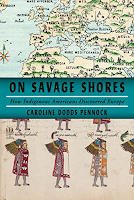
On Savage Shores: How Indigenous Americans Discovered Europe by Caroline Dodds Pennock

Once the first shocks of invasion were past, the Native men (and occasionally women) who crossed the Atlantic for political purposes were ordinarily not isolated pioneers striking out into the unknown. They were sophisticated diplomats, aware of the nuances of what we would all international law (the foundations of which were being laid in this period, often in response to the challenges of indigenous diplomacy), and able to draw on the experience and support of previous travellers, legal advocates and colonial officials.

I'm looking forward to when, in a couple weeks, my friends and I return to Ocracoke Island in North Carolina, where we've been going every February for over a decade. The island is already rich with history--it was the favorite haunt of Blackbeard--but when I go this time, I'll be thinking of a story Caroline Dodds Pennock tells in her history On Savage Shores: Manteo and Wanchese, two Croatan men who had traveled to England in the late 16th century to meet Sir Walter Raleigh and Queen Elizabeth I, were on their way home when, off the shore of Ocracoke, then called Wococon, their ship ran aground and begun to sink. "We can only imagine the feelings of Manteo and Wanchese," Pennock writes, "after nearly a year away, fearing that they would die only metres from the soil of their homeland."

Today, Manteo and Wanchese are the names of the two towns on Roanoke island: Manteo "nicer" and Wanchese, perhaps, more "rustic." There's something in that that matches the separate paths of their lives; Manteo stayed loyal to the English and their interests in the New World, whereas Wanchese turned against the English and fomented resistance among the Croatan. What must have Wanchese seen in England that turned him against his former friends? Was it, like a Powhatan man who accompanied Matoaka (Pocahontas) on her journey, that he was shocked by the abundance of corn and wheat among the English who putatively had arrived in North America looking for resources? Or, as many other Indigenous sources report on their sojourns, was he aghast at the rampant inequality among Europeans? Or was he simply feeling jealous of the greater prestige given to Manteo who--as I did not know, despite having learned all about Manteo and Wanchese as a kid in North Carolina--helped to create the first Algonquin alphabet while in England?

As Pennock shows, we often think about the arrival of Europeans in the New World as a one-way endeavor: they arrived, took root, did some rather dirty deeds, and stayed. Our historical narratives, too, tend to face from west to east, looking through the eyes of the Europeans at a strange world full of resources and plunder. Rarely do we think about how Indigenous people looked back at Europe, or what they saw when they traveled there. As they did, apparently, in numbers that might seem to us surprising. Pennock splits these narratives up into six categories: "Slavery," which tells the stories of those who were forcibly removed from North America and whose labor was exploited in Europe; "Go-Betweens," for those who, like Manteo and Wanchese, acted as interpreters and envoys for European colonizers; "Kith and Kin," for those Indigenous people who married into European families and their children, who inherited lineages from two hemispheres; "The Stuff of Life," about the many resources, including tomatoes, potatoes, and tobacco, that crossed the Atlantic during the Columbian exchange and those who supplied them; "Diplomacy"--rather self-explanatory--; and "Spectacle and Curiosity," which tells stories like the tale of the Inuk man who wowed crowds by fishing in the Thames with a spear.

Just to consider the chapter titles is to understand how diverse the experiences of Indigenous people in Europe were. Some arrived in chains, but others arrived in full regalia, and were treated--after some prodding--as the kings they were. On Savage Shores recently attracted some negative attention from the kind of people who are devoted to coloring-book notions of European colonialism. Too bad they didn't really read it, because if they had, they might have noted that several stories in Pennock's book resist easy lefty narratives about colonial violence. Many Indigenous people were quite happy to ally themselves to European power for assistance in conquering their local enemies; others were simply politically def. For example, the city of Tlaxcala was pretty Machiavellian in the way it used Cortes and the Spanish to bring down its rival, Tenochtitlan; the Inca ensured some measure of survival by doing what European powers did, marrying into Spanish families. Which is not to say Pennock is anything but clear about the horrors of colonialism; one of the book's great challenges is to tease out stories and voices that were intentionally elided from the historical record. While factually scrupulous, Pennock engages in a necessary amount of supposition--What must Manteo and Wanchese have seen? Of course, what the book's malcontents really object to is the inclusion of Indigenous voices at all.

Here's one specific thing I didn't appreciate until reading On Savage Shores: not only did the Spanish really get to the Americas before the English and French, their approach to the Indigenous people they found there was totally different. They weren't any less brutal, really, but Indigenous people were assimilated into Spanish society more readily than that of their northern rivals. Sometimes that meant forced enslavement--I was shocked to read about how many Indigenous slaves there were in Spain, and how often they sued for their freedom by arguing that their enslavement was illegal, not to mention how often they succeeded--and sometimes it meant intermarriage. That alone goes a long way in explaining the contemporary differences between American and Canadian relationship to Indigenous people and Mexican or Latin American ones. I had often wondered why Mexican culture values the idea of mestizaje--a shared Indigenous heritage--in a way that's totally foreign to us up here.

The best thing I can say about On Savage Shores is this: it's one of those history books that seems so obviously needed, you wonder why nobody's written it before. Its simple reframing--what did Europe look like through Indigenous eyes?--turns so much of what we think we know about history on its head.

Saturday, January 14, 2023

All the Answers by Michael Kupperman

When you avoid talking about one conspicuous thing in a family, soon you stop talking about any conspicuous things in the family. It’s like a form of rot. My father’s early stardom became a piece of trivia. An odd fact that didn’t really mean anything, even as it influenced every aspect of our lives.


All the Answers opens in June 2015, with Michael Kupperman alone, staring out the window of his parents’ house, where his wife has dropped him off so he can do some work. Kupperman is a cartoonist, researching for his newest project, a memoir about his father, the once-famous Joel Kupperman--the Quiz Kid.

Quiz Kids, in case you don’t know--I didn’t--was a wildly popular radio and television program that ran from roughly 1940 -1956. It was, as the name indicates, a quiz show populated by children, albeit unusually intelligent ones, who answered trivia questions sent in by the listening (and later viewing) audience. Of the contestants, the most famous by far was Joel Kupperman, a six-year-old math prodigy who’s adorable lisp and precocious intelligence turned him, overnight, into a national sensation. There were books, poems, cameo appearances, and even a movie, and Joel met with many of the biggest stars of the era--he was everywhere. But like most child stars, Joel’s draw eventually waned, as he stayed on the show well past the normal 15 year old cut off, and, as Kupperman puts it he was “a contestant on a never-ending game show with no prizes. And he was overstaying his welcome.”

Finally, Joel left Quiz Kids, no one knows quite why or when, and found that, as a teenager known for being smart and compliant, he’d become a laughingstock among his peer group. Bullying and ostracism followed until he finally left the country, returned (narrowly avoiding disgrace amid the $64,000 Pyramid scandal, and reinvented himself as a philosopher, and a well-regarded one--dozens of his books are still in print and active use.

Alongside the history of Quiz Kids and Joel himself, Kupperman is examining a second, more pressing subject, the impact of his father’s history on his own life. Joel refused to speak about those years at all for most of Kupperman’s life, and it’s only when Kupperman is reestablishing his relationship with Joel, who is now falling into dementia, that he begins to piece together the puzzle of his father’s disconnection and how it relates to his exploitation as one of the original child stars.

The conversations between Kupperman and his father are the real backbone of the book, as interesting as the history is, providing answers that Kupperman manages to assemble into something coherent but which Joel, in spite of his quiz kid acumen,can’t quite put together himself. Kupperman, in the end, recognizes the irony that must have inspired the title--there is no secret chest where all the answers can be found, unless that chest is found in excavating ourselves and moving forward. Kupperman has this realization on the subway, just before entering a dark tunnel, having released the hope of finding answers and speeding, willingly or not, into the darkness to see what’s next.

With these graphic novels I’ve reviewed, I’ve spent little time on the art, not because I don’t think it’s important or meaningful, but because I feel like I lack the ability to really analyze the visuals the way they deserve. However, I’ve been a fan of Kupperman’s comics for a while, and the art here is a masterclass in adapting a style that looks simple on the surface to the situation. The conversations between Kupperman and Joel are rendered starkly, mostly tight drawings of faces against empty backgrounds, while the Quiz Kid years are busy, full of detail and historical color. But even in these years, Joel himself is often presented in small panels by himself, rarely with other faces present, emphasizing his isolation. All the Answers is rarely funny--most of Kupperman’s work is--but there’s a joy to the draftsmanship here in spite of the complex subject matter.

Kupperman has a Patreon, which I support, so I’m adding a link to that here as well. It’s a real treasure trove of his work, including a great piece about his years working for the New Yorker.

Monday, October 10, 2022

The Park and the People by Roy Rosenzwieg and Elizabeth Blackmar

On October 13, 1857, just two weeks after the park dwellers left their homes, the Board of Commissioners of the Central Park offered prizes of four hundred to two thousand dollars for the four best proposals for "laying out the park." This notice for the first important landscape design competition in the United States elicited thirty-three varied proposals, which revealed the influence of English and continental traditions of landscape design as well as more eclectic vernacular ideas about what would make this public place appealing. But when the commissioners opened the proposals six months later, they found one curious entry. Plan 2 by an anonymous contestant was nothing but a pyramid.

I love Central Park. For a while, I worked basically on its doorstep: two short blocks after work and I was at the beautiful Onassis reservoir. I'm a little farther away now, but a short subway ride in the afternoon takes me to one of many favorite spots: the Loch, a creek of still green water running through the North Woods, or the Ramble, a bird-filled jumble of looping paths designed to let you get lost. These are my spots, but what I've always loved about the park is how it is many things to many people. Someone else might gravitate toward the Great Lawn, or the Sheep Meadow, or the Harlem Meer, or the Bethesda Fountain, or the Nature Sanctuary, or one of the tennis courts of ballfields, or Belvedere Castle or Delacorte Theater, or the zoo, or one of the two world-class museums fit snugly inside of it: the Metropolitan Museum of Art and the American Museum of Natural History. So varied is the immense park that it's almost a surprise to learn just how contested a space it has been since it's very conception, as historians Roy Rosenzwieg and Elizabeth Blackmar show in their history of Central Park, The Park and the People.

Rosenzwieg and Blackmar begin their history with the contentious political battle over the park's location and design. Central Park was very nearly not central at all: early politicos wanted a spot on the East River known as Jones Wood for the city's first park, going so far as snatching it from its wealthy owners by the force of legislative decree, but years of jockeying led to the abandonment of the Jones Wood site in favor of a truly "central" park, then located far uptown from the city center. The design contest that led to the selection of Frederick Olmsted and Calvert Vaux's Greensward plan is the stuff of legend, though Rosenzwieg and Blackmar note that Olmsted had been selected as the park's director before the contest had even begun, putting his thumb on the scale somewhat. Still, Olmsted was a young unknown at the time, and with the development of Central Park, he and his architect partner Vaux basically invented the field of landscape architecture.

In the latter half of the 20th century, the historians note, Olmsted's historical reputation has grown tremendously. And to be fair, much of what is so stunning about the park can be traced back to its original design: when walking through the Ramble, you are walking more or less through the park as it was first design, and the section first opened to the public, tracing history in a literal way. But the historians show how the contested nature of the park space can be traced back even to the rifts between Olmsted and Vaux. Olmsted put more pride in his position as the park's managing director than he did as its designer, and believed that a firm hand was needed in managing the public's use of the park, instituting a number of draconian rules, including a prohibition on walking on the park's grass. Vaux, for his part, had a more generous opinion of the public, and believed that a beautiful space like Central Park would inspire New Yorkers to be the most elevated versions of themselves.

It would be a little too neat to say that Olmsted was the avatar of future park stewards who felt it was their duty to defend the rustic nature of the park against the creep of recreational uses, or that Vaux was the avatar of those who imagined a changing park that reflected the value of public opinion. Both men rejected outright those designs that would turn the park into a popular "pleasure garden," a kind of pre-amusement park that was popular at the time. But Vaux's bohemian spirit seems to me in keeping with the best elements of Central Park, and it is undeniably true, though it really goes unsaid in the book, that Vaux doesn't get nearly enough credit for his contributions to the park's design: the Greensward plan is drawn in Vaux's hand after all, not Olmsted's. Even in his own era Vaux complained to Olmsted time and again that he wasn't being given the credit he deserved, and he seems to have been right.

In any case, both men (and especially Olmsted) remained in official positions at the park for most of the latter 19th century, defending their control, sometimes successfully and sometimes not, against the city's powerful Tammany Hall machine. In the 20th century, Olmsted's strong hand would be rivalled by Robert Moses, who opened up the park to playground and car traffic, and who ruled the city's parks department with an iron fist. In between Olmsted and Moses, the park remained in states of waxing and waning, of being well-funded and well-maintained, then underfunded and in disrepair. In either state, the park's use was always contested: should it host concerts? The Puerto Rican day parade? Political demonstrations? Presidential speeches? Museums? Restaurants? Ice skating and baseball? Horse-drawn carriages? Automobiles? And as Rosenzwieg and Blackmar show, these battles often emerged from larger, competing ideas of what the city should do and be. Even in its very beginning, one sees the specter of American political upheaval in the clearing out of poor New Yorkers (especially the black community of Seneca Village, only belatedly memorialized in the park) to build it.

The Park and the People was written in 1992. When it ends, the boathouse at Harlem Meer is still in disrepair. A shady businessman named Donald Trump has just swooped in to renovate the Wollman Rink. (Though the book mentions the Central Park jogger rape case, no mention is made of Trump's famous "Bring Back the Death Penalty" ad.) The historians wonder what the increasing prevalence of private partnerships for park maintenance will do to the park as a place for all people. (Yeah, how did the privatization push of the 80's and 90's work out for us?) The Central Park Conservancy is barely a decade old. How nice it would be to have an updated version that would trace the last thirty years of Central Park, which doubtless lies at the center of all our conflicts about gentrification and urban renewal. Of course, we might learn only what has always been true: that Central Park is the heart of New York City, for good and bad.

Thursday, January 27, 2022

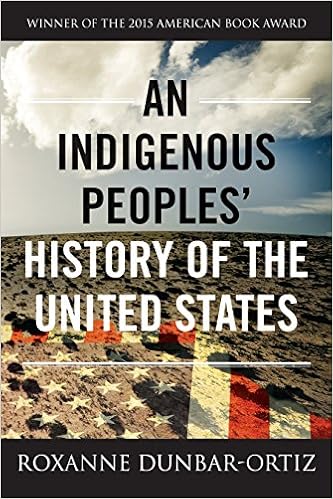
An Indigenous Peoples' History of the United States by Roxanne Dunbar-Ortiz

Neither superior technology nor an overwhelming number of settlers made up the mainspring of the birth of the United States or the spread of its power over the entire world. Rather, the chief cause was the colonial settler-state's willingness to eliminate whole civilizations of people to possess their land. This trend of extermination became common in the twentieth century as the United States seized military and economic control of the world, capping five hundred years of European colonialism and imperialism. The canny Prussian Otto von Bismarck, founder and first chancellor (1871-90) of the German empire, was prescient in observing, "The colonization of North America has been the decisive fact of the modern world." Jefferson was its architect. Andrew Jackson was the implementer of the final solution for the Indigenous peoples east of the Mississippi.

I remember learning about Indian boarding schools in high school--places where Native American children were sent to be stripped of their identity and assimilated into white society. I count myself lucky for that; as the graves of abused children continue to be discovered throughout the United States and Canada, I get to be slightly less shocked than most. I learned about the Trail of Tears, too, though I guess everybody does, and I was fortunate not to get the Saturday Evening Post version of the Thanksgiving story. But I wonder now about the things I never learned. I didn't learn--or don't recall learning--that the population of North America was about 80% that of Europe (though the majority of that were clustered in the Aztec Empire of central Mexico). I didn't learn that most of the continent the Europeans "discovered" was carefully cultivated and maintained. I didn't learn that the Pilgrims were only able to set up shop at Plymouth because a disease brought by white settlers had cleared the shore of Wampanoag for them. I didn't learn that the white-on-white fighting of the Civil War was a relative blip in a century-long campaign pitting the Army against Native nations. And though I knew about boarding schools I never learned about allotment, termination, or that anyone ever went back to Wounded Knee.

What does the history of America look like when you foreground the perspective of indigenous peoples? This is the project of Roxanne Dunbar-Ortiz's An Indigenous Peoples' History of the United States, which traces the experiences of the various Native nations who live in the land now called the United States from the advent of white settlers to the present day. In my schooling experience, Native Americans have tended to be bit players who waltzed onto the stage a few times--once at Jamestown, then Plymouth, and then the Trail of Tears, right before intermission--and disappeared into the wings. When the perspective shifts, a new story emerges, one of various nations at the edge of a white frontier that moves violently across the continent under the banner of "manifest destiny," a sanitizing belief in its own inevitability.

Dunbar-Ortiz's thesis, more or less, is that the extermination of Native peoples is not merely incidental the story of the United States, but integral to it. This claim may seem rather radical, and the prose is certainly incendiary (see the "final solution" language in the blurb above?), but it's hard to argue in the face of the narrative assembled here. Extermination, Dunbar-Ortiz notes, was the official policy of every president until 1890, and though the violence largely, arguably ended with Wounded Knee, the same ideology is behind the allotment and termination periods, which first attempt to turn Indians into capitalist homeowners, and then "regular Americans." And Dunbar-Ortiz shows how the past, as they say, is present, tracing the ways in which the myths that justified genocide are still part of the ideologies that bolster American identity today: the noble frontiersman, manifest destiny, the multicultural state. 

The United States of America, as Dunbar-Ortiz describes it, does not merely have its origins in a settler colonialist project, but remains one. The endemic and reinforced poverty of Native nations is a part of that. But America's global militarism, too, has its roots in the Indian wars: did you know, for example, that the Army uses the term "Indian Country" to mean "behind enemy lines?" This is not merely an anachronism. Dunbar-Ortiz seizes on Frederick Jackson Turner's "frontier" thesis--more or less, the idea that American identity and democracy are uniquely shaped by the frontier--to examine the ways in which the frontier's "closing" at the end of the 19th century provoked U.S. adventurism abroad. What would it mean, for example, to see the Vietnam war as a kind of colonial assault on indigenous people like the Black Hawk War or the Seminole War?

One of the strengths of An Indigenous Peoples' History of the United States is how deftly it extends the context of this history forward and backward, as well as outward. It's helpful to think, for instance, of how colonialism as a project has its roots in the Crusades, as well as the English Acts of Enclosure, and its immediate antecedent in the English conquest of Ireland. Did you know that the Scots-Irish are the descendants of Scottish planters granted Irish land by the English crown? I have heard this term literally all my life and did not realize that's what it referred to. It's these Scots-Irish who become, according to Dunbar-Ortiz, the "foot soldiers" of settler colonialism in the U.S., doing the dirty work of "opening up" the frontier as they are displaced by larger plantations. It's no coincidence, she points out, that many of the 19th century's most notorious Indian-killers, are the descendants of these Scots-Irish, like Andrew Jackson, or legendary frontiersmen like Daniel Boone and Davy Crockett. I always thought it was a funny coincidence that so many Tennesseans ended up in Texas that they call Tennessee the "Volunteer State," but seeing the frontier as an anti-indigenous movement makes it all make sense--when the frontier moved, so did the frontiersmen, though the indigenous people they had to move out of their way may have changed.

I found this book vital and sobering, especially at the beginning and the end, when it covered much of the historical territory that I know less about. My only criticism--and perhaps I don't read enough popular history to compare--is that it seems awfully short to cover so much ground. It was disarming, in a way, to see the bits I know better passed over in a few sentences. (Someone should show the three-sentence summary of the Nez Perce War to William T. Vollmann; it would have saved him a lot of time.) But in the end, it does what it sets out to do: inform and unsettle. I felt visceral disgust, and quite a bit of helplessness, reflecting on how central genocide is to the story of our country. But, as Dunbar-Ortiz notes in the book's final pages, the future is not written, and there is still hope that with a tremendous effort, this place can be "radically reconfigured, physically and psychologically."

Friday, July 27, 2018

The Sun King by Nancy Mitford

By day it had a different aspect, serving as the main street or market place of that City of the Rich.  It was packed with people; servants hurrying to and fro with messages, courtiers button-holing each other for a chat, or dashing at top speed from one ceremony to the next; cows and asses on their way to provide fresh milk for little princes--all this was occasionally pushed aside so that some royal sedan chair could get by, like the ministers' motor cars in a modern capital.  Here, too, could be seen foreign visitors and tourists, easily recognizable by their strange clothes and aimless gait, looking round them in wonder.  Versailles was more truly open to the public then than nowadays; anybody could wander in at any hour.  There were seldom fewer than two hundred fiacres waiting outside, where the car-park is now.  Hardly any of the rooms were banned to the ordinary citizen, but if by accident he should stray into one that was, a servant would quietly follow him, pretending that it was to draw a curtain or make up a fire, and point out his mistake in a low voice so that he would not feel humiliated.  The kings at Versailles, almost unguarded, lived in a perpetual crowd, and yet, in a hundred years there was only one half-hearted attempt at assassination.

Louis XIV reigned longer than any European monarch has to this day--nearly 72 years.  In that time, he oversaw the completion of the enormous palace known as Versailles, and the wholesale transfer of the French political class from Paris into it.  He also fought several wars, including the nearly ruinous War of the Spanish Succession, and witnessed the death of his son and his son's son, his two heirs, in close succession.  He's remembered today as an avatar of the divine right of kings, and the apotheosis of the symbolic power of use of wealth.

I think I thought Nancy Mitford's biography of Louis was a historical novel when I bought it.  It's not that; it's a straight history, but it doesn't read like a historical biography today might.  Though it's steeped in primary sources--mostly the letters and diaries of Louis' courtiers--there's minimal hand-wringing over how to balance or analyze or look through them.  The tone is breezy and casual, and enhanced by Mitford's keen eye for baroque detail, like the King's doctor who, "[w]hen obliged to go out, he covered himself with a morocco robe and mask and wore six pairs of stockings and several fur hats.  He always kept a bit of garlic in his mouth, incense in his ears, and a stick of rue sticking out of each nostril."  Mitford's account of L'affaire des Poisons, in which dozens of people, mostly women, including many courtiers and Louis' paramour Madame de Montespan, were accused of using poison and witchcraft to punish their rivals and, often, their spouses, is as lurid as it deserves to be.  I also did not know that the "Man in the Iron Mask"--a mysterious prisoner shuttled between French prisons, and kept in a mask all his life, thought by Voltaire to be the king's twin brother--was real.

Here's the thing: Louis XIV was a piece of shit.  I'm not sure how you can avoid this conclusion in 2018.  One of the big themes of his life, according to Mitford's account, is his shift toward piety after his second marriage to the devout Madame de Maintenon.  Louis regretted his early sexual escapades, and sought to live a more upright life, but that vision of piety never extended to a more conscientious treatment of France's poor.  In fact, Mitford frequently emphasizes that the Sun King hated hearing about the poor, and banished people that talked excessively about their plight from his presence.  The symbolism of Versailles, both in its ostentatious wealth and its pointed isolation from the common life, underscores the rottenness of the divine right of kings.  It hardly seems mitigated by the fact that Louis, at the height of the economic crisis of the War of Spanish Succession, "melted his gold plate and ate off silver gilt."

Mitford doesn't hide these aspects of Louis' character.  She calls his sense of religion that of a "clever child."  She goes out of her way to point out those who tried, and failed, to bring the poor to Louis' attention.  But mostly, The Sun King seems to admire Louis, and to believe that his shortcomings are balanced by the beauty of his existence.  The King's agony over the death of his wife, his lovers, his heirs, is the object of tremendous sympathy.  It's hard to shake the sense that Mitford, a socialite from a well-known British family, sees an essential beauty in Louis that reflects on her own station.  Maybe that's unfair--I don't know much about her, or her sisters.  But The Sun King definitely left me with a sense that the revolutionaries who sacked Versailles in 1789 came about 100 years too late.

Tuesday, March 22, 2016

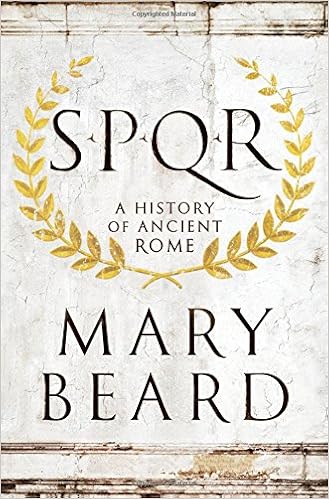
SPQR by Mary Beard

I no longer think, as I once naively did, that we have much to learn directly from the Romans--or, for that matter, from the ancient Greeks, or from any other ancient civilisation... But I am more and more convinced that we have an enormous amount to learn--as much about ourselves as about the past--by engaging with the history of the Romans, their poetry and prose, their controversies and arguments . Western culture has a very varied inheritance.  Happily, we are not the heirs to the classical past alone.  Nevertheless, since the Renaissance at least, many of our most fundamental assumptions about power, citizenship, responsibility, political violence, empire, luxury, and beauty have been formed, and tested, in dialogue with the Romans and their writing.

When Mary Beard's SPQR is described as a "popular history of Ancient Rome," it might be easy to miss the resonances hidden in the acronym: Senatus Populusque Romanus--the Senate and the Roman people.  It's a history which is written for the layperson, sure, but Beard's title intentionally draws our attention to that second populus, which is part of what makes the book so engaging.  It's not just a story of Great Men--though there are plenty of them here, from Romulus to Cincinnatus to Hannibal to Julius Caesar to Augustus--but also a book that pays special attention to what life was like for the average Roman citizen, who tends to get lost in the historical narrative.  What was it like to be a woman in Rome?  What about a slave?

That kind of approach can seem like a fuzzy kind of history, one that forsakes the clarity of what happened for the ephemera of domestic life.  But Beard makes a clear case that such an approach is necessary if we really want to engage with the problems and ideas that shaped the Roman consciousness over a millennium, and which continue, shadow-like, to inform our own problems and ideas today.  The class conflict between the Senate and the plebs, and later the optimates and populares, don't map neatly onto our own class conflicts, but man, are they recognizable.  So too the argument about citizenship--who gets to be a Roman, where, and why?--that preoccupied the ancients until universal citizenship was granted in the third century CE have their own echoes in our current political cycle.  The preemptive strike which utterly destroyed the city of Carthage in the Third Punic War looms large when we think about our own role as the world's mightiest military, and Beard carefully and consciously wants us to consider what it might have been like to be a Carthaginian.

But SPQR is also filled with those great, faintly familiar stories about power, intrigue, statecraft, and war which are the hallmarks of Edward Gibbon's The History of the Decline and Fall of the Roman Empire.  It's fun to read about Cicero railing against the traitor Catiline, even as Beard asks us to consider the hypothesis that Catiline was something of a popular reformer, rather than a venal turncoat.  And who doesn't love to hear about the bloody exploits of Nero, who fiddled while Rome burned and bungled the murder of his own mother, even as Beard points out that it's the murdered emperors, on whose perfidy their successors' legitimacy rested, seem to be the worst of the bunch?

SPQR hits a sweet spot for me--it reminds me of the history that I know already, and which fascinates, while prodding me to think in directions I might not have otherwise.  It's thoughtful in a way that a "popular history" probably doesn't have to be, and that's what makes it worth reading.

Wednesday, January 29, 2014

No Applause, Just Throw Money: The Book That Made Vaudeville Famous by Trav S. D.

I love Vaudeville.

Not that I love every goofy, borscht belt joke or watch the 3 Stooges on a loop (I swear!), but there’s something so strange and appealing about the scene, Hollywood before Hollywood was a thing, a massive cultural phenomenon that, aside from the filmed work of some of it’s bigger stars, has been largely forgotten by the public.

Trav S. D., who apparently runs a modern Vaudeville revue of some sort, gives the whole movement a popular history that anyone could enjoy. Thoroughly sourced and pithily written, Trav spends time with not only the most well-known stars of the Vaudeville stage, such as the Stooges, the Marx Brothers, Bill “Bojangles” Robinson, and Buster Keaton, but he also turns his eye to lesser performers--sword swallowers, contortionists, freaks, weirdos and lunatics--and, in doing so, brings out what a strange, wonderful world Vaudeville really was.

I particularly enjoyed the first couple chapters, where Trav traces Vaudeville’s history back to the travelling minstrels and theater troupes  in the Middle Ages, and even further, to the wild bacchanals of ancient Rome. While it seems like a little bit of a stretch to view Caligula as an early P. T. Barnum, if the shoe fits... From these inauspacious beginnings, Vaudeville developed from “Men Only” burlesque beginnings to the biggest show on earth, and then, in the span of only about a decade, was completely wiped out by motion pictures.

Although it’s doubtful that most of us would trade, say, Scorcese’s output to watch a man set himself on fire onstage, there is something sad about the disappearance of Vaudeville. Nowdays, unless you live in a large city, you probably don’t have much access to live theater and you certainly can’t see the large variety of things present in the average Vaudeville program. Trav also makes a fairly convincing, if somewhat rose-colored, case for Vaudeville’s inclusiveness of minorities and women and posits the movement on the whole as a net positive. I’m inclined to agree. In many ways, the rise and fall of Vaudeville seems like a uniquely American event, one brief moment when the melting pot came together to watch the world’s fattest lady do... whatever she did.

Saturday, August 3, 2013

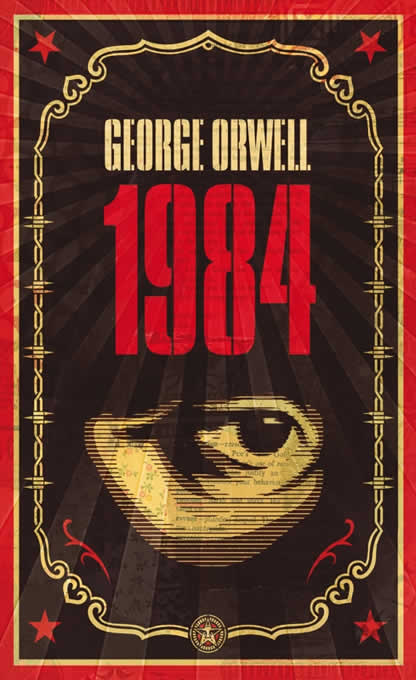
Nineteen Eighty-Four by George Orwell

He took a twenty-five cent piece out of his pocket.  There, too, in tiny clear lettering, the same slogans were inscribed, and on the other face of the coin the head of Big Brother.  Even from the coin the eyes pursued you.  On coins, on stamps, on the covers of books, on banners, on posters, and on the wrapping of a cigarette packet--everywhere.  Always the eyes watching you and the voice enveloping you.  Asleep or awake, working or eating, indoors or out of doors, in the bath or in the bed--no escape.  Nothing was your own except the few cubic centimeters inside your skull.

1984 is one of those books whose cultural influence completely outstrips its presence as a novel.  I mean that, even if you haven't read it, details and themes from it are so ingrained into the way we think about politics and society that you can't help but being familiar with it.  I have read it, and until I revisited it recently I have to admit that my mental conception of 1984 was still dominated by its pop culture distillations, which are often facile and shallow: Big Brother the television show, V for Vendetta and those stupid Guy Fawkes masks, the flaccid banality of most political protests in the post-Vietnam era.  Just this year I told a student who was reading 1984 to pick up Brave New World, because it was "much richer."

But you know what?  1984 is great.  It's much more subtle, more carefully wrought, and more terrifying than I had remembered.  First, I was struck by just how little happens in the novel.  (Spoilers commence, though if you haven't read it--what did you do in high school?)  There is the protagonist, Winston, an "Outer Party" member who secretly harbors unorthodox opinions and a skepticism about Big Brother and the Party establishment.  Winston allows himself small heresies at first--keeping a diary, for instance.  But then he becomes swept up in an affair with a young woman, Julia, who shares his antipathy.  They know that their affair, like all love and non-procreative sex, is a one-way ticket to the Ministry of Love, which enforces law and order in Airstrip One (the Party name for Britain--love that), and yet they go about it anyway.  They are recruited by a shadowy organization, the Brotherhood, and for a moment, it seems as if the novel is about to explode into espionage and action, but that is the very moment that the hammer drops and Winston and Julia are captured by the Party's Thought Police.

The Brotherhood turns out to be a ruse, of course, a tool of entrapment--an unnecessary one, since we learn that Winston has been under surveillance for his unorthodoxy for years and years.  I can't help but compare this to other dystopian works, all of which take after 1984 in a way: V for Vendetta is one, but also The Hunger Games.  These works are all about collective resistance, but 1984 remains more terrifying than these because resistance is clearly impossible, a foregone conclusion.  Winston knows from the moment he begins to write in his diary that he is a "dead person," and things go more or less exactly according to his fears.  In this way 1984 reminds me more of Never Let Me Go, another novel which explores the way that oppressive systems work to preclude even the idea of resistance.  There is no fighting back; the Party always wins; we know the famous last words of the novel which describe Winston's dissolution as an individual and complete subjugation to the state: "He loved Big Brother."

Second, I was struck by how philosophically rich the novel is.  It's easy to see 1984 as an allegory for the fascist and totalitarian movements that sprung up in Europe at the time of its writing, but Orwell's thoughts on power, history, and subjectivity deal in questions that have been around for thousands of years, including one of the most fundamental: "What is truth?"  The Party of 1984 operates by controlling the truth, falsifying facts and manipulating records so that history always seems to validate the Party's essential goodness.  The Party relies on a philosophy that negates any sense of "reality":

Only the disciplined mind can see reality, Winston.  You believe that reality is something objective, external, existing in its own right.  You also believe that the nature of reality is self-evident.  When you delude yourself into thinking that you see something, you assume that everyone else sees the same thing as you.  But I tell you, Winston, that reality is not external.  Reality exists in the human mind, and nowhere else.  Not in the individual mind, which can make mistakes, and in any case soon perishes; only in the mind of the Party, which is collective and immortal.  Whatever the Party holds to be truth is truth.  It is impossible to see reality except by looking through the eyes of the Party.  That is the fact that you have got to relearn, Winston.  It needs an act of self-destruction, an effort of the will.  You must humble yourself before you can become sane.

It strikes me that Orwell here is offering what we consider a very conservative philosophy, one that stresses the importance of an objective reality to political freedom and philosophical health.  One of the most interesting and useful ideas he offers is that of doublethink: a "Newspeak" word which means to hold two contrasting ideas in your head at a time, and to believe them both:

To know and not to know, to be conscious of complete truthfulness while telling carefully constructed lies, to hold simultaneously two opinions which cancelled out, knowing them to be contradictory and believing in both of them, to use logic against logic, to repudiate morality while laying claim to it, to believe that democracy was impossible and that the Party was the guardian of democracy, to forget whatever it was necessary to forget, then to draw it back into memory again at the moment when it was needed, and then promptly to forget it again, and above all, to apply the same process to the process itself--that was the ultimate subtlety: consciously to induce unconsciousness, and then, once again, to become unconscious of the act of hypnosis you had just performed.  Even to understand the word "doublethink" involved the use of doublethink.

I do not believe that the modern world is in danger of becoming the world of 1984.  One thing I think we are learning from the recent Snowden-NSA debacle is that one-way methods of surveillance are never truly one way, and that the better those in power get at watching us, the better we get at watching those in power.  But dystopian fictions are not really predictions, they are exaggerations, hyperbolic descriptions of attitudes and processes that already exist, and I see doublethink everywhere.  Our entire system of political discourse, with its rah-rah partisanship, is founded on doublethink, and the subjugation of truth to power.  We see it every time some Republican idea becomes cherished by Democrats and loathed by Republicans, or vice versa.

One of the scariest things about 1984 is the way that it shows how a really successful fascism doesn't merely pummel the opposition into non-existence.  ("If you want a picture of the future," Winston's interrogator tells him, "imagine a boot stamping on a human face--forever.")  It also enlists us in the oppression, and asks us to invest in power at the expense of truth.  If we really wanted to let Orwell be useful in the 21st century, we'd keep that in mind.

Tuesday, March 26, 2013

Capital of the World by Charlene Mires

When discussing government infrastructure, as I often do, the question sometimes arises, “Why is this organization located here, and not here?” I have always assumed that most buildings are placed by playing a riveting game of “Pin the Building on the Map” and then having a few drinks. I kid, but in truth, this is not a topic most people, myself included give a lot of thought to. Charlene Mires’ Capital of the World, which follows the United Nations from conception to finding its own place, reveals the truth behind the process: it’s not a game of darts, it’s more like a finely tuned farce, where dozens of setpieces move ridiculously before dovetailing, in the end, to a denouement that seems inevitable. One of the people in the book says it should be a movie; I’d like to nominate the Marx Brothers to star.

I don’t want to give the wrong impression: Mires’ book is not a work of humor. It’s a scholarly work whose bulk is nearly 25% endnotes and other appendices, and, though Mires is a good writer, she isn’t aiming for comedy. It’s just that, as the story plays out, it’s hard not to laugh. There’s a large cast of characters and the story is writ large on the world stage. Apparently, everyone wanted the U.N. in their backyard (except Concord, CT) and residents, from average Joes to the Rockefellers, fought to get it there. The size of the “capital” also went through various metamorphoses during the process: originally conceived as a small town, the U.N. eventually became a large compound instead.

There’s far too much content in Mires’ book to go into much detail about the process, but Mires keeps the book moving at a pretty steady pace, even if I did get a little bogged down once or twice in the endless litany of names and places presented for consideration. Of course, even that isn’t necessarily a bad thing--it probably accurately replicated how the U.N. felt after being approached dozens of times by boosters from South Dakota, Michigan, San Francisco, and, of course, New York. The material, which could potentially be very dry, is handled well, and I suspect that someone more attuned to world history or any of the civic areas the book touches on would enjoy it even more than I did. There are also numerous photos and sketches throughout, and they serve as a powerful illustration of how crazily monomanicial the various boosters got in pursuit of their cause.

In the end, the U.N. ends up in New York City, of course, and, to us 75 years later, the competition for the U.N. looks a little silly. Mires is aware of this, but she addresses it well at the end of the book when she says:
Looking back, if it all seems a little crazy, then we have lost touch with the atmosphere of determination, hope, and anxiety the characterized American society at the end of the Second World War. We have forgotten the time when people in cities and towns across the United States imagined themselves on the world stage--and not just the stage, but at its center as the stars of the show.
If you want to see if your hometown was a contender, check out the full list at Mires' blog, Capital of the World.