Showing posts with label Ancient Rome. Show all posts

Thursday, November 23, 2023

Emperor of Rome by Mary Beard

Yet it is also impossible not to be curious about emperors beyond the spin and the stereotypes. Can we get a view of those real-life human being, in all their ordinary human variety and frailty, who sat at the heart of the palace, as they hosted their dinners, greeted the senators at the salutatio, or just chatted to their slave barbers in the morning while they were shaved? And what was it like to be the ruler himself within a court culture of deference, deceit and dystopia? It is easy to understand how flattery humiliates the flatterers, even when it is spoken with knowing irony. We put ourselves more readily in the position of the underdog than of the autocrat. But the flattered are victims too. How did it feel to be the one person who knew that no one could ever be trusted to tell them the truth?

What must it have been like to be a Roman emperor? On one hand, you're so high above everyone else in the Empire that upon your death, you're likely to be elevated to the level of a god. Your face is on every coin, your words etched on buildings a thousand miles away; your likeness appears even on cookie presses, meaning you're devoured by your own subjects. On the other hand, much of your job, if it is a job, is taken up with settling small, petty disputes: as Mary Beard writes in Emperor of Rome, the central authority of the Emperor made him the final judge in all matters, and he spent a huge portion of his day settling disputes that came to him by mail, or were pressed into his hand by supplicants during his morning appearances. Perhaps more important was the emperor as symbol; first and foremost the emperors are called on to perform emperor-ness. Should we be surprised that emperors like Nero and Commodus took it a little too far, seizing the limelight on the stage, or the gladiatorial field?

I enjoyed Beard's SPQR, which sought to explain what life might have been like for ordinary citizens under the Roman Empire. Emperor of Rome, which takes the same methods and strategies but aims that at the top of Rome's social pyramid, left me even more impressed at Beard's abilities. What's so interesting about both books, I think, is that Beard really does manage to reorient one's perspective on ancient history, to see things in a new way, in a genre--let's face it, these are pop-history books; bound for airport tables--that rewards watered-down retreads. The magic is in Beard's simple, non-chronological approach. Instead of going emperor by emperor, Beard organizes the book into sections that deal with different aspects of the emperor's life: imperial banquets, royal palaces, foreign policy, relationships with slaves, relationships with women. The total impression is of a remarkably stable social system, with the emperor at top, that lasts for over two hundred years, before emperors became increasingly taken from outside Italy and power-sharing schemes became more common.

As in SPQR, one of the more interesting aspects of Emperor of Rome is the skeptical eye Beard turns toward our traditional notions of "good" and "bad" emperors. She begins the book with Elagabalus, remembered today--if he's remembered at all--for sexual perversions and cruel tricks. (Although, as Beard notes, there's an increasing acknowledgement of Elagabalus as a proto-trans figure, who implored his doctors to help him become a woman by surgically removing his genitals.) Beard reminds us that Elagabalus was only fourteen when he became emperor and eighteen when he was assassinated--how much of a true tyrant could he have been? The stories about Elagabalus--and Nero, and Caligula, and others--ought to be seen, Beard suggest, less as true indications of their character and rule, and more as stories that serve other interests: to posthumously illustrate the and govern the relationship between the emperor and the empire, or to indemnify a ruler whose claim to inheritance is shaky. Similarly, the stories of the "good" emperors, from Augustus to Marcus Aurelius, were spread at least in part by their successor who wanted to emphasize the unbroken--and virtuous--nature of their own power.

It doesn't sound all that fun to be emperor. You got to eat a lot of good food, but mostly you had to share it with senatorial guests at banquet to show your largesse. You could build your own house, and make it as big as you wanted, wherever you wanted, but in many ways you were a prisoner in that house, and as likely as not it would end up the site of your assassination. You had unlimited power, but the exercise of that power could be dreary, taken up by niggling complaints from your provincial governors and subjects alike. (As Beard notes, there was no such thing as a "grand strategy" or political agenda for most emperors, whose rule was mostly reactive rather than active. Even acts of conquest were mostly meant to project success and achievement "at home," and many conquered lands were barely governed and quickly abandoned.) There was no such thing as a private life; every aspect of your identity, from your family to your sexual preference, was absorbed into the empire. Your own flaws became the empire's flaws, and you'd better keep up performing your virtues, because those are the empire's virtues. You might become a divus when you die, but you could hardly enjoy that while you are alive. Still, it was a life that elevated men to such a symbolic status that we still remember their names today--for better or worse.

Monday, September 19, 2022

Awake by Harald Voetmann

Nature begets monsters, fire-breathing bulls with lion's teeth who imitate human speech and call our names to lure us from our tents and cabins. She created man solely so he could suffer, the only animal who cries, the only animal who knows death and understands the scope of its suffering. The only animal who understands that it is made to suffer for nature's amusement. He who believes himself meant for better things is the unknowing victim of nature's game, hardly better than an animal. My suggestion: We must learn to enjoy the cruel game, and so be it that it is at our own expense.

There are four voices in Danish classicist and novelist Harald Voetmann's Awake: First, the voice of Pliny the Elder, as recorded in his Historia Naturalis, a first century AD attempt at taxonomizing the natural world. Then, a second voice of Pliny, elaborating inwardly on his Historia, embellishing it with details from his childhood on the hard margins of the Roman Empire, which are perhaps meant to represent the final dictations to his slave Diocletes, whose is the third voice. The fourth voice is Pliny's nephew, Pliny the Younger, commenting on his uncle's final works after his death at the hands of Mt. Vesuvius.

Pliny, as he writes his final additions to the Historia, is an aging and miserable wreck, mostly unable to rise from his bed and covered in various excretions: first piss, then blood--he's prone to nosebleeds--then vomit. (There's a grim irony in our knowledge that it's a volcano, not these ailments, that do old Pliny in.) The elder Pliny, it seems, seeks to finish his categorization of nature because he fears and disdains it; as he sees it, death and misery are the ultimate ends of the natural world, and to know nature better is to have a map of the enemy's forces. In this attempt he makes suppositions of a grand and imaginative nature, which the Younger Pliny--more of a poet, but more of a skeptic, too--punctuates dismissively. When the elder Pliny, for example, records that he has seen stars descend on a ship and "hop like birds from place to place," his nephew notes: "He is confusing stars with fireflies or something."

I'm just a sucker for these fictionalized versions of real historical figures. Awake couldn't be less like The Organs of Sense in tone, style, and method, but it, too, is about the ambitious quest for scientific knowledge. Pliny worked with fewer tools than Liebniz or the astronomer of that book, and, relying only on the pieces of the Historia Naturalis replicated here, wrong about every single thing, but for him, too, the desire to know the universe bordered on a kind of madness. Unlike The Organs of Sense, Awake is deeply unsatisfying, even intentionally unsettling: Pliny the Elder claims to have paid a man to have sex with his daughter, who was born without any orifices whatsoever. Later, he sentences his own slave and scribe Diocletes to a horrible death by crucifixion, as if intent on participating in the very cruelty of nature he's set out to document. Awake is, like the life of Pliny (and us all) short, difficult, beset with lust and misery, and full of gross physical ailments.

Wednesday, March 18, 2020

Memoirs of Hadrian by Marguerite Yourcenar

Different persons have ruled me in turn, though none of them for long; each fallen tyrant was quick to regain power.  Thus have I played host successively to the meticulous officer, fanatic in discipline, but gaily sharing with his men the privations of war; to the melancholy dreamer intent on the gods; the lover ready to risk all for a moment's rapture; the haughty young lieutenant retiring to his tent to study his maps by lamplight, making clear to his friends his disdain for the way the world goes; and finally the future statesman.  But let us not forget, either, the base opportunist who in fear of displeasing succumbed to drunkenness at the emperor's table; the young fellow pronouncing upon all questions with ridiculous assurance; the frivolous wit, ready to lose a friend for the sake of a bright remark; the soldier exercising with mechanical precision his vile gladiatorial trade.  And we should include also that vacant figure, nameless and unplaced in history, though as much myself as all the others, the simple toy of circumstance, no more and no less than a body, lying on a camp bed, distracted by an aroma, aroused by a breath of wind, vaguely attentive to some eternal hum of a bee.

Machiavelli called Hadrian one of the "Five Good Emperors": a stretch of Roman emperors also including Nerva, Trajan, Antoninus Pius, and Marcus Aurelius, each of whom used power effectively and wisely, and who were distinguished from those who came before and after them by adopting a successor they thought deserving of leadership, rather than letting the role fall to their biological heirs.  Hadrian, if he's remembered at all today, is probably remembered for Hadrian's Wall, the defensive battlement that stretches across the narrowest part of Britain, and which still stands.  That's  a pretty good monument for Hadrian, who was a builder above all else, and who wisely fortified the edges of the empire.  Marguerite Yourcenar's novel Memors of Hadrian imagines the emperor toward the end of his life, crippled by disease, reflecting on his achievements and missteps in a long missive to the emperor-to-be Marcus Aurelius.

The obvious analog to Memoirs of Hadrian is John Williams' terrific novel Augustus.  Both mine the last days of the emperor's life, and the approach of terminal illness, for incredible pathos.  But Williams was interested in the way that myths and legends accrete around a person, and how the subject beneath them remains true to is own human weakness.  For that reason, Williams keeps Augustus from speaking on his own behalf until the end of the novel; it becomes the pulling away of a veil.

Hadrian is no Augustus: his achievements, while far-reaching, are hardly the stuff of legend.  He discards many of the territorial gains under his predecessor Trajan, knowing that they only make the empire more vulnerable to attack.  He builds cities and public works projects: temples, aqueducts, stadia, defensive battlements.  He spends much of his time away from Rome, visiting the far-flung places that Rome has conquered, seeking ways to incorporate these strange new lands into the body politic.  These achievements are not flashy, and they gain Hadrian little support in the Senate or fame in Rome, and yet they are more permanent than any of the bloodthirsty conquest perpetrated by Hadrian.  Hadrian's greatest gift is his far-reaching sense of time; he seeks a Rome that will endure for centuries, even while he's aware that nothing can endure forever.  This is a difficult wisdom that, in his last days, he applies to the realization of his own mortality.

Yourcenar imagines this mindset with great subtlety and generosity; the 20th century never filters through ironically.  It's not hard to imagine, with some concession to the language itself, that you're really reading the private thoughts of a 2nd century emperor.  Even privately, Hadrian can be wonkish and aloof, but from time to time the emperor lets great emotions bubble up.  The most convincing and tragic part of the book is when Hadrian's young lover Antinous has himself killed in a ritual sacrifice for Hadrian's good fortune without the emperor realizing it:

I descended the slippery steps; he was lying at the bottom, already sunk in the river's mud.  With Chabrias' aid I managed to lift the body, which had suddenly taken on the weight of stone.  Chabrias hailed some boatmen who improvised a stretcher from sail cloth.  Hermogenes, called in haste, could only pronounce him dead.  That body, once so responsive, refused to be warmed again or revived.  We took him aboard.  Everything gave way; everything seem extinguished.  The Olympian Zeus, Master of All, Saviour of the World--all toppled together, and there was only a man with greying hair sobbing on the deck of a boat.

I'd never heard this story, and I was affected by it here.  Yourcenar is able to do something extraordinary here: she bridges a gap of 1800 years to allow us to feel the pain of someone who would ordinarily seem impossibly remote.  In her afterword, Yourcenar emphasizes that the expanse of time is not as great as we think: "Some five and twenty aged men, their withered hands interlinked to form a chain, would be enough  to establish an unbroken contact between Hadrian and ourselves."  In this--the ability to compress the immensity of time, and make it seem not so immense--Yourcenar shares a gift with Hadrian himself.

Sunday, March 19, 2017

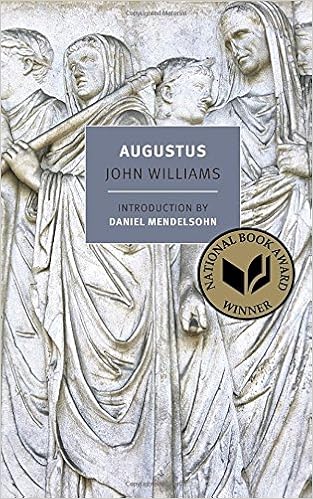
Augustus by John Williams

The young man, who does not know the future, sees life as a kind of epic adventure, an Odyssey through strange seas and unknown islands, where he will test and prove his powers, and thereby discover his immortality.  The man of middle years, who has lived the future that he once dreamed, sees life as a tragedy; for he has learned that his power, however great, will not prevail against those forces of accident and nature to which he gives the names of gods, and has learned that he is mortal.  But the man of age, if he plays his assigned role properly, must see life as a comedy.  For his triumphs and his failures merge, and one is no more the occasion for pride or shame than the other; and he is neither the hero who proves himself against those forces, nor the protagonist who is destroyed by them.  Like any poor, pitiable shell of an actor, he comes to see that he has played so many parts that there no longer is himself.

Augustus Caesar is one of those figures, like Alexander or Genghis Khan or Napoleon, whose life seems to defy the idea of interiority.  How can one really know someone whose effect on the world was so outsized?  Even Julius Caesar, the man who brought the Roman world under his heel, is humanized by the tragedy of his death, and the simple betrayal of his beloved Brutus.  Augustus, on the other hand, lived to be an old man, and put in the long, hard political work of solidifying the Roman state that Julius never had a chance to.  He created a lasting peace and an empire that lasted a thousand years; what could be said about him as a human being?

John Williams' Augustus has an interesting strategy for dealing with this problem.  His fictional life of Augustus is written as an epistolary novel, so that it seems that everyone in Rome is talking to or about Augustus--but, until the last fifty pages or so of the novel, Augustus himself is silent.

The first section of the novel deals with the aftermath of Julius' death and the long civil war that ended with the young Octavian's defeat of Mark Antony and the assumption of the title Augustus Caesar.  Antony, as most depictions do, borrows from Shakespeare's image of a vain, proud, and bungling fool who can't even get his own suicide right, yet who somehow retains a measure of shrewdness with dealing with the Roman people.  Octavian is young, and frequently dismissed, but his calm intelligence is more than a match for Antony.

The second section deals with Augustus' years in power, and focus on his conflict with his beloved daughter Julia, who was caught up in a plot against her father's life with her lovers and banished under the very anti-fornication laws that Augustus himself had passed decades earlier.  This section is interspersed with Julia's diary entries from her exile on the tiny island of Pandetaria, where she lived out teh rest of her life, never speaking to her father again.  Julia's letters show a sad and quiet resignation for her fate; others write exultantly in their political triumph. 

But the last section, a long letter written by Augustus as he knows he is dying, is what makes Augustus a terrific book.  Is the real Augustus ruthless, shrewd, loving, foolish, lucky, adulterous, loyal?  As an old man (like his adoptive father never got to be) Augustus has come to understand that all these things are true, and that at the end of his life the certitude of his ego has begun to fall away.  Williams paints a picture of a man who has given his life, his identity, even his daughter to the service of Rome even as he understands that his achievements will only be temporary.  He wonders if these sacrifices were worth it, and then zen-like waves the question away with the gesture of his hand--worth it or not, they were.  The elegiac quality of this final section--interspersed with the dry, guarded words of Augustus' actual Res Gestae, his own account of his achievements--pushes the novel beyond the self-prepossessing political intrigue of a book like I, Claudius.

All the famous characters of the early Empire are here: Julius, Vergil, Horace, Ovid, Maecenas, Agrippa, Cleopatra, Antony, Lepidus, Tiberius.  But it's the voice of Augustus himself, kept hidden until the very end, that makes Augustus feel as if it has some real insight into the past, and into the riddle of the human self.

Tuesday, March 22, 2016

SPQR by Mary Beard

I no longer think, as I once naively did, that we have much to learn directly from the Romans--or, for that matter, from the ancient Greeks, or from any other ancient civilisation... But I am more and more convinced that we have an enormous amount to learn--as much about ourselves as about the past--by engaging with the history of the Romans, their poetry and prose, their controversies and arguments . Western culture has a very varied inheritance.  Happily, we are not the heirs to the classical past alone.  Nevertheless, since the Renaissance at least, many of our most fundamental assumptions about power, citizenship, responsibility, political violence, empire, luxury, and beauty have been formed, and tested, in dialogue with the Romans and their writing.

When Mary Beard's SPQR is described as a "popular history of Ancient Rome," it might be easy to miss the resonances hidden in the acronym: Senatus Populusque Romanus--the Senate and the Roman people.  It's a history which is written for the layperson, sure, but Beard's title intentionally draws our attention to that second populus, which is part of what makes the book so engaging.  It's not just a story of Great Men--though there are plenty of them here, from Romulus to Cincinnatus to Hannibal to Julius Caesar to Augustus--but also a book that pays special attention to what life was like for the average Roman citizen, who tends to get lost in the historical narrative.  What was it like to be a woman in Rome?  What about a slave?

That kind of approach can seem like a fuzzy kind of history, one that forsakes the clarity of what happened for the ephemera of domestic life.  But Beard makes a clear case that such an approach is necessary if we really want to engage with the problems and ideas that shaped the Roman consciousness over a millennium, and which continue, shadow-like, to inform our own problems and ideas today.  The class conflict between the Senate and the plebs, and later the optimates and populares, don't map neatly onto our own class conflicts, but man, are they recognizable.  So too the argument about citizenship--who gets to be a Roman, where, and why?--that preoccupied the ancients until universal citizenship was granted in the third century CE have their own echoes in our current political cycle.  The preemptive strike which utterly destroyed the city of Carthage in the Third Punic War looms large when we think about our own role as the world's mightiest military, and Beard carefully and consciously wants us to consider what it might have been like to be a Carthaginian.

But SPQR is also filled with those great, faintly familiar stories about power, intrigue, statecraft, and war which are the hallmarks of Edward Gibbon's The History of the Decline and Fall of the Roman Empire.  It's fun to read about Cicero railing against the traitor Catiline, even as Beard asks us to consider the hypothesis that Catiline was something of a popular reformer, rather than a venal turncoat.  And who doesn't love to hear about the bloody exploits of Nero, who fiddled while Rome burned and bungled the murder of his own mother, even as Beard points out that it's the murdered emperors, on whose perfidy their successors' legitimacy rested, seem to be the worst of the bunch?

SPQR hits a sweet spot for me--it reminds me of the history that I know already, and which fascinates, while prodding me to think in directions I might not have otherwise.  It's thoughtful in a way that a "popular history" probably doesn't have to be, and that's what makes it worth reading.

Monday, January 23, 2012

Coriolanus by William Shakespeare

His nature is too noble for the world:
He would not flatter Neptune for his trident,
Or Jove for ‘s power to thunder.

Coriolanus, by most reckonings Shakespeare’s last tragedy, is probably also his least known (Only Timon of Athens or Cymbeline could really contest it for obscurity, I think), but since there’s a new film adaption that’s been getting rave reviews, it seemed like a good time to give it a shot.

Coriolanus is a warrior, but not just any warrior. He’s more like a Shakespearean Superman, completely fearless and virtually indestructible. However, unlike Othello, maybe his closest analog, he isn’t beloved. He’s arrogant and has little regard for the opinions of those he considers beneath him, which is almost everyone, excluding his mother, Voluminia, his wife, Virgilia, and his mentor, Menenius, . Having returned from a battle with the Volsces, led by his chief rival, Tullus Arfidius, in which he more-or-less singlehandedly won the day, Coriolanus is honored by the senate, but, through the scheming of certain senators, the people are turned against him, and his day of victory becomes one of sorrow, as he is exiled from Rome. He allies himself with Arfidius, his former enemy, to destroy Rome, but, at the last minute, is convinced by his mother to broker a peace instead. Of course, this being a tragedy, he is betrayed and killed in the final pages of the play.

Coriolanus is a little different from the typical Shakespearean lead because we’re not given much of a glimpse into his psyche. There are no real soliloquies, no soul-searching, for him. He’s a man’s man, a warrior who values battle and valor for their own sake and always speaks his mind. He’s not a very sympathetic protagonist in a lot of ways, but the conspiracies that slowly destroy his life turn him into an antihero for the people—a term the patrician Coriolanus would probably detest—in the sense that, who hasn’t felt like they were under-appreciated despite clearly being the best at what they do?

There’s an interesting fascist undertone to the play as well. Coriolanus is openly contemptuous of the common folk, disparaging them for wanting to influence the workings of empire, and, while the play never explicitly states that he is correct, his tragic heroism gives his statist leanings a sheen of idealism, something for Shakespeare scholars to fight over for a while, when they get tired of arguing about sexism in Taming of the Shrew.

Wednesday, November 9, 2011

Cleopatra by Stacy Schiff

The personal inevitably trumps the political, and the erotic trumps all: We will remember that Cleopatra slept with Julius Caesar and Mark Antony long after we have forgotten what she accomplished in doing so, that she sustained a vast, rich, densely populated empire in its troubled twilight, in the name of a proud and cultivated dynasty.

Stacy Schiff's Cleopatra is a dogged attempt at the resuscitation of one woman's reputation, sullied over two millennia by misogynists, xenophobes, and axe-grinders. It is perhaps a little late--I suspect that our modern aversion to outdated stereotypes of manipulative and unserious women has scrubbed off much of the tarnish--Cleopatra's reputation as the Great Seducer remains. Schiff doesn't deny Cleopatra's erotic appeal, but traces it to her eloquence, not her lasciviousness, and affirms her canny political acumen. After all, as Pharaoh and later Queen of Egypt, Cleopatra was in a precarious position on a Mediterranean shore being carved up by decades of Roman civil war, and her alliance with two of its most preeminent power holders--Julius Caesar and Mark Antony--ensured her survival for decades in a kingdom where monarchs frequently lasted months, or weeks.

The shortcomings of Schiff's project are many, but they are perhaps not her fault. The long stretches in which Cleopatra takes a backseat to the machinations between Antony and Octavian are probably necessary, both for our understanding and because of a spotty historical record. She is probably right when she argues that Cleopatra's record has been maligned, but when she has torpedoed the bias of ancient historians, she frequently finds herself lacking much material to go on. This is disguised in part by presenting the book as stridently non-academic--she quotes, many times, "one ancient historian," and buries the citation in the endnotes--but this is also it's greatest strength: it's fairly engrossing, and its narrative compelling.

One of the most appealing parts of the book for me was the fulsome descriptions of ancient Alexandria, the (I had not realized) foremost city of the world at the time. Rome was a rustic backwater, but Alexandria "remained a swirl of reds and yellows, a swelling kaleidoscope of music, chaos, and color. Altogether it was a mood-altering city of extreme sensuality and high intellectualism, the Paris of the ancient world: superior in its ways, splendid in its luxuries, the place to spend your fortune, write your poetry, find (or forget) a romance, restore your health, reinvent yourself, or regroup after having conquered vast swaths of Italy, Spain, and Greece over the course of a Herculean decade." Schiff makes much of Cleopatra's expense records, with their absurd numbers of suckling pigs and oysters and golden everythings, and it's easy to see why a man like Antony, with his imperial pretensions, would have such a difficult time returning to Rome, Cleopatra notwithstanding. For Schiff, Alexandria is an image of Cleopatra herself: seductive, exuberant, but also marked by intelligence, prosperity, and a vaunted heritage.

In the end, of course, Schiff cannot excuse the simple fact that Cleopatra's acumen came up short: whether you believe they were in love or not, Cleopatra backs the wrong horse in Antony. In fact, Schiff is nearly undone by her alluring portrait of Alexandria. Cleopatra and Antony's disastrous flight at Actium, a battle staged only to give them a chance to escape back to Egypt once at sea, makes Antony look like a man more desperate to return to luxury than to rule the world. Nor does her description of Antony as a "great brooding hulk" after Actium mitigate the traditional perspective that Cleopatra held undue sway over the once-powerful general.

The greatest part of the story, as it is in Shakespeare (soon to come), the end: Antony, having mangled his own suicide, dying in Cleopatra's arms; Cleopatra committing hers surreptitiously, and somewhat triumphantly, under the watchful eye of Octavian's guard. She cynically implodes the story of the asp, saying that "[a] woman known for her crisp decisions and meticulous planning would surely have hesitated to entrust her fate to a wild animal." But, she suggests, there is always the possibility that Octavian, remembering the sympathy unwittingly engendered toward Cleopatra's captured sister Arsinoe in Julius Caesar's triumph decades before, had her killed. "While her death reduced the glory a little," she writes, "it also eliminated a host of complications."

My Roman history is not quite as thorough as my Latin degree might suggest. But it seems to me that either Schiff is a popular biographer, not a historian, and thus odd to be the first person to voice this suspicion--or she's working from sources she fails to cite. Is that prejudiced? Maybe. But if reputations are going to be resuscitated, it ought to be by means more stringent than the histories that maligned them in the first place.

But that's pedantic. Cleopatra succeeds, in the end, by straddling the line between popular non-fiction and thorough historical assessment. She won the Pulitzer prize for her biography of Vera Nabokov, and it wouldn't surprise me to see this make the shortlist either.