Showing posts with label Augustus Caesar. Show all posts

Sunday, March 19, 2017

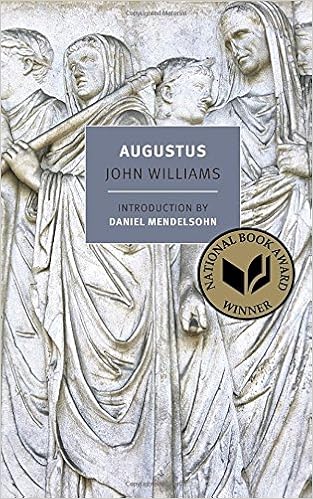
Augustus by John Williams

The young man, who does not know the future, sees life as a kind of epic adventure, an Odyssey through strange seas and unknown islands, where he will test and prove his powers, and thereby discover his immortality.  The man of middle years, who has lived the future that he once dreamed, sees life as a tragedy; for he has learned that his power, however great, will not prevail against those forces of accident and nature to which he gives the names of gods, and has learned that he is mortal.  But the man of age, if he plays his assigned role properly, must see life as a comedy.  For his triumphs and his failures merge, and one is no more the occasion for pride or shame than the other; and he is neither the hero who proves himself against those forces, nor the protagonist who is destroyed by them.  Like any poor, pitiable shell of an actor, he comes to see that he has played so many parts that there no longer is himself.

Augustus Caesar is one of those figures, like Alexander or Genghis Khan or Napoleon, whose life seems to defy the idea of interiority.  How can one really know someone whose effect on the world was so outsized?  Even Julius Caesar, the man who brought the Roman world under his heel, is humanized by the tragedy of his death, and the simple betrayal of his beloved Brutus.  Augustus, on the other hand, lived to be an old man, and put in the long, hard political work of solidifying the Roman state that Julius never had a chance to.  He created a lasting peace and an empire that lasted a thousand years; what could be said about him as a human being?

John Williams' Augustus has an interesting strategy for dealing with this problem.  His fictional life of Augustus is written as an epistolary novel, so that it seems that everyone in Rome is talking to or about Augustus--but, until the last fifty pages or so of the novel, Augustus himself is silent.

The first section of the novel deals with the aftermath of Julius' death and the long civil war that ended with the young Octavian's defeat of Mark Antony and the assumption of the title Augustus Caesar.  Antony, as most depictions do, borrows from Shakespeare's image of a vain, proud, and bungling fool who can't even get his own suicide right, yet who somehow retains a measure of shrewdness with dealing with the Roman people.  Octavian is young, and frequently dismissed, but his calm intelligence is more than a match for Antony.

The second section deals with Augustus' years in power, and focus on his conflict with his beloved daughter Julia, who was caught up in a plot against her father's life with her lovers and banished under the very anti-fornication laws that Augustus himself had passed decades earlier.  This section is interspersed with Julia's diary entries from her exile on the tiny island of Pandetaria, where she lived out teh rest of her life, never speaking to her father again.  Julia's letters show a sad and quiet resignation for her fate; others write exultantly in their political triumph. 

But the last section, a long letter written by Augustus as he knows he is dying, is what makes Augustus a terrific book.  Is the real Augustus ruthless, shrewd, loving, foolish, lucky, adulterous, loyal?  As an old man (like his adoptive father never got to be) Augustus has come to understand that all these things are true, and that at the end of his life the certitude of his ego has begun to fall away.  Williams paints a picture of a man who has given his life, his identity, even his daughter to the service of Rome even as he understands that his achievements will only be temporary.  He wonders if these sacrifices were worth it, and then zen-like waves the question away with the gesture of his hand--worth it or not, they were.  The elegiac quality of this final section--interspersed with the dry, guarded words of Augustus' actual Res Gestae, his own account of his achievements--pushes the novel beyond the self-prepossessing political intrigue of a book like I, Claudius.

All the famous characters of the early Empire are here: Julius, Vergil, Horace, Ovid, Maecenas, Agrippa, Cleopatra, Antony, Lepidus, Tiberius.  But it's the voice of Augustus himself, kept hidden until the very end, that makes Augustus feel as if it has some real insight into the past, and into the riddle of the human self.

Wednesday, November 9, 2011

Cleopatra by Stacy Schiff

The personal inevitably trumps the political, and the erotic trumps all: We will remember that Cleopatra slept with Julius Caesar and Mark Antony long after we have forgotten what she accomplished in doing so, that she sustained a vast, rich, densely populated empire in its troubled twilight, in the name of a proud and cultivated dynasty.

Stacy Schiff's Cleopatra is a dogged attempt at the resuscitation of one woman's reputation, sullied over two millennia by misogynists, xenophobes, and axe-grinders. It is perhaps a little late--I suspect that our modern aversion to outdated stereotypes of manipulative and unserious women has scrubbed off much of the tarnish--Cleopatra's reputation as the Great Seducer remains. Schiff doesn't deny Cleopatra's erotic appeal, but traces it to her eloquence, not her lasciviousness, and affirms her canny political acumen. After all, as Pharaoh and later Queen of Egypt, Cleopatra was in a precarious position on a Mediterranean shore being carved up by decades of Roman civil war, and her alliance with two of its most preeminent power holders--Julius Caesar and Mark Antony--ensured her survival for decades in a kingdom where monarchs frequently lasted months, or weeks.

The shortcomings of Schiff's project are many, but they are perhaps not her fault. The long stretches in which Cleopatra takes a backseat to the machinations between Antony and Octavian are probably necessary, both for our understanding and because of a spotty historical record. She is probably right when she argues that Cleopatra's record has been maligned, but when she has torpedoed the bias of ancient historians, she frequently finds herself lacking much material to go on. This is disguised in part by presenting the book as stridently non-academic--she quotes, many times, "one ancient historian," and buries the citation in the endnotes--but this is also it's greatest strength: it's fairly engrossing, and its narrative compelling.

One of the most appealing parts of the book for me was the fulsome descriptions of ancient Alexandria, the (I had not realized) foremost city of the world at the time. Rome was a rustic backwater, but Alexandria "remained a swirl of reds and yellows, a swelling kaleidoscope of music, chaos, and color. Altogether it was a mood-altering city of extreme sensuality and high intellectualism, the Paris of the ancient world: superior in its ways, splendid in its luxuries, the place to spend your fortune, write your poetry, find (or forget) a romance, restore your health, reinvent yourself, or regroup after having conquered vast swaths of Italy, Spain, and Greece over the course of a Herculean decade." Schiff makes much of Cleopatra's expense records, with their absurd numbers of suckling pigs and oysters and golden everythings, and it's easy to see why a man like Antony, with his imperial pretensions, would have such a difficult time returning to Rome, Cleopatra notwithstanding. For Schiff, Alexandria is an image of Cleopatra herself: seductive, exuberant, but also marked by intelligence, prosperity, and a vaunted heritage.

In the end, of course, Schiff cannot excuse the simple fact that Cleopatra's acumen came up short: whether you believe they were in love or not, Cleopatra backs the wrong horse in Antony. In fact, Schiff is nearly undone by her alluring portrait of Alexandria. Cleopatra and Antony's disastrous flight at Actium, a battle staged only to give them a chance to escape back to Egypt once at sea, makes Antony look like a man more desperate to return to luxury than to rule the world. Nor does her description of Antony as a "great brooding hulk" after Actium mitigate the traditional perspective that Cleopatra held undue sway over the once-powerful general.

The greatest part of the story, as it is in Shakespeare (soon to come), the end: Antony, having mangled his own suicide, dying in Cleopatra's arms; Cleopatra committing hers surreptitiously, and somewhat triumphantly, under the watchful eye of Octavian's guard. She cynically implodes the story of the asp, saying that "[a] woman known for her crisp decisions and meticulous planning would surely have hesitated to entrust her fate to a wild animal." But, she suggests, there is always the possibility that Octavian, remembering the sympathy unwittingly engendered toward Cleopatra's captured sister Arsinoe in Julius Caesar's triumph decades before, had her killed. "While her death reduced the glory a little," she writes, "it also eliminated a host of complications."

My Roman history is not quite as thorough as my Latin degree might suggest. But it seems to me that either Schiff is a popular biographer, not a historian, and thus odd to be the first person to voice this suspicion--or she's working from sources she fails to cite. Is that prejudiced? Maybe. But if reputations are going to be resuscitated, it ought to be by means more stringent than the histories that maligned them in the first place.

But that's pedantic. Cleopatra succeeds, in the end, by straddling the line between popular non-fiction and thorough historical assessment. She won the Pulitzer prize for her biography of Vera Nabokov, and it wouldn't surprise me to see this make the shortlist either.