Showing posts with label Biography. Show all posts

Sunday, September 14, 2025

The Dazzling Paget Sisters by Ariane Bankes

What elusive quality is it that propels people into the centre of things? My mother, Celia Paget, and her identical twin sister Mamaine seemed to possess that quality, to gravitate towards the very heart of the era in which they lived. Born in 1916 and brought up in relative simplicity in rural Suffolk, their lives became entangled with some of the most remarkable figures of the twentieth century, whether as friends or lovers, muses or wives.

The Paget sisters were identical twins who went from reluctant debutantes to society darlings, eventually becoming enmeshed in the social circles of England's greatest mid-century authors. Celia was a longtime lover of George Orwell, while her twin sister Mamaine was the lover and eventually wife of Orwell's friend and intellectual rival Arthur Koestler, the Hungarian emigre known for his novel Darkness at Noon. Mamaine carried on a brief, torrid affair with Albert Camus, and around the margins of their lives other literary greats hung: Beauvoir and Sartre, of course, as well as Andre Malraux and others. The Dazzling Paget Sisters, written by Celia's daughter Ariane Bankes, seeks to discover what it is that drew her mother and aunt "into the centre of things."

What that "elusive quality" was, I'm not quite sure. Apparently (as one can tell easily from the cover) both twins were quite beautiful, and they had a kind of twinly, otherworldly connection with each other. The question seems like a powerful one--why would these two ordinary girls from Suffolk end up so wrapped up with the century's literary greats?--but Bankes' biography mostly has the effect of demythologizing the very question she poses. The answer seems to be part privilege and part happenstance: the girls were "picked up" by a society maven named Dick Wyndham, who introduced them to these writers. As the story of their lives unfolded, I began to understand their lives not as a series of unlikely brushes with greatness, but something more ordinary: these writers, of course, all knew each other, and it stands to reason that their social circle included people who weren't writers.

What I enjoyed most about The Dazzling Paget Sisters was learning more about the emerging tensions between this circle as the Cold War began. Koestler in particular, who modeled Darkness at Noon on the Soviet gulag, spared no mercy for his fellow writers who let their Socialist sympathies lead them toward the USSR. This led to both Koestler and Mamaine becoming, half-willingly, useful operatives for the CIA, something I wish the book had explored in more detail. And I was interested, of course--who wouldn't be--in the doomed romantic dalliance between Mamaine and Camus, under Koestler's nose. But mostly, I felt that The Dazzling Paget Sisters might have been better served by an author other than Celia's daughter, who approaches the material in a hyper-faithful chronological way that never quite penetrates the surface. It made me wonder if someone with more of an outside perspective, with less loyalty to the letter of the story, might have found a way in to the real "centre of things."

Tuesday, March 4, 2025

Alexander's Bridge by Willa Cather and Chasing Bright Medusas by Benjamin Taylor

He happened to be engaged in work of public utility, but he was not willing to become what is called a public man. He found himself living exactly the kind of life he he had determined to escape. What, he asked himself, did he want with these genial honors and substantial comforts? Hardships and difficulties he had carried lightly; overwork had not exhausted him; but this dead calm of middle life which confronted him, -- of that he was afraid. He was not ready for it. It was like being buried alive.

Bartley Alexander is a renowned builder of bridges. He's hard at work on a bridge in Canada that will be the world's longest cantilever bridge, and his reputation has made him a public figure of know-how and enterprise. He's married to an elegant, pragmatic woman named Winifred, but on a trip to London, he reconnects with a spirited Irish actress named Hilda, whom he threw over to marry his now-wife. Meeting her again reignites his passion, and soon they are in the throws of a love affair that sunders Bartley's personality between the private and the public, and threatens to destroy him.

Alexander's Bridge was Cather's first novel. It was followed less than a year later by a masterpiece, O Pioneers!; Alexander's Bridge is not a masterpiece. It wears its debt to Henry James openly on its sleeve, but Cather was never a very Jamesian writer. James might have worked out the psychology of Bartley's affair to the most minute detail, but Cather's writing is all wrong for intricacy. Her characters are too plainspoken, to us and to themselves; there's not many shades of sentiment or feeling. Cather tends to say one thing and to say it well. It's perhaps unfair to think of it this way, but it's why she's so much more talented at capturing the life of a Nebraska homesteader, whose life, like her prose, is made up of the most simple things in delicate and meaningful arrangement. The Boston-to-London life of Bartley Alexander makes more room for a Jamesian artifice that Cather seems to think she's interested in, but isn't.

The novel ends--spoiler--with the collapse of the record-breaking bridge in Canada. Bartley has had to skimp on materials to meet the cost demands of his benefactors, but there's no way to test whether they'll hold until the bridge is built. They don't, and Bartley is drowned in the collapse of his greatest achievement. This ending really is beneath the writer that Cather would become: pointedly symbolic, but not really integrated with character or plot. The bridge collapses because Bartley collapses, riven by his double life, but this image is too easy and too predictable to really work.

That the novel of manners was not her metier she had to learn the hard way, by writing one. Alexander's Bridge is a case of borrowed finery, as she felt almost immediately on its completion. Still, reading it today one fids much to admire in the book's tragic love triangle.... One cannot help suspecting Cather was here expressing the divided state of her own personal life, split as it was between two women, Isabelle and Edith. This cannot be demonstrated; I only propose it here as a possibility.

In his biography of Cather, Chasing Bright Medusas, Benjamin Taylor describes Alexander's Bridge as a failure that Cather was aware of. She was pushing forty; to have her first novel as an artistic failure might have scared her off forever. Thank God she kept on writing and produced O Pioneers!. Taylor's book marches dutifully through Cather's life from book to book and story to story, and its clear that the author is a passionate fan who loves the texts about which he's writing. The book--which is very short for a biography--lingers most leisurely when discussing the books themselves. Much of the book is taken up with unpacking the tone and quality of the books' reviews--which were deemed a success, which a failure, etc., etc.

All that, I thought, comes at the cost of never really dipping too far past the surface of Cather's life. We get the fascinating tidbit, which I did not know, that Cather's lifelong "companion" Edith Lewis was actually her second love, after a woman named Isabelle McClung who broke Cather's heart by marrying. What her compensatory relationship with Edith was like is barely touched upon here. Perhaps there's little way to know what went on in this "Boston marriage," but Cather and her writing are too much the focus here to really admit anyone else. Like Cather's novels, the biography is made up of simple stuff delicately arranged, but like all homages and imitations, it pales against the quality of the master.

Sunday, June 25, 2023

Crazy Horse: The Strange Man of the Oglalas

Sometimes it was days before visiting warriors saw the man they had come to follow, for often Crazy Horse kept far from the noise and the drumming, perhaps making a fast, hoping for a vision or a dream to tell him what must be done. It seemed if he could make himself more a part of the earth and the sky and the things between that a way would come to save the people. He even tried the medicine things of the Old Ones, and for two days he looked unmoving towards the Black Hills, overrun as by ants digging up the rocks and the cool green valleys and the slopes red with the grass berries so sweet to the tongue. But it was no more than a wind in the gully and n his way back to camp he saw that the buffalo chips were indeed becoming few, the trees no longer rubbed smooth by the backs of the shedding herds.

What a nice coincidence to be able to write this review on the anniversary of the victory of a coalition of Lakota and Cheyenne fighters at the Little Bighorn, or as they call it, the Battle of the Greasy Grass. During that fight, the larger force of Indian fighters utterly destroyed the forces of General George Armstrong Custer, killing Custer and almost every other American soldier. By the time of the battle, the Lakota leader called Crazy Horse was at the peak of his renown, having already distinguished himself as an especially courageous warrior in actions against the American forces, including, ten years earlier, leading a decoy action in the "Fetterman Fight" that led to the greatest losses suffered by American forces--greatest, that is, until Little Bighorn. Just a few years later, Crazy Horse's band of holdouts against reservation life would be drastically reduced, and then, once he himself surrendered to the Red Cloud agency in Nebraska, he himself would be killed by a military guard with a bayonet.

Mari Sandoz, the great Nebraskan writer, depicts Crazy Horse as the "Strange Man of the Lakotas." Crazy Horse was marked as unusual from his birth by his fine blond hair which earned him, long before he took the name of his father, also called Crazy Horse, the name "Curly." But Crazy Horse was also "strange" in the sense that he was aloof and unsociable, and cared little for the scalps and war trophies that dominated the Lakota idea of what it meant to be renowned in battle. Crazy Horse, instead, is driven by an obsessive passion for the survival of the Lakota, rather than personal gain or fame:

Their blankets held out around them, as was customary, they went on as women do, about this Hunkpatila so often in their camp, with hair summer-bleached to the color of an elk's rump. Nor was he a big man, as a Lakota leader should be; instead he stood slender as a young warrior, almost a boy when riding beside the seven-foot Touch the Clouds. He did not sing or dance as a Lakota should, and never made the ordeals of the sundance to give himself fortitude and courage. It was true that he was strong in the fighting, but he brought in no scalps for the women to dance and no stories of coups counted or deeds done. He was indeed a Strange Man.

Sandoz' depiction of Crazy Horse's life is a compelling one, animated by the central drama of the warrior's "strangeness." His early life is dominated by the difficulty of his love for Black Buffalo Woman who marries another man, No Water. In Lakota culture, a woman may divorce her husband freely by moving her things from her husband's lodge to another man's, but when Black Buffalo Woman leaves No Water for Crazy Horse, No Water responds by shooting Crazy Horse in the face; a controversy for which Crazy Horse is "unshirted," losing his authority among the leaders of the Lakota. 

That theme--Crazy Horse's conflict with Lakota leaders--is picked up later as Crazy Horse becomes the avatar of the "hostile" Lakota, who want to pursue resistance against the American forces, as opposed to the "friendlies" who prefer to accommodate the Americans by giving up their freedom of movement in exchange for food and supplies provided by their reservation Indian agencies. This conflict is not, as Vollmann depicts it in The Dying Grass, merely driven by differing perspectives on what is best for the people, but the greed and short-sightedness of Lakota leaders, who benefit from the Americans' authority. Red Cloud comes in for special criticism here, sacrificing the Lakota's autonomy by signing the "peace paper" in exchange for being designated the "paper chief" of all the Lakota, a role which had never existed among the highly decentralized bands. Red Cloud is Crazy Horse's foil in Sandoz' telling, a selfish and greedy man who sacrifices the interests of his people for his own.

What makes Crazy Horse such a compelling tragedy is that, in the end, it's a betrayal story: the Americans could never defeat the Strange Man of the Lakota, but the Lakota could, and in the end it's a constellation of jealous Indians who bring about Crazy Horse's death. These Judases have their own fascinating figures, like Little Big Man, who holds Crazy Horse's arms down for both No Water and, later, the military guard who bayonets Crazy Horse; and Woman's Dress, a childhood rival of Crazy Horse's whose name refers to his flamboyant, over-decorated appearance. I was especially interested in a figure called "the Grabber," a part-Lakota, part-Black scout and translator whose real name was Frank Grouard. It's the Grabber who seals Crazy Horse's fate by badly mistranslating his agreement to assist the whites in their war against Chief Joseph: Crazy Horse promises to fight until not a single Nez Perce is left standing, but the bumbling--or malicious--Grabber translates this as "not a single white is left standing."

I'm not equipped to judge Sandoz' ability to enter into the Lakota perspective and render a faithful rendition of the Lakota leader, but from where I stand, I find the book's wholesale rejection of the colonial white narrative pretty remarkable. Vine Deloria writes in his introduction about being persuaded by the book, despite initial skepticism. One reason the book is so convincing, though, I think, is that it relies on firsthand testimony: Sandoz relies on interviews she made herself in the 1930s with Crazy Horse's friends and associates, like the loyal He Dog, and White Calf, a witness to the great warrior's tragic murder. Though Crazy Horse himself might have found Black Elk Speaks author John Neihardt's description of the book as "the story of a great American" objectionable, it's hard to deny that Sandoz captures a spirit of greatness. After Little Bighorn, a popular myth about Custer sprang up in the USA which depicted him as a valiant man who fought to the last moment in the face of certain doom--but isn't that a better and truer description of Crazy Horse, the Strange Man of the Oglalas?

Saturday, November 26, 2022

Divine Invasions: A Life of Philip K. Dick

But let's put aside theories for now and try first to determine just what happened in 2-3-74 and the months that followed. Be forewarned that Phil's experiences during this time simply do not fall into a neat, overarching pattern--to fashion one for them is to distort them irrevocably. They include moments of doubt, panic, and anguish such as to make them seem all too human. But there are also times of startling sublimity, not to mention sheer breathtaking wonder. They neither prove that Phil was crazy, nor do they establish the existence of a Saint Phil. In fact, the 2-3-74 experiences resemble nothing so much as a wayward cosmic plot from a Phil Dick SF novel--which is hardly surprising, given who the experiencer was.

Philip K. Dick was a twin: his sister, Jane, died in her infancy. Dick never quite got over his sister's death, according to Lawrence Sutin, the biographer who writes about Dick in Divine Invasions. For one, he never ceased to blame his mother for his sister's death. But traces of Jane can also be found in the constant doubling and dissociation of Dick's novels. Jane, Sutin writes, was never far from Dick's mind, and his impressions of the person she would have been had she lived--he imagined her, interestingly, as a lesbian--were a more permanent relationship than any Dick had with real "flesh and blood" women.

This is the first really fascinating thing about Philip K. Dick, and it forms a kind of tentpole with the other thing: a series of visions that occurred in February and March 1974, and which Dick called "2-3-74." Details of these visions were known to me, as they are to anyone who has read VALIS and The Divine Invasion, the novels that deal most directly with these experiences: a belief that time stopped during the Roman Empire, that the modern world is an illusion, that this information was beamed down to Dick in the form of a beam of pink light from a kindly alien divinity somewhere in the vicinity of the star Fomalhaut. But the actual visions were much more complex and varied, and never cohered into a single understanding, as much as Dick wanted them to. The last years of his life Dick spent coldly and rationally dissecting his visions, an effort that produced the 1000-page religious tome published as The Exegesis. They sound like the visions of a mentally ill man--and they almost certainly were--but Dick was well and sober often enough to look at them with a kind of skepticism that resembled the patterns of his books: the humdrum suburbanite who must decide whether his reality is really real. And in the visions, as Sutin describes, with their doublings, their sense of a realer reality that lies inaccessibility, there are intimations of the lost Jane.

Divine Invasions is as thorough a biography as I've ever read. Dick's life between Jane's death and the 2-3-74 visions is, if I'm being honest, not all that fascinating, dominated as it was by scrounging for royalties and a tawdry series of doomed marriages. (If anyone out there decides Dick needs to be canceled, there's plenty of material in here.) But Sutin has gone through it all with a fine-toothed comb, stocking it with commentary from all of Dick's wives, friends, and acquaintances, as well as important passages from Dick's letters and the Exegesis. Sutin has done his homework: he even informs us that, when he played Monopoly, Dick would always choose to the old shoe. But more importantly, Sutin illuminates how the threads of Dick's life become woven into the books themselves. And it ends, as every authorial biography should, with a chronological assessment of all of Dick's writings, each with a ranking out of 10. (Among other things, the ranking of The Transmigration of Timothy Archer, Dick's best book, is scandalously low at 7.) The overall impression is of a prolific madman--Dick could write a whole book in a couple weeks, apparently, working through the day and night--but also a genius who produced 10 to 15 books of outstanding innovation, and about twice as many that are merely good.

Friday, July 27, 2018

The Sun King by Nancy Mitford

By day it had a different aspect, serving as the main street or market place of that City of the Rich.  It was packed with people; servants hurrying to and fro with messages, courtiers button-holing each other for a chat, or dashing at top speed from one ceremony to the next; cows and asses on their way to provide fresh milk for little princes--all this was occasionally pushed aside so that some royal sedan chair could get by, like the ministers' motor cars in a modern capital.  Here, too, could be seen foreign visitors and tourists, easily recognizable by their strange clothes and aimless gait, looking round them in wonder.  Versailles was more truly open to the public then than nowadays; anybody could wander in at any hour.  There were seldom fewer than two hundred fiacres waiting outside, where the car-park is now.  Hardly any of the rooms were banned to the ordinary citizen, but if by accident he should stray into one that was, a servant would quietly follow him, pretending that it was to draw a curtain or make up a fire, and point out his mistake in a low voice so that he would not feel humiliated.  The kings at Versailles, almost unguarded, lived in a perpetual crowd, and yet, in a hundred years there was only one half-hearted attempt at assassination.

Louis XIV reigned longer than any European monarch has to this day--nearly 72 years.  In that time, he oversaw the completion of the enormous palace known as Versailles, and the wholesale transfer of the French political class from Paris into it.  He also fought several wars, including the nearly ruinous War of the Spanish Succession, and witnessed the death of his son and his son's son, his two heirs, in close succession.  He's remembered today as an avatar of the divine right of kings, and the apotheosis of the symbolic power of use of wealth.

I think I thought Nancy Mitford's biography of Louis was a historical novel when I bought it.  It's not that; it's a straight history, but it doesn't read like a historical biography today might.  Though it's steeped in primary sources--mostly the letters and diaries of Louis' courtiers--there's minimal hand-wringing over how to balance or analyze or look through them.  The tone is breezy and casual, and enhanced by Mitford's keen eye for baroque detail, like the King's doctor who, "[w]hen obliged to go out, he covered himself with a morocco robe and mask and wore six pairs of stockings and several fur hats.  He always kept a bit of garlic in his mouth, incense in his ears, and a stick of rue sticking out of each nostril."  Mitford's account of L'affaire des Poisons, in which dozens of people, mostly women, including many courtiers and Louis' paramour Madame de Montespan, were accused of using poison and witchcraft to punish their rivals and, often, their spouses, is as lurid as it deserves to be.  I also did not know that the "Man in the Iron Mask"--a mysterious prisoner shuttled between French prisons, and kept in a mask all his life, thought by Voltaire to be the king's twin brother--was real.

Here's the thing: Louis XIV was a piece of shit.  I'm not sure how you can avoid this conclusion in 2018.  One of the big themes of his life, according to Mitford's account, is his shift toward piety after his second marriage to the devout Madame de Maintenon.  Louis regretted his early sexual escapades, and sought to live a more upright life, but that vision of piety never extended to a more conscientious treatment of France's poor.  In fact, Mitford frequently emphasizes that the Sun King hated hearing about the poor, and banished people that talked excessively about their plight from his presence.  The symbolism of Versailles, both in its ostentatious wealth and its pointed isolation from the common life, underscores the rottenness of the divine right of kings.  It hardly seems mitigated by the fact that Louis, at the height of the economic crisis of the War of Spanish Succession, "melted his gold plate and ate off silver gilt."

Mitford doesn't hide these aspects of Louis' character.  She calls his sense of religion that of a "clever child."  She goes out of her way to point out those who tried, and failed, to bring the poor to Louis' attention.  But mostly, The Sun King seems to admire Louis, and to believe that his shortcomings are balanced by the beauty of his existence.  The King's agony over the death of his wife, his lovers, his heirs, is the object of tremendous sympathy.  It's hard to shake the sense that Mitford, a socialite from a well-known British family, sees an essential beauty in Louis that reflects on her own station.  Maybe that's unfair--I don't know much about her, or her sisters.  But The Sun King definitely left me with a sense that the revolutionaries who sacked Versailles in 1789 came about 100 years too late.

Thursday, April 18, 2013

Pain, Parties, Work by Elizabeth Winder

When Pain, Parties, Work, a new micro-biography of Sylvia Plath, came up for review, I decided I should introduce myself to some Plath, who I had never read. I owned The Bell Jar and some poetry, and decided to start with the novel. Having read Pain, Parties, Work, I’m really glad I did--although I knew that Plath’s experiences as a junior editor for Mademoiselle had informed her most famous work, I didn’t realize to what extent. A Venn diagram of Plath’s trip and the plot of The Bell Jar would almost be a circle.

For those unfamiliar, Plath was an amazing poet and writer whose suicide has come to define her, unfairly, as the patron saint of depressed teenage girls. Elizabeth Winder, a poet herself, wrote the book as a way to rewrite Plath’s story in popular culture, and, while I’m not sure the book will be enough to change public perception, Winder does a good job turning Plath into a fully-formed human being.

The layout of the book is interesting--it looks something like a magazine itself, with sidebars and images interspersed throughout the text, and the actual chapters vary in structure as well, from oral histories from Sylvia’s roommates on the trip to poetic excursions into the ephemera of Mademoiselle, the fashion world, and other, related topics. This makes for a fast read, but the information is good, and as a transformative tool for Plath, it works wonders.

Plath wasn’t the type to lock herself in a room to write. Instead, she gathered her inspiration from her experiences, particularly, as Winder notes, the concrete details of her experiences. Winder makes the case for Plath as an aesthete, appreciative of beauty for its own sake, one who believed the art needed no purpose but to exist. Not only was Plath a concrete thinker, she was also a social creature. She had a policy of never turning down a date, saying that even the worst of them provided material for her writing. Indeed, several of the dates mentioned here provide fodder for their lightly-fictionalized counterparts in The Bell Jar.

Plath’s fellow junior editors didn’t know what to make of her, and I don’t either, exactly, after reading Pain, Parties, Work. What I can say is that, between The Bell Jar and this book, my perspective on Plath has been challenged and upended. It’s challenged my sometime unintentionally sexist views on literature, and made me more open to trying other female authors who I might have previously dismissed. And I’m sure future readings of The Bell Jar will be greatly enhanced, knowing something about the story behind the story.

Friday, January 27, 2012

Malcolm X: A Life of Reinvention by Manning Marable


There are two basic approaches to biographies. The first is the "Great Man," the tome, the multi-volume approach. The idea behind this approach is that readers will be better suited to understand the life of a person if they have all the facts--all the facts. The second model is a more focused approach. Gone are the superfluous details. Gone are the tangents that often lead readers into the proverbial weeds. What remains is a carefully crafted story of a life.

Both of these models serve a purpose. And it is true that the streamlined biographies frequently rely on the tomes that have come before them. They also often highlight a certain aspect--albeit usually rather broad--of a person's life. This is the case with Manning Marable's excellent Malcolm X: A Life of Reinvention.

In 1988, Marable was teaching a course in African-American politics that included The Autobiography of Malcolm X. He states, "A close reading of the text revealed numerous inconsistencies, errors, and fictive characters at odds with Malcolm's actual life." Marable didn't begin working on this book in earnest until the early 2000s. According to Marable, his initial breakthrough came when he "finally realized that critical deconstruction of the Autobiography held the key to reinterpreting Malcolm's life." The Malcolm X Project began in 2001 at Columbia University. At one point, more than twenty graduate and undergraduate students were employed by the Malcolm X Project, writing hundreds of profiles and abstracts of important individuals, institutions, and groups that were mentioned in the Autobiography. Much of their work is available at http://ccnmtl.columbia.edu/projects/mmt/malcolmx and the subsequent more multimedia-rich website http://mxp.manningmarable.com.

The next major element in the writing of this biography was the construction of a detailed chronological grid of Malcolm X's life. Each entry on this grid would indicate the source or sources of the information. It took Marable and his team of historians six years to construct the massive chronology that would form the foundation for this biography.

Marable's writing is clear, straightforward and very readable. He includes a great amount of detail about Malcolm's life without getting in to the aforementioned weeds. The parts I enjoyed the most were those that dealt with the periods in Malcolm's life that the Autobiography glossed over or skipped altogether. I found particularly interesting the odd beliefs and historical traditions of the Nation of Islam and the extremely complicated relationship between Malcolm X and Elijah Muhammad. Marable handles the convoluted events surrounding Malcolm's death exceptionally well.

I would recommend this book to anyone. Marable and his team of researchers do an excellent job reconstructing and portraying the life of one of America's most enigmatic political and cultural figures. If you don't think you want to commit the time to reading this book, I seriously recommend the nine-page epilogue "Reflections on a Revolutionary Vision."

For further reading on the relationship between Malcom X, Elijah Muhammad, Muhammad Ali, I recommend Gerald Early's "Muhammad Ali as Third World Hero" in his book This is Where I Came In.

Wednesday, December 21, 2011

Elizabeth I by Anne Somerset

Under Elizabeth, the nation regained its self-confidence and sense of direction. At a time when the authority of the majority of her fellow monarchs was under threat or in decline, she upheld the interests of the Crown while not encroaching on those of her subjects, restored the coinage, and created a Church which, for all its failings, came close to being truly national. While many European countries were being rent by civil war, insurrection and appalling acts of bloodshed, she presided over a realm which (with the exception of her Irish dominions) was fundamentally stable and united. She herself was proud of the contrast between the condition of her own kingdom and that of others.

It might not be fair to compare Anne Somerset's stout biography of Queen Elizabeth I with Stacy Schiff's recent book about Cleopatra--Somerset has probably roughly a hundred times the primary source material to work with--but it is difficult to resist the temptation. Elizabeth and Cleopatra are, after all, probably the two most powerful and legendary female rulers in history. (With Catherine the Great a distant third... am I missing someone?) And while I liked Schiff's colorful account, Somerset's chronicle of Elizabeth's life seems to me to strike the perfect balance between engrossing and rigorous. Like Schiff, Somerset often leans too far in Elizabeth's favor. But as the passage above notes, Elizabeth offers much to be praised, if not lionized. She was prudent, and ably protected her nation from the financial ruin that decades of war threatened; she was shrewd, and ultimately outwitted and outlasted the host of Catholic powers--Spain, France, Rome--that demonized her and her rule; she was a great communicator, and her speech at Tilbury deserves its renown:
I know I have the body but of a weak and feeble woman; but I have the heart and stomach of a king, and of a king of England too, and think foul scorn that Parma or Spain, or any prince of Europe, should dare to invade the borders of my realm; to which rather than any dishonour shall grow by me, I myself will take up arms...


Somerset is smart to let her own prose get out of the way of Elizabeth's, whose words have the power of great poetry. Being a monarch is surely a largely thankless position, but who has expressed as wonderfully as this: "Who longest draws the thread of life, and views the strange accidents that time makes, does not find out a rarer gift than thankfulness is, that is most precious and seldomest found."

But Somerset is also honest about Elizabeth's faults, which are myriad. Her shrewdness meant that she was not particularly loyal, and she felt free to break what few promises she made. She was unerringly temperamental, and though reluctant to imitate her sister "Bloody" Mary Tudor, she sent her fair share of her subjects to the Tower of London for perceived slights. Much of her authority was predicated on a delicate system of romantic gamesmanship, in which her courtiers professed a Petrarchan sort of romantic love for her. (See Raleigh's "The Ocean to Cynthia," where the Ocean is Raleigh, whose first name was pronounced as water, and Elizabeth is Cynthia, a name for the virgin goddess Diana.) These relationships, Somerset explains, cemented her courtiers' loyalty and intimacy and prospered the Queen's reputation, but they also placed the courtiers in a sort of limbo that prevented them from marrying. When they did marry, it was often in secret, and if the Queen found out, as she did in the case of her favorite, the Earl of Leicester, it meant political disgrace or, in extreme cases, a trip to the Tower.

In much the same way Elizabeth responded to the pleas of Parliament to produce an heir by maintaining a long succession of would-be husbands, none of which (to the Queen's clear delight) ever came to fruition. Such was the double-edged sword of Elizabeth's womanhood; it afforded her a kind of power over foreign governments eager to form alliances, but her unwillingness to formalize a marriage made the nation's future uneasy.

My favorite episode in Elizabeth's life, and one about which I knew very little before reading this book, is the long captivity of Mary, Queen of Scots. Mary was the Catholic queen of Scotland, but also Elizabeth's cousin and probable heir, which meant that she was the inspiration of innumerable rebellions and attempted rebellions who wished to depose Elizabeth and place Mary on the English throne. Unsurprisingly, this led to an uneasy relationship between the two. Ultimately, when Mary was implicated in the scandalous murder of her husband Lord Darnley (because she, uh, married his murderer), she was forced to abdicate in favor of her son James and flee to England where Elizabeth had her arrested. For almost two decades Elizabeth held Mary prisoner, ignoring her advisers' pleas to execute her, until serious plots against Elizabeth's life forced her hand. Somerset describes Elizabeth's pains of conscience as the fruit of her stalwart belief in divine right:

She did not regret that Mary had been killed, but deplored the official nature of the deed, for even though it had been unavoidable to do violence to an anointed Queen, it would have been preferable if it had been done unwitnessed and on the sly. Much as Elizabeth had detested her cousin, she was speaking no more than the truth when she told the French ambassador in May 1587 that "this death will wring her heart as long as she lives."


The best part of the story, however, is the fact that one of the conspirators was so sure that Elizabeth's murder would be lauded by the English that he commissioned a portrait of himself and the other conspirators beforehand, making it really easy to identify the other culprits.

Somerset's biography is not made to be a best-seller; it is too thick, too dense, and too respectful of its readers' intelligence for that. (She, for example, leaves odd Latin phrases untranslated.) But it shares with Schiff's Cleopatra a clear, breezy style with a muted undercurrent of sardonicism. It's nearly three times the length of Cleopatra but I found myself being bored with the latter far more quickly. Part of that may be Somerset, but part of it may be Elizabeth, who is legendary while Cleopatra seems only a legend.

Wednesday, November 9, 2011

Cleopatra by Stacy Schiff

The personal inevitably trumps the political, and the erotic trumps all: We will remember that Cleopatra slept with Julius Caesar and Mark Antony long after we have forgotten what she accomplished in doing so, that she sustained a vast, rich, densely populated empire in its troubled twilight, in the name of a proud and cultivated dynasty.

Stacy Schiff's Cleopatra is a dogged attempt at the resuscitation of one woman's reputation, sullied over two millennia by misogynists, xenophobes, and axe-grinders. It is perhaps a little late--I suspect that our modern aversion to outdated stereotypes of manipulative and unserious women has scrubbed off much of the tarnish--Cleopatra's reputation as the Great Seducer remains. Schiff doesn't deny Cleopatra's erotic appeal, but traces it to her eloquence, not her lasciviousness, and affirms her canny political acumen. After all, as Pharaoh and later Queen of Egypt, Cleopatra was in a precarious position on a Mediterranean shore being carved up by decades of Roman civil war, and her alliance with two of its most preeminent power holders--Julius Caesar and Mark Antony--ensured her survival for decades in a kingdom where monarchs frequently lasted months, or weeks.

The shortcomings of Schiff's project are many, but they are perhaps not her fault. The long stretches in which Cleopatra takes a backseat to the machinations between Antony and Octavian are probably necessary, both for our understanding and because of a spotty historical record. She is probably right when she argues that Cleopatra's record has been maligned, but when she has torpedoed the bias of ancient historians, she frequently finds herself lacking much material to go on. This is disguised in part by presenting the book as stridently non-academic--she quotes, many times, "one ancient historian," and buries the citation in the endnotes--but this is also it's greatest strength: it's fairly engrossing, and its narrative compelling.

One of the most appealing parts of the book for me was the fulsome descriptions of ancient Alexandria, the (I had not realized) foremost city of the world at the time. Rome was a rustic backwater, but Alexandria "remained a swirl of reds and yellows, a swelling kaleidoscope of music, chaos, and color. Altogether it was a mood-altering city of extreme sensuality and high intellectualism, the Paris of the ancient world: superior in its ways, splendid in its luxuries, the place to spend your fortune, write your poetry, find (or forget) a romance, restore your health, reinvent yourself, or regroup after having conquered vast swaths of Italy, Spain, and Greece over the course of a Herculean decade." Schiff makes much of Cleopatra's expense records, with their absurd numbers of suckling pigs and oysters and golden everythings, and it's easy to see why a man like Antony, with his imperial pretensions, would have such a difficult time returning to Rome, Cleopatra notwithstanding. For Schiff, Alexandria is an image of Cleopatra herself: seductive, exuberant, but also marked by intelligence, prosperity, and a vaunted heritage.

In the end, of course, Schiff cannot excuse the simple fact that Cleopatra's acumen came up short: whether you believe they were in love or not, Cleopatra backs the wrong horse in Antony. In fact, Schiff is nearly undone by her alluring portrait of Alexandria. Cleopatra and Antony's disastrous flight at Actium, a battle staged only to give them a chance to escape back to Egypt once at sea, makes Antony look like a man more desperate to return to luxury than to rule the world. Nor does her description of Antony as a "great brooding hulk" after Actium mitigate the traditional perspective that Cleopatra held undue sway over the once-powerful general.

The greatest part of the story, as it is in Shakespeare (soon to come), the end: Antony, having mangled his own suicide, dying in Cleopatra's arms; Cleopatra committing hers surreptitiously, and somewhat triumphantly, under the watchful eye of Octavian's guard. She cynically implodes the story of the asp, saying that "[a] woman known for her crisp decisions and meticulous planning would surely have hesitated to entrust her fate to a wild animal." But, she suggests, there is always the possibility that Octavian, remembering the sympathy unwittingly engendered toward Cleopatra's captured sister Arsinoe in Julius Caesar's triumph decades before, had her killed. "While her death reduced the glory a little," she writes, "it also eliminated a host of complications."

My Roman history is not quite as thorough as my Latin degree might suggest. But it seems to me that either Schiff is a popular biographer, not a historian, and thus odd to be the first person to voice this suspicion--or she's working from sources she fails to cite. Is that prejudiced? Maybe. But if reputations are going to be resuscitated, it ought to be by means more stringent than the histories that maligned them in the first place.

But that's pedantic. Cleopatra succeeds, in the end, by straddling the line between popular non-fiction and thorough historical assessment. She won the Pulitzer prize for her biography of Vera Nabokov, and it wouldn't surprise me to see this make the shortlist either.

Saturday, August 13, 2011

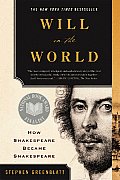
Will in the World by Stephen Greenblatt

Toward the end of Will in the World, Stephen Greenblatt relates a story about Shakespeare's dealings as a property owner. When a set of wealthy landowners threatened to enclose a large area of land, some Shakespeare's, essentially transforming common land into private property, he protested the move, as it would have staunched the income he received from the tenants. Having reached a protective agreement with the landowners, however, Shakespeare quite non-heroically dropped his protest--even though the enclosure still promised to evict and impoverish many farmers. "It is not a terrible story," Greenblatt writes, "but it is not uplifting either. It is merely and disagreeably ordinary."

Merely and disagreeable ordinary--this phrase perfectly encapsulates the problem of Greenblatt's method. That is, Shakespeare's life is not particularly thrilling. While Christopher Marlowe was being assassinated by fellow spies in faked bar fights, Shakespeare quietly spent his days turning himself into a shrewd businessman, writing two or three plays a year, and avoiding his wife and children. The details we have of his life, which are extremely few, are strikingly banal.

The result is that Greenblatt's book is composed primarily of conjecture. Shakespeare may have done or seen this, if he was in this place or did that thing, and isn't it possible that that experience is reflected, here, in Much Ado About Nothing?

Shakespeare's plays then combine, on the one hand, an overall diffidence in depicting marriages and, on the other hand, the image of a kind of nightmare in the two marriages [in Hamlet and Macbeth] they do depict with some care. It is difficult not to read his works in the context of his decision to live for most of a long marriage away from his wife. Perhaps, for whatever reason, Shakespeare feared to be taken in fully by his spouse or by anyone else; perhaps he could not let anyone so completely in; or perhaps he simply made a disastrous mistake, when he was eighteen, and had to live with the consequences as a husband and a writer... And perhaps, beyond these, he told himself, in imagining Hamlet and Macbeth, Othello and The Winter's Tale, that marital intimacy is dangerous, and the very dream is a threat.


This makes for a remarkably readable and interesting biography, but what are the chances that even the most careful reader of Shakespeare--the most aloof of all writers--can sketch the map of his interiority, as Greenblatt pretends that he can do? He reminds us over and over again that this is, at best, guesswork, but that doesn't make it any more trustworthy.

Some of the surmises here seem innocent enough--it seems probable that the mobs in Julius Caesar and Coriolanus show Shakespeare's familiarity with, and suspicion of, similar occurrences in London. Some of it seems dangerous, like the long story about the show trial of Elizabeth I's once-Jewish adviser Dr. Ruy Lopez, which suggests to Greenblatt a wariness about public anti-Semitism that informs The Merchant of Venice.

Will in the World can be compelling, and convincing, and as far as biographies of Shakespeare go, it's probably the best that we're going to get. But the method of cherry-picking passages from the plays and matching them to biographical possibilities makes me deeply uneasy, not least because it is the method that leads a whole host of otherwise reasonable people to believe that Shakespeare's plays were written by Edward de Vere, the Earl of Oxford.

It probably isn't Greenblatt's fault. It is ours, who crave to see the man "behind the plays," and who want Shakespeare to be as interesting as Marlowe or Greene or Kyd. Shakespeare's texts are so compelling, it seems inconceivable that he could be "merely and disagreeably ordinary," but that may be a fact we shall all have to accept.

Sunday, November 7, 2010

Divine Invasions: A Life of Philip K. Dick by Lawrence Sutin

“This has been a novel about some people who were punished entirely too much for what they did. They wanted to have a good time, but they were like children playing in the street; they could see one after another of them killed — but they continued to play anyhow.”

The quote above is actually from A Scanner Darkly, not Divine Invasions (not be confused with The Divine Invasion, a novel by Dick), but it seems like such an appropriate summation of PKD’s life story that I couldn’t leave it out. As the title indicates, Divine Invasions is a biography, unauthorized, of one Philip K. Dick, author, counterculture hero, drug addict, schizophrenic, possible misogynist, hypochondriac, possible genius. But for those who don’t read past the first paragraph, here’s my summation of Divine Invasions: You can learn nearly as much about PKD from his novels as you can from this book, and the man who emerges is both fantastical and sort of terrible.

I try to avoid personal anecdotes in these reviews, but it seems appropriate to place myself somewhere in the pantheon of PKD fandom. I’ve read two of his novels, A Scanner Darkly and VALIS, seen one movie based on his work, Minority Report, and few short stories. I wouldn’t say I was the target audience for this book, but after reading VALIS, I was curious about the man behind it.

PKD was born in Chicago in 1928, along with a twin sister, Jane, who died six weeks later. Dick’s father, Edgar, left his mother when he was young, and thoughout the rest of his life, PKD’s contact with his father was minimal. His relationship with his mother was strained, running hot and cold. He began writing fiction while still in middle school, and by the time he was in his late 20s, he was working full time as a writer, barely eking out a living in the newborn gutter of science fiction. After several marriages, a lot of drugs, and a volume of work that makes the aspiring author shrink to think of it, he died of a stroke in 1982.

Biographies are tough to review because it’s hard to condense someone’s life down to the bare bones without sounding like an obit, but I’d like to focus on what was both the most fascinating aspect of PKD, the man, and the dullest of Divine Invasions: the visions. In my review of VALIS, I go into some detail concerning the imaginary cosmology of Horselover Fat, the novel’s protagonist who is also PKD. I didn’t realize, however, that Fat’s visions in VALIS were not fictionalized at all. They were taken whole cloth from Dick’s largest (unpublished) work Exegesis, which was over 3000 pages long at the time of his death, and was, in my opinion, the chronicle of a man slowly losing his grip on reality.

Divine Invasions goes into some detail on the content of the Exegesis—the final 3rd of the book is mostly dedicated to it--and while it’s interesting in theory, after a while, it gets to be a bit of a slog. Sutin will quote a section, explain how it related to PKD’s life, and speculate on whether or not Dick was actually learning about the ultimate truth or if he was just crazy. Perhaps an interesting book could be made out of this. Unfortunately, Divine Invasions is not it. The last 3rd starts well, but gets bogged down in this repetitive pattern it never really breaks out of. It’s interesting to read about the bizarre things that happened in PKD’s life; it’s less interesting to read about how he thought he caused it while possessed by the spirit of the prophet Elijah.

The other issue I have with Divine Invasions is one of tone. Sutin is clearly a huge fan of PKD’s work, and he makes this clear from the beginning. As a result, portions of the book read almost like a hagiography, with Sutin using Dick’s fixation of his sister’s death, his volatile relationship with his mother, et al. to justify, in part, some of the stupid or just plain malicious PKD did, like beating at least two of his wives. This might be ok, except Sutin seems to want to have his cake and eat it too—although he admits Dick might be crazy, and therefore not entirely to blame for his less forgivable episodes, he also wants to attribute some amount of veracity to Dick’s ever-changing visions. Brief consideration near the end of the novel, where Sutin mentions possible mental conditions that could have caused Dick’s visions, don’t counterbalance the suggestion throughout the rest of the work that PKD was more than a troubled soul—he was some sort of sci-fi prophet.

Divine Invasions isn’t terrible. It’s well-written and Dick’s life was certainly interesting. Ultimately though, it seems a little pointless—you can read about PKD’s crazy life on Wikipedia, his visions in VALIS, and his drug addiction in A Scanner Darkly, and probably enjoy yourself more. Why not get the information from the man himself? It’s not like he tried to hide who he was.

Monday, June 7, 2010

Muriel Spark: The Biography by Martin Stannard

Brent recently noted that my reviews of Muriel Spark's books never seem to reflect a real enthusiasm, even as I claim to be a fan of her work. It's hard to argue with this; certainly I disliked both Aiding and Abetting and The Finishing School (the last two books Spark ever wrote), and while my esteem for The Prime of Miss Jean Brodie is clear, my reviews of Robinson, The Girls of Slender Means, and The Driver's Seat must seem rather indifferent.

But it seems to me that Spark's books function differently from other novels, that if I seem to not engage with them it is because they do not ask to be engaged with in that way. They offer little in the way of human connection. The characters are ripe, but they are also frequently grotesque and off-putting. You are not permitted under anyone's skin, and neither would they want you there. But they certainly attack the mind with some shocking precision; for such slim books they present quite a bit to think upon.

Martin Stannard's new biography of Spark is a welcome opportunity to see her fiction from another, more human angle. I am not usually a fan of biographies--I prefer to think that the literature ought to speak for itself--but something about Spark's coldness and sparseness makes me want to find out more about her. In fact, Spark was adamant that nothing could be gleaned about her from her work, even when it mirrored autobiographical details. She leaves precious few holes through which the author can be glimpsed. It is no wonder, I think, that one should be naturally curious.

This reflects one of the major themes that seems to arise in Stannard's biography: Spark's obsessive need to control her own biography. Stannard speaks early on of something he calls the "nevertheless principle," illustrated by an uncharacteristically stark, black cathedral spire in the middle of Spark's native Edinburgh--the idea that nothing is one thing only. In spite of this--or because of it?--she kept stern watch over her public image, threatening to sue those who got even the minutest details wrong or dared to mischaracterize her. Her own biography, Curriculum Vitae, is described as a disappointment, seeking to correct the inaccuracies of the way she was depicted, but offering no substantial insight into her own life. These details form part of a larger capriciousness, torpedoing friendships for small or perceived slights. As her friend Ved Mehta notes, "She'd absolutely conquer you immediately. And then of course she'd move on to someone else."

Stannard depicts all of this in what is probably the most charitable way possible. His work hews as closely to Spark's point of view as it is able, allowing her always the last word in her own defense. As an account of her life, I find this approach fairly reasonable. He does not, for instance, mention that although Spark asked him to be her biographer, she disliked the final product and tried to go at it with the proverbial fine-toothed comb to preserve her own careful conception of herself. This is probably much of the reason that it took eighteen years to complete. However, it is impossible to ignore what Stannard elides: frequently Spark could be a nasty piece of work.

Not a single friendship seems to last or simply fade, they all seem to implode. (The one exception being Penelope Jardine, who was her platonic companion for the last few decades of her life.) God help you if you were her agent, editor, or publisher. But most distressing was her relationship with her son, Robin. Born in Africa to Spark and her unstable, violent husband, Spark sent Robin to live with his grandmother when he was small, partly because of monetary and custody concerns, but also because, as Stannard admits, having Robin around interfered with her literary goals. As an adult, Spark and Robin treated each other with open contempt. He increasingly aligned himself with Orthodox Judaism, waging a public campaign claiming that Spark's mother was a Jewish convert and that therefore she herself was fully (not half-) Jewish, and that Spark, a Catholic convert, had purposefully concealed that part of her identity.

It is easy to see why Robin's actions enraged Spark, especially in light of her obsession over controlling her image. Her conversion was a fundamental part of her identity, and Robin's insistence on her family's Judaism in a way sought to annull her personal religious freedom and trap her in the traditions of her family. That would have been a gross insult to her independence. But Stannard cannot conceal a lifetime of indifference to her son, and even he lets in a little soft criticism when describing Robin's art career:

Muriel usually applauded those who followed Gaugin's example. She had followed it herself. But her son, she felt, was not Gauguin and she suspected ulterior motives: a flavour of competition ('Anything you can do...'), a desire to cash in on her fame. It seems not to have occurred to her that is desire to become an artist was a genuine passion perhaps connected with his craving for her approval. Instead, she saw the problem as twofold: he was fifty and lacked talent.


If I speak too much of Spark's negatives, it is because they are what Stannard leaves unsaid. She is also brilliant, and the biography is at its best when it attempts literary criticism--as it does for each of Spark's 22 novels--refracting the themes of her work in her life's prism. In her later years, Spark seems brittle, irritable, and often cruel, but it is those same qualities that make her, in her youth, such a compelling figure: fierce, independent, spiritually incisive but not dogmatic. Her palming off of Robin is more favorably mirrored in her slavish obedience to her writing, enduring long bouts of poverty and hardship in order to create. One of the most fascinating--though surely difficult--periods Stannard describes is a spell of strange hallucinations brought on by Dexedrine, which she took to help stave off hunger while she wrote. (Among other things, she thought that T.S. Eliot was concealing threatening messages to her in his work.)

She would have loathed being identified with Fleur Talbot, the heroine of her novel Loitering with Intent, even though it is cobbled together from the bits and pieces of her own personal history. But Fleur also says something that seems to me as good an epitaph as any:

When people say that nothing happens in their lives... I believe them. But you must understand that everything happens to an artist; time is always redeemed, nothing is lost and wonders never cease.

Monday, January 21, 2008

What is the What by Dave Eggers

The oughts, the 2000s, the O-Os. Call this decade what you will, but Dave Eggers has to be one of the best writers from it. This is somewhere between his 5th and 10th book depending on how you count them. It's the "autobiography" of a Sudanese lost boy. It's a truish story. A novelized memoir, written by a third party. It's hard to put Eggers' works into categories.

The story follows Valentino Achak Deng from his childhood in southern Sudan, along his march to refugee camps during the Sudanese Civil War, and through his adjustments to life in the US. The book opens with a robbery in his apartment in Atlanta. Bound and gagged, he tells his story silently to his assailants. Jumping back and forth from the present, he explains the conflict and how a whole population of Sudanese boys wound up in the States.

It's a personal story. People all around him die. He's separated from his family, forced to join a rebel army. He finds love. He struggles to adapt to a new culture, contemplates murder and suicide. And nowadays he travels the country recounting all of this, in short and long versions, to churches, schools, crowded bookstores, and youtube-ees. All Eggers did was come up with a way to get all that down in book form.

If you like audio books, definitely go that route with this one. It's narrated by Dion Graham (of The Wire) who does an excellent job with the voices. I listened to it on two consecutive 8 hour drives and never got road weary. A+ to everyone involved.

Friday, November 30, 2007

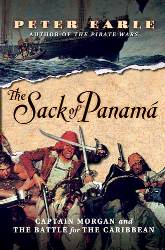
The Sack of Panamá by Peter Earle

This is the story Captain Henry Morgan. Before he was on the rum bottle, he was a pirate, or as they were more politely called, privateer. He and his associates dominated the Caribbean sea during the later half of the 17th century, robbing the Spaniards into a state of fear and poverty. The book culminates with his campaign across the isthmus of Panama which successfully halted the shipment of gold and silver from Peru to Spain. My favorite story, however, was definitely his battle in Maracaibo. He pulled the ol' wooden-planks-painted-like-sailors trick and caught the Spaniards off guard. Classic pirate adventures for sure.

The book reads more like fiction than history, probably because the subject matter is so action packed. Earle is really knowledgeable and a good storyteller to boot. I plan on reading more privateer biographies, but for now haven't come across any more. Suggestions?