Showing posts with label Panama. Show all posts

Wednesday, May 27, 2026

The Captain and the Enemy by Graham Greene

I cannot pretend that all these details which I am trying so hard to reconstruct from my memory are necessarily true, but I feel myself today driven by a compulsive passion now that we are separated to make these two people live before my eyes again, to bring them back out of the shadows and set them to play their sad parts as closely as possible to the truth. I want above anything else to make the two of them clear to myself, so that they will continue to live as visibly as two photographs might seem to do propped up on a shelf beside my bed, but I don't own a single photograph of either of them. Why am I so possessed by them? Of the Captain I have heard nothing for years, and Liza, whom I left of my own accord, I see only from time to time, always with a sense of guilt. It's not because of any love I feel for them. It is as though I had taken them quite coldbloodedly as fictional characters to satisfy this passionate desire of mine.

As a boy, Jim finds himself taken out of his boarding school by a mysterious figure who calls himself "The Captain." Jim doesn't mind going--he's one of those boys who seems to always be on the outside of the group, a victim for bullies. The Captain, it turns out, has "won" Jim in a backgammon game from his true father, a dissolute gambler known to Jim only as "The Devil." The Captain is Jim's liberator in many ways, but he makes it clear that he has no plans to be a substitute father for the boy, except in the sense that he changes his name immediately, from Victor. He quickly instructs Jim in a series of confidence games and petty tricks that reveal his true nature as a con artist and thief--the name change, in fact, is more in the way of a guise than a fatherly act. Ultimately, the Captain drops Jim off with his girlfriend Liza, who seems to have made a stray remark about wanting a child, a remark the Captain has gone above and beyond to fill. Jim ekes out a strange life with Liza, who never quite rises to the level of a mother, a strange and peripheral existence punctuated by the Captain's abandonments and returns.

I was immediately captivated by the beginning of The Captain and the Enemy. Greene thrusts us into the position of young Jim, trying to figure out the strange figure who has dropped into his life and transformed it, perhaps for the better, perhaps not. "The Captain" is a Greenian figure par excellence, a con artist and trickster native to the English underworld. If he's hard to figure out, it's because he doesn't want to be figured out. Never do we really understand what the Captain's grift is: is he a big-time criminal, or a petty one? The only thing that Jim seems to be able to say for sure is that Liza, his not-quite mother, is head over heels in love with him. Later, as Jim tries to make sense of the strange childhood he has had, this fact hits him with depressing clarity: in that household or any other, no one loved him as much as these two loved each other.

I was disappointed, then, by the second half of The Captain and the Enemy, which transforms something unstable and weird into much more common Greene fare. As an adult, Jim travels to Panama, where the Captain has been living, to inform him of Liza's death, but when he arrives, he finds that he's unable to do it--not out of tenderness but what seems to be a willful rejection of the shape of the life that the Captain forced upon him as a child. The choice of Panama seems to be inspired by Greene's friendship with leader Omar Torrijos, which he wrote about in Getting to Know the General. The intrigue that embroils Jim is obscurely related to the revolution in Nicaragua and Panama's peculiar importance to the United States, as well as the agitation over the return of the Canal Zone. The Captain is implicated now in some kind of international espionage, and his enemy is an English journalist--who may be a secret American--named Quigley. Is Quigley the enemy, or is it Jim, who is offered the opportunity to betray his father figure? It's all very Oedipal, but the intrigue is too blurry and the story too familiar; it made me long for the strangeness of the opening chapter.

Saturday, September 6, 2025

Getting to Know the General by Graham Greene

The novel On the Way Back nagged at me night and day on my return to France. Those characters which I had so mistakenly drawn from life wouldn't let me rest. I would constantly remember Chuchu's boast, "I'm never going to die"; is complex theology--"I believe in the Devil. I don't believe in God," and the way that he would prove the existence of the Devil by pushing at a swing door in the wrong direction. The General and Chuchu went on living, far away in Panama, and they refused to become characters in my novel. And Panama--so much of the little country had still been left unseen and it seemed highly unlikely that I would ever be able to return for a second visit.

In the 1970's, Graham Greene received a call inviting him to the small Central American nation of Panama. The request came from no other than General Omar Torrijos, Panama's recently installed leader. Torrijos, it seems, was sort of an odd duck: not explicitly Marxist but having come to power in a coup against Panama's right-wing regime, a passionate believer in social democracy but not in partisan or sectarian politics. His core issue is the return of the Panama Canal to Panamanian control. Arriving in Panama City, Greene finds himself immersed in a world of intriguing figures: Sandinistas and Somozans working against each other in nearby Nicaragua, right-wing journalists, scheming viziers. But at the heart of it all is Torrijos, who turns out, in Greene's telling, to be a simple and humble person who only wants to spend a little time with what he sees, through Greene's novels, as a kindred spirit.

I'm reaching a bittersweet age where I'm exhausting all my favorite novelists, so it was heartening to calculate recently that, at the rate of one book a year, I can be reading Graham Greene into my fifties, even if I have likely read all of his best works. I was drawn to Getting to Know the General because I'd never read one of Greene's non-fiction books, and I was interested to see what it was like for Greene becoming, in a way, a character from his own books. In fact, for the length of his time in Panama, which includes sporadic journeys over a period of five or six years, Greene is writing a book in his head based on the General and his right-hand man Chuchu. (Despite his expressions of admiration for Torrijos, it seems like most of Greene's time in Panama is spent with Chuchu.) The book, called On the Way Back, is doomed to never be written. Perhaps the real people crowded out the fiction, or perhaps Greene simply got too deeply integrated with his Panamanian friends to cultivate the necessary distance to write his novel.

The subtitle of the book, after all, is "The Story of an Involvement," and Greene did get involved: several times he describes, with offhand diffidence, lending his efforts to negotiating for the liberation of hostages taken by Central American guerilla groups. Greene is there in the room when the treaty between Torrijos and the Carter administration that provides for the return of Panamanian sovereignty to the Canal Zone; it's fascinating to see him look witheringly at some of the assembled slaughterers, like Pinochet and Henry Kissinger. Novel, too, to read about his friendship with "Gabo," Gabriel Garcia Marquez, who ends up as a kind of Latin-American counterpart in the light intrigues that Torrijos extracts from Greene.

So, as much as anything, Getting to Know the General is a fascinating document that captures a little-remembered slice of 20th century history. But it's a pleasure, too, in the way that Greene lends his cosmopolitan eye and ear to the natural and cultural landscapes of Panama: its islands, its mountains--like the one that will ultimately take the General's life in a suspicious plane crash--its towns, its rundown hotels and haunted houses, its terrible food and vile rum punches.  

Friday, November 30, 2007

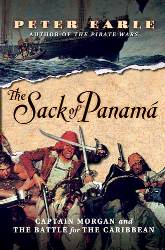
The Sack of Panamá by Peter Earle

This is the story Captain Henry Morgan. Before he was on the rum bottle, he was a pirate, or as they were more politely called, privateer. He and his associates dominated the Caribbean sea during the later half of the 17th century, robbing the Spaniards into a state of fear and poverty. The book culminates with his campaign across the isthmus of Panama which successfully halted the shipment of gold and silver from Peru to Spain. My favorite story, however, was definitely his battle in Maracaibo. He pulled the ol' wooden-planks-painted-like-sailors trick and caught the Spaniards off guard. Classic pirate adventures for sure.

The book reads more like fiction than history, probably because the subject matter is so action packed. Earle is really knowledgeable and a good storyteller to boot. I plan on reading more privateer biographies, but for now haven't come across any more. Suggestions?