Showing posts with label George Orwell. Show all posts

Sunday, September 14, 2025

The Dazzling Paget Sisters by Ariane Bankes

What elusive quality is it that propels people into the centre of things? My mother, Celia Paget, and her identical twin sister Mamaine seemed to possess that quality, to gravitate towards the very heart of the era in which they lived. Born in 1916 and brought up in relative simplicity in rural Suffolk, their lives became entangled with some of the most remarkable figures of the twentieth century, whether as friends or lovers, muses or wives.

The Paget sisters were identical twins who went from reluctant debutantes to society darlings, eventually becoming enmeshed in the social circles of England's greatest mid-century authors. Celia was a longtime lover of George Orwell, while her twin sister Mamaine was the lover and eventually wife of Orwell's friend and intellectual rival Arthur Koestler, the Hungarian emigre known for his novel Darkness at Noon. Mamaine carried on a brief, torrid affair with Albert Camus, and around the margins of their lives other literary greats hung: Beauvoir and Sartre, of course, as well as Andre Malraux and others. The Dazzling Paget Sisters, written by Celia's daughter Ariane Bankes, seeks to discover what it is that drew her mother and aunt "into the centre of things."

What that "elusive quality" was, I'm not quite sure. Apparently (as one can tell easily from the cover) both twins were quite beautiful, and they had a kind of twinly, otherworldly connection with each other. The question seems like a powerful one--why would these two ordinary girls from Suffolk end up so wrapped up with the century's literary greats?--but Bankes' biography mostly has the effect of demythologizing the very question she poses. The answer seems to be part privilege and part happenstance: the girls were "picked up" by a society maven named Dick Wyndham, who introduced them to these writers. As the story of their lives unfolded, I began to understand their lives not as a series of unlikely brushes with greatness, but something more ordinary: these writers, of course, all knew each other, and it stands to reason that their social circle included people who weren't writers.

What I enjoyed most about The Dazzling Paget Sisters was learning more about the emerging tensions between this circle as the Cold War began. Koestler in particular, who modeled Darkness at Noon on the Soviet gulag, spared no mercy for his fellow writers who let their Socialist sympathies lead them toward the USSR. This led to both Koestler and Mamaine becoming, half-willingly, useful operatives for the CIA, something I wish the book had explored in more detail. And I was interested, of course--who wouldn't be--in the doomed romantic dalliance between Mamaine and Camus, under Koestler's nose. But mostly, I felt that The Dazzling Paget Sisters might have been better served by an author other than Celia's daughter, who approaches the material in a hyper-faithful chronological way that never quite penetrates the surface. It made me wonder if someone with more of an outside perspective, with less loyalty to the letter of the story, might have found a way in to the real "centre of things."

Saturday, August 3, 2013

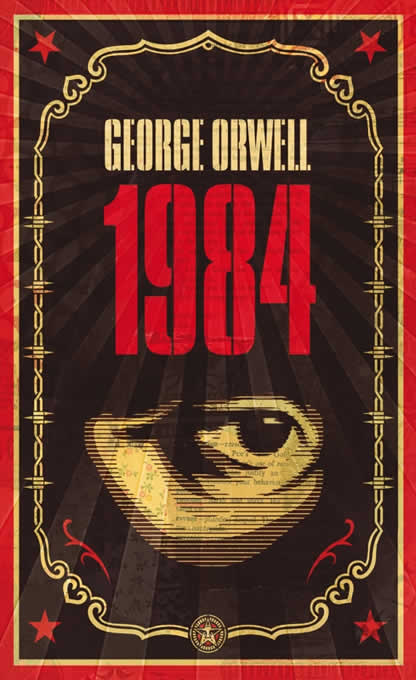
Nineteen Eighty-Four by George Orwell

He took a twenty-five cent piece out of his pocket.  There, too, in tiny clear lettering, the same slogans were inscribed, and on the other face of the coin the head of Big Brother.  Even from the coin the eyes pursued you.  On coins, on stamps, on the covers of books, on banners, on posters, and on the wrapping of a cigarette packet--everywhere.  Always the eyes watching you and the voice enveloping you.  Asleep or awake, working or eating, indoors or out of doors, in the bath or in the bed--no escape.  Nothing was your own except the few cubic centimeters inside your skull.

1984 is one of those books whose cultural influence completely outstrips its presence as a novel.  I mean that, even if you haven't read it, details and themes from it are so ingrained into the way we think about politics and society that you can't help but being familiar with it.  I have read it, and until I revisited it recently I have to admit that my mental conception of 1984 was still dominated by its pop culture distillations, which are often facile and shallow: Big Brother the television show, V for Vendetta and those stupid Guy Fawkes masks, the flaccid banality of most political protests in the post-Vietnam era.  Just this year I told a student who was reading 1984 to pick up Brave New World, because it was "much richer."

But you know what?  1984 is great.  It's much more subtle, more carefully wrought, and more terrifying than I had remembered.  First, I was struck by just how little happens in the novel.  (Spoilers commence, though if you haven't read it--what did you do in high school?)  There is the protagonist, Winston, an "Outer Party" member who secretly harbors unorthodox opinions and a skepticism about Big Brother and the Party establishment.  Winston allows himself small heresies at first--keeping a diary, for instance.  But then he becomes swept up in an affair with a young woman, Julia, who shares his antipathy.  They know that their affair, like all love and non-procreative sex, is a one-way ticket to the Ministry of Love, which enforces law and order in Airstrip One (the Party name for Britain--love that), and yet they go about it anyway.  They are recruited by a shadowy organization, the Brotherhood, and for a moment, it seems as if the novel is about to explode into espionage and action, but that is the very moment that the hammer drops and Winston and Julia are captured by the Party's Thought Police.

The Brotherhood turns out to be a ruse, of course, a tool of entrapment--an unnecessary one, since we learn that Winston has been under surveillance for his unorthodoxy for years and years.  I can't help but compare this to other dystopian works, all of which take after 1984 in a way: V for Vendetta is one, but also The Hunger Games.  These works are all about collective resistance, but 1984 remains more terrifying than these because resistance is clearly impossible, a foregone conclusion.  Winston knows from the moment he begins to write in his diary that he is a "dead person," and things go more or less exactly according to his fears.  In this way 1984 reminds me more of Never Let Me Go, another novel which explores the way that oppressive systems work to preclude even the idea of resistance.  There is no fighting back; the Party always wins; we know the famous last words of the novel which describe Winston's dissolution as an individual and complete subjugation to the state: "He loved Big Brother."

Second, I was struck by how philosophically rich the novel is.  It's easy to see 1984 as an allegory for the fascist and totalitarian movements that sprung up in Europe at the time of its writing, but Orwell's thoughts on power, history, and subjectivity deal in questions that have been around for thousands of years, including one of the most fundamental: "What is truth?"  The Party of 1984 operates by controlling the truth, falsifying facts and manipulating records so that history always seems to validate the Party's essential goodness.  The Party relies on a philosophy that negates any sense of "reality":

Only the disciplined mind can see reality, Winston.  You believe that reality is something objective, external, existing in its own right.  You also believe that the nature of reality is self-evident.  When you delude yourself into thinking that you see something, you assume that everyone else sees the same thing as you.  But I tell you, Winston, that reality is not external.  Reality exists in the human mind, and nowhere else.  Not in the individual mind, which can make mistakes, and in any case soon perishes; only in the mind of the Party, which is collective and immortal.  Whatever the Party holds to be truth is truth.  It is impossible to see reality except by looking through the eyes of the Party.  That is the fact that you have got to relearn, Winston.  It needs an act of self-destruction, an effort of the will.  You must humble yourself before you can become sane.

It strikes me that Orwell here is offering what we consider a very conservative philosophy, one that stresses the importance of an objective reality to political freedom and philosophical health.  One of the most interesting and useful ideas he offers is that of doublethink: a "Newspeak" word which means to hold two contrasting ideas in your head at a time, and to believe them both:

To know and not to know, to be conscious of complete truthfulness while telling carefully constructed lies, to hold simultaneously two opinions which cancelled out, knowing them to be contradictory and believing in both of them, to use logic against logic, to repudiate morality while laying claim to it, to believe that democracy was impossible and that the Party was the guardian of democracy, to forget whatever it was necessary to forget, then to draw it back into memory again at the moment when it was needed, and then promptly to forget it again, and above all, to apply the same process to the process itself--that was the ultimate subtlety: consciously to induce unconsciousness, and then, once again, to become unconscious of the act of hypnosis you had just performed.  Even to understand the word "doublethink" involved the use of doublethink.

I do not believe that the modern world is in danger of becoming the world of 1984.  One thing I think we are learning from the recent Snowden-NSA debacle is that one-way methods of surveillance are never truly one way, and that the better those in power get at watching us, the better we get at watching those in power.  But dystopian fictions are not really predictions, they are exaggerations, hyperbolic descriptions of attitudes and processes that already exist, and I see doublethink everywhere.  Our entire system of political discourse, with its rah-rah partisanship, is founded on doublethink, and the subjugation of truth to power.  We see it every time some Republican idea becomes cherished by Democrats and loathed by Republicans, or vice versa.

One of the scariest things about 1984 is the way that it shows how a really successful fascism doesn't merely pummel the opposition into non-existence.  ("If you want a picture of the future," Winston's interrogator tells him, "imagine a boot stamping on a human face--forever.")  It also enlists us in the oppression, and asks us to invest in power at the expense of truth.  If we really wanted to let Orwell be useful in the 21st century, we'd keep that in mind.

Thursday, April 22, 2010

1984, Brave New World and other depressing stuff


Many a time we've participated as a family in the "No TV for a week" program at my children's school. Every year my kids, for the first few days, act like they're going to die a slow, retracted, terribly excruciating death. What? Read a book instead of watching SpongeBob? Play outside with our actual legs moving, our actual heart beating, instead of our fingers getting early carpel tunnel on a game console? But my "friends" won't know that I'm eating dinner, or that I ran an errand today! Perish the thought!

Until eventually, when the whining reaches a decibel only dogs can hear, it then, amazingly, stops. They adjust. They realign like a good hip joint slipping back into place. A miracle happens. We start to do more together as a family. We talk more around the dinner table because we're not in a rush to get back to the idiots on Survivor. Do we all fall in love again? No, this isn't The Cosby Show (hee hee), but really, by the end of the week we do connect again in almost a primal way. (Just kiddin. I do love my family anyway, sort of..when they're nice to me..)

I agree with Postman, we are now more Brave New World than 1984, in that we love the distractions, the silly minutiae that controlls us. I like OK Magazine just as much as I like Newsweek. Reading a book online and on the printed page is as aligned in my brain as peanut butter and jelly. But as our little tv and computer experiment shows, it is possible to get back to the prehistoric basics if we want to.

But do we want to?
That's the problem.
Brave New World here we come.

Written in the 1930's, I got the feeling throughout that Huxley wasn't a big fan of American capitalism, or was that just me. Hmm..
Have we turned out like he predicted? Are we sex-starved, atheist, gum-chewing, movie-watching, drug users who never want to be unhappy, at all costs? (Did I mention I like OK Magazine and Entertainment Tonight?)

Maybe not to that extreme, but we have evolved I guess. For better or worse, in this "marriage" of ideas who knows for sure. It probably depends on who you ask - which may also depend on who you voted for, and who you listen to on the radio. I tend to hope our country isn't headed straight down the crapper, but don't mind me - I'm high on my "soma" and am currently hanging out on Fantasy Island and getting a tan with Ricardo Montalban. Read the book and you'll get why I said that. Worth at least one try for its historical significance.


So, the year 1984 came and went without too many major government take overs. (Not really but let's pretend.) But we've made great strides haven't we? Currently, we can steal a person from their home claiming they've violated the rules of our country. They're an Enemy of the State not worthy of basic rights. A great danger to the norm we call our society. We torture them for answers they don't want to give. Tell them they're insane, that our way is the best way, the only way, until they break and the creases are permanent do we cure them of their vile ways. A shiny new American penny coming out clean on the other side. A carbon copy of ourselves and our ideals. Or so we think.

But what if instead of America, it's Oceania. In place of Guantanamo Bay, put the Ministry of Love. In the place of our government, put Big Brother.

Even I noticed the similarities.
And I'm a Democrat.
Scary, scary.
Anybody else have some thoughts on these books and the state of our current lives? What similarities do you see?

As for me, time to read something lighter, like Of Mice and Men before I run as fast as I can into a brick wall, or drive my imported car off a cliff.

Thursday, February 28, 2008

Animal Farm by George Orwell

Okay, so I am one of the few people in America, perhaps the world, who hasn't read this book. I think it is normal high school fair, but then I didn't go to a normal high school. At my school, if we wanted to read poetry, we read Genesis. If we wanted to read history, we read Genesis. If wanted to read about science...well you get the idea.

Orwell said that he never wrote anything good that was not about politics. He also said, "Animal Farm was the first book in which I tried, with full consciousness of what I was doing, to fuse political purpose and artistic purpose into one whole." Animal Farm was written as a political indictment of the Soviet Union. In the preface to this edition, Russell Baker points out that given the political climate of the time, Orwell had trouble getting this book published. In fact, it was not published until 1945 after the end of World War II. Criticizing the Soviet Union in the early 40s was nearly heretical. After all, the Red Army had just beat back Hitler and his "invincible" army. But Orwell cautioned that the political system that was evolving in the USSR was not really socialism, but a "hierarchical society, in which the rulers would have no more reason to give up their power than any other ruling class."

This is precisely the type of society that Orwell depicts in Animal Farm. The animals revolt against the farmer who has oppressed them for years. They set up a farm where all animals are equal and they work for the betterment of themselves, not for the prosperity of some despotic ruler. The pigs, who are clearly the smartest animals on the farm lead the rebellion and are instrumental in setting up their utopian farm. Two pigs fall into leadership roles: Snowball and Napoleon. Eventually Napoleon runs Snowball off the farm, and it is not long before Napoleon and his cronies are running the farm in the same fashion that Farmer Jones did.

I really enjoyed this book, especially having recently read Finding George Orwell in Burma. As usual, I saved both the preface and introduction until after I had finished the book, and was a little disappointed to find out that neither of them was written by Orwell. In the preface, Russell Baker alludes on more than one occasion to a preface to Animal Farm written by George Orwell. I wonder why they didn't include that in this edition. It would no doubt have been interesting. While the preface was interesting and worth reading, I found the introduction by C. M. Woodhouse to be rather stuffy and pretentious.

Monday, February 18, 2008

Finding George Orwell in Burma by Emma Larkin

Emma Larkin is a pseudonym used by an American journalist based in Bangkok. She was born and raised in Asia, studied the Burmese language in London, and writes extensively about Burma (present-day Myanmar). She cannot use her real name for fear that the Burmese government would bar her from entering the country.

Larkin titled her book brilliantly. In the year that she spent in Burma she found Orwell in two ways, she made interesting discoveries about the writer's life in colonial Burma and she also discovered that Orwell's writings were alarmingly applicable to the country of Burma. She points out that some people say that Orwell wrote the history of Burma in three volumes: Burmese Days, Animal Farm, and Nineteen Eighty-Four.

The book, which is equal parts travelogue, biography, and political exposé, is organized into five main sections: Mandalay, The Delta, Rangoon, Moulmein, and Katha. These are all places where Orwell spent time. Most of them appear in his writings, for example, Burmese Days is set in Katha. Larkin pulls from these writings, dropping quotes throughout the book. At times it is difficult to distinguish the portentous words of Orwell from the political rhetoric of the oppressive Burmese (Myanmarian?) government. I am sure this was intentional.

Finding George Orwell in Burma was extremely interesting. The people and places that Larkin visits are described in vivid detail, and the conversations that she had are enlightening and often humorous. Larkin managed to be informative and entertaining throughout the book.

Wednesday, June 13, 2007

1984 by George Orwell

You probably already know the premise of 1984, easily George Orwell’s most famous book. A friend told me that it was disappointing, so I hesitated in reading it, but am glad to report that I disagree with that friend, and am thus considering revoking their status as such.

In a nutshell: Oceania, formerly the British Isles and the Americas, is an absurdly controlled and oppressed country where even thinking the wrong thing is punishable by torture and death. Its citizens are constantly monitored down to the minutest detail, to the point that even an involuntary twitch of the eyelids, or momentary betrayal of a disapproving expression, can result in arrest, forced labor, and, again, torture and death. Winston Smith, the book’s protagonist, works for the paradoxically named Ministry of Truth, and his job is to constantly correct certain ‘misprints’ in government issued documents, so that the government always manages to exceed their production estimates, or predict the outcome of the next war, or so that a disappeared person has never existed in any recorded form.

Always the eyes watching you and the voice enveloping you. Asleep or awake, working or eating, indoors or out of doors, in the bath or in bed -- no escape. Nothing was your own except the few cubic centimetres inside your skull.

I was most impressed by the palpable sense of real fear that the book generates. The whole plot seems to balance on the edge of a knife; Winston, a dissenter, can’t help but express his opposition to the government, but does so at extreme risk. 1984 is frighteningly believable, almost a thought experiment on human nature and power. It’s surprisingly and depressingly pessimistic about our capacity to resist oppression, always choosing self-preservation over liberty, or justice for one’s fellows. Occasionally, it was eerily reminiscent of the little that I know about the situation in North Korea. Obviously, the year 1984 has come and gone without the world dividing itself into three totalitarian countries, but that doesn’t make the book any less powerful. There will always be those people hungry enough for power that they’d kill not only their enemies but their countrymen by the thousands to get it. Unfortunately, I can’t say anything about how it ends without giving it away. It’s a powerful, poignant book, and I’d recommend reading it.

You can access the full text online, for free, here.

Monday, March 26, 2007

Brave New World by Aldous Huxley

Well, I finally completed the dystopian trilogy. I borrowed 1984 from my brother three or four years ago; two summers ago I read Fahrenheit 451; and I closed the cover of Brave New World not 10 minutes ago. Although all three of these novels dealt with roughly the same topic, they were quite different. The worlds of 1984 and Fahrenheit 451 were police states, where people were forced to conform with the threat of violence. With Brave New World, Huxley depicts a society in which people are intoxicated into a state of conformity.

Huxley's future is more believable than the future created by either Orwell or Bradbury. This edition of Brave New World includes a letter written by Huxley to Wells, shortly after the publication of 1984. Huxley praises the book, but notes that the violent coercion that takes place in 1984 will ultimately give way to a more subtle form. Brave New World's ubiquitous somma that puts those who take it into a coma-like state of bliss strikes me as a more practical method of control than brute force.

While none of these books offers a completely accurate reflection of modern society, they come eerily close at many points. Huxley is not concerned with making specific predictions, but the world that he describes has many parallels to the present.

Note: P.S. is an imprint of Harper Collins Publishers. They produce great editions of classic works. The supplementary materials are informative and insightful. Even the binding if better than most books, allowing the book to actually remain open while you read it, instead of constantly flipping shut. Look for great P.S. books at your local bookseller!