Showing posts with label Ray Bradbury. Show all posts

Monday, February 12, 2018

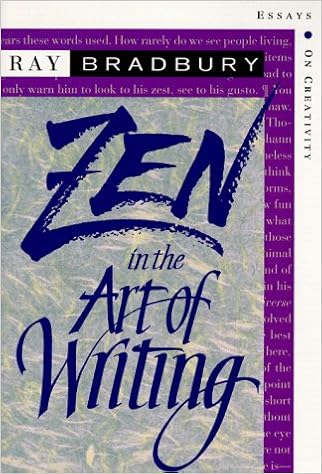
Zen in the Art of Writing by Ray Bradbury

You must stay drunk on writing so reality cannot destroy you.

For writing allows just the proper recipes of truth, life, reality as you are able to eat, drink, and digest without hyperventilating like a dead fish in your bed.

In one essay from Zen in the Art of Writing, Ray Bradbury describes his method: Write a story on Monday, a second draft on Tuesday, a third on Wednesday, a fourth on Thursday, a fifth on Friday, and then send it off on Saturday.  And unlike some other advice-givers, Bradbury doesn't seem to be one of those who says you must do it mechanically, even when inspiration isn't striking.  To the contrary, he writes, "[I]f you are writing without zest, without gusto, without love, without fun, you are only half a writer."  The impression these essays ultimately give is of a writer so full of gusto and zest you hope that some of it will rub off on you.

If you're looking for practical advice, you might be disappointed by the collection.  Bradbury credits most of his successful work to a single list of nouns he jotted down one day in his twenties.  (THE LAKE, THE BABY, THE OLD WOMAN, THE RAVINE.)  Over several decades, Bradbury returned to this same list--or so he claims--to inspire him.  ("The Old Woman" and "The Ravine," for sure, I remember as some of the most outstanding sections of the story-collection-as-novel Dandelion Wine.)  Who can imitate that?  No one, I expect.  But the essays themselves are so full of life and good feeling that they give you the impression that you might just be able to, especially if Bradbury believes in you--and they also give the impression that, somehow, he believes in you.

Zen is a collection of essays written at various points throughout Bradbury's life, and as with a lot of these compilations, you hear the same stories over and over again.  Bradbury is especially fond of talking about how, as a kid, he tore up all his Buck Rogers comics in an effort to fit in, and the guilt he felt at betraying Buck was so strong that he vowed never to turn his back on his childhood loves again.  "Since then," he writes, "I have never listened to anyone who criticized my taste in space travel, sideshows, or gorillas.  When this occurs, I pack up my dinosaurs and leave the room."  It's such a charming aside that you don't mind hearing it again.

Zen in the Art of Writing won't change any aspect of how or what I write.  But it did give me some classic snippets that I'm going to share with my students.  And as I find myself striving, slogging, to finish a book of my own, it was a nice inspirational kick in the pants.

Sunday, May 30, 2010

The Martian Chronicles by Ray Bradbury

"I've always to see a Martian," said Michael. "Where are they, Dad? You promised."

"There they are," said Dad, and he shifted Michael on his shoulder and pointed straight down.

The Martians were there. Timothy began to shiver.

The Martians were there--in the canal--reflected in the water. Timothy and Michael and Robert and Mom and Dad.

The Martians stared up at them for a long, long silent time from the rippling water...

The oldest stories in Ray Bradbury's Martian Chronicles were not meant to be part of a comprehensive mythology, and some of the seams show: The brown-skinned, golden-eyed Martians of "Ylla" and "The Summer Night" are conspicuously unlike the glittering jade mantis of "The Night Meeting," but Bradbury doesn't seem to find it necessary to detail why there are two sentient species on Mars, or how they interacted with one another. But for the most part, all the stories here seem to fit together into a larger whole, if not in testament to Bradbury's ability to go back and fill in the gaps, then definitely to the consistency of the themes that dominate his work: the passage of time on scales large and small, the vitality of small-town life, the hope for social progress that only science fiction can truly reflect. Bradbury imposes a larger arc on the stories he had already written in which, in roughly a thirty year span, man first reaches Mars, colonizes it (accidentally killing off the local population), and returns back to try to save an Earth dying from world war.

"The Night Meeting" is my favorite of these. In it, a man named Tomas Gomez encounters a Martian while traveling through a dead Martian town. Both are shocked at and fascinated by the others' presence, but when they try to shake hands, they pass right through each other. Eventually, Gomez and the Martian determine that they exist on different planes of time. When Gomez points out that his time-dimension must be the later one--he can see the ruins of the same great city that the Martian is from--the Martian dismisses the significance of this:

"Who wants to see the Future, who ever does? A man can face the Past, but to think--the pillars crumbled, you say? And the sea empty, and the canals dry, and the maidens dead, and the flowers withered?" The Martian was silent, but then he looked on ahead. "But there they are. I see them. Isn't that enough for me? They wait for me now, no matter what you say."


I love this for two reasons. First, it wonderfully expresses a theme to which Bradbury frequently returns, usually with less subtlety: the primacy of the moment, living and cherishing the here and now. Secondly, it affirms that Bradbury's chosen task, writing about the Future, ironically does the exact opposite. Here Bradbury uses the Future to tell us, as the Gospel says, "do not worry about tomorrow, for tomorrow will worry about itself."

But the episodic nature of The Martian Chronicles makes it uneven. Consider "The Third Expedition," in which an explorer comes to Mars only to land in what seems to be his hometown of Green Bluff, Illinois in the day of his childhood. The line between Green Bluff and the Green Town that provides the setting for Dandelion Wine and Something Wicked This Way Comes (mine, Brent) is nearly nonexistent. As such, the explorer's experience mirrors Bradbury's modus operandi. The explorer travels to Mars, only to find he is back in Green Bluff. For all his ingenuity, Bradbury seems incapable of truly imagining a world in which the small Illinois town he was born in is not the fulcrum of the universe.

This idiosyncrasy of Bradbury's turns The Martian Chronicles into something of a paradox. His investigation of Martian society can be strikingly creative:

Mr. and Mrs. K had lived by the dead sea for twenty years, and their ancestors had lived in the same hourse, which turned and followed the sun, flower-like, for ten centuries... Once they had liked painting pictures with chemical fire, swimming in the canals in the seasons when the wine trees filled them with green liquors, and talking into the dawn together by the blue phosphorous portraits in the speaking room.


I especially like the idea that the Martians are telepathic. This is how Gomez can communicate with the Martian, and in an earlier story an expedition crew is locked in a Martian asylum because the natives they meet assume their strange appearance and story are the mental projections of mental insanity.

But elsewhere, Bradbury seems trapped by his own perceptions. The worst offender here is "Way in the Middle of the Air," a story about how all the blacks in the United States decide to move to Mars to escape social oppression. A bitter racist named Samuel Teece is outraged that he is losing his hired help:

"I suppose you got names for your rockets?"

They looked at their one clock on the dashboard of the car.

"Yes, sir."

"Like Elijah and the Chariot, The Big Wheel and The Little Wheel, Faith, Hope, and Charity, eh?"

"We got names for the ships, Mr. Teece."

"God the Son and the Holy Ghost, I wouldn't wonder? Say, boy, you got one named the First Baptist Church?"

"We got to leave now, Mr. Teece."

Teece laughed. "You got one named Swing Low, and another named Sweet Chariot?"

The car started up. "Good-by, Mr. Teece."

"You got one named Roll Dem Bones?"

"Good-by, mister!"

"And another one called Over Jordan! Ha! Well, tote that rocket, boy, lift that rocket, go on, get blown up, see if I care!"


This story is set in 2003, but its depiction of race relations is culled straight from the year The Martian Chronicles was written, 1946. How is it that Bradbury is able to imagine a Martian society so unlike ours, but can't conceive how human society might have changed in almost sixty years? This story leaves a bad taste, and underlines an undercurrent of pessimism that sets The Martian Chronicles apart from most of Bradbury's other works.

Still, the stories that succeed outweigh and outshine those that don't. Strangely, Bradbury kills off the Martians early on (from chicken pox, sort of like The War of the Worlds), but it seems necessary to get them out of the way. At its heart, The Martian Chronicles is about human ambition and discovery, the possibilities afforded by a new frontier. For Bradbury, space travel seems to represent a fundamental challenge to the compassion and wisdom of the human race. His characters, sadly, don't respond to this challenge very well, but the last image of the book--a human family seeing their reflection in the rivers of Mars, knowing they are looking at true Martians--suggests a hope that Bradbury will be proven wrong.

Tuesday, May 25, 2010

Something Wicked This Way Comes by Ray Bradbury

“Beware the autumn people...For some, autumn comes early, stays late, through life, where October follows September and November touches October and then instead of December and Christ’s birth there is no Bethlehem Star, no rejoicing, but September comes again and old October and so on down the years, with no winter, spring or revivifying summer. For these beings, fall is the only normal season, the only weather, there be no choice beyond.”

Somehow, I missed Something Wicked This Way Comes while I was scouring the children’s section of the library, and it’s probably a good thing. It’s hard to imagine how an avid Goosebumps reader would have dealt with a scary book that’s actually scary and substantial, not just for the grotesque images or the shocking twists, but for the themes it carries. There are spoilers in this review, mostly from the first third of the book.

The book opens on its dual protagonists, Jim Nightshade and Will Holloway. Both thirteen years old, they are inseparable sides of the same coin. Jim is rash and impetuous, always on the lookout for a thrill or an adventure; Will is more careful, although, as he says in the book, is often dragged into adventure by Jim whether he wants to be or not. The books opens in Autumn with the arrival of a mysterious carnival, populated by a diverse array of freaks and run by the Illustrated Man, Mr. Dark, a mysterious entity who exercises control over his freaks with his vast array of tattoos. The centerpiece of the carnival is broken down Carousel that nevertheless comes alive at night. It can spin either way, making its riders either older or younger. Soon after the carnival opens, Jim and Will see the carousel in action and make an enemy of Mr. Dark who, of course, spends the rest of the book trying to turn them into a couple of his freaks.

In addition to the boys, there’s a third, equally important character: Charles Holloway, Will’s 54 year old father. Married to a beautiful woman 20 years his junior, he struggles with feeling too old for her and too old to properly relate to his son.

Something Wicked
is surprisingly dense, and there are a lot of things I could talk about, but I’d like to focus on what seemed like the overriding themes: the elders’ fear of aging and death and the youth’s desire to speed the process along. The Carousel stands at the center of the novel, towering over even Mr. Dark in its sway over the protagonists. So let’s start with a laundry list: Will fears that, with time, he and Jim will grow apart. Jim fears that he will never grow up at all, and Charles fears that he’s already too old to relate to the people he cares most about. The thing is aging or de-aging on the carousel is no good. It rushes things, so young men end up with old men’s minds and old men are still children inside. It is the ultimate relationship breaker, because it makes relation with other people of your own age impossible—who wants to hang out with the 30 year old who still wants to play marbles, or the 16 year old who has all the worries in the world?

I don’t want to talk much more about the plot, but I will say that there are some very disturbing images, not so much because they’re graphic, but because being turned into a wax dummy is kind of terrifying. Anyway, this review is all over the place, but if you missed this as a child, it’s well worth reading. And I hear the film is pretty scary.

Thursday, December 24, 2009

Dandelion Wine by Ray Bradbury

It was a quiet morning, the town covered over with darkness and at ease in bed. Summer gathered in the weather, the wind had the proper touch, the breathing of the world was long and warm and slow. You had only to rise, lean from your window, and know that this indeed was the first real time of freedom and living, this was the first morning of summer.

I am not sure that the dead of winter was the right time to read Dandelion Wine, as obsessed as it is with the magic of the summertime. The hero of the story is Douglas Spaulding, a twelve-year old boy in Green Town, Illinois (the same town in which Bradbury's much better Something Wicked This Way Comes takes place), who on the first day of summer, 1928, realizes for the first time that he is alive. This realization gives Douglas a new lease on life, and he begins to become aware of the significance of summer's mandatory rituals: the new pair of sneakers, the bottling of dandelion wine (which, honestly, sounds gross), etc., etc. The narrative jumps from Douglas to the other denizens of Green Town, but Douglas' hyper-awareness makes him the fulcrum around which the novel turns.

Though Bradbury is characteristically poignant here, his enthusiasm gauge is stuck squarely at eleven. Sometimes the "aw-shucks factor" is overwhelming:

"The reason why grownups and kids fight is because they belong to separate races. Look at them, different rom us. Look at us, different from them. Separate races, and 'never the twain shall meet.' Put that in your pipe and smoke it, Tom!"

"Doug, you hit it, you hit it! That's right! That's exactly why we don't get along with Mom or Dad. Trouble, trouble, from sunrise to supper! Boy, you're a genius!"


Oh boy, Davey! There's something slightly disingenuous about this, I think, and it's true for a lot of books about children. Children may be innocent, but it's not because they lack vices; it's because they don't know any better. In fact, children are typically vapid, selfish, cruel and prone to anger. Bradbury wants us to believe, as many do, that children occupy a purer state, but I'm not sure I buy into that, even in 1928. Not to mention my inherent distrust of the saccharine and overenthusiastic.

But Bradbury successfully tempers these tendencies with a grim streak: As in the beginning of the summer, Douglas realizes that he is truly alive, he later realizes that he, too, must die. This realization is brought on by the death of several elderly folks in Green Town, as well as the re-appearance of a serial strangler known as The Lonely One. At the book's climax, Douglas takes ill and nearly dies, saved finally by a traveling junkman with vials of exotic air. At his happiest, Bradbury is an above average prose stylist, but I think it's these darkest moments where he truly excels. When Douglas is lying prone in his bed, on death's door, Bradbury writes:

Inside redness, inside blindness, Douglas lay listening to the dim piston of his heart and the muddy ebb and flow of the blood in his arms and legs.

His lips were heavy and wouild not move. His thoughts were heavy and barely ticked like seed pellets falling in an hourglass slow one by falling one. Tick.


To Bradbury's credit, he seems to take death seriously but not morbidly; that Douglas' excitement at merely being alive and his awareness of death can coincide is the book's message and its triumph.

Thursday, March 19, 2009

Something Wicked This Way Comes by Ray Bradbury

At dawn, a juggernaut of thunder wheeled over the stony heavens in a spark-throwing tumult. rain fell softly on town cupolas, chuckled from rainspouts, and spoke in strange subterranean tongues, beneath the windows where Jim and Will knew fitful dreams, slipping out of one, trying another for size, but finding all cut from the same dark, mouldered cloth.

In the rustling drumbeat, a second thing occurred:

From the sodden carnival grounds, the carousel suddenly spasmed to life. Its calliope fluted up malodorous steams of music.


I had never read Something Wicked This Way Comes, but I have good memories of reading Ray Bradbury's short stories as a boy, including two other books tangentially related to this one, The Illustrated Man and Dandelion Wine. Then, a year or so ago, I happened to pick up Fahrenheit 451, which I had never read. It was good, I thought, if a little scattershot. But I was disappointed by one of the appended stories, "The Veldt," which I remembered fondly but upon returning seemed shallow and artless. I figured I had overestimated Bradbury as a teenager, biased by a love of speculative fiction.

For that reason, I was blown away by Something Wicked This Way Comes, which, along with Dandelion Wine, I had always thought of as juvenile fiction--and true, Something Wicked seems like it might appeal to a particularly bright kid, as it embodies a lot of what is at the heart of childhood: a sense of immortality and limitless fantasy, coupled with an ironic desire to be older. But it is also about nostalgia, and the desire of adults to have what they lost by leaving their childhood. Also the prose, while bold and full of strong visual imagery like you expect from YA fiction, has a certain obtuse flair that kids might find hard to follow, but that really makes the book enjoyable for an adult reader.

Macbeth's witches provide the title: "By the pricking of my thumbs / something wicked this way comes." That "something wicked" is a carnival, Cooger & Dark's Pandemonium Shadow Show, populated by a number of freaks: the ancient and mummified fortuneteller called Dust Witch, the human skeleton, the dwarf, and the Illustrated Man, Dark himself, who is covered head-to-toe in tattoos--tattoos which we find represent the souls trapped in bondage by the evil carnival. Cooger and Dark have travelled the world with evil intent for centuries, kept in stasis by a carousel that can age a rider forwards or backwards, depending on the way it is ridden.

Two boys, Jim and Will, discover the carnival's secret and set out to destroy it, in typical fashion. Will is horrified by the carnival, but Jim is seduced by the idea of the carousel. I love Bradbury's descriptions of Jim's character:

Waiting, his eyes were dark as twilight, with shadows under the eyes from the time, his mother said, he had almost died when he was three and still remembered. His hair was dark autumn chestnut and the veins in his temples and brow and in his neck and ticking in his writsts and on the backs of his slender hands, all these were dark blue. He was marbled with dark, was Jim Nightshade, a boy who talked less and smilled less as the years increased.

The trouble with Jim was he looked at the world and could not look away. And when you never look away all your life, by the time you are thirteen you have done twenty years worth of taking in the laundry of the world.


Jim is "marbled with dark." That says it all, doesn't it? Jim's counterpoint is Will's father, Charles Halloway, who works at the local library and longs to recapture the magic of youth. Dark's carousel, of course, provides that opportunity, but at a tremendous cost. A lesser book would present this as a conflict of conscience, where Charles is forced to choose between youth and the safety of his son, but Bradbury is wisely content to present Charles as a man who has no doubts when it comes to helping his son, but aware of his own temptations all the same.

Though Will and Jim are its heroes, some of the most powerful passages in the book come from Charles:

His wife smiled in her sleep.

Why?

She's immortal. She has a son.

Your son, too!

But what father ever really believes it? He carries no burden, he feels no pain. What man, like woman, lies down in darkness and gets up with child? The gentle, smiling ones, own the good secret. Oh, what strange wonderful clocks women are. They nest in Time. They make the flesh that holds fast and binds eternity. They live inside the gift, know power, accept, and need not mention it. Why speak of Time when you are Time, and shape the universal moments, as they pass, into warmth and action? How men envy and often hate these warm clocks, these wives, who know they will live forever. So what do we do? We men turn terrible mean, because we can't hold to the world or ourselves or anything. We are blind to continuity, all breaks down, falls, melts, stops, rots, or runs away. So, since we cannot shape Time, where does that leave men? Sleepless. Staring.


I love that. That passage alone rehabilitates Bradbury for me, and I think I'm going to have to revisit Dandelion Wine in the near future. All in all, this is one book I am glad that I stole from school.

Friday, March 7, 2008

The Martian Chronicles by Ray Bradbury

The Martian Chronicles is a series of loosely connected stories about man's attempts to colonize Mars in the shadow of a pending nuclear war. It's not the easiest book in the world to review, like most collections of short stories, but it manages to feel cohesive despite its episodic nature. The stories are tied together by vignettes that are often a page or less. While researching this book, I found that the interstitials were influenced by the similar ones in The Grapes of Wrath, which I thought was interesting.

Most of the stories in the collection were written for outside publications initially, but they are tied together by their chronology, some of their characters, and the themes of the book. Several of them are thinly veiled attacks on colonialism, as the humans come to Mars and completely (and intentionally) destroy Martian civilization. The other theme is man's insignificance in the universe, and most of the stories touch on both of these, pointing out the foolishness of decimating other cultures when the conquering one will eventually die out itself.

The characters in these stories are diverse. There are a couple groups of astronauts, a man who wants to start the first hot dog stand on the moon, a Martian woman trapped in an unhappy marriage, and, in perhaps the books most famous section, There Shall Come Soft Rains, an automated house that keeps running, completely unaware that it's occupants have been dead for a year. There's an interesting connection to Bradbury's other famous work, Fahrenheit 451, because the house in the story is very similar to the one occupied by the main character of F451.

Most of these stories have a pitch black sense of humor to them, particularly the second expedition to Mars. The astronauts arrive and can't figure out why no one seems surprised or excited to see them. They're finally taken to a large hall where the inhabitants are thrilled that they're there, but the group quickly realizes the inhabitants are insane, and the astronauts themselves are interrogated, declared incurably crazy, and euthanized. Somehow, this story is played for laughs until the denouement which is, really, kind of disturbing.

I guess at this point I'd characterize myself as a fan of Bradbury, and anyone who liked F451 or his other short stories collections would be well-advised to read this as well.

Thursday, April 12, 2007

Fahrenheit 451 by Ray Bradbury

Part III in the ongoing series, "Books that everyone else read in school but me": Ray Bradbury's Fahrenheit 451.

This book is widely regarded as one of science fiction's canonical classics, and it's one of the few science fiction books to really have a massive cultural impact; that it did not make the Times list is criminal. Summarizing it is perhaps unnecessary: in an unspecified future period, homes have been made fireproof and the role of firemen has mutated into the role of book-burners, cauterizing the wounds that literature and art have given society. The protagonist, Guy Montag, is a fireman who has sudden qualms about burning books and begins to horde them in secret.

The thing about this plot is that it's inherently ridiculous. If Bradbury had pitched this book to you, you probably would have thought the notion of book-burning was a little hokey. But Bradbury, like the best science fiction writers, can turn hokey concepts into believable narratives because of the weight of his striking prose. The way Bradbury writes is really unmistakable, but somehow unquantifiable at the same time.

The theme here is the rise of anti-intellectualism. Bradbury's world is one in which real literature and art are dead, not because a fascist regime killed them, but because we voluntarily put them to sleep because they discomforted us. Montag's wife Mildred lives in a world that is populated only by her "family," recorded television shows projected onto the living room walls that allow you to become a participant. One wonders if Bradbury updated Fahrenheit for today, what he would make of reality tv. The hip thing for teens to do is street race--the billboards, a young girl makes Montag notice, are actually stretched out so that you can read them at ridiculous speeds--and by the carful they die, unmourned by parents who hardly knew they existed. America is at war, but no one knows or care with whom or how it might affect them. People are completely unanalytical about their own lives to the point where they hardly exist at all.

There is a point at which Montag, fed up with the shallowness of his wife and her friends, grabs a collection of poems and reads 'Dover Beach' at random. The last lines of the poem make one of the women cry, which settles the matter for Mildred--all literature does is make you cry; it's not fun like her "family." Bradbury did not choose 'Dover Beach' at random--Mildred's friend says that she doesn't know why she cries, but she cries because that's what the last lines of 'Dover Beach' do to you. They make you face the confusion, the isolation, the uncomfortableness of what it really means to be alive. 'Dover Beach' makes you cry, so you shut it in a box, throw it away, or you burn it. That's the future that Bradbury wants to prevent--one in which we voluntarily destroy our ability to look at ourselves and the short span of life we're given. No one cares or notices when kids die in car crashes because the devaluation of literature means the devaluation of life.

Side note: This version of Fahrenheit 451 includes two short stories by Bradbury: "The Playground" and "And the Rock Cried Out." I haven't read a short story by Bradbury in years, so I read them as soon as I finished the book, but they were oddly unsatisfying. It's as if Fahrenheit 451, though short (~150 pp.) has been given enough room to develop the complexity of its ideas, whereas the two short stories are simply novel ideas, twists without narratives to accompany them. If you get this edition, skip the stories and read Dandelion Wine instead.

Next up: Part bazillion in the ongoing series, "Books I ought to be reading to class but am not."

Monday, March 26, 2007

Brave New World by Aldous Huxley

Well, I finally completed the dystopian trilogy. I borrowed 1984 from my brother three or four years ago; two summers ago I read Fahrenheit 451; and I closed the cover of Brave New World not 10 minutes ago. Although all three of these novels dealt with roughly the same topic, they were quite different. The worlds of 1984 and Fahrenheit 451 were police states, where people were forced to conform with the threat of violence. With Brave New World, Huxley depicts a society in which people are intoxicated into a state of conformity.

Huxley's future is more believable than the future created by either Orwell or Bradbury. This edition of Brave New World includes a letter written by Huxley to Wells, shortly after the publication of 1984. Huxley praises the book, but notes that the violent coercion that takes place in 1984 will ultimately give way to a more subtle form. Brave New World's ubiquitous somma that puts those who take it into a coma-like state of bliss strikes me as a more practical method of control than brute force.

While none of these books offers a completely accurate reflection of modern society, they come eerily close at many points. Huxley is not concerned with making specific predictions, but the world that he describes has many parallels to the present.

Note: P.S. is an imprint of Harper Collins Publishers. They produce great editions of classic works. The supplementary materials are informative and insightful. Even the binding if better than most books, allowing the book to actually remain open while you read it, instead of constantly flipping shut. Look for great P.S. books at your local bookseller!