I understood immediately the thrill of seeing oneself in print. It provides some sort of primal verification: you are in print; therefore you exist. Who knows what this urge is all about, to appear somewhere outside yourself, instead of feeling stuck inside your muddled but stroboscopic mind, peering out like a little undersea animal--a spiny blenny, for instance--from inside your tiny cave?
"Do it every day for a while," my father kept saying. Do it as you would do scales on the piano. Do it by prearrangement with yourself. Do it as a debt of honor. And make a commitment to finishing things."
I heard a preacher say recently that hope is a revolutionary patience; let me add that so is being a writer. Hope begins in the dark, the stubborn hope that if you just show up and try to do the right thing, the dawn will come. You wait and watch and work: you don't give up.
The very first thing I tell my new students on the first day of a workshop is that good writing is about telling the truth.
E. L. Doctorow once said that "writing a novel is like driving a car at night. You can see only as far as your headlights, but you can make the whole trip that way."
Writing can be a pretty desperate endeavor, because it is about some of our deepest needs: our need to be visible, to be heard, our need to make sense of our lives, to wake up and grow and belong. It is ino wonder if we sometimes tend to take ourselves perhaps a bit too seriously.
The first draft is the child's draft, where you let it all pour out and then let it romp all over the place, knowing that no one is going to see it and that you can shape it later. You just let this childlike part of you channel whatever voices and visions come through and onto the page. If one of the characters wants to say, "Well, so what, Mr. Poopy Pants?" you let her.
Writing a first draft is very much like watching a Polaroid develop. You can't--and in fact, you're not supposed to--know exactly what the picture is going to look like until it has finished developing. First you just point at what has your attention and take the picture.
But something must be at stake or else you will have no tension and your readers will not turn the pages. Think of a hockey player--there had better be a puck out there on the ice, or he is going to look pretty ridiculous.
You get your intuition back when you make space for it, when you stop the chattering of the rational mind. The rational mind doesn't nourish you. You assume that it gives you the truth, because the rational mind is the golden calf that this culture worships, but this is not true. Rationality squeezes out much that is rich and juicy and fascinating.
...you don't always have to chop with the sword of truth. You can point with it, too.
Wednesday, September 4, 2019
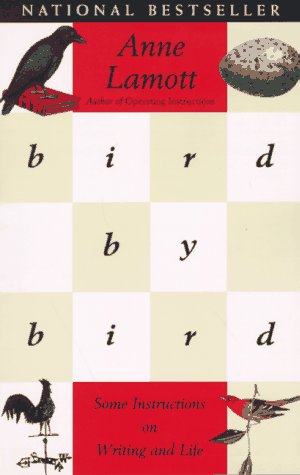
Bird by Bird by Anne Lamott
Sunday, March 10, 2019
Steering the Craft by Ursula K. Le Guin
I didn't get as much out of Ursula K. Le Guin's book on writing, Steering the Craft: A 21st-Century Guide to Sailing the Sea of Story, as I was hoping. It's pretty narrowly focused, eschewing big questions about character and plot and worldmaking--the things I would really like to hear from Le Guin about--for discussions of real nuts-and-bolts stuff like point-of-view, tense, and repetition. Now, don't get me wrong, I love that stuff, and it's a lot of what I focus on in my fiction writing class. And maybe that's the problem: Le Guin's book is full of great, practical advice, but it's mostly stuff I already believe.
It was nice to hear, however, some of my own advice repeated back to me, like:
Particularly disturbing is the effect of being jerked into a different viewpoint for a moment. With care, the involved author can do this (Tolkien does it with the fox). But it cannot be done in limited third person. If you're writing the story from Della's point of view, you can say, "Della looked up into Rodney's adoring face," but you can't say, "Della raised her incredibly beautiful violet eyes to Rodney's adoring face." Though Della may be well aware that her eyes are violet and beautiful, she doesn't see them when she looks up. Rodney sees them.(Beginning writers do this literally all the time, and it's always just like this: a description of eyes, or a face, or a smile.) Or:
Anton Chekhov gave some advice about revising a story: first, he said, throw out the first three pages. As a young writer I figured that if anybody knew about short stories, it was Chekhov, so I tried taking his advice. I really hoped he was wrong, but of course he was right.
The best section of the book, actually, is Le Guin's examples of the different kinds of point of view. She tells one simple story, about a space princess who is anxious about her place in the kingdom and makes eye contact with a friendly face in a crowd, from several different points of view and the examples do a terrific job of showing how each affects the nature of the story. I'm going to use those as examples in my class. But the exercises she includes are not especially helpful and interesting, and though she includes a lot of really fascinating examples of authors using the tools she discusses--mostly, it turns out, Virginia Woolf--I would have liked to see them explicated or explored more.
Wednesday, January 23, 2019
Burning Down the House by Charles Baxter
"There are a number of wild claims here," Charles Baxter says in the introduction to his collection of essays, Burning Down the House, "an occasional manic swing toward the large statements." They are "meant to be playful rather than ponderous," but they are meant to perform the title action of dismantling the understanding we have of literature, the kind that is so ubiquitous that we barely notice it. You can see that kind of fence-swinging in his statement on poets, whose lives are rarely the kind you would "wish upon your children." That seems a little more Ezra Pound than Mary Oliver to me, but it serves as a preface to a thoughtful essay that examines the way that narrative fiction, like poetry, has its own kind of rhyming, and like poetry it suffers if the rhyming is too clunky or exact.
I don't know if Baxter succeeds in burning down anything, but I did come away from these essays feeling like I had noticed things about modern literature that were beyond my sight. "Against Epiphanies," for example, shows just how reliant we have become on sudden realizations, though they are only rarely to be found in life as it's really lived. When we begin to expect epiphanies from our fiction we create false expectations and a kind of staleness: "The old insight train just comes chugging into the station, time after time."
Several essays deal with the ways in which our narratives have become deprived of meaningful action, especially wrong or villainous action. In one, he connects this symptom to the passive Nixonese that is still the lingua franca of the political class: "Mistakes were made." "In an atmosphere of constant moral judgment," he writes, "characters are not often permitted to make interesting and intelligent mistakes and then to acknowledge them." Instead, we write fiction as therapy, in which characters unearth traumas that explain their actions but rob them of agency. "The injury is the meaning" in these agentless narratives, "although it is, itself, opaque." A Thousand Little Acres receives special opprobrium. In another essay, he links our distaste for melodrama--defined as something like the work of evil for its own sake against innocence--to the cultural disappearance of the devil:
Satan as a figure is dead, but evil continues, without, however, someone to answer for it. Evil is more evil than ever, even when we have no name for it and no Satanic figure to blame for it. We still have melodrama, however: the honorable narrative house of horror and the unforgivable.
I got this book because it was on a list, somewhere, of great books about writing. It is a great book about fiction, but I'm not sure it's a great book about writing. Really interesting writing books are often full, I have found, of useless advice. Not necessarily wrong, but not useful, at least not for my purposes:
As an undergraduate I was taught that when a writer starts a story, s/he must begin with a character, an active, preferably vivid, ideally sympathetic, character. It takes a bit of time to see that stories don't in fact begin with characters, not from here, at least, not from behind this keyboard. They begin with words, one word after another.
Although I would never tell a student to make a character sympathetic (much better to make them a nasty little shit), I do tell them to begin with character. And it's not because that's what good fiction always does--though I don't think it's true in any meaningful sense that it begins with words, one word after another, either--but because it disorients students from the way they see writing as about plot and action. Baxter wants to return action, and moral agency, to the center of fiction, but students have trouble when it comes to retrofitting characters to the kinds of stories they want to tell. If they want to write a story about an alcoholic dad (and they do), they will fit the character into that box, but if you have them think about what kind of person the dad is and what he wants and how that manifests in action, the story begins to look more like life. And in fact, I think teenagers are especially susceptible to the kind of void in agency that he critiques, partially because they have yet to develop a critical eye toward the kind of narratives they consume, and partially because their own lives are pretty free of meaningful agency.
Anyway. The essays here are thoughtful and clever, wry and colloquial in style, and filled with illustrations from Flannery O'Connor and Marilynne Robinson and Donald Barthelme and Sylvia Townsend Warner in a way that seems mostly borne out of love. (Not poor old Jane Smiley, though.) It gave me a lot to think about in my own writing, even if it didn't make me want to burn down the whole house.
Thursday, June 7, 2018
How the Light Gets In: Writing as a Spiritual Practice by Pat Schneider
"This is not a 'How To' book," Pat Schneider writes in the notes to How the Light Gets In, "it is an invitation to a reader to look over my shoulder as I do the thing itself: write as a spiritual practice. In that way I hope it can act as a guide for individual writers, an example of using one's own life story to trace the presence of mystery and the outlines of grace." I had planned on reading her how-to book Writing Alone and with Others, in preparation for the fiction-writing class I'll be teaching high school seniors in the fall, but instead I was drawn to this book, which has fewer lessons (but not none) for teachers of creative writing.
At times it borders on straight memoir, actually, giving us a glimpse into the way Schneider uses writing as a way to understand her own past. The images she returns to in the practice she likens to prayer are all from her troubled upbringing: the peach tree under which she was "saved" into the church, the roaches in the sour bottles of milk in her tenement home in St. Louis, the bed in the orphanage. And we get to see the construction of some very wonderful poems out of these images in real time.
How the Light Gets In is less a book of instruction than a book of wisdom. It's separated into chapters that deal with broad experiential concepts--death, the body, freedom, joy--in which Schneider uses the writing process to explore these things and how they touch in her own life. (The poignancy of which is all amplified by her advanced age--though I am pleased to say she's still around and alive.) The content overlaps with the practice. For Schneider, writing itself is a kind of prayer in which she approaches what, having fallen out with her fundamentalist upbringing, calls only "the mystery." I was particularly struck by the chapter on "Strangeness":
Writing about writing, I have been exploring what I think I already know. But writing about mystery, I have tried neither to teach nor preach. I have tried to constantly veer away from that which is familiar and known, toward that which is just beyond my grasp. In writing, this is most commonly done in story and in metaphor. I have met strangeness again and again as I have been writing this book. Trying to describe strangeness is--forgive me!--strange. It requires story. It requires metaphor.
What a brief and lucid defense of the entire idea of literature! I want to frame it and hang it on my classroom wall. It resonates with Marilynne Robinson's assertion that the universe keeps showing itself to be stranger than we ever imagined. And this chapter, I think, I hope, presented to me a solution to a problem I had been having with the ending of the novel I've been writing. When I put it on paper I will let you know.
There are a few key moments I know I'll want to share with my students. One is Schneider's simple "acid test for the health of any group, class, or workshop one might try: When I leave, do I feel more like writing, or less like writing?" Another is an exercise in which she encourages her students to begin by considering the language of their own upbringing, because "we must first learn to recognize and value the strengths and the beauty in our languages of origin, and in our ability to tell our own stories in our own voices." I think that's a beautiful idea, and a spiritual one, linked to the assertion of the God-image in every person, though that's not the language I would ever use in the classroom.
The lessons I take for my own writing are much more difficult, perhaps impossible, to articulate. They might begin with admiration for Schneider's bravery in writing about her own experience, and the double bravery of writing about the writing process, which for me is secret and often embarrassingly messy. They also contain a deep sympathy for the idea of writing as a form of prayer, a way of approaching that for which ordinary didactic language has no words. This is a book I know I'll return to.
Monday, February 12, 2018
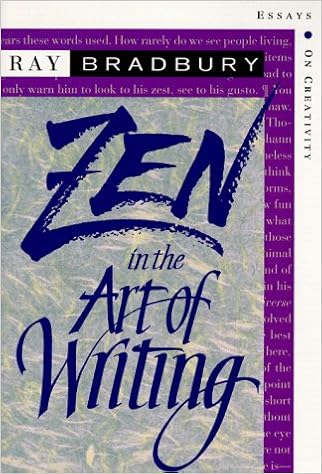
Zen in the Art of Writing by Ray Bradbury
For writing allows just the proper recipes of truth, life, reality as you are able to eat, drink, and digest without hyperventilating like a dead fish in your bed.
In one essay from Zen in the Art of Writing, Ray Bradbury describes his method: Write a story on Monday, a second draft on Tuesday, a third on Wednesday, a fourth on Thursday, a fifth on Friday, and then send it off on Saturday. And unlike some other advice-givers, Bradbury doesn't seem to be one of those who says you must do it mechanically, even when inspiration isn't striking. To the contrary, he writes, "[I]f you are writing without zest, without gusto, without love, without fun, you are only half a writer." The impression these essays ultimately give is of a writer so full of gusto and zest you hope that some of it will rub off on you.
If you're looking for practical advice, you might be disappointed by the collection. Bradbury credits most of his successful work to a single list of nouns he jotted down one day in his twenties. (THE LAKE, THE BABY, THE OLD WOMAN, THE RAVINE.) Over several decades, Bradbury returned to this same list--or so he claims--to inspire him. ("The Old Woman" and "The Ravine," for sure, I remember as some of the most outstanding sections of the story-collection-as-novel Dandelion Wine.) Who can imitate that? No one, I expect. But the essays themselves are so full of life and good feeling that they give you the impression that you might just be able to, especially if Bradbury believes in you--and they also give the impression that, somehow, he believes in you.
Zen is a collection of essays written at various points throughout Bradbury's life, and as with a lot of these compilations, you hear the same stories over and over again. Bradbury is especially fond of talking about how, as a kid, he tore up all his Buck Rogers comics in an effort to fit in, and the guilt he felt at betraying Buck was so strong that he vowed never to turn his back on his childhood loves again. "Since then," he writes, "I have never listened to anyone who criticized my taste in space travel, sideshows, or gorillas. When this occurs, I pack up my dinosaurs and leave the room." It's such a charming aside that you don't mind hearing it again.
Zen in the Art of Writing won't change any aspect of how or what I write. But it did give me some classic snippets that I'm going to share with my students. And as I find myself striving, slogging, to finish a book of my own, it was a nice inspirational kick in the pants.
Saturday, November 18, 2017
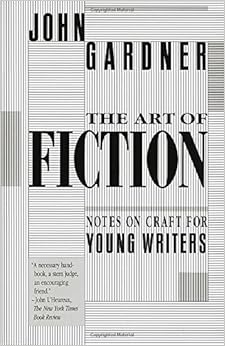
The Art of Fiction by John Gardner
I just started teaching Creative Writing this year, and it's been a real mixed bag. I decided to start with poetry, and for some students, the results were terrific. Many were already accomplished poets, but the best moments are when mediocre or unpracticed young writers stumble through experiment and practice into arresting lines or stanzas. Others have such a disinterest in poetry I think I may have lost them, though I hope that our upcoming unit writing short fiction will help them reengage with writing.
To that end, I've been reading some books on writing like John Gardner's The Art of Fiction and Ann Lamott's Bird by Bird. Lamott's book is mostly inspirational, an encouragement to writing in the face of all the things that discourage it. Gardner's is more of a survey of the nature of fiction, and neither are exactly practical. These books all struggle, I think, because of how difficult it is to speak to each writer at their particular moment; a lot of Gardner's advice seemed obvious to me, and much of it seemed very strange.
The Art of Fiction has a whiff of mothballs to it: For one, Gardner is pretty devoted to the most traditional notion of fiction as an imitation of life and dismissive, even as he claims he isn't, of the kind of "metafiction" that has preoccupied the postmodernists of the past seventy-odd years. He claims, perhaps rightly, that only those who have mastered fiction are able to write self-conscious metafiction effectively, but you get the sense that he thinks it's probably a mistake, and has little notion of why those writers find metafiction the only possible mode in their particular historical moment. Elsewhere, there's the unfortunate patina of chauvinism, as when he throws up his hands at the sad fact that the English language prioritizes male pronouns. He describes as brilliant a treatment of a student's novel he had heard, in which a Native American scholar unwittingly takes a position in an "Indian Studies" department--as in, East Indian--and has to muddle through pretending to be from Delhi, or something. In a more general way, his insistence that fiction relies most importantly on the accumulation of details that make you feel as if you were really somewhere else seems shortsighted and of another time.
But it's worth embracing, to an extent, the tradition articulated by Gardner here, and not forgetting why those narratives have been so powerful in the first place. His chapters on crafting individual sentences are exceedingly useful, and would probably help a lot of today's writers whose popular blandness seems like a flaw on the most fundamental level. Most useful to me were the series of exercises in the back of the book, many of which I'm definitely going to use: "Describe a lake as seen by a young man who has just committed murder. Do not mention the murder." Now, that's fun, and I have an inkling it will be a satisfying exercise for a bunch of high schoolers whose idea of fiction always operates at the highest pitch of drama. But we'll see.
Saturday, September 9, 2017
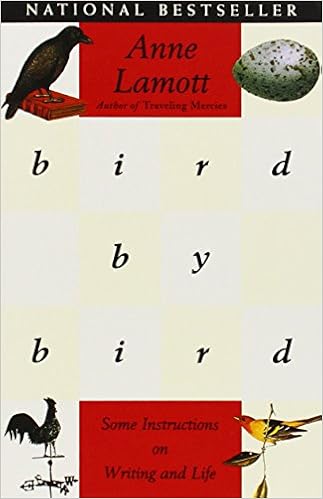
Bird by Bird by Anne Lamott
I can't name any of Anne Lamott's books; I think a lot of people who know Bird by Bird can't. There's a special irony to that, that an author's book on writing could so completely eclipse the fiction that they have written. Budding writers turn to this book again and again despite having no real proof that Lamott is a worthy person to be giving advice. What could be the reason for it?
It certainly doesn't contain the most practical advice. There are few exercises, and what there are of concrete suggestions are idiosyncratic. Don't write on Mondays, she says. Start by just writing about your childhood. The magic of Bird by Bird, I think, is how perfectly it captures the neurosis and trauma that visits writers. Lamott understands neurosis and trauma pretty well, but especially that kind that visits writers. She writes about it with a dark but assuring sense of humor, managing somehow to provide optimism while reminding the reader that what they write will probably never be successful. Lamott's powerful, sardonic voice gives the impression of sympathy; there's someone out there who understands what it's like to want to write and have it not come easy.
Ultimately, Bird by Bird makes good on its subtitle: "Some instructions for writing and life." The writing advice is good, if not always pragmatic, but the most powerful parts are when Lamott talks about the death of her witty, intelligent father from brain cancer, or the death of her close friend Pammy, also from cancer. She talks about writing their stories as a kind of gift to give to them and it doesn't seem at all maudlin. She's able to get to the heart, I think, of why writing is so appealing: its ability to transcend, or feel as if it transcends, the narrowness of the world, and even the banal inevitability of dying. And yet the book is so lighthearted.
I'm teaching creative writing--four sections of it, my gosh--for the first time this year. I don't know what I'm doing. I returned to Bird by Bird for some advice that might be useful to my own budding writers, but I also found a lot of good advice about dealing with not knowing what you're doing in general. Most of writing is just showing up and doing it, she says. Hopefully that's true for teaching writing, too.
Tuesday, November 20, 2012
Because You Have To: A Writing Life by Joan Frank
Where most books on writing seem to be written by fairly well-known authors or teachers, Joan Frank’s new collection of essays on the writing life comes from a different place, the pen of a writer who has learned, in her own words, “there may not be any breakthrough.” This is a woman who has published five works of fiction, been reviewed in the New York Times, but has come to accept that she may never be a household name, never able to answer the question, which she addresses in an essay, “Have you written anything I’ve heard of?” in the affirmative.
And yet, she continues to write, and write well, because, well, because she has to. Reading her essays felt more relatable to me, a wannabe writer who has published one story and a couple poems, than, say, Stephen King’s On Writing--although it’s good too. There is a compulsion in everyone who calls themselves a writer to create, to put the words down on paper and make them real, and Frank expresses that feeling more eloquently than most. She understands, and communicates, that writing is not about fame, or money, or notoriety. It’s about desire, about an insatiable need to get what’s inside outside. Every writer, famous or not, can relate to that.
Because You Have To isn’t a book on craft, for the most part. It’s more similar to Anne LaMott’s Bird by Bird or Ray Bradbury’s Zen and the Art of Writing. It’s full of advice--or sometimes just empathy--about the mundane things in a writer’s life: rejection letters, finding--or making--a place to write, and feeling as though you must “steal” time from the real world in order to get it down on paper.
Ultimately, what a reader gets from this sort of collection probably depends on what they brought into it. If they don’t write, have no desire to write, they won’t come away with a real understanding of the madness; but anyone who’s felt like they would burst if they didn’t tell their story, well, this one’s for you.
Thursday, July 16, 2009
This Year You Write Your Novel by Walter Mosley
The first thing you must know about writing is that it is something you must do every day-- every morning or every night, whatever time it is you have. Ideally, the time you decide on is also the time you do your best work. This Year Write Your Novel was a wedding gift to me from Carlton, who was under the impression that this was a new, more abstract Easy Rawlins novel. After reading the book once and being completely confused about the plot, I tried again and realized that it works best as an instructional book rather than a traditional narrative.
The book exists in some writing netherworld between The Elements of Style and something like Bird by Bird, but is probably closer to the former then the latter. The bulk of the book, such as it is, is mostly concerned with fairly basic ideas, like “write every day” and “write honestly.” The instruction is clearly written and enjoyable to read, and Mosley has a distinctive voice even in this setting, coming across as a gruff, grandfatherly figure who's been around the block a few times.
There are pros and cons to Mosley's approach. On the one hand, the book is slim and quite readable, and it inspired me to begin a couple writing projects I've been putting off. On the other, there isn't much here that anyone who's read a couple other good writing books doesn't already know. Ultimately, This Year is most suited for brand new writers who have no idea where to start, or experienced writers who just need a kick in the pants. I'm the latter, so it was worth it for me.
Sunday, March 16, 2008
A Room of One's Own by Virginia Woolf
For that visit to Oxbridge and the luncheon and the dinner had started a swarm of questions. Why did men drink wine and women water? Why was one sex so prosperous and the other so poor? What affect has poverty on fiction? What conditions are necessary for the creation of works of art?-a thousand questions at once suggested themselves. But one needed answers, not questions...In 1929, Woolf was asked to give lectures on the topic of "women and fiction" at both Girton and Newnham colleges. Later she expanded those two lectures into this book. A Room of One's Own is a unique blend of writing styles. It is essentially a book about writing, however, it is not about the art of writing. It is about what it takes for women to become writers. Even more interesting, the thoughts of Woolf are filtered through the words of a character she created. The book follows this young, nameless woman as she attempts to find out why so few women are writers.
Woolf comes to a simple conclusion: women must have a fixed income and a room of their own in order to be successful writers. She acknowledges that there have been female writers that did not have these accommodations, such as Jane Austen and Charlotte Bronte. But she views them as exceptions, not the rule. This book was not at all what I expected, but I actually found it very interesting.
Friday, February 8, 2008
Bird by Bird by Anne Lamott
I also remember a story I know I've told elsewhere but that over and over helps me get a grip: thirty years ago, my older brother, who was ten years old at the time, was trying to get a report on birds written that he'd had three months to write, which was due the next day. We were out at our family cabin in Bolinas, and he was at the kitchen table close to tears, surrounded by binder paper and pencils and unopened books on birds, immobilized by the hugeness of the task ahead. Then my father sat down beside him, put his arm around my brother's shoulder, and said, "Bird by bird, buddy. Just take it bird by bird."Such is the wisdom of Anne Lamott's Bird by Bird, a book on writing. It is a very good book; through a strange little quirk of fate it a much more widely read book than any of Lamott's novels, which is an irony I'm sure not lost on her.
I had to read this for my creative writing class, and, while it's fairly short on how to write--style and grammar and plot and shit like that--it is heavy on inspirational material, on why you ought to write and how to make yourself do it and how to get in the right frame of mind for a writer. If you are a writer, chances are it will make you want to write; if you are not a writer you will probably be confused by how little concrete information it offers. But that's not really what it's about. It's really more like a book written by someone enamored with books, who really loves writing and wants to share exactly what writing does for her. People with the same enamoration will relate, and Lamott's prose is simple, fluid, and at times hugely funny.
If you want to write, I recommend it--it took me only a couple of hours to read and it really rejuvenated my desire to write. I leave you with Lamott's advice on writing about your ex-spouse:
Make yourself the first wife or girlfriend, not the third wife, and do not include his offensive children, especially the red-haired twins. If you disguise this person carefully so that he cannot be recognized by the physical or professional facts of his life, you can use him in your work. And the best advice I can give you is to give him a teenie little penis so he will be less likely to come forward.
Sunday, January 20, 2008
The Elements of Style by William Shrunk JR. and E.B. White
"The breezy style is often the work of an egocentric, the person who imagines that everything that comes to mind is of general interest and that uninhibited prose creates high spirits and carries the day."