Who was she, the "I," that had loved? And Henry, who and what was he? A physical presence, threatened by time and death, and therefore the dearer for that factual menace? Or was his physical presence merely the palpable projection, the symbol, of something which might justly be called himself? Hidden away under the symbol of their corporeality, both in him and in her, doubtless lurked something which was themselves. But that self was hard to get at; obscured by the too familiar trappings of voice, name, appearance, occupation, circumstance, even the fleeting perception of self became blunted or confused. And there were many selves. She could never be the same self with him as when she was alone; and even that solitary self which she pursued, shifted, changed, melted away as she approached it, she could never drive it into a dark corner, and there, like a robber in the night, hold it by the throat against the wall, the hard core of self chased into a blind alley of refuge.
Henry Holland, Lord Slane, former Prime Minister of the United Kingdom and Viceroy of India, has died. His vain and mercenary children, themselves quite old, are slavering about the possibility of inheriting his jewels and fretting about where his widow, Lady Slane will go. To their surprise and consternation she rejects their eminently reasonable proposal--to rotate between their households, like the seasons. She's decided, not reasonably, to live on her own in a house in the neighborhood of Hampstead she fell in love with decades ago.
In her new house at Hampstead, Deborah Holland, Lady Slane, lives with the company of other superannuated people: the cantankerous owner of the property Gervase Bucktrout, a humble carpenter named Mr. Gosheron, and a hermit-like art collector, FitzGeorge, who fell in love with her seventy years ago in India, and has now returned to resume a friendship that never really could be kindled. She forbids her great-grandchildren from visiting; she only wants the old, those who understand what she might be going through in her old age, taking on a final measure of independence at the end of her life, reflecting on the way her life has gone.
Lady Slane's life is, though marked by prestige, an exceedingly ordinary life. Though she once dreamed of being an artist, she repressed her own desires for the political ambitions of her husband, whom she married out of expectation. Sackville-West makes it clear that Lady Slane did love her husband and her children, but that this love has never been enough to fully overcome the way that English society is designed to subjugate women: "He merely killed you," FitzGeorge says to Lady Slane about her husband, "that's all. Men do kill women. Most women enjoy being killed; so I am told."
In a long dreamy midsection, Lady Slane imagines herself walking beside the girl she once was, wondering what her life might have become if she had been able to nurture that dream of being an artist. (It seems that she never even got a chance to put brush to paint--she may have been a gifted painter and maybe not, but Sackville-West wants us to see that she never even got past the seed of a dream!) Lady Slane is the embodiment of Virginia Woolf's thesis about women need a "room of one's own," and no wonder: Sackville-West and Woolf had a longstanding romance; Woolf based the protagonist of Orlando on her. Lady Slane hasn't been tortured or miserable, but who knows what she might have become if allowed?
It's no good for Sackville-West to be associated with Woolf; though her novels outsold Woolf's in their lifetime, Woolf's genius will always outshine Sackville-West's talent. Which is a shame, because All Passion Spent is a good novel, perceptive and funny, presenting both psychological complexity (in the reflections of Lady Slane) and broad social comedy (in the vapid selfish banter of her children). It seems tempting to see in its mere existence a confirmation of Lady Slane's experience: Sackville-West and Woolf both managed to wrench an artist's life away from the pressures of expectation, and while Woolf clearly proved to be the genius, there is a remarkable quality to the feat itself.
Showing posts with label virginia woolf. Show all posts
Monday, May 18, 2020
Monday, April 8, 2019
The Waves by Virginia Woolf
But to myself I am immeasurable; a net whose fibres pass imperceptibly beneath the world. My net is almost indistinguishable from that which it surrounds. It lifts whales--huge leviathans and white jellies, what is amorphous and wandering; I detect, I perceive. Beneath my eye opens--a book; I see to the bottom; the heart--I see to the depths. I know what loves are trembling into fire; how jealousy shoots its green flashes hither and thither; how intricately love crosses love; love makes knots; love brutally tears them apart. I have been knotted; I have been torn apart.
The Waves is the story of six people, three women and three men, from their childhood to their old age. Bernard is in love with words, and is always seeking to make "phrases"; Neville is a gay man who yearns for a perfect love with a single person; Louis is an Australian anxious about being an outsider; Rhoda is full of anxiety; Susan loves the countryside and becomes a mother; Jinny is a beautiful socialite who loves admiration.
All that's true, but it hardly gives you a sense of what The Waves is, as a novel, if it is a novel and not some sort of extended prose poem or neo-Greek play. I'm tempted to say that it's structured like a Greek chorus, but the chorus speaks in unison and the characters of The Waves speak in individual voices, one after the other. It resembles, rather, the forms of strophe and antistrophe, when the chorus splits into parts who speak one after the other while turning on the stage. Nothing happens in The Waves that's not filtered by a particular consciousness. Everything is figured as speech by one of these six characters, who go on for paragraphs or pages, all with their own obsessions and needs, but each with Woolf's characteristically abstracted voice. These speeches are punctuated by scenes, reminiscent of the middle part of To the Lighthouse, describing a seashore landscape from dawn to dusk.
There is another principal character: Percival, a school friend beloved by the six, who ends up dying in India when he's thrown by a horse. We are treated to the individual griefs of each character, which are elegiac and beautiful, but Percival never gets a voice of his own. Partly, maybe, because the image he represents--the genial imperialist, the world conqueror, the carrier of the white man's burden--doesn't permit an interiority. The world of Percival, Woolf suggests, has passed away; in its place is the modern world and modern literature, which are reduced to the interior mind only.
The big theme of The Waves is how individual people--consciousnesses, personalities--become separate from humanity generally. It's in the central image of the wave, which appears out of the unindividuated sea, only to break on the shore. (The breaking is death, obviously.) (And I suspect, though I'm not 100% sure the historical context allows it, that Woolf is alluding to scientific waves, which move through a medium but are not themselves the medium--is a person a movement through the field of humanity?) Toward the end, Bernard, now an old man, muses,
The Waves is really a beautiful book. It breaks all the rules, as great literature often does: it's so ensconced in each of these individual consciousnesses that it traffics in very little plot, detail, setting. It wouldn't work if Woolf weren't such an expert in representing consciousness with images, providing it with a kind of specificity and solidity that eludes other writers. Even Joyce couldn't represent the inner consciousness as faithfully or convincingly. Woolf understood the source of human loneliness, and how it can exist even in a crowd, but what's more, she knew the words to explain it. That's really something.
The Waves is the story of six people, three women and three men, from their childhood to their old age. Bernard is in love with words, and is always seeking to make "phrases"; Neville is a gay man who yearns for a perfect love with a single person; Louis is an Australian anxious about being an outsider; Rhoda is full of anxiety; Susan loves the countryside and becomes a mother; Jinny is a beautiful socialite who loves admiration.
All that's true, but it hardly gives you a sense of what The Waves is, as a novel, if it is a novel and not some sort of extended prose poem or neo-Greek play. I'm tempted to say that it's structured like a Greek chorus, but the chorus speaks in unison and the characters of The Waves speak in individual voices, one after the other. It resembles, rather, the forms of strophe and antistrophe, when the chorus splits into parts who speak one after the other while turning on the stage. Nothing happens in The Waves that's not filtered by a particular consciousness. Everything is figured as speech by one of these six characters, who go on for paragraphs or pages, all with their own obsessions and needs, but each with Woolf's characteristically abstracted voice. These speeches are punctuated by scenes, reminiscent of the middle part of To the Lighthouse, describing a seashore landscape from dawn to dusk.
There is another principal character: Percival, a school friend beloved by the six, who ends up dying in India when he's thrown by a horse. We are treated to the individual griefs of each character, which are elegiac and beautiful, but Percival never gets a voice of his own. Partly, maybe, because the image he represents--the genial imperialist, the world conqueror, the carrier of the white man's burden--doesn't permit an interiority. The world of Percival, Woolf suggests, has passed away; in its place is the modern world and modern literature, which are reduced to the interior mind only.
The big theme of The Waves is how individual people--consciousnesses, personalities--become separate from humanity generally. It's in the central image of the wave, which appears out of the unindividuated sea, only to break on the shore. (The breaking is death, obviously.) (And I suspect, though I'm not 100% sure the historical context allows it, that Woolf is alluding to scientific waves, which move through a medium but are not themselves the medium--is a person a movement through the field of humanity?) Toward the end, Bernard, now an old man, muses,
And now I ask, 'Who am I?' I have been talking of Bernard, Neville, Jinny, Susan, Rhoda, and Louis. Am I all of them? Am I one and distinct? I do not know. We sat here together. But now Percival is dead; and Rhoda is dead; we are divided; we are not here. Yet I cannot find any obstacle separating us. There is no division between me and them.
The Waves is really a beautiful book. It breaks all the rules, as great literature often does: it's so ensconced in each of these individual consciousnesses that it traffics in very little plot, detail, setting. It wouldn't work if Woolf weren't such an expert in representing consciousness with images, providing it with a kind of specificity and solidity that eludes other writers. Even Joyce couldn't represent the inner consciousness as faithfully or convincingly. Woolf understood the source of human loneliness, and how it can exist even in a crowd, but what's more, she knew the words to explain it. That's really something.
Labels:
The Waves,
virginia woolf
Wednesday, November 23, 2011
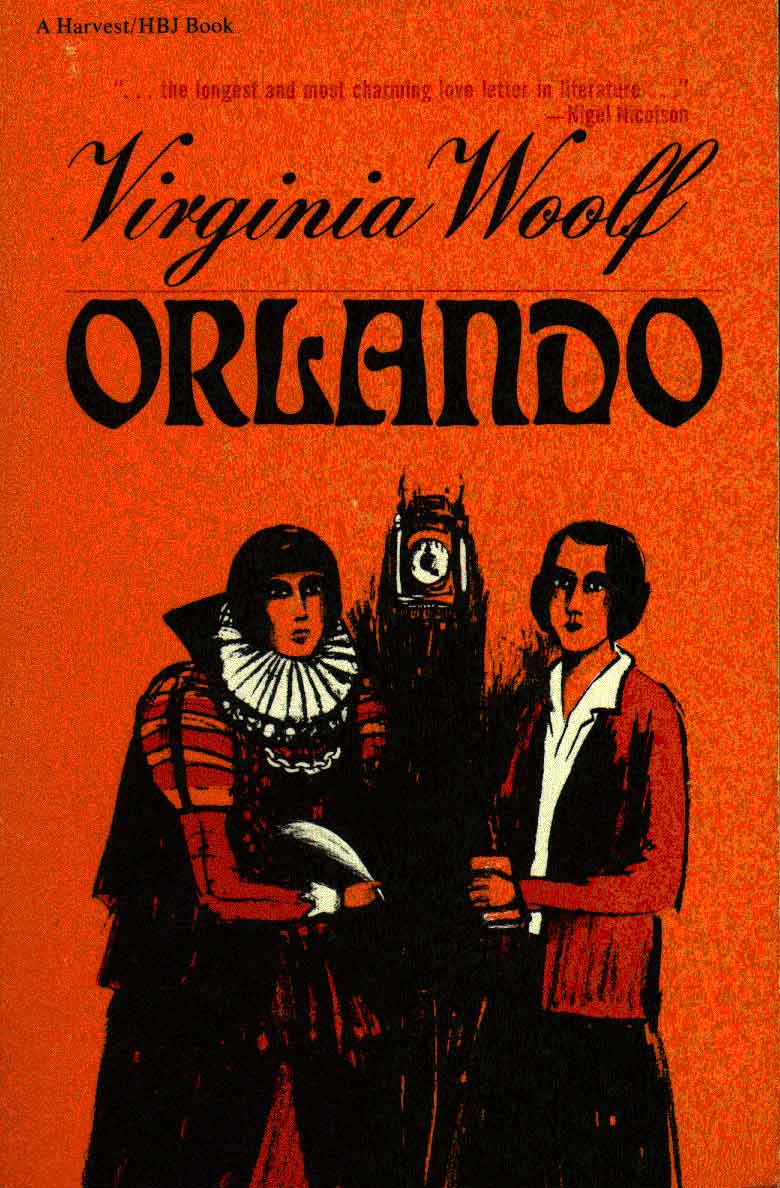
Orlando by Virginia Woolf
And indeed, it cannot be denied that the most successful practitioners of the art of life, often unknown people by the way, somehow contrive to synchronise the sixty or seventy different times which beat simultaneously in every normal human system so that when eleven strikes, all the rest chime in unison, and the present is neither a violent disruption nor completely forgotten in the past. Of them we can justly say that they live precisely the sixty-eight or seventy-two years allotted them on the tombstone. Of the rest some we know to be dead though they walk among us; some are not yet born though they go through the forms of life; others are hundreds of years old when they call themselves thirty-six. The true length of a person's life, whatever the Dictionary of National Biography may say, is always a matter of dispute.Virginia Woolf's Orlando is a strange book: A sort of love letter to a married woman, in which the woman spends the first half of the book a man. Orlando, the alter ego of Woolf's friend/lover Vita Sackville-West, begins life as a boy serving in the court of Elizabeth I; later, as an ambassador to Constantinople for Charles II he suddenly becomes a she, in a scene that Woolf drags out with laborious humor:
And now again obscurity descends, and would indeed that it were deeper! Would, we almost have it in our hearts to exclaim, that it were so deep that we could see nothing whatever through it s opacity! Would that we might here take the pen and write Finis to our work! Would that we might spare the reader what is to come and say to him in so many words, Orlando died and was buried. But here, alas, Truth, Candour, and Honesty, the austere Gods who keep watch and ward by the inkpot of the biographer, cry No! Putting their silver trumpets to their lips they demand in one blast, Truth! And again they cry Truth! and sounding yet a third time in concert they peal forth, The Truth and nothing but the Truth!
Woolf is quite clearly having her bit of fun, not least from mimicking the silliest floridness of Enlightenment writers, but in the book's general mode, which pretends to be a biography cobbled together from real sources, and in such setpieces as the "Great Frost" that turns Elizabeth's Thames into an endless carnival rink. The circuitous, often inscrutable prose that typifies Woolf's more "serious" fiction is reserved for the book's latter portions, in which Orlando, now a woman, adjusts to the advent of the eighteenth and nineteenth centuries (the fact that no one thinks it's odd that Orlando is over 400 years old is one of the book's better jokes).
Along the way Orlando falls in love, is rejected, joins a band of gypsies, becomes ambassador, is courted, falls in love again, is reciprocated, and writes a poem--"The Oak Tree," for which the quotations in the text are actual reproductions of a poem by Sackville-West. The point, I suppose, being that Sackville-West's work, as well as person, represents the best of 400+ years of European culture, or, rather, as something that, like the best literature, battles against the expectations of its own age:
Orlando was unaccountably disappointed. She had thought of literature all these years (her seclusion, her rank, her sex must be her excuse) as something wild as the wind, hot as fire, swift as lightning; something errant, incalculable, abrupt, and behold, literature was an elderly gentleman in a grey suit talking about duchesses. The violence of her disillusionment was such that some hook or button fastening the upper part of her dress burst open, and out upon the table fell 'The Oak Tree,' a poem.
But moreso, Orlando learns in his/her 400 years to exist beyond words. She and her husband, Marmaduke Bonthrop Shelmerdine, speak in a "cypher language which they had invented between them so that a whole spiritual state of the utmost complexity might be conveyed in a word or two without the telegraph clerk being any the wiser, and added [to the telegraph] the words 'Rattigan Glumphoboo,' which summed it up precisely." Or, sweetly, they speak not at all:
...and really it would profit little to write down what they said, for they knew each other so well that they could say anything, which is tantamount to saying nothing, or saying such stupid, prosy things as how to cook an omelette, or where to buy the best boots in London, things which have no lustre taken from their setting, yet are positively of amazing beauty within it. For it has come about, by the wise economy of nature, that our modern spirit can almost dispense with language; the commonest expressions do, since no expressions do; hence the most ordinary conversation is often the most poetic, and the most poetic is precisely that which cannot be written down. For which reasons we leave a great blank here, which must be taken to indicate that the space is filled to repletion.
Of course, a great white space follows. There is an overwhelming suggestion, I think, that since no words can really express how Woolf feels about Sackville-West, any words may do, and the silly, absurd, ironic mess that is Orlando is as great a testament as any that could be made. As such, Orlando is a book as much about the limits of what can be said as it is about the limitlessness of one man/woman.
Labels:
Orlando,
sex change,
Tilda Swinton,
virginia woolf
Tuesday, January 4, 2011
The Things That Matter by Edward Mendelson
In the process of applying to graduate school, I have been seized by a fear--perhaps one I should not detail too thoroughly in this, a public forum--a fear that I am entering into a world of obscurism and arcana, the kind of universe that inspired the late Dennis Dutton's yearly bad writing contest. For this reason I have gravitated toward critics like Harold Bloom, James Wood, and Edward Mendelson, a Columbia professor of English who in The Things That Matter writes:[Novels]were not written to be read objectively or dispassionately, as if by some nonhuman intelligence, and they can be understood most fully if they are interpreted and understood from a personal point of view, not only from historical, thematic, or analytical perspectives. A reader who identifies with the characters in a novel is not reacting in a naive way that ought to be outgrown or transcended, but is performing one of the central acts of literary understanding.
Mendelson divides The Things That Matter into seven parts, each corresponding to the Seven Ages of Man. Each age is embodied by a book; for Mendelson, Frankenstein becomes a novel about birth, Wuthering Heights about childhood, Jane Eyre, adolescence; Middlemarch, marriage. Love, parenthood, and "the future" are given to three novels of Virginia Woolf's: Mrs. Dalloway, To the Lighthouse, and Between the Acts, respectively.
This works better than it probably should. Mendelson is a thoughtful and--if this is a thing that can be said--a creative reader, seeing in novels what I had not imagined. He has the kind of wisdom that sees wisdom, and I found myself moved by several thoughts. Who would have thought that Frankenstein--which I disliked--had such subtleties as this, in an explanation of Victor's fascination with alchemy:
Magic is different from modern science in two crucial ways. First, magic promises results that are spectacularly vast in comparison with the amount of effort that goes into them, and, second, only exceptional individuals can wield magical powers. The words of a magical spell can be spoken as easily as any ordinary words, but when spoken by the right person, they cause earthquakes and thunders... Part of the appeal of the alchemist's magic is that it claims to give you something for nothing, provided that you are special enough to deserve it. (A similar fantasy of getting something for nothing seems to be behind the idea of "magic" in the realm of human relations: the husband or wife who complains that "the magic has gone out of my marriage" is perhaps disappointed at no longer being given something for nothing.)
Or this, about Jane Eyre and Mr. Rochester:
Jane Eyre and Edward Rochester have each endured loneliness and solitude in order to arrive at this point, because in the world perceived by Charlotte Bronte all roads to the gardens of intimacy lead through deserts of solitude, and no one can attain intimacy who has not accepted loneliness.
I certainly do not agree with everything that Mendelson says. He makes a bold claim in his introduction that our foremost novelist of the past two centuries is Virginia Woolf, and that our sacred cows--specifically, Eliot, Yeats, and Joyce--are exalted by the assumption that pattern and myth are superior to human emotion and psychology. It is easy to appreciate the underlying sentiment, which appeals to the non-professional reader and forsakes the academic, but understates the ways in which pattern and myth anchor and organize human spirits and personalities. Nor does Mendelson quite believe it, I think, as he spends quite a bit of the section on Mrs. Dalloway explaining how it is patterned after Ulysses--itself patterned after The Odyssey.
But The Things That Matter rekindles my excitement for graduate work. Writers like Mendelson (and Bloom, and Wood) maintain, like the keeper of the vestal flame, the vitality of literature, and leave good maps for those who might follow them.
Sunday, March 16, 2008
A Room of One's Own by Virginia Woolf
For that visit to Oxbridge and the luncheon and the dinner had started a swarm of questions. Why did men drink wine and women water? Why was one sex so prosperous and the other so poor? What affect has poverty on fiction? What conditions are necessary for the creation of works of art?-a thousand questions at once suggested themselves. But one needed answers, not questions...In 1929, Woolf was asked to give lectures on the topic of "women and fiction" at both Girton and Newnham colleges. Later she expanded those two lectures into this book. A Room of One's Own is a unique blend of writing styles. It is essentially a book about writing, however, it is not about the art of writing. It is about what it takes for women to become writers. Even more interesting, the thoughts of Woolf are filtered through the words of a character she created. The book follows this young, nameless woman as she attempts to find out why so few women are writers.
Woolf comes to a simple conclusion: women must have a fixed income and a room of their own in order to be successful writers. She acknowledges that there have been female writers that did not have these accommodations, such as Jane Austen and Charlotte Bronte. But she views them as exceptions, not the rule. This book was not at all what I expected, but I actually found it very interesting.
Labels:
virginia woolf,
writing
Friday, June 15, 2007
To the Lighthouse by Virginia Woolf
I really enjoy taking reading recommendations from people. If you ask a friend to suggest a book for you to read, and they actually give it some thought, chances are the book will tell you something about your friend. To the Lighthouse is another in a long list of books that have been recommended to me in the last couple of months.Let me start by saying this was not a particularly easy book to read. Many times I would decide to put the book down and go to bed, then realize that I had only read eight or nine pages. I think the best word to describe it is dense. Much of this stems from Woolf writing style. It is very stream-of-consciousness. She moves abruptly from one character to the next--often without warning--leaving it up to the reader to determine who she is writing about.
The book is split up into three parts. The first, and the longest, takes place at the summer beach house of an aristocratic British family. Throughout this section, Woolf supplies her readers with glimpses into the minds of her characters, of which there are many. Mr. Ramsay is a professor of philosophy, and brought some of his brighter student with him to the beach house. There is Lily Briscoe, and a young painter who is enraptured with the Ramsay family. Mr. and Mrs. Ramsay also have a number of children.
The second part of the book is cold, almost sterile. Woolf describes the now empty, nearly abandoned house, without sneaking a peak into the mind of anyone, save the maid. A few years have passed since the first section (I am not referring to the rate at which I was reading.) and many changes have come. That is all I will say.
For the final section we are back in the minds of the primary characters. Much of the time, we see the world from the perspective of Lily Briscoe. She doesn't seem to realize that the reason she is never satisfied with what she paints while at the house is because she is trying to capture the essence of the Ramsay family.
The book is really much better than this review makes it sound. Simply describing what takes place does the book injustice, since the plot is really minimal to the work. What made To the Lighthouse so enjoyable was Virginia Woolf's writing and insight into the human psyche. As a friend, I recommend that you read this.
Labels:
lighthouse,
philosophy,
Time 100 Books List,
virginia woolf
Subscribe to:
Posts (Atom)