Showing posts with label George Eliot. Show all posts

Sunday, May 20, 2018

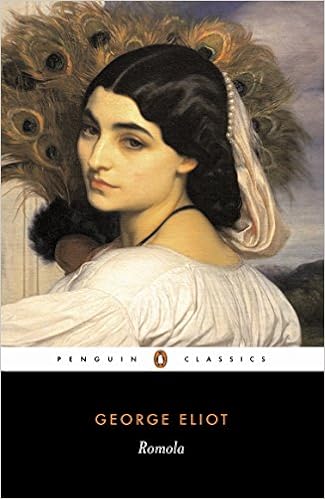
Romola by George Eliot

The law was sacred.  Yes, but rebellion might be sacred too.  It flashed upon her mind that the problem before her was essentially the same as that which had lain before Savonarola--the problem where the sacredness of obedience ended and where the sacredness of rebellion began.

My wife and I just started watching Netflix's Wild Wild Country, a docuseries about Baghwan Shree Rajneesh, who transplanted his utopian ashram from India to Oregon in the 1980's, leading to a catastrophic conflict with local Oregonians.  The charismatic Baghwan put into my mind the figure of medieval Florentine monk Fra Girolamo Savonarola as interpreted by George Eliot in the historical novel Romola: Both are charismatic religious leaders, whose message is one of a special dispensation for the time and place in which they live.  The world will be changed, they argue, but it will begin to be changed here and now, through us.  And both ended up embracing the ordinary dirtiness of politics they wanted to believe themselves apart from.

If you know about Savonarola, you probably associate his name with the bonfire of the vanities--enormous literal bonfires of things thought to distract from a holy life, like jewelry, fancy clothes, and proscribed books.  It's hard today to imagine how a guy like that amassed such a huge following.  He sounds like such a prude!  But Eliot does a great job of showing how such attitudes might sweep through an entire city, and entire culture, not just because of their Puritan repressiveness but because they offered a glimpse of a new social order in which the poor and the mighty are equal.

Against this backdrop Eliot tells the story of Tito Melema, a learned Greek who arrives in Florence after a shipwreck.  Tito becomes an assistant to a blind scholar named Bardo Bardi, and falls in love with his daughter Romola.  Bardo is reminiscent of Casaubon from Middlemarch--a determined scholar whose prime worry is that he will die before his great work is complete.  (In fact, the level of historical detail of Romola shows Eliot herself to be a little Casaubon-like, I think.)  But Bardo is kind, rather than selfish, and Tito's devotion to him has a great effect on Romola.  When they marry, she has no idea that he has another wife, the peasant Tessa, whom he's married in a mock "ceremony" during a festival (she doesn't understand it was a farce--it's complicated), and with whom he'll end up having several children.  Nor does she know that he has decided not to go looking for his father Baldassare, shipwrecked and enslaved by Turks.

Tito's character arc is well-done.  He begins as a charming protagonist but becomes a thoroughgoing villain.  Tito becomes a bad guy for the simplest of reasons: he doesn't want to give up his comfort.  He doesn't want to search for Baldassare because he'd rather sell the jewels he might use for ransom, and live in comfort with Romola.  He has two wives because he just likes them both.  He knows his love for Romola is more profound, but man, Tessa sure is nice to be around.  Eliot gets to a sad truth: some of the worst things we do are for the dumbest, most self-serving reasons:

Under every guilty secret there is a hidden brood of guilty wishes, whose unwholesome infecting life is cherished by the darkness.  The contaminating effect of deeds often lies less in the commission than in the consequent adjustment of our desires--the enlistment of our self-interest on the side of falsity; as, on the other hand, the purifying influence of public confession springs from the fact, that by it the hope in lies is forever swept away, and the soul recovers the noble attitude of simplicity.

Of course, this being a Victorian novel, you would expect Baldassare to end up in Florence, and he does, looking for revenge.  This offers Tito the opportunity to dig his moral hole deeper, to reject his own father and drive him to madness.  Later he becomes embroiled in the political affairs of Florence, perfecting a self-serving strategy of double-dealing, allying with the Mediceans against the forces of Savonarola, and vice versa.

It takes the novel a long time to get around to the title character of Romola.  She doesn't seem present or real until Tito's perfidy is already very clear to her, and to us.  Her moral arc is predicated on her unhappy marriage.  Trying to flee the city, she runs into Savonarola, who convinces her to return and accept the burden of the marriage vows she's made.  She becomes one of the monk's acolytes, and begins to devote her life to helping the needy.  As Savonarola's influence wanes and his own flaws become clear, she begins to reflect on the difficult question represented in the passage I quoted at top: when is it right to obey and when is it right to rebel?  In a dreamlike passage, she lies down in a boat and floats away from Florence, only to find herself in a village decimated by the plague, which she helps to nurse back to life.  (Again, the parallels with Middlemarch abound--like Dorothea Brooke, Romola also turns to selflessness to cope with a failed marriage.)

Romola is a long novel.  It's about 700 pages.  It's full of compelling characters: Tito and Romola especially, but also Baldo and Baldassare, and several strong supporting characters.  Niccolo Machiavelli is here, in addition to Savonarola, and several other real-life figures from late 15th-century Florence.  To be honest, most of the politicking went over my head.  Eliot clearly has a deep and intricate understanding of the political scene in this place and time, and punctuates the main narrative with a lot of conversation between common folks about what's going on with the Medici and the devotees and Savonarola and all of that.  I gave into the urge to skim through a lot of it, in order to get to the stuff with Tito and Romola.  But you can't say that Romola doesn't give a sense of life to the 15th century, or make a strange relic like Savonarola a little easier to understand.


Friday, February 14, 2014

Silas Marner by George Eliot

Turning towards the hearth, where the two logs had fallen apart, and sent forth only a red uncertain glimmer, he seated himself on his fireside chair, and was stooping to push his logs together, when, to his blurred vision, it seemed as if there were gold on the floor in front of the hearth.  Gold!--his own gold--brought back to him as mysteriously as it had been taken away!  He felt his heart begin to beat violently, and for a few moments he was unable to stretch out his hand and grasp the restored treasure.  The heap of gold seemed to glow and get larger beneath his agitated gaze.  He leaned forward at last, and stretched forth his hand; but instead of the hard coin with the familiar resisting outline, his fingers encountered warm soft curls.  In utter amazement, Silas fell on his knees and bent his head low to examine the marvel: it was a sleeping child--a round, fair thing, with soft yellow rings all over its head.

The question that struck me before I picked up Silas Marner was: can George Eliot write a short book as well as a long book?  Some people seemed inclined to write one or the other, so it's strange to me that Eliot was able to pump out something as tome-like as Middlemarch as well as this little under-200 pp. book.  Silas Marner, as expected, doesn't have the complexity of Middlemarch, but it shares a concern in the vitality of communal living, and effectively gives the impression that its characters are only one glimpse of a larger story of the town in which they live, as in Middlemarch.

Silas Marner is a weaver and a miser who adores the pile of gold he keeps beneath his floorboards.  He was once a religious man, but an instance of betrayal--his closest friend blames on him a horrible crime--made him shun society, and horde the proceeds of his weaving.  One night, his gold is stolen and his world unravels.  But a few days later a young golden-haired child appears mysteriously in its place, as if the gold has been transformed.

We know the provenance of the child--a woman trekking through the snow has died and the child sought shelter in Marner's cabin--but to Marner and the other villagers, this is a mysterious occurrence.  Eliot is concerned with the nature of Providence: what is it, what does it mean to be given it and what does it mean to be denied it?  The young Marner's guilt is determined by drawing lots, and the result drives him away from God and church.  But the transformation of the gold into the girl, whom Marner names Eppie, is a different kind of Providence.  Eliot lets us see the human striving and action behind the mystery, and this way manages to suggest that we are the engines of God's beneficence--which Marner, cut off from his community, has long been starved of.  Eppie reconnects him to other people:

The disposition to hoard had been utterly crushed at the very first by the loss of his long-stored gold: the coins he earned afterwards seemed as irrelevant as stones brought to complete a house suddenly buried by an earthquake; the sense of bereavement was too heavy upon him for the old thrill of coin.  And now something had come to replace his hoard which gave a growing purpose to his earnings, drawing his hope and joy continually onward beyond the money.

There's a cloying cuteness to this story.  This "adorable-child-redeems-an-antisocial-lout" conceit is surprisingly popular these days, and most often is a sign of laziness.  (It even happens to Tim Riggins.)  But perhaps the idea was fresher in Eliot's day.  Even still, Silas Marner has the air of a fable, neatly packaged with a moral at the end.  It seems to owe a definite debt to the story of Rumpelstiltskin.  But Eliot is such a masterful writer--at times she reminds me of Hardy, but with a better sense of authorial control--that it never seems cheap or overly didactic.

Tuesday, January 1, 2013

Middlemarch by George Eliot

Here and there a cygnet is reared uneasily among the ducklings in the brown pond, and never finds the living stream in the fellowship with its own oary-footed kind.  Here and there is born a Saint Theresa, foundress of nothing, whose loving heartbeats and sobs after an unattainted goodness trembled off and are dispersed among hindrances, instead of centring in some long-recognizable deed.

Middlemarch is a book about a pair of bad marriages.  The first is that of Dorothea Brooke, the "Saint Theresa" of the above passage, who is ardently devoted to religion and to charity, and hopes to marry a man whose wisdom and devotion will help to elevate her spirit.  She thinks that the aging, ugly Reverend Edward Causubon is that man:

"He thinks with me, said Dorothea to herself, "or rather, he thinks a whole world of which my thought is but a poor twopenny mirror.  And his feelings, too, his whole experience--what a lake compared with my little pool!"


But, as she will learn, Casaubon is not that man--his life's work, a Robert Graves-like "Key to All Mythologies," remains unrealized, an abortive intellectual project that would be useless and meaningless even if he could ever get around to writing the first page of it.  Casaubon feels keenly that he is a failure, and Dorothea's devotion to him ultimately only spurs his anger and resentment.  Because this kind of plot requires there to be a right man for Dorothea, Casaubon's insecurity is amplified by his fear that Dorothea is in love with his young cousin Will Ladislaw.

The second marriage is that of the young doctor Tertius Lydgate and Rosamond Vincy.  Lydgate is an ambitious man, eager to contribute to the world of medicine and with the talent to do so, but he falls for the vain Rosamond, who drives him into debt and derails his hopes.  These two marriages act as pillars for the novel, which also contains a handful of side plots concerning the inhabitants of the titular town, but Eliot puts the Dorothea story clearly at the center of the novel.  Ironically, Dorothea's poor marriage does elevate her spirit and grow her in wisdom, as she shows when she finally meets Rosamond in the book's final pages:

"Marriage is so unlike everything else.  There is something even awful in the nearness it brings.  Even if we loved some one else better than--than those we were married to, it would be no use"--poor Dorothea, in her palpitating anxiety, could only seize her language brokenly--"I mean, marriage drinks up all our power of giving or getting any blessedness in that sort of love.  I know it may be very dear--but it murders our marriage--and then the marriage stays with us like a murder--and everything else is gone.  And then our husband--if he loved and trusted us, and we have not helped him, but made a curse in his life..."


"The marriage stays with us like a murder"--that is wonderfully evocative, and a great example of Eliot's formidable prose and strong characters.  Dorothea is intricately realized, but so are the "fringe" characters that populate Middlemarch, like Dorothea's scatterbrained father Mr. Brooke, the lazy but warm-hearted Fred Vincy, and ten or fifteen others.  I mentioned in my year-end review that Tolstoy was a big fan of Eliot's, and Middlemarch has that kind of immense Tolstoyan scope but also the kind of fine attention to the peculiarities of character that I associate with somebody like Austen or even Shakespeare.

Eliot sets her story at the historical moment of political argument over the Reform Bill of 1832.  The minor figures of Middlemarch talk about it constantly; Will Ladislaw champions it as the editor of a local paper with the patronage of Mr. Brooke, who mulls a candidacy for Parliament.  I admit I didn't understand most of the details, but I did glean that the reform in question was the expansion of suffrage, and Middlemarch reflects that in the expansiveness of its depiction of the town.  By focusing on such a large cast of characters, Eliot expresses a kind of universal suffrage, as she is interested in capturing the voices of as many people as possible.  Reform, too, seems to me to be a central idea: how people seek to reform themselves by seeking wisdom, prudence, and responsibility.

The story of Dorothea knits those two aspects up nicely: she is constantly seeking to be a better person, though she is certainly the best person in the book already.  Furthermore, Eliot is deeply interested in the idea that there are unrecognized saints, like Dorothea, whose goodness never gets recognized because it toils in anonymity.  Eliot ultimately can't bear to deny Dorothea the happiness she deserves, and though perhaps it would have been bolder to let her remain in selfless abegnation, it's rewarding to see goodness rewarded.

Tuesday, January 4, 2011

The Things That Matter by Edward Mendelson

In the process of applying to graduate school, I have been seized by a fear--perhaps one I should not detail too thoroughly in this, a public forum--a fear that I am entering into a world of obscurism and arcana, the kind of universe that inspired the late Dennis Dutton's yearly bad writing contest. For this reason I have gravitated toward critics like Harold Bloom, James Wood, and Edward Mendelson, a Columbia professor of English who in The Things That Matter writes:

[Novels]were not written to be read objectively or dispassionately, as if by some nonhuman intelligence, and they can be understood most fully if they are interpreted and understood from a personal point of view, not only from historical, thematic, or analytical perspectives. A reader who identifies with the characters in a novel is not reacting in a naive way that ought to be outgrown or transcended, but is performing one of the central acts of literary understanding.


Mendelson divides The Things That Matter into seven parts, each corresponding to the Seven Ages of Man. Each age is embodied by a book; for Mendelson, Frankenstein becomes a novel about birth, Wuthering Heights about childhood, Jane Eyre, adolescence; Middlemarch, marriage. Love, parenthood, and "the future" are given to three novels of Virginia Woolf's: Mrs. Dalloway, To the Lighthouse, and Between the Acts, respectively.

This works better than it probably should. Mendelson is a thoughtful and--if this is a thing that can be said--a creative reader, seeing in novels what I had not imagined. He has the kind of wisdom that sees wisdom, and I found myself moved by several thoughts. Who would have thought that Frankenstein--which I disliked--had such subtleties as this, in an explanation of Victor's fascination with alchemy:

Magic is different from modern science in two crucial ways. First, magic promises results that are spectacularly vast in comparison with the amount of effort that goes into them, and, second, only exceptional individuals can wield magical powers. The words of a magical spell can be spoken as easily as any ordinary words, but when spoken by the right person, they cause earthquakes and thunders... Part of the appeal of the alchemist's magic is that it claims to give you something for nothing, provided that you are special enough to deserve it. (A similar fantasy of getting something for nothing seems to be behind the idea of "magic" in the realm of human relations: the husband or wife who complains that "the magic has gone out of my marriage" is perhaps disappointed at no longer being given something for nothing.)


Or this, about Jane Eyre and Mr. Rochester:

Jane Eyre and Edward Rochester have each endured loneliness and solitude in order to arrive at this point, because in the world perceived by Charlotte Bronte all roads to the gardens of intimacy lead through deserts of solitude, and no one can attain intimacy who has not accepted loneliness.


I certainly do not agree with everything that Mendelson says. He makes a bold claim in his introduction that our foremost novelist of the past two centuries is Virginia Woolf, and that our sacred cows--specifically, Eliot, Yeats, and Joyce--are exalted by the assumption that pattern and myth are superior to human emotion and psychology. It is easy to appreciate the underlying sentiment, which appeals to the non-professional reader and forsakes the academic, but understates the ways in which pattern and myth anchor and organize human spirits and personalities. Nor does Mendelson quite believe it, I think, as he spends quite a bit of the section on Mrs. Dalloway explaining how it is patterned after Ulysses--itself patterned after The Odyssey.

But The Things That Matter rekindles my excitement for graduate work. Writers like Mendelson (and Bloom, and Wood) maintain, like the keeper of the vestal flame, the vitality of literature, and leave good maps for those who might follow them.