Craft is essential; I will work all my life at my craft. But craft is not the same thing as art. Craft is the knowledge of how to mix blue with yellow on my palette, but art is the courage to dip the brush into the paint and lay it on the canvas in my own way. Craft is knowing when to revise a manuscript and when to leave it alone, but art is the fire in the mind that put the story on the page in the first place. To grow in craft is to increase the breadth of what I can do, but art is the depth, the passion, the desire, the courage to be myself and myself alone, to communicate what I and only I can communicate: that which I have experienced or imagined.
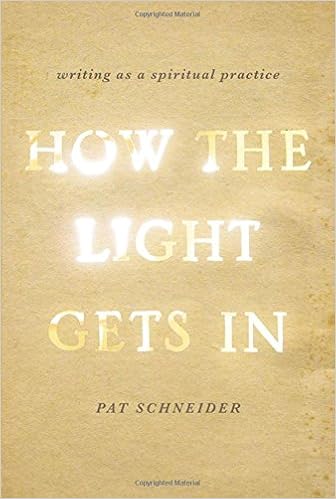
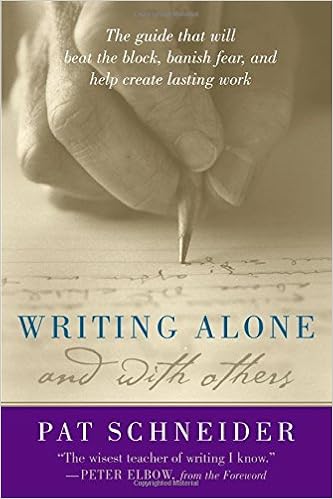
I read Pat Schneider's How the Light Gets In a few months ago. The summer--or the beginning of it at least--is time for my writing, and I really loved Schneider's thoughtful meditations on how writing is connected to the inner spiritual life of the writer. But fall is back, which means school is back, which means I'm returning to the more didactic Writing Alone and With Others to prepare.
Even though the book is instructional, not fictional, Schneider's style reminds me most of Marilynne Robinson. Schneider's vision of the workshop is full of the same kind of generosity, borne out of a deep regard for the intrinsic value of people. Schneider draws deeply on her experience leading workshops for women in housing projects in western Massachusetts, and while she insists that writing "isn't therapy," she sees it as a vital step in recognizing one's own voice. "You are a writer," she reminds the reader. She encourages her participants to reflect on the ways they have been writing their whole life, and on the power of their own voice. I was touched by a story in which a black woman, highly educated, writes a poem in the vernacular of her close family, a voice truer to her childhood than the one which she has painstakingly learned, and says, "No one has ever wanted that from me before." I have been thinking for the past few weeks about how those kind of moments can happen in the crucible of the high school classroom.
A lot of what's in Writing Alone and With Others gets developed more fully in How the Light Gets In. There's a shorter version of the story in which her writing teacher tells her a bare lightbulb hanging from the ceiling of her impoverished home is "cliche," even though that's the way it really was for Schneider growing up poor in the Ozarks. I was more affected by the personal touch of How the Light Gets In, because it gives a convincing model for how self-actualization can actually happen through writing, but the practical side of Writing Alone has already made it an invaluable tool for my classroom. Among other things, she's convinced me not to give grades on writing assignments, and to allow students to deviate more from assignments when they feel empowered to.
Her collection of exercises is mostly pretty commonplace--write using a photograph, write to someone you haven't seen in a long time--but others are so bizarre I can't help but bookmark them for future use. I like the one where she invites her students to imagine a person with whom they have unfinished business as an animal, and then themselves as an animal, and then they meet, as animals. I also really liked the comment from a participant who relishes in simpler prompts, saying that they'd rather describe "God's hat" than reflect on God. I'm excited to ask my students to describe God's hat.
Showing posts with label Pat Schneider. Show all posts
Wednesday, September 12, 2018
Thursday, June 7, 2018
How the Light Gets In: Writing as a Spiritual Practice by Pat Schneider
When I achieve true waiting, true listening, something happens that I experience as a gift. Whether it comes from my own subconscious reservoir or from outside myself makes no difference to me. If I am a creature made in the image of God--and I do accept the teaching of ancient Hebrew prophets and poets that in fact I am so created, and the teaching of some theologians that all of creation, even the rock and the turnip, is an image of God--then the creature that I am partakes in the holiness of the creator. If I am made in the image of the creator, then I myself am a creator, and my acts of creating participate in mystery.
"This is not a 'How To' book," Pat Schneider writes in the notes to How the Light Gets In, "it is an invitation to a reader to look over my shoulder as I do the thing itself: write as a spiritual practice. In that way I hope it can act as a guide for individual writers, an example of using one's own life story to trace the presence of mystery and the outlines of grace." I had planned on reading her how-to book Writing Alone and with Others, in preparation for the fiction-writing class I'll be teaching high school seniors in the fall, but instead I was drawn to this book, which has fewer lessons (but not none) for teachers of creative writing.
At times it borders on straight memoir, actually, giving us a glimpse into the way Schneider uses writing as a way to understand her own past. The images she returns to in the practice she likens to prayer are all from her troubled upbringing: the peach tree under which she was "saved" into the church, the roaches in the sour bottles of milk in her tenement home in St. Louis, the bed in the orphanage. And we get to see the construction of some very wonderful poems out of these images in real time.
How the Light Gets In is less a book of instruction than a book of wisdom. It's separated into chapters that deal with broad experiential concepts--death, the body, freedom, joy--in which Schneider uses the writing process to explore these things and how they touch in her own life. (The poignancy of which is all amplified by her advanced age--though I am pleased to say she's still around and alive.) The content overlaps with the practice. For Schneider, writing itself is a kind of prayer in which she approaches what, having fallen out with her fundamentalist upbringing, calls only "the mystery." I was particularly struck by the chapter on "Strangeness":
What a brief and lucid defense of the entire idea of literature! I want to frame it and hang it on my classroom wall. It resonates with Marilynne Robinson's assertion that the universe keeps showing itself to be stranger than we ever imagined. And this chapter, I think, I hope, presented to me a solution to a problem I had been having with the ending of the novel I've been writing. When I put it on paper I will let you know.
There are a few key moments I know I'll want to share with my students. One is Schneider's simple "acid test for the health of any group, class, or workshop one might try: When I leave, do I feel more like writing, or less like writing?" Another is an exercise in which she encourages her students to begin by considering the language of their own upbringing, because "we must first learn to recognize and value the strengths and the beauty in our languages of origin, and in our ability to tell our own stories in our own voices." I think that's a beautiful idea, and a spiritual one, linked to the assertion of the God-image in every person, though that's not the language I would ever use in the classroom.
The lessons I take for my own writing are much more difficult, perhaps impossible, to articulate. They might begin with admiration for Schneider's bravery in writing about her own experience, and the double bravery of writing about the writing process, which for me is secret and often embarrassingly messy. They also contain a deep sympathy for the idea of writing as a form of prayer, a way of approaching that for which ordinary didactic language has no words. This is a book I know I'll return to.
"This is not a 'How To' book," Pat Schneider writes in the notes to How the Light Gets In, "it is an invitation to a reader to look over my shoulder as I do the thing itself: write as a spiritual practice. In that way I hope it can act as a guide for individual writers, an example of using one's own life story to trace the presence of mystery and the outlines of grace." I had planned on reading her how-to book Writing Alone and with Others, in preparation for the fiction-writing class I'll be teaching high school seniors in the fall, but instead I was drawn to this book, which has fewer lessons (but not none) for teachers of creative writing.
At times it borders on straight memoir, actually, giving us a glimpse into the way Schneider uses writing as a way to understand her own past. The images she returns to in the practice she likens to prayer are all from her troubled upbringing: the peach tree under which she was "saved" into the church, the roaches in the sour bottles of milk in her tenement home in St. Louis, the bed in the orphanage. And we get to see the construction of some very wonderful poems out of these images in real time.
How the Light Gets In is less a book of instruction than a book of wisdom. It's separated into chapters that deal with broad experiential concepts--death, the body, freedom, joy--in which Schneider uses the writing process to explore these things and how they touch in her own life. (The poignancy of which is all amplified by her advanced age--though I am pleased to say she's still around and alive.) The content overlaps with the practice. For Schneider, writing itself is a kind of prayer in which she approaches what, having fallen out with her fundamentalist upbringing, calls only "the mystery." I was particularly struck by the chapter on "Strangeness":
Writing about writing, I have been exploring what I think I already know. But writing about mystery, I have tried neither to teach nor preach. I have tried to constantly veer away from that which is familiar and known, toward that which is just beyond my grasp. In writing, this is most commonly done in story and in metaphor. I have met strangeness again and again as I have been writing this book. Trying to describe strangeness is--forgive me!--strange. It requires story. It requires metaphor.
What a brief and lucid defense of the entire idea of literature! I want to frame it and hang it on my classroom wall. It resonates with Marilynne Robinson's assertion that the universe keeps showing itself to be stranger than we ever imagined. And this chapter, I think, I hope, presented to me a solution to a problem I had been having with the ending of the novel I've been writing. When I put it on paper I will let you know.
There are a few key moments I know I'll want to share with my students. One is Schneider's simple "acid test for the health of any group, class, or workshop one might try: When I leave, do I feel more like writing, or less like writing?" Another is an exercise in which she encourages her students to begin by considering the language of their own upbringing, because "we must first learn to recognize and value the strengths and the beauty in our languages of origin, and in our ability to tell our own stories in our own voices." I think that's a beautiful idea, and a spiritual one, linked to the assertion of the God-image in every person, though that's not the language I would ever use in the classroom.
The lessons I take for my own writing are much more difficult, perhaps impossible, to articulate. They might begin with admiration for Schneider's bravery in writing about her own experience, and the double bravery of writing about the writing process, which for me is secret and often embarrassingly messy. They also contain a deep sympathy for the idea of writing as a form of prayer, a way of approaching that for which ordinary didactic language has no words. This is a book I know I'll return to.
Labels:
How the Light Gets In,
Pat Schneider,
writing
Subscribe to:
Posts (Atom)