Showing posts with label satire. Show all posts

Friday, January 7, 2022

Joy in the Morning by P. G. Wodehouse

“It was one of those cases where you approve the broad, general principle of an idea but can't help being in a bit of a twitter at the prospect of putting it into practical effect. I explained this to Jeeves, and he said much the same thing had bothered Hamlet.”

In the past 3 years, I have read aloud what I believe to be every Wodehouse story, novella, and novel about Bertram Wooster and his butler, Jeeves. When I read Right Ho, Jeeves back in 2010, I didn't expect to read another; but while sitting in the car waiting for something, there was a Jeeves book in the glove-box. I read a couple pages, decided to read Liz a funny part, had to start on page one for context and here we are.

The corpus consists of 11 novels and 35 short stories, though there is some contention about whether some of the early stories, starring a guy named Reggie instead of Wooster, should be counted in that number as most of those stories were rewritten later for Bertram. But I digress.

For the completely unfamiliar, the stories follow Bertram Wooster, an upper class twit, good-hearted but "oofy", and his wise beyond all reason valet, Jeeves. All but one, Ring for Jeeves, are narrated by Wooster, and all involve a series of misunderstandings, usually brought about or at least exacerbated by societal expectations. All eventually seems lost, until we learn in the end that Jeeves has been working behind the scenes and that all is well.

When Chris, on my recommendation, read Code of the Woosters, he had this to say:
I liked The Code of the Woosters. I didn't exactly develop a lifelong addiction, like some people do; in fact, I probably won't read another one of these. I expect, rightly or wrongly, that they mostly all go the same way.
And he is, more or less, correct. Indeed, some of the plot points recur in almost every book--Bertie accidentally becomes engaged to a woman he doesn't want to marry, often on a rebound from one of his many friends; Bertie is coerced into carrying out some unpleasant social business for his aunt; Jeeves reads Spinoza, a philosopher well-suited for a man who seems to run the world as an extension of himself; Bertie has an article of clothing/piece of art Jeeves hates (and will eventually dispose of). There are even two separate books that revolve around Bertie's theft of the same cow-shaped creamer ladle!

And yet, the books are compulsively readable and often very funny, largely due to Wodehouse's absolute mastery of Bertie's voice, with which he never produces an anodyne sentence. Reading one for the first time, one is struck by the preponderance of lingo, most of which seems to have never really existed outside of Wodehouse's novels.  For example:

You know, the way love can change a fellow is really frightful to contemplate. This chappie before me, who spoke in that absolutely careless way of macaroons and limado, was the man I had seen in happier days telling the head-waiter at Claridge’s exactly how he wanted the chef to prepare the sole frite au gourmet aux champignons, and saying he would jolly well sling it back if it wasn’t just right. Ghastly! Ghastly!

Further, there is, if not exactly character development--Bertie never, thankfully, outgrows his dependence on Jeeves--growth. Early on, Bertie feels cowed asking Jeeves for help, and often goes his own way, returning only when the straits are dire; later on, Jeeves is always stop number one. Bertie is forever searching for words, which Jeeves provides, and attempting to quote poetry, which ditto, and as the novels progress, Bertie incorporates these words and lines into his narration. Little things, satisfying nods to the continuity of the Jeeves/Wooster relationship.

The books are fundamentally about relationships, to each other and to society. Upper-class British society and its often confounding mores are the machine that drives the plot, and Wooster's stable of friends both male--Catsmeat Potter-Pirbright, Gussie Fink-Nottle, Stilton Cheeseright--and female--Rosie M. Banks, Madeline Bassett, Stiffy Byng--provide the old oil. In spite of being the best known in popular culture, Jeeves himself is largely a foil for Wooster, disappearing for large chunks of the narrative to allow the plot to thicken, springing into reader-visible action only in the last act. There's rarely any explicit criticism of the class differences inherent in the Wooster-Jeeves relationship, though one can certainly intuit from the large cast of incompetent trust-fund adults that the serving class, of whom Jeeves is representative, is what really keeps society from collapsing.

And here we are at the end and I've said nothing about Joy in the Morning specifically, and there's a reason for that. The plot is more-or-less what I've outlined above, though it's one of the better books (Code of the Woosters may be the best), and I probably won't review the rest of the Jeeves books indiviudually. I like these books and find them comforting, fun, and funny. And I guess that's it.

Thursday, March 29, 2018

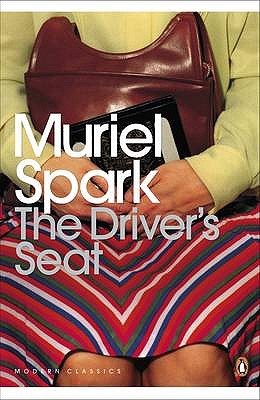
The Driver's Seat by Muriel Spark

‘One should always be kind,’ Lise says, ‘in case it might be the last chance. One might be killed crossing the street, or even on the pavement, any time, you never know. So we should always be kind.’ She cuts her sandwich daintily and puts a piece in her mouth.

Even for the notoriously cold and sometimes nasty Spark, The Driver's Seat is a bleak piece of work. Slim--barely 100 pages--all in present tense and never cutting away from its protagonist, the story starts on a shopping trip and ends with Lise dead behind a pavilion at the end of her perfect death day.

The above paragraph might seem like a spoiler but it isn't, really, since we learn most of this by the second chapter. The only real mysteries are either insignificant (Who will kill her?) or completely opaque (Why does she want to die?). And the story moves at such a breakneck pace, at such an impersonal register, that we never connect to Lise or any of her supporting cast in any meaningful way. Indeed, except for a brief moment at the very end, there's no pathos to this tale at all. From a writer with Spark's skill, this can't be accidental, not that Dame Muriel is senitmental at her softest, but it makes for a chilly read.

Is it fun? Well, parts are, and of course the potboiler structure, however predestined the ending, can't help but light up the whodunnit centers of the brain, though as Lise says of the unnamed book she carries around for the duration of her story, it's more of a "whydunnit" and that's an answer we never get. Parts are infused with Spark's merciless humor, as when one of Lise's temporary traveling companions talks about her husband getting a little too cocksure:

‘They are demanding equal rights with us,’ says Mrs Fiedke. ‘That’s why I never vote with the Liberals. Perfume, jewellery, hair down to their shoulders, and I’m not talking about the ones who were born like that. I mean, the ones that can’t help it should be put on an island. It’s the others I’m talking about. There was a time when they would stand up and open the door for you. They would take their hat off. But they want their equality today. All I say is that if God had intended them to be as good as us he wouldn’t have made them different from us to the naked eye. They don’t want to be all dressed alike any more. Which is only a move against us. You couldn’t run an army like that, let alone the male sex. With all due respects to Mr Fiedke, may he rest in peace, the male sex is getting out of hand. Of course, Mr Fiedke knew his place as a man, give him his due.’

Or when a man spends an entire plane ride trying to seduce Lise, telling her how he's her type and forcing his hydroponics obsession on her. But mostly, the tone is dry and disorienting as Lise picks up one piece of her plan after another and finally enlists the help of a psychotic she vibed with to do the killing.

SPOILERS BELOW

The killing is the only part of the story with any real weight, and it is nasty. Lise instructs him on how to tie her up, where to stab her, what to tie with the scarf and what to tie with the tie--but ultimately, even her death is taken out of her hands as he refuses--perhaps cannot not refuse--her command not to hae sex with her, and rapes her before following the rest of her instructions to the letter. So, sadly, for all her effort to exert control over her fate, she dies knowing it was all an illusion. Sad.

Spark is no stranger to aggressive foreshadowing, if what she does can even be called that, but this book, so concise and so focused on theme, strips away everything but the fatalism until the whole book begins, in retrospect, to look like an ironical joke. What was the point of the planning, the work, the actions taken, when Lise was dead before the story even started? Spark doesn't go in for explicit metafictional games but as she often does, her artistic vision includes the author as a God who is either absent, inscrutable, or cruel, but nevertheless cannot be resisted.

Monday, January 12, 2015

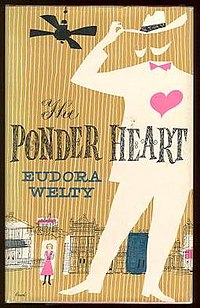
The Ponder Heart by Eudora Welty

The funeral was what you'd expect if you've ever seen Polk--crowded.  It was hot as fluzions in that little front room.  A lot of Jacob's-Ladder tops and althea blooms sewed on cardboard crosses, and a salvia wreath with a bee in it.  A lot of ferns hauled out of creek bottoms and drooping by the time they got ready for them.  People, people, people, flowers, flowers, flowers, and the shades hauled down and the electricity burning itself up, and two preachers both red-headed; but mainly I felt there were Peacocks.  Mrs. Peacock was big and fat as a row of pigs, and wore tennis shoes to her daughter's funeral--I guess she couldn't help it.  I saw right there at the funeral that Bonnie Dee had been the pick.

Do you ever notice how some authors, for whatever reason, obsessively repeat the same plot?  Edith Wharton loved having men fall in love with her wives' cousins.  Carson McCullers can't stop writing about pre-teen girls isolated by the process of getting older.  Eudora Welty, I guess, loves writing about older men who fall marry younger women.  These infant brides are never as good as their husbands, and they come with a boatload of unsavory family members to boot.  In the case of The Optimist's Daughter, the bride is a greedy harpy intent on snatching every bit of property she can away from her husband's family.  Bonnie Dee Peacock, who marries the titular Daniel Ponder of The Ponder Heart is merely a pretty dullard, who has "not a whit of human curiosity," like an overgrown kewpie doll.  The Optimist's Daughter mined this set-up for unexpected, lyric depth; The Ponder Heart is in full-on satirical mode.

And it's really funny.  The story is narrated by Edna Earle Ponder, whose duties consist in keeping her Uncle Daniel in check.  His childlike--not childish--need to be loved produces a runaway generosity, and Edna Earle has to keep him from giving away every single thing he and everybody else has.  I decided that I loved this book as soon as I read about Uncle Daniel leaving Edna Earle on a Ferris Wheel so he could pass out ice cream to the dancing girls at the fair:

He'd belted me into the Ferris Wheel, then vanished, instead of climbing into the next car.  And the first thing I made out from the middle of the air was Uncle Daniel's big round hat up on the platform of the Escapades side-show, right in the middle of those ostrich plumes.  There he was--passing down the line of those girls doing their come-on dance out front, and handing them out ice cream cones, right while they were shaking their heels to the music, not in very good time.  He'd got the cream from the Baptist ladies' tent--banana, and melting fast.  And I couldn't get off the Ferris Wheel till I'd been around my nine times, no matter how often I told them who I was.  When I finally got loose, I flew up to Uncle Daniel and he stood there and hardly knew me, licking away and beside himself with pride and joy.  And his sixty cents was gone, too.  Well, he would have followed the fair to Silver City when it left, if I'd turned around for good.

But Edna Earle can't stop Uncle Daniel from marrying Bonnie Dee Peacock (the names!), who does nothing of interest except when she runs away and when she comes home again.  When Bonnie Dee dies of fright during a storm, Uncle Daniel is charged with her murder by her backwoods family.  During the trial--a hilarious prototype of the kind of Southern courtroom scene that you see in To Kill a Mockingbird or Midnight in the Garden of Good and Evil or A Time to Kill or, obviously, My Cousin Vinny--the Peacocks talk over the lawyers, and get up for water every couple of minutes, and one of the boys spends the whole time playing the harmonica.  It's great.

Welty has an ear for the particular music of Southern language and life like no author I've ever read; including McCullers and Flannery O'Connor.  Maybe this book wouldn't strike the same chord with someone from another part of the country, but to me it was both hilariously strange and persuasively real.  I put it 7th on my top ten list this past year, but looking back at it now, that seems ridiculously low.

Tuesday, November 11, 2014

Decline and Fall by Evelyn Waugh

Ten boys sat before him, their hands folded, their eyes bright with expectation.

"Good morning, sir," said the one nearest him.

"Good morning," said Paul.

"Good morning, sir," said the next.

"Good morning," said Paul.

"Good morning, sir," said the next.

"Oh shut up," said Paul.

At this the boy took out a handkerchief and began to cry quietly.

Decline and Fall made an interesting comparison to At Freddie's, which I read over the summer.  Both are books about school, more from the angle of teaching it than being a student, and the schools in books are awfully strange places.  But where the actors' school of At Freddie's felt thoroughly realized, if outsized and absurd, the Llanabba School in Decline and Fall exists mostly as the set-up to mordant jokes like the one above.  The students are all opaque troublemakers, the teachers, inept drunks.  Nuance is not on the class schedule.  Don't get me wrong, the jokes are good.  Brent is fond, and I am too, of a running gag throughout the novel in which a young boy shot by a starter's pistol at the school games slowly succumbs to his injury and dies.  That's not particularly funny, but the non-reaction from the characters in the novel is; Waugh's characters all boast a kind of satiric self-absorption that drives the comedy of the novel.

Of course, I'm wrong: Decline and Fall is only half a school novel, but that's the part that stood out to me most.  It's really the story of Paul Pennyfeather, who is de-pantsed in a college prank at Oxford--turns out it's a case of mistaken identity based on the width of the stripes on Paul's tie--and "sent down," or expelled.  He becomes a schoolteacher because that's what you do when your life is ruined.  His luck seems to be on its way up when he becomes engaged to the mother of one of his pupils, but it turns out that she's using him as a patsy in a criminal scheme and he's sent to jail.

Though it hints at social criticism--Paul is "sent down" basically because he doesn't belong to one of the tony Oxford clubs--Decline and Fall asks little more than to be thought of as funny.  In that respect, it's a mild success, about on par with Waugh's The Loved One but not as funny as Kingsley Amis' Lucky Jim, which seems to me to tread similar ground.  One of my favorite characters is actually a pretty decent parody of mid-20th century architectural theory, the Professor Otto Silenus, who believes that man "is never happy except when he becomes the channel for the distribution of mechanical forces":

"I suppose there ought to be a staircase," he said gloomily.  "Why can't the creatures stay in one place?  Up and down, in and out, round and round!  Why can't they sit still and work!  Do dynamos require staircases?  Do monkeys require houses?  What an immature, self-destructive, antiquated mischief is man!  How obscure and gross his prancing and c hattering on his little stage of evolution!  How loathsome and beyond words boring all the thoughts and self-approval of this biological by-product! this half-formed, ill-conditioned bod! this erratic, maladjusted mechanism of his soul: on one side the harmonious instincts and balanced responses of the animal, on the other the inflexible purpose of the engine, and between them man, equally alien from the being of Nature onf the doing of the machine, the vile becoming!"

Finally, the best joke--spoiler alert--is that Paul, released from prison, re-matriculates at Oxford.  He doesn't even change his name; still, no one recognizes him.  In the end, the linear "decline" narrative suggested by the title turns out to be nothing more than a toothless cycle with no consequences.

Thursday, June 6, 2013

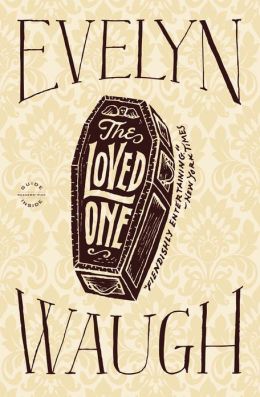
The Loved One by Evelyn Waugh

Dennis was a young man of sensibility rather than of sentiment.  He had lived his twenty-eight years at arm's length from violence, but he came of a generation which enjoys a vicarious intimacy with death.  Never, it so happened, had he seen a human corpse until that morning when, returning tired from night duty, he found his host strung to the rafters.  The spectacle had been rude and momentarily unnerving; but his reason accepted the event as part of the established order.  Others in gentler ages had had their lives changed by such a revelation; to Dennis it was the kind of thing to be expected in the world he knew and, as he drove to Whispering Glades, his conscious mind was pleasantly exhilarated and full of curiosity.

Aimee Thanatogenos is caught between two men: One is Mr. Joyboy, her boss at the Whispering Glades Crematorium.  Though slightly older, Joyboy is an expert mortician, specializing in composing the dead in just the attitude their family and friends desire, and Aimee idolizes him.  The other is Dennis, a louche Brit who works at the Happier Hunting Ground, a crematorium for pets that aspires to Whispering Glades' reputation:

There was a funeral with full honours that morning, the first for a month.  In the presecne of a dozen mourners the coffin of an Alsatian was lowered into the flower-lined tomb.  The Reverend Errol Bartholomew read the service.

'Dog that is born of bitch hath but a short time to live, and is full of misery.  He cometh up, and is cut down like a flower; he fleeth as it were a shadow, and never continueth in one way...'

That's the general style of Waugh's satire in The Loved One, wish is crueler and bolder than Brideshead Revisited, the only other book of Waugh's that I've read.  The exaggerated brashness of The Loved One reflects Waugh's ideas about its American setting, and I suspect that, since it's set in mid-century Los Angeles, Waugh is making some comment on a peculiarly Hollywood fixation on appearances and decadence, even to the point of death.

What Aimee ultimately discovers is that the choice she agonizes over is really no choice at all; both men are utter losers.  Dennis takes advantage of her ignorance by sending her classic poems with her name inserted, knowing that she won't recognize them.  Joyboy, so admired for his adroit handling of dead bodies, turns out to be little more than a middle-aged man who lives with his critical, neglectful mother and her ancient parrot.  She is the "loved one" of the title, but that's also what they call the corpses at Whispering Glades--which is pretty ominous.

I thought The Loved One was a collection of interesting satirical ideas that never really came together.  I might have liked it more if it hadn't been so clearly indebted to the books of Nathanael West--Waugh's LA looks a lot like the sunny hellscape of The Day of the Locust, and a plotline where Aimee seeks advice from a local newspaper advice columnist is cribbed straight from Miss Lonelyhearts.  Bringing those books to mind only makes The Loved One seem more limp by comparison, and underscores how little we are made to care about the fate of these characters.  Ultimately, The Loved One seems to me like an author trying unsuccessfully to be someone else.

Wednesday, May 30, 2012

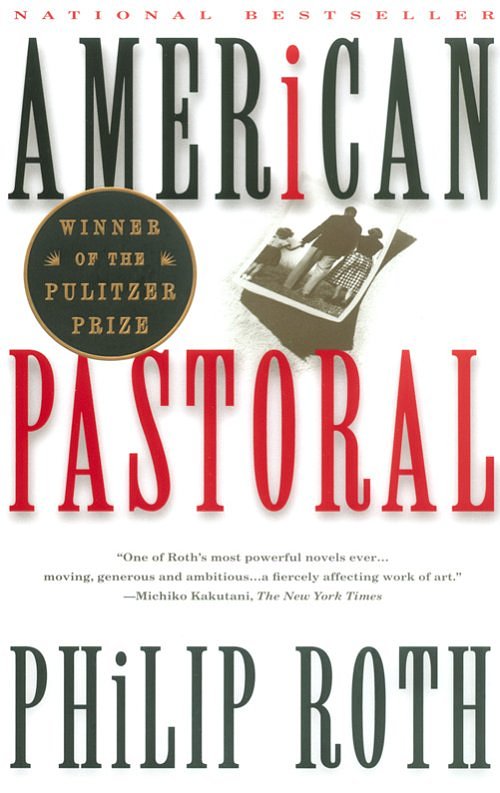
American Pastoral by Philip Roth


“You fight your superficiality, your shallowness, so as to try to come at people without unreal expectations, without an overload of bias or hope or arrogance, as untanklike as you can be, sans cannon and machine guns and steel plating half a foot thick; you come at them unmenacingly on your own ten toes instead of tearing up the turf with your caterpillar treads, take them on with an open mind, as equals, man to man, as we used to say, and yet you never fail to get them wrong. You might as well have the brain of a tank. You get them wrong before you meet them, while you're anticipating meeting them; you get them wrong while you're with them; and then you go home to tell somebody else about the meeting and you get them all wrong again. Since the same generally goes for them with you, the whole thing is really a dazzling illusion. ... The fact remains that getting people right is not what living is all about anyway. It's getting them wrong that is living, getting them wrong and wrong and wrong and then, on careful reconsideration, getting them wrong again. That's how we know we're alive: we're wrong. Maybe the best thing would be to forget being right or wrong about people and just go along for the ride. But if you can do that -- well, lucky you.”
 

A couple years ago, I went a Roth micro-binge and read The Counterlife and Everyman. I wasn’t extremely impressed, and, although I thought The Counterlife had some interesting ideas, I mostly wrote Roth off as an author who was clearly very talented, but maybe not for me. Fast forward a few years, and, married with a newborn daughter, I picked up American Pastoral to kill some time and  found myself completely sucked in.


The novel follows Seymour Levov, “The Swede”, a Jewish man who was once the godlike star of his high school. Handsome, athletic, friendly, the Swede was a hero to all he met, including Roth’s frequent stand-in, Zuckerman, who, at his request, agrees to write about the Swede’s father only days before the Swede dies of prostate cancer. At the meeting, Zuckerman is convinced that the Swede has led a charmed, unchallenging life, but finds that he is wrong when he learns (SPOILER) that Merry Levov, the Swede’s only child, bombed a post office as a teenager, and destroyed her family in the process.


I’m glad I waited until now to read American Pastoral, because it, like much of Roth’s later work, doesn’t really seem oriented toward the twenty-something crowd. It takes its time to get moving, spending the first third at a high school reunion after a short open paean to the Swede, and then following Zuckerman’s extrapolation of how the Swede’s life may have played out after high school. Interestingly, Roth never reveals what actually happened, never drops any hints as to the veracity of Zuckerman’s narrative, but it ultimately doesn’t matter: Zuckerman’s slow motion replay of the Swede’s life is a complete gut punch. At one point, I even did something I never do, skipping several pages detailing Merry’s debasement because it was too difficult to read in my situation. The entire second half of the novel is pretty heavy, as the Swede attempts to make sense of his daughter’s actions. His mental inventory of all his mistakes as a father bring him no closer to a sense of understanding or closure; indeed, Merry’s fate seems to have been set in motion before she was even born, pushing the nearly beatific Swede to the edge and just past.


Reading review of Pastoral is illuminating, because many readers took issue with the long digressions on glovemaking--the source of the Levov’s considerable wealth--or beauty pageants, but to me, these all served to underline the novel’s themes: no matter how hard you work or how good you are, your world is only one rash action from being turned to rubble. Or, as Roth puts it, “He had learned the worst lesson that life can teach - that it makes no sense.”  It’s easy to read the novel another way as well, with the Swede representing the 50s ideal and Merry and her friends as the whirlwind 60s, but in my mind, what really sticks out is not the fine prose or the clever parallels, but the truly terrifying portrait of a family falling to pieces, and the good man who can do nothing about it, and maybe never could.

Sunday, January 29, 2012

The Light Fantastic by Terry Pratchett

“Rincewind, all the shops have been smashed open. There were a whole bunch of people across the street helping themselves to musical instruments, can you believe that?”

“Yeah,” said Rincewind, picking up a knife and testing its blade thoughtfully, “Luters, I suspect.”

It’s always a challenge to write decent reviews of light literature. It's easy to think of something to write about Ulysses, Othello, or Malcolm X, but what can be said about fluff, the sort of books that aren’t guilty pleasures, exactly, but which occupy a place in between real literature (Hamlet) and trash (Twilight)? I tend to read Discworld or John Grisham as palette cleansers after something particularly challenging, but it’s not exactly fair to demote such books to being simply trifles. After all, reading is a pleasurable, as well as mentally stimulating activity, and these books offer their own pleasures. If you enjoy reading high literature at all times, by all means, do it; I’ll take to occasional potboiler or adventure to mix things up.

Of course, low literature has enjoyed something of a renaissance in recent years, with authors like David Foster Wallace, Michael Chabon, Neil Gaiman, and even Thomas Pynchon taking cues from less lofty genres, but, while these and many other authors have genuine affection for the material they homage and reference, it’s hard not to read a little postmodern irony into their genre exercises—after all, something like Pynchon’s Inherent Vice might nod toward Carl Hiassen and Donald Westlake, but could hardly be mistaken for one of their books.

So, that said, The Light Fantastic is a Discworld book, the second, and it’s worlds better than the first, The Colour of Magic, in that it actually a) has a plot, rather than feeling like a series of comical vignettes strung together and b) feels like a Discworld book tonally, in spite of still being embryonic in the bigger scheme of things. It’s fast-moving, short, and introduces many of the characters that populate the later books. Aside from that, I don’t have a lot to say about it. It’s not particularly satirical, except when satirizing fantasy literature itself, and it’s not as funny or as well-plotted as the later books, but I enjoyed reading it, as I always enjoy Pratchett’s novels. It may be pulp, but it’s my pulp.

Friday, June 17, 2011

Catch-22 by Joseph Heller

"What is a country? A country is a piece of land surrounded on all sides by boundaries, usually unnatural. Englishmen are dying for England, Americans are dying for America, Germans are dying for Germany, Russians are dying for Russia. There are now fifty or sixty countries fighting in this war. Surely so many countries can't all be worth dying for."

"Anything worth living for," said Nately, "is worth dying for."

"And everything worth dying for," answered the sacrilegious old man, "is certainly worth living for."


When Joseph Heller was asked, late in life, why he had never written another book as good as Catch-22, he responded, “Who has?” Cocky, perhaps, but not unjustified—Catch-22 is certainly one of the densest, funniest, most rewarding books I’ve ever read.

The plot ostensibly follows Yossarian, a bombardier captain in the waning days of World War II, who wants nothing more to be sent home. He first tries completing the required missions, but his captain keeps raising the number. He carries on, faking sickness, faux insanity, and even talking to his largely inept or uncaring superiors, but nothing works—he is caught in a catch 22, a term that is never directly defined in the novel, but which has passed into popular usage as an impossible situation, and is exemplified throughout the novel, both explicitly and more subtly. Defining the novel as Yossarian’s story is misleading though, as any first-time reader will quickly learn.

Structurally--and I’m a serious geek for structure--it’s right up there with Ulysses and As I Lay Dying, completely unique and sometimes bewildering in its presentation. Chapters jump from person to person and place to place, sometimes in mid-scene. The novel is constantly folding in on itself, jumping through timelines, shifting perspectives, and recasting previous events as the backstories and motivations of supporting characters become more fully fleshed out. There’s really no way to explain how all this works; it just does. It brings to mind the film technique of showing a character, say, looking into a mirror, and when the camera pulls back, the character’s face is now on a photograph being held by someone else. It’s remarkably effective, both comedically and dramatically, throughout Catch-22, and I’m fairly certain I’ve never seen another novel use it. Nothing is unimportant or frivolous—even the most insignificant character arc pays off as the story goes on. As the disparate strings were woven together, it was honestly pretty amazing.

Catch-22 has a reputation as a funny book, and it definitely is, for much of its bulk, laugh out loud funny. Even the pervasive humor, however, works toward the novel’s unexpected final third, where everything comes together in a way that’s both nightmarish and bleakly (VERY bleakly) hilarious. It’s a scathing satire not just on the military or the long-term futility of war, but on the very core American values. Nothing escapes unscathed—God, country, capitalism, government—but the satire isn't without buried affection, and the ending is almost joyful, relative to the very bad things leading to it.

Still, this is a challenging book. Anyone expecting a comic novel to be an easy read will probably be put off fairly quickly—just check out some of the scathing Amazon reviews for proof—but this is serious literature covered in a thin candy shell, and it deserves to read that way. It’s almost a Catch-22 itself.

Sunday, January 2, 2011

Gulliver’s Travels by Jonathan Swift

“…the question therefore was not whether a man would choose to be always in the primes of youth, attended with prosperity and health, but how he would pass a perpetual life under all the usual disadvantages which old age brings along with it. For although few men will avow their desires of being immortal upon such hard conditions, yet in the two kingdoms before-mentioned of Balnibari an Japan, he observed that every man desired to put off death for some time longer, let it approach ever so late, and he rarely heard of any man who died willingly, except he were incited by the extremity of grief or torture. And he appealed to me whether in those countries I had traveled, as well as my own, I had not observed the same general disposition.” – Gulliver, on living forever

Gulliver’s Travels is a strange book. Now mostly pigeonholed as a children's book, perhaps because most adaptations never make it past part two, it’s actually a scathing—extremely scathing—satire on both the specific political events at the time it was written, and on the shortcomings of mankind in general. It’s also an occasionally grotesque comedy, full of more poop than you can shake a stick at, and occasionally leavened with moments of poignancy, like the excerpt above, where the disadvantages of living forever are spelled out to the titular traveler.

The plot, for those who don’t know, revolves around Lemuel Gulliver, an intrepid traveler with an unnatural propensity for ending up in the most unusual places: Lilliput, where the tallest citizen barely exceed 6 inches in height; Brobdingnag, a land of giants; Laputa, a floating city full of brilliant idiots; and the country of the Houyhnhnms, where horses rule over feral—or are they?—humans.

Each episode is basically self-contained, and each presents it’s own opportunities for Swift’s two favorite things: the aforementioned scathing satire, and all the scatological humor a reader could ever want. Dogs are inflated with billows until they burst; horses climb trees to cover Gulliver in excrement; Gulliver is used as some sort of sexual aid for giant women; Gulliver pees on a building to put out a fire. Just saying, Swift likes his bodily fluids.

Of course, Gulliver’s Travels isn’t well-regarded because of its giggle-inducing dirty bits. Swift’s pen takes on virtually every high tower of the European empire (although we are repeatedly assured that the negative things Gulliver says about Europe do not apply to England), and the satire is as sharp and relevant today as when it was published. For example, government officials in Lillput are chosen thusly:

I was diverted with none so much as that of the rope-dancers, performed upon a slender white thread, extended about two feet, and twelve inches from the ground… This diversion is only practised by those persons who are candidates for great employments, and high favour at court. They are trained in this art from their youth, and are not always of noble birth, or liberal education. When a great office is vacant, either by death or disgrace (which often happens,) five or six of those candidates petition the emperor to entertain his majesty and the court with a dance on the rope; and whoever jumps the highest, without falling, succeeds in the office.

Cutting.

It’s difficult to tell to what extent Swift empathizes with Gulliver, which makes certain sections of the book a little challenging—for example, the Houyhnhnms, whom Gulliver seems to admire, and to whom are given mostly desirable qualities in contrast to humans, practice breeding in a way that seems perilously close to eugenics, and at one point, their council seriously considers genocide to rid their land of the Yahoo—that is, feral human—menace. Gulliver also, disturbingly enough, eats Yahoo meat and uses Yahoo skin to make clothes, making him essentially a cannibal and a Nazi tailor. They also seem rather xenophobic, eventually exiling Gulliver after 3 years of peaceful coexistence. To attribute all these views to Swift seems awfully presumptuous—he did, after all, write a famous essay about eating Irish babies—but they present a complicated counterpoint to Swift’s overall point—mankind has major issues.

Wednesday, September 23, 2009

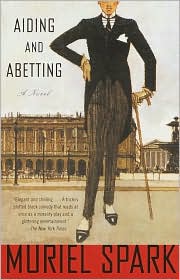
Aiding and Abetting by Muriel Spark

The good Dr. Wolf looked at her patient and let the above facts run through her head. Was this man sitting in front of her, the claimant to be Lord Lucan, in fact the missing murder suspect? He was smiling, smiling away at her thoughtfulness. And what had he to smile about?

She could ring Interpol, but had private reasons not to.

She said, "There is another real one? 'Lord Lucan' in Paris at the moment. I wonder which of you is the real one? Anyway, our time is up. I will be away tomorrow. Come on Friday."

"Another
Lucan?"

"I will see you on Friday."


The story of Lord Lucan is particularly grizzly: the London socialite disappeared after a bungled attempt to murder his wife, which instead left the Lucans' nanny dead, bludgeoned to death in a case of mistaken identity. A fugitive, he appears in Paris and walks into the psychiatric offices of Dr. Hildegard Wolf, who is happy to help but for the complicating fact that she already has a patient who says that he is Lucan.

I loved Spark's The Prime of Miss Jean Brodie, which was small but remarkably solid, building believable and fascinating characters from very few blocks. I wish I could say the same for Aiding and Abetting, which is written in the same typical style, and has a really fascinating premise to boot, but can't escape feeling slight. There simply isn't enough space to pull the usual mystery tricks; Dr. Wolf has a notion of which of her patients is the real Lucan from the very beginning and seems to care only slightly if she is correct. Spark, it seems, is equally disinterested.

What she does concern herself with is the idea of identity, what is it that makes a person who they are. Is it mutable, or static? Lucan has long been nagged by the sheer amount of blood that came out of his nanny, and Spark uses that blood as the novel's central conceit--do we carry ourselves inside our bodies, as we do our blood? Or are they something we adopt and fashion, as the fake Lucan does, and Dr. Wolf herself, who is hiding her own shady past?

But that message is, strangely enough for an author whose hallmark is succinctness, muddled and incongruent; piecing together what exactly it is Spark wants to say is difficult and probably wouldn't be satisfying. The elements of social satire that abound here--the aiders and abetters of the title are, by-and-large, Lucan's fellow blueblood aristocrats who help him for seemingly no other reason than he is one of them--are either toothless or so markedly British in focus that they seem so to me.

I suppose I shouldn't complain; after all, I've read books that take an hour and a half to read that are much less engaging (see future entry: Tears of a Tiger). All in all, I would have traded the incredible tightness of Jean Brodie for a fuller, more detailed novel.

Monday, June 15, 2009

A Confederacy of Dunces by John Kennedy Toole

Most comic characters are generally unknowing. Genuinely comic characters don't know how funny they are. Somebody who comes out and thinks that he's incredibly important, but he's not...well, that's very funny.
- Jonathan Franzen, bigthink.com

About a year ago, while walking down Bourbon Street with one of my coworkers, I pointed out this hot dog vendor who judged solely on his actions at that moment could only be described as crazy. Jane said that the main character in A Confederacy of Dunces was a hot dog vendor. From her two- or three-sentence description of the book, it sounded interesting and bizarre.

The main character of Dunces is Ignatius J. Reilly, the epitome of the anti-hero. He is grotesquely overweight, obnoxiously loud, extremely slothful, and not all that surprisingly celibate. Ignatius lives with his mother, who he treats horribly, in New Orleans. He spends most of his days watching TV, writing his "masterpiece" in his room, or catching the latest release at the local movie theater. Although he watches plenty of TV and a large number of movies, he describes most of it as pure dreck, hurling insults and vile oaths at the screen--silver or otherwise. His language and his code of conduct harken back to an earlier era. He longs for a monarchy, hoping that a king would impose some order and discipline an the uncouth world that surrounds him.

The characters that Toole surrounded Reilly with are nearly as interesting as the rotund curmudgeon. All of their stories connect in the over-the-top reality that is the French Quarter, when Ignatius' mother forces him to get a job. People often compare the character of Ignatius J. Reilly to that of Don Quixote, and with good reason. Both characters are essentially imbeciles; they long for the social mores of years gone by, and their tales are rambling yarns that are more about characters and experiences then some overarching plot.

Dunces is the most enjoyable book that I have read in a long while. The characters, dialogue, and storyline were brilliantly hilarious.

Catch-22 by Joseph Heller

I fully expected to enjoy this book, especially after reading Christopher's positive review of it a while back. But for the most part, I did not enjoy reading Catch-22. Every time I put it down, I had to force myself to pick it back up. It has been a couple of weeks since I finished this book, and in that time I have been unable to figure out what I disliked about it. "Dislike" may actually be a little strong. I just was rather uninterested in Catch-22. I was told by a number of people that the book got better toward the end. That, and the fact that I don't like not finishing a book once I have started it, kept me reading til the end.

I think my problems may have been with Heller's writing style. I found his style a little clunky and difficult to read easily, but not in a this-guy-is-a-genius way, like Nabokov or Dostoevsky. I don't want to paint too negative of a picture here. Catch-22 definitely had its absurdly comical moments. I laughed out loud at some of the dialogue.

While there are a large number of integral characters in the book, the story really focuses on Captain Yossarian, an American bombardier stationed someone in the Mediterranean Sea during World War II. The very basic plot of the book is that Yossarian wants to go home. Every time he gets close to his quota of missions, Colonel Cathcart raises the number of missions his men must fly. Yossarian tries to get himself grounded in increasingly crazier ways. Through Yossarian and the litany of supporting characters, Heller satirizes the military and war, highlighting the general absurdity of both.

As I was told, the last 50 or so pages did manage to improve on what came before them. The ending recast earlier parts and brought some of the more disparate pieces of the story together in sharper focus.

Saturday, December 13, 2008

Candide by Voltaire

Truly, this is the best of all possible worlds.

Spoilers.

The subject matter of Candide is among the most timeless in all literature. Why is there evil in the world? If there is a loving creator, why does he allow bad things to happen to us? If we are completely in control of our own fates, why hasn't society weeded out the dross?

Candide is a naive young man living in a peaceful kingdom. He is preparing to marry the girl of his dreams. He is cheerily oblivious to anything negative in the world, indoctrinated into the beliefs of his mentor Dr. Pangloss, beliefs that can be summarized by my lead-in quote, “Truly, this is the best of all possible worlds.”

Candide's commitment to this philosophy is tested when his kingdom is attacked. His family is violently murdered, his fiancée brutally raped and disfigured, and his mentor, Dr. Pangloss, is killed. Candide himself is sold into slavery, and things only get worse from there. His fortunes improve only in preparation for further degradation. He attempts to cling to his belief in the best of all possible worlds, but gradually grows more and more disenchanted, finally rejecting it. Oh, and somehow this book manages to be pretty funny.

The interesting thing about Candide is Voltaire doesn't actually try to directly answer any of the questions raised in it. Instead, he satirizes the blind optimism and gullibility of his countrymen, particularly the religion ones whose beliefs mirrored those of Pangloss. Candide is often presented as pure cynicism, but Voltaire's point doesn't seem to be that the world is a relentlessly terrible place as much as it is that each man makes his own way and controls his own circumstances. This is essentially the conclusion Candide himself arrives at, finally finding happiness when he decides that, both literally and metaphorically, “every man must tend his own garden.” Rather than a wholesale attack on religion and optimism, I read Candide as a call for a realistic, pro-active approach to life, where we actively make it better rather than assuming it will naturally take the best course.

Oh, and seriously, it's pretty funny.

Monday, June 2, 2008

Slaughterhouse-Five by Kurt Vonnegut

"Mary," I said, "I don't think this book of mine is ever going to be finished. I must have written five thousand pages by now, and thrown them all away. If I ever do finish it though, I promise you, there won't be a part for Frank Sinatra or John Wayne."

Last year, several of us got together and sort of unofficially agreed that Kurt Vonnegut was overrated. We had a few drinks, watched the 1987 movie adaptation of Harrison Bergenon, and nodded our heads knowingly as one criticism after another was leveled at the late author. I joined in, partly because of peer pressure and partly because the Pepsi bubbles were going straight to my head. I stumbled out of Carlton's house, head crazy with brief paragraphs and absurd non-sequitirs, and began Slaughterhouse-Five.

I read S5 when I was in high school and remember enjoying it on at least a "this is a really strange book" sort of level. Beyond that, Vonnegut's story of Billy Pilgrim, a man unstuck in time, didn't resonate much with me. Billy's abduction by Tralfamadorians seemed like a golly-gee plot device that didn't mean much, and the whole thing left me in a bit of a muddle. I'm glad I gave it another shot.

The plot can be summarized in a short paragraph: Billy Pilgrim is abducted by Tralfamadorians, aliens from another galaxy, while fighting in World War II, just before the bombing of Dresden. The story is told through a series of anecdotal paragraphs, tied together by Vonnegut's authorial voice. The narrative, like Billy himself, jumps around in time, and manages to contrast the brutality of war with the beauty and absurdity of life, a high achievement for a book with a full-page line drawing of a pair of breasts, but it succeeds.

There's really nothing I can say in a review like this that will describe how this book affected me. It packed an emotional punch like nothing else I've read this year, and, even though I'm still not entirely sold on Vonnegut, this book is beautiful.

Slaughterhouse-Five is infinitely quotable, but I want to end this review with my favorite excerpt from the book, where a Tralfamadorian is describing to Billy how Tralfamadorian books work. It's a fantastic encapsulation of both the book's style and message:

"There are no telegrams on Tralfamadore. But you're right: each clump of symbols is a brief, urgent message--describing a situation, a scene. We Tralfamadorians read them all together, not one after another. There isn't any particular relationship between all the messages, except that the author has chosen them carefully so that, when seen all at once, they produce an image of life that beautiful, surprising, and deep. There is no beginning, no end, no suspense, no moral, no causes, no effects. What we love in our books are the depths of many marvelous moments seen all at one time."

And so it goes.

Thursday, February 28, 2008

Animal Farm by George Orwell

Okay, so I am one of the few people in America, perhaps the world, who hasn't read this book. I think it is normal high school fair, but then I didn't go to a normal high school. At my school, if we wanted to read poetry, we read Genesis. If we wanted to read history, we read Genesis. If wanted to read about science...well you get the idea.

Orwell said that he never wrote anything good that was not about politics. He also said, "Animal Farm was the first book in which I tried, with full consciousness of what I was doing, to fuse political purpose and artistic purpose into one whole." Animal Farm was written as a political indictment of the Soviet Union. In the preface to this edition, Russell Baker points out that given the political climate of the time, Orwell had trouble getting this book published. In fact, it was not published until 1945 after the end of World War II. Criticizing the Soviet Union in the early 40s was nearly heretical. After all, the Red Army had just beat back Hitler and his "invincible" army. But Orwell cautioned that the political system that was evolving in the USSR was not really socialism, but a "hierarchical society, in which the rulers would have no more reason to give up their power than any other ruling class."

This is precisely the type of society that Orwell depicts in Animal Farm. The animals revolt against the farmer who has oppressed them for years. They set up a farm where all animals are equal and they work for the betterment of themselves, not for the prosperity of some despotic ruler. The pigs, who are clearly the smartest animals on the farm lead the rebellion and are instrumental in setting up their utopian farm. Two pigs fall into leadership roles: Snowball and Napoleon. Eventually Napoleon runs Snowball off the farm, and it is not long before Napoleon and his cronies are running the farm in the same fashion that Farmer Jones did.

I really enjoyed this book, especially having recently read Finding George Orwell in Burma. As usual, I saved both the preface and introduction until after I had finished the book, and was a little disappointed to find out that neither of them was written by Orwell. In the preface, Russell Baker alludes on more than one occasion to a preface to Animal Farm written by George Orwell. I wonder why they didn't include that in this edition. It would no doubt have been interesting. While the preface was interesting and worth reading, I found the introduction by C. M. Woodhouse to be rather stuffy and pretentious.

Saturday, February 23, 2008

The Big Over Easy by Jasper Fforde

The Big Over Easy delivered what I was expecting from the terrible Basket Case, namely a Discworld-like parody of the detective genre. Rather than parodying the genre by attempting to make a run of the mill muder case comical, TBOE (as it will henceforth be known) satirizes classic noir literature by setting the case in a fictional world where literary characters live lives that are both similar and dissimilar to their famous fictional ones.

The synopsis of TBOE is as follows: Jack Spratt (who still eats no fat) is head of the struggling Nursury Crime Division of the Reading Police Department. The NCD is struggling because, in Reading, departments must not only solve cases but also solve them in such a way that they'll make good reading in the various detective periodicals. Enter Mary Mary, the repetitively-monikered writer assigned to the NCD to record Spratt's cases. As soon as she is assigned to the division, Humpty Dumpty dies under suspicious circumstances, and the rest of the book follows Spratt as he works his way through the labyrinthine plot against Humpty.

There was a lot to like about TBOE. It was clever, and several bits made me laugh out loud, especially the bits at the beginning of each chapter from various fictional papers, with headlines such as "Identical Twin Plot Device Outlawed" and "Butler Did Do it Shocker!" The characters have habit fitting with their famed situations (Humpty Dumpty enjoys sitting on walls), and also attributes that are intentionally ludicrous (Humpty was also quite a ladies man, and had an affair with Rapunzel). The plot itself was clever and satirized the twisting narrative of much pulp noir very well, and Jack Spratt was a very likable character.

On the other hand, the writing was sometimes a little sloppy, probably because this is a rewrite of Fforde's first unpublished novel, and the exact setup of the literary universe is a little confusing. What is Prometheus doing in the same story as the three little pigs, for instance? it's also explained that the nursery characters don't really what they are, and, although Jack is aware that his cases are based on nursery rhyme, he seems unaware that he and Mary Mary are also part of that world.

Overall, however, I enjoyed this book and found it pretty funny and a quick read. I'd recommend it to anyone who likes Discworld or Douglas Adams, although the concensus seems to be that it's Forde's weakest book. I guess we'll see. I'm planning on reading The Eyre Affair later this year.

Wednesday, February 13, 2008

A Farewell to Arms by Ernest Hemingway

"I kissed her and saw that her eyes were shut. I kissed both her shut eyes. I thought she was probably a little crazy. It was all right if she was. I did not care what I was getting into. This was better than going every evening to the house for officers where the girls climbed all over you and put your cap on backwards as a sign of affection between their trips upstairs with other officers."

A Farewell to Arms seems to follow Hemingway's typical format for both novels and short stories. All the essential components are present with his stoical and somewhat autobiographical man along with an unreasonable woman struggling to satisfy these same unemotional demands.

Many critics feel that it lacks the emotional punch of its predecessor, Hello to Legs, but I think it was actually better, possibly because arms are easier to relate to than legs. Have you ever known anyone without arms? How about without legs? I rest my case.

Parts of the book do strain credibility. For example, it's hard to believe that a nurse with all four appendages intact would fall for a double-amputee, but when we learn later in the book about (SPOILER) her lack of a pelvis, it explains both her attraction and Hemingway's description of her as "an amorphous blob, beautiful and fragile, a vision of boneless beauty." Hemingway's prose, by the way, is as brief as always, with all of the sentences in the second half being three words long or shorter.

But seriously folks, Hemingway is far too caught up with emotionless undeveloped characters, drinking, women, sex, war, and Americans living in foreign countries. I did think his minimalist style was creative and unique and the frequent dialog told the story well. Obviously Hemingway was obsessed with his own experiences, and although he wrote them simplistically, his attempts to unveil his emotional pain paints a beautiful picture. His story is sad, bitter, and depressing, but it is a story he tells with sincerity.

Thursday, November 22, 2007

Cat's Cradle by Kurt Vonnegut

At the risk of falling out of favor with the hip, college-kid crowd, I don’t think Vonnegut is all that great. He is a prime example of hype gone bad. People talk about Vonnegut like he is some kind of genius or god, or some kind of god-genius, or a god who is really smart. The combinations of ways that people talk about him are seemingly endless.

I have only read two of Vonnegut’s books, so how much can I really say? Well, I can say that I found both to be interesting, generally well-written, and perhaps most importantly, humorous. However, neither bowled me over, as I was led to believe they would by so many people.

Cat’s Cradle was recommended to me by a few people after I read A Man without a Country. In Cat’s Cradle, Vonnegut tells the fictionalized story of Dr. Hoenikker, the scientist responsible for the atomic bomb. Really, it is the story of a man who is writing a book about this scientist. His search leads him to the island country of San Lorenzo, where Hoenikker’s children have gathered. While on the island the writer meets a beautiful woman and falls in love, discovers a new religion, and narrowly escapes being wiped out by one of Hoenikker’s virtually unknown creations. Ice-Nine, which was originally created so the Marines would no longer have to trudge through mud, is essentially a restructuring of water so that its melting point is 150 degrees Fahrenheit. By simply tossing a bit of Ice-Nine into some muddy slush, the Marines would soon have a hard, “frozen” surface to travel across. The only problem is how to stop the reaction once it has started. Needless to say, Ice-Nine kills people. But stupidly enough, only if they touch it to their lips. Vonnegut seemed to ignore the fact that human skin in quite porous. This really annoyed me.

Anyway…sure Vonnegut has a gift for satire, but that alone does not elevate someone to the status of a great writer. Cat’s Cradle was good. Just good. I think I will try Slaughterhouse 5 next.

Sunday, September 9, 2007

Thud! by Terry Pratchett

There's really no need to go into much detail about this book. It's a Discworld book, he second one I've reviewed this year, and it was funny, entertaining,and fairly well-plotted, although neihter the plot or the satire are handled as well as in some of his other books.

This is probably the worst review since Chihuahuas.

Vernon God Little by DBC Pierre

Since Chris and Alyson have already read and reviewed this book, I'm not going to go in depth about the plot. I'm going to talk about the things I liked in bullet points, and then I'm going to take a nap.

Despite nearly constant profanity, obscenity, and scatalogical references in the first two thirds of the book, VGL still managed a large number of very poignant moments, which I won't enumerate here since I think Carlton is going to read this book.

- The writing itself was really good, although it took some adjusting, partly due to the things metioned in the previous point.

- You have no idea how strange of a book this is until you get to the last third. There's barely even a hint. I think that's a positive.

- This book is funny.

One of the most interesting aspects was the way that Vernon sees the world. Despite using language that would make Scocese blush, he's really nothing more than a naive innocent, caught in the middle of events much bigger than himself, manipulated by everyone around him, and thrust into situations over which he has no control. Somehow, Pierre manages to make Vernon both vulnerable and likeable.


The only downside is that VGL might be a little much for some people. Frank descriptions of sexual abuse and violence, along with making light of school shootings, is probably going to make this a poor choice for grandmothers or children.