Showing posts with label muriel spark. Show all posts

Saturday, February 8, 2025

The Only Problem by Muriel Spark

Patience, pallor, and deep anxiety: there goes suffering, Harvey reflected. And I found him interesting. Is it only by recognizing how flat would be the world without the sufferings of others that we know how desperately becalmed our own lives would be without suffering? Do I suffer on Effie's account? Yes, and perhaps I can live by that experience. We all need something to suffer about. But Job , my work on Job, all interrupted and neglected, probed into and interfered with: that is experience, to; real experience, not vicarious, as is often assumed. To study, to think, is to live and suffer painfully.

Harvey Gotham is studying Job. It represents, he says, the "only problem": why is it that God lets us suffer? The question to him is, perhaps at first, mostly academic; he's rich enough to be inured from most suffering. That is, until his estranged wife Effie is suspected of terrorist activity, and Harvey finds himself under intense suspicion by the police, who think he may be funding her terrorist cell. In truth, Harvey hasn't seen Effie in years; he left her in the middle of an excursion to the Italian countryside when she stole a chocolate bar from a gas station, claiming that she acted out of solidarity with the working class. But Harvey is still enmeshed with Effie's world, and even lives for a time with her sister Ruth, who has left her husband Edgar, an actor who makes up the final point in the foursquare drama.

I have fond memories of this one, and often list it among my favorite Spark novels. Re-reading it now, I'm struck by how unusual it is among Spark's works because of how unified it is. I often find that Spark's novels have one or two extraneous details that throw the whole thing into whack, forcing you to wonder how it is they fit in. Here, maybe it's the student-cum-housekeeper Nathan, who may or may not be mixed up in Effie's activities, but for the most part, The Only Problem is remarkable in how it tells a single story: Harvey, trying desperately to work on his book about Job, being pestered and interrupted by the police. It's remarkable, too, because of the sense that it is telling a story where all the events are happening somewhere else, off screen. Spark has no interest in the bloody details of Effie's terrorist cell, or the policeman they kill (you can practically see her sneering at the cop who interviews Harvey, begging him to take his colleague's death seriously), or their justification for their actions. It's a thriller with no thrills, a shoot-em-up with no shooting.

Is that the way with suffering, especially in the developed West? Are we not always thinking about suffering as something that is happening somewhere else, far away? Harvey insists that his work being interrupted is a kind of suffering, and maybe he's right. He's certainly suffering more than he otherwise would be, but is suffering that must be measured at a certain minimum level, or does it have its various shades? When we are but slightly put upon or annoyed, are we, too, partaking in some sense the story in the story of Job? After all, does an omnipotent God not have the ability to keep us from waiting in lines or having minor toothaches? What is funny, though, is the way that Harvey is always talking about Job. In a letter written to his lawyer, Harvey interrupts his refusal to offer Effie any alimony with speculation about the date of Job's composition; he just can't help himself. In one really funny scene, he forces a gaggle of reporters who want to know about his relationship with Effie to listen to an hour of rambling about Job and the nature of suffering. Harvey thinks endlessly about suffering, but it isn't at all clear he ever experiences it, or truly understands it.

Having read all of Spark's books now, I would probably rate The Only Problem a little lower than I had first thought. But it may be one of her books with the most singular vision, and one of the most thematically interesting.

Monday, March 4, 2024

The Prime of Miss Jean Brodie by Muriel Spark

They were as dark as anything, and all marching in the straightest of files, with their hands raised at the same angle, while Mussolini stood on a platform like a gym teacher or a Guides mistress and watched them. Mussolini had put an end to unemployment with his fascisti and there was no litter in the streets. It occurred to Sandy, there at the end of the Middle Meadow Walk, that the Brodie set was Miss Brodie's fascisti, not to the naked eye, marching along, but all knit together for her need and in another way, marching along. That was all right, but it seemed, too, that Miss Brodie's disapproval of the Girl Guides had jealousy in it, there was an inconsistency, a fault. Perhaps the Guides were too much a rival fascisti, and Miss Brodie could not bear it. Sandy thought she might see about joining the Brownies. Then the group-fright seized her again, and it was necessary to put the idea aside, because she loved Miss Brodie.

Two years ago I finished the last of Muriel Spark's books, and I grieved. Last year I wanted to start reading them again, and I thought it would be fun to read them in the order I first read them--but my copy of The Prime of Miss Jean Brodie was lent somewhere to someone, who hopefully read and enjoyed it, whoever they may be. So I reread Robinson instead, a strange and charming book. But this year, I really wanted to get back to Jean Brodie, and to find out whether it really is the best of Spark's books, or if I only remember it so fondly because it was the first (and of course, most famous). I'm pleased to report that it really is that book: riotous, shocking, mean-spirited, and deeply sad.

This time around, I found myself strangely more sympathetic toward Miss Brodie. The first time around I was a rookie teacher, and I still found myself sympathizing with the students rather than the faculty. Fifteen years on (!), I see in Miss Brodie some teachers I have known: people who use their classrooms to enact fantasies of control, perhaps because so much of life outside the classroom is uncontrollable. Miss Brodie is a fascist, an admirer of Mussolini, and fascism, too, is a fantasy of control and a childish one at that; a fantasy of perfect order by the suppression and exclusion of undesirable elements--those things that are not, as Brodie says, the "creme de la creme."

But the childishness of the fantasy is what makes Brodie a sad figure. I see now how she reduces class, and life, to a series of rote cliches and performative gestures. The fantasy has deadly consequences, of course--she urges one girl toward the war in Spain, and her death--but that makes it somehow more pathetic. And in Sandy Stranger, Brodie's betrayer, I see less an avenging angel than another kind of pettiness. Sandy seizes upon Brodie's fascist leanings to have her sacked, but it's not out of concern for the dead girl in Spain, or for poor stupid Mary Macgregor who is at the bottom of the Brodie totem pole. It's out of some other kind of pique, a resentment that Brodie takes on the role of God, as if Sandy herself is not a kind of planner and schemer.

A couple other things I noticed this time around: the "flash-forward" technique that I've always considered characteristic of Spark's technique is really much more prominent here. It's so mean-spirited: Spark can barely mention Mary Macgregor without reminding us that one day she's going to die in a fire, running "hither and thither" like an idiot. But it also takes on an air of predestination, as if Mary's ultimate death is inseparable from her essential identity, as essential as Sandy's taking the veil, or Miss Brodie's eventual betrayal and death. At the risk of repeating myself, Spark is always God, pushing her characters around, assigning them destinies. She's a cruel God, Calvin's God--she clearly thinks Mary Macgregor's death is funny, and it is. Perhaps by striking out against Miss Brodie, Sandy is striking out against Spark, too, but the joke's on her, because it's Spark who puts her in the nunnery.

Another thing: Jean Brodie is more of an Edinburgh novel than nearly anything Spark has written. I can't remember off the top of my head if any of her other novels are set in Edinburgh--many are London--and though I'm sure some of them are, I don't know the city is really central to any of them. But, among other things, Jean Brodie is a novel about the awakenings that come with coming-of-age, and one of the things that Sandy learns is the particular shape of middle-class Edinburgh life that surrounds her, and how it may differ from other kinds of life: "All she was conscious now was that some quality of life peculiar to Edinburgh and nowhere else had been going on unbeknown to her all the time, and however undesirable it might be she felt deprived of it; however undesirable, she desired to know what it was, and to cease to be protected from it by enlightened people." Part of that Edinburgh life is the bourgeois standards that keeps Jean Brodie from consummating her love for the art teacher Teddy Lloyd, and which drives her to recruit Rose, then Sandy, as her surrogate. Another part is Calvinism, and perhaps it's reacting against the pervasiveness of that religion that drives Sandy--like Spark herself--to Catholicism.

In this case, I think the critics got this one right. I have a few personal favorites among Spark's books, like The Mandelbaum Gate and The Takeover, and I think that Loitering with Intent and A Far Cry From Kensington may actually be more indicative of her style and themes, but everything about The Prime of Miss Jean Brodie sings. There's no one like Miss Brodie--that particular mix of self-regard and pathetic smallness--in any of her other books, or any book, frankly. And it's enlivened by the irony of the young students' untutored viewpoints, which is a tactic Spark seems not to have much patience for in other books. It's the creme de la creme--Miss Muriel Spark in her prime.

Monday, April 3, 2023

Robinson by Muriel Spark

The more I pondered the murder the more did I come to think of Robinson as a kind of legendary figure since it was hard to believe that only a few weeks had passed since he had led me on my first visit to the Furnace. Perhaps, even at that time, he had assumed near-mythical dimensions my eyes. I saw him now as an austere sea-bound hero, a noble heretic, who to follow his mystical destiny, had hidden himself away from the world with only a child-disciple for company. I supposed he had recognized in Miguel a strong unformed religious potentiality. Robinson himself was essentially a religious man. Jimmie had once, in the manner of one who had a relative bitten with an eccentric ambition, referred to Robinson's desire for spiritual advancement. In thinking of Robinson, I had to perform an act of imaginative distortion in that I could not think of him as part of the present tense, a human creature who had been born into a particular age and at a particular point of developed doctrine--I vaguely thought of him as having no proper station in life like the rest of us. I thought of his rescue work at the time of the crash, his nursing us to health, the burial of the dead, and his patience with our ungrateful intrusion into his elected solitude. That he could have met his ends at the hands of one of his beneficiaries seemed to me the essence of his tragedy. And in this interesting light he took on the heroic character of a pagan pre-Christian victim of expiation.

January Marlow is one of three survivors of a plane crash that strikes a small island off the coast of the Azores. The others are Jimmie Waterford, a charming foreigner who speaks in a strangely affected English, and Tom Wells, a boorish grifter with a suitcase full of cheap charms to be sold for luck. They have found themselves on the island of Robinson, named after its proprietor, a mercurial loner who has chosen the island as his refuge from the world--and who happens to be Jimmie's uncle. As they wait for the yearly pomegranate to arrive in two month's time, the only other companionship they have is Miguel, Robinson's impressionable young ward, and a cat that can play ping-pong. Robinson runs the island with a strict hand, set in his ways as hermits often are, until one day, he disappears. A trail of bloody clothes leads up to the "Furnace," an active volcanic crater. Their caretaker, January reasons, has been murdered, and the only possible suspects are her two fellow survivors.

I'd like to reread all of Spark's books, now that I've exhausted them. I had vaguely planned on reading them in the order I first read them, but I have given away my copy of The Prime of Miss Jean Brodie, so here's the second book I read, years ago, which happens also to be her second novel. It has a kind of richness or fullness that her later books mostly abandon, but much of what makes Spark Spark is fully present in Robinson: Robinson, for example, stands out as the divine stand-in, who arranges the lives of his wards, whom he has saved and protected, and yet cannot be truly known, or even spoken with. Robinson the island is roughly laid out in the shape of a man; January and the others find themselves in a manner inside of him. And when he disappears, is that any less than the frightening disappearance of God from modern life?

What to do, then, with Robinson's hatred of the Catholic veneration for Mary? Maybe it's not too much to think of Robinson as the jealous God who hates to share his acclaim with someone else, a woman especially. And maybe it's not too much to read January's sudden arrival on the island as a kind of imposition of womanhood on the bachelor Robinson's life, as Mary amends the traditional masculinity of God. Robinson lumps Marianism in with the good luck charms Tom Wells sells to unsuspecting travelers: luck, perhaps even providence, are the province of suckers, but if that's true, what to make of the incredible fortune that they crashed on just this island? Or that one of the survivors is Robinson's own nephew? Could the mysterious Robinson have arranged even that?

Or maybe there's nothing to all of that. Maybe the man-shaped island represents the way that January, after Robinson's disappearance, must investigate the house and determine the shape of his character in order to understand what happened to him. Maybe she must explore him as she explores the island, with its molten heart and secret passageways. Maybe it's a metaphor for the detective story.

Who knows. At her best, Spark, though she often pares her novels to the "essentials," provides no easy symbols of readings. Her images and details are slippery, and there always seems to be one detail too many, or perhaps one detail too few. Robinson is all those things, but it's a tremendously fun send-up of "desert island" literature--I mean, you've got Swiss Family Robinson and Robinson Crusoe right there. Her books are always fun, I think, but Robinson is fun in that specific way that lots of people mean when they say a book is "fun." It's an adventure, and that's enough. I'm impressed, actually, by how well it holds up: if it's not quite the quality of Jean Brodie or Loitering with Intent, it's in an (only slightly) lower tier.

Thursday, February 3, 2022

Not to Disturb by Muriel Spark

The other servants fall silent as Lister enters the room.

'Their life,' says Lister, 'a general mist of error. Their deaeth, a hideous storm of terror.--I quote from The Duchess of Malfi by John Webster, an English dramatist of old.'

'When you say a thing is not impossible, that isn't quite to say it's possible,' says Eleanor, who, though younger than Lister, is his aunt. She is taking off her outdoor clothes. 'Only technically is the not impossible, possible.'

'We are not discussing possibilities today,' Lister says. 'Today we speak of facts. This is not the time for inconsequential talk.'

"And Alexander wept, for there were no more Sparks to conquer." That's right: after 22 books, I have officially read every novel Muriel Spark ever wrote. I have loved reading them, these tight little performances of control. They are all quite different, but no author could be more unmistakable; each and every one is a meditation in some way on predestination and power. They are frequently cruel and often funny, usually blackly or bloodily so. They are somehow simultaneously undercooked and overstuffed, drawn down to what seems like their most essential details, and yet why each detail is essential often remains elusive, like an extra piece of a completed puzzle. They are full of surprises, and I'm sorry that I'll never be surprised by another one.

What kind of Spark was this to end on? Not to Disturb is certainly not the worst of her books (that's The Finishing School), but it is probably the slightest. It takes place over the course of a single night, in the "backstairs" of a grand English manor, among a group of servants awaiting for their masters, the Baron and Baroness. The head servant, Lister, seems to know exactly what will go down: the Baron and the Baroness will arrive separately, and so will their secretary, Victor Passerat, and they will convene inside the library, where the Baron will give orders that they are not to be disturbed. The Baron will shoot the Baroness and the secretary, who, it is suggested, is her lover. The photographer and writer the servants have hired for the occasion will write it all down in a manner that is salacious, yet flattering to the servants themselves. They will option the story as books and films, in which they will play themselves, or perhaps each other.

All this is more or less what happens. The reader waits on a conflict, some unpredictable wrench, that never comes. There are complications, yes, as when the Reverend arrives to check on the Baron's mad brother, who is kept hidden away in the attic. Quick-thinking Lister has the dotty Reverend marry the brother with pregnant Heloise (who is hilariously unashamed of her inability to determine which of a dozen men is the father), ensuring that she will inherit the Baron's vast fortune. But this is ingenuity, or perhaps luck, and not conflict; everything happens as Lister says it will, and the characters are shuffled happily off the stage at the end of this very short book, having encountered nothing to stop them on the way to riches and fame.

I think what I liked best about Not to Disturb is the canny inversion of wealth and power the servants represent. In this book, it is Lister and the others who hold the Godlike power of predestination. It's almost beside the point to ask how Lister knows the evening will go exactly as he says it does. He's Spark's co-writer; and the pieces fall into place like he says they will because she's the one that places them. Like I said, all of Spark's books are about predestination in way or another, figured in the power of the author herself, but instead of writing about a character who fights against it, like the suicide of The Driver's Seat, Not to Disturb is about someone who happily collaborates in the arrangement. This works because of Lister's social station; the idea of a servant dictating the life of his master is one that provides the pleasure of busted social hierarchies. It's nice to see the lowly get their way.

As brief as it is, Not to Disturb has its share of the extraneous elements that make Spark's novels so enduringly fascinating and slippery. What are we to make of the fact that Lister has a flirtatious and semi-incestuous relationship with his younger aunt, Eleanor? Or the fact that the walls of the great house are lined with hundreds of only the smallest paintings? Looking back now, I've come to see these details as reminders that power doesn't need justification; if God can construct a world that is so paradoxical and strange, Muriel Spark can fill the wall with miniatures; to say that our lives are predestined is not to say they make sense, or have a purpose, or anything like that. The strangest detail in Not to Disturb, actually, is a literal act of God: a lightning bolt that kills the secretary Passerat's two friends, who've been skulking around the house all night, locked inside the gate but barred from the house. Lister describes them as minor characters, irrelevant to the plot he's either created or described, and Spark's lightning bolt proves him right. And that's the scary thing: who can say whether they are a minor character in real life?

Wednesday, April 7, 2021

Reality and Dreams by Muriel Spark

Tom often wondered if we were all characters in one of God's dreams. To an unbeliever this would have meant the casting of an insubstantiality within an already insubstantial context. Tom was a believer. He meant the very opposite. Our dreams, yes, are insubstantial; the dreams of God, no. They are real, frighteningly real. They bulge with flesh, they drip with blood. My own dreams, said Tom to himself, are shadows, my arguments--all shadows.

I briefly thought that this was the last of Muriel Spark's novels that I had yet to read. What a bittersweet moment that would have been! It would have been gratifying, then, to find that Reality and Dreams is so fun, in the mordant way that only Spark's novels can be fun, and that it begins with a sentence that is so much like her as this one: "He often wondered if we were all characters in one of God's dreams."

Nearly all of Spark's novels are about this, about control, about free will. Her characters are always seeking it--control--over themselves and others, sometimes finding it, other times finding it elusive. But it's always the writer, like God, who really has it, always Spark. In this case, the protagonist, Tom Richards, is not an author but a director, another God-like figure who, through his films, exerts a kind of control over reality. That control is to some extent illusory, because what's on the screen is an invention, but in other ways it is very real: Tom controls the lives and livelihoods of all his actors and crew, and to be cast or not cast is life-changing. In his real life, Tom is always casting, imagining the roles for which his acquaintances and loved ones would be most certain. As the novel begins, however, Tom has just fallen from a crane while filming, leaving him hobbled and--for once--helpless. A reminder, maybe, of who is in control of reality and who is in control only of dreams.

One of the motifs in Reality and Dreams is redundancy. This is a particularly British term, I think, that means someone has been found unnecessary at their job, and therefore sacked. To be found redundant, as many of the supporting characters do, is to be found unnecessary to the plans of those in control, whether God or otherwise. To be redundant is to lose control and to be erased. It's Tom's sour and unattractive daughter Marigold who finds the way out of redundancy by disappearing on purpose. (In this she reminded me of characters in both The Driver's Seat and The Public Image, who stage elaborate suicides as exertions of control, but Marigold is too nasty to obliterate herself permanently.) In Marigold's absence, Tom, who has never liked her ("She is nemesis in drag," Tom thinks, "She is the Last Judgment..."), begins to at last find her irreplaceable, and finally invents a part for her: an ancient Druid who can see the future. Another fantasy of godliness, maybe--imagined omniscience to go with imagined omnipotence.

Compare Marigold to Jeanne, the doomed waif cast in the other of Tom's two projects. The movie is based on a fantasy Tom had, seeing a beautiful girl making hamburgers at a campsite, he imagines a wealthy benefactor bestowing millions upon her without identifying himself. Jeanne is cast as the hamburger girl (in what is briefly and hilariously titled The Hamburger Girl), but her role is small, fleeting; she doesn't understand that the role is only a fantasy and wants desperately to make it real. Unlike Tom, who is satisfied with the power he has in dreams, Jeanne needs the film to become true, for dreams to become reality, and to receive the munificence of stardom. That Jeanne, increasingly strung out, begins to mix up reality and dreams is the fount of her tragedy.

It seems likely that this was Spark's final really good novel. She only wrote two more in her lifetime, both of which felt too hollowed out to me: Aiding and Abetting and The Finishing School. I'll come back to them someday, I'm sure; I wouldn't be surprised if they have charms that escaped me. Spark's novels are always a little jagged, a little elusive. They have the air of someone who doesn't want to be pinned down, and who knows she holds all the cards. It's powerful to be an artist, as Dame Muriel knew. But it's an illusory power, to be used like a plaything, and to forget where real power lies is dangerous. You can climb the crane but you can't make anything happen from up there, and you run the risk of falling.

Monday, May 27, 2019

The Public Image by Muriel Spark

She responded then, and did it well, and was genuinely glad to cry; and then was driven home through intertwining dark-lit streets, under the high-flying white flags of washing that swayed from window to window of the old palaces.  The poisoner behind the black window-square, a man flattened against a wall with the daggers ready... she wondered how the film would end, and although she wanted to leave the cinema and go home, she wanted first to see the end.

Annabel Christopher is an up-and-coming actress.  She's more popular in Italy than in her native England, and her popularity depends on the careful cultivation of her public image.  In the Italian tabloids she's called "The Lady-Tiger," meaning someone who seems ladylike in public, but in private is passionate, demanding, strong-willed.  It isn't true, but it is funny: her public image has a public image of its own.

Her public image is also that of a married woman, part of a power couple in which she is the dominant figure.  Her husband Frederick, a not-very-talented screenwriter and small-time actor, seethes with jealousy at her popularity and acclaim.  He thinks that an "actor should be sincere in the part he play[s], and should emotionally experience whatever he was to portray, from the soul outward."  To him, Annabel is shallow and superficial, and people wouldn't think her acting was any good if they knew her like he did.  He's a hypocrite, of course, and his notions of public vs. private life are cartoonish.  Spark herself seems to agree with the director, Luigi Leopardi, who is "not at all concerned or cynical about the difference between her private life and her public image; he did not recognise that any discrepancy existed."

Spark relates the history of the Christophers' marriage from a birds-eye view, playing, perhaps, with the idea of superficiality itself.  That is, until Annabel learns that Frederick has thrown himself off a scaffolding at a church, killing himself inside a crypt of martyrs.  (The symbolism is as overwrought as Frederick himself, who sees himself as a martyr to Annabel's career, and who imagines that by this particular suicide he might penetrate into the reality of things, like falling into the crypt.)  His suicide is an elaborate attempt to undermine Annabel's public image: he has arranged for several guests to show up to a party at the time of his suicide, unbeknownst to Annabel, and has written several letters accusing her of throwing orgies.  His death is a bitter parody of Lise's death in The Driver's Seat, scrupulously planned and executed, an ironic attempt to control life through death.

The drama of The Public Image consists of Annabel's attempts to reassert control over her public image, and to fend off Frederick's jealous attack from the grave.  For the most part, it seems that she'll be successful: she collects the letters, denies that Frederick could ever have committed suicide, and tells the press that he was chased off the scaffolding by some number of lovesick fans.  Truth, of course, is never relevant, only the battle between two different narratives.  That's what's so hypocritical about Frederick's suicide: if he really wants people to see how Annabel really is, he fails utterly.

I found myself wishing the novel had unfolded in a more unexpected manner; after Frederick's suicide, The Public Image has few genuine surprises.  Annabel is able to control the narrative until the character who we always expected to betray her, does--another question of public versus private life.  Frederick's spectacular death stands at the center of the novel, comic and foolish, but making everything before and after it seem a little humdrum.

Wednesday, August 8, 2018

The Comforters by Muriel Spark

Caroline found the true facts everywhere beclouded.  She was aware that the book in which she was involved was still in progress.  Now, when she speculated on the story, she did so privately, noting the facts as they accumulated.  By now, she possessed a large number of notes, transcribed from the voices, and these she studied carefully.  Her sense of being written into the novel was painful.  Of her constant influence on its course she remained unaware and now she was impatient for the story to come to an end, knowing the narrative could never become coherent to her until she was at last outside it, and at the same time consummately inside it.

Caroline Rose begins to hear voices, speaking in unison, along with the clacking sound of a typewriter.  The voices seem to be describing what Caroline is doing, including descriptions of her own inner thoughts.  She realizes, after a crippling anxiety that she's going mad, that she is a character in a novel, and the voice she hears is the author, writing about her.

It's a vexing experience, being in a novel.  For one, it doesn't feel very good to think that your actions are predetermined by someone else.  Caroline does her best to thwart the heavy hand of her novelist.  When she hears that she is going to visit her boyfriend Laurence's grandmother by car instead of train, she insists on taking the train, to assert a little bit of her free will.  But at the last minute she realizes that it's a holy day of obligation, and she's got to go to mass--she's a recent convert to Catholicism--and so, just like the novelist wrote, she ended up taking the train.  She refuses to engage with Laurence's belief that his grandmother, Louisa, is part of a diamond smuggling ring, because the whole story seems to plotty, too much like a novel.  (The novel opens with Laurence finding a set of diamonds baked into a loaf of bread--an image that might have come from a Dashiell Hammett novel, if it weren't so obviously from a Muriel Spark novel instead.)

I have said as much before: it's not much of a stretch to think of every Spark novel as a meditation on the parallels between the author and God.  Caroline's struggle to assert her free will in defiance of the novelist writing about her is an image of the Catholic who goes about acting as a free agent in their life even while suspecting that they have no control at all.  The title, The Comforters, is taken from the story of Job: those who indulge what they see as Caroline's delusions are, in Spark's view, like the comforters in the story who fail to help Job assuage the intense pain of being the object of God's machinations.

It's also a story about belief.  Spark draws a connection between several of the characters' beliefs in what seem like absurd, outre narratives: Caroline believes that she is a character in a novel; Laurence believes that his grandmother is smuggling diamonds; their friend Baron Stock believes that he is hot on the trail of England's foremost Satan-worshipper, whose evil work is manifesting in their lives.  Now, Caroline and Laurence are right, and the Baron is wrong, but that doesn't stop him from demanding equal indulgence for his fantasies, in what I read as a snide attack on "tolerant religion."  But the intersection of belief and free will is important.  If we don't have it, what do our beliefs matter?  Why does God drive some of us to believe the right thing and others the wrong?

Spark includes a character, Georgina Hogg, who is a religious fanatic and a super prude.  "Georgina's lust for converts to the Faith was terrifying," Spark writes, "for by the Faith she meant herself."  Georgina disapproves of Laurence's relationship with Caroline; and she tries her best to throw a wrench into Grandma's diamond smuggling.  When she returns to her flat, Spark writes: "However, as soon as Mrs Hogg stepped into her room she disappeared, she simply disappeared.  She had no private life whatsoever.  God knows where she went in her privacy."  Later on, while she sleeps, she literally disappears, reappearing only when she wakes.

What's up with that?  I read it this way: Georgina is the character in the novel who is the most like a character, she is completely fictional in a way that Carolina resists being.  Her fanaticism, her severe belief in "the Faith" leaves no room for doubt or struggle, and obliterates even the possibility of free will.  In a way, I think Spark is saying that it is the struggle to assert free will which produces humanity, even if it may be a losing battle, in the end.  Like it is for Job.  Spark's novels are full of bad Catholics, but it's the bad Catholics who are the best Catholics.

I was surprised, actually, to find those themes so fully and deeply explored in this, her first novel, and with such recognizable cleverness and cynicism.  Spark's unmistakable style and voice are here, already perfectly formed from the first moment.  If anything, I think The Comforters wears its ideas a little more plainly than Spark's later novels, which have a ragged, incomplete quality that makes them challenging.  When she comes back to these ideas, like she does in The Driver's Seat, the pieces don't fit quite so neatly.  But it makes The Comforters one of her more satisfying novels.

Thursday, March 29, 2018

The Driver's Seat by Muriel Spark

‘One should always be kind,’ Lise says, ‘in case it might be the last chance. One might be killed crossing the street, or even on the pavement, any time, you never know. So we should always be kind.’ She cuts her sandwich daintily and puts a piece in her mouth.

Even for the notoriously cold and sometimes nasty Spark, The Driver's Seat is a bleak piece of work. Slim--barely 100 pages--all in present tense and never cutting away from its protagonist, the story starts on a shopping trip and ends with Lise dead behind a pavilion at the end of her perfect death day.

The above paragraph might seem like a spoiler but it isn't, really, since we learn most of this by the second chapter. The only real mysteries are either insignificant (Who will kill her?) or completely opaque (Why does she want to die?). And the story moves at such a breakneck pace, at such an impersonal register, that we never connect to Lise or any of her supporting cast in any meaningful way. Indeed, except for a brief moment at the very end, there's no pathos to this tale at all. From a writer with Spark's skill, this can't be accidental, not that Dame Muriel is senitmental at her softest, but it makes for a chilly read.

Is it fun? Well, parts are, and of course the potboiler structure, however predestined the ending, can't help but light up the whodunnit centers of the brain, though as Lise says of the unnamed book she carries around for the duration of her story, it's more of a "whydunnit" and that's an answer we never get. Parts are infused with Spark's merciless humor, as when one of Lise's temporary traveling companions talks about her husband getting a little too cocksure:

‘They are demanding equal rights with us,’ says Mrs Fiedke. ‘That’s why I never vote with the Liberals. Perfume, jewellery, hair down to their shoulders, and I’m not talking about the ones who were born like that. I mean, the ones that can’t help it should be put on an island. It’s the others I’m talking about. There was a time when they would stand up and open the door for you. They would take their hat off. But they want their equality today. All I say is that if God had intended them to be as good as us he wouldn’t have made them different from us to the naked eye. They don’t want to be all dressed alike any more. Which is only a move against us. You couldn’t run an army like that, let alone the male sex. With all due respects to Mr Fiedke, may he rest in peace, the male sex is getting out of hand. Of course, Mr Fiedke knew his place as a man, give him his due.’

Or when a man spends an entire plane ride trying to seduce Lise, telling her how he's her type and forcing his hydroponics obsession on her. But mostly, the tone is dry and disorienting as Lise picks up one piece of her plan after another and finally enlists the help of a psychotic she vibed with to do the killing.

SPOILERS BELOW

The killing is the only part of the story with any real weight, and it is nasty. Lise instructs him on how to tie her up, where to stab her, what to tie with the scarf and what to tie with the tie--but ultimately, even her death is taken out of her hands as he refuses--perhaps cannot not refuse--her command not to hae sex with her, and rapes her before following the rest of her instructions to the letter. So, sadly, for all her effort to exert control over her fate, she dies knowing it was all an illusion. Sad.

Spark is no stranger to aggressive foreshadowing, if what she does can even be called that, but this book, so concise and so focused on theme, strips away everything but the fatalism until the whole book begins, in retrospect, to look like an ironical joke. What was the point of the planning, the work, the actions taken, when Lise was dead before the story even started? Spark doesn't go in for explicit metafictional games but as she often does, her artistic vision includes the author as a God who is either absent, inscrutable, or cruel, but nevertheless cannot be resisted.

Tuesday, January 9, 2018

Symposium by Muriel Spark

I've read 5 or 6 Spark books now, and I never cease to be amazed at how cold she is to her characters. Not just in the way that many authors are mean, putting characters through their plot-required paces for some grand purpose. Rather, Spark treats so many--maybe most--of those who people who novels with barely contained contempt. A particularly worthy supporting character may earn pity. Unless you're Fleur Talbot, if you find yourself in a Spark story, prepare to get the sharp end of the stick. Everything is fair game: appearance, weight, intelligence, dreams, naivete, being too kind, not being kind enough. Anyway.

And Symposium is definitely not a kinder breed. Bookended by a dinner party involving all the novel's principals, it's a nasty, intermittently funny piece of work that delights in tearing the characters to shreds. To a man or woman, everyone--Hurley Reed, philistine painter; Lord and Lady Suzy, crushing boors;  the Utzingers, mutually involved in a bisexual cuckold; the Sykes, who I don't actually recall; and Margaret and William Damien, cheery, wealthy newlyweds--has something singularly unpleasant to hide or to flaunt.

The conversation at the dinner party is dominated by the unbearable Lord Suzy, who is quite distressed that the burglars who robbed his house also peed on the walls ("It feels like a rape", he says repeatedly, uncomfortably) and we are mercifully pulled from the dinner part to the weeks before, where we get background on everyone, but most especially Margaret Damien, the closest thing the book has to a protagonist.

Margaret is unlucky, always in the vicinity when bad things happen, and, tired of the blame, she's decided to get a piece of the action, by way of poisoning her new mother-in-law. How we get to this point is a masterful exercise in spare but clever plotting, spanning Italy to a convent with unusally profane and media-saavy nuns.

And is this funny? Well, sometimes. But much like The Finishing School, the mood here is so bleak and unsympathetic that you can hardly read for the characters, so the plot, twisting and unfolding, is the real draw. I laughed at the cursing nun, but what is one to make of a story in which everyone is a fool, and the last event is the only decent character being murdered by Suzy's gang of roving burglars? The tragedy is the irony, as Margaret is once again close to ground zero without being the bomb--but I can't say I really laughed.

Wednesday, June 28, 2017

The Bachelors by Muriel Spark

Marlene Cooper led the way, as she had done regularly since the year after her husband died, and she had taken to thoughts of the spirit.  For how, she felt, could it be that Harry Cooper, who his worst business enemies agreed was sheer dynamite, could come to nought in the end?  'No,' she said, 'Harry is as alive as he ever was.  He is communicating with me and I am communicating with him.'

There is a moment in Muriel Spark's The Bachelors that is as good an illustration of her approach to novel-writing as any.  Marlene Cooper, a devotee of the spiritual medium Patrick Seton, enters into a room where a seance is going badly:

The room was in turmoil when Marlene flung wide the door.  'What is this turmoil?' she said, trembling with the impatience she had been repressing throughout her service-hatch vigil.

That repeated word turmoil is completely Sparkian: Spark uses it, and so does Marlene.  The illusion of the distance between the author and the character is completely obliterated.  What's the point, you might imagine Spark saying, of imagining that these assortments of words we call characters have any inner life?

Which is funny, because The Bachelors, which centers on a circle of spiritualists who perform these seances, is all about inner life, and the presence of the spirit, and the question of what happens to it when one dies.  Patrick is accused by a seance-goer of being a fake, and bilking her out of her money.  Is Patrick a fake?  The question hardly seems to matter to Spark.  Although, since Seton is planning on killing his pregnant girlfriend by an accidental overdose of insulin, it might be fair to observe he doesn't seem too worried about her coming back during a seance with her grievances.

Seton is one of those classic Spark characters, all shallowness and self-interest masked as spiritualism.  (Thinking of Hubert in The Takeover.)  For a spiritualist, his spirit is thin:

There is a lot of nasty stuff in life which comes breaking up our ecstasy, our inheritance.  I think, said Patrick, people should read more poetry and dream their dreams, and I do not recognize man-made laws and dogmas.  There is always a fuss about some petty cash, or punctuality.  'Tread softly,' he recites to the young girls he meets, 'because you tread on my dreams.'  The girls are usually enchanted.  'I have spread my dreams under your feet,' he says, 'tread softly...'

Just, like, dream your dreams, man.  Of course, his claim to a spiritual life is a kind of cover for his own ego, and it's hard not to think that he would include the murder of his girlfriend or the defrauding of a lonely woman in the ranks of "a fuss about some petty cash."

The Bachelors is joined by other great personages: Ronald, an expert in handwriting and forgery whose epilepsy is mistaken for a spiritual fit is one.  Another is Marlene, who can't imagine her husband could ever die because he was such "sheer dynamite" in his business.  A favorite of mine is a bachelor who eats onions before dates so that women will reject him and he won't be tempted into lewdness.  Other "bachelors" fill out the pages with less interest, but in service of one of those silly shaggy-dog plots where nothing really happens but spinning wheels.

The Bachelors was Spark's second novel; it might have been her twentieth.  Its best moments are small and cynical, and never quite reach the heights of Miss Jean Brodie or The Girls of Slender Means, which manage to make cynicism seem huge.  But it shows a fully-formed style and a wholesome lack of sentimentality.

Saturday, December 17, 2016

The Takeover by Muriel Spark

The two women were greeted occasionally by busy shoppers who passed and swept a glance, along with their smiles, at Agata's hard-done-by belly of shame, while the whole of eternal life carried on regardless, invisible, and implacable, this being what no skinny craving cat with its gleaming eyes by night had ever pounced upon, no tender mole of the earth in the hills above had ever discovered down there under the damp soil, no lucky spider had caught, nor the white flocks of little clouds could reveal hen they separated continually, eternal life untraceable and persistent, that not even the excavators, long-dead, who had dug up the fields of Diana's sanctuary had found; they had taken away the statues and the effigies, the votive offerings to the goddess of fertility, terracotta replicas of private parts and public parts, but eternal life had never been shipped off with the loot; and even the lizard on the cliff-rocks in its jerky fits had never been startled by the shadow or motion of that eternal life which remained, past all accounting, while Clara and Agata chattered on, tremendously blocking everyone's path although no one cared in the slightest that they did so.

Muriel Spark spent much of her life living in Italy with her companion Penelope Jardin; but even still her fiction tended to focus on the Scotland and the England of her relative youth.  The Takeover gives an image of what Spark might have been attracted to in Italy: one of its two protagonists, Hubert Mallindaine, lives on the secluded shores of Lake Nemi where he believes his ancestress, the goddess Diana, once roamed, and which is still redolent with the kind of nature she prized.  Hubert is in the midst of being thrown out by his old friend and landlady, Maggie Radcliffe, who wants to take possession of the house she has lent him; but Italian law makes this obscenely difficult.

Like most of Spark's books, that summary really doesn't get to the strange and complex things happening inside The Takeover.  It's a little longer than most of her novels, and Spark uses the extra space to people The Takeover with a rich caste of characters: the patriotic young noblewoman Letizia, the pansexual, perpetually aggrieved servant Lauro, Hubert's loyal but stupid secretary Pauline, even a couple of Jesuit priests who are strangely delighted when Hubert starts his own cult of Diana-worship at Nemi.  That's a Spark book for you: people never do what you expect them to; in fact, they do the opposite.  Just like the obscure lawyer who Maggie enlists to help her oust Hubert, only for him to abscond immediately to Hubert and offer him his two-timing services.  The effect is a book which can only be appropriately described as madcap.

The house which Maggie owns and Hubert inhabits turns out to have been built on the land of the servant Lauro's fiancee.  It is, according to Italian law, abusivo, illegal--it doesn't exist.  In the eyes of the law, it's pure fiction, and it doesn't really belong to anyone.  I think part of Spark's intention in The Takeover is to show just how deeply we are invested in things we feel are material, but really are not.  Maggie gives her fortune to be entrusted to a shady jetsetter with the excellent name of Coco de Renault; it disappears, spread among the balance sheets of hundreds of shady banks.  The connection Hubert feels to his home, and to Nemi, are pure imagination.  The wealthy set who make up the caste of The Takeover, Spark asks--what do they really own?  What do they look like when they are, in the words of King Lear, nothing but "unaccommodated man?"

It also has the benefit of being one of Spark's funniest books.  A late scene where Pauline interrupts one of Hubert's cult meetings, trying to ruin it by injecting a Bible verse, only for the whole thing to turn into a riot and an orgy, is especially satisfying.  And in her cynical, mordant way it can be quite insightful, as when she talks about Hubert's belief in his prayer to Diana:

...so ardently had he been preaching the efficacy of prayer that he now, without thinking, silently invoked the name of Diana for every desire that passed through his head, wildly believing that her will not only existed but would certainly come to pass.  Thus, like ministers of any other religion, he was estranged from reality in proportion as he mistook the nature of prayer, offering up words of praise, of gratitude, penitence, intercession and urgent petition in the satisfaction that his god would reply in kind, hear, smile, and wave a wand.  So that, merely because he had known in the past that the unforeseen stroke of luck can happen, and that events which are nothing short of a miracle can take place, Hubert had come secretly to take it with a superstitious literalness that the miraculous may happen in front of your eyes; speak the word, Diana, and my wish will be fulfilled.  Whereas, in reality, no farmer prays for rain unless the rain is long overdue; and if a miracle of good fortune occurs it is always at the moment of grace unthought-of and when everybody is looking the other way.

For a woman whose conversion to Catholicism is such a notable part of her biography, Spark always seems to look at religion with a jaundiced and pragmatic eye. 

I enjoyed The Takeover quite a bit.  I always worry that getting deep into an author's oeuvre will bear diminishing returns, that after you read the notable stuff you're just going to end up disabusing yourself of your admiration.  But The Takeover gave me hope that there's still some hidden gems in Spark's back-catalogue.

Wednesday, August 17, 2016

The Ballad of Peckham Rye by Muriel Spark

'I know where you got all these disgusting ideas from.  You got them from Dougal Douglas.  Well, I'm glad he's gone and there won't be him at the wedding to worry about in case he starts showing off the lumps on his head or something.'

'I liked Dougal,' Humphrey said.

Here they were, kneeling at the altar.  The vicar was reading from the prayer book.  Dixie took a lacy handkerchief from her sleeve and gently patted her nose.  Humphrey noticed the whiff of scent which came from the handkerchief.

The vicar said to Humphrey, 'Wilt thou have this woman to be thy wedded wife?'

'No,' Humphrey said, 'to be quite frank I won't.'

They say there's only two stories: a fish out of water and a stranger comes to town.  Muriel Spark's The Ballad of Peckham Rye is a quintessential example of the second type.  It's all about what happens when the hermetic nature of a community is interrupted by an outsider, who, in this case is not only destabilizing, but outright destructive.

The stranger in this case is a Scotsman named Dougal Douglas, who is hired as an "Arts man" (whatever that means) at a textile manufacturer in the working-class London neighborhood of Peckham.  Dougal's task seems to be to improve the lives of the menial laborers at Meadows, Meade & Grimley, a job which he insists will require extensive research into the town, the factory, and its workers, but which consists mostly of not working.  When he does talk to his co-workers about work, it's usually to encourage them to take unasked-for days off.  Otherwise, he spends his time not showing up, befriending the locals, and working a subtle wedge into the many relationships which precede him in Peckham.  He gets a job at a rival company, and doesn't show up to that one, either.  Sometimes, he asks people to feel the lumps on his head, which he insists are the vestiges of two horns, sawed off his head at birth.

It's strange to think of Spark as subtle, but she's remarkably reticent when it comes to the deeper themes of her works.  Like Nabokov, half the time she seems to be playing games with the reader, baiting them into looking for deeper meanings that may not be there at all.  Unlike Nabokov, it's the sparseness of the novels and their bare-bones plots which can make such investigations futile; like looking for messages in spiderwebs.

But if there's something more profound going on in The Ballad of Peckham Rye than the mere joy of destruction, I think it's this: Dougal presents himself as a kind of Satan-figure, and his arrival in town really does end in disaster.  His friend Humphrey, who likes Dougal, answers "no" at the altar when he's about to marry Dixie, who doesn't.  His boss, Mr. Druce, commits a brutal murder out of jealousy toward Dougal.  But Dougal doesn't kill anyone; his worst sins, really, are skipping out on work, encouraging absenteeism, and ardent flirting.  In Dougal, Spark blurs the line between social and moral transgressions.  We laugh at the kind of banal corporate moralizing that we see in modern society all the time--I'm thinking of the boss in Office Space, droning on about cover sheets--but what if professionalism really were a bulwark between good and evil?  Or politeness?

The frightening thing about Dougal is that he seems to revel in the destruction he causes, then skips town.  He's not so different from Spark in that way, who clearly loves to be gruesome and doesn't care to linger on the repercussions.  I'd like to think that Spark, herself a Scottish transplant in London (and who, according to her biography, rather enjoyed stirring up trouble), saw the devilish Dougal as a representation of herself.

Tuesday, July 21, 2015

Territorial Rights by Muriel Spark

Tuesday afternoon.  Curran had spent the morning with his Italian lawyer who had been summoned overnight from Milan, and even with this old acquaintance Curran had seen the poison of Robert's missive working.  The man was plainly uncertain how much Curran had to hide.  If there were indeed two halves of a man's body in the garden of the Pensione Sofia, the lawyer pointed out, and should they be exhumed, it might be easy for Curran to deny knowledge of them, but certainly he would be involved in a scandal such as the newspapers of Europe would rejoice in for weeks on end.  Yes, said the lawyer, it was true, he was sure, that Curran had not murdered Pancev (imagine it!) but there was no doubt he had known Pancev well... Then, the question of drugs.  Boys and drugs.  Yes, the young man Leaver would eventually, of course, go to prison for calumny; that was, if he could be found, and if he could be proved to have written these accusations voluntarily.  But the publicity would be enormous.  On the other hand, if there were not two halves of a body...

'I'm afraid there are,' said Curran.

Robert Leaver is on a trip to Venice with his friend and, it is presumed, lover, the wealthy art dealer Curran, when he runs into his own father, who has skipped to Venice from their native England with his mistress.  Robert, disgusted, disappears, leaving behind both Curran and his girlfriend, the Bulgarian emigre Lina Pancev.  Soon, a series of incriminating letters find their way to Curran and others threatening to reveal Curran's involvement in the death of Lina's father, who--for reasons that are never clear--was cut in half and buried in the garden of the hotel Pensione Sofia decades ago.  Meanwhile, Robert's mother contracts a private investigation firm in England to find out what her husband and son are up to, but mostly sits at home reading trashy novels.

The cloak-and-dagger stuff is very much part of Spark's oeuvre, but here it is mostly toothless.  The death of Pancev is a red herring, a plot contrivance to keep Curran on edge and give the mysteriously omniscient Robert the air of a puppet-master, working from behind the curtain.  It does result in one memorable scene when Robert's letters persuade Lina, not knowing her father is buried beneath, to dance on the twin rose gardens of the back garden of the Pension Sofia.  But otherwise Robert's hijinks remain hijinks, scare tactics for the sake of scaring.  No money is moved; the only revelations occur to the reader, and they are slight ones at that.  In many ways Territorial Rights is a parody of a dime-store thriller novel, the kind old Mrs. Leaver reads because she is necessarily absent from the adventures of her husband and son.

Ultimately, this was one of the least compelling of Spark's novels.  The cast is too large, bogged down by characters both indistinct and unamusing.  Like her other works, the disparate parts barely seem to hang together, despite the novel's brevity, but unlike them, I don't really care to think about the ways they might be made to cohere thematically.  Venice as a setting is never vividly described or purposefully employed except as a blank space occupied by the moneyed classes, and might just have well been Ibiza or Stockholm or some other place.  Territorial Rights produces a few good moments--one is when Lina, having discovered that she has slept with a Jew, jumps despairingly into the canal--but that's about it.

Tuesday, June 9, 2015

All the Stories of Muriel Spark

All over the Colony it was possible to hear the subtle voice of the grey-crested lourie, commonly known as the go-away bird by its call, 'go'way, go'way.'  It was possible to hear the bird, but very few did, for it was part of the background to everything, a choir of birds and beasts, the crackle of vegetation in the great prevalent sunlight, and the soft rhythmic pad of natives, as they went barefoot and in single-file, from kraal to kraal.

I've often wondered why Muriel Spark never wrote a novel about Africa.  She lived there for many years, first with her husband Solly, and then by herself when the marriage went sour, but her books never wander far from the London neighborhoods she settled in when she returned.  Having read this collection of all of Spark's short stories, I think it's possible that Spark felt that she said in them all that she had to say about Africa.

Her first story, "The Seraph and the Zambesi," was written for a contest.  In her autobiography she tells the charming story about how, dead broke, she had to borrow writing paper from an art shop, promising she would buy something if she won the contest.  She won, and she made good on her promise.  The story that resulted is admirably bizarre for a first stab at fiction.  In it, a group of English colonists try to put on a Christmas play, only to be foiled by the appearance of an objecting angel.  Other stories speak more directly to Spark's African experience: "The Curtain Blown by the Breeze" repurposes a story Spark heard from a fellow colonist who bragged about shooting a young African boy caught peeping at his wife during breastfeeding.  The best story in the book, and the longest, is "The Go-Away Bird," about a South African girl who hears in the bird's namesake call an exhortation to leave the Colony, and bounces back and forth between England and Africa.

Elsewhere, Spark seems to have used short fiction to indulge some of her wilder ideas.  There are loads of ghosts--one of the best in the collection, "The Portobello Road," is actually written from the perspective of a ghost who haunts her murderer with Spark's characteristic disaffection and glibness.  Sometimes Spark seems to be indulging half-baked notions for their own sake, as with "Miss Pinkerton's Apocalypse," a story about a couple who see an alien in a flying saucer, but which is actually a saucer, like for tea.  But sometimes these wild ideas pay off, as with one of my favorites, "The First Year of My Life," told from the perspective of an infant born during World War I:

Let me therefore get my word in first, because I feel pretty sure, now, about the authenticity of my remembrance of things past.  My autobiography, as I very well perceived at the time, started in the very worst year the world had ever seen so far.  Apart from being born bedridden and toothless, unable to raise my myself on the pillow or utter anything but farmyard squawks or police-siren wails, my bladder and my bowels totally out of control, I was further depressed but the curious behavior of the two-legged mammals around me.  There were those black-dressed people, females of the species to which I appeared to belong, saying they had lost their sons.  It was like the special pin for my nappies which my mother or some other hoverer dedicated to my care was always losing.  These careless women in black lost their husbands and brothers.  Then they came to visit my mother and clucked and crowed over my cradle.  I was not amused.

All in all, Spark's style, which leans toward the brief and brusque, is perfectly situated to the short story, and many of these stand up to her best novels.  Some are misfires, but most are canny observations about human nature whose plain style balance their tendency toward the supernatural and the macabre.  It's hard to imagine what might never have been written if she hadn't won that first contest.

Tuesday, January 13, 2015

Curriculum Vitae by Muriel Spark

It was in Africa that I learned to cope with life.  It was there that I learned to keep in mind -- in the front of my mind -- the essentials of our human destiny, our responsibilities, and to put in a peripheral place the personal sorrows, frights, and horrors that came my way.   I knew my troubles to by temporary if I decided so.  There was an element of primitive truth and wisdom, in that existence in a great tropical zone of the earth, that gave me strength.

Muriel Spark's life contained quite a lot of interesting stories.  She worked at Bletchley Park, the famous English intelligence station during World War II (you may have seen Alan Turing in The Imitation Game).  She lived in colonial Africa, at a time when tensions between Africans and their colonizers were high.  Half-crazed by diet pills, she once thought that T. S. Eliot was sending her cryptic messages through his plays.

But if you're looking for in-depth treatment of those years in her autobiography, Curriculum Vitae, you'll be disappointed.  Spark is as eager to get out of the Africa section of the novel as she was to get out of Africa; the Eliot mania gets a sentence or two.  The Bletchley Park stuff is well served enough, but it pales in length and detail compared to the sections on her childhood in Edinburgh, which are wistful and overlong, lingering on every teacher and school chum that Spark can remember.

In other words, as a biography, Curriculum Vitae isn't much.  How did Spark feel about choosing to separate from her young son, who went to live with her parents during the war, and with whom she had a famously tense relationship through his adult years?  Either not much, or whatever she did feel hasn't made it in here.  Curriculum Vitae isn't the kind of memoir that spends its time hand-wringing over past actions; I suspect that Spark wasn't that kind of person, either.

The most interesting parts, to a reader of Spark's novels, are the brief insights to the origins of her novels: The Helena Club becomes the May of Teck Club in Girls of Slender Means; her experience battling literary fogeys at the Poetry Society becomes the plot of Loitering with Intent.  Spark gives credit for her terse and "managerial" prose to the technical instruction she had in college, though her peers thought her choice of school was strange.  And best of all, Spark goes on at length about her grade school teacher Miss Kay, who would later become the basis of her most famous character, Jean Brodie.  Miss Kay has all her charisma, but there's no hint of Jean Brodie's malevolent or controlling tendencies.  It makes me wonder if Miss Kay ever knew what Spark, who speaks so warmly about her class, had made of her.

The narrative ends as soon as Spark publishes her first novel.  This suggests we are meant to read Curriculum as a memoir about her formation as an artist--there's a long German word for this I forget--and dissatisfying as it is, since the hallmarks of her art are terseness, disinterest, and reticence, I guess it's hard to imagine it being any other way.

Tuesday, January 6, 2015

A Far Cry from Kensington by Muriel Spark

At this point the man whom I came to call the pisseur de copie enters my story.  I forget which of the French symbolist writers of the late nineteenth century denounced a hack writer as a urinator of journalistic copy in the phrase 'pisseur de copie', but the description remained in my mind, and I attached it to a great many of the writers who hung around or wanted to meet Martin York; and finally I attached it for life to one man alone, Hector Bartlett...  Pisseur de copie!  Hector Bartlett, it seemed to me, vomited literary matter, he urinated and sweated, he excreted it.

Mrs. Hawkins used to be looked to for advice from everyone; that was before she lost all the weight and no one looked at her that way anymore.  It was back in Kensington, when she was working for a series of small publishers, each their own kind of insane: one a very bad blackmailer, another obsessed with a pseudo-scientific program called "radionics" which involves turning the knobs of a mysterious box (perhaps inspired by the Scientologists and their e-meter?  Writing in England in 1988, it's hard to say).  One day, Mrs. Hawkins is pressed for an introduction to her boss by Hector Bartlett, a terrible but vain writer, and she calls him a "pisseur de copie"--a French term meaning, basically, prose-pisser.  But Hector is friends with a powerful novelist, and Mrs. Hawkins loses her job for the outburst.  Then she loses another, because she refuses to apologize for it.  It's not hard to read that kind of proud irascibility as something Spark saw in herself.

At the same time, Mrs. Hawkins neighbor at the boarding house, Wanda Podolak, has begun to receive threatening letters:

Mrs Podolak,

We, the  Organisers, have our eyes on you.  You are conducting a dressmaking business but you are not declaring your income to the Authorities.

Take care.

An Organiser.

(Spark loves secret, cryptic messages--like the unexplained phone calls in Memento Mori.)  Mrs. Hawkins knows the threat is hollow, but Wanda doesn't, and eventually worry causes her to commit suicide.  I found this passage to be one of the most elegiac and touching things Spark's ever written, describing the process of cleaning out Wanda's apartment:

The sadness of these last gatherings of personal effects, the siftings and sortings and parcelling-up, is more inexpressible than the funeral, where at least there is a fixed rite, there are words, the coffin has a shape and the grave a certain depth, and even the sorrow of the mourners has some silent eloquence if only conveyed and formally interpreted by their standing still.  But the grief which is latent in relics like Wanda's pair of worn shoes has no equivalent at all.

I've read quite a few Spark books, and I expected these disparate storylines to stay disparate.  But to my surprise, I was wrong; Spark ties the different threads--the publishing houses, Bartlett, Wanda--rather neatly at the end.  That, and the uncharacteristic strength of Mrs. Hawkins as a character and a narrator, make this one of the more innately satisfying of Spark's novels.  Her protagonists are often enigmatic ciphers or sociopaths, or sometimes both.  The exceptions, like The Mandelbaum Gate's Barbara Vaughan and Loitering with Intent's Fleur Talbot, all seem to be self-portraits to some extent, and that's the case here, too.  I'm not totally sure, but I think this is one of only two Spark novels I've read with a first-person narrator, which gives it a sense of intimacy that undercuts her more savage tendencies.  (The other is Robinson.)  All in all, this is easily one of my favorites.

Wednesday, February 5, 2014

Symposium by Muriel Spark

'Perhaps', said Dan, 'you can't be a friend.  Maybe in fact you're our worst enemy.  It may be.'

'Undoubtedly,' said Magnus.  'In families, one never knows.'

Muriel Spark's Symposium starts with a very basic plot: A collection of well-to-do Londoners meet for dinner, including the newlyweds Margaret and William--whose mother can't make it, because she's being murdered in her apartment on the other side of town.  From there it branches off disparately, through the recent histories of all the dinner party's guests.  That's a particularly Sparkian trick, to pack as much disparate information into a tightly sealed space, and here, as in The Finishing School, another "late" Spark novel, the sparseness struck me as a bit excessive.  I think that Spark grew only chillier and more ascetic as she grew older, and parts of Symposium seemed jarringly rote.

The best parts--most of which have to do with Margaret, who might just barely be called a "main character"--are shuffled unceremoniously in and out without time to really appreciate their fertile weirdness.  There's Margaret's mad Uncle Magnus, who everyone in the family seems to agree is not always mad, and who is the family's principle adviser in his lucid moments.  And the Marxist sisters of Mary of Good Hope (Spark loves nuns!) who take Margaret in as a novice before a murder forces them to dissolve.  Here's a letter Margaret writes:

Sister Lorne is furious because the Bishop sent a dictionary to Sister Marrow.  He said he had been given to understand she was at a loss for words, how to express herself.  He wrote something like that.  And he recommended she should study the dictionary or look it up when the accurate epithet was called for.  We had a meeting about the letter.  Sister Lorne has written back to the Bishop that this was an insult.  She said that four-letter words were the lifeblood of the market place, the People's parlance and aphrodisiac, the dynamic and inalienable prerogative of the proletariat.  Sister Marrow added a PS. Fuck your balls Bishop, you are a fart and a shit.  I posted the letter myself.  The Bishop can't do a thing.  Sister Lorne remarked that there is no power in Church or State that can stop the inexorable march of Marxism into the future.

Are the sisters of Mary of Good Hope a humorous diversion, or integral to the themes of the novel?  As I always find with Spark, it's hard to tell.  Margaret, we find out, has a bad knack for being around people when they are murdered, including her own grandmother.  That's why she's in the convent.  But, naturally, even her own family suspects that she may somehow be implicated in these murders, and for a moment, we are led to think that, too.  Ultimately, Margaret decides that if she's going to be thought of as a murderer, she might as well have the fun of murdering, and she sets her sights on William's mother:

'I'll tell you what,' said Margaret, 'I'm tired of being the passive carrier of disaster.  I feel frustrated.  I almost think it's time for me to take my life and destiny in my own hands, and actively make disasters come about.  I would like to do something like that.'  She sat on the sofa beside Magnus, tossing back her red hair, rather like a newly graduated student seriously discussing her future with her college tutor.

'Perpetrate evil?' Magnus offered.

'Yes.  I think I could do it.'

'The wish alone is evil,' said Magnus with the distant equanimity of a college tutor who has two or three other students to see that afternoon.

'Glad to hear it,' said Margaret.

Ironically--SPOILER ALERT--it's not Margaret that kills William's mother.  She's done in by a ring of thieving butlers who swoop in on empty homes when they know their occupants will be at swanky dinner parties.  The black comedy of it all is that Margaret, who has tried unsucessfully for so much of her life to bring good to others--she lives by philosophy she calls Les Autres--makes a sudden switch to the pursuit of evil, and she's foiled even in that.  Spark wants us to laugh at Margaret's utter failure to practice any sort of morality at all.  It makes sense, then, that she opens the novel with a quotation from Plato's Symposium:

...the chief thing which he remembered was Socrates compelling the other two to acknowledge that the genius of comedy was the same with that of tragedy, and that the true artist in tragedy was an artist in comedy also.

Fair enough.  But Symposium is only infrequently funny, and the digressions to the other members of the party--of which there are eight or so, and whom I have addressed here not at all--enervates the central plotline of any real tragedy.  The ironic comparison of the dinner party to a Platonic Symposium is cute, but as a writer's ethos, it seems more well matched to, say, Loitering with Intent.  (Incidentally, the book that Fleur Talbot writes in Loitering shares a plotline with this novel.)  Don't get me wrong, I loved reading it--I always love Spark's novels.  But I wouldn't recommend it to a novice.

Thursday, April 11, 2013

Loitering with Intent by Muriel Spark

What is truth?  I could have realized these people with my fun and games with their life-stories, while Sir Quentin was destroying them with his needling after frankness.  When people say that nothing happens in their lives I believe them.  But you must understand that everything happens to an artist; time is always redeemed, nothing is lost and wonders never cease.

Muriel Spark wrote an autobiography in 1992 called Curriculum Vitae.  I haven't read it, but it seems to have been poorly received.  The charge, as I gather from Martin Stannard's biography, is that Spark held her cards too close to her chest; given her prickly reputation and her fetish for authorial control, I believe it.

Loitering with Intent was published eleven years before Curriculum Vitae, but it seems that Spark was already thinking about her own autobiography, and autobiographies in general.  Two of Spark's favorites, those of Cardinal John Henry Newman and Benventuo Cellini, recur throughout Loitering, which is all about the way people write about themselves, and the way that writing, as life, can spin out of control.

Fleur Talbot, trying to support herself while writing a novel, takes a job as a secretary for the Autobiographical Society under the patrician snob Sir Quentin Oliver.  Her task is to edit the memoirs of the Society's members, which are dull, delusional, and poorly written.  Fleur begins to add embellishes to them, turning their lives into fictions.  Spark's accounts of the Society Members are some of her best comic passages:

"Indeed, you have made some very interesting changes.  Indeed, I wondered how you guessed that the butler locked me in the pantry to clean the silver, which he did indeed.  Indeed he did.  But Nanny on the rocking-horse, well, Nanny was a very religious woman.  On my rocking-horse with our butler, indeed, you know.  It isn't the sort of thing Nanny would have done."

"Are you sure?" said Sir Quentin, pointing a coy finger at him.  "How can you be sure if you were locked in the pantry at the time?  In your revised memoir you found out about their prank from a footman.  But if in reality..."

"My rocking-horse was not at all a sizeable one," said Sir Eric Findlay, K.B.E., "and Nanny, though not plump, would hardly fit on with the butler who was, though thin, quite strong."

"If I might voice an opinion," said Mrs. Wilks, "I thought Sir Eric's piece very readable.  It would be a pity to sacrifice the evil nanny and the dastardly butler having their rock on the small horse, and I like particularly the stark realism of the smell of brilliantine on the footman's hair as he bends to tell the small Sir Eric-that-was of his discovery.  It explains so much the Sir-Eric-that-is."

But Sir Quentin has something nefarious up his sleeve, and soon the manuscript of Fleur's novel goes missing, and then the lives of the Autobiographical Society begin mimicking its plot.  Spark keeps the mechanism of these events ambiguous--clearly Sir Quentin is manipulating them to some extent, but even Fleur admits that the members of the Society bear a remarkable likeness to her characters, who were created before she even took the job.  The line between recording a life and creating it through writing is never clear, and Spark seems to be wondering which of the two we are actually doing when we write about ourselves.

It is tempting to read Fleur as the author's stand-in and Loitering as a kind of autobiography.  Stannard points out how many of the details of Fleur's life are adapted from Spark's own.  Fleur's discovery that (spoiler alert) Sir Quentin has been feeding the members hallucinatory Dexedrine mirrors Spark's own issues with the diet pill, which caused her to believe, for a time, that T. S. Eliot was subliminally threatening her through his works.  But such a reading never coheres, and Spark seems to be daring us to fall into this trap.

Yet, Loitering is a fascinating glimpse into Spark's thinking about writing.  I am certain that, on that subject, Fleur and Spark are the same.  "No matter what is described," Fleur tells us, "it seems to me a sort of hypocrisy for a writer to pretend to be undergoing tragic experiences when obviously one is sitting in relative comfort with pen and paper or before a typewriter."  That explains so much of the Muriel-that-was.  And: "I've come to learn for myself how little one needs, in the art of writing, to convey the lot, and how a lot of words, on the other hand, can convey so little."  And then there's the last sentence of the passage I opened this review with, which I'm going to repeat, because it's just so, so good:

But you must understand that everything happens to an artist; time is always redeemed, nothing is lost and wonders never cease.

Tuesday, January 17, 2012

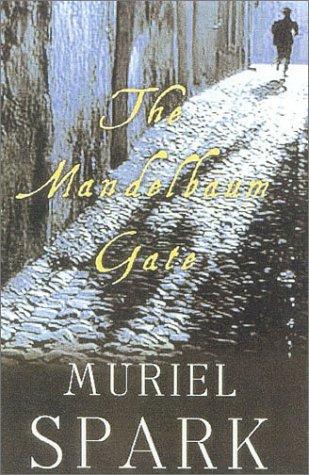
The Mandelbaum Gate by Muriel Spark

Arabs lived in the shelter of the eighteenth-century ruined fortresses, and even now in the years of the establishment of Israel, burning with its mixture of religion, hygiene, and applied sociology, the poor Arabs still hung their washing on the battlements, so that it fluttered all along the antique sea-front, innocent of the offence it was committing in the eyes of the seekers of beautiful sights and spiritual sensations, who had come all the way from the twentieth century, due west of Acre. Indeed, the washing draped out on the historic walls was a sign or progress, enlightenment, and industry, as it had been from time immemorial; it betokened a settlement and a society with a sense of tomorrow, even if it was only tomorrow's clean shirt, as against the shifty tent-dwelling communities of the wilderness; and however murky the cave-like homes along the shore, nad however indolent the occupants, they were one up on the Bedouin, at least in their own eyes if not in the sight of the tourist cameras which photographed the Bedouin shepherds continually but deplored the hung-out washing at Acre.

The Mandelbaum Gate is Muriel Spark's longest book (at a whopping 320+ pages), and bears few of her trademarks. It is surprisingly compassionate toward its protagonists, short on death and tragedy, though the subject matter might have easily invoked Spark's more violent tendencies, and at times borders on florid (the above passage is two sentences!).

But then again, its protagonist, Barbara Vaughan, is the most like Spark of all heroines, so perhaps it's unsurprising that Spark felt kindly disposed toward her, and her attention captured for longer. Like Spark, Vaughan is a half-Jewish, half-Protestant convert to Catholicism. The setting is Jerusalem, 1961, a city separated into an Arab and a Jewish half by the title gate, which is closely guarded and travel restricted. Barbara's fiance, an archaeologist, is working on the Arab side of the border, and Barbara undertakes to pass through, knowing that her Jewish blood puts her at danger even though she is a British citizen.

Such a premise threatens to devolve into a very Graham Greene-like spy caper, but Spark slyly buries the most espionage-like elements into b-plots and isolated moments. Instead, Barbara lingers at the Christian shrines in Jordan, disguised as an Arab woman, catches scarlet fever, and lingers in a sick bed--in short, there is simply too much lingering for The Mandelbaum Gate to qualify as a caper of any kind.

Instead, what Spark delivers is an uncharacteristically deft exploration of the multifarious perspectives on the Holy Land. One of my favorite passages is the one above, which describes the way that the residents of Acre struggle to maintain a present existence against the expectation of tourists and pilgrims, whose in their faith paradoxically seek to deaden and ossify the shrines they visit. In another passage, a collection of friars at the Church of the Holy Sepulchre look on in horror as a visiting priest cautions his congregation against trusting the claims of every shrine:

The three friars gazed at the priest as with one gaze. They had known it. The incipient defroque was undermining the Holy Land, as he went on to enumerate for practical purposes the shrines which his pilgrimage might well skip and the dubiety of their origins, their thoughts went to their brethren, the custodians of the Holy Land to whom these places were their whole heart and life; tears came to the eyes of the eldest friar as he thought of the venerable Franciscan, well past ninety, who kept the house where Our Lady was conceived by St. Joachim and St. Anne, and who had wanted nothing for himself all his life but to show it to the pilgrims and pray with them as they came, and collect alms for the poor of the place, and die there on that spot.


Again we are faced with the essential oxymoron created when the word Holy collides with Land; without a doubt the priest is the more literally correct, but his neatly ordered faith leaves no room for the lives of those that still live in Israel--or, as the Arabs in the book call it, Occupied Palestine.

In a broad sense, the Mandelbaum Gate itself provides a symbol of this conundrum, illustrating the difficulty of moving from one's own perspective into another's:

He followed the ancient walls of the city and Temple, past the gates of historic meaning, sealed and barred against Israel--the Zion Gate, Dung Gate, Jaffa Gate, New Gate. Then St. Stephen's Gate opened within the Old City to another medieval maze of streets--Damascus Gate, that gate of the Lord's triumphal entry into Jerusalem on Palm Sunday, and HErod's Gate. He walked round the city until at last, fumbling in his pocket for his diplomatic pass, he came to the Mandelbaum Gate, hardly a gate at all, but a piece of street between Jerusalem and Jerusalem, flanked by two huts, and called by that name because a house at the other end once belonged to a Mr. Mandelbaum.


But then again, the Mandelbaum Gate carries a different symbolic charge for each character. For the Arab Abdul Ramdez, the gate is the division of his family, as it separates him from his beloved sister, Suzi. For the normally staid English diplomat, Freddy Hamilton, who helps Barbara pass through into Jordan against his character, it is the inaccessible wall that prevents him from recovering his memories of the pilgrimage, through which he seems to inhabit some sort of fugue state. For Barbara, it is the artificial barrier between her Jewish self and Gentile self, that if only it were opened, may provide a total sense of identity:

She had thought then, but who am I?
I am who I am.
Yes, but who am I?


Spark is both canny and blasphemous enough to note the echo of Jehovah's words in Exodus, "I am that I am." If Barbara, made in God's image, cannot get a picture of herself, what then of God? The Holy Land is fractured, Spark maintains, because our view of God is fractured. Just as uncharacteristically, Spark ends the book optimistically, in the passage just above, as Freddy wanders through Jerusalem looking at the gates. Most are shuttered, but the Mandelbaum remains--the only entry way from one side of Jerusalem to the other--and it seems very small and mean, "flanked by two huts," and perhaps even comic. Can such a barrier really be insuperable?

Saturday, August 27, 2011

Reality and Dreams by Muriel Spark

She had married him for his looks which were admittedly star quality; but marriage was not a film; Cora was not a director; she had cast him in the role of a husband and he was hopeless at it. In screenplays the husband has a script to go by. Johnny had next to none.

The only other Spark book I’ve read, The Prime of Miss Jean Brodie, did not in any way prepare me for this slim volume. Strangely, it reminded me much more of late-era Don DeLillo: it is similarly dispassionate, features a lot of stylized dialog, and even the plotline reminded me a lot of DeLillo’s Point Omega. It is, however, much colder and crueler than that; no one does distant like Muriel Spark.

The story follows Tom Richards, a film auteur whose entire live revolves around his film career. Not only does he spend most of his time either on the film set or working on his scripts, he sees the world as a giant set itself. He wonders, more than once, if the world is just a dream God is having, and it isn’t hard to see why the question fascinates him—in his mind, the world is a dream in his head. The story begins after Tom has a fall from a crane while shooting a difficult shot, which brings his family together. The family consists of Claire, his sort-of, open-relationship wife, Cora, his child from an earlier marriage, about whom Tom nurses some disturbingly romantic feelings, and Marigold, Tom and Claire’s daughter, who no one else in the family really understands or likes.

Redundancy is a recurring theme in the book, both the American and British sense. American, in the sense that all the characters feel redundant to one another—Tom’s stream of young actresses are ultimately made redundant by Claire; Marigold is born redundant, since Cora already exists—and British in the sense that everyone seems to be losing their jobs, to such an extent that Marigold decides to make a documentary about redundancy. At some point in the novel, Marigold disappears, and, since this seems to be one of the few Spark books that has a mystery at its center, I won’t spoil what eventually happens. I will say that this is where the book most closely reminded me of Point Omega—in both novels, a strange girl disappears and no one seems especially miffed. Here, though, the reasons no one really cares are spelled out, and boy, are they cold. It’s hard not to see some parallels with Spark’s own life—as covered here—and her estrangement from her own child.

Everything ultimately explodes in violence, according to the blurb on the back, although “explode” is probably a bit strong. Instead, things fall into a not-so-nice cyclical arc. Things get a little muddled thematically, but Reality and Dreams is a funny, nasty, thoughtful piece of work.