
 Warning: Here, too, are minor spoilers.
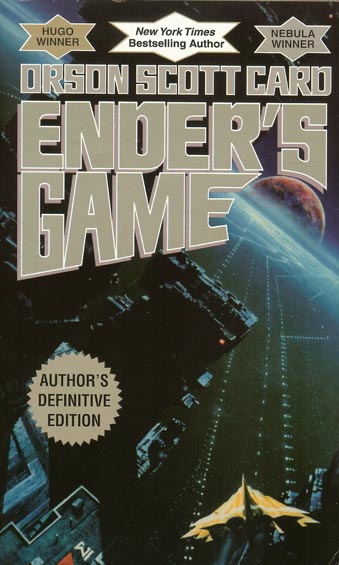
A while back I received a signed copy of Ender's Shadow, one of the sequels to Ender's Game. I thought pretty highly of it, especially the first half which follows Bean (an ancillary character in Game) during his youth as a homeless but brilliant runt in Rotterdam. Ender's Game, as I kind of expected, is similar almost to the point of overlap. Both are about children who are sent to Battle School (a space station where they are taught to fight humanity's enemy, the ant-like Formics) at an unusually young age; both characters are brilliant strategists and canny judges of character who are adept at manipulating situations to their benefit. The only difference is that Ender carries quite a bit more guilt about it, and as a result is probably the more interesting character. Even the twist ending is the same!
But that doesn't mean that Ender's Game wasn't worth reading. I love how tightly plotted Card's books are; they embody a kind of human logic and predictability that I don't think actually exists in real life. This is best on display at Battle School, where the students play a team-based strategy game that involves fighting in zero-G rooms with lasers that have the ability to freeze an opponent's limbs or body. Ender, being cast into leading a squadron before his time, is a master at this game and never loses; in each game he out-strategizes his opponent brilliantly. These episodes are a lot of fun, and reading about Ender using his strategic skills in the real world drags quite a bit in comparison. (By contrast, the first half of Ender's Shadow illustrates Bean's social intelligence outside the Battle Room more capably.)
One thing I found myself thinking about was the political implications of Ender's world--while Ender is at Battle School training, his psychopathic brother Peter and his compassionate sister Valentine are cooking up a scheme to protect the world from internecine conflict by pretending to a pair of adversarial writers who form public opinion on domestic matters. This is a neat bit, because it pretty accurately presages the existence of blogs, though the power of any individual blogger and the amount of security that exists on Card's equivalent of the internet are pretty laughable.
But that's not the point I want to make. Ultimately, Peter and Valentine are able to orchestrate it so that Peter becomes the leader of the world, staving off a world war after the Formics are defeated by Ender, who we have come to learn is pretty much the only guy that exists with the ability to lead world forces into battle. I think that makes them basically a more formidable family than the Adamses, Bushes, Kennedys, and Osbournes combined.
Card dabbles in right-wing punditry, but strikes me as more the Huckabee type--he is an outspoken critic of gay marriage, but maintains a pretty strong skepticism of free markets. I see this reflected in Ender's Game; collective human actions seem to lead to disaster without the guidance of a few super-individuals. In Ender's world, at least, a strong central power is both the political and military solution--oligarchy, monarchy, fascism, whatever you want to call it, it works. Does that idea make you a little bit uncomfortable? I admit that while I am of the opinion that a particular human being can change the world in significant and measurable ways, it isn't always for the better and this kind of solution is generally not to be trusted.
But maybe I'm inventing parallels when there are none--after all, one of Ender's chief strategies in battle is to delegate a lot of responsibility to his subordinates. But, then again, in the end he's the only one who can be trusted to take his ship to the Formic homeworld.
Political positions aside, this is probably one of the better traditional science fiction books I've ever read, as good as Asimov or Bradbury and a sight better than most of Card's contemporaries. I've been getting recommendations to read it for years, and I'm glad I did.

 Emma Larkin is a pseudonym used by an American journalist based in Bangkok. She was born and raised in Asia, studied the Burmese language in London, and writes extensively about Burma (present-day Myanmar). She cannot use her real name for fear that the Burmese government would bar her from entering the country.