Showing posts with label Orson Scott Card. Show all posts

Saturday, August 12, 2017

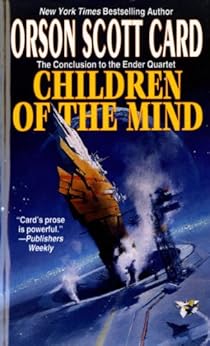
Children of the Mind by Orson Scott Card

Jane could feel it, the anguish of the bodies that she ruled now.  They were in pain, something that she hadn't felt before, the bodies writhing in agony as the myriad aiuas rebelled at having her to rule them.  Now in control of three bodies and three rains, she recognized amid the chaos and the madness of their convulsions that her presence meant nothing but pain and terror to them, and they longed for their beloved one, their ruler who had been so trusted and so well-known to them that they thought of him as their very self.  They had no name for him, being too small and weak to have such capacities as language or consciousness, but they knew him and they knew that Jane was not their proper master and the terror and the agony of it became the sole fact of each body's being and she knew, she knew she could not stay.

I know it's been said before.  But I'm going to say it again.  The strangest thing about Orson Scott Card and his Ender books is how unable he has been to practice their simple message of empathy in the real world.  Here's a passage written by the anti-gay marriage Card in Children of the Mind:

But that was absurd.  Her body was a woman's body.  And where did the choice of loves come from, if not the body?  Was there something male or female in the aiua?  Before it became master of flesh and bone, was it manly or womanly?  And if so, would that mean that the aiuas composing atoms and molecules, rocks and stars and light and wind, that all of those were neatly sorted into boys and girls.  Nonsense.  Ender's aiua could be a woman, could love like a woman as easily as it now loved, in a man's body and in a man's own ways, Miro's own mother.

The anti-gay reading of this passage is that we are all in a sense servants of our own bodies, that our physical maleness demands a certain sexual orientation that gayness perverts.  But it's hard to square that with the notion of the aiua, the soul, which in Card's universe fills even the "rocks and stars and light and wind" and has neither gender or sexuality, but is the font of love.  In Card's mythos, it's the aiua that has the power, and is the primary motivating spirit of the human being, and which demands empathy--not the body, which, like in Xenocide, crumbles into dust without it.

Children of the Mind is the last of the "Ender" novels (though there have been many more that focused on ancillary characters like Peter and Bean) because in it, Ender dies.  That's sort of a spoiler, but it's also part of the book's central conflict.  It's a bit convoluted, unless you've read the prior novels, so stay with me: The planet of Lusitania holds three sentient species, the "piggies," the Hive Queen whose race Ender nearly destroys in Ender's Game, and human beings.  All three are subject to a mysterious virus, the descolada, which may or may not be a species of its own.  The ruling body, the Starways Congress, is sending a fleet to destroy the world and commit the second "Xenocide" of entire species because of its fear of the descolada.

Ender and his associates are trying desperately to save the piggies and the Hive Queen with the help of faster-than-light travel, which only they possess.  It's facilitated by the friendly supercomputer Jane, who lives in the faster-than-light network of communications devices known as ansibles.  She takes the ship to a mysterious place known as "Outside," where the aiuas, or souls of things not yet born, live, and then teleports it back "Inside."  This process, in a way I don't really want to try to explain, ends in Xenocide with Ender creating versions of his sister and brother, the altruistic Val and the cynical Peter, though they are really projections of himself and thus his own aiua split in parts.  The Starways Congress is trying to kill Jane by shutting down the ansibles, meaning to save Jane they must "download" her aiua into one of the new vessels, Peter or Val, and use the other to house the aiua of the dying Ender.  (The brave version of this would be to have Ender in Val and Jane in Peter, but I'll let you guess how it turns out.)  Okay.  So the attempt to save Jane by putting her in a human body is basically the plot of his novel.  Got it?

The convolutedness of Children of the Mind isn't what makes it such a disappointing ending.  It's actually the opposite: all the complexity of the plotline is steadily built over the course of the three previous novels, and once there's nothing left to introduce, Children of the Mind kicks its tires for several hundred pages.  There's no radical challenge to what sentience might mean, as represented by the piggies and the Hive Queen or the aiuas.  Card introduces one intriguing possibility, that the descolada itself is a kind of language used by a species that communicate by manipulating genes (neat), but this plot is left unresolved.  (Is it resolved in another book, perhaps?  I'm not sure I want to know.)

I want to talk a little bit about something else that bothers me about the series.  In Card's planetary system, most sovereign worlds reflect a twentieth-century national identity.  There's Path, a Chinese-Confucian world, and Divine Wind, a Japanese-Shinto one.  There's a Nordic one called Trondheim and a Pacific Islander one called Pacifica.  Lusitania is Brazilian.  Card stresses, intriguingly, that these worlds are racially diverse; no one thinks it's weird that a white guy like Peter is on Divine Wind, because what matters is that it is culturally Japanese, not racially Japanese.

But the result is a strange projection of twentieth-century politics 3000 years into the future.  Think about what the world was like 3000 years ago.  We might retain, for example, the influence of ancient Egypt, but the idea of a polity that represents an abstract form of ancient Egypt as it was snapshotted in 1000 BC would be absurd.  On Divine Wind, the bombings of Hiroshima and Nagasaki help to inform the choice to use the "Little Doctor" planet-destroying device on the Lusitanians.  But as the events of the past week remind us, this only makes sense in a world in which humanity has been sane enough to keep its hands off nuclear weapons in the 3000 years since Hiroshima and Nagasaki, which seems increasingly optimistic.  Card places these cultural fiefdoms light-years away from one another, preserving them, as if in amber, and the result is that he can avoid imagining the way cultures might communicate or cross-pollinate.  What it shows is a quality anathema to the highest-quality science fiction: a lack of imagination.

All that was easy enough to put aside when the Ender novels were providing new and interesting things to think about.  But Children of the Mind is so rote, relatively speaking, that the series' flaws loom larger.

Sunday, July 6, 2014

Xenocide by Orson Scott Card

Miro found himself at the door of the cathedral.  In the cool morning air it stood open.  Inside, they had not yet come to the eucharist.  He shuffled in, took his place near the back.  He had no desire to commune with Christ today.  He simply needed the sight of other people.  He needed to be surrounded by human beings.  He knelt, crossed himself, then stayed there, clinging to the back of the pew in front of him, his head bowed.  He would have prayed, but there was nothing in the Pai Nosso to deal with his fear.  Give us this day our daily bread?  Forgive us our trespasses?  Thy kingdom come on earth as it is in heaven?  That would be good.  God's kingdom, in which the lion could dwell with the lamb.

Then there came to his mind an image of St. Stephen's vision: Christ sitting at the right hand of God.  But on the left hand was someone else.  The Queen of Heaven.  Not the Holy Virgin but the hive queen, with whitish slime quivering on the tip of her abdomen.  Miro clenched his hands on the wood of the pew before him.  God take this vision from me.  Get thee behind me, Enemy.

The third book of the Ender series picks up where Speaker for the Dead left off: Starways Congress, the organization which controls the known universe, has sent a fleet to destroy the world of Lusitania, home of the descolada, a crippling virus which has the power to destroy all human life.  But not only are Ender and his family on Lusitania, but the only two sentient non-human life forms ever discovered: the formics, who were carried there by Ender in the second novel, and the pequeninos, who depend on the descolada for the operation of their life cycle.

Xenocide deals with the efforts of Ender, his sister Valentine, his adopted children, and the artificial intelligence program known as Jane to stop the Lusitania fleet.  Whether they do or don't, I can't tell you--the novel ends before the fleet arrives (which takes years and years, considering the distance required for space travel).  In the process, though, they manage to invent faster-than-light space travel and unravel the mystery of philotes, the elemental rays which connect all life in the universe--so there's that.

In many ways, Xenocide reproduces the themes of the first two novels.  It argues passionately for a world view that recognizes all forms of life as valuable and encourages its reader to imagine what it is like to be the Other, whether it's an alien entity or a human rival.  What it adds to these is a sense of how complicated that recognition can be.  The pequeninos and formics are hatching a plan to build their own spacecraft and save their species, but that would mean spreading the descolada throughout the universe.  How does one properly recognize life when the continued existence of one means the elimination of the other, and vice versa?  And what counts as life, anyway?  Jane is alive, in a sense, and one possible solution--shutting off the communication networks in which she exists--may mean her death.  One of Ender's stepchildren theorizes that the descolada itself could be a form of sentient life, deserving of its own right to exist.  Would destroying it be xenocide, the destruction of an entire intelligent species?

Xenocide also offers an interesting take on religion.  One of the few new characters introduced is Li Qing-jao, a girl on the planet of Path who is tasked in aiding Starways Congress and the Lusitania fleet.  She is "godspoken," blessed by the gods of Path with superior intelligence, but also forced to undergo humiliating rituals of penance to rid her of uncleanliness.  Spoiler alert--it turns out that this condition is a form of genetic OCD inflicted on the super-intelligent citizens of Path to keep them under control.  When this is revealed to her, Li Qing-jao dismisses it as an evil lie meant to keep her from true obedience.  She is, in a way, the very picture of the unskeptical fundamentalist that Orson Scott Card has been portrayed as--perhaps rightly so.  I thought Ender's thoughts on Qing-jao were especially interesting:

Qing-jao, I know you well, thought Ender.  You are such a bright one, but the light you see by comes entirely from the stories of your gods.  You are like the pequenino brothers who sat and watched my stepson die, able at any time to save him by walking a few dozen steps to fetch his food with its anti-descolada agents; they weren't guilty of murder.  Rather they were guilty of too much belief in a story they were told.  Most people are able to hold most stories they're told in abeyance, to keep a little distance between the story and their inmost heart.  But for these brothers--and for you, Qing-jao--the terrible lie has become the self-story, the tale that you must believe if you are to remain yourself.  How can I blame you for wanting us all to die?  You are so filled with the largeness of the gods, how can you have compassion for such small concerns as the lives of three species of raman?  I know you, Qing-jao, and I expect you to behave no differently from the way you do.  Perhaps someday, confronted by the consequences of your own actions, you might change, but I doubt it.  Few who are captured by such a powerful story are ever able to win free of it.

What to make of that in light of Card's own trenchant Mormonism?  Or Miro's compulsive re-imagining of the story of the Holy Viring to include the hive queen, above?  What does it mean to be "free" of the stories we tell?

Despite these fascinating aspects, Xenocide shows signs of diminishing returns.  The characters simply aren't complex or interesting enough to support what is at this point maybe 1,500 pages of fiction, and start to wear a little thin.  The technological efforts of Ender and the Lusitanians starts to verge on absurd: the "philotic connections" are awfully New-Agey, and the time it takes them to invent faster-than-light travel (which involves momentarily leaving the fabric of spacetime) beggars belief.  But the plot remains compelling, and deferring the one thing the third book seemed to promise--the arrival of the fleet--is a canny move that pretty much ensures I'll have to read the next one.

Friday, January 3, 2014

Speaker for the Dead by Orson Scott Card

"You're quite right that the truth about him will cause nothing but pain, but not because he was a miserable man," said the Speaker.  "If I told nothing but what everyone already knows--that he hated his children and beat his wife and raged drunkenly from bar to bar until the constables sent him home--then I would not cause pain, would I?  I'd cause a great deal of satisfaction, because then everyone would be reassured that their view of him was correct all along.  He was scum, and so it was all right that they treated him like scum."

"And you think he wasn't?"

"No human being, when you understand his desires, is worthless.  No one's life is nothing.  Even the most evil of men and women, if you understand their hearts, had some generous act that redeems them, at least a little, from their sins."

I said in my top ten for last year that I thought one of the remarkable things about Speaker for the Dead is how miserably its author, Orson Scott Card, seems to have lived up to the moral vision it expresses.  If you want to read a more thorough and coherent along those same lines, I highly recommend Rany Jazayerli's article in Grantland about what Card's Ender's Game meant to him as a young Muslim in America.  Speaker, even more than Ender's Game, is a paean of "inclusion and tolerance," and a serious investigation into what those terms might mean in a universe where humans discover that they are not alone.

As a sequel to Ender's Game, Speaker takes a wild left turn.  It's set thousands of years in the future, but Ender is still around, thanks to the (sort of ) life-lengthening benefits of interstellar travel.  Yet he travels incognito as Andrew, as Ender has become a legend of evil for his role in destroying the Buggers eons ago--the "Xenocide".  Ender, still haunted by his actions, works as a "Speaker for the Dead," researching and declaiming on the lives of those who have passed away so that the living might understand their life as they had wanted to live it.

Ender gets several calls from the planet Lusitania requesting his services.  He is invited to speak for Pipo, a biologist studying a native race of sentient beings called "piggies"--the only other sentient race discoverd since the Buggers--as well as for Marcao, a brutish lout whom almost everyone is happy to see dead.  Pipo and Marcao's lives were intertwined in the way one might expect from the inhabitants of a very small colony, but I won't try to explain the very messy network of relationships that Ender wanders into here.  More important is the fact that Pipo, as well as his son Libo who has attempted to follow in his father's footsteps, have been brutally murdered by the piggies for reasons that no one seems to be able to explain.  Once the murders become known throughout the colonized universe, the piggies face the possibility of being wiped out, like the Buggers before them.  Ultimately, Ender must speak not only for Pipo and for Marcao, but for the piggies themselves.

By creating an alien race that is so foreign and so difficult to understand, Card challenges his reader's own sense of inclusiveness.  How different, he asks, does another sentient being have to be before we are no longer willing to grant its life sanctity?  I think that only a science fiction novel could do this so well; we are so used to the language of "human rights" and "tolerance for all people" that only by imagining a non-human race can we see how empty those terms often are for us.  And though at first blush a novel about "inclusion and tolerance" seems like a shallow creation, we are incredibly bad at actually putting the ideas Card offers here into practice.  I think you can see this in the recent Phil Robertson kerfuffle, not only in his startling lack of sympathy toward homosexuals but in the eagerness of his detractors to cast him as beyond the boundaries of civilized society.  We are so bad, in fact, that Card has clearly failed at it himself through his public comments on homosexuality.

In the eighteenth and nineteenth centuries, many writers and thinkers believed that sympathy with others was the underpinning of moral life.  Adam Smith wrote that sympathy with others begins with imagination, the ability to mentally share in the feelings and experiences of others.  If we believe fiction can make us better people, even a little, this is why.  While Speaker of the Dead wasn't crafted with the same kind of writerly skill as the other books on my top ten list from last year, it is a feat of great imaginative sympathy, and that may be worth even more.

Sunday, January 4, 2009

Ender's Game by Orson Scott Card

Warning: Here, too, are minor spoilers.

A while back I received a signed copy of Ender's Shadow, one of the sequels to Ender's Game. I thought pretty highly of it, especially the first half which follows Bean (an ancillary character in Game) during his youth as a homeless but brilliant runt in Rotterdam. Ender's Game, as I kind of expected, is similar almost to the point of overlap. Both are about children who are sent to Battle School (a space station where they are taught to fight humanity's enemy, the ant-like Formics) at an unusually young age; both characters are brilliant strategists and canny judges of character who are adept at manipulating situations to their benefit. The only difference is that Ender carries quite a bit more guilt about it, and as a result is probably the more interesting character. Even the twist ending is the same!

But that doesn't mean that Ender's Game wasn't worth reading. I love how tightly plotted Card's books are; they embody a kind of human logic and predictability that I don't think actually exists in real life. This is best on display at Battle School, where the students play a team-based strategy game that involves fighting in zero-G rooms with lasers that have the ability to freeze an opponent's limbs or body. Ender, being cast into leading a squadron before his time, is a master at this game and never loses; in each game he out-strategizes his opponent brilliantly. These episodes are a lot of fun, and reading about Ender using his strategic skills in the real world drags quite a bit in comparison. (By contrast, the first half of Ender's Shadow illustrates Bean's social intelligence outside the Battle Room more capably.)

One thing I found myself thinking about was the political implications of Ender's world--while Ender is at Battle School training, his psychopathic brother Peter and his compassionate sister Valentine are cooking up a scheme to protect the world from internecine conflict by pretending to a pair of adversarial writers who form public opinion on domestic matters. This is a neat bit, because it pretty accurately presages the existence of blogs, though the power of any individual blogger and the amount of security that exists on Card's equivalent of the internet are pretty laughable.

But that's not the point I want to make. Ultimately, Peter and Valentine are able to orchestrate it so that Peter becomes the leader of the world, staving off a world war after the Formics are defeated by Ender, who we have come to learn is pretty much the only guy that exists with the ability to lead world forces into battle. I think that makes them basically a more formidable family than the Adamses, Bushes, Kennedys, and Osbournes combined.

Card dabbles in right-wing punditry, but strikes me as more the Huckabee type--he is an outspoken critic of gay marriage, but maintains a pretty strong skepticism of free markets. I see this reflected in Ender's Game; collective human actions seem to lead to disaster without the guidance of a few super-individuals. In Ender's world, at least, a strong central power is both the political and military solution--oligarchy, monarchy, fascism, whatever you want to call it, it works. Does that idea make you a little bit uncomfortable? I admit that while I am of the opinion that a particular human being can change the world in significant and measurable ways, it isn't always for the better and this kind of solution is generally not to be trusted.

But maybe I'm inventing parallels when there are none--after all, one of Ender's chief strategies in battle is to delegate a lot of responsibility to his subordinates. But, then again, in the end he's the only one who can be trusted to take his ship to the Formic homeworld.

Political positions aside, this is probably one of the better traditional science fiction books I've ever read, as good as Asimov or Bradbury and a sight better than most of Card's contemporaries. I've been getting recommendations to read it for years, and I'm glad I did.

Saturday, April 7, 2007

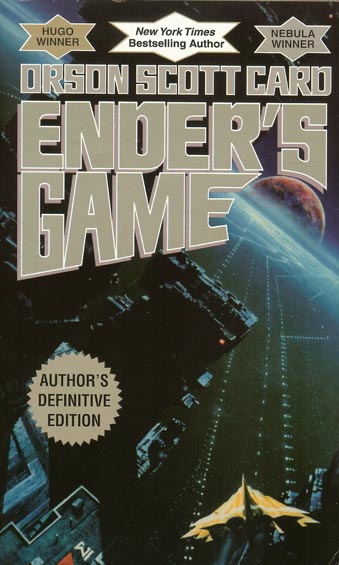
Ender's Game by Orson Scott Card

I remember all my nerdy friends reading this in high school. I was a nerd as well, just not quite as big of one as they were. I didn't know how to say anything in Klingon. However, had I read this book while I was in high school I would have loved it. Although I am sure I would have been tempted to steal ideas from it, since I was constantly working on a "novel" set in space. I really wish I could find my unfinished "novel". I am sure it would be absolutely hilarious.

I bought this book in the children's section at Joseph-Beth, but I don't think it is a kids book...maybe young adult. The candy-coated cover of this version (there are more adult-looking versions) belies the violence and serious themes within the book. Beyond that, I think that many kids would not understand much of the political content of the book.

The basic plot of the book is that the people of earth are in the middle of a war with an alien race that the humans referred to as buggers since they look like insects. Children are monitored throughout their lives to see if they would make good commanders or pilots. If they show promise, then they are sent to a space station set up specifically for training children for battle. The book follows a boy named Ender Wiggin throughout his training.

The author, Orson Scott Card, provides excellent descriptions. This is not to say that he went all "Tom Clancy" and spent four pages describing a laser gun. Card does a superb job of describing something just enough and then allowing the reader to easily fill in the rest. While reading, I realized that the vivid mental images of the battle rooms, simulator rooms, and barracks were really of my own creation, since Card did not described any of these places in detail. The writing was good, and the characters were developed very well.

I loved this book. It was like Lord of the Flies meets The Matrix meets StarFox. What's not to like?