Showing posts with label nebraska. Show all posts

Sunday, June 25, 2023

Crazy Horse: The Strange Man of the Oglalas

Sometimes it was days before visiting warriors saw the man they had come to follow, for often Crazy Horse kept far from the noise and the drumming, perhaps making a fast, hoping for a vision or a dream to tell him what must be done. It seemed if he could make himself more a part of the earth and the sky and the things between that a way would come to save the people. He even tried the medicine things of the Old Ones, and for two days he looked unmoving towards the Black Hills, overrun as by ants digging up the rocks and the cool green valleys and the slopes red with the grass berries so sweet to the tongue. But it was no more than a wind in the gully and n his way back to camp he saw that the buffalo chips were indeed becoming few, the trees no longer rubbed smooth by the backs of the shedding herds.

What a nice coincidence to be able to write this review on the anniversary of the victory of a coalition of Lakota and Cheyenne fighters at the Little Bighorn, or as they call it, the Battle of the Greasy Grass. During that fight, the larger force of Indian fighters utterly destroyed the forces of General George Armstrong Custer, killing Custer and almost every other American soldier. By the time of the battle, the Lakota leader called Crazy Horse was at the peak of his renown, having already distinguished himself as an especially courageous warrior in actions against the American forces, including, ten years earlier, leading a decoy action in the "Fetterman Fight" that led to the greatest losses suffered by American forces--greatest, that is, until Little Bighorn. Just a few years later, Crazy Horse's band of holdouts against reservation life would be drastically reduced, and then, once he himself surrendered to the Red Cloud agency in Nebraska, he himself would be killed by a military guard with a bayonet.

Mari Sandoz, the great Nebraskan writer, depicts Crazy Horse as the "Strange Man of the Lakotas." Crazy Horse was marked as unusual from his birth by his fine blond hair which earned him, long before he took the name of his father, also called Crazy Horse, the name "Curly." But Crazy Horse was also "strange" in the sense that he was aloof and unsociable, and cared little for the scalps and war trophies that dominated the Lakota idea of what it meant to be renowned in battle. Crazy Horse, instead, is driven by an obsessive passion for the survival of the Lakota, rather than personal gain or fame:

Their blankets held out around them, as was customary, they went on as women do, about this Hunkpatila so often in their camp, with hair summer-bleached to the color of an elk's rump. Nor was he a big man, as a Lakota leader should be; instead he stood slender as a young warrior, almost a boy when riding beside the seven-foot Touch the Clouds. He did not sing or dance as a Lakota should, and never made the ordeals of the sundance to give himself fortitude and courage. It was true that he was strong in the fighting, but he brought in no scalps for the women to dance and no stories of coups counted or deeds done. He was indeed a Strange Man.

Sandoz' depiction of Crazy Horse's life is a compelling one, animated by the central drama of the warrior's "strangeness." His early life is dominated by the difficulty of his love for Black Buffalo Woman who marries another man, No Water. In Lakota culture, a woman may divorce her husband freely by moving her things from her husband's lodge to another man's, but when Black Buffalo Woman leaves No Water for Crazy Horse, No Water responds by shooting Crazy Horse in the face; a controversy for which Crazy Horse is "unshirted," losing his authority among the leaders of the Lakota. 

That theme--Crazy Horse's conflict with Lakota leaders--is picked up later as Crazy Horse becomes the avatar of the "hostile" Lakota, who want to pursue resistance against the American forces, as opposed to the "friendlies" who prefer to accommodate the Americans by giving up their freedom of movement in exchange for food and supplies provided by their reservation Indian agencies. This conflict is not, as Vollmann depicts it in The Dying Grass, merely driven by differing perspectives on what is best for the people, but the greed and short-sightedness of Lakota leaders, who benefit from the Americans' authority. Red Cloud comes in for special criticism here, sacrificing the Lakota's autonomy by signing the "peace paper" in exchange for being designated the "paper chief" of all the Lakota, a role which had never existed among the highly decentralized bands. Red Cloud is Crazy Horse's foil in Sandoz' telling, a selfish and greedy man who sacrifices the interests of his people for his own.

What makes Crazy Horse such a compelling tragedy is that, in the end, it's a betrayal story: the Americans could never defeat the Strange Man of the Lakota, but the Lakota could, and in the end it's a constellation of jealous Indians who bring about Crazy Horse's death. These Judases have their own fascinating figures, like Little Big Man, who holds Crazy Horse's arms down for both No Water and, later, the military guard who bayonets Crazy Horse; and Woman's Dress, a childhood rival of Crazy Horse's whose name refers to his flamboyant, over-decorated appearance. I was especially interested in a figure called "the Grabber," a part-Lakota, part-Black scout and translator whose real name was Frank Grouard. It's the Grabber who seals Crazy Horse's fate by badly mistranslating his agreement to assist the whites in their war against Chief Joseph: Crazy Horse promises to fight until not a single Nez Perce is left standing, but the bumbling--or malicious--Grabber translates this as "not a single white is left standing."

I'm not equipped to judge Sandoz' ability to enter into the Lakota perspective and render a faithful rendition of the Lakota leader, but from where I stand, I find the book's wholesale rejection of the colonial white narrative pretty remarkable. Vine Deloria writes in his introduction about being persuaded by the book, despite initial skepticism. One reason the book is so convincing, though, I think, is that it relies on firsthand testimony: Sandoz relies on interviews she made herself in the 1930s with Crazy Horse's friends and associates, like the loyal He Dog, and White Calf, a witness to the great warrior's tragic murder. Though Crazy Horse himself might have found Black Elk Speaks author John Neihardt's description of the book as "the story of a great American" objectionable, it's hard to deny that Sandoz captures a spirit of greatness. After Little Bighorn, a popular myth about Custer sprang up in the USA which depicted him as a valiant man who fought to the last moment in the face of certain doom--but isn't that a better and truer description of Crazy Horse, the Strange Man of the Oglalas?

Saturday, April 1, 2023

Lucy Gayheart by Willa Cather

Suddenly something flashed into her mind, so clear that it must have come from without, from the breathless quiet. What if--what if Life itself were the sweetheart? It was like a lover waiting for her in distant cities--across the sea; drawing her, enticing her, weaving a spell over her. She opened her window softly and knelt down beside it to breathe the cold air. She felt the snowflakes melt in her hair, on her hot cheeks. Oh now she knew! She must have it, she couldn't run away from it. She must go back into the world and get all she could of everything that had made him what he was. Those splendours were still on earth, to be sought after and fought for. In them she would find him. If with all your heart you truly seek Him, you shall ever surely find Him. He had sung that for her in the beginning, when she first went to him. Now she knew what it meant.

How strange to read Willa Cather write about a city. Lucy Gayheart is a small town Nebraska girl who travels to the big city--Chicago--to study piano. She falls in love with a famous and married singer, but first she falls in love with Chicago, which makes her hometown of Haverford seem irredeemably provincial and cramped. But Cather describe the city as she does natural landscapes: the buildings are gray cliffs, and Lake Michigan is prairie-like in the way the subtle changes of the sky, purple and green, rise above its flatness. 

The singer, Clement Sebastian, seeks Lucy out because he needs an accompanist. They never play together in public, but he practices with her daily, and they are drawn into the fabric of each others' lives. In Lucy, Sebastian sees a freshness and youth that has passed him by; in Sebastian, Lucy sees an elevated spirit who contrasts with the shrewd, earthy Haverford banker whom everyone presumes she'll marry. Nothing happens between Lucy and Clement, not really, but what happens to Lucy happens in spirit, rather than the body. When the banker, Harry Gordon, comes to Chicago to propose to her, she tells him truthfully that she is caught up with another man, and when he presses her about how far their relationship has gone, she exclaims "All the way!" Harry, of course, takes this to mean she has been physically reckless, but "the way" Lucy means in the way of the spirit, or the way of the mind. She's a sentimentalist in the most literal sense; the great experiences of her life are those that happen within.

So, let me give a spoiler alert for what I'm going to say next: Cather is one of the cruelest and most bloodthirsty authors that ever existed. She's more pitiless than George R. R. Martin. First, she kills off Clement, who dies by drowning on Lake Como weeks before he's supposed to return and resume his work with Lucy. She returns to Haverford a changed woman, somewhat darkened and diminished, but having embraced the idea that what happens within her cannot die, though the man who caused it might. Still, she finds herself unable to repair the break between her and Harry, who has married a woman he does not care for just to spite her.

And then Cather kills her off. I couldn't believe it. In a fit of despair Lucy takes her skates out to the old skating spot on the Platte river, not knowing that beneath the snow the river has changed course and skating is no longer safe. She encounters Harry on the way, but he makes a lame excuse and turns his carriage away from her. Blinded by anger at Harry, she fails to notice the cracking ice before it's too late. In this way she's symbolically united with Clement, having perished the same way he did. It's not quite O Pioneers! perhaps, but it hurts. Clement is old-ish, has already felt past the best years of his life, but Lucy is young, and her youthfulness and promise are her most essential qualities. But Cather dispatches Lucy at her lowest point, and it's Harry Gordon--practical, unsentimental, philistine--left to deal with the aftermath in the book's final pages. Willa, you ogre! You beast!

Sunday, September 11, 2022

Yonnondio by Tillie Olsen

He learned all right, the tortures of the damned:

feet slapping the pavement, digging humbly into carpets, squatting wide apart in front of chairs and the nojobnojob nothingdoingtoday buzzing in his ears; hugging the coffee--and, shuffling along, buddy (they made a song out of it) can you spare a dime, and the freights north east south west, getting vagged, keep movin, keep movin (the bulls dont need to tell ya, your own belly yells it out, your own idle hands), sing a song of hunger the weather four below holes in your pockets and nowhere to go, the flophouses, the slophouses, a bowl of misery and a last month's cruller and the crabs having a good time spreading and spreading (you didn't know hell would be this bad, did you?).

The subtitle of Tillie Olsen's Yonnondio is "From the Thirties," and what it has to say about the Thirties is that they sucked big time and were bad. The novel follows the Holbrook family--father Jim, mother Anna, daughter Mazie, siblings Jimmie, Ben, Will, and baby Bess--as Jim moves from job to job in the American plains, looking for work that will allow the family to survive and rise above the depredations of poverty. First, it's coal mining in Wyoming, then farming in South Dakota, and finally the slaughterhouses of Omaha. In each place, Jim finds himself owing more to his bosses than he is paid, thanks to the brutal policies of company towns, and he takes his anger and frustration out not on his bosses--one thing Yonnondio seeks to illustrate is how poverty and abuse don't necessarily translate into political awareness--but on Anna. Sickness, violence, and misery ensue.

I like Yonnondio more when I read in the postscript that it was written by Olsen when she was in her early twenties, put away unfinished, then rediscovered and published decades later. As a novel, it seems to have only a downward shape, like The Inferno, from one circle of Hell to another. Even though there are small and hopeful moments--the discovery of a beautiful field of dandelions, with their edible greens, in the middle of Omaha--Yonnondio shows how punishing life was for the poor during the Great Depression by punishing the reader.

But seeing it less as a novel than a collection of fragments, the poetic and impressionistic elements of Yonnondio come to the forefront. Olsen's language can be brutal and lurid, Gothic in imagery and sentiment, and filled with strange, bold choices (like the stretch quoted above). Less successful, I thought, were Olsen's attempts to capture the family's vernacular, which very well might be accurate, but doesn't sound like any human beings I've ever heard. Jim is a thoughtless brute, and Anna and Mazie mostly characterized by their suffering, which approaches madness at times. But some of the minor characters provide the most interesting moments: the coal miner, disfigured and addled by the explosion of a seam, who nearly drops Mazie into the mineshaft to appease the gods of coal he imagines are torturing him; the street urchin Mazie befriends in Omaha who patterns her personality after movies she's too poor to have seen.

Olsen, as I understand it, chose not to finish or rework any of the material she had written in her youth, when the Depression was not yet a memory. As a result, there's no cant here about the nobility of poverty, or of those who grind through the exploitation the Holbrooks experience. Poverty isn't ennobling, Olsen shows; in fact, one of its harshest consequences is that it breeds cruelty in its victims. For that observation alone Yonnondio remains powerful.

Tuesday, July 5, 2022

Lonesome Dove by Larry McMurtry

Life was finally starting, Newt thought. Here he was below the border, about to run off a huge horse herd, and in a few days or weeks he would be going up the trail to a place he had barely even heard of. Most of the cowpokes who went north from Lonesome Dove just went to Kansas and thought that was far--but Montana must be twice as far. He couldn't imagine what such a place would look like. Jake had said it had buffalo and mountains, two things he had never seen, and snow, the hardest thing of all to imagine.

Okay, first of all: Three-fourths of Lonesome Dove doesn't even take place in the town of Lonesome Dove on the Texas-Mexico border. The whole point of the massive novel is leaving Lonesome Dove. Two aging Texas Rangers, garrulous Gus McCrae and stern Woodrow McCall, decide to give up their livery stable, which has led to a too-easy life, to lead a final cattle drive all the way from Texas to the Montana, arriving in the rich grasslands with their thousands-strong herd before other homesteaders and ranchers get there for them. Along for the ride are a motley crew of cowpokes: young Newt, who hasn't figured yet out figured out that he's Call's illegitimate son; Deets, the black tracker of preternatural skill; Jake Spoon, an unreliable gambler and womanizer; Lorena, a former prostitute in Lonesome Dove who sees Jake as her ticket to a better life in San Francisco; Dish Boggett, a talented cattle driver who is madly in love with Lorena. The story of these cattle drivers intersects with others: the Arkansas sheriff and his deputy who are looking to hang Jake Spoon, the sheriff's wife, who absconds with a group of rough-and-tumble buffalo hunters, and Gus' old flame Clara, long since settled on the Platte with her now-disabled husband.

Gus is the central character of Lonesome Dove. He's a skilled ranger and lawman, but he prefers to talk, and his incessant joking and chattering is the bane of his laconic partner, McCall. In fact, Gus gives the first couple hundred pages of Lonesome Dove, the part where the "outfit" is making plans for their cattle drive, a kind of broad comic quality that make the sudden death of a young Irish cowboy by a nest of water moccasins even more unsettling. It took me a long time to adjust my expectations for the novel; the juxtaposition of its comic tone and the brutality of the trail felt to sour to me, at times. The nadir of this, for me, was the introduction of a mysterious and barefoot young girl, with almost feral outdoor skills, who takes up with the hapless deputy Roscoe and who is--spoiler alert--almost immediately killed off in the most brutal manner, and not alone. But as the novel goes on, Gus' humor begins to seem more like a reasonable response to a life filled with unpredictable cruelty. The Irishman, the girl, are buried, and the cattle drive moves on.

Lonesome Dove seems, in many ways, like the quintessential western. For one, it's truly epic: 850 pages long and covering several thousand miles, as well as a couple dozen different character viewpoints. It's a snapshot of the American West at a moment when it seems empty, Native Americans driven back, the buffalo thinned out to near-extinction, but before the great droves of settler wagons and cattle drives that Call and McCrae know are coming. Sometimes, the Western tropes are a little too strong. I didn't like the depiction of Blue Duck, the unusually vicious Comanche outlaw who kidnaps Lorena and sells her to a group of Indians and Comancheros to be beaten and raped. Though Lonesome Dove makes some gestures toward ambivalence about Native Americans--Gus is supposed to have a more compassionate demeanor toward them than many of his peers--but Blue Duck seems like a monster straight out of American myth, the kind that has long been used to justify genocide and displacement. And I was troubled by the character of Lorena, too, who is headstrong at first, and who becomes terrified and helpless after her ordeal. Vicious Native Americans, helpless damsels.

But ultimately, I was engrossed by the vividness of the characters, and the sweep of the novel's great drama. The novel gets stronger, I think, the farther the outfit goes, and the wider its scope becomes. It's sort of a marvel, actually, that the novel doesn't falter as it brings in the Arkansas sheriff, July Johnson, or the story of Gus' old love Clara, a headstrong woman who has lost two children and whose husband now has been rendered braindead by the kick of a horse. But the novel is something like Gus and Call themselves: stifled by the lazy, talk-heavy life of a Lonesome Dove horse trader, and needing the great open space of the West in order to thrive. By the time the cattle drive arrives in Montana, it has become a legend in its own right, but the costs have been great: lives lost, men buried in unmarked graves in impossible to find places. Every real Western needs to have a measure of ambivalence about the West, and this is Lonesome Dove's. Has it been worth it, to reach Montana? Is the myth worth the men it leaves behind?

Saturday, April 30, 2022

One of Ours by Willa Cather

When Ernest left, Claude walked as far as the Yoeders' place with him, and came back across the snow-drifted fields, under the frosty brilliance of the winter stars. As he looked up at them, he felt more than ever that they must have something to do with the fate of nations, and with the incomprehensible things that were happening in the world. In the ordered universe there must be some mind that read the riddle of this one unhappy planet, that knew what was forming in the dark eclipse of this hour. A question hung in the air; over all this quiet land about him, over him, over his mother, even. He was afraid for his country, as he had been that night on the State House steps in Denver, when this war had been undreamed of, hidden in the womb of time.

Claude Wheeler is a desperate man. He takes over his father's Nebraska farm, but day-to-day existence seems intolerable to him. He's an idealist, but no ideal seems worth his devotion; he wants badly to admire someone, but the grand scope of the Nebraska plains no longer seems to admit any real greatness. He thinks momentarily that he has found a purpose in life by marrying his sweetheart Enid, but her kind of idealism doesn't match his own. She leaves him at home while she goes to temperance marches; eventually, after several bitter disputes, she leaves him to go take care of her missionary sister in China, an environment for which she has been training all her life. Only when the United States enters World War I does Claude find a stage commensurate with the moral and aesthetic greatness he desires, and he becomes a lieutenant on the French front.

This is the, what--fifth?--book of Cather's I've read. For the first time I think I'm coming to understand that Cather is a deeply conservative writer, perhaps the greatest conservative writer that the United States has ever produced. In The Death of the Archbishop, it's the bolstering of the national mythmaking of the frontier--for example, the whitewashing of an anti-indigenous marauder like Kit Carson. In A Lost Lady, it's the inherently conservative sense of a despoiled golden age, and the diminished state of modern life. Those elements are here, too, but alongside the glorification of war as a way of self-actualization:

The sound of the guns had from the first been pleasant to him, had given him a feeling of confidence and safety; tonight he knew why. What they said was, that men could still die for an idea; and would burn all they had made to keep their dreams. He knew the future of the world was safe; the careful planners would never be able to put it into a strait-jacket,--cunning and prudence would never have it to themselves.

It's almost stunning to read the phrase "men could still die for an idea" and realize it's meant to be a good thing! I suspect that World War II supplanted World War I in our public memory, and allowed the notion that World War I was largely a bloody and pointless waste to find purchase. But of course Cather is writing in 1922, well before World War II and when World War I was simply known as "The Great War," and so the scale of the war becomes a magnet for those conservative ideals. Claude, living after the age of the great frontier, inherits a West full of bankers and clerks; the European front becomes for him a new frontier, on which he can becomes his best self, a leader of men and a self-sacrificer. When--spoiler alert--Claude is killed in the trenches at the novel's end, while leading his men in a desperate and doomed hold on an important position, we are asked to read it not as a waste of a life that might have blossomed in other ways, but as the proper culmination of a life that has finally found a reason for being.

All this is to say: the ethics of this book are kind of fucked up? And maybe the ethics all of Cather's books? But she's such a great writer that it's easy to forget all of that, and the prose so pointedly blonde that when she turns out one of her evocative phrases ("this war had been undreamed of, hidden in the womb of time") it's enough to take your breath away. One of Ours proves that Cather is as good at describing the French countryside as she is the Nebraska plains. One of the most subtly powerful moments comes when the Nebraska soldiers, riding in a train across the north of France, spot the familiar cottonwoods that dot the riversides of their farmland homes, which allows them both to see a new value in those things they have taken for granted, and to cement a kind of kinship with the foreign world they have been enlisted, like a noble dream, to protect.

Saturday, July 24, 2021

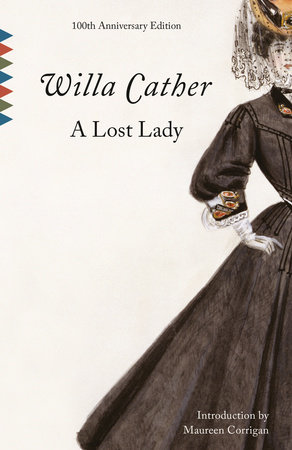
A Lost Lady by Willa Cather

Long, long afterward, when Niel did not know whether Mrs. Forrester were living or dead, if her image flashed into his mind, it came with a brightness of dark eyes, her pale triangular cheeks with long earrings, and her many-coloured laugh. When he was dull, dull and tired of everything, he used to think that if he could hear that long-lost lady laugh again, he could be gay.

Niel is a poor boy, a homesteader's son, when he becomes enchanted with the wife of the railroad magnate Captain Forrester. Beautiful, elegant, educated--and of course, rich--Mrs. Forrester becomes an embodiment of all that is sweet and good about the Nebraska outpost of Sweet Water they both call home. Over years, he becomes more and more attached to the Forresters, lingering behind when his own father gives up on his dreams of farming to study law with the Forresters' patronage. But slowly, Niel's ardor for Ms. Forrester becomes disenchanted, as when, having come from the pond with freshly picked prairie flowers, he hears the caddish Frank Ellinger inside Mrs. Forrester's room. He deduces--correctly--that the two are having an affair, and the realization shatters his beliefs: "This day saw the end of that admiration and loyalty that had been like a bloom on his existence. He could never recapture it. It was gone, like the morning freshness of the flowers."

Time is unkind to the Forresters. Captain Forrester is bankrupted by a failing bank, though we learn that his bankruptcy is partially attributed to the fact that he, in his largesse, backed the many small investors with his own money, essentially giving up his own riches so that hundreds would survive. He suffers a series of strokes, leaving Mrs. Forrester to become his caretaker. Money dwindles, and so does their stature, until Mrs. Forrester is compelled to seek investments with shady criminals without her husband's knowledge. The Forresters--both of them--are a representation of the Great West, settled by men of genius and daring, but which in later generations has fallen prey to vicious speculators:

"Because," he roused himself from his abstraction and looked about the company, "because a thing that is dreamed of in the way I mean, is already an accomplished fact. All our great West has been developed from such dreams; the homesteader's and the prospector's and the contractor's. We dreamed the railroads across the mountains, just as I dreamed my place on the Sweet Water. All these things will be everyday facts to the coming generation, but to us--" Captain Forrester ended with a sort of grunt. Something forbidding had come into his voice, the lonely, defiant note that is so often heard in the voices of old Indians.

This is, in all fairness to wonderful Willa, bullshit. The original homesteaders and railroad-builders of the American West might have had a kind of bravery their successors didn't, but it's not hard to see that Cather is engaged in a kind of active myth-making that papers over the atrocities westward expansion required. Note the subtle association of Captain Forrester with the "old Indians" who no longer recognize their homelands, which steps quietly over the question of where the Indians went, who sent them there, and how the railroads that Forrester himself helped to build were involved. Cather's attempts to taxonomize the different generations of pioneers certainly obscures how the covered wagons opened up the trails that became the railroads, and how the railroads brought the prospectors in. On the other hand, there's no shortage of writers who engage in the mythmaking of America, and few of them are as persuasive or skillful as Cather is. 

Into the vacuum left by the noble pioneers like Captain Forrester rush lawyers like Ivy Peters, the novel's villain. When Niel and Ivy are boys, Ivy shocks Niel by--in a moment as viscerally horrible as anything I have ever read--catching a woodpecker and gouging its eyes out, laughing as it flaps helplessly in painful darkness. The new Nebraska suits Ivy, and he becomes rich, even buying much of the Forresters' land. He turns the beautiful pond into a wheatfield, not merely for the profit, but because it represents something beautiful over which he now has power, and wants to eradicate. Ivy is one of those "who had never dared anything, never risked anything. They would drink up the mirage, dispel the morning freshness, root out the great brooding spirit of freedom, the generous, easy life of the great land-holders. The space, the colour, the princely carelessness of the pioneer they would destroy and cut up into profitable bits, as the match factory splinters the primeval forest." Tragically, it's Ivy to whom Mrs. Forrester turns with her want of money, further disenchanting poor Niel.

It's hard to love A Lost Lady as one loves O Pioneers! or My Antonia. For one, it's focused on the downfall of the very rich, rather than the striving of the very poor. Yet, those books are made for love and admiration; this one is designed to produce mostly revulsion. Thinking back upon those pioneer novels makes me more sympathetic, actually, to A Lost Lady, which wants me to believe that something noble that was born out in the West has been irrevocably lost.

Thursday, July 22, 2021

Dalva by Jim Harrison

What I am trying to do is trade in a dead lover for a live son. I'll throw in a dead father with the dead lover and their souls I have kept in the basement perhaps. The world around me and the world of people looks immense and solid but it is more fragile than lark or pheasant eggs, women eggs, anyone's last heartbeat. I'm a crazy woman. Why didn't I do this long ago? I'm forty-five and there's still a weeping girl in my stomach. I'm still in the arms of dead men--first Father then Duane. I may as well have burned down the goddamned house. Whether I see the son at least he is a living obsession.

Dalva is part-Lakota Sioux, a social worker living in Santa Monica. When she oversteps professional boundaries to protect a young boy from his abusive uncle, she finds herself out of a job and in danger of being targeted by the uncle himself, so she leaves Santa Monica to return to western Nebraska, where she spent her childhood, vowing to finally find the son she put up for adoption when she was only a teenager. Back in Nebraska, she and her current beau Michael--a dipsomaniac historian from Stanford--reconnect with the places and the people of her childhood, and we learn the story of her whirlwind romance with a boy named Duane Stone Horse, who gave her a child, then ran off and committed suicide.

Dalva has a funny three-part structure: the first and third sections are narrated by Dalva herself, but the middle section is narrated by the historian Michael, who has agreed to help Dalva find her son if she will give him access to the papers of her ancestor John Wesley Northridge, a 19th-century pioneer who became a friend to the Lakota and, as a consequence, despised by other white settlers and the U.S. army who took on the task of eradicating the Lakota from the landscape. Michael's narrative quotes heavily from Northridge's journals, which track the pioneer's turn from missionary to apostate, and give an overview of the sad and sorry history of American policy toward Native Americans in the latter half of the 19th century: broken treaties, forced emigration and starvation, bloodshed, etc. These journals contextualize the contemporary lives of characters like Dalva and Duane, who are both part white and part Lakota, though in ways I often found vague. As a narrator, Michael is funny and high-spirited; his scholarly focus is balanced by a wily capacity for ferreting out hidden liquor, and his amorousness gets him into quick trouble in the small Western town.

On the other hand: I read this book bit by bit over a long trip through the part of the country Dalva describes, and the ultimate effect of this structure was to alienate me from Dalva, who is the novel's emotional core. Dalva is a long and rich novel, thick with detail, but perhaps too thick, filled with digressions, literal wanderings to other places: Dalva's uncle's place in the Arizona desert, the Baja peninsula in Mexico, the Florida keys were Duane commits suicide--when all I really wanted was to return to the immediacy and importance of Nebraska. Perhaps this is more about the conditions of my reading than the book itself, but I enjoyed the first section the most, which I read on a long airplane flight and thus could really immerse myself in the thoroughness and vividness of Dalva's life. 

Wednesday, June 17, 2020

O Pioneers! by Willa Cather

Emil stood looking down at her, holding his shoulders stiff and stiffening the arm to which she clung. Her white dress looked gray in the darkness. She seemed like a troubled spirit, like some shadow out of the earth, clinging to him and entreating him to give her peace. Behind her the fireflies were weaving in and out over the wheat. He put his hand on her bent head. "On my honor, Marie, if you will say you love me, I will go away."

She lifted her face to his. "How could I help it? Don't you know?"


Emil was the one who trembled, through all his frame. After he left Marie at her gate, he wandered the fields all night, till morning put out the fireflies and the stars.

I tried to read O Pioneers! several years ago while driving through Nebraska. It opens with the young Alexandra Bergson asking Carl Linstrum to save her brother Emil's cat from where it's climbed up an icy pole. Winter on "the Divide" is a gray and monotonous thing, even for a place that feels monotonous even in the summer, and Cather's prose is grown in that soil: spare, cautious, without adornment. It's beautiful, if you know how to look, but it's not going to tell you how to look. In that way, it's a lot like Nebraska. Anyway, the combination of being in Nebraska and reading about Nebraska in Nebraskan prose was too much for me and I had to put it away.

Reading it now, I'm sorry I let it go too quickly. O Pioneers! is a beautiful love letter to the Nebraska of Cather's youth, and it's a bittersweet counterpart to the (mostly) more optimistic My Antonia. Cather's main characters are all established in that first scene: Alexandra, who is entrusted pages later to keep up the land by her dying father; Carl, a man she loves who ends up leaving Nebraska; Emil, the sensitive young boy who will hopefully be the beneficiary of the prosperity Alexandra promise to her father; and Marie Tovesky, the curly-haired darling who plays with Emil as a child and later marries the moody, tragic Frank Shabata.

O Pioneers! moves across time in fits and starts. We get to see Alexandra fulfill the promise she made to her father, buying up adjacent lots and turning the Bergson homestead into the most successful on the Divide. But prosperity brings change, and ruins her selfish brothers Lou and Oscar, whose masculine entitlement makes them believe they, and not Alexandra, are the ones responsible. Prosperity allows Emil to move to Mexico City to escape his hopeless love for Marie Shabata. And it wreaks changes on the land itself, too, which grows and changes, though something of the pioneer spirit that dominated its early days is a little lost. Alexandra and Emil, who are the novel's twin moral centers, are perhaps the only one with enough perspective to see this, and its bittersweet nature finds expression in the symbol of a wild duck:

Under the overhanging willows of the opposite bank there was an inlet where the water was deeper and flowed so slowly that it seemed to sleep in the sun. In this little bay a single wild duck was swimming and diving and preening her feathers, disporting herself very happily in the flickering light and shade. They sat for a long time, watching the solitary bird take its pleasures. No living thing had ever seemed to Alexandra as beautiful as that wild duck. Emil must have felt about it as she did, for afterward, when they were at home, he used sometimes to say, "Sister, you know our duck down there'--" Alexandra remembered that day as one of the happiest in her life. Years afterward she thought of the duck as still there, swimming and diving all by herself in the sunlight, a kind of enchanted bird that did not know age or change.

My first impressions of O Pioneers! was that it was a lot like My Antonia, though perhaps a little simpler and more pastoral. Alexandra Bergson has the same determination as Antonia, but it's rarely in any opposition to the land, or to the new society that grows up around the homestead; she moves in it more easily and naturally. All that is to say I wasn't prepared for O Pioneers! to end the way it did, with violence and bloodshed breaking into the peaceful nature of the plains. Death is a part of both books for sure, but mostly it comes in the form of illness, exhaustion, or age. As Emil thinks, looking on the grave of a friend, "That, too, was beautiful, that simple doorway into forgetfulness." (What sins I might happily commit to write a sentence like that just once in my life.) In retrospect, that should have been a warning that Emil's attitude is bound to be challenged. I liked Antonia better, but O Pioneers! shocked me, which is something I hadn't really expected from Cather.

Sunday, November 17, 2019

My Antonia by Willa Cather

"Do you know, Antonia, since I've been away, I think of you more often than of any one else in this part of the world.  I'd have liked to have you for a sweetheart, or a wife, or my mother or my sister--anything that a woman can be to a man.  The idea of you is a part of my mind; you influence my likes and dislikes, all my tastes, hundreds of times when I don't realize it.  You really are a part of me."

She turned her bright, believing eyes to me, and the tears came up in them slowly.  "How can it be like that, when you know so many people, and when I've disappointed you so?  Ain't it wonderful, Jim, how much people can mean to each other?..."

Let me say two first things about reading My Antonia: 1.) I meant to read O Pioneers! instead, to complete a trio of books with exclamation points, after Swamplandia! and Gef!.  I forgot that my copy of O Pioneers! fell apart before I could get back to reading it.  2.) I tried to read O Pioneers! years ago, when I was driving through Nebraska, but I could barely get started.  Nebraska was too flat, too long, too featureless; to read about it at the same time was almost overwhelming.  I felt like Jim Burden, the young boy in My Antonia who moves to Nebraska to live with his grandparents, whose first impression of the state is that "[t]he only thing very noticeable about Nebraska was that it was still, all day long, Nebraska."

But I'm glad my attempts to read O Pioneers! fell apart, and I had to resort to my copy of My Antonia instead, because this is one tremendously beautiful book.  The narrator and protagonist is Jim, who grows up out there, first among the fields and farms and then in the town of Black Hawk (I assume this is a version of Cather's hometown of Red Cloud), but the story revolves around Antonia Shimerda, the slightly older Czech girl whose family travels to Nebraska on the same train as Jim.  Jim and Antonia begin their life on the prairie at the exact same moment, and while their experiences are different--Antonia struggles at first under the poverty of the immigrant, while Jim thrives in his grandparent's home--their lives are forever bound up with one another.

My understanding is that Jim is a version of Cather herself: like him, she was born in Virginia, moved to Nebraska as a young child, and although she drifted away to New York and did not return, Nebraska kept its hold on her spirit and imagination.  (There's probably a few good articles about Cather's reimagining herself as a boy, probably with the word queering in the title...)  Cather's prose is so pellucid and striking, as spare as Hemingway's and a clear forerunner of writers like Marilynne Robinson, and she uses it here to fashion some pretty breathtaking descriptions of the prairie:

As I looked about me I felt that the grass was the country, as the water is the sea.  The red of the grass made all the great prairie the color of wine-stains, or of certain seaweeds when they are first washed up.  And there was so much motion in it; the whole country seemed, somehow, to be running.

There's some drama in Antonia's life: she ends up being used and impregnated by a railway conductor who has no intention to marry her, and her life as an adult threatens to be as hard as her life as a child.  But those developments are late in the novel, and it's not really that kind of book.  Like Death Comes for the Archbishop, My Antonia meanders and plods, more interested in providing a full and complex image of life on the prairie than it is conflict or a single narrative thread.  Tragedies, like Antonia's father's death or her jilting and pregnancy, interrupt the story as they do life, but they do seem like interruptions: they're like the immense snake that a young Jim kills in defense of Antonia in the midst of exploring the prairie.

What keeps the narrative together, beyond its terrific evocation of Nebraska, is the relationship between Jim and Antonia.  He teaches her English as a boy, they become friends, and briefly enemies; when he moves to Black Hawk she becomes one of the "country girls" whose companionship isn't quite seen up to his level.  At one point he professes his love for her, but romantic interest is just another passing phase in their relationship.  I was struck by the passage I quoted above, which captures the complexity and breadth of their relationship.  Antonia might have been "a sweetheart, a wife, or my mother or my sister," but any of these labels would impose something on their relationship that might kill or stunt it.  Even the word "friend" isn't quite right: to Jim, she is only "My Antonia."

Thursday, July 3, 2008

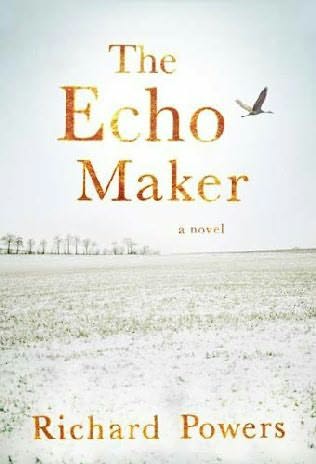
The Echo Maker by Richard Powers

There are some truly remarkable things about Richard Powers' The Echo Maker, a novel about a young Nebraska man named Mark Schluter who is in a horrible car crash and develops a rare psychological condition known as Capgras syndrome, which causes him to believe his sister has been replaced by a high-quality duplicate. Upon this background Powers has free license to wonder aloud about the nature of the self, its messiness, its unity, its mere existence. And his description of the Nebraska marsh even makes it seem mildly pleasant.

But there's a lot of flaws to The Echo Maker I simply couldn't get over: It's long, ponderous beginning, Mark's clumsy blue-collar gratingness, the completely unsatisfying solution to the big mysteries that surround Mark's accident. The Echo Maker seems much better in concept than solution, and while it has a heap of interesting things to say, Powers' attempts at spicing up the plot with intrigue fall surprisingly flat.