Showing posts with label Texas. Show all posts

Thursday, June 6, 2024

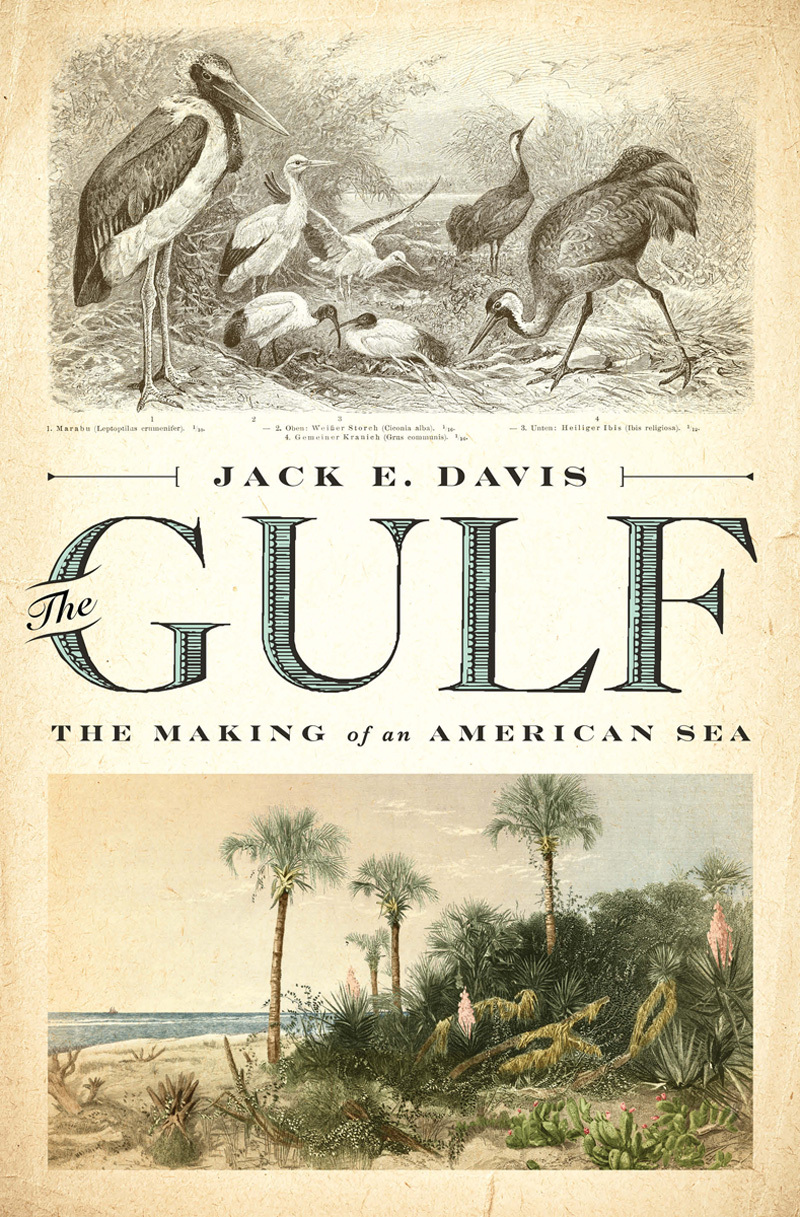
The Gulf: Making of an American Sea by Jack E. Davis

The Gulf's history, as we shall see, is America's history; the energies of one are shared with the other. Our school books taught us that there were thirteen British colonies caught up in the war for American independence, yet in truth there were fifteen: the forgotten two were the Gulf colonies of East Florida and West Florida. The Gulf was on the frontier line that advanced from the original US states, delivered opportunities to Americans and immigrants searching for a better life, and nourished the nation's coming-of-age--doing so not in just western woodland, mountain, and river valley, but on the southern sea itself... With every new train line that reached the coast, every new hotel that opened ,and every new craving for a marketable resource, the region drew closer to the furious pace of change and consumption that possessed the rest of the nation--and then surpassed it. The Gulf had become America's sea.

I've traveled a lot in the United States, but to my mind, the Gulf of Mexico has seemed elusive and inaccessible: the first time I saw it was from the remote western edge of the Everglades, a part of the national park where few venture. Then, I saw it from a small fishing village that seemed intent on disappearing from the map of Louisiana. A third time, just recently, I saw it from Texas' beautiful Padre Island National Seashore. Three times might seem like many, but we're talking a big old gulf here--and many fewer encounters than I've had with the Atlantic or Pacific. The Gulf, Jack E. Davis contends, is rather forgotten, dimmer in the American imagination than either of the great oceans. And yet, it's the Gulf that's truly an "American sea"; though Mexico has nearly as much shoreline on it (and claims the name), the waters of the Gulf emerge almost entirely from the Mississippi, America's river. Its history, he says, is American history, from the birth of European colonization to the modern mega-business of tourism, commercial fishing, and, of course, oil.

What distinguishes The Gulf is the way that Davis brings together various genres and methods: it's a history book, but also a natural science book, and a work of cultural criticism. He begins by describing the arrival of Spanish colonizers and describing their interactions, typically fraught, with local tribes in Florida and Texas. Though the Gulf's shores were the first point of mainland contact for Europeans, the Gulf itself was long forgotten in the making of the American colonial experiment; only in the mid- to late-20th century, Davis says, did the prospect of fishing bring American attention. (Davis describes the Spanish sailors as unable or unwilling to eat the immense bounty of shrimp, oysters, and fish that provided sustenance to the Calusa and Karankawa, even as they ate their own horses and boot leather.) And even then, we learn, it's sport fishing--not commercial fishing--that makes the Gulf, where Americans first learned to hook the tarpon, a massive fish who had eluded anglers for a century.

In each section, Davis relies on the stories of individuals to tell the story of the Gulf. Some, like early settler Leonard Destin (namesake of Destin, Florida) and Key West resident Ernest Hemingway, are familiar, but others are more underheralded figures, like the environmental lawyer working to clear the Gulf of industrial pollution, or the reckless brothers who turned west Florida into a sinking morass of real estate grotesqueries. I was especially stuck by the story of Walter Anderson, an artist I'd never heard of, who basically abandoned his family to live on the remote islands of what are now the Gulf Islands National Seashore, and whose painted shack walls are preserved in a museum in Ocean Springs, Mississippi. Davis never wants the reader to forget that the story of the Gulf is the story not just of birds and sawgrass and oil but the story of people, too.

The Gulf isn't shy about its political and ecological agenda. Perhaps partly because it is so ignored in the American imagination, the Gulf of Mexico is uniquely endangered. The fish are overfished; the birds, even after the early 20th century push to preserve their habitats to keep them safe from plume hunters, are diminishing in number. Oil, of course, is the number one threat, but it's joined by the effects of heavily polluting factories and the effects of eliminating marshland in favor of landfill and sea wall. "We cannot destroy or control the sea," Davis notes, "but we can diminish its gifts, and when we do, we turn away from our providence and diminish ourselves."

Saturday, May 11, 2024

The Last Picture Show by Larry McMurtry

In Thalia sex was just not talked about. Even Genevieve would go to  considerable lengths to keep from calling a spade a spade. Everything acknowledged the existence of sex: babies were born now and then, and things to prevent them were sold at the drugstores and one or two of the filling stations. The men told dirty jokes and talked all the time about how they wished they had more pussy, but it didn't really seem to bother many of them so long as the football team was doing well. The kids were told as little about sex as possible and spent most of their time trying to find out more. The boys speculated a lot among themselves and got the nature of the basic act straight when they were fairly young, but some of the girls were still in the dark about it when they graduated from high school. Many girls simply refused to believe that the things the boys peed out of could have any part in the creation of babies. They knew good and well that God wouldn't have wanted any arrangement of His to be that nasty.

Sonny and Duane are seniors in the (very) small town of Thalia, Texas. Duane is going with Jacy, the most beautiful girl in the school, and plans to marry her, while Sonny secretly pines for her. When Sonny breaks up with his own girlfriend, he finds himself adrift, until the school's coach asks him to drive his wife to a medical appointment. Sonny and Ruth, the coach's wife, find themselves ineluctably drawn together: for Sonny, it's a chance at the kind of real physical intimacy that scarcely belongs to the naive world of high school girls. For Ruth, whose boorish husband prefers the bodies of his male students to hers--a sexuality so secret that he seems not to even recognize it in himself--Sonny offers a chance to be touched, and loved, for the first time. They try to keep it a secret, not very well. Sonny and Ruth's relationship forms the core of The Last Picture Show, and flawed as it is, it may be the only relationship, in either physical or romantic terms, that gives anybody in the sad, lonely town any kind of pleasure at all.

McMurtry's vision of small town America is horribly bleak. Thalia is stultifying and repressive, ruled by a set of social norms that murder pride and pleasure of any kind. The Last Picture Show is, at its heart, a book about the consequences of sexual repression, which manages not to eliminate sex but to transmute it into dangerous, joyless forms. One of the favorite pastimes of the boy of Thalia High School is--unbelievably--to "play around" with local farmers' calves. That's how little romance McMurtry has for small towns--they're full of people who fuck cows. Repression's other consequences are, if not as graphic, even more dispiriting: the boys pay a whore to have sex with a mentally handicapped teen against his will; the deeply closeted coach lashes out of his own misery by having an English teacher fired for being the "queer" he himself really is; Sonny and Duane receive their own sexual initiation among underage, pregnant prostitutes in Mexico. And none of the adults, Sonny's parents or Jacy's, who have spent their whole miserable lives in Thalia have relationships that are anything but curdled.

Among such repression, Jacy, the prettiest girl in school, quickly learns to weaponize her attractiveness, using sex to climb the social ladder, from Duane to a series of wealthy "city boys." (Hilariously, the "city" for these characters is the metropolis of Wichita Falls.) Knowing that Sonny has always held a torch for her, she sets out to wreck his affair with Ruth just because she can. She even goes so far as to suggest eloping, in order to stick it to her parents, who she knows will come to fetch her and have the marriage annulled. She's a moral monster, and yet she is only what small towns like Thalia are designed to produce. She, too, is a victim, young and naive enough to think that her sexuality is a weapon that only she can wield and not one that can be wielded against her, too; she knows enough to see the way that she might manipulate Duane and Sonny but walks into the very same traps when set by men who are richer, older, or more sophisticated.

I really enjoyed Lonesome Dove, but I think The Last Picture Show is the more powerful novel. Lonesome Dove is a true epic, a long book (and part of an even longer series) written over a large map, and though it begins in Texas it encompasses nearly all of the American frontier. The Last Picture Show is a modern vision of the frontier that has shrunk down, where the last few generations cling to a lonely and barren place. Even as Duane gets out of Thalia--by way of the U.S. Army--Sonny never seems able to imagine a life outside of Thalia. The scene where, having graduated, he attends a football game only to discover how outside that world he is, is one of the saddest in a book where all of the scenes are sad. Even the excursions to the outside world--Wichita Falls, Fort Worth, Matamoros, even a senior trip to San Francisco--seem to exist only to confirm how provincial and inescapable Thalia really is. It takes real skill, I think, to craft a book so singularly punishing and bleak that doesn't feel like an exercise in cynicism. But I think The Last Picture Show speaks powerfully against a small-town romanticism that may be even more powerful today than it was when it was written. Sometimes, small towns are just small: in size, in vision, and in virtue.

Thursday, May 2, 2024

Texas: The Great Theft by Carmen Boullosa

It's high noon in Bruneville. Not a cloud in the sky. The sun beats down, piercing the veil of shimmering dust. Eyes droop from the heat. In the Market Square, in front of Cafe Ronsard, Sheriff Shears spits five words at Don Nepomuceno:

"Shut up, you dirty greaser."

He says the words in English.

Last week I spent a few days in Brownsville, a city on the Rio Grande where Texas borders Mexico. Brownsville is one of the most heavily Latino cities in the United States, and it still has a distinctly Mexican feel to it. Across the border lies the city of Matamoros, Brownsville's Mexican "twin." Though we never saw it, we did overlook the border many times, looking for birds. It's hard to stand there and not feel underwhelmed; is this narrow, sluggish, brown river really such a meaningful boundary that it preoccupies our national imagination? A kindly local suggested we try birding at a former golf course on the river "where the illegals cross," though he hastened to add that nothing bad would happen there. Nearby, on an anonymous and scrubby patch of grassland, is where the opening shots of the Mexican-American war rang out. You feel the history, perhaps, but the feeling of the border, the boundary, is elusive.

Mexican writer Carmen Boullosa's book Texas: The Great Theft begins on the American side of the river, in Bruneville, a fictionalized version of Brownsville, in the 1850s. A white sheriff is picking on a Mexican drunk in the town square. When Don Nepomuceno, a wealthy Tejano rancher, objects, the sheriff insults him, calling him a "greaser," a word which will reverberate for miles and miles on both sides of the Rio Grande, and which will ultimately lead to a war between Nepomuceno's forces and the white settlers who resent the claims that the Mexicans, Tejanos, and Indians have on the land. The first quarter or so of the novel follows the news of the sheriff's insult as it passes from mouth to mouth, a process by which it takes in all of the novel's frankly enormous cast of characters: ranchers, vaqueros, gamblers, the bargeman, the innkeeper, the doctor, the mayors of Bruneville and its twin Matasanchez, journalists, spies, bandits, enslaved men, freedmen, Seminoles, Comanches, Germans, children, the keeper of the messenger pigeons, fishermen, and more. Texas has maybe the largest cast of characters per page of any book I've ever read; Boullosa pointedly gives us as wide a view as possible. The sheriff's insult, then, ripples like a stone dropped in the river.

Texas is a highly fictionalized version of a true story; Nepomuceno is a version of the Tejano rancher Juan Nepomuceno Cortina, who lead bands of raiders against the white ranchers in south Texas. I recognized many of the ranchers' names, like Kenedy and Kleberg, who gave their names to south Texas counties, and King, whose namesake ranch is still the largest in the United States, and who inspired the cattle barons of Edna Ferber's novel Giant. Like the Rio Grande, the border between fiction and history is permeable, and who belongs to which is not always discernable. The sheer number of characters gives the novel a kind of breakneck pace, and steers it away from modes that emphasize the interiority or psychology of historical figures. Instead, it gives the history a kind of fable-like quality, a colorful flatness that emphasizes breadth over depth.

It's a story not just about Nepomuceno but all of south Texas, and it's a story about racial violence that comes down squarely on the side of the Mexicans and Tejanos. For them, the border is a boundary placed down to delineate and permit violence and deprivation. The sheriff's insult sets off the war, but the larger context is the white ranchers who have eaten away by subterfuge the lands belonging to Nepumoceno's mother Dona Estefania, and who exert control over Mexicans (and Black people and Indians) by a regime of dispossession and disrespect. Boullosa captures the way that Brownsville/Bruneville, having been founded to mark and watch over the border, represents a kind of diminished and degraded mirror image of its sister city across the border. And I thought it was interesting how Nepomuceno, having been roped into the United States by the machinations of the Anglo ranchers, cannily insists on his claim to American citizenship--though the two cities are emblems of opposition, they exist in a kind of symbiosis that cannot be fully pulled apart or cleanly separated.

Sunday, April 28, 2024

The Gay Place by Billy Lee Brammer

Those names, those occasional faces, were wonderfully reassuring. Life rolled on. There seemed always to be enough names and faces to fill in the gaps where some of the others had left off and deserted. This was reality, the genuine article--it was like stepping down off the stage and moving past the footlights to find an audience of flesh and blood people after all. Silent... vaguely preoccupied... ground under, some of them, by the weight of days--but people live and pumping all the same.

The public life? It was a joke. There seemed no life less public than the politician's. What they had was a fantasy world, populated with kings and priests and brigands and court jesters and camp followers. There was no getting round or out of it. The thing to do was to accept, embrace, believe. Who could be certain whether Miss Alice abandoned reality when she went off down the rabbit hole?

A young state rep from a rural part of Texas is enlisted to help usher in a piece of liberal legislation; a recently appointed U.S. senator must decide whether to run for the seat; the governor's press secretary shepherds him through a weekend on a film shoot as a scandal brews in the capital. All three, protagonists in the novellas that make up Billy Lee Brammer's 1961 political novel The Gay Place, are minor planets orbiting the charismatic governor Arthur Fenstemaker, who was modeled on Brammer's own boss, Lyndon Baines Johnson.

Apparently famously, Brammer's depiction of LBJ as Fenstemaker got him exiled from the governor's good graces. It's difficult, perhaps, in hindsight to see why; many of Fenstemaker's traits cast a kindly light on Johnson. He's both a liberal and a pragmatist, canny and shrewd about what he can and can't accomplish, and uses his know-how and talent to get the most progressive legislation possible in a conservative state. Of course, LBJ was never governor of Texas--when The Gay Place was written, Johnson was still Senate majority leader, and he never held statewide office--but the novel captures some of the capable wheeling and dealing that made him such a powerful politician. In retrospect, one might even say that, in Fenstemaker, LBJ's more vulgarian edges have been sanded down; the Governor never, for example, tries to intimidate anyone by pulling out his enormous penis. But perhaps those elements that do remain in the novel, even admiringly--Fenstemaker's hard drinking, his dalliances with women other than his wife "Sweet Mama" (a stand-in for Lady Bird), his cussing and carousing--might have been too far for a mwn with designs on the White House.

The three novella protagonists struck me as so similar, they might as well be the same person. Neil Christiansen, the senator of "Room Enough to Caper," might be a slightly older version of Roy Sherwood, the rural back-bencher of "The Flea Circus." All three, including the press secretary Jay McGown in "Country Pleasures," are relative nobodies who have been personally plucked out of obscurity by Fenstemaker, who spends much of his time convincing them they possess the value and skill he sees in them. Sometimes they are the objects of his political manipulation, openly or in secret; in "Room Enough to Caper," Fenstemaker leaks the Communist associations of Christiansen's wife and now-dead friend to his possible election opponent, trying to push his chosen candidate into the race. Christianesen, like Sherwood and McGown, is deeply ambivalent about his political ambitions, and suffers from what he feels is a lack of vision. Do politics require vision? Is "vision" what Fenstemaker has, or is it something more earthly and practical? Another thing that binds the three men together is their rocky relationship with women: Sherwood is having an affair with a colleague's wife; Christiansen is half-heartedly trying to rekindle a now-cold marriage; McGown ping-pongs between the sensual movie actress who is the mother of his daughter and the beautiful-but-needy aide he loves. These relationships, in fact, take up most of the men's minds--it's only "Goddamn" Fenstemaker whose prodding brings their attention back to the political life.

I expected The Gay Place to be a satire--perhaps only because LBJ seems like a figure that's ripe for satire. Or perhaps because satire remains the mode by which we typically engage with politics in literature. But The Gay Place, though sometimes funny, is not a satire. It may not even be political. To the extent that it's interested in politics, it offers a snapshot of state politics of a bygone era, in which the halls of power are occupied by the scions of wealthy rural families for whom politics is a hobby, a short-term exercise. They spend less time legislating than they do at the Dearly Beloved Beer Garden (Brammer's version of Austin's legendary Scholz Garden) and having affairs with each other. It's not a place for true believers; there are no true believers, in fact, only wayward souls. I expect that Texas politics, which are increasingly dominated by national news-grabbers and psychopaths like Greg Abbott and Ken Paxton, would be unrecognizable to Brammer. A hint of this future, perhaps, can be seen in "Country Pleasures," where Fenstemaker is happy to be recruited to play an old-time governor in the movie being filmed by McGown's actress wife--a glimpse, perhaps, in which the political life would become not merely a local stage but a national one. A flash of Reagan.

Ultimately, what was most powerful about The Gay Place was its least political aspects. It often reminded me of Walker Percy, with whom it shares a vision of men who are spiritually lost amidst the banal and chauvinist elements of a Southern culture. The title suggests an unfound Eden, the elusive place where true happiness can be found; politics may seem like a way of establishing such a place for all, but these dreams mean little to the men who battle estrangement, alienation, grief, ennui, in the midst of the strangeness of public life. The prose is much better than I expected; if it's not quite Percy, who is, but it captures a poignant disaffection and even makes fascinating use of stream-of-consciousness. If it's a great political novel--as many think--it's because it neither imagines politics as all=encompassing, or incidental. It's a novel that finds the common life between the bedroom and the senate floor, the governor's office and the barroom.

Friday, April 19, 2024

The Dog of the South by Charles Portis

My wife Norma had run off with Guy Dupree and I was waiting around for the credit card billings to come in so I could see where they had gone. I was biding my time. This was October. They had taken my car and my Texaco card and my American Express card. Dupree had also taken from my bedroom closet my good raincoat and a shotgun and perhaps some other articles. It was just like him to pick the .410--a boy's first gun. I suppose he thought it wouldn't kick much, that it would kill or at least rip up the flesh in a satisfying way without making a lot of noise or giving much of a jolt to his sloping monkey shoulder.

Ray Midge is after his wife, who's run off with her first husband, no-good Guy Dupree. Dupree has taken his wife and his credit cards and, what's worse, his beloved Ford Torino, leaving his own beat-up Buick with a hole in the floor. Through his credit card statements, Ray's able to track the pair from Arkansas to Texas and then San Miguel Allende in Texas; from there he learns that they've made for British Honduras, now Belize, where Dupree has a family farm. Ray is joined by a cantankerous old doctor named Reo Symes, trying to make his way to Belize to see his mother. Belize turns out to be a town as ramshackle as they are, and finding Dupree--and Norma--not easy at all, and what's worse, a great hurricane begins to brew.

God, this book is funny. It's as good as everyone says. I'm not even sure what else to say about it, really. I look over the summary above, and it barely seems to capture the madcap energy of the book; it barely seems relevant at all. The Dog of the South is a road trip book, and road trip books, you'd think, have a kind of forward logic, a plottiness like the journey of Ulysses into the underworld--a metaphor that ought to work even better here, given the general downward direction of the beat-up Buick--but the charm of The Dog of the South is the digressions. It's what happens in between the events, which themselves become the core of the novel. Norma is no more important to the novel than the interminable conversation between Ray and Symes about the cheap business grindset pamphleteer Symes thinks is the greatest author of all time, or Symes' mother's pious chiding--Ray, she informs him, is not a name found in the Bible. Half the book seems to be someone telling someone a story about someone else, someone their interlocutor's never met, and Ray, though the straight man of the novel, is no exception. In this way, perhaps, Portis captures something true about the way we talk and the stories we tell, and how little what we say is actually meant to interest or inform anyone else.

In the end, the book is all digression. Norma, Dupree--they're as inconsequential as everything else. We sense early on that the quest will come to naught. That even if Ray is successful in finding his wife and bringing her back home, The Dog of the South is not interested in giving us the catharsis of a showdown, or a tearful reunion, and especially not a moment where the digressions and palaver are all cast away for the "real story." In fact, Ray does find Norma, sick in the Belize hospital and abandoned, and though the moment has its own bittersweet depth, it, too, is deflating, an occasion for a story, though in this case, it's the story--no less shaggy than Ray's--of how she and Dupree ended up in Belize in the first place. (It's there, too, that Ray sees the body of a man he'd recently befriended, a man who had just before been mistakenly placed in Ray's own hotel room, and it's as if this poor unlucky man has wandered into the wrong novel.)

Though The Dog of the South has its moments of profundity and pathos, I think it's impossible to say that it's about much in the hoary old thematic sense. It's funny and frenetic, what might be called a yarn, and maybe one of the best that ever got unspooled. I haven't read True Grit, but it's not hard to see why the Coen Brothers were attracted to Portis' writing; no other book I've read, I think, captures as precisely their particular picaresque sensibility and sense of humor. 

Wednesday, April 17, 2024

The Which Way Tree by Elizabeth Crook

The question come to us then as to whether we was tracking the panther or if, by some unknown hand we was dealt, the panther might be tracking us. I am uneasy to wonder at it even now, and I was sure uneasy at that time. I had seen the size of that panther twice. I had beat its hind end as it gone up the tree after Sam on the night it done in Juda. I had seen the lantern light in its yellow eyes in the goat pen. But the thought of them eyes being on me whilst I slept, and watching me in the dark unawares, was a worse thing to think about than meeting face-on with the creature. It give me a frosty feeling in my soul.

Benjamin Shreve is a young boy living in the Hill Country of Texas during the Civil War. His half-sister, Samantha, is the daughter of his father and his new wife, a formerly enslaved woman named Juda. One day, when Benjamin's father is away, a panther attacks Samantha, leaving her scarred--"cat-marked," as one character later calls it--and kills Juda, who leaps into defend her daughter. Samantha becomes obsessed with tracking and killing the panther, and when it returns years later, she ushers herself and Benjamin into an adventure that will encompass a genteel Mexican horse thief, a kindly preacher, a ragged old panther-hunting dog, and a two-bit criminal named Clarence Hanlin.

The jacket copy of The Which Way Tree compares it to Clinton Portis' picaresques like Dog of the South. I don't know about that, but I'll let you know soon enough. What it reminded me most of, actually, was Huck Finn. The Which Way Tree is narrated by Benjamin as a series of letters to a Texas court judge, who is intent on trying Hanlin in absentia for the murder and robbery of a traveling party. Benjamin knows Hanlin is guilty, and was the last one to see Hanlin alive, and the whole story, which Benjamin tells over the course of several long missives, is, ostensibly, a way to help the judge understand what happened to Hanlin and how. Benjamin's voice is one of the best aspects of the novel. It has a rustic quality, like Huck's, and like Huck an insight belied by the voice's obvious youth. The simplified language of a young teen, steeped in backcountry ways, without a need or capacity for flights of prose, makes the novel brisk and readable.

Benjamin makes allusions to a book he's picked up somewhere called The Whale, one of the few he's ever owned or read, but he claims to have read it cover to cover more than once. The parallels are so obvious, you don't really mind when Crook spells them out: Benjamin's sister Sam is like Ahab, obsessed with bringing down the panther, whom we learn is a legendary mankiller called Demonio de Dos Dedos--the demon of the two toes, an allusion to the bits of the cat that Juda chopped off with her cleaver in saving her daughter's life. The adventure itself could be a little cinematic for my tastes--too much action, too little clarity and insight--but time and again, both Sam and Benjamin must confront the tension between a desire for vengeance and other human needs, like family, kindness, and belonging. Benjamin accuses Sam of being so caught up in bloodlust that she is blind to the way that he has taken care of her since their parents' deaths, and he's right. It's the essential goodness in Benjamin that the judge recognizes over the course of their apparently long correspondence. But vengeance is a hard thing to break free from, and the closer they get to the panther, the more intensely it burns.

Monday, April 15, 2024

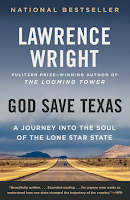
God Save Texas: A Journey Into the Soul of the Lone Star State by Lawrence Wright

I drove back to Austin, under a Turneresque sunset with a gibbous moon rising from a bank of pink clouds. A herd of Black Angus cattle moved like shadows in the places where the buffalo once grazed. I thought about how unintentional most of life is. Part of me had always wanted to leave Texas, but I had never actually gone. Sometimes we are summoned by work or romance to move to another existence, and for me those moments when there is no reasonable alternative to departure have always been joyful, full of a sense of adventure and reinvention. Staying is also a decision, but it feels more like inertia or insecurity. Most of the time I live in a state of vague discontent, tempted by the vision of another life but unwilling to let go of the friends and daily habits that fill my time. When I am in other states or countries, I'm always aware of being in exile from my own culture, with all its outsized liabilities. I wish I lived in the mountains of Montana or on the Spanish Mediterranean. I wish I had a condo in a high-rise overlooking Central Park, with a piano by the window. These thoughts have been at play in my imagination for decades. Now here I was, on a darkening highway in Texas, with so much more road behind me than what lay before.

How hard it must be to write a book about Texas. Alaska may be bigger, but it's relatively unpeopled; to encompass Texas, you'd have to write about Houston's oil booms, Austin's weirdness, tensions on the Rio Grande. You'd have to talk about Dallas and Dealey Plaza, about the great nothingness in the middle, about Big Bend and the far west. Lawrence Wright's essay collection God Save Texas might not be Texas-sized; it's hard not to sense that in its attempts to cover every corner, it's missed some of the true mystery that lies along the way, but it's good enough for an outsider like me. From the first moment, when Wright describes biking along the path between San Antonio's historic Spanish missions, it whetted my whistle for the trip I'm taking next week, where I hope to do exactly that. (Let's hope those predictions of rain are exactly that.)

Wright brings a set of necessary skills to the project: he's a journalist, and much of the novel reads like well-researched journalism, especially the section about Houston that traces the history of the oil boom. Wright clearly has access to the chambers of the statehouse in Austin; he devotes two sections--titled "Making Sausage" and "More Sausage" to the conflicts within the Texas Legislature between moderate and ultra-conservative Republicans, and no one, it seems, is unwilling to talk to him--not even Karl Rove, who pops in for a queasy hello. I could have done with less of this stuff, maybe, because Texas's political scene is the least pleasant thing about the whole state, and I'd rather not think about it. But Wright, writing during the Trump administration, makes a powerful case that Texas is--shudder to think--the crucible of the American political scene. Ironically, given its iconoclasm, Wright suggests that Texas is at the forefront of American politics, and what we see there is soon to be what we see everywhere. It's hard to say he's wrong about that.

But Wright is a playwright, too, and much more pleasant are the sections where he uses his more writerly gifts to extol the state's grandeur and beauty. I loved the section about far west Texas, a severe desert where modern artists like Donald Judd found a landscape that could match the pure shape and color of their innovations. Chapters like "Borderlands" and "The High Lonesome," the latter ostensibly about the mid-Texas landscape that birthed musical icons like Buddy Holly, manage to capture in words something of Texas's sheer, mind-altering scale.

Wright, a Texan by birth, writes about returning to his ancestral land after sojourns in New York, Atlanta, Tennessee, and even as far away as Egypt. It's beautiful and difficult, I think, to return to the place whence you came, like the spiral returning; it has an air of backwardness, or perhaps of the final stages of something. But I find it easy, actually, to imagine that returning to Texas feels like home.

Saturday, October 14, 2023

A Manual for Cleaning Women by Lucia Berlin

At first, when a voice on the intercom would say, "Nurse! Quick!" I'd ask, "What's the matter?" That took too much time; besides, nine times out of ten it's just that the color's off on the TV.

The only ones I pay attention to are the ones who can't talk. The light comes on and I push down the button. Silence. Obviously they have something to say. Usually something is the matter, like a full colostomy bag. That's one of the only other things I know for sure now. People are fascinated by their colostomy bags. Not just the demented or senile patients who actually play with them but everyone who has one is inevitable awed by the visibility of the process. What if our bodies were transparent, like a washing machine window? How wondrous to watch ourselves. Joggers would jog even harder, blood pumping away. Lovers would love more. God damn! Look at that old semen go! Diets would improve--kiwi fruit and strawberries, borscht and sour cream.

Must an incredible writer lead an incredible life? No, surely not, given how much of it takes place in a small room in front of a keyboard. But there are writers like Lucia Berlin who make you wonder otherwise: born in Alaska, having grown up in a series of mining camps from Idaho to Chile, working as a nurse or cleaning woman in El Paso or Mexico City, overcoming the ravages of alcoholism. These experiences make their way into the stories that make up the collection A Manual for Cleaning Women, though Berlin's stand-in is only sometimes labeled as Lucia--sometimes she is an analog named Carlotta--along with a number of repeating motifs that were surely drawn from real life: a sister, reconnected with only after her terminal cancer diagnosis, a sexy fling with a Mexican deep sea diver, a bitter, witty mother with her many "suicides." In the hands of Berlin the writer, these experiences are transmuted into vignettes that are blackly funny and deeply touching.

The comparisons are already there in the introduction: there's Grace Paley, whose stories of Jewish New York have a freewheeling, riotous nature that's mirrored in Berlin's. (It's a bad comparison, because it can only diminish Berlin a little, given that no American short story writer ever really reached the heights of Paley's best work.) I thought of Joy Williams, perhaps because I'm always thinking of Joy Williams, or maybe because Berlin's downtrodden but spirited desert dwellers seem as if they could come right out of Williams' Arizona

What sets Berlin's stories apart, I think is their structural boldness and looseness. Look close at the spaces between the paragraphs, which often have no connecting tissue whatsoever; they jump from idea to idea in a way that obscures the structural inventiveness and circuitousness of the stories. The title story might be the best example of this, which weaves together the narrator's descriptions of her clients with the route of a Berkeley bus, labeled by stop, and bits of guidance for other cleaning women. It's a story that seems like it's doing too much, but at length the story that binds the thread together emerges: grieving the death of a friend, the narrator is stockpiling sleeping pills from her clients with which to commit suicide. ("Ter," she addresses the dead toward the end, "I don't want to die at all, actually.")

A Manual for Cleaning Women collects over 40 of Berlin's stories. There's something a little unjust about putting so many in one place; inevitably, the awe wears off and the seams in some of the stories begin to show. I felt that the stories in which Berlin tries to take on the voice of a first person narrator who's not her own analog--as she does with the high-flying lawyer in "Let Me See You Smile"--were the weakest. But there are far fewer missteps than triumphs: the abortive Mexican abortion of "Tiger Bites," the hilarious account of a dowdy woman who sets off to have a post-menopausal affair in "A Love Affair," the joyous account of little Lucia's first child love with a mischievous mining camp boy in "Temps Perdu." A mad comic energy enlivens most of the collection's best stories, but Berlin's relentless focus on the poor and the working class, especially in the barrios of Mexico and around El Paso, means that some of the powerful are not funny at all: never again will I want to read "Mijito," the story of how poverty and neglect lead to the death of an infant child, despite the best intentions of the doctors and nurses at the free clinic. Elsewhere, Berlin describes the life of the true alcoholic, shaking with withdrawal, who wonders if they'll even be able to live before the first liquor store opens at five in the morning.

Berlin's endings are special: they always seem to flip the story on its head, or at least wrench it a little out of place. They do what's nearly impossible to do: seem both surprisingly and entirely logical. Sometimes they are little stories in themselves, moving from laughter to tears and back again:

Sally and I write rebuses to each other so she doesn't hurt her lung talking. Rebus is where you draw pictures instead of words or letters. Violence, for example, is a viola and some ants. Sucks in somebody drinking through a straw. We laugh, quietly, in her room, drawing. Actually, love is not a mystery for me anymore. Max calls and says hello. I tell him that my sister will be dead soon. How are you? he asks.

Wednesday, April 12, 2023

10:04 by Ben Lerner

I'd been hard on Whitman during my residency, hard on his impossible dream, but standing there with Creeley after my long day and ridiculous night, looking at the ghost of ghost lights, we made, if not a pact, a kind of peace. Say that it was standing there that I decided to replace the book I'd proposed with the book you're reading now, a work that, like a poem, is neither fiction, nor nonfiction, but a flickering between them; I resolved to dilate my story not into a novel about literary fraudulence, about fabricating the past, but into an actual present alive with multiple futures.

Adam, Ben Lerner's stand-in (who also appears as a teenage debater in The Topeka School), begins 10:04 by discovering that he has a possible dissection in his heart that may kill him. The specter of death, both certain and uncertain, hangs behind the other dilemmas of his life that are, if not smaller, of obviously less permanent import. Existential questions have a way of doing that. When not worrying about the secret machinations of his body, Adam is a budding writer who has had a successful story in the New Yorker, and his attempts to think through an expansion of the story into a novel are squeezed by the pressure of a successful follow-up. At the same time, his best friend Alex has decided she wants to have a child, and wants Adam to provide the sperm sample.

First, about that: though Alex is clear that Adam can be a involved with "the child" as he wishes, the arrangement suggests a newfangled, perhaps diminished, version of the nuclear family. Which is fine, because the nuclear family hasn't proved to be all that helpful recently. Adam's feelings about the "donation" are complicated by the threat of his sudden death, and the need for legacy-leaving, as well as his own latent romantic feelings for Alex. Though what's offered to Adam isn't quite "fatherhood" in a familiar sense, the novel offers several childlike stand-ins for him to practice upon: Roberto, the elementary school-aged child Ben helps to research and write a book about dinosaurs; a young intern in Marfa, Texas who does too much cocaine and who needs safekeeping; Calvin, an advisee in Adam's poetry program who mistakes his own mental breakdown for poetic inspiration. In each of these cases, Adam is only moderately successful as a father figure, though never a failure, and the partial quality of each relationship seems like a trial run for the possibility of having a child with Alex.

How much of this is "real?" The dinosaur book, charmingly reproduced here, is actually the work of Elias Garcia, a kid Lerner really did mentor, but we are told that in all other ways "Roberto" is a fictional creation. Likewise, the New Yorker story is real, and we tend to believe Ben/Adam when he says that the book in our hands is the product itself, though if Ben is not quite Adam and Adam is not quite Ben, it's puzzling to wonder how the two of them ended up creating the same book. Lerner really is one of the very best at the sort of "autofiction" that dominates the literary consciousness today (see, for example, Annie Ernaux's recent Nobel Prize), because the lines between the real and the fictional are so blurred, and because the blurring of the lines becomes the actual subject of the novel. That sounds tedious, maybe, but Lerner does it so well.

We get to see several versions of "Adam": the fictionalized version, for example, that becomes the writer character of the story, and we see Alex's resentment when she sees that something she's said has become fodder for Adam's fictional life. But these are only layers beneath which an inaccessible "real" Lerner also lies. He calls it a "flickering" between fiction and nonfiction, and the comparison to poetry, I think, is the key to much of Lerner's work. But I also see a metaphor of threads which are tied together, both fictional and nonfictional, and which resemble what I see as the key strength of Lerner's prose: the ability to combine vastly different threads--Superstorm Sandy, modern art, fossils, whatever--into something that works without forcing.

Maybe I've got DeLillo on the brain because we're reading White Noise in my junior class, but I see a lot of him in 10:04: The (real-ish) Institute of Totaled Art, which displays masterpieces whose damage makes them unsellable, seems right out of one of DeLillo's consumerist critiques. And the dissection that lives within Adam like a time bomb seems to me a novel revision of White Noise's Jack Gladney, who must live with the statistical certainty of his own death after the "Airborne Toxic Event." (Side note: the punning between "Marfan Syndrome," which Adam's doctors suggest he may have, and the residency he takes up in Marfa, Texas is so under-played to be almost unnoticeable. If Lerner hit that note any harder the book would tip over into parody, but he pitches it just right.) Like DeLillo, Lerner seems to me one of the few novelists with something really convincing to say about "the way we live now." The hyper-contemporary details, like the scene during Superstorm Sandy, or Occupy Wall Street, which would seem desperately faddish in another author are convincing here. The unconventional possibilities of Adam's life begin to seem like a way forward into a new world, leaving behind the forms which led us into the kind of crisis that hangs, like Marfan Syndrome or an aortic dissection, over everything.

Tuesday, July 5, 2022

Lonesome Dove by Larry McMurtry

Life was finally starting, Newt thought. Here he was below the border, about to run off a huge horse herd, and in a few days or weeks he would be going up the trail to a place he had barely even heard of. Most of the cowpokes who went north from Lonesome Dove just went to Kansas and thought that was far--but Montana must be twice as far. He couldn't imagine what such a place would look like. Jake had said it had buffalo and mountains, two things he had never seen, and snow, the hardest thing of all to imagine.

Okay, first of all: Three-fourths of Lonesome Dove doesn't even take place in the town of Lonesome Dove on the Texas-Mexico border. The whole point of the massive novel is leaving Lonesome Dove. Two aging Texas Rangers, garrulous Gus McCrae and stern Woodrow McCall, decide to give up their livery stable, which has led to a too-easy life, to lead a final cattle drive all the way from Texas to the Montana, arriving in the rich grasslands with their thousands-strong herd before other homesteaders and ranchers get there for them. Along for the ride are a motley crew of cowpokes: young Newt, who hasn't figured yet out figured out that he's Call's illegitimate son; Deets, the black tracker of preternatural skill; Jake Spoon, an unreliable gambler and womanizer; Lorena, a former prostitute in Lonesome Dove who sees Jake as her ticket to a better life in San Francisco; Dish Boggett, a talented cattle driver who is madly in love with Lorena. The story of these cattle drivers intersects with others: the Arkansas sheriff and his deputy who are looking to hang Jake Spoon, the sheriff's wife, who absconds with a group of rough-and-tumble buffalo hunters, and Gus' old flame Clara, long since settled on the Platte with her now-disabled husband.

Gus is the central character of Lonesome Dove. He's a skilled ranger and lawman, but he prefers to talk, and his incessant joking and chattering is the bane of his laconic partner, McCall. In fact, Gus gives the first couple hundred pages of Lonesome Dove, the part where the "outfit" is making plans for their cattle drive, a kind of broad comic quality that make the sudden death of a young Irish cowboy by a nest of water moccasins even more unsettling. It took me a long time to adjust my expectations for the novel; the juxtaposition of its comic tone and the brutality of the trail felt to sour to me, at times. The nadir of this, for me, was the introduction of a mysterious and barefoot young girl, with almost feral outdoor skills, who takes up with the hapless deputy Roscoe and who is--spoiler alert--almost immediately killed off in the most brutal manner, and not alone. But as the novel goes on, Gus' humor begins to seem more like a reasonable response to a life filled with unpredictable cruelty. The Irishman, the girl, are buried, and the cattle drive moves on.

Lonesome Dove seems, in many ways, like the quintessential western. For one, it's truly epic: 850 pages long and covering several thousand miles, as well as a couple dozen different character viewpoints. It's a snapshot of the American West at a moment when it seems empty, Native Americans driven back, the buffalo thinned out to near-extinction, but before the great droves of settler wagons and cattle drives that Call and McCrae know are coming. Sometimes, the Western tropes are a little too strong. I didn't like the depiction of Blue Duck, the unusually vicious Comanche outlaw who kidnaps Lorena and sells her to a group of Indians and Comancheros to be beaten and raped. Though Lonesome Dove makes some gestures toward ambivalence about Native Americans--Gus is supposed to have a more compassionate demeanor toward them than many of his peers--but Blue Duck seems like a monster straight out of American myth, the kind that has long been used to justify genocide and displacement. And I was troubled by the character of Lorena, too, who is headstrong at first, and who becomes terrified and helpless after her ordeal. Vicious Native Americans, helpless damsels.

But ultimately, I was engrossed by the vividness of the characters, and the sweep of the novel's great drama. The novel gets stronger, I think, the farther the outfit goes, and the wider its scope becomes. It's sort of a marvel, actually, that the novel doesn't falter as it brings in the Arkansas sheriff, July Johnson, or the story of Gus' old love Clara, a headstrong woman who has lost two children and whose husband now has been rendered braindead by the kick of a horse. But the novel is something like Gus and Call themselves: stifled by the lazy, talk-heavy life of a Lonesome Dove horse trader, and needing the great open space of the West in order to thrive. By the time the cattle drive arrives in Montana, it has become a legend in its own right, but the costs have been great: lives lost, men buried in unmarked graves in impossible to find places. Every real Western needs to have a measure of ambivalence about the West, and this is Lonesome Dove's. Has it been worth it, to reach Montana? Is the myth worth the men it leaves behind?

Tuesday, January 12, 2021

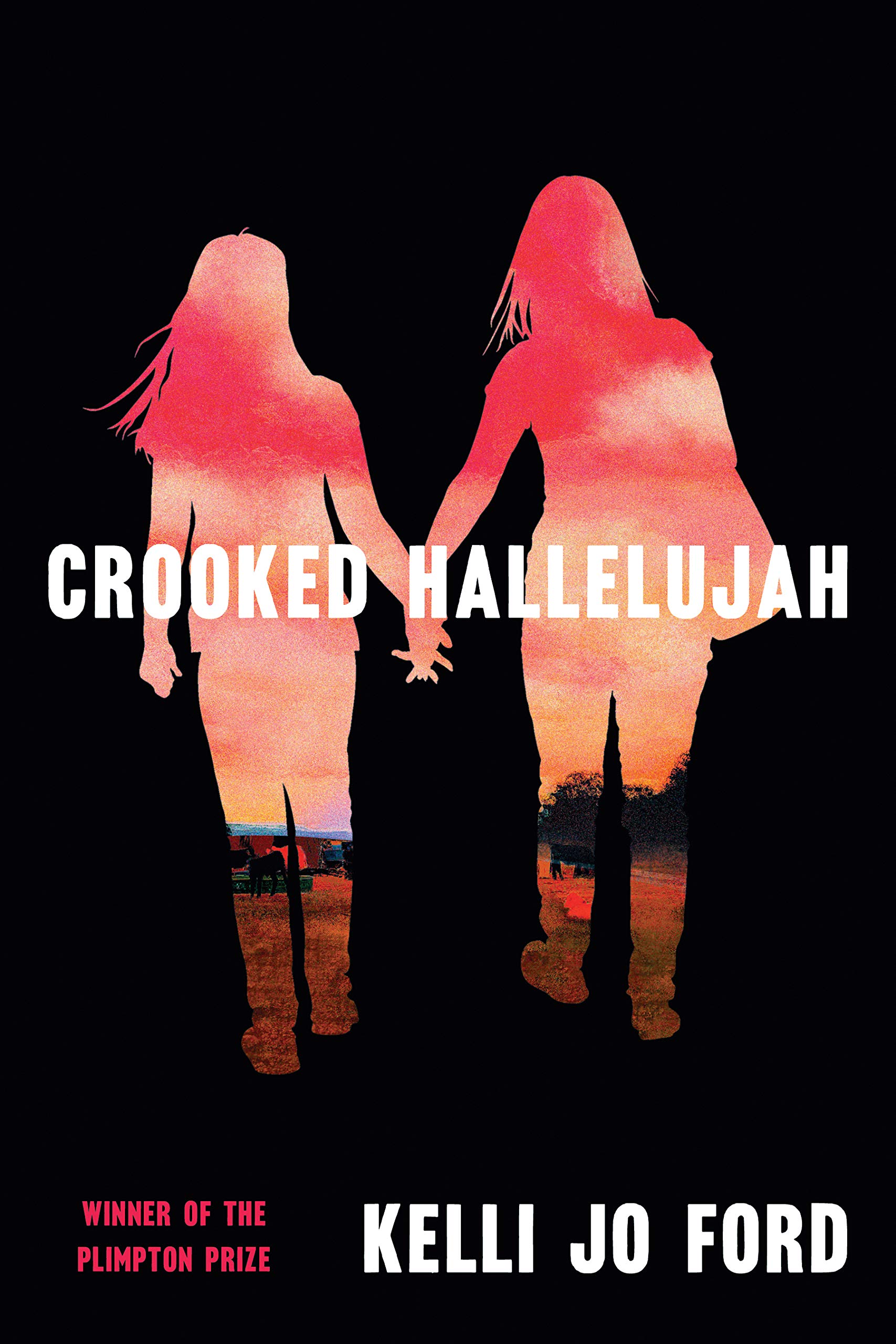
Crooked Hallelujah by Kelli Jo Ford

Granny held tightly to the roof outside the rolled-down window and muttered something in Cherokee that Justine couldn't understand. Lula's shouting only goaded John Joseph. He pressed the car faster up the big hill into town. The wind whipped in the windows, and Justine forgot for a minute what would happen when they got home and the real questions and the crying bean. She couldn't know how in a few months she'd be flooded with a crippling love for another human being that would wound he for the rest of her days, how her insides would be wiped clean, burdened, and saved by a kid who'd come kicking into this world with Justine's own blue eyes, a full head of black hair, and lips Justine would swear looked just like a rosebud. For now, that little car filled with three--almost four--generations flew. And when they dropped over the top of the hill, Justine threw her hands up, her mouth agape in wonder.

Justine lives in the Sequoyah Hills of Oklahoma with her mother Lula, a fanatic Pentecostal, and her grandmother, who keeps the old ways of her Cherokee upbringing alive. She's not allowed to bare her arms or legs, but that doesn't keep her from being victimized--it never does, does it--when she's raped by an older Choctaw man at the age of fifteen. Her daughter Reney grows up ping-ponging across the Red River between the oil-scarred fields of North Texas where Justine's cowboy husband Pitch lives, and Oklahoma's Indian Country, where--I'm sorry, but it's a cursed phrase to type--four generations of powerful women reside over one roof.

That's selling Crooked Hallelujah short: it's never glib, but I found it often stepped right up to the edge of cloying. To its credit, the novel is attentive to the ways that Lula's Holiness Church traumatizes Justine and Reney in turn, even as it holds that the power of love between mothers and daughters is sacrosanct. I was interested in the way charismatic Christianity colors the dynamic between these women, for good and bad, and veils in some way the connection to the Cherokee heritage represented by the aging Granny. A healthy respect for the ways of the heartland is at the heart of the novel, and not just the ranchers, cowboys, and oilhands: several key scenes take place at a Dairy Queen, and everyone seems to constantly be drinking Dr. Pepper.

But mostly I found Crooked Hallelujah to be too scattered to really enjoy: third-person narratives are interrupted by first-person ones, and I had a hard time telling Justine and Reney in these sections, and even sometimes Lula. But I absolutely did not want to be distracted by the first-person narratives of ancillary characters, even when, like Pitch's callous, aging father, they provide some of the novel's more challenging and interesting moments. I couldn't stand the section from the point of view of Justine's neighbor, a wayward young man who loses his mother before becoming fast friends with a lesbian couple who move in down the street. What's that about?

An even more baffling choice--although perhaps the best choice in the novel--comes at the end, when the novel suddenly becomes a work of dystopian fiction. The hyperrealism, the sentimentalism, give way to a vision of ecological collapse: the oil fields of North Texas where an older Justine is still living are beset by earthquakes, fires, horde of locusts. These things have their foreshadowing in more mundane catastrophes--a tornado and a brushfire--in the book's earlier chapters, but nothing prepared me for the final chapter, in which Reney and her new husband must decide whether to force Justine to leave her home, which has become the epicenter of the End of Days. Is it a testament to the power of love to overcome everything? No, it deserves more credit than that. But it does open up, at the last available moment, a possibility for what the novel might have been, a possibility I think I might have liked more.

Tuesday, July 14, 2020

Pale Horse, Pale Rider by Katherine Anne Porter

Granite walls, whirpools, stars are things. None of them is death, nor the image of it. Death is death, said Miranda, and for the dead it has no attributes. Silenced she sank easily through deeps under deeps of darkness until she lay like a stone at the farthest bottom of life, knowing herself to be blind, deaf, speechless, no longer aware of the members of her own body, entirely withdrawn from all human concerns, yet alive with a particular lucidity and coherence; all notions of the mind, the reasonable inquires of doubt, all ties of blood and the desires of the heart, dissolved and fell away from her, and there remained of her only a minute fiercely burning particle of being that knew itself alone, that relied on nothing beyond itself for its strength; not susceptible to any appeal or inducement, being itself composed entirely of one single motive, the stubborn will to live. This fiery motionless particle set itself unaided to resist destruction, to survive and to be in its own madness of being, motiveless and planless beyond that one essential end. Trust me, the hard unwinking angry point of light said. Trust me. I stay.

In the title novella of Pale Horse, Pale Rider, Miranda is a young small-town journalist who's sick of World War I. Suited thugs show up at her newsroom to berate her for being the only one there not to buy Liberty Bonds; before the third act of a play (she's a theater critic), the entire cast sings propaganda songs about the Hun in front of an oversized flag. But more importantly, she's recently begun to see Adam, who is about to enter the army, and the certainty of Adam's violent death casts a pall over everything. Their relationship, too young to turn to sentimentality, takes on a heedless and ironic cast; it becomes a long mordant joke.

But the real enemy in "Pale Horse, Pale Rider" isn't the war: it's the Spanish Flu. Miranda feels constantly "off," a sensation that's enmeshed with her expectation of doom for herself and Adam, but it's not just existential; she really is sick. When the flu begins to ravage her, Adam takes care of her, but she recedes into a foggy world of sickness. This extended scene, in which Porter captures the associative, illogical, luminous feeling of sickness, is some really bravura writing; just look at the passage quoted above. Sickness pares away everything: work, love, even the self, or the things that we believe are the self, leaving behind the "hard unwinking angry point of life" that is ourselves unmediated. When she comes out of the fog, Miranda learns that Adam has died of the flu while at base camp, though it seems almost certain that she's the one that gave it to him.

What's it like to read "Pale Horse, Pale Rider" in a pandemic? Unlike The Plague, where the doctor stands at arm's length from the psyche of the sick, it gives the reader a persuasive sense of what it really must be like to be badly sick. I haven't read anything like it. But there's something recognizable, too, in the way that the whole world around Miranda is so wrapped up in war that there is no time or thought for sickness. Our social order is arranged to conquer enemies with guns, by ostracism, hate, militarism, but it doesn't know what to do with an inhuman virus. That--and not just incompetence--is behind the phrase "Kung Flu." If we can turn the virus into a foreign threat, we think we might know how to deal with it, by building walls and dropping bombs. We're ready to make the sacrifice of war but we have no idea how to be like Adam, and sacrifice ourselves for the care of others. "Pale Horse, Pale Rider" made me feel despair to see how little things have changed.

The title story of Pale Horse, Pale Rider is actually the last of three combined novellas, and the best. The other two are "Old Mortality," a story (also about Miranda, though not in any important way) about two girls in a genteel Texas family who learn to deconstruct the romantic myths of their family, a legend about their doomed cousin Amy and her husband Gabriel who shot a man in a duel for her honor. The middle one, "Noon Wine," is about a laconic Norwegian farmhand who comes to work on a small Texas farm and stays for years before a visitor comes to find him, claiming he's an insane murderer on the loose. What drives that story is actually the guilt of the farmer, who kills the bounty hunter because he fears for the life of the farmhand.

The novellas of Pale Horse, Pale Rider are death-haunted. In "Old Mortality," the stories that grow up around death must be punctured to see it plainly for what it is. In "Noon Wine," Porter's interested in the way that guilt over a man's death, because of its finality, can never really be assuaged or divested. In "Pale Horse," Miranda imagines in a dream that the pale rider of Revelation follows her to the stables, where he saddles a pale horse of his own and follows her down the bridle path. You can't outrun it, Porter seems to say--but you might not recognize it when it arrives.

Wednesday, April 22, 2020

Giant by Edna Ferber

Bigger.  Biggest ranch.  Biggest steer.  Biggest houses.  Biggest hat.  Biggest state.  A mania for bigness.  What littleness did it hide?...

So the big men strode the streets, red of face, shirt-sleeved, determined.  Their kind had sprung from the Iowa farms, the barren New England fields, from Tennessee.  Their ancestors had found the land too big, too lonely, it had filled them with a nameless fear and a sense of apartness, so they set out to conquer it and the people whose land it was.  And these, too, they must overcome, and keep conquered, they were a constant menace, they kept surging back to it.  All right, let them work for us, let them work for a quarter a day till the work is done, then kick them back across the border where they belong.

Jordan "Bick" Benedict is in charge of Reata Ranch, one of the biggest cattle ranching operations in the entire state of Texas.  The ranch spans across millions and millions of acres, surrounding whole towns, and employing thousands, from the skilled vaqueros and ranch hands to the nameless Mexican laborers who live in dirt-poor shacks.  It's a big operation in the biggest state, and Bick's dreams are only to make it bigger and better.  Into this unique American landscape arrives his new Virginian bride, Leslie, for whom Texas is a strange and foreign country that seems intent on keeping her at arm's length.  She reads books, she walks the ranch--a strange concept to those who live there and traverse it on horses or automobiles--but she despairs that she'll ever truly be a "Texian."

Man, I needed a book like this right now.  I enjoyed the tricksy experimentalism of Bearheart and Event Factory, but you just kind of skate over the surface of books like those, which are sometimes nothing but surface.  I really needed a big, thorough realist book to help distract me from the isolation we're all dealing with at the moment.  Giant is a book like that, an exemplar of a certain kind of mid-century social realism with few tricks up its sleeve.  But like Texas, Giant's realism is a bigger, more heightened type, and it veers often to a satisfying, soapy melodrama, like an episode of Dallas.  This is a book, after all, with a character with the ridiculous name "Jett Rink"--the cantankerous drunken ranch hand who swears one day he'll be a millionaire, and then he'll get revenge on the Benedicts for the way he treated them.  (This is the James Dean role from the movie.)  It's also a book where Bick's imperious sister Luz is thrown and--spoiler alert--killed by a racehorse brought by Leslie from Virginia named My Mistake.  ("How terribly strange and terrible," Leslie thinks, "that it should have been My Mistake.")  It can be gloriously silly.

Leslie, Bick, and the other characters of the book never stop talking about Texas.  They talk about the Alamo, they talk about Santa Ana, they talk about Bowie, they talk about the Davis Mountains in the west and the Panhandle in the north and the Gulf of Mexico--somehow, Reata seems to touch all of these.  Ferber clearly is in love with the bigness and strangeness of Texas as Bick, but Leslie's appearance injects a much-needed cynical eye into the ranch: it's Leslie who insists on visiting the Mexican ranchers' shacks, despite Bick's injunction; it's Leslie who sticks her nose in the shady politics that Bick uses to keep the county commissioners on his side.  This is never clearer than when Leslie, visiting Bick's uncle in the "Western" division, discovers a migrant hiding in a shed, fresh from the Rio Grande.  Bick's uncle feeds the boy and lets him go, but Bick, he says, would have transported him back over the river himself.

Giant is a book that revels in some of our national myths at the same time that it punctures them.  Bick's operation relies not just on the spirit of Texas but the underpaid labor of thousands, and "that's the way it is in Texas" is not enough for Leslie, or for Ferber.  National myths, I guess, tend to cover up a lot of hard labor and suffering.  Ferber also does a great job of depicting a Texas on the verge of great change: oil has arrived to replace the ranchers, and it's the malicious Jett Rink, of course, who's in position to capitalize.  Can Bick survive a changing Texas?  Is the idea of Texas--static, bigger than life--a lie worth preserving?  Everything's bigger in Texas, but, as Leslie puts it, "what littleness does it hide?"

Thursday, October 4, 2018

Cities of the Plain by Cormac McCarthy

The wind outside and the cold in the room were like those winter nights on the north Texas plains when he was a child in his grandfathers house.  When the storms blew down from the north and the prairie land about the house stood white in the sudden lightning and the house shook in the thunderclaps.  On just such nights and just such morning in the year he'd gotten his first colt he'd wrap himself in his blanket and go out and cross to the barn, leaning into the wind, the first drops of rain slapping at him hard as pebbles, moving down the long barn bay like some shrouded refugee among the sudden slats of light that stood staccato out of the parted board walls, moving through those serried and electric prosceniums where they flared white and fugitive across the barn row on row until he reached the stall where the little horse stood waiting and unlatched the door and sat in the straw with his arms around its neck till it stopped trembling.

In the third book of Cormac McCarthy's "Border Trilogy," John Grady Cole, the protagonist of All the Pretty Horses, and Billy Parham, the protagonist of The Crossing, are working as cowboys at a ranch outside Alamogordo.  It's a crossover episode!  Both men, isolated and long-suffering as they are, like being cowboys.  But it's a life that might not be long for this world; the federal government wants to turn the land they graze on into a military installation (today's White Sands Missile Range, probably).  In the middle of the century, cowboys are a dying breed.  One character, I forget who, remarks that the war changed everything.

It's not clear how the war changed cowboying, but it does remind me of the terrific ending of--which?--I think The Crossing, with its reference to the Trinity nuclear bomb test.  And it aligns with McCarthy's notions of history, all of which he believes was written at the beginning of time, down to the life and death of a single man.  For McCarthy, the arc of history is the same as entropy, it bends toward destruction and chaos.

The end is hastened by John Grady's falling in love with a Mexican prostitute.  Their love poses its difficulties: she's fifteen, but that's nothing compared to the fact that she lives over the border in Juarez and is kept by a madman pimp who is also in love with her.  Oh, and she has epilepsy, but she hasn't told John Grady that.  It all unfolds in a recognizably violent fashion, remarkably recorded but with very few surprises.

At one point, Billy says:"I damn sure dont know what Mexico.  I think it's in your head.  Mexico."  Which of course, is true.  Both Billy and John Grady, despite fluent Spanish and extensive experience in the country to their south, understand Mexico as a kind of reflection of their own inner darkness.  That's because McCarthy thinks about it as a reflection of their own inner darkness as well.  Going to Mexico, especially in The Crossing, is something like the descent into hell in Greek epics.  It's easy to excuse the way McCarthy exoticizes Mexico because he does that to America too, in a different way.  After all, it's under a Texas overpass that the long epilogue takes place, in which an aged Billy meets a wise beggar who tells him about a mysterious dream.

I can accommodate that, but did I need another Mexican waif to fall in love with?  I certainly didn't need her to be fifteen years old.  Her age, her illness, all add up to extreme vulnerability and powerlessness, mark her for violence and death, make her the center of male rage, whether Eduardo's in keeping her or John Grady's in defending her.  Her relationship with John Grady seems borrowed from his love for Alejandra in All the Pretty Horses, but with more mythology and more blood.  In McCarthy's books, tragedy repeats itself as even darker tragedy.

The most well-wrought relationships in Cities of the Plain are between men.  Between John Grady and Billy, outcasts and pilgrims who end up finding each other, and the other cowboys, who are mostly of the same stock.  McCarthy has an ear for their language that sits in lovely tension alongside the mythopoetic gibberish he likes so much.  (I don't mean that as an insult--I like that stuff, even when it's gibberish.)  His belief in an irrevocable destiny, as violent as it is, ennobles these plainspoken cowboys.

Saturday, November 12, 2016

All the Pretty Horses by Cormac McCarthy

The old man shaped his mouth how to answer.  Finally he said that among men there was no such communion as among horses and the notion that men can be understood at all was probably an illusion.  Rawlins asked him in bad spanish if there was a heaven for horses but he shook his head and said that a horse had no need of heaven.  Finally John Grady asked him if it were not true that should all horses vanish from the face of the earth the soul of the horse would not also perish for there would be nothing out of which to replenish it but the old man said that it was pointless to speak of there being no horses in the world for God would not permit such a thing.

John Grady Cole is a sixteen year old rancher, living and working on his grandfather's ranch is all that he's ever known.  When his grandfather dies, leaving the ranch to his mother, who insists on selling it, he is unmoored, alienated from his former life, and sets out with his friend Lacey Rawlins across the Mexican border looking for work and a new life.  They are accompanied by a young stranger, calling himself Jimmy Blevins--probably a fake name, taken from a popular radio show host--who seems to be another runaway, but who is more anxious and immature than John Grady and Rawlins, and less capable.

The Mexican landscape these men--boys, really--explore is beautifully and carefully portrayed by McCarthy.  It's a mysterious, unfamiliar land, only a day's ride from their Texas home but culturally and spiritually distant.  It offers luxury and satisfaction, as on the hacienda where John Grady finds work as an expert in horses, but also the threat of violence and death.  Like in all of McCarthy's works, these twin evils are part of the unknowable, unchanging nature of the universe:

In history there are no control groups.  There is no one to tell us what might have been.  We weep over the might have been, but there is no might have been.  There never was.  It is supposed to be true that those who do not know history are condemned to repeat it.  I don't believe knowing can save us.  What is constant in history is greed and foolishness and a love of blood and this is a thing that even God--who knows all that can be known--seems powerless to change.

(How's that for a reflection on the week of Trump's election?)  And yet All the Pretty Horses is, surprisingly for McCarthy, a conventional kind of love story.  John Grady falls in love with the beautiful Alejandra, the daughter of the rich haciendado who employs him.  They can't be together, of course, and McCarthy's paratactic style, like the love child of Ernest Hemingway and Raymond Carver, is surprisingly well-suited to capturing the bittersweetness of this well-worn story:

They stood on the platform and she put her face against his shoulder and he spoke to her but she did not answer.  The train came huffing in from the south and stood steaming and shuddering with the coach windows curving away down the track like great dominoes smoldering in the dark and he could not but compare this arrival to that one twenty-four hours ago and she touched the silver chain at her throat and turned away and bent to pick up the suitcase and then leaned and kissed him one last time her face all wet and then she was gone.  He watched her go as if he himself were in some dream.  All along the platform families and lovers were greeting one another.  He saw a man with a little girl in his arms and he whirled her around and she was laughing and when she saw his face she stopped laughing.  He did not see how he could stand there until the train pulled out but stand he did and when it was gone he turned and walked back out into the street.

In fact, McCarthy's idiosyncratic style--which is perfectly attuned, here, to the numbness of loss--struggles sometimes with the sturm und drang of his moral philosophy.  Sometimes, he reaches too far, and ends up sounding silly, like a parody of himself:

The browsing horses jerked their heads up.  It was no sound they'd ever heard before.  In the gray twilight those retchings seemed to echo like the calls of some rude provisional species loosed upon that waste.  Something imperfect and malformed lodged in the heart of being.  A thing smirking deep in the eyes of grace itself like a gorgon in an autumn pool.

A Gorgon in an Autumn Pool--the new album by Necromancer, in stores Friday.

But McCarthy is more versatile than he gets credit for.  The arguments between Rawlins and Jimmy Blevins, whose childishness is written with glee, are funny and charming.  Elsewhere, as in the long stretch where John Grady must navigate the dangers of a Mexican prison, or a character's assassination at the hands of rural police, McCarthy is as chilling and unsettling as his reputation suggests.  Mostly, All the Pretty Horses succeeds because, unlike the apocalyptic dreamscapes of Blood Meridian and The Road, it's a small, believable, human story.

Saturday, January 7, 2012

Empire of the Summer Moon by S.C. Gwynne

Subtitled: "Quanah Parker and the Rise and Fall of the Comanches, the most Powerful Indian Tribe in American History." This was an extremely riveting account of a very significant period in American history that I knew basically nothing about. Am I the only one?

Pre-colonization, the Comanche tribe was living what Gwynne calls a stone-age existence, scratching out their survival mostly by foraging, falling victim to neighboring tribes with more complex culture, technology and religious rites. Post-colonization, as the invading Spanish managed to lose entire herds of horses to the wilderness, they transformed themselves with fierce determination into an unrivaled force, building their warrior culture around their almost superhuman skill on horseback.

Boys were given their first horse at age two or three, and within a few years were expected to perform small tricks, like picking up an object from the ground while riding. This little trick gets progressively more challenging until adulthood, at which point they could approach a fallen comrade, pick him up, and put him on the back of their horse without breaking stride. They were known to drop to the side of their horses when passing an enemy, with just one heel hooked over the back of the animal, and could release between ten and twenty arrows from beneath its neck before their opponent could reload their cumbersome ball and powder guns. This incredible discipline allowed them to master the art of mounted warfare apparently better than anyone before or since, and stop the advancing line of settlement in western Texas for over 150 years, at times even reversing it.
A large portion of the book is devoted to extremely graphic descriptions of the kind of brutality the Comanche inflicted on their enemies, rival tribes and white settlers alike. The mutilation, rape and murder of white settlers by Comanche bands was widely published (and often exaggerated) in Texas, drumming up anti-Indian sentiment to a fever pitch. Gwynne's timeline of the different militia groups and federal dispatches that tried and failed to solve the "Indian problem" gets muddled and confusing (how many unsuccessful military engagements am I supposed to keep track of?), but engaging nonetheless. He presents the Texas Rangers as a filthy, ragtag band of bloodthirsty adventure-seeking young men who proved the most successful opponent to the Comanches until the federal military managed to subdue them completely in the late 19th century (SPOILER ALERT).

Quanah Parker starts as something of a side story that Gwynne keeps returning to, and eventually takes center stage as the leader of one of the last free bands of Comanches that managed to resist the reservation, the Quahadis. His story is emblematic of the American west at the time: his mother, captured by a Comanche war band at age 9, was adopted into the tribe as an equal. She married a minor war chief, had two sons, and was forcibly returned to white society after her band was attacked by General So-and-so's latest expedition. She spent the rest of her life trying to return to them. Quanah went on to rally the remaining Comanche bands to form a resistance movement that managed to route the federals for a while but, surprisingly, surrendered when he realized it was hopeless. He went on to become a strong proponent of his tribe's assimilation, becoming the first principal chief of the Comanche tribe.

I'm rambling, but it's hard to know where to stop. The entire book is completely engaging, and manages to stay relatively impartial throughout. I don't know if I expected this going into it, but there's no clear picture of who held the moral high ground throughout, and Gwynne gives as much attention to the bloodlust and brutality of the Comanches as he does to the groups of settlers who would strike down Comanche women and children on revenge raids. There are moments of tenderness and humanity on both sides, and the clearest picture I can take away from such a complex history is that these were two cultures doing everything they could to preserve their ultimately irreconcilable ways of life.


Monday, April 23, 2007

Vernon God Little by DBC Pierre

Jesus Navarro was born with six fingers on each hand, and that wasn't the most different thing about him. It's what took him though, in the very, very end. He didn't expect to die Tuesday; they found him wearing silk panties. Now girls' underwear is a major focus of the investigation, go figure. His ole man says the cops planted them on him. Like, 'Lingirie Squad! Freeze!' I don't fucken think so.

Why do people find Vernon God Little difficult to finish? In an informal survey, the BBC found that more than a third of Britons put this book down before they've finished it. It isn't a particularly dense or boring book, like fellow Booker Prize winner The Line of Beauty, and it's not particularly long, like the second least-finished book, Harry Potter and the Goblet of Fire. Maybe it's because VGL is so distasteful--you see, it's about a school shooting in the small town of Martirio, Texas by an abused Mexican boy named Jesus Navarro. Jesus' best friend in the world is Vernon Gregory Little, a typical white Texan boy who feels trapped by the insanity of small-town living. When Jesus goes on a rampage and ultimately kills himself, the town and the country turn to Vernon, the killer's only friend, as a scapegoat for the murder, trying him as an accessory. But it's a delicate subject that Pierre treats with a sledgehammer.

I planned on reading this book before what happened at Virginia Tech a week ago, but those events pushed it to the front of my reading list. But VGL isn't necessarily about the shooting, which occurs before the action of the novel, but the later reaction, which is dark, hilarious, obscene, scatalogical, and terrifying. It's full of vain, fat proto-American characters who are always coming from or going to the local Bar-B-Chew Barn, overcome by their own idiocy and shallowness. Vernon's mother never really seems convinced of Vernon's innocence, though she tells him tritely while waiting for her new fridge to arrive, "Even murderers have mothers who love them." No wonder Vernon feels he has to escape to Mexico. It is tempting to scorn Pierre, who was born in Australia, lived in Mexico during his youth, and currently lives in Ireland, for satirizing Americans so ruthlessly, but his satire falls embarrassingly near the mark.

It's a punishing read psychologically, but it has a certain poignancy given the media frenzy over the identity of Cho Seung-Hui. The plot of VGL is driven by a similar media frenzy that whips up over Vernon: Every murder that occurs in the state of Texas during the time he's on the run is attributed to him. A power-hungry would-be reporter cashes in on his affair with Vernon's mother and buys the rights to televise his trial--and possibly his execution. Reading it, I couldn't help but think about the decision of NBC to televise the video manifesto made by Cho, and the outpouring of disgust at that over copycat concerns. This book was written four years ago, but it seems even more relevant now, if you can get over its general tastelessness.

Side note: I don't know why I've read so many more Booker Prize books than Pulitzer Prize books. (The Booker Prize is the analogous prize for Britain or former members of the British commonwealth, minus America.) But the Pulitzer Prize was recently awarded to The Road, so it's not like I'm some weird Anglophile or something.