Showing posts with label Mexico. Show all posts

Monday, July 6, 2026

House of Rain by Craig Childs

I turned off my light in the back of the cave. I closed my eyes. It felt as if all these centuries, these thousands of years, were contained here, their processions playing out again and again as drips strummed the pool beside me. The same routes are traveled repeatedly, the same meridians followed across horizons, over hundreds of years. Anasazi, I thought, was never a people. It was a rhythm, a form of motion stirred up from the land. People merely fell into step.

I got to return to Mesa Verde National Park last week and tour two more of the enormous cliff dwellings built nine hundred years ago directly into the rock. They are impressive places, made up of turrets and geometric stacks of rooms and huge circular underground kivas. It's hard not to think what the first white Americans, cattle ranchers, thought when they encountered them for the first time: how could somebody build something like this and then just abandon it? The "disappearance" of Ancestral Puebloans, previously known as the Anasazi, has been compelling narrative for a long time, a puzzle to be solved. Craig Childs, in House of Rain, travels through major and minor Puebloan sites throughout the southwest and Mexico, seeking an answer to just that question.

Among other things, House of Rain is a travelogue, and some of the most impressive passages involve Childs moving across the high, dry landscape of the Four Corners area on foot, sometimes with his wife and infant son in tow. He skillfully and poetically describes the beauty of this area, which is among my favorite places in the world. So in that sense it was like comfort food to me. And I appreciated hearing descriptions of some of these Puebloan sites I'll never see; tucked away in the corners of deep canyons, undisturbed in the way those first ranchers must have seen them. You can see how much more uncomfortable Childs is at, say, Aztec Ruins, a site run by the National Park Service in the backyard of a suburb of Farmington, New Mexico. Better to pass into these regions of quietude, where the intervening years can disappear and the past reappear in the form of a broken wall, a husk of corn, a potsherd.

So what happened to the Ancestral Puebloans? As Child notes, though a little begrudgingly, the mystery is not much of a mystery at all: they migrated, probably because of an intense drought in the high country of the Four Corners. Childs puts some specifics to this that I found highly interesting: his conclusion, based on the introduction of new kinds of polychromatic pottery in the lower regions of Arizona, is that the Puebloan culture migrated to the south, mingling with Hohokam and Mogollon cultures that were already there to create the culture now known by archaeologists as the Salado. It's Childs' contention, actually, that tensions between the new elements of this multicultural society resulted in the collapse of that society, leading the Pueblo peoples to splinter into the groups that now make up the two-dozen-odd Pueblos of the Rio Grande Valley, as well as the Hopi. But Childs throws his lot in with some more outre conclusions as well, like a revisionist theory that Puebloans migrated north from Chaco Canyon to Mesa Verde and then south again along the same meridian to a location in Mexico known as Paquime (or today as Casas Grandes), which other archeologists consider more closely related to the Aztec cultures of Mexico to the south. In any case, Childs favors a version of the Puebloans that emphasizes their grandeur, claiming for them a larger sphere of influence than many of his peers.

House of Rain is only twenty years old, but it wears its age. The term Anasazi, a rude exonym that comes from the Navajo, has been entirely supplanted by "Ancestral Puebloan." And while Childs undercuts the question Where did they go, my understanding is that nobody accepts this any longer as a framework from which to begin--something which perhaps Childs should be given credit for. But my biggest frustration with House of Rain is how it keeps modern Pueblo peoples at arm's length. They appear infrequently, and often in ways that stymie Childs' research, as with a council of elders that refuses to give Childs permission to conduct research. Childs paints this as a typical reservedness, but then again, he's the one who uses the word Anasazi around them, knowing it's offensive, but catching himself too late. Childs folds in some of the stories and legends of modern-day Puebloans that support the narrative of migration, but I noticed that these stories always tend to begin "a Hopi man once told me," while the researchers have names. At a dig, Childs notes the frustration of an archeologist who is forced to stop digging when human remains are found--a key stipulation of the Native American Grave Protection and Repatriation Act--and, in way that felt telling to me, lets that frustration pass by without comment.

All of these are minor missteps, perhaps, but they add up to a sense that Childs is most interested in the version of the Ancestral Puebloans that live in his imagination, and keeps the modern-day Puebloans and Hopi who might shine light on them at arm's length because they might complicate that imagination. Which is all just to say that I think House of Rain would be stronger if it had found a way to engage more deeply with them. That said, in the end, I really enjoyed deepening my understanding of the people of Mesa Verde this way, and I was persuaded by Childs' invitation to see them not as a static society that suddenly "collapsed," but a living, moving culture passing through several stages of development over centuries: a rhythm, a form of motion.

Wednesday, February 26, 2025

Paradais by Fernanda Melchor

Polo never told fatboy anything during their drinking sessions; he never shared what he really thought of him or his ridiculous fantasies about Señora Marian, at least not in the beginning, during their first meetings down by the dock, when fatboy would get hammered and spend hours telling Polo whatever filthy shit went through his head, sparing no details and without a hint of embarrassment: about the porn he watched and how many times a day he masturbated, or the things he'd do to Señora Marian when he finally got his hands on her, by whatever means necessary, while Polo just nodded and chuckled along and shiftily downed three quarters of the bottle of rum that fatboy had paid for, humoring the fat prick but never opening his mouth unless it was to drink from his plastic cup or exhale his cigarette smoke up into the sky to chase away the mosquitoes that swarmed in vertiginous clouds above their heads, occasionally nodding to give fatboy the impression that he was listening to him, that he "got" him, and that he wasn't just there for the handouts, right?

Polo works as a groundskeeper for a luxury condominium in Progreso, a seaside town on Mexico's Yucatan Peninsula. He lives across the lagoon--supposedly haunted by the ghost of a sinister doña--with his mother and cousin Zorayda, who tortures him with sexual aggressions. The only friend he's ever had, his cousin Milton, has recently left, recruited against his will into the schemes of the cartel. In a long reported story, Milton tells Polo the gruesome ordeal of his own kidnapping, and of being forced to murder at the cartel's bidding, and yet Polo can only see the story as offering a kind of escape from the dreariness and poverty of his own life. At Paradais, he befriends Franco, the filthy-minded son of a wealthier family, though secretly Polo despises him and thinks of him as "fatboy." Franco/Fatboy is obsessed with Señora Marian, an elegant neighbor, and is constantly describing his own lurid fantasies of kidnapping and rape. Between the two of them--the desperate Polo and the sinister Franco--the fantasies inch closer and closer to becoming a real plan.

Paradais is the story of how a terrible crime comes about. Polo and Franco are quite different, both in temperament and status, and yet they both become invested in realizing Franco's bloody, predatory fantasies. Franco could never be a point-of-view character; he's poisoned by his relative affluence to the point of desensitization. We get the sense that life is not much different to him than a video game, or a video on the pornography websites he spends most of his time on. It's harder to understand, on the other hand, why Polo participates. He hates Franco, and despises his fantasies, and yet they come to represent for him a lashing out against the forces that have conspired to place in in poverty and immobility: his cruel mother, his lascivious cousin, his abandonment by Milton, his tyrannical boss, and especially the moneyed residents of Paradais, whose freedom over their own lives Polo recognizes as something he can never have. Polo is a teenager, and we can see easily that his desperation and resentment are stronger than the reasoning centers of his brain. Yet, beyond the misfortune of his station, Melchor does very little to make him an appealing or sympathetic character. There's no heart of gold here, just nastiness and despair.

Paradais is a dispiriting read. It's bleak, it's seedy, it's sordid. It makes you feel like taking a shower. You pray that something will happen to derail the horrible denouement, but it never does--that would be too literary, too easy. It's effective in its portrayal of the anger and resentment produced in those who think they have no escape from their own poverty, or the simple tedium of a life without the benefits of wealth. And yet I felt at the end of it that it hadn't quite justified, or found something revelatory, in its own sheer ugliness. I finished reading it in the emergency room, and boy, that felt bad. But you can't say it doesn't do exactly what it wants to do, as unremittingly awful as that might be.

Thursday, May 2, 2024

Texas: The Great Theft by Carmen Boullosa

It's high noon in Bruneville. Not a cloud in the sky. The sun beats down, piercing the veil of shimmering dust. Eyes droop from the heat. In the Market Square, in front of Cafe Ronsard, Sheriff Shears spits five words at Don Nepomuceno:

"Shut up, you dirty greaser."

He says the words in English.

Last week I spent a few days in Brownsville, a city on the Rio Grande where Texas borders Mexico. Brownsville is one of the most heavily Latino cities in the United States, and it still has a distinctly Mexican feel to it. Across the border lies the city of Matamoros, Brownsville's Mexican "twin." Though we never saw it, we did overlook the border many times, looking for birds. It's hard to stand there and not feel underwhelmed; is this narrow, sluggish, brown river really such a meaningful boundary that it preoccupies our national imagination? A kindly local suggested we try birding at a former golf course on the river "where the illegals cross," though he hastened to add that nothing bad would happen there. Nearby, on an anonymous and scrubby patch of grassland, is where the opening shots of the Mexican-American war rang out. You feel the history, perhaps, but the feeling of the border, the boundary, is elusive.

Mexican writer Carmen Boullosa's book Texas: The Great Theft begins on the American side of the river, in Bruneville, a fictionalized version of Brownsville, in the 1850s. A white sheriff is picking on a Mexican drunk in the town square. When Don Nepomuceno, a wealthy Tejano rancher, objects, the sheriff insults him, calling him a "greaser," a word which will reverberate for miles and miles on both sides of the Rio Grande, and which will ultimately lead to a war between Nepomuceno's forces and the white settlers who resent the claims that the Mexicans, Tejanos, and Indians have on the land. The first quarter or so of the novel follows the news of the sheriff's insult as it passes from mouth to mouth, a process by which it takes in all of the novel's frankly enormous cast of characters: ranchers, vaqueros, gamblers, the bargeman, the innkeeper, the doctor, the mayors of Bruneville and its twin Matasanchez, journalists, spies, bandits, enslaved men, freedmen, Seminoles, Comanches, Germans, children, the keeper of the messenger pigeons, fishermen, and more. Texas has maybe the largest cast of characters per page of any book I've ever read; Boullosa pointedly gives us as wide a view as possible. The sheriff's insult, then, ripples like a stone dropped in the river.

Texas is a highly fictionalized version of a true story; Nepomuceno is a version of the Tejano rancher Juan Nepomuceno Cortina, who lead bands of raiders against the white ranchers in south Texas. I recognized many of the ranchers' names, like Kenedy and Kleberg, who gave their names to south Texas counties, and King, whose namesake ranch is still the largest in the United States, and who inspired the cattle barons of Edna Ferber's novel Giant. Like the Rio Grande, the border between fiction and history is permeable, and who belongs to which is not always discernable. The sheer number of characters gives the novel a kind of breakneck pace, and steers it away from modes that emphasize the interiority or psychology of historical figures. Instead, it gives the history a kind of fable-like quality, a colorful flatness that emphasizes breadth over depth.

It's a story not just about Nepomuceno but all of south Texas, and it's a story about racial violence that comes down squarely on the side of the Mexicans and Tejanos. For them, the border is a boundary placed down to delineate and permit violence and deprivation. The sheriff's insult sets off the war, but the larger context is the white ranchers who have eaten away by subterfuge the lands belonging to Nepumoceno's mother Dona Estefania, and who exert control over Mexicans (and Black people and Indians) by a regime of dispossession and disrespect. Boullosa captures the way that Brownsville/Bruneville, having been founded to mark and watch over the border, represents a kind of diminished and degraded mirror image of its sister city across the border. And I thought it was interesting how Nepomuceno, having been roped into the United States by the machinations of the Anglo ranchers, cannily insists on his claim to American citizenship--though the two cities are emblems of opposition, they exist in a kind of symbiosis that cannot be fully pulled apart or cleanly separated.

Friday, April 19, 2024

The Dog of the South by Charles Portis

My wife Norma had run off with Guy Dupree and I was waiting around for the credit card billings to come in so I could see where they had gone. I was biding my time. This was October. They had taken my car and my Texaco card and my American Express card. Dupree had also taken from my bedroom closet my good raincoat and a shotgun and perhaps some other articles. It was just like him to pick the .410--a boy's first gun. I suppose he thought it wouldn't kick much, that it would kill or at least rip up the flesh in a satisfying way without making a lot of noise or giving much of a jolt to his sloping monkey shoulder.

Ray Midge is after his wife, who's run off with her first husband, no-good Guy Dupree. Dupree has taken his wife and his credit cards and, what's worse, his beloved Ford Torino, leaving his own beat-up Buick with a hole in the floor. Through his credit card statements, Ray's able to track the pair from Arkansas to Texas and then San Miguel Allende in Texas; from there he learns that they've made for British Honduras, now Belize, where Dupree has a family farm. Ray is joined by a cantankerous old doctor named Reo Symes, trying to make his way to Belize to see his mother. Belize turns out to be a town as ramshackle as they are, and finding Dupree--and Norma--not easy at all, and what's worse, a great hurricane begins to brew.

God, this book is funny. It's as good as everyone says. I'm not even sure what else to say about it, really. I look over the summary above, and it barely seems to capture the madcap energy of the book; it barely seems relevant at all. The Dog of the South is a road trip book, and road trip books, you'd think, have a kind of forward logic, a plottiness like the journey of Ulysses into the underworld--a metaphor that ought to work even better here, given the general downward direction of the beat-up Buick--but the charm of The Dog of the South is the digressions. It's what happens in between the events, which themselves become the core of the novel. Norma is no more important to the novel than the interminable conversation between Ray and Symes about the cheap business grindset pamphleteer Symes thinks is the greatest author of all time, or Symes' mother's pious chiding--Ray, she informs him, is not a name found in the Bible. Half the book seems to be someone telling someone a story about someone else, someone their interlocutor's never met, and Ray, though the straight man of the novel, is no exception. In this way, perhaps, Portis captures something true about the way we talk and the stories we tell, and how little what we say is actually meant to interest or inform anyone else.

In the end, the book is all digression. Norma, Dupree--they're as inconsequential as everything else. We sense early on that the quest will come to naught. That even if Ray is successful in finding his wife and bringing her back home, The Dog of the South is not interested in giving us the catharsis of a showdown, or a tearful reunion, and especially not a moment where the digressions and palaver are all cast away for the "real story." In fact, Ray does find Norma, sick in the Belize hospital and abandoned, and though the moment has its own bittersweet depth, it, too, is deflating, an occasion for a story, though in this case, it's the story--no less shaggy than Ray's--of how she and Dupree ended up in Belize in the first place. (It's there, too, that Ray sees the body of a man he'd recently befriended, a man who had just before been mistakenly placed in Ray's own hotel room, and it's as if this poor unlucky man has wandered into the wrong novel.)

Though The Dog of the South has its moments of profundity and pathos, I think it's impossible to say that it's about much in the hoary old thematic sense. It's funny and frenetic, what might be called a yarn, and maybe one of the best that ever got unspooled. I haven't read True Grit, but it's not hard to see why the Coen Brothers were attracted to Portis' writing; no other book I've read, I think, captures as precisely their particular picaresque sensibility and sense of humor. 

Sunday, March 10, 2024

You Dreamed of Empires by Alvaro Enrigue

Where Tenoxtitlan had been there was now a Spanish city: palaces, churches, convents. There was a nun who was purest light, who also dreamed, and who, though she spoke Spanish, at mole and pipian and papalo and nogada. It was a huge coutnry: ravines, mountains, deserts, jungles. But it was a country of purest suffering too. The macehualtin uprisings, the slave ships, the priests fighting under the banner of Guadalupe, a republic fractured yet worthy in its way. The fucking gringos; a Zapotec tlatoani who won a war with France. Books, wars, universities, cities with many more people than anyone could ever have imagined; another tlatoani, a Mixtec--everybody was Oaxacan--and Eufemio Zapata walking through Moctezuma's palace dressed like a Spaniard; another republic that rose the best it could; and another hundred years and this book and you reading it and it was then that Hernando woke up.

It's the year 1519. Spanish conquistador Hernando Cortes has been invited into the city of Tenoxtitlan by Moctezuma, but the emperor has made himself scarce. Instead, Cortes dines with the city's priests, with the princess who is both Moctezuma's sister and his wife, with his own generals, with his Maya translator, Malinalli. He schemes and plots, knowing his allies the Tlaxcala are stationed just outside the city. But with Moctezuma absent, the killing blow will have to wait.

Alvaro Enrigue's rendition of Moctezuma is, perhaps, the most interesting thing about his new novel You Dreamed of Empires. At first glance, it seems that his Moctezuma shares many of the flaws that have been assigned to him through history: his superstition, his indolence and indifference, his weakness. He seems to be overly dependent on psychedelic drugs; while Cortes is making his plots, Moctezuma is getting high on mushrooms and refusing to forego his daily nap. Enrigue's Moctezuma is obsessed with the conquistadors, these strange men from far across the ocean, but mostly he is obsessed with their cahuayos, their large deer--their caballos, their horses--which have eaten up one of the palace's interior gardens. Is this another kind of superstitious predilection, or is it evidence that Moctezuma, who recognizes the strategic promise of the cahuayos, is cannier than he is letting on? Does he, in fact, have a plan to foil the conquistadors who are only pretending to be good guests?

I had the good fortune to see Enrigue speak about this novel at the New York Public Library a month or so ago. He is all charm, with the dashing long-haired look of an older novelist, buttressed by a tremendous bank of knowledge and a gregarious laugh. It's easy to read You Dreamed of Empires, which is at times chummy and chatty, in his voice. The novel begins with a conquistador, Caldera, nearly nauseated by the smell of the human skin cloak he must wear while dining with the priests. This is a novel, we see, about cultural clashes, about two groups who must look past the unfamiliarity of their respective cultures to understand each other, to see one another's capacities for friendship, or malice. Enrigue emphasizes the clash with a pointedly anachronistic style, full of cliches and over-familiar phrases that stand out as strange purely through context. In one scene, which much interested his interviewer, Moctezuma overhears a snatch of spectral music that "he couldn't place, though in a possible future we would have recognized it. It was T. Rex's 'Monolith.'" I myself didn't find these qualities of the novel all that successful, but when I imagined Enrigue reading them aloud in his own voice, I felt more disposed to them.

I wanted to like You Dreamed of Empires a little better than I did. I was sort of interested in its lack of forward motion. Both the Mexica and the Caxilteca--a cutesy Nahautl-ism formed from the Spaniards' Kingdom of Castile--spend most of the novel sort of milling around and figuring out what to do; the strangeness of the context almost seems to paralyze them. In one scene, Cortes' generals get totally and utterly lost in Moctezuma's palace, which is labyrinthine in its orderliness and repetitiveness. I was a little lost as to what was happening with the literal "palace intrigue." But I did admire the boldness of the novel's final scenes, in which--spoiler alert--Moctezuma, finally face to face with Cortes, offers him a lick of a psychedelic cactus. The lick sends Cortes into a hallucinatory dream, in which he sees the future of Mexico after the Spanish conquest--but then he wakes up, and is killed. That's right, Enrigue pulls a Tarantino on us. But it works, especially because of the unsettling suggestion that we, too, are part of the dream. One day, You Dream of Empires suggests, we may all wake up from history.

Saturday, March 9, 2024

Cross Stitch by Jazmina Barrera

My grandmother always used a thimble. She was taught to embroider by her aunt in the small Yucatan town where she grew up but didn't discover thimbles until she moved to Merida. She thought they were marvelous and used to say that sewing machines, washing machines, and thimbles had changed her life. I never found thimbles comfortable to wear, but there was a period when I spent so much time embroidering that I got calluses on my fingertips, and if I pricked myself, the needle would never go deep enough to draw blood. Citlali would give a nervous giggle when I'd ask her to prick me to demonstrate the quality of my calluses. Remembering her laughter makes me want to laugh too, but I stop myself so as not to wake my daughter, who's sleeping in the next room while I embroider her name on the backpack she needs for her first day at nursery school. Laughter has to be one of the hardest things in the world to hold back, almost harder than tears.

Mila, the narrator of Jazmina Barrera's Cross Stitch, receives terrible news: Citlali, her old friend from high school, has drowned off the coast of Senegal. Mila arranges for the reception and disposal of Citlali's ashes with a ceremonial gathering of her friends, but the painful loss brings back a rush of memories, divided into what you might call--appropriately, given the novel's title and central motifs--two threads. First, the high school friendship between Citlali, Mila, and beautiful, much-desired Dalia. Second, a college trip to London and Paris, in which Mila and Dalia go looking for Citlali, whom they worry is in distress. When they find her in Paris, the three have the first adult adventure of their lives, but their worries are not misplaced, as Citlali shows repeated signs of an eating disorder. Though her later death in Senegal seems accidental, the trip seems to foreshadow their friend's ultimate disintegration--perhaps, unraveling.

I was really charmed by Jazmina Barrera's On Lighthouses, a mix of memoir, autofiction, and non-fiction essay. I found it both thoughtful and scrupulous, drawing on an impressive number of historical, geographic, and fictional sources on the subject of lighthouses. Cross Stitch, though more pointedly fictional, is a little like that, too: interspersed with--I guess I have to say woven, right?--the main narrative are many brief snippets about embroidery and sewing. Like On Lighthouses, the sources are innumerable and diverse. Barrera draws from Mayan cultural practices, modern feminist artists like Louise Bourgeois and Leticia Parente, medical textbooks, and fiction novels like Jane Eyre and my beloved Prime of Miss Jean Brodie.

In one way, these pieces speak to the embroidery pursuits of the three girls, who bond over it, but in a symbolic way, they suggest an image of life as something woven together. The fabrics of life, perhaps, are threaded together from the lives of others. It's a cheesy way of putting it, but perhaps one point is that, though a thread may be cut, it reminds part of the larger fabric, where it intersects with other lives, other memories. Citlali remains woven in the fabric of the narrator's life. Nor is it lost that sewing and stitching are, in medical and garment contexts, a kind of healing that knits broken things together. It's a testament to Barrera's skill and the novel's thoughtfulness and gentleness that the book is not cheesy. The symbol, which might otherwise seem hackneyed or cliche--after all, the image of life as a thread goes back to the ancient Greeks--is renewed and invigorated by the essay portions of the novel. 

Saturday, February 3, 2024

Two Books About the Aztecs: Fifth Sun by Camilla Townsend and The Mexican Dream by J. M. G. LeClezio

Many years later, it would become an accepted fact that the indigenous people of Mexico believed Hernando Cortes to be a god, arriving in their land in the year 1519 to satisfy an ancient prophecy. It was understood that Moctezuma, at heart a coward, trembled in his sandals and quickly despaired of victory. He immediately asked to turn his kingdom over to the divine newcomers, and naturally, the Spaniards happily acquiesced. Eventually, this story was repeated so many times, in so many reputable sources, that the whole world came to believe it. Moctezuma was not known for his cheerful disposition. Even he, however, had he known what people would someday say, would certainly have laughed, albeit with some bitterness, for the story was, in fact, preposterous.

The word "advanced," like the word "primitive," is a word that's slung around too often without being questioned. Yet, by any metric, the Aztec civilizations that the Spanish conquerors encountered were the most "advanced" of North American peoples. They planned and lived in great urban cities; they had complex systems of trade and technology; they had spectator sports and libraries. In many ways, they are more recognizable to us as "modern" than, say, the nomadic tribes of the U.S. plains. And yet, they found themselves quickly subdued by a small group of Spaniards. Why? Answers to this question have often relied on the Aztecs' religion. I remember learning in school that the Aztecs believed that the Spaniard and the horse were a single, frightening creature, and that they saw in Cortes the return of the god Quetzacoatl. Camilla Townsend's award-winning history of the Aztecs, Fifth Sun, calls bullshit.

The problem with these accounts, as Townsend describes it, is that they rely too heavily on Spanish language accounts of the conquest. This, despite the fact that several accounts written in the indigenous Nahautl language survive, and present a very different story. Townsend's history--she implies, and I'm ready to believe--is the first account of the Aztecs to prioritize indigenous sources. And what those sources, like several "annals"--basically Aztec accounts of what happened each year--and the history of the Indigenous historian Don Domingo Chimalpahin, tell is a different story. In this story, the Aztecs quickly understood the military superiority of the Spanish, predicated on "the Spaniards' use of metal, and their extraordinary communication apparatus." "What is striking," Townsend writes about the Aztec reaction to the Spaniards' military advantages, was not that they interpreted them as divine, but "how quickly they realized that these issues were at the heart of the matter." The choices made by Moctezuma and his allies, as well as those who allied with the Spaniards like the Maya woman historically known as Malinche, begin to make sense as pragmatic and political acts. 

Townsend's history is split basically into thirds: Aztec life before the conquest, the conquest, and the aftermath. I really enjoyed reading the first part, about the Aztec world pre-Cortes, which is something about which I knew very little. I was especially eager to hear what Townsend had to say about human sacrifice, which, if you've ever had the misfortune of interacting with a Twitter racist, you might know is used to justify the brutal colonial practices of not just the Spanish but all European colonizers of the new world. Townsend notes that the scale of human sacrifice is, first and foremost, much smaller than formerly assumed--she estimates it at perhaps two thousand sacrifices over a hundred year period. For the Aztecs, sacrifice was connected to stories in which a god allowed themselves to be destroyed so that a new world might be born; they themselves believed the universe had exploded four times and they were living in the "fifth sun."

But Townsend makes it clear that, during the rise of the Mexica Empire centered on Tenochtitlan, sacrifice took on a practical and military aspect as well, punishing cities that refused to pay homage and allegiance. Fascinatingly, the Mexica engaged in "Flower Wars" with their most entrenched enemies like the city of Tlaxcala: a type of ritualized, less lethal warfare, which maintained the status quo between rivals who would otherwise attack one another. The Spaniards, who attacked and then allied with the Tlaxcala against their Mexica rivals, actually managed to explode a stable political detente into the violence that had long been avoided.

The "after," too, is fascinating for its glimpse into the processes which transformed a nation of conqueror and conquered into the Mexico of today: the beginning of the encomienda system, which supplanted and extended the Aztec system of imperial tribute, the brutality of forced labor, the subsummation of Aztec identity into a Spanish identity that evolved into the mestizaje ideology of Mexican "mixedness," etc. I was surprised to hear that much of the instability of early colonial Mexico fell not just on the Indigenous but on Black slaves imported from Africa. It's in the midst of this world that writers like Don Chimalpahin wrote their own accounts of the conquest in their own language, and knowing the circumstances they were writing under makes their resolve in recording their story for future generations all the more impressive.


Thus began the True Story, with that meeting of two dreams. There was the Spanish dream of gold, a devouring, pitiless dream, which sometimes reached the heights of cruelty; it was an absolute dream, as if there were something at stake entirely different from the acquisition of wealth and power; a regeneration in violence and blood to live the myth of Eldorado, when everything would be eternally new.

On the other side was the ancient dream of the Mexicans, a long-awaited dream, when from the east, from the other side of the ocean, those bearded men guided by the Feathered Serpent Quetzalcoatl would come to rule over them once again. Thus, when the two dreams and the two peoples met, the one demanded gold and riches, where as the other wanted only a helmet to show the high priests and the king of Mexico, since, as the Indians said, it resembled those once worn by their ancestors, before they disappeared.

After reading Towsend's history, it's hard to turn to Nobel winner J. M. G. LeClezio's account of the Spanish Conquest of Mexico and not think bullshit, bullshit, bullshit. All the myths Townsend identifies are here: the single creature made of horse and rider, the reincarnation of Quetzalcoatl in the form of Cortes. The Aztecs' fall to the Spanish can be explained, for LeClezio, by the intensity of their apocalyptic religious beliefs, by the power of prophecy and visions that foretold the coming of the conquerors. It's no surprise that LeClezio, writing in the mid-60s, draws entirely on the True History of Spanish evangelist Bernardino de Sagahun that Townsend identifies as the source of many of these self-serving stories.

To his credit, LeClezio seems to really know a great deal about Indigenous Mexican religion, not just that of the Mexica and other Aztecs, but the Maya and the Purepecha, who were and are centered in the western region of Michoacan. I have no way of knowing how accurate he is--I have a general sense that Indigenous Mexican religion is often misread, that some figures are falsely conflated and figures who really are avatars of one another are often missed--but LeClezio's account of the three main religious systems in rich and detailed. For LeClezio, these are "barbarian" religions, a term used more with admiration than disgust: he believes that the immanence of their religion made them closer to both nature and the divine, which is supposedly in contrast to European Christianity, which is less an animating force for the Spaniards than a quasi-religious "dream" of riches and gold. LeClezio's interlude about Antonin Artaud, who went to Mexico in search of a pre-European way of being only to come back a mental and physical wreck, make the stakes of The Mexican Dream clear: LeClezio is less interested in understanding Aztec religion than he is in using it as a kind of mirror held up to European degradation.

In this one respect, I do agree with LeClezio: the conquest of Indigenous America interrupted a process of historical development that might have served us better than the European colonial project did. LeClezio asks: "How might those civilizations, those religions have evolved? What philosophy might have developed in the New World if the destruction of the Conquest had not taken place?" In one way, this is a silly question; Indigenous civilizations did not disappear; they're still with us, and they have evolved. Mexico is home to two million Nahuatl speakers. But in another way, I think LeClezio is plainly right. He writes about an Indigenous belief in that "equilibrium was the very expression of divine creation," that we have a divine mandate to live in reciprocal relationships with places and resources. I often wonder what our world would be like today if it were this ideology that had taken root around the world, rather than one predicated on resource extraction and economic development at all costs. When LeClezio writes that Western man has "put himself in a position of disequilibrium, because he has let himself be carried away by his own violence," it's hard to disagree.

Friday, January 26, 2024

Calling for a Blanket Dance by Oscar Hokeah

"Kiowas always wear red on the left," I told them. I wanted to teach them about their culture. I knew Turtle and Lila were always busy with work. I didn't know how much time the spent at the gourd dances.

"What color do Cherokees wear?" Ever asked.

"Cherokees don't have a color."

"Mom is not going to like that," Quinton aded.

"No, I mean in the gourd dances there are two colors. Red for Kiowa and blue for Comanche."

"My dad's a Comanche," Quinton said. He was almost to the end of his popsicle.

"Your dad is Kiowa and Comanche," I told Quinton.

"Do Mexicans have a color?" Ever asked.

"No, Mexicans don't have a color."

"How come I saw three colors on a big blanket at my house?" Ever asked. "Red, white, and green."

"That was a flag, Ever."

Ever Geimausaddle is like a lot of people growing up in Oklahoma, the crossroads of Indian culture in the United States: a mix of cultures. His mother Turtle is Kiowa and Cherokee and his father Everardo is Mexican. Though Everardo is an abusive brute, made bitter by a beating he receives at the hands of Mexican border agents, Ever himself has a large, rich extended family to support him during what turns out to be a coming of age made difficult by poverty, addiction, and violence. Calling for a Blanket Dance is a polyphonic novel, a collection of stories that capture a snapshot of Ever's life from childhood to adulthood, each one narrated by a different person in his life--mother, auntie, cousin, girlfriend, son.

The central story, to me, was the one narrated by Ever's most distant relative, Opbee--the niece of his grandfather Vincent. In this story, the title "blanket dance" is performed at a powwow for Ever and his family, in which they are surrounded by dancers, symbolizing the support of the larger community--who also toss cash onto their blanket. Later, Opbee realizes that a quilt she's purchased from Ever after the powwow is one knit by his grandmother Lena for her great-grandchild. Opbee travels around the area searching for the blankets, sold out of necessity, to re-purchase them and collect them so they can be returned to Ever and his children. There's a neat symbolism to the quilt, itself a woven object, and the act of "knitting up" committed by Opbee, who literally ties together the loose strands of Ever's life and gathers them back together. One of the strengths of Calling for a Blanket Dance is its insistence that all the strands of one's life and heritage are important. The passage above, from when Ever is a child, is pretty funny, but it also captures some of the difficulty of navigating the many facets of one's identity--Mexican, Kiowa, Cherokee, Comanche, each with its own gifts, and its demands.

Calling for a Blanket Dance is interested, too, in the ways young men grow up. Men like Ever's father Everardo and his grandfather Vincent never grow out of their destructive patterns, or, as in the case of Vincent, who gives up alcohol to late to save his health and his life, grow out of them too late. Ever, too, must fend off the allure of gang violence and drug addiction; his first wife, Lonnie, is ravaged by meth. Ever seeks a refuge in the army, but even this proves to be a false start; discharged, he returns home. Ultimately, it's fatherhood that saves him, first by adopting a troubled teen named Leander (whose casual and sarcastic voice is one of the novel's best artistic strokes) and then having children of his own.

Funnily, Calling for a Blanket Dance covers some of the same ground as Brandon Hobson's novel of the Oklahoma foster system, Where the Dead Sit Talking. But the comparison reveals the limitations of Calling for a Blanket Dance. When, in Hobson's novel, Sequoyah imagines grinding his thumb into the face of his sleeping roommate, we believe him; we are convinced that he may lash out in violence he cannot control. When Leander feels like lashing out, we are certain that social worker Ever's solution--"When you get angry, I want you to draw"--will help Leander channel his impulses into positive behavior. There's never any other narrative possibility; though marginal characters like Vincent and Lonnie may suffer, we are sure that Ever and his immediate family will be knit back into health and safety. When, in the final story, narrated at last by Ever, he camps out overnight waiting for a crack at a foreclosed house being distributed by the Cherokee Nation, is there any doubt that he'll receive one--or that, in a gesture toward the possibility of loss, that he'll be the last person in line to get one? Still, the many voices of Calling for a Blanket Dance are a difficult feat, and are what make it worth reading.

Saturday, November 18, 2023

A Visit to Don Otavio: A Mexican Journey by Sybille Bedford

Under the next morning's sun, Morelia does not look like Avila and autumnal Castile. All the same it is very Spanish. A town of under fifty thousand, architecturally homogenous, of long lines of arcades and seventeenth-century facades, compact, grey, handsome, dwindling into mud huts, ending abruptly in unbroken countryside. It is quiet after Mexico City, serene by day and melancholy by night. There is nothing particular to see. From the hotel roof, the view over the plain is enchanting. The inside of the cathedral is decorated to the last square inch in 1890 polychrome. Christ wears a wig of real hair, the Saints' tears are pearly beads, the Martyrs' blood lozenges of crimson wax, and the images are kissed to a high polish. Before independence, Morelia was called Valladolid, Valladolid of Michoacán. Yes, it is very Spanish, but it is not Spain. Like the Puritans of New England, the Spanish impressed themselves on Mexico. Both settle in a part of the continent whose climate and countryside were familiar and congenial. Both established their language, their religion and a style of building, However, unlike the Puritans, the Spaniards did not eliminate the Indians. In fact, the Indians have about eliminated them. There are now supposed to be only some forty thousand whites left in a population of three million pure Indians and seventeen million mestizos, and many of these whites are only whites by courtesy or the use of face powder.

Shortly after World War II, German-English writer Sybille Bedford got tired of the United States and decided she wanted to take a trip to Mexico. She took with her a companion identified here only as E.--in truth, her lover Evelyn Gendel--and spent a year traveling the country by rail, by automobile, by boat, and by airplane. What she found was a country of great natural beauty, suffused with history, and not at all like the fashionable travel destinations of Europe. It's not said, but it may have been that Bedford, who from what I understand was sort of rushed out of Europe by her literary friends when the war came calling, had become disillusioned with Europe as an idea; Mexico, the oldest country in the Americas (as Bedford describes it) seems paradoxically quite new, totally undiscovered.

Bedford's Mexico is a country that has not quite become friendly to visitors: to drive anywhere, you must first go somewhere else in the other direction. Much of the narrative is taken up by travel mishaps, by waiting around for a bus or a boat to appear, which it sometimes does, and sometimes doesn't. An attempt to drive through the jungle to the Pacific coast goes as well as you'd imagine. In one hotel, S. and E. try to return to the lobby only to discover there are no stairs. It's in this environment that Don Otavio de X. y X. y X., the charismatic hacendado who invites S. and E. to stay with him in the book's central sections, wishes to turn his ancestral home into a hotel. There is much wrangling among Otavio and his family about who will invest in the hotel, and what will remain reserved for whom in the hacienda; I didn't quite understand it, but it was funny. The main obstacle for Don Otavio is that a long-promised road around Lake Chapala has yet to be built, so visitors must come by boat. Which is to say that the general disorderliness of the Mexican authorities is only one manifestation of a larger, perhaps spiritual, shabbiness to which S. and E. must accustom themselves.

Bedford comes to Mexico with an intense interest in the country's history. On the long train rides, on the second-class buses where she is crammed next to the chickens, she reads about the ill-fated "Emperor of Mexico" Maximilian, installed by European powers and later killed by Mexican republicans, who didn't take much to the idea of a European leader. Maximilian, as Bedford describes him, was a well-meaning fool, whose reformist ideals were quite different from the conservative powers who invited him to rule, and who thought that would be enough to stave off revolution. In a way, Maximilian is mirrored in the many European and American exiles that Bedford meets at Don Otavio's: the meddlesome Englishman, the German homeopath who locals consider a witch, the poisonously racist Virginian. Perhaps they are all castoffs, fled to Mexico because their idiosyncrasies have made them impossible to deal with in the places from which they came. Next to them, Don Otavio's fecklessness is charming, and seems of a piece with his openness and warmth.

No doubt today's Mexico is not much like the Mexico of Bedford's day. The charming villages are, in many cases, sprawling urban cities. I would guess that there are working roads between, say, Puebla and Vera Cruz, though I can't say for sure. Still, Bedford's travelogue gave me an appetite to see it for myself: the vistas, the volcanoes, the haciendas and churches, the roadside stands of tortillas and beans, the tierra caliente and the tierra templada. 

Saturday, October 14, 2023

A Manual for Cleaning Women by Lucia Berlin

At first, when a voice on the intercom would say, "Nurse! Quick!" I'd ask, "What's the matter?" That took too much time; besides, nine times out of ten it's just that the color's off on the TV.

The only ones I pay attention to are the ones who can't talk. The light comes on and I push down the button. Silence. Obviously they have something to say. Usually something is the matter, like a full colostomy bag. That's one of the only other things I know for sure now. People are fascinated by their colostomy bags. Not just the demented or senile patients who actually play with them but everyone who has one is inevitable awed by the visibility of the process. What if our bodies were transparent, like a washing machine window? How wondrous to watch ourselves. Joggers would jog even harder, blood pumping away. Lovers would love more. God damn! Look at that old semen go! Diets would improve--kiwi fruit and strawberries, borscht and sour cream.

Must an incredible writer lead an incredible life? No, surely not, given how much of it takes place in a small room in front of a keyboard. But there are writers like Lucia Berlin who make you wonder otherwise: born in Alaska, having grown up in a series of mining camps from Idaho to Chile, working as a nurse or cleaning woman in El Paso or Mexico City, overcoming the ravages of alcoholism. These experiences make their way into the stories that make up the collection A Manual for Cleaning Women, though Berlin's stand-in is only sometimes labeled as Lucia--sometimes she is an analog named Carlotta--along with a number of repeating motifs that were surely drawn from real life: a sister, reconnected with only after her terminal cancer diagnosis, a sexy fling with a Mexican deep sea diver, a bitter, witty mother with her many "suicides." In the hands of Berlin the writer, these experiences are transmuted into vignettes that are blackly funny and deeply touching.

The comparisons are already there in the introduction: there's Grace Paley, whose stories of Jewish New York have a freewheeling, riotous nature that's mirrored in Berlin's. (It's a bad comparison, because it can only diminish Berlin a little, given that no American short story writer ever really reached the heights of Paley's best work.) I thought of Joy Williams, perhaps because I'm always thinking of Joy Williams, or maybe because Berlin's downtrodden but spirited desert dwellers seem as if they could come right out of Williams' Arizona

What sets Berlin's stories apart, I think is their structural boldness and looseness. Look close at the spaces between the paragraphs, which often have no connecting tissue whatsoever; they jump from idea to idea in a way that obscures the structural inventiveness and circuitousness of the stories. The title story might be the best example of this, which weaves together the narrator's descriptions of her clients with the route of a Berkeley bus, labeled by stop, and bits of guidance for other cleaning women. It's a story that seems like it's doing too much, but at length the story that binds the thread together emerges: grieving the death of a friend, the narrator is stockpiling sleeping pills from her clients with which to commit suicide. ("Ter," she addresses the dead toward the end, "I don't want to die at all, actually.")

A Manual for Cleaning Women collects over 40 of Berlin's stories. There's something a little unjust about putting so many in one place; inevitably, the awe wears off and the seams in some of the stories begin to show. I felt that the stories in which Berlin tries to take on the voice of a first person narrator who's not her own analog--as she does with the high-flying lawyer in "Let Me See You Smile"--were the weakest. But there are far fewer missteps than triumphs: the abortive Mexican abortion of "Tiger Bites," the hilarious account of a dowdy woman who sets off to have a post-menopausal affair in "A Love Affair," the joyous account of little Lucia's first child love with a mischievous mining camp boy in "Temps Perdu." A mad comic energy enlivens most of the collection's best stories, but Berlin's relentless focus on the poor and the working class, especially in the barrios of Mexico and around El Paso, means that some of the powerful are not funny at all: never again will I want to read "Mijito," the story of how poverty and neglect lead to the death of an infant child, despite the best intentions of the doctors and nurses at the free clinic. Elsewhere, Berlin describes the life of the true alcoholic, shaking with withdrawal, who wonders if they'll even be able to live before the first liquor store opens at five in the morning.

Berlin's endings are special: they always seem to flip the story on its head, or at least wrench it a little out of place. They do what's nearly impossible to do: seem both surprisingly and entirely logical. Sometimes they are little stories in themselves, moving from laughter to tears and back again:

Sally and I write rebuses to each other so she doesn't hurt her lung talking. Rebus is where you draw pictures instead of words or letters. Violence, for example, is a viola and some ants. Sucks in somebody drinking through a straw. We laugh, quietly, in her room, drawing. Actually, love is not a mystery for me anymore. Max calls and says hello. I tell him that my sister will be dead soon. How are you? he asks.

Sunday, April 2, 2023

Signs Preceding the End of the World by Yuri Herrera

We are to blame for this destruction, we who don't speak your tongue and don't know how to keep quiet either. We who didn't come by boat, who dirty up your doorsteps with our dust, who break your barbed wire. We who came to take your jobs, who dream of wiping your shit, who long to work all hour. We who fill your shiny clean streets with the smell of food, who brought you violence you'd never known, who deliver your dope, who deserve to be chained by neck and feet. We who are happy to die for you, what else could we do? We, the one who are waiting for who knows what. We, the dark, the short, the greasy, the shifty, the fat, the anemic. We the barbarians.

Makina must travel from her home in Mexico over the U.S. border to bring a message from her mother to her brother, who crossed before her. To bring it she must ingratiate herself among Mexico's criminal underground, asking favors from men with names like Mr. Aitch and Mr. Double-U and Mr. Q. They will help her make arrangements with the coyote, the man who assists crossers over the border, but of course they also want something of their own to go with her.

Why do so many cross the border? What are they looking for, and what will they do to get there? When they arrive, what happens to them? Mexican novelist Yuri Herrera's Signs Preceding the End of the World approaches these questions with the sensibility of a poet, perhaps one who has recently ingested peyote. The novel's hallucinogenic methods reflect the metaphor that lurks beneath the story: the traveler to the underworld. Makina is like Odysseus, searching in Hades for the shade who will tell him where home can be found. In the novel's opening scene, a mysterious sinkhole opens up in the ground before her, and though she's saved, we understand that her journey across the border is another descent into something strange and subterranean. And like some ancient travelers to the underworld, the greatest risk is that she won't be able to find her way back.

When Makina arrives in the U.S., she discovers that her brother has disappeared. She hears a rumor that he has entered the domestic service of a white military family; tracking down the family's son she discovers her brother himself, having taken the son's place to save him from war. He's a walking metaphor for the requirements and perils of crossing the border: he is indispensable but invisible; more chillingly, he has been transformed into someone else. He refuses to come back with her, and in the end, Makina finds herself in a strange waiting room where new names and identities are being parceled out. Will she, too, be changed by the crossing?

Like Aura Xilonen's The Gringo Champion, another--but very different--novel about migrants crossing the border, the translator must have had fun with this one. In the translator's note, Lisa Dillman discusses the neologism jarchar, a word Herrera adapts from an Arabic term for "to leave." Dillman chooses to translate the word as verse, and suddenly a whole host of new meanings open up in the novel: not just leaving, but crossing, as in transverse. But there are intimations, too, of changing, of conversion and reversion, of turning, and of course, of the poetic "verse." When briefly captured by the border police, Makina grabs a cop's notebook and writes the prose poem above, which he reads aloud. For Herrera (and Dillman), the act of crossing becomes a kind of writing, a story or poem written in deed. Can what is written be unwritten?

Sunday, March 26, 2023

The Gringo Champion by Aura Xilonen

I shrug my shoulders again and feel like gunning away right there, awash in the many gallons of ink it must have taken the printers to splatter all those books with letters. But it's not like I'm scared of his anger. In the brawl outside, my pulse had been cataleptic, mummified. Serene. I could have passed a camel through the eye of a needle while I was pulping those scruffs. No, it's the chickadees, especially the beautiful ones, the flirtatious ones, that give me the shakes; I feel things leap in my belly just imagining I'm near one of them; I think I shouldn't even be breathing the same air they breathe; my marrow sizzles if I just brush their skin with my eyes, I can handle punch-ups, no problem. With those curves, though, I spin out and plunge into my deepest voids or whatever--but when the chickadee headed out of the bookstore I felt desolate, upside down, and all saggy-like.

Liborio works at a bookstore in a large, unnamed city somewhere on the northern side of the U.S.-Mexico border. His foul-mouthed boss lets him sleep in a small loft above the books, but when the store is broken into and vandalized, Liborio has to scram in case the cops come by and discover he's in the country illegally. Basically homeless, Liborio finds many people coming to his aid: a prurient woman reporter with cancer, the proprietor of a children's shelter, but most importantly, Aireen, the "chickadee" who lives across the street and with whom Liborio has fallen deeply in love. Being cast out brings challenges, but it ends up giving Liborio a new path in life, first with Aireen, and then as an amateur boxer: Liborio, we discover, has a punch that can take down even the biggest opponent.

I discovered while reading The Gringo Champion that Mexican-German writer Aura Xilonen was just 19 years old when she wrote it, and something about that makes sense; it has the air of a book written by an especially talented teenager. The story, such as it is, doesn't quite work; although the jacket compares it to The Adventures of Augie March, there's little of Augie's sense of being propelled forward into the wider world. Instead, Liborio kind of circles around the corner where Aireen lives, and where the bookstore was, spinning in circles, and the book sort of spins in circles, too. The latter of the book, set in the children's shelter, is a little treacly. (Liborio's greatest cheerleader is a young girl in a wheelchair; together they build the shelter a library.) And the way that Aireen appears in Liborio's life, cheerful and deeply interested, with only brief gestures toward conflict, reflects a teenager's hopeful attitude toward romance.

Despite all that, I couldn't put the book down, because I was captivated by the language. Liborio is an autodidact who learns everything he knows from the books in the bookstore; he's intelligent and articulate, and his eloquence overflows the vocabulary set out for him. Things are "poltergeistal," "polypathetic," "alphabeticated," "spangalanged." The success of it belongs, surely, as much to the translator, Andrea Rosenberg, as to Xilonen herself. And I was most struck by the way that Liborio describes the tribulation of crossing the Rio Grande into the United States; interspersed with the boxing and the chickadee-wooing is a harrowing story of braving the sun and the heat, and of narrowly escaping the bullets of the Border Patrol. Liborio is such a vivid, engaging presence; it can be easy to forget just how hard some people work to keep him from being here.

Thursday, June 9, 2022

Consider This, Senora by Harriet Doerr

It was now that Ursula, nearing the end of her days, discovered at last what life is. She could hear the voices but not the words of her guests. They spoke in shallow waves that rose and broke, subsided, and rose again. Occasionally, someone laughed. Frances had lit two lamps, and as people moved about, their shadows came and went on Ursula's bedroom wall. She found herself enjoying this silent company.

Our lives are brief beyond our comprehension or our desire, she told herself. We drop like cottonwood leaves from trees after a single frost. The interval between birth and death is scarcely more than a breathing space. Tonight, in her house on a Mexican hill, Ursula Bowles listened to the five assembled in her sala and thought she heard the faint rustle of their days slipping by. She could see now that an individual life is, in the end, nothing more than a stirring of air, a shifting of light. No one of us, finally, can be more than that. Even Einstein. Even Brahms.

Then the widow slept.

Sue Ames, an American artist, decides on a whim that she wishes to buy a parcel of land in the small Mexican village of Amapolas. An American businessman, Bud Loomis--running from the taxes he owes in California--decides to do the same, and since neither of them has the funds to do so on their own, they decide, despite being strangers, to buy the lot together. Bud is keen to separate it into lots to be sold, but Sue only wants to live out a half-buried dream. Alas for Bud, Amapolas is too out of the way, too obscure to be transformed to the Mexican suburb he imagines, but a few lots are sold, one to a German pianist, then one to another American, Fran Bowles. Then, next to Fran, her mother Ursula, who has come to Mexico to die near the town where she was born.

Some authors really do write variations on the same theme over and over. Like Stones for Ibarra, Consider This, Senora is a story about white "North Americans" who try to make a life for themselves in a small Mexican village, to the bemusement of the tolerant locals. It might be easy enough to blame Consider This for being too much a pale imitator of that other novel--it isn't as good, it's true--but then again, if you see it perhaps as a sequel to that novel, a collection of ideas that didn't make it into the first edition, it becomes nearly as wistful and affecting. The prose, so clearly a word-by-word homage to the pastoralisms of Willa Cather, is just as powerful.

What sets Consider This apart, perhaps, is the novel's treatment of death. In Stones for Ibarra, the husband's illness is something that comes on suddenly and without warning, interrupting the life the Norteamericanos have planned for themselves. But in Consider This, it's Ursula Bowles, the 79-year old widow, who comes to Amapolas to die. ("In late summer, Ursula Bowles, accompanied by a drumroll of thunder, lightning, and drenching rain, arrived in the Mexican village where she expected, sooner or later, to die.") It's no coincidence that the Amapolas bluff where Ursula lives looks down on the panteon, the cemetery. Early on, Doerr introduces the reader to an old woman named Goya, who pretends to be deaf and who is never seen without a goat tied to her waist. The goat, we are told, once belonged to her son, and when it was sold, he went to visit it, and was hit and killed by a truck. Deaths like that happen in Amapolas; they are grievous occasions but they are not ignored or treated as if they are anomalous, just as when the goat gets to close to the edge of the bluff, and topples over it, along with Goya herself. To die here, for the widow Bowles, might be not just to return home but to look death in the face as it approaches.

Now that I think about it, that "widow" part matters, too: Bowles is a widow, and Sue Ames, the land's half-owner, is a divorcee who is constantly battling unbidden thoughts of her former husband, Tim. Ursula's daughter Fran is a lovelorn fool who lets every man she falls for lead her far away from the home she's said she desires. These women come to Amapolas looking for a life away from the wreckage and disorder of love. But the contracts of love are built here, too, as with Bud Loomis, who lets his mind off his money just long enough to impregnate his beautiful--and much younger--house maid. What a contrast, I suppose, to Stones, a novel about an already established couple who come to Mexico to try to live out a shared dream.

It's entirely possible that I would prefer Consider This, Senora to Stones for Ibarra if I'd read them in opposite order. They are, after all, extremely similar books. But I don't think so: Consider This is missing something of the spark that made Stones for Ibarra such a heartbreaker. But when the writing is so lovely, it's hard to complain about getting more of the same.

Friday, February 18, 2022

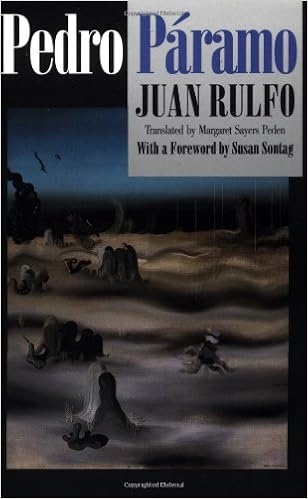
Pedro Paramo by Juan Rulfo

I had expected to see the town of my mother's memories, of her nostalgia--nostalgia laced with sighs. She had lived her lifetime sighing about Comala, about going back. But she never had. Now I had come in her place. I was seeing things through her eyes, as she had seen them. She had given me her eyes to see. Just as you pass the gate of Los Colimotes there's a beautiful view of a green plain tinged with the yellow of ripe corn. From there you can see Comala, turning the earth white, and lighting it at night. Her voice was secret, muffled, as if she were talking to herself... Mother.

"And why are you going to Comala, if you don't mind my asking?" I heard the man say.

"I've come to see my father," I replied.

Juan Preciado makes his way to the town of Comala at the behest of his mother, who has just died. She has told him that he will find his father there, Pedro Paramo. Juan is aided by a horseman named Abundio, and takes shelter in the house of a woman named Eduviges. Eduviges is shocked to hear that it is Abundio who has guided him, because Abundio is dead. But then, of course, Eduviges turns out to be dead, too. Everyone in Comala is dead: it's a town full of ghosts. Some seem to know it, and others not, but each gives Juan a piece of the story of his father, Pedro Paramo. Some appear as visions, and some as voices; they speak to each other as well as to him, and soon it seems they even claim him, too, as one of the dead.

Being dead, ghosts have a poor sense of chronology. The story of Pedro Paramo unfolds with little regard to the order of the action, and one often finds oneself trying to remember who in the story is dead, and who is yet to die. (Does this part come after the death of the priest, Father Renteria? No, here he comes to administer last rites...) But when taken as a whole, the story becomes one of power and seduction: Pedro, the wealthy haciendero who takes over the land of Comala bit by bit, by violence and extortion. The murder of his father, and Pedro's bloody revenge; the death of his son--a vicious rapist--thrown from a horse. And of course, Pedro's many women, some of whom are seduced by his wealth, and some who really lust for him, and the one woman he truly loved, the doomed Susana. As Pedro's son, Juan fits into this story, too, but somehow over the course of the book he seems to fade away, becoming as ghostly as his interlocutors, and eventually being absorbed wholesale into the story of his father and disappearing.

It was interesting to read this book shortly after Carlos Fuentes' The Old Gringo; both touch on the revolution of Pancho Villa in Romantic and expressionist ways, though the books are wildly different. Don Pedro is exactly the kind of haciendero that Fuentes' General Arroyo despises, though he manages to buy off the Villistas by offering them provisions and support. The dangers in Pedro Paramo are metaphysical--death, memory, madness--rather than political. Yet both capture the way power relies on, is created by, great violence, and the way many lives can be swallowed up by the greed and malice of few men.

I'm not sure what to make of Pedro Paramo. It's a book that seems somehow both entirely haphazard and entirely minimalist, something hewn down to its most basic parts. It is lyrical and elegiac, and rejects straightforward kinds of storytelling for a patchwork method that reminds me the way a blurred image might come slowly into view. Latin American magic realists and surrealists seem to have loved it, and one can see how it plays an outsized influence on the Spanish language literature that emerges in the following few decades, Fuentes included. And it's really like no other book in the world, which seems to me one of the highest forms of praise you can give to a book. 

Wednesday, February 16, 2022

The Old Gringo by Carlos Fuentes

The mountains rose like worn, dark-skinned fists and the old man imagined the body of Mexico as a gigantic corpse with bones of silver, eyes of gold, flesh of stone, and balls hard as copper.

The mountains were the fists. He was going to pry them open, one after the other, hoping that sooner or later, like an ant scurrying along the furrowed palm, he would find what he was after.

Writer and satirist Ambrose Bierce traveled to Mexico at age 71 to witness first-hand the rebellion of Pancho Villa. He sent back a couple of dispatches, and then he disappeared forever. To this day no one knows for sure what happened to him. Carlos Fuentes' novel The Old Gringo is an imagined rendition of Bierce's journey that fills in the gaps, from his crossing of the border at El Paso to his death at the hands of a tempestuous general in Villa's army.

The old gringo, as he's called--the novel doesn't name him until a couple pages from the end--comes to Mexico because he wants to die. Having suffered the deaths of his two sons, one by suicide, and estrangement from his daughter, having become disillusioned with his satire and the journalism he performed at the behest of William Randolph Hearst, the old gringo has finished living. He insinuates himself into the company of General Tomas Arroyo, who has taken over the hacienda where he was born and chased away the wealthy landowners that brutalized him and the other peasant workers. Volunteering his services, he finds not the death he is looking for, but an unsought honor: his lack of a fear of death makes him the bravest man on the battlefield, and his experiences in the Civil War (they call him "Indiana General") make him invaluable. He convinces Arroyo to let him stay by shooting a clean hole through a peso.

Fuentes writes: "[E]ach of us has a secret frontier within him, and that is the most difficult frontier to cross because each of us hopes to find himself alone there, but finds only that he is more than ever in the company of others." For the old gringo, crossing into Mexico is crossing that inner frontier, not into exile and death, but toward a new version of himself, one where he can make new associations, new relationships. The novel is structured in a triangle, linking the old gringo with Arroyo and Harriet Winslow, a white American schoolteacher hired by the fleeing Miranda family to teach their children, and who has been stranded in the occupied hacienda. Harriet is convinced that she must not forsake the duty of her position--she's been paid in advance--and tries to educate and civilize the peasant men and women of the hacienda.

The old gringo's attitude toward Harriet vacillates between the lustful and the paternal; sometimes he looks at her and Arroyo and sees them as a son and daughter. Harriet, for her part, sees the old gringo as a substitute for her father, who ran off to live with a woman in Cuba, though she tells everyone he died there, his body lost and his grave at Arlington empty. The relationships between the three are amorphous and shifting, symbolically incestuous; if they are the old gringo's children, how does one read Arroyo's demand that a not-unwilling Harriet sleep with him to save the old gringo's life? There is something in this that connects to the fervor of Villa's revolution, and the way that old relationships in Mexico have begun to crumble and must be remade; the Mexican Fuentes is most convincing, I thought, when describing the suffering of Arroyo's ragtag bunch, and their passionate hope that the brutal hacienda system is close to destruction. In this way they reconstitute themselves--much is made of the symbolism of the hacienda ballroom, the only room which Arroyo leaves standing, which is lined with mirrors where the men, who have only seen their reflections in rivers and cisterns, can see themselves for the first time.

The Old Gringo was written at a level of abstraction I found grating. In its most literal elements--the description of the landscape, of Bierce riding into battle, the ruined hacienda and the stranded railcar in which Arroyo makes his camp--Fuentes' writing is fantastic. But I found the emotional and mental states of the characters overwrought in a Romantic way, untethered from the immediacy of the action: why does the old gringo regard Harriet as his daughter? How and why is she so attached to him? These questions have answers in the symbology and narrative structure of the story--he's the father in the empty tomb, which is literally what he becomes in the book's closing turns--but not narrative ones, or ones that get crowded out by time shifts and rhetorical questions. I suspect this is a book that gets better the second or third time you read it; it's certainly rich, and powerfully unique. I think I might try it again one day--maybe when I'm 71 and looking for another frontier to cross.

Thursday, January 13, 2022

The God Who Sees by Karen Gonzales

It’s uncomfortable, and maybe even frightening, for many of us to consider having porous borders, especially in a time when terrorism abounds around the globe. Yet Christians are not called to value the false sense of security created by closed borders and walls. We are called to trust in God and to love our neighbors, particularly our neighbors in need. Closed borders in North America are not directed toward an existing threat of invasion by a foreign army but toward poor economic immigrants seeking opportunities and toward refugees fleeing for their very lives. Hardened borders are designed to prevent the movement of the world’s poor—a people whom God says Christians should care for and not harm.

I grew up in a small town in Indiana that was approximately half Mexican by the time I was a teenager. Many, maybe most, of the immigrants were undocumented, and talking to my friends in that group, it was always surprising, almost unbelievable, how much difference their nationality (and legal status) made in day to day life. Everything from attending school, to getting a job, to getting a driver's license was a minefield, full of mistakes waiting to explode lives if they were made.

One night, an officer followed a friend of mine, brought into the US covertly when he was only six, as he drove home from work, finally pulling him over for going too slowly. When the officer discovered he was undocumented, it set into motion a sequence of events that led to an awful choice: either go to jail, or agree to deportation with no possibility of re-entry for at least 8 years. He chose the latter, leaving behind his family, his friends, and the country he'd spent most of his life in. He was 21.

The God Who Sees is full of stories like this, both explicitly narrated and present in the statistics about deportation, immigration, racism, numbers that represent lives that all too often jerked around like marionettes because they lack a green card, or have a parent who crossed the border illegally. And, because this is a work of Christian theology and memoir, Jesus-followers, the vast majority in the US, loom large behind the facts and figures--who's making these laws, wrecking these lives, ignoring these people in favor of nationalism and fear?

I loved the structure, which alternates between theological ruminations on the stories of immigrants and outsiders in the biblical narratives--Hagar, Abraham, Ruth, Joseph-and memoir, structured around the sacraments of the Catholic church--baptism, communion, confirmation, anointing, and reconciliation. Though not Catholic herself, the sacramental structure serves a dual purpose, illustrating both the integration of the sacred into her life and providing signposts as her story of immigration--hers and her family's--unfolds. Personal growth is entwined with the complexity mutating relationships with her mother, her abuela, and God. Gonzales refuses to give easy answers or to separate the systemic oppression her family experiences from her own spiritual journey, and the result is a story of faith and change that moves holistically from numbers to names and back again. I love the title--the God who sees is the name given by Hagar, the first person in the Torah to name God--and I finished the book thinking of all the people we fail to see every day, the people we leave behind, who are not left by God.

The last 30 or so pages are something I've never seen before, a series of short vignettes enumerating ways people, Christian and not, can be involved in ending unjust treatment of immigrants, ranging from scripts for calling your reps to how-tos for getting involved with volunteering and visiting imprisoned refugees. It's a practical step I'd like to see become more commonplace in books intended to provoke a response.

Sunday, June 27, 2021

The Story of My Teeth by Valeria Luiselli

I'm the best auctioneer in the world, but no one knows it because I'm a discreet sort of man. My name is Gustavo Sanchez Sanchez, though people call me Highway, I believe with affection. I can imitate Janis Joplin after two rums. I can interpret Chinese fortune cookies. I can stand an egg upright on a table, the way Christopher Columbus did in the famous anecdote. I know how to count to eight in Japanese: ichi, ni, san, shi, go, roku, shichi, hachi. I can float on my back.

This is the story of my teeth, and my treatise on collectibles and the variable value of objects. As any other story, this one begins with the Beginning; and then comes the Middle, and then the End. The rest, as a friend of mine always says, is literature: hyperbolics, parabolics, circulars, allegorics, and elliptics.

Gustavo Sanchez Sanchez--Highway--is in his forties when he discovers his true calling: to be an auctioneer. He's always loved collecting things, from straws to ribbons, and auctioneering allows him to express his attachment to these objects. He describes his method in terms of conic sections, the hyperbolics, etc, etc, described above, which as any mathematician will tell you, are distinguished by their eccentricity, meaning some orbit very closely to their central point while others careen into distant topics. A simpler description of his method might be lying: his first great sales, which he recounts to us, are the sale of his own teeth, which he describes as belonging to famous people from history, from Plato to Virginia Woolf. He sells each tooth by telling a simple story about its owner, and he replaces the teeth he's had removed with a set belonging to Marilyn Monroe he purchased. At the end of the auction he's so overcome with his storytelling that he offers himself up to be bid upon, and is bought by his own estranged son, eager for revenge.

The story of The Story of My Teeth is a unique one: Luiselli was originally commissioned to write a piece of fiction for a catalog of the art collection belonging to Grupo Jemez, a juice company. The gallery and juice factory can both be found in Mexico City's heavily industrialized suburb of Ecatepec, and Luiselli conceived of a project that would bridge the divide between the two. After writing each section, she sent it to the factory to be shared with the workers--in an imitation of the "tobacco readers" that can still be found in Cuban cigar factories--who were recorded discussing it, and their conversations were then incorporated into the text.

This collaborative process resulted in a book that feels fresh and clever, engaged in constant revision and regeneration of itself. But it also grounds the book in the material world which it parodies and critiques. Absurdist narratives like The Story of My Teeth can often feel untethered from the real world, like exercises in self-referentiality that lack any kind of context that makes them readable. Yet for all its absurdity, Luiselli's novel feels like an honest window into the factory life of Ecatapec, where both Highway and his son Siddhartha are employed as guards. The unusual process manages not only to bridge the factory-gallery divide but inscribe, in a way, Luiselli's collaborators onto the page. It's a book that is, as Luiselli describes in the afterword, "not so much about but for the factory workers."

One of the things that The Story of My Teeth understands so well is the way in which both factory and gallery are connected sites of commercial production. The factory makes juice to buy and sell, and the artworks in the gallery, too, are bought and sold; what makes them different from juice? Highway offers an understanding of value, in its capitalist sense and otherwise, that is about storytelling. Having stolen the various artworks from the gallery, he sells them--or perhaps he only imagines he does--by enacting the same strategy as with the teeth, writing brief stories about the famous people who once owned the objects. The differences between these stories and those about the teeth illustrate the difference between "parabolics" and "allegorics," but what struck me most is the way that the line between production and self is blurred: we don't make our teeth in the same way we make an artwork, but what if the difference is reducible to the kind of story we tell about each? How is storytelling at the heart of our possession of ourselves?

Thursday, June 17, 2021

The Hearing Trumpet by Leonora Carrington

Houses are really bodies. We connect ourselves with walls, roofs, and objects just as we hang on to our livers, skeletons, flesh and bloodstream. I am no beauty, no mirror is necessary to assure me of this absolute fact. Nevertheless I have a death grip on this haggard frame as if it were the limpid body of Venus herself. This is true of the back yard and the small room I occupied at that time, my body, the cats, the red hen all my body all part of my own sluggish bloodstream. A separation from these well-known and loved, yes loved, things were "Death and Death indeed" according to the old rhyme of the Man of Double Deed. There was no remedy for the needle in my heart with its long thread of old blood. Then what about Lapland and the furry dog team? That would also be a fine violation of those cherished habits, yes indeed, but how different from an institution for decrepit women.

Marian Leatherby is 92 years old, living in Mexico City with her son and his family in the suburbs of Mexico City. One day, her friend Carmella gives her the gift of an ornate hearing trumpet made of horn, and once she puts it to her ear, the once-nearly-deaf Marian can hear at last what her family thinks of her: she's a nuisance and a burden, and the sooner they can put her in an old folks' home, the better. The home turns out to be a strange place called Santa Brigida, where a dozen eccentric old women--a blind painter, a fake spiritualist and murderer, a real spiritualist, a man pretending to be a woman--live in concrete huts shaped like mushrooms and boots and things. At Santa Brigida Marian, with her trusty hearing trumpet in tow, suffers with the other women under the scrutiny of the moralistic owners, but the new company of these women will open up new avenues in her life she had not yet imagined.

It's hard to talk about The Hearing Trumpet without spoiling it, because its most remarkable and essential quality is its transformation from one kind of book to a very different one. (Though I would suggest that this quality is so remarkable, you can't really approach it without an appreciation of that fact, so feel free to read on.) The Hearing Trumpet begins as a wry comedy about a little old lady discovering herself at last and becomes--perhaps you can guess--a novel about the end of the world, in which the earth begins to reverse its polarity after the release of the destructive horned god Sephira, who must be appeased with the return of the Holy Grail.

How does it this strange little book get from A to B? Well, at Santa Brigida, Marian is fascinated by the hanging portrait of a medieval nun who seems to be winking. She discovers that this portrait is of the Abbess Rosalinda, a Spanish occultist who spent her life hunting down the Grail itself, as well as a magical ointment associated with Mary Magdalene called musc de Madeleine. The Abbess, though sanctified by the church, really spent her life working against it, infiltrating the Knights Templar in order to pinch the grail and deliver it to the pagan Gods that Christianity has chased into exile. At Santa Brigida, Marian happily enlists in the cult of this Abbess, as many of the other residents have done, and it's their collective efforts that help bring about an apocalypse.

In one scene, a newly informed Marian descends the stairs of the great tower at Santa Brigida where the god Sephira has recently emerged, like an egg. At the bottom she finds herself, stirring an enormous pot of stew. Her doppelganger demands that she must decide which of them is the true Marian by way of climbing into the pot, or refusing to do so, and when Marian climbs into the soup, her consciousness is instantly transferred to the witchy doppelganger. This moment is The Hearing Trumpet in a nutshell: an old woman, comfortable but bereft of agency, refashions herself in opposition to the oppressive forces of Christianity, of family, of culture. The Hearing Trumpet is a book about the radical rejection of systems and creeds, and the embrace of something both ancient and feminine that lies within.

Putting a high gloss on it can seem silly, though, because the book itself is essentially silly, an exercise in joyous camp. Carrington saves one of her finest jokes for the very end, when an old friend of Marian's appears on a sledge--the reversing of the poles has turned Mexico into a snowscape, you see--with his new wife, the Queen of the Wolves, and her wolf army. Together with the old women and a platoon of bees, they defeat the Catholic Archbishop and restore the grail to Sephira--something which takes place in a single paragraph, like something written by a student who got bored at the end of their creative writing assignment. I like to think that the book steps up to the line of something very conventional--a Hollywood-style fantasy--and stops short, content to be the weird, winking, humorous thing it is.