Showing posts with label chicago. Show all posts

Saturday, April 1, 2023

Lucy Gayheart by Willa Cather

Suddenly something flashed into her mind, so clear that it must have come from without, from the breathless quiet. What if--what if Life itself were the sweetheart? It was like a lover waiting for her in distant cities--across the sea; drawing her, enticing her, weaving a spell over her. She opened her window softly and knelt down beside it to breathe the cold air. She felt the snowflakes melt in her hair, on her hot cheeks. Oh now she knew! She must have it, she couldn't run away from it. She must go back into the world and get all she could of everything that had made him what he was. Those splendours were still on earth, to be sought after and fought for. In them she would find him. If with all your heart you truly seek Him, you shall ever surely find Him. He had sung that for her in the beginning, when she first went to him. Now she knew what it meant.

How strange to read Willa Cather write about a city. Lucy Gayheart is a small town Nebraska girl who travels to the big city--Chicago--to study piano. She falls in love with a famous and married singer, but first she falls in love with Chicago, which makes her hometown of Haverford seem irredeemably provincial and cramped. But Cather describe the city as she does natural landscapes: the buildings are gray cliffs, and Lake Michigan is prairie-like in the way the subtle changes of the sky, purple and green, rise above its flatness. 

The singer, Clement Sebastian, seeks Lucy out because he needs an accompanist. They never play together in public, but he practices with her daily, and they are drawn into the fabric of each others' lives. In Lucy, Sebastian sees a freshness and youth that has passed him by; in Sebastian, Lucy sees an elevated spirit who contrasts with the shrewd, earthy Haverford banker whom everyone presumes she'll marry. Nothing happens between Lucy and Clement, not really, but what happens to Lucy happens in spirit, rather than the body. When the banker, Harry Gordon, comes to Chicago to propose to her, she tells him truthfully that she is caught up with another man, and when he presses her about how far their relationship has gone, she exclaims "All the way!" Harry, of course, takes this to mean she has been physically reckless, but "the way" Lucy means in the way of the spirit, or the way of the mind. She's a sentimentalist in the most literal sense; the great experiences of her life are those that happen within.

So, let me give a spoiler alert for what I'm going to say next: Cather is one of the cruelest and most bloodthirsty authors that ever existed. She's more pitiless than George R. R. Martin. First, she kills off Clement, who dies by drowning on Lake Como weeks before he's supposed to return and resume his work with Lucy. She returns to Haverford a changed woman, somewhat darkened and diminished, but having embraced the idea that what happens within her cannot die, though the man who caused it might. Still, she finds herself unable to repair the break between her and Harry, who has married a woman he does not care for just to spite her.

And then Cather kills her off. I couldn't believe it. In a fit of despair Lucy takes her skates out to the old skating spot on the Platte river, not knowing that beneath the snow the river has changed course and skating is no longer safe. She encounters Harry on the way, but he makes a lame excuse and turns his carriage away from her. Blinded by anger at Harry, she fails to notice the cracking ice before it's too late. In this way she's symbolically united with Clement, having perished the same way he did. It's not quite O Pioneers! perhaps, but it hurts. Clement is old-ish, has already felt past the best years of his life, but Lucy is young, and her youthfulness and promise are her most essential qualities. But Cather dispatches Lucy at her lowest point, and it's Harry Gordon--practical, unsentimental, philistine--left to deal with the aftermath in the book's final pages. Willa, you ogre! You beast!

Saturday, January 15, 2022

Sacred Smokes by Theodore C. Van Alst Jr.

Choochi says, C'mon, Teddy. Let's get these fuckers.

We head down Clark Street, our street, Farwell and Clark Street, F/C, site of lots of young gangbanger triumphs (and whoa, wait, we should clear that up pretty quick like--"gangbanger" here means "gang member," containing zero hints of any nefarious connotations implied by that rhymey and angular term that can mean so much sexually and violently and so little socially all at once) and also a library. A Chicago Public Library. Site of so much theft and pillaging, much pilfering, of knowledge, of words, and of Conan books. Definitely those. Oh. And a Beowulf. That's right. 'Cause fuck those Geats.

Sacred Smokes is a collection of loosely-related stories about an adolescence among the street gangs of 1970's Chicago. The narrator is Teddy, a bright Native American kid from the North Side. (One might expect that "Teddy" is a fictionalized version of the author, Indigenous Studies professor Theo C. Van Alst, Jr., but the book is billed, to the best of my knowledge, as fiction and not memoir.) Teddy has an ambivalent relationship the violence he both witnesses and employs in the city's turf wars. One story opens:

I had a friend named Idiot. One day I strangled him. Well, not to death, but close enough. That fucking guy. He was a relentless torment. Twice my size, wicked, and ceaseless. I just couldn't do it anymore, couldn't take his shit.

But elsewhere he begins to worry about how to extricate himself from the life he's grown up into:

And then one day after walking away from a nasty shit-talking fight with some of boys, which I won, of course. I sort of came to and looked around. I was alone, and felt it deeply, but I envisioned myself envisioning this moment, older and tired somewhere, maybe in a shitty suburb, or worse, maybe around the corner from right fucking here, and wishing I had come to that moment differently, and I knew the only way to make a difference was to re-envision myself. I didn't know then what I needed to do, but I knew this, all this, was fucked, wasn't for me, would kill me dead if I let it, and I wasn't ready to die just then. Not at that age. Not what that buzz, not with that smile on my face, not with that clear forehead, that long hair, that tanned brown skin, that girlfriend, that ice-cold quart of Old Style, that boombox, that song, that moment of sublime warmth, no sƃuıʞ, no cops, no crap, no fear. No way.

Eventually, Teddy gets his opportunity; caught in a bind by a couple of idiot cops he calls "Lenny and Squiggy," he accepts their offer: jail or the Navy. The cops seem to think of Teddy as a thorn in their side, not because he's merely a "gangbanger," but because he's clearly smarter than they are. Teddy's intelligence and powers of sharp observation are part of what make the book so fascinating, and his creative capacity. At one point, a "gangbanger" friend demands, "Tell us a story, Teddy," and he unfurls an improvised and highly-detailed vignette of a soldier at war. When he writes a vivid and jagged story about pursuing a rival gang member for an English class, he receives an A, along with a year of suspicious looks from his teacher. These qualities are influenced by Teddy's voracious reading habits; over the stories he reads Louise Erdrich novels, Cormac McCarthy ones, old Conan paperbacks, Vine Deloria, Karl Marx, Beowulf ("fuck them Geats"). Teddy devours these books and absorbs them, crafting a slangy-but-educated voice that gives the stories the bulk of their power and humor.

Structurally, the stories are very slippery. Teddy has a habit of slipping from one topic to the next in a way that might catch a lacksadaiscal reader (like me) off guard. In the space of a single paragraph he might remark that the gang member he's talking about resembles someone else he knew in the Navy, and that this someone reminds him of another story than the one he was telling. The stories often come full circle, but not always, and even by the end of each one it can become difficult to determine what it was the story was about, really, a quality that extends in some respect to the book as a whole. Sometimes this method works beautifully, as in the opener "Old Gold Couch," which--nominally, at least--is about his father's resolution to purchase a new couch with the coupons saved from thousands of cigarette packs. Other times, as in "Push It"--a story that ends with Teddy stumbling into a Salt-N-Pepa concert--it seems as aimless as the limousine ride that provides the story its loose structure.

I read Sacred Smokes as part of "Indijanuary," in which I read books by Native American authors until January is over, or I run out, whichever comes first. The role of indigeneity in Sacred Smokes is somewhat oblique. It certainly has no grand statements to make about urban life as a Native American, a la There There, and is probably better, realer, for it. Instead it reveals itself in small and surprising ways: "You dress like a Puerto Rican," his father tells him, to which Teddy replies, "Look at you, man. We live in the middle of the city. You wear western shirts and cowboy boots every day." Teddy's father is a drunk and a jerk, but one wonders if there isn't something to his aloofness from the city, the way he stands apart from it, while Teddy frets about the way he is swept up in it. And there is a kind of nostalgia for a lost possibility when he describes his Cherokee mother's birthplace in Tennessee, a place "where the houses are gone, along with our genealogy, which got stole by some Yankee fuck tourist out of one of the houses that the Feds turned into some kind of living museum or human zoo exhibit in the national park that sits where our land used to be, but the flowers remain, rectangular plots of flowers that still grow around the perimeters of long-ago houses that have burned into ashy pages of lost history." But I wouldn't want to push the thought too far; Sacred Smokes is too circuitous, and more interested in getting out and moving on than looking back.

Sunday, October 21, 2018

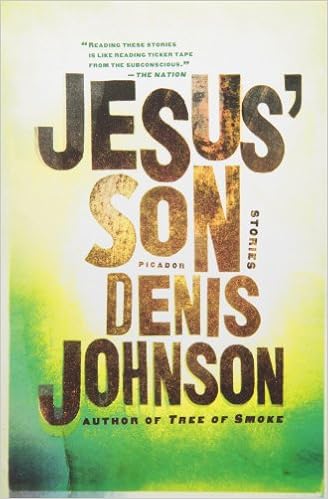
Jesus' Son by Denis Johnson

The man hanging out of the wrecked car was still alive as I passed, and I stopped, grown a little more used to the idea now of how really badly broken he was, and made sure there was nothing I could do.  He was snoring loudly and rudely.  His blood bubbled out of his mouth with every breath.  He wouldn't be taking many more.  I knew that, but he didn't, and therefore I looked down into the great pity of a person's life on this earth.  I don't mean that we all end up dead, that's not the great pity.  I mean that he couldn't tell me what he was dreaming, and I couldn't tell him what was real.

Denis Johnson's story "The Other Man" begins: "But I never finished telling you about the two men."  And sure enough, you recall: earlier in the collection Jesus' Son, there is a story called "Two Men," but it's really just about one man: a deaf-and-dumb giant of a dude who ends up in the narrator's car, signaling that he'd like to be taken somewhere.  He's a stranger, but somehow his inability to speak fends off a fight, and compels the narrator to comply.  The man in "The Other Man" is a tourist who pretends, convincingly, to be a Polish tourist until he admits it was a prank all along.  Yet the reveal doesn't reveal all:

When I've told others about this man, they've asked me, "Did he make a pass at you?"  Yes, he did.  But why is that out come to this encounter obvious to everyone, when it wasn't at all obvious to me, the person who actually met and spoke with him?

What's the connection between the two men?  Are they both liars?  And why does it take the narrator so long to remember to finish the story?  All of Jesus' Son is like that, within and across stories: obscure connections are made and broken; time skips unpredictably and without warning.  In "Out on Bail," the narrator is at a bar commiserating with a friend about to go to prison, until he remembers that the moment was actually one of celebration, because the friend was acquitted.  In the virtuosic "Emergency," he tells us a story about getting stuck in a car in the snow, and accidentally kills a nest of newborn rabbits he'd been trying to protect.  Then he says, "Or maybe that wasn't the time it snowed."  This moment that he's thinking of, "The bunnies weren't a problem yet, or they'd already been a problem and were already forgotten, and there's nothing on my mind."  The fractured nature of the narrative reflects the drunken, drug-addled mindset of the narrator--nicknamed, unfortunately, "Fuckhead."

Does that sound frustrating?  Does it sound like the worst excesses of our most masculine hacks?  Our Bukowskis, our Palahniuks, our Bret Easton Ellises?  Certainly you can their shadows in a story like "Car Crash While Hitchhiking," which spares little in the way of violence or gore, or the black humor of the moment in "Emergency" when the strung-out orderly glibly removes the knife in a man's eye while prepping him for the surgery that's supposed to do exactly that.  Denis Johnson is the writer those guys all wish they could be, or maybe think they are.  For one thing, he can write circles around them, as in this drugged-out vision of the Iowa countryside:

Glaciers had crushed this region in the time before history.  There'd been a drought for years, and a bronze fog of dust stood over the plains.  The soybean crop was dead again, and the failed , wilted cornstalks were laid out on the ground like rows of underthings.  Most of the farmers didn't even plant anymore.  All the false visions had been erased.  It felt like the moment before the Savior comes.  And the Savior did come, but we had to wait a long time.

But also, Jesus' Son has a kind of warmth and generosity those authors can't match.  Johnson has a sincere affection for those who are down and out, like Fuckhead, which is all the more remarkable because it doesn't require the kind of gritty realism that we usually think of us being the hallmark of empathetic literature about the lowest strata of our society.  Dreams and visions, induced by pills or otherwise, are respected as part of human creativity and ingenuity.  And both Johnson and Fuckhead are aware that much of human life is the product of circumstance and luck:

"You just don't realize.  Being a cheerleader, being on the team, it doesn't guarantee anything.  Anybody can take a turn for the worse," said Richard, who'd been a high school quarterback or something himself.

About Dundun, a sadistic man who tortures a friend of Fuckhead's, he writes:

Will you believe me when I tell you there was kindness in his heart?  His left hand didn't know what his right hand was doing.  It was only that certain important connections had been burned through.  If I opened up your head and ran a hot soldering iron around in your brain, I might turn you into something like that.

The collection zips from Iowa to Chicago to Seattle, but it ends in Arizona, where Fuckhead is all cleaned up and trying to live a sober life as an orderly in an old folk's home.  He spends his afternoons and evenings spying on a Mennonite couple who live nearby, trying to peer into their inner life.  He's interested in them before he knows they are Mennonite, but the story says something like this: even the most straitlaced of us have inner lives that are unique, perhaps even bizarre, that we are all as weird as the drifters and addicts of Jesus' Son, thought not all of us live close enough to risk for that part of us to emerge.  "All these weirdos," Fuckhead writes serenely at the end, "and me getting a little better every day right in the midst of them.  I had never known, never even imagined for a heartbeat, that there might be a place for people like us."

Sunday, February 13, 2011

The Adventures of Augie March by Saul Bellow

The Adventures of Augie March begins with America:

I am an American, Chicago born--Chicago, that somber city--and go at things as I have taught myself, freestyle, and will make the record in my own way: first to knock, first admitted; sometimes an innocent knock, sometimes a not so innocent.


And ends with it, too:

Look at me, going everywhere! Why, I am a sort of Columbus of those near-at-hand and believe you can come to them in this immediate terra incognita that spreads out in every gaze. I may well be a flop at this line of endeavor. Columbus too thought he was a flop, probably, when they sent him back in chains. Which didn't prove there was no America.


In his introduction, Christopher Hitchens identifies Augie's opening assertion as essentially radical. Augie, a Jew and the descendant of immigrants, claims an American birthright, unthinkable in the 1920's of the novel's opening and not much less so when it was written in 1953. We are inheritors of this assertion and will not find it strange; most of us will take it for granted that America is land of opportunity, an immigrant nation, where the ladders of social mobility can be scaled quicker.

Still, we can appreciate Augie's bold claim to exhibit a new conception of our national character. Augie is an American, that is to say, democratic. He tells us early on that the phrase "various jobs" is the "Rosetta stone" of his existence, and indeed his "adventures" can be summed as a series of tasks: He is a dog groomer, a union organizer, a petty thief, a sales clerk, a ship's pharmacist, an assistant to more than one millionaire. In one of the book's greatest sections, he spends a long period in Mexico training an eagle to hunt lizards. Some of these jobs are menial and low-class and others come with fancy wardrobes, but the overall line of progression is fluctuated, not upward as in some Horatio Alger story. When I say that Augie is democratic, this is what I mean--the dogged insistence that meaning and fulfillment, though not likely to be found, can be approached from all sides and all stations:

"How is your campaign after a worthwhile fate, Augie?" asked Clem, for he knew a lot about me, you see. Alas, why should he kid me so! I was only trying to do right, and I had broken my dome, lost teeth, got burned in the progress, a mighty slipshod campaigner. Lord, what a runner after things, servant of love, embarker on schemes, recruit of sublime ideas, and good-time Charlie! Why, it was a crying matter, no fooling, to anyone who might know which side was up, that here was I trying to refuse to lead a disappointed life.


Democratic, too, are Augie's attitudes toward people. On his ship during wartime he becomes a sort of confidant and advice-giver for his shipmates and tells us, "I advocated love, especially." Love is democratic because it regards social class, like all other concerns alien to mere personhood, as irrelevant. Augie's attitude reminds me of the King of France from King Lear, who remarks that "Love is not love / When it is mingled with regards that stand / Aloof from th'entire point." So it happens that, in my favorite section of the book, Augie risks estrangement from his heiress girlfriend, Lucy, in order to help a a friend obtain an illegal abortion. Lucy's parents believe he is mixed up with the girl sexually, not that it would matter if he weren't, and Augie mistakenly expects from Lucy the same kind of inconsiderate love that he gives freely:

Inside, on the turned-over heels of the yard shoes I hadn't remembered to change, I walked to the mirror to knot my black tie and saw backward, by the drape in the living room, the tense belly of Uncle Charlie, his sharp feet prepared, and sitting waiting in the oriental mix-up of brass, silk, wool, and all that gave the place so much power, Lucy, her mother, and Sam, observing me. I felt there was a big machine set against me. But I had come in order not to disappoint Lucy, toward whom, given their chance, my feelings could have shone and warmed again. I expected poisoned looks, against which I was coated and immune; at least, my greater trouble made such looks seem negligible; and I wasn't willing to be tagged for lascivious crime and false pretenses or whatever the coutns were that they thought they had against me. By no means nervous, therefore, I judged that I had only to do with Lucy, no fortune hunting now involved, for I could go any distance independent of brothers, relations, and all, provided that her impulse was a true one and she was, as she had always said, in love.


But love for others is not always the same as love for Augie, who has no conception of the love of money or the love of power. When he calls himself, at book's end, a "Columbus of those near-at-hand," he celebrates the love of people, the personal, individual life as opposed to the "big machine" which only has the power to oppose.

No wonder, then, that Bellow rejects the prose of Hemingway--who might be called typically American in that he exalts the stark, shorn pioneerism of Emerson and Thoreau--in favor of a looser, more exuberant style that is democratic in the sense that no word seems to excessive to leave out. Augie March is dense and allusive, delighting in its metaphors. The hem of a dress is "stiff as a line of Euclid." Elsewhere "the wheat looked like the glass of wheat." The human heart "circulates and warms, when it's piled at any bar or break, burns inward or out with typical embers or sores, and makes a track of fever or fire whose corresponding part is darkness and cold gaps." It is easy to lose the thread, and such long-windedness fails perhaps as often as it succeeds, but one comes to feel that, like Augie, such failures must be permitted.

Hitchens refuses to call it "The Great American Novel," though apparently Martin Amis does so freely. I myself categorically reject the existence of such a thing, but I will note that Augie March is obsessed with the reason that such a novel is impossible: America is too vast, too broad, too pluralistic to be pinned down. It is, in short, like Augie.

Sunday, January 2, 2011

The Devil in the White City by Erik Larson


"I was born with the devil in me," he wrote. "I could not help the fact that I was a murderer, no more than the poet can help the inspiration to sing."

This book considers, as Larson tells it, two key attributes of the human condition, pride and lust for power, through the stories of Chicago's World Columbian Exposition (the world's fair) of 1893 and of H.H. Holmes, one of the most prolific and downright creepy serial killers in America's history. Though the two stories are only related by time and place, Devil in the White City is still an interesting book and Larson weaves the stories together nicely.

Holmes's story is certainly the more lurid of the two. In the few years before and after the fair, he may have murdered somewhere between 20 and 100 people. He confessed to 27, but that number was clearly a lie (some of those people were still alive) and he was only convicted of murdering one, but the investigator who finally pinned it on him also dug up enough evidence to probably convict him of three others. In addition, investigators found bones from an unidentified number of people in the hotel he constructed only a few blocks from the fair, which doubled as his house of torture. His preferred method of murder was locking his victims, usually young women, in airtight chambers and either leaving them their to asphyxiate or pumping poisonous gas into the chambers. What made him really creepy was his ability to charm the pants off of just about anyone he chose. He convinced four women to marry him (he never divorced any of them, either, and only killed a couple or three of them) and frequently talked his creditors into suspending or forgetting his debts. Now I'm going to have to make a list of my friends and decide which one is a secret serial killer, because Holmes proved it really can be anyone...

Despite how gory and titillating the true accounts of Holmes's activities are, Larson's story of the Fair is more dramatic. In the last decade of the 1800s Chicago was suffering from a serious inferiority complex with respect to New York, so it nearly bit off more than it could chew by bidding on and winning the right to host a big ass world's fair to mark the 400th anniversary of Columbus's arrival on the continent. Paris had held a world's fair a few years before (at which it unveiled the Eiffel Tower, an architectural marvel for the era) and Chicago had to step up and surpass it or humiliate itself and the country. The story of how the Fair came together was pretty interesting, especially considering how much of a marvel many of its aspects were at the time and the fact that it was the largest peaceful gathering in the history of the world to that point.

Overall an interesting tale and definitely worth a read.

Tuesday, May 4, 2010

Black Boy by Richard Wright

Though I have not been posting for a while, I have been reading: This is one of about five reviews I have in my backlog. As it turns out, teaching in an actually functioning school has certain demands and some things have fallen by the wayside--reviews being one of them. I apologize, and promise never again to sacrifice my blog stewardship for something as trivial as the education of American youth.

In this case, the two are not exclusive--I read Black Boy because I thought it was going to be the next book I would read in my senior class; but when we discovered that there was only one full class set I had to turn my attention (not without some pleasure) to Pride and Prejudice.

Which is not to say I didn't like Black Boy--I did. But I didn't connect with it like many do. Why not, I wondered? I briefly considered that it may be because I simply don't have a point of reference for Wright's narrative; I can't relate to it, as my students often say.

It is the quintessential outsider narrative: Wright grows up in the Jim Crow South, a place and time not amenable to the ambitions of young blacks. Richard is fiercely intelligent, but his poverty means that his schooling is intermittent and he never connects with his classmates. Work is scarce and demeaning, and usually involves submitting to the tyranny of a white boss who fails to even imagine that a black child may have aspirations, or can write. At home, things are not much better: Richard fails to grow into the religious mold his grandmother and aunts and uncles expect of him; his father is absent from his earliest days. Wright subtitled the memoir American Hunger, and recalls that he is perpetually starving:

Hunger stole upon me so slowly that at first I was not aware of what hunger really meant. Hunger had always been more or less at my elbow when I played, but now I began to wake up at night with hunger standing at my bedside, staring at me gauntly.


First he associates the hunger with the absence of his father, but it is more; it is the starvation of all that it means to be human, the deprivation of the things which sustain life and thought. He survives meagerly, snatching at scraps of knowledge as he does scraps at food.

But I am not an outsider. I am not so progressive to admit that, in the great scheme of things, I am a have and not a have-not. Though I thought this, I rejected it: I had forgotten that relatability is one of the great smokescreens of reading. (As if we should never stoop to understand what we do not recognize as like ourselves.)

Instead, I think that Black Boy failed to resonate with me because I suspect there is some measure of airbrushing in Wright's accounts of himself. It isn't a self-hagiography; he hardly paints himself as a saint, but his sins are sins of youthful ignorance. For example, he takes a job delivering a newspaper because he likes the serials printed on the back, but fails to notice that the paper itself is militantly pro-Jim Crow. Contrast the scene in which Richard, desperate to please his grandmother, tells her that he would believe if he saw an angel--which she mishears as fact and tells the church that her grandson has had a vision. These misunderstandings lead to Richard being beaten, but always through the intolerance and narrow-mindedness of his family; he admits to no malice or ill intention. This pattern continues into the book's restored second half, which traces Wright's dalliances with the Chicago Communist community, which finds his free-thinking suspicious and seeks to eradicate it as his family did.

Ultimately, I think we are meant to see Wright as a victim. Not a victim to be pitied, but to be championed because of his ultimate success, but a victim all the same. I think this is the source of ambivalence for this book--yet it makes me want to read Native Son, whose protagonist seems more conflicted. That's the kind I like.