Showing posts with label Willa Cather. Show all posts

Monday, February 2, 2026

Sapphira and the Slave Girl by Willa Cather

The tall black man turned to Nancy and put a hand on her shoulder. "Dey ain't strangers where you're goin', honey. Dey call theyselves Friends, an' dey is friends to all God's people. You'll be treated like dey had raised you up from a chile, an' you'll be passed along on yo' way from one kind fambly to de next. Dey got a letter all 'bout you from the Reverend Fairhead, an' dey all feels 'quainted. We must be goin' now, chile. We want to git over the line into Pennsylvany as early tomorrer as we kin." There was something solemn yet comforting in his voice, like the voice of prophecy. When he gave Nancy his hand, she climbed into the chaise.

Sapphira and the Slave Girl, Willa Cather's last published novel, might be a seen as a return to Virginia, the state where Cather was born. The story takes place shortly before the Civil War (Cather was born not long after it), in the household of Sapphira Dodderidge Colbert, who has grown old alongside her husband, a miller in the Blue Ridge mountains. As a young woman, Sapphira married slightly below her station, and the rural town where she and the miller live is not quite the plantation of her youth, and yet she maintains a full household of Negro "servants," whom she treats for the most part with kindness. The exception is Nancy, a young half-white woman, rumored to be the daughter of either an itinerant artist or one of the miller's own brothers, and who Sapphira suspects--wrongly--to be the object of her husband's sexual or romantic affections. Sapphira punishes Nancy in a lot of passive-aggressive ways, but Nancy's ultimate punishment comes when Sapphira opens her doors to a rakish young nephew whom she knows will not take Nancy's "no" for an answer.

I was surprised by just how heavy the threat of sexual violation hangs over Sapphira and the Slave Girl. Cather's prose is characteristically elegant, bordering on the plain, but in this case it conceals a deep and distressing sexual anxiety. Nancy is already marked from birth by the anxieties of interracial sex and rape, and Sapphira's belief that her husband's kindness toward Nancy is evidence of a sexual relationship shows just how intense those anxieties can be. Sapphira's solution is to introduce, even if by inaction, a greater and more predatory threat, as if to say, "Oh, you want to have sex with your white master, do you?" But of course, Nancy doesn't, and even if she did, there would be no meaningful consent within the boundaries of the master-slave relationship; Sapphira's antipathy toward Nancy reveals the mental gymnastics needed by the slaver to assign a sexual power to the enslaved in order to clear one's own conscience. Sapphira essentially targets Nancy for rape, and a suspicion that the book still believes in her genteel virtues may explain why Sapphira and the Slave Girl is so little read today. Sapphira's daughter, Rachel Blake, ultimately helps Nancy escape on the Underground Railroad.

Toni Morrison famously used Sapphira and the Slave Girl as a case study in her analysis of the white imagination; I haven't read that essay, but it's not hard to see where such an analysis might begin. At times the novel is surprisingly didactic, as when one character realizes quite pointedly that whether one treats one's slaves "well" is immaterial, that the system is fundamentally immoral. But it's hard not to feel that the novel wants to have it both ways, that it really wants us to admire and sympathize with the anti-slavery whites like Rachel, and not to be too harsh on Sapphira. It also wants us, I'd argue, to admire the hardiness and gentility of antebellum society, as when one of Rachel's daughters is killed by a diphtheria epidemic. The biggest flaw, perhaps, is that Nancy herself is a character that holds little interest, a passive recipient of sexual torment whose most developed moment comes when she must agonize over whether to leave the life she has known or light out for Canada. Whatever the promise of the title, it's hard to argue that both Nancy and the woman who keeps her enslaved have equal billing.

Tuesday, March 4, 2025

Alexander's Bridge by Willa Cather and Chasing Bright Medusas by Benjamin Taylor

He happened to be engaged in work of public utility, but he was not willing to become what is called a public man. He found himself living exactly the kind of life he he had determined to escape. What, he asked himself, did he want with these genial honors and substantial comforts? Hardships and difficulties he had carried lightly; overwork had not exhausted him; but this dead calm of middle life which confronted him, -- of that he was afraid. He was not ready for it. It was like being buried alive.

Bartley Alexander is a renowned builder of bridges. He's hard at work on a bridge in Canada that will be the world's longest cantilever bridge, and his reputation has made him a public figure of know-how and enterprise. He's married to an elegant, pragmatic woman named Winifred, but on a trip to London, he reconnects with a spirited Irish actress named Hilda, whom he threw over to marry his now-wife. Meeting her again reignites his passion, and soon they are in the throws of a love affair that sunders Bartley's personality between the private and the public, and threatens to destroy him.

Alexander's Bridge was Cather's first novel. It was followed less than a year later by a masterpiece, O Pioneers!; Alexander's Bridge is not a masterpiece. It wears its debt to Henry James openly on its sleeve, but Cather was never a very Jamesian writer. James might have worked out the psychology of Bartley's affair to the most minute detail, but Cather's writing is all wrong for intricacy. Her characters are too plainspoken, to us and to themselves; there's not many shades of sentiment or feeling. Cather tends to say one thing and to say it well. It's perhaps unfair to think of it this way, but it's why she's so much more talented at capturing the life of a Nebraska homesteader, whose life, like her prose, is made up of the most simple things in delicate and meaningful arrangement. The Boston-to-London life of Bartley Alexander makes more room for a Jamesian artifice that Cather seems to think she's interested in, but isn't.

The novel ends--spoiler--with the collapse of the record-breaking bridge in Canada. Bartley has had to skimp on materials to meet the cost demands of his benefactors, but there's no way to test whether they'll hold until the bridge is built. They don't, and Bartley is drowned in the collapse of his greatest achievement. This ending really is beneath the writer that Cather would become: pointedly symbolic, but not really integrated with character or plot. The bridge collapses because Bartley collapses, riven by his double life, but this image is too easy and too predictable to really work.

That the novel of manners was not her metier she had to learn the hard way, by writing one. Alexander's Bridge is a case of borrowed finery, as she felt almost immediately on its completion. Still, reading it today one fids much to admire in the book's tragic love triangle.... One cannot help suspecting Cather was here expressing the divided state of her own personal life, split as it was between two women, Isabelle and Edith. This cannot be demonstrated; I only propose it here as a possibility.

In his biography of Cather, Chasing Bright Medusas, Benjamin Taylor describes Alexander's Bridge as a failure that Cather was aware of. She was pushing forty; to have her first novel as an artistic failure might have scared her off forever. Thank God she kept on writing and produced O Pioneers!. Taylor's book marches dutifully through Cather's life from book to book and story to story, and its clear that the author is a passionate fan who loves the texts about which he's writing. The book--which is very short for a biography--lingers most leisurely when discussing the books themselves. Much of the book is taken up with unpacking the tone and quality of the books' reviews--which were deemed a success, which a failure, etc., etc.

All that, I thought, comes at the cost of never really dipping too far past the surface of Cather's life. We get the fascinating tidbit, which I did not know, that Cather's lifelong "companion" Edith Lewis was actually her second love, after a woman named Isabelle McClung who broke Cather's heart by marrying. What her compensatory relationship with Edith was like is barely touched upon here. Perhaps there's little way to know what went on in this "Boston marriage," but Cather and her writing are too much the focus here to really admit anyone else. Like Cather's novels, the biography is made up of simple stuff delicately arranged, but like all homages and imitations, it pales against the quality of the master.

Saturday, August 3, 2024

Shadows on the Rock by Willa Cather

"Get on the sled and I will pull you up. See, there's the evening star--how near it looks! Jacques, don't you love winter?" She put the sled-rope under his arms, gave her weight to it, and began to climb. A feeling came over her that there would never be anything better in the world for her than this; to be pulling Jacques on her sled, with the tender, burning sky before her, and on each side, in the dusk, the kindly lights from the neighbours' houses. If the Count should go back with the ships next summer, and her father with him, how could she bear it, she wondered. On a foreign shore, in a foreign city (yes, for her a foreign shore), would not her heart break just for this? For this rock and this winter, this feeling of being in one's own place, for the soft content of pulling Jacques up Holy Family Hill into paler and paler levels of blue air, like a diver coming up from the sea.

I spent a day last week in Quebec City. If you've ever been there, you know it's not for the easily winded: it's built upon a huge rock called Cap Diamant, and the lower town, at the rock's bottom, and the upper town, on its peak, are linked by stairs so precipitous they have names like Escalier Casse-Cou, the break-neck stairs. It's in the middle of one of these climbs that Euclide Auclair, the apothecary at the heart of Willa Cather's Shadows on the Rock lives. Symbolically, it shows something about Euclide's character. Though brought to Quebec from France in the service of the governing Count de Frontenac, Euclide serves the common people also, with steadfast prudence. And perhaps, more even than others, it demonstrates the way that the apothecary clings to the rock, like a sea bird in its nest, an isolated refuge in the midst of a large and wild place. Most of the novel takes place over the village's long winter, from the moment that the last boats leave for their treacherous journey back to France to the time they return along the St. Lawrence River. During that time, the colonists are truly cut off from France. Perhaps this is when they not only must fend for themselves but when they are most themselves.

Euclide, a widower, has a daughter named Cecile. Cecile is the light of the village; as Euclide is steadfast, she is virtuous and pure. It's Cecile who entreats the Count to provide shoes for her friend Jacques, the son of a base prostitute. Cecile, too, is a natural Canadian; though born in France, she has no memory of the place, and to her, the thought of being recalled to France is a frightening one. Cather, who was ever interested in the mythology of nation-making, is trying to pinpoint the moment, I think, that refugees from one place become the residents of another. Cecile is a real Canadian, not just a Frenchwoman clinging to the rock for fear of being swept out to sea. She boasts all the virtues of French civilization, including a devout Catholic piety, though in her they are transformed into something distinctly French Canadian. One can imagine this book might have been influential among the French Canadians, who insist politically and culturally on calling themselves a nation, if only it had avoided the original sin of being written in English.

It's difficult to read Shadows on the Rock without thinking about Death Comes for the Archbishop, which Cather had published four years earlier. Both books are about European, even French, exiles in the new world. Euclide is a humble apothecary, but he, and Cecile especially, seem hardly less the representatives of the faith than Bishop Latour. Both books suggest that the transposition to the New World enliven that faith and make it stronger; in Shadows of the Rock, we are treated to a long story about a devout Montreal anchorite whose devotion to solitude harkens back to a medieval piety no longer possible in Europe. Shadows on the Rock even provides a Bishop Latour-like figure, the Bishop Laval, a real figure whose tomb I saw in the basilica at Quebec. This figure--genial, wise, and forgotten by Europe--even gets a death scene at the end, a "good death" that mimics Latour's.

The comparison does Shadows on the Rock little favor. The mystery and ambivalence of Archbishop are largely supplanted here by a conservative devotion to the myth of missionary goodness. Euclide's steadfastness, Cecile's virtue, will not permit a scene like that in Archbishop in which Latour is brought to a secret cave where he hears the howling sound of ancient gods, nor will they permit a vision, like Latour has, of the Holy Family as part-Indigenous mestizos. The Indigenous, in fact, are kept largely off-screen, lurking as frightful threats and agents in the martyrdom of Jesuit missionaries like Jean Brebeuf. (It would be interesting to compare this vision to Vollmann's Fathers and Crows, a novel that casts the Jesuit missionary work among the Hurons and Haudenosaunee in a more contemporary, and cynical, light.) I really enjoyed Cather's rich image of colonial life, and of course, the writing is as lovely as ever. (Don't you love the "paler and paler levels of blue air, like a diver coming up from the sea?") But I couldn't shake the feeling that the novel clings, like the colonists in Quebec, to a rock-like certitude.

Wednesday, January 3, 2024

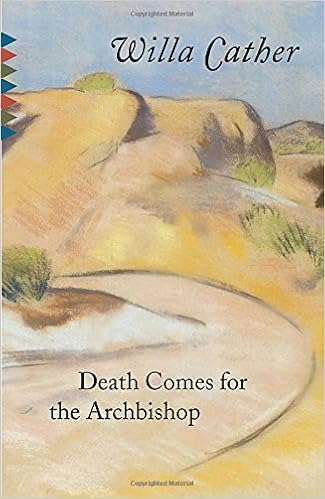
Death Comes for the Archbishop by Willa Cather

Ever afterward the Bishop remembered his first ride to Acoma as his introduction to the mesa country. One thing which struck him at once was that every mesa was duplicated by a cloud mesa, like a reflection, which lay motionless above it or moved slowly up from behind it. These cloud formations seemed to be always there, however hot and blue the sky. Sometimes they were flat terraces, ledges of vapour; sometimes they were dome-shaped, or fantastic, like the tops of the silvery pagodas, rising one above another, as if an oriental city lay directly behind the rock. The great tables of granite set down in an empty plain were inconceivable without their attendant clouds, which were a part of them, as the smoke is part of the censer, or the foam of the wave.

I'm excited to have a ticket to a dinner and seminar at the New York Historical Society next week about Willa Cather's Death Comes for the Archbishop. Only, what I thought was a seminar seems to be more of a discussion, and I'm actually supposed to have recently read the book. So, while starting the new year, with all its attendant slate-clearing and excitement, with a re-read is not ideal, there's few books that could better inaugurate the year.

The first time I read Death Comes for the Archbishop, I didn't get it. I kept waiting for the death, and I was stupid. The second time I read it, I saw the simple grandeur of Cather's prose for what it is, and having read more of her books since then, it's only grown higher in my estimation. So I thought I'd try something unusual and write a negative review of Death Comes for the Archbishop.

Let's start with the moral case against Cather's novel. Cather, it seems to me, has escaped critical censure for the small-c conservative and traditionalist aspects of her writing. In One of Ours, it's the glorification of World War I heroism and the sacrifice of young American lives for what I think we now see as little reward. In O! Pioneers and My Antonia, it's the myth-making around the long-gone days of the pioneer, which situates American identity in a past that never really existed. Similarly, Death Comes for the Archbishop is primarily about whitewashing the frontier and the "civilizing" of the American West. To see this, you need only to look at the Bishop Latour's praise for and friendship with Kit Carson, one of the premiere Indian fighters of his day, and whose depredations Latour only goes so far as to call "misguided." Or to Latour's nostalgia for the Spanish "martyrs" who were driven out centuries before by the Pueblo Revolt. The novel's central symbol is the cathedral that Latour builds from a hill of yellow rock he finds near the Pueblo of Acoma. The cathedral's design is European, French, but the rock is taken quite literally from the land, which Latour believes no one will miss, though he doesn't seem to have asked.

Cather goes out of her way to present Latour and his bosom friend, Father Vaillant, as friends of the Indians. On his deathbed, Latour rejoices that he has lived long enough to see the Navajo returned to their lands (no thanks to the "misguided" Kit Carson), and the novel's grandest villain is the gluttonous Fray Ramirez who abuses his parishioners at Acoma, and gets thrown off the cliff wall for it. But Death Comes for the Archbishop is invested, too, in a fundamental vision of Indian differentness, not simply rooted in the past but atavistic to the point of simplicity. Indians are both somehow manifestations of the land itself and an ancient prehistory. In some ways, this is meant to be a compliment: when one rebellious priest warns Latour not to try to change the old ways of the Indian religion, Latour remarks that ancientness is what he likes in the people of New Mexico--it is a quality shared with the Catholic church.

This might be the book's most significant elision: its insistence that the spread and maintenance of the Church in New Mexico is neither coercive nor particularly transformative. Latour and his fellow Catholics are consistently contrasted with "bad whites" like the murderous Buck Scales, who abuses his Mexican wife, or the town Protestants who love to violate sacred places and things. But this only serves to hide the ways in which the Church is one arm of European colonial transformation. Latour can build his cathedral because he believes that the Catholic church is catholic in that old sense of universal; it belongs everywhere. Contrary to the U.S. government, he is grateful that the Navajos have returned to "their land," but it does not occur to him, even as he digs up that yellow rock to build his cathedral, that the Church itself is a kind of invading force, using and possessing someone else's land.

Aesthetically, the novel reflects this project of elision. Unlike My Antonia or O! Pioneers, which have more conventional dramatic narratives--even as they, like Archbishop, each cover many years--Death Comes for the Archbishop feels strangely episodic and halting, without forward movement. It moves from anecdote to excursion: from a story that someone tells Father Latour (like that of the villainous priest at Acoma) to another trip out into the difficult desert. What happens at home in Santa Fe is hardly ever seen; the yellow rock is discovered, the cathedral is built. We know that the priests at Acoma force their charges to gather heavy pine trees from the distant mountains to build the church, but who builds the Cathedral of St. Francis, we're not permitted to know. I don't know either, of course, but it seems to me there's something intentionally obscured about the workings of the Church that's reflected in the book's subtly unconventional structure. Archbishop is a book with plenty of event, but no history, perhaps because it's unable to look at history with honesty.

Okay, I can't believe in any of that, even as I think there's some truth in it. Truly, I only appreciate Death Comes for the Archbishop more having seen this summer so many of the places it describes, like the cloud citadel of Acoma--which, of course, Cather describes perfectly. One thing I love about New Mexico, and the Southwest more broadly, is that the vast and striking landscape puts me in mind of eternity. It's a place for spiritual people, and I do actually think that Cather effectively imagines a profound similarity between Latour, Vaillant, and their parishioners: all are simple people, trying their best to keep their minds on the things that really matter. The anecdote about the waylaid traveler who is helped by a Mexican-Indigenous family, only to realize later that they were the Holy Family is one of the truest and most effecting parts of the novel. And the last thirty pages, in which the Archbishop--finally--dies remain among the greatest creations of American literature. I do think that Cather engages in more than her share of American mythmaking, which always requires a partly blind eye. But Death Comes for the Archbishop is about something greater than America.

Saturday, April 1, 2023

Lucy Gayheart by Willa Cather

Suddenly something flashed into her mind, so clear that it must have come from without, from the breathless quiet. What if--what if Life itself were the sweetheart? It was like a lover waiting for her in distant cities--across the sea; drawing her, enticing her, weaving a spell over her. She opened her window softly and knelt down beside it to breathe the cold air. She felt the snowflakes melt in her hair, on her hot cheeks. Oh now she knew! She must have it, she couldn't run away from it. She must go back into the world and get all she could of everything that had made him what he was. Those splendours were still on earth, to be sought after and fought for. In them she would find him. If with all your heart you truly seek Him, you shall ever surely find Him. He had sung that for her in the beginning, when she first went to him. Now she knew what it meant.

How strange to read Willa Cather write about a city. Lucy Gayheart is a small town Nebraska girl who travels to the big city--Chicago--to study piano. She falls in love with a famous and married singer, but first she falls in love with Chicago, which makes her hometown of Haverford seem irredeemably provincial and cramped. But Cather describe the city as she does natural landscapes: the buildings are gray cliffs, and Lake Michigan is prairie-like in the way the subtle changes of the sky, purple and green, rise above its flatness. 

The singer, Clement Sebastian, seeks Lucy out because he needs an accompanist. They never play together in public, but he practices with her daily, and they are drawn into the fabric of each others' lives. In Lucy, Sebastian sees a freshness and youth that has passed him by; in Sebastian, Lucy sees an elevated spirit who contrasts with the shrewd, earthy Haverford banker whom everyone presumes she'll marry. Nothing happens between Lucy and Clement, not really, but what happens to Lucy happens in spirit, rather than the body. When the banker, Harry Gordon, comes to Chicago to propose to her, she tells him truthfully that she is caught up with another man, and when he presses her about how far their relationship has gone, she exclaims "All the way!" Harry, of course, takes this to mean she has been physically reckless, but "the way" Lucy means in the way of the spirit, or the way of the mind. She's a sentimentalist in the most literal sense; the great experiences of her life are those that happen within.

So, let me give a spoiler alert for what I'm going to say next: Cather is one of the cruelest and most bloodthirsty authors that ever existed. She's more pitiless than George R. R. Martin. First, she kills off Clement, who dies by drowning on Lake Como weeks before he's supposed to return and resume his work with Lucy. She returns to Haverford a changed woman, somewhat darkened and diminished, but having embraced the idea that what happens within her cannot die, though the man who caused it might. Still, she finds herself unable to repair the break between her and Harry, who has married a woman he does not care for just to spite her.

And then Cather kills her off. I couldn't believe it. In a fit of despair Lucy takes her skates out to the old skating spot on the Platte river, not knowing that beneath the snow the river has changed course and skating is no longer safe. She encounters Harry on the way, but he makes a lame excuse and turns his carriage away from her. Blinded by anger at Harry, she fails to notice the cracking ice before it's too late. In this way she's symbolically united with Clement, having perished the same way he did. It's not quite O Pioneers! perhaps, but it hurts. Clement is old-ish, has already felt past the best years of his life, but Lucy is young, and her youthfulness and promise are her most essential qualities. But Cather dispatches Lucy at her lowest point, and it's Harry Gordon--practical, unsentimental, philistine--left to deal with the aftermath in the book's final pages. Willa, you ogre! You beast!

Wednesday, June 17, 2020

O Pioneers! by Willa Cather

Emil stood looking down at her, holding his shoulders stiff and stiffening the arm to which she clung. Her white dress looked gray in the darkness. She seemed like a troubled spirit, like some shadow out of the earth, clinging to him and entreating him to give her peace. Behind her the fireflies were weaving in and out over the wheat. He put his hand on her bent head. "On my honor, Marie, if you will say you love me, I will go away."

She lifted her face to his. "How could I help it? Don't you know?"


Emil was the one who trembled, through all his frame. After he left Marie at her gate, he wandered the fields all night, till morning put out the fireflies and the stars.

I tried to read O Pioneers! several years ago while driving through Nebraska. It opens with the young Alexandra Bergson asking Carl Linstrum to save her brother Emil's cat from where it's climbed up an icy pole. Winter on "the Divide" is a gray and monotonous thing, even for a place that feels monotonous even in the summer, and Cather's prose is grown in that soil: spare, cautious, without adornment. It's beautiful, if you know how to look, but it's not going to tell you how to look. In that way, it's a lot like Nebraska. Anyway, the combination of being in Nebraska and reading about Nebraska in Nebraskan prose was too much for me and I had to put it away.

Reading it now, I'm sorry I let it go too quickly. O Pioneers! is a beautiful love letter to the Nebraska of Cather's youth, and it's a bittersweet counterpart to the (mostly) more optimistic My Antonia. Cather's main characters are all established in that first scene: Alexandra, who is entrusted pages later to keep up the land by her dying father; Carl, a man she loves who ends up leaving Nebraska; Emil, the sensitive young boy who will hopefully be the beneficiary of the prosperity Alexandra promise to her father; and Marie Tovesky, the curly-haired darling who plays with Emil as a child and later marries the moody, tragic Frank Shabata.

O Pioneers! moves across time in fits and starts. We get to see Alexandra fulfill the promise she made to her father, buying up adjacent lots and turning the Bergson homestead into the most successful on the Divide. But prosperity brings change, and ruins her selfish brothers Lou and Oscar, whose masculine entitlement makes them believe they, and not Alexandra, are the ones responsible. Prosperity allows Emil to move to Mexico City to escape his hopeless love for Marie Shabata. And it wreaks changes on the land itself, too, which grows and changes, though something of the pioneer spirit that dominated its early days is a little lost. Alexandra and Emil, who are the novel's twin moral centers, are perhaps the only one with enough perspective to see this, and its bittersweet nature finds expression in the symbol of a wild duck:

Under the overhanging willows of the opposite bank there was an inlet where the water was deeper and flowed so slowly that it seemed to sleep in the sun. In this little bay a single wild duck was swimming and diving and preening her feathers, disporting herself very happily in the flickering light and shade. They sat for a long time, watching the solitary bird take its pleasures. No living thing had ever seemed to Alexandra as beautiful as that wild duck. Emil must have felt about it as she did, for afterward, when they were at home, he used sometimes to say, "Sister, you know our duck down there'--" Alexandra remembered that day as one of the happiest in her life. Years afterward she thought of the duck as still there, swimming and diving all by herself in the sunlight, a kind of enchanted bird that did not know age or change.

My first impressions of O Pioneers! was that it was a lot like My Antonia, though perhaps a little simpler and more pastoral. Alexandra Bergson has the same determination as Antonia, but it's rarely in any opposition to the land, or to the new society that grows up around the homestead; she moves in it more easily and naturally. All that is to say I wasn't prepared for O Pioneers! to end the way it did, with violence and bloodshed breaking into the peaceful nature of the plains. Death is a part of both books for sure, but mostly it comes in the form of illness, exhaustion, or age. As Emil thinks, looking on the grave of a friend, "That, too, was beautiful, that simple doorway into forgetfulness." (What sins I might happily commit to write a sentence like that just once in my life.) In retrospect, that should have been a warning that Emil's attitude is bound to be challenged. I liked Antonia better, but O Pioneers! shocked me, which is something I hadn't really expected from Cather.

Sunday, November 17, 2019

My Antonia by Willa Cather

"Do you know, Antonia, since I've been away, I think of you more often than of any one else in this part of the world.  I'd have liked to have you for a sweetheart, or a wife, or my mother or my sister--anything that a woman can be to a man.  The idea of you is a part of my mind; you influence my likes and dislikes, all my tastes, hundreds of times when I don't realize it.  You really are a part of me."

She turned her bright, believing eyes to me, and the tears came up in them slowly.  "How can it be like that, when you know so many people, and when I've disappointed you so?  Ain't it wonderful, Jim, how much people can mean to each other?..."

Let me say two first things about reading My Antonia: 1.) I meant to read O Pioneers! instead, to complete a trio of books with exclamation points, after Swamplandia! and Gef!.  I forgot that my copy of O Pioneers! fell apart before I could get back to reading it.  2.) I tried to read O Pioneers! years ago, when I was driving through Nebraska, but I could barely get started.  Nebraska was too flat, too long, too featureless; to read about it at the same time was almost overwhelming.  I felt like Jim Burden, the young boy in My Antonia who moves to Nebraska to live with his grandparents, whose first impression of the state is that "[t]he only thing very noticeable about Nebraska was that it was still, all day long, Nebraska."

But I'm glad my attempts to read O Pioneers! fell apart, and I had to resort to my copy of My Antonia instead, because this is one tremendously beautiful book.  The narrator and protagonist is Jim, who grows up out there, first among the fields and farms and then in the town of Black Hawk (I assume this is a version of Cather's hometown of Red Cloud), but the story revolves around Antonia Shimerda, the slightly older Czech girl whose family travels to Nebraska on the same train as Jim.  Jim and Antonia begin their life on the prairie at the exact same moment, and while their experiences are different--Antonia struggles at first under the poverty of the immigrant, while Jim thrives in his grandparent's home--their lives are forever bound up with one another.

My understanding is that Jim is a version of Cather herself: like him, she was born in Virginia, moved to Nebraska as a young child, and although she drifted away to New York and did not return, Nebraska kept its hold on her spirit and imagination.  (There's probably a few good articles about Cather's reimagining herself as a boy, probably with the word queering in the title...)  Cather's prose is so pellucid and striking, as spare as Hemingway's and a clear forerunner of writers like Marilynne Robinson, and she uses it here to fashion some pretty breathtaking descriptions of the prairie:

As I looked about me I felt that the grass was the country, as the water is the sea.  The red of the grass made all the great prairie the color of wine-stains, or of certain seaweeds when they are first washed up.  And there was so much motion in it; the whole country seemed, somehow, to be running.

There's some drama in Antonia's life: she ends up being used and impregnated by a railway conductor who has no intention to marry her, and her life as an adult threatens to be as hard as her life as a child.  But those developments are late in the novel, and it's not really that kind of book.  Like Death Comes for the Archbishop, My Antonia meanders and plods, more interested in providing a full and complex image of life on the prairie than it is conflict or a single narrative thread.  Tragedies, like Antonia's father's death or her jilting and pregnancy, interrupt the story as they do life, but they do seem like interruptions: they're like the immense snake that a young Jim kills in defense of Antonia in the midst of exploring the prairie.

What keeps the narrative together, beyond its terrific evocation of Nebraska, is the relationship between Jim and Antonia.  He teaches her English as a boy, they become friends, and briefly enemies; when he moves to Black Hawk she becomes one of the "country girls" whose companionship isn't quite seen up to his level.  At one point he professes his love for her, but romantic interest is just another passing phase in their relationship.  I was struck by the passage I quoted above, which captures the complexity and breadth of their relationship.  Antonia might have been "a sweetheart, a wife, or my mother or my sister," but any of these labels would impose something on their relationship that might kill or stunt it.  Even the word "friend" isn't quite right: to Jim, she is only "My Antonia."

Monday, April 9, 2018

Death Comes for the Archbishop by Willa Cather

The Bishop sat a long time by the spring, while the declining sun poured its beautifying light over those low, rose-tinted houses and bright gardens.  The old grandfather had shown him arrow-heads and corroded medals, and a sword hilt, evidently Spanish, that he had found in the earth near the water-head.  This spot had been a refuge for humanity long before these Mexicans had come upon it.  It was older than history, like those well-heads in his own country where the Roman settlers had set up the image of a river goddess, and later the Christian priests had planted a cross.  This settlement was his Bishopric in miniature; hundreds of square miles of thirsty desert, then a spring, a village, old men trying to remember their catechism to teach their grandchildren.  Their Faith planted by the Spanish friars and watered with their blood was not dead; it awaited only the toil of the husbandman.

It was really interesting to re-read Death Comes for the Archbishop on the heels of Ceremony.  In the latter Silko adds the white missionaries who came to the indigenous populations of New Mexico to the forces of witchery, the colonialist evil that Tayo must expunge through a traditional Pueblo ceremony.  Willa Cather's account of Bishop Jean Latour--a fictionalized version of the real Bishop Lamy--quite obviously does not feel the same way.  But it's also not that far off as you might suppose.  Cather has a keen appreciation for the indigenous people Latour ministers to that seems respectful without being patronizing, and though Latour himself is a paragon of gentleness, he arrives to a church in disarray, represented by men who use the wild remoteness of the land to abuse others.  At the mesa-top community of Acoma, Latour muses that the beautiful church, constructed of giant wood beams that must have been carried for hundreds of miles by workers who were little more than slaves, represents a great cruelty.  (For this crime and others we learn that the former priest of Acoma was unceremoniously tossed off the mesa.)

In fact, Death Comes for the Archbishop is full of cruelty, from the Mexican priests who refuse to give up their fiefdoms to the new French Archbishop to the poor whites who murder supplicant travelers.  Or the protestant family that refuses to let their Mexican servant see a priest or attend the Catholic church of her upbringing.  It's easy to miss these things because Cather's style is as gentle as Latour himself.  My memory was of a novel where nothing much happens, but that's not true.  A lot happens, but it plods by episodically with the easy grace of a man whose eyes are set on higher things.

I liked the novel more on this re-reading for several reasons.  I knew that the novel isn't really about the Arcbishop's death, but rather his life--a surprise which, subtle as it is, threw me the first time.  Or perhaps it's more correct to say it's about a friendship, that of Latour and his vicar Father Joseph Vaillant, boyhood friends from France who have come together to serve God in the desert.  One way of reading Death Comes for the Archbishop is as a study of goodness; both Latour and Vaillant are scrupulously kind and pious men, but in wildly different ways.  Whereas Vaillant is an outgoing populist who serves passionately among the most deprived, Latour is a quieter, more contemplative man whose passion for his people comes perhaps from a deeper understanding.  Latour says that Vaillant "must always have the miracle very direct and spectacular, not with Nature but against it.  He would almost be able to tell the colour of the mantle Our Lady wore when She took the mare by the bridle back yonder among the junipers and led her out of the pathless sand-hills, as the angel led the ass on the Flight into Egypt."  Another reason I liked it more this time is that a friend pointed out to me the way in which Archbishop is a model for Marilynne Robinson's Gilead, a study of a good and quiet man of the cloth.  Both novels are remarkable because they believe that good can be as interesting, and as multiform, as evil.

Not far from his humble church in Santa Fe, Latour finds a single golden hill whose rock he decides will form his cathedral.  In contrast to the priest at Acoma, extracting it will be no unnecessary burden.  In contrast to the priest at the heart of William Golding's The Spire, he desires the cathedral not in vanity but in hope that it will make a permanent thing of beauty.  He tells Vaillant, "the Cathedral is not for us, Father Joseph.  We build for the future--better not lay a stone unless we can do that."  Doubtless Silko would read the cathedral's symbolism differently.  For me, it was wonderful to walk out of our rented apartment in Santa Fe and walk a few short blocks down to the plaza, four hundred years old, and see the thing itself, still gold, framed by a red mountain.  It allowed me to really understand both the reason and the beauty in Latour's words.

They frame also the final chapter of the book, which shares its title.  Though the book isn't really about Latour's death, like I said, the final chapter does contain its most compelling language, and its most beautiful observations about human life.  It's the kind of stuff that makes you want to quote without comment:

In New Mexico he always awoke a young man; not until he rose and began to shave did he realize that he was growing older.  His first consciousness was a sense of the light dry wind blowing in through the windows, with the fragrance of hot sun and sage-brush and sweet clover; a wind that made one's body feel light and one's heart cry "Today-today," like a child's.

How about:

The air would disappear from the whole earth in time, perhaps; but long after this day.  He did not know just when it had become so necessary to him, but he had come back to die in exile for the sake of it.  Something soft and wild and free, something that whispered to the ear on the pillow, lightened the heart, softly, softly picked the lock, slid the bolts, and released the prisoned spirit of the man into the wind, into the blue and gold, into the morning, into the morning!

How remarkable that that passage isn't about the Archbishop's death, but rather the experience of his life!  When Latour does begin to die, Cather writes about it as an experience not of diminution but of enlargement and expansion:

He observed also that there was no longer any perspective in his memories.  He remembered his winters with his cousins on the Mediterranean when he was a little boy, his student days in the Holy City, as clearly as he remembered the arrival of M. Molny and the building of his Cathedral.  He was soon to have done with the calendared time, and it had already ceased to count for him.  He sat in the middle of his own consciousness; none of his former states of mind were lost or outgrown.  They were all within reach of his hand, and all comprehensible.

Does one have to be as good a man as Latour to have as good a death?  I don't know.  I hope not.  But I do know that Cather is one of the only authors who can make death seem not only not frightening but perhaps even pleasant.

In the midst of the Archbishop's dying Cather stops to recount the story of the Navajos who, after being expelled to the other side of the Rio Grande, were allowed to return to their ancestral lands after a campaign of rebellion against the U.S. government.  It's a story I didn't know, and a rare reprieve in the long and sorry history of U.S.-Native relations.  It might seem like a strange digression from the Archbishop, but I think that Cather tells it because it represents a kind of reconciliation that parallels the reconciliation at the heart of Christian religion, the reconciliation that is promised to the Archbishop, who lies on his deathbed thinking about his boyhood in France with his friend Vaillant, himself long since dead.  If God has the power to return life to the dead, friend to friend, perhaps He can also return the Native peoples of America to the full vitality that was stolen from them.

Tuesday, January 18, 2011

Death Comes for the Archbishop by Willa Cather

James Wood calls the final chapters of Willa Cather's Death Comes for the Archbishop some of the most beautiful in the English language. To be sure, the final chapters are where the most striking moments lie:

In New Mexico he always awoke a young man; not until he rose and began to shave did he realize that he was growing older. His first consciousness was a sense of the light dry wind blowing in through the windows, with the fragrance of the hot sun and sage-brush and sweet clover; a wind that made one's body feel like and one's heart cry "To-day, to-day," like a child's.


Cather paints death in the bright, pastel colors of the Southwest; for Jean Marie Latour, the Archbishop of New Mexico, death seems to hold little anxiety. Latour tells us that he will "soon be done with calendared time," a phrase that reduces death--and life--to little more than a material object. Death Comes for the Archbishop is mostly free of individual conflict; Bishop Latour's battles are on the larger scale that determines whether the church will thrive or wither in the distant Southwest. It is no wonder, then, that when the final conflict comes, Latour has his mind on greater things.

But Wood's claim reminds me of the Misfit from Flannery O'Connor's "A Good Man is Hard to Find," who says of his latest victim, "She would of been a good woman... if it had been somebody there to shoot her every minute of her life." Death Comes for the Archbishop is best when it faces last things, but Cather has the Bishop's entire story to tell. More typical are passages like this:

The streams were full of fish, the mountain was full of game. The pueblo, indeed, seemed to lie upon the knees of these verdant mountains, like a favoured child. Out yonder, on the juniper-spotted plateau in front of the village, the Spaniards had camped, exacting a heavy tribute of corn and furs and cotton garments from their hapless hosts. It was from here, the story went, that they set forth in the spring on their ill-fated search for the seven golden cities of Quivera, taking with them slaves and concubines ravished from the Pecos people.


There's nothing wrong with this, per se. It has a breezy plainness that seems appropriate to the arid setting. Take out the "u" in "favoured" and it could have been written in 1997 as much as in 1927. But it seems to me to work against the story itself: Latour is a French-born priest who served until his thirties in an Ohio diocese; the land he has been chosen to preside over stretches across thousands of miles, many of them desolate and sparsely populated. Yet we know the name of every cactus and shrub in New Mexico. Cather takes frequent breaks from Latour's story to tell us ones about Spanish explorers and native Americans like the one above. This surfeit of knowledge, combined with the dry style, veers to the tedium of mediocre travelogues. Does this reflect the mystery, the strangeness, the wonder of what someone like Bishop Latour must experience in this unknown wilderness?

But death is a wilderness about which neither Latour or Cather can overwhelm us with details. It is the quintessential "undiscovered country." In spite of his dismissal of it, death makes Latour more interesting and elevates the novel. If you believe your life is boring, you may want to think of that inevitability with some comfort.