Showing posts with label Penelope Fitzgerald. Show all posts

Monday, September 8, 2025

The Means of Escape by Penelope Fitzgerald

She let her thoughts run free. She knew perfectly well that Savage, after years of enforced solitude, during which he had been afforded no prospect of a woman's love, was unlikely to be coming to her room just for a bundle of clothes. If he wanted to get into bed with her, what then, ought she to raise the house? She imagined calling out (though not until he was gone), and her door opening, and the bare shanks of the rescuers jostling in their nightshirts--the visiting preacher, Mr Luke, her father, the upstairs lodgers--and she prayed for grace. She thought of the forgiven--Rahab, the harlot of Jericho, the wife of Hosea who had been a prostitute, Mary Magdalene, Mrs Watson who had cohabited with a drunken man.

The title story of Penelope Fitzgerald's The Ways of Escape concerns a young Australian girl who discovers an escaped convict hiding in a rural church. Dressed in a hood, she can't see his face, and so she is able to project her young desires and fears onto him--not that he's young or handsome, exactly; she never rises quite to that level of imagination, but that he's arrived to carry her away on a tide of romance, in its older meaning. She waits for him to climb into her bedroom for a set of clothes as promised, but he never shows, and she discovers in the morning that he's run off with a much older servant woman.

This ending is a little too much of a punchline; it doesn't do justice to Fitzgerald's powers of plotting. But the story works because Fitzgerald captures young Alice's perspective so well: never over-wild, but callow and apprehensive, perhaps even purposely refusing to follow the line of her thoughts in order to let the mysterious event of her life happen. The convict has an analogue in the title character of "The Red-Haired Girl," a servant and painter's muse who ends up sacked for petty theft--how paltry the objects of our fascination turn out to be! But there's real magic, too, to be had, as with the title character of "Beehernz," a reclusive conductor living on a remote Scottish isle who is convinced to return and conduct a major orchestra because of the simple folk song idly sung by a woman who seems to the story in other ways entire irrelevant.

I really loved "Desideratus," a story about a poor boy who loses a precious medal--there's the great Penelopean image of the boy discovering the medal at the bottom of a puddle and ice and having to return after the thaw, only to find it gone--and then traces it to a wealthy estate, where a rich man pries the medal from the hands of his ill son. We never find out why the son was sick (did it have something to do with the ice and the thaw?) or whether the rich man is serious when he asks if the poor boy would trade the medal for a sum of money. We never find out anything else at all, because the lives of the rich and poor have only intersected here, once, obliquely, and then sundered to remain at arm's length.

But I must admit my favorite was "The Axe," a gruesome little ghost story framed as a memo from a middle manager to his boss, who has forced him to fire a long-time employee. That employee reemerges at the office with his neck severed, as if with the proverbial axe, and the middle manager rushes to his office, where, we learn, he's been writing the memo the whole time, not knowing whether the bloody apparition is still on the other side of the door. Fitzgerald was always so clever--and yet her work hardly ever seems too-clever or too neat; cleverness is always in service to a real human feeling. I'd long ago finished her novels, so it was a real treasure to discover this collection of stories, which I didn't even realize existed--none, perhaps, has quite the impact of her longer work, but it was great to luxuriate again in the work of such a peerless writer.

Monday, December 21, 2020

The Blue Flower by Penelope Fitzgerald

'As things are, we are the enemies of the world, and foreigners to this earth. Our grasp of it is a process of estrangement. Through estrangement itself I earn my living from day to day. I say, this is animate, but that is inanimate. I am Salt Inspector, that is rock salt. I go further than this, much further, and say this is waking, that is a dream, this belongs to the body, that to the spirit, this belongs to space and distance, that to time and duration. But space spills over into time, as the body into the soul, so that the one cannot be measured without the other. I want to exert myself to find a different kind of measurement.

'I love Sophie more because she is ill. Illness, helplessness, is in itself a claim on love. We could not feel love for God Himself if he did not need our help. -- But those who are well, and have to stand by and do nothing, also need help, perhaps even more than the sick.'

Approaching the end of the year I decided to return to a book I very much love: Penelope Fitzgerald's The Blue Flower. The first of her books I read and also the best, and what seems to me one of few very perfect novels, The Blue Flower seems to shine on every page. It's funny, sad, touching, clever. Reading it put me in the spirit of Fritz's mother, seeing her old home for the first time in years, the feeling of "coming home after having done one's best."

The question posed by The Blue Flower--or, perhaps, the earthly and practical question posed by it, because there are a number of philosophical and aesthetic questions--is, why does the brilliant philosopher-poet Fritz von Hardenberg, later known as Novalis, choose Sophie von Kuhn, a largely unremarkable young girl, to be his betrothed? Fritz calls her his "Philosophy," but she is largely unphilosophical, disinterested in writing, amused primarily by trinkets and dogs, touched but sort of befuddled by Fritz's interest. And yet, Fritz is not the only member of the family who ends up being captured by Sophie's charms: first his brother Erasmus, who had been against the match, and then his severe, businesslike father, follow Fritz. "It is quite unsuitable," Fritz's precocious six-year old brother the Bernhard repots: "It is our business to see the beauty of that."

In a way, Sophie is like philosophy: she is the generator of questions, rather than the solution to them; Fritz's undying ardor for her is the given that generates wonder. "A story that begins with finding," Fritz says, "must end with searching." That, perhaps, describes philosophy and Sophie both--and poetry, too, and all kinds of human endeavors that Sophie comes to stand in for. Perhaps what impresses me most about Fitzgerald's warmth and humanity is that the legitimacy of Fritz's love for Sophie is never in question; it's not played for irony or laughs. It's puzzling, sure, but Fitzgerald also suggests that there is something eminently reasonable in it, that there is a quality in Sophie that is worth admiration but eludes our narrow definitions of intelligence, of talent, of human worth. "I don't want to become," Sophie says to Fritz when they first meet, suggesting that a purity and immutability that eludes, but foreshadowing, too, Sophie's sudden and debilitating consumption.

Reading The Blue Flower for the second time, I was struck by just how immense and how vivid the cast of characters is. Sophie and Fritz are the stars, of course, but Fitzgerald manages to people the novel with a dozen memorable figures: the Bernhard, wise beyond his years, stands out, but also Sophie's pragmatic sister known as "the Mandelsloh," Sophie's jovial stepfather Herr Rockenthien, Fritz's sister Sidonie, his lovesick friend Karoline, Sophie's mischievous brother George, several other siblings, and even the insular and pretentious "Jena crowd" that includes well-known philosophers like Schiller and Schlegel. The Blue Flower transports you into the world of late 18th century Prussia, not because it's meticulously researched (although Fitzgerald is clearly knowledgeable), but because the world seems so recognizably human. 

Someone who knows more about Romanticism and German philosophy could probably tell you a lot about the subtext of The Blue Flower. I don't feel like I have anything particularly smart of knowledgeable to say about it. As heady as it may seem, The Blue Flower hits me in the purest pleasure zones of the brain, the places that light up after a really good story, well-told.

Wednesday, July 27, 2016

The Golden Child by Penelope Fitzgerald

'The object of the museum is to acquire and preserve representative specimens, in the interests of the public,' he said.

'You say that,' returned Sir William, with another winning smile, 'and I say balls.  The object of the Museum is to acquire power, not only at the expense of other museums, but absolutely.  The art and treasures of the earth are gathered together so that the curators may crouch over them like the dynasts of old, showing now this, now that, as the fancy strikes them.  Who knows what wealth exists in our own reserves, hidden far more securely than in the tombs of the Garamantes?  There are acres of corridors in this Museum that no foot has ever trod, pigeons nesting in the cornices, wild cats, the descendants of the pets of Victorian curators, breeding unchecked in the basements, exhibits that are only looked at once a year, acquisitions of great value stacked away and forgotten.  The wills of kings and merchant princes, who bequeathed their collections on condition they should always be on show to the public, are disregarded in death, and those sufferers trudging like peasants to the temporary canteen, to be filled with coconut cakes and lift plastic containers to their lips--they pay for all, queue for all, are the excuse for all; I say, poor creatures!'

This is a sad moment for me.  I was blown away by Penelope Fitzgerald's The Blue Flower when I read it in 2012; it was one of those times when you say, "I know I'm going to read everything this person ever wrote."  And now, four years later, I have.  Nothing was ever quite as good as The Blue Flower, which is one of my favorite books ever, but I enjoyed them all immensely.  At least two others, to my mind, are unquestionably great: Innocence and At Freddie's.  I would go so far as to say that Fitzgerald is one of the most underappreciated writers of the 20th century.

The Golden Child is Fitzgerald's first novel.  She was sixty years old (!!!!) when she wrote it.  It bears the hallmarks of Muriel Spark more clearly, I think, than anything else Fitzgerald wrote.  It's a book where Fitzgerald is still finding her voice, but at moments, the Fitzgerald of The Blue Flower shines through quite clearly.

The story is a murder-mystery inspired by the exhibition of King Tut in the 1970's.  (Doesn't that sound awesome?)  A museum, clearly modeled after the British Museum, is exhibiting a set of golden treasures from the made-up civilization of Garamantia.  The heart of the exhibit is the tomb of the Golden Child, a Tut-like mummy in a golden casket who is said, like Tut, to carry a curse.  Waring Smith, a junior-level officer at the museum, is alone in the museum one night when a phantom figure tries to strangle him with the Golden Twine, a relic meant to guide the Golden Child back to the land of the living--but also one that should have crumbled when touched because of its advanced age.  Later, the archaeologist who discovered the treasures, Sir William, is discovered dead, caught between the sliding steel bookcases of the musem library.

The Golden Child fails to offer the kind of highly individuated, interesting characters that make Fitzgerald's other books standouts.  The irreverent Sir William, who openly disdains the exhibition he made possible, comes close, but Waring is archetypically hapless and henpecked.  He's the kind of guy that Martin Freeman would play in a movie, and not much more than that.

It stops short also of developing really interesting observations on the nature of a museum, whose internecine power squabbles mirror the historical clashes the museum seeks to document.  (Sir William's monologue on power above is as close as the novel comes.)  Nor does it really pause to consider the question of what it means to be real or authentic, which are questions of huge import to the exhibition.  But it does capture a kind of lyrical sadness in the image of the British public, waiting in four-hour long queues for an exhibit for reasons that are obscure even to them.  And the middle of the book, in which Waring is sent to Moscow to authenticate a piece of the treasure only to find out that the entire exhibit is a fake and the Russians have managed to gather the real thing, is funny and frenetic in a way that shows just what a gripping author Fitzgerald would become.

Saturday, June 20, 2015

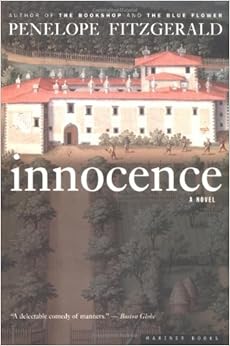
Innocence by Penelope Fitzgerald

Chiara and Salvatore quarrelled, but no successfully as they made love.  Chiara had no gift for quarrelling at all and could scarcely understand how it was done, nor, really, had Salvatore, since his argument was with himself and he was therefore bound to lose.  When they had torn up the grey dress together in the hotel they had hardly known whether they were for or against each other.  When Salvatore's temper rose Chiara become not frightened but reckless, as when driving through the city's traffic.  They knew each other, to be honest, so little, and had so few memories in common (the concert, the limonaia, the wedding) that they had to use them both for attack and defence.  They loved each other to the point of pain and could hardly bear to separate each morning.  The bed was on the narrow side so that it was impossible to lie for very long back to back or six inches of hostility apart.  This led to truces or reconciliations of a kind, rather too easily made...

Salvatore and Chiara never quarrelled twice on the same subject.  Each battle, as it closed, was recorded in their memories, as in an elementary history book.  In these books you usually get three or four causes of hostilities given, and afterwards three or four results, which have to be learned by heart.  It must have been eight weeks or more before there was any kid of dispute between them in public.

Chiara Ridolfi is the daughter of a Tuscan Count, whose noble family is not quite as wealthy as it once was.  Salvatore Rossi is a no-nonsense doctor, brought up in poverty in the south of Italy.  These two meet, only briefly, at a piano concert, but afterwards neither can stop thinking of the other.  After a strange and abortive courtship, which consists mostly of creepy stalking, they get married, only half understanding each other.  In another novel, this might be a recipe for disaster, or tragedy, but Fitzgerald is optimistic about human beings' abilities to reach out from the social bubbles in which they are born in live.

The novel opens with an account of the Ridolfi family, whose estate Ricordanza ("remembrance," appopriately) is still flanked by a pair of stone midgets that represent Chiara's little-person ancestors:

With great difficulty and many enquiries the Ridolfi followed up reported instances of midget families, so that by the time she was six their only child had a retinue suitable to her position, a tiny governess, a tiny doctor, a tiny notary, and so forth, all to size.  The child never went out, and was confident that the world consisted of people less than 1.3 metres high.  To amuse her, a dwarf (not a midget) was sent for from Valmarana, but without success.  She pitied him, because she thought that he must suffer knowing that, as a dwarf, he was different from anyone else at Ricordanza.  Then, in trying harder and harder to make her laugh, he fell and cracked his head, which made the little girl cry so bitterly that he had to be sent away.

Like the midget Contessa, both Chiara and Salvatore have difficulty engaging with those beyond their own small universes, but their infatuation for each other compels them to new worlds.  Chiara is young, unsure, and somewhat insulated by her class.  Salvatore is formed by the indignity of his childhood poverty, and the memory of his father's ardent Communism.  There is a great scene in which the young Salvatore visits the Italian Communist leader Gramsci, whom his father idolizes, during the last days of the dehabilitating illness that eventually killed Gramsci:

Salvatore knew by now the question he ought to put... He was quite well used to being told to put questions, as well as answering them, in the presence of a school inspector.  That was simply a matter of knowing what was wanted.  The more important these men were, the easier it was to reply.  ne of them had told the whole class to remains tanding and to answer the question in the first liens of the Fascist Chorus of Youth: "Duce, Duce, when the time comes, who will not know how to die for you?"  Impossible to go wrong there.  But Salvatore had also half-absorbed from the long droning evenings in the passage room, and form what they had earnestly tried to explain to him, the concerns of his father and Sannazzaro.  Suppose he tried: "Comrade Gramsci, sir, when the time comes, who will not want liberty?"

Courage.  But the words he had formed in his mind suddenly made themselves scarce, and still wanting and intending to say something quite different he asked loudly: "Why are you bleeding?"

Salvatore's experience seeing his father's idol disintegrate taught him to be beyond both sentiment and politics, and to cling to what is rational.  This is what makes him a great doctor, but also an irascible person, and unable to relate easily to other people:

"I've been told she has an aunt, an eccentric, possibly of unsound mind.  Don't you think that Chiara should be forcibly separated from her?"

"You can't expect me to have an opinion.  But if she has an aunt, I suppose it's natural that this young woman should be fond of her."

"Natural!  It's not natural, Nature is something quite else.  Do you think that a horse, or a pigeon, is fond of its aunt?  Could it recognise its aunt as such?"

"Perhaps not, but in ordinary human society..."

"So you're trying once again to distinguish us from the rest of animal creation," cried Salvatore in tones of angry satisfaction.  "You renounce behaviorism.  Is that what I'm to understand?"

Salvatore's a terrific, completely realized character, in a book full of them.  I'm consistently impressed by Fitzgerald's ability to draw vivid, human characters, even at the edges of the novel: Chiara's brash English friend Barney, her taciturn cousin Chiara, the servant, Bernardino, who is under the impression that he is the actual owner of the Ridolfi estate.  Fitzgerald is good at creating the impression that, rather than dictating the actions of her characters, she simply makes them and then lets them loose, and the plot results organically from their human interactions.

I realized after finishing this novel that there are only two novels by Fitzgerald, who didn't start writing fiction until she was in her sixties, that I haven't read.  That makes me deeply sad.  Every time I finish one of her books I want to find another, and read it immediately, but I think in this case I need to practice the virtue of delayed gratification.

Monday, February 9, 2015

The Gate of Angels by Penelope Fitzgerald

At the end of his first year as a Junior Fellow, Fred thought it only right to tell his father that he was no longer a Christian, but in such a way to distress him as little as possible.  All this sounded more like 1857 than 1907.  He had heard family stories, distant echoes or reminiscences of giant battles from what seemed heroic days.  Two of his uncles had quarrelled over Strauss' Leben Jesu and struck each other and one of them had caught his head on the edge of the fender and broken his skull.  The other one, Uncle Philip, had been known for the rest of his life, though never in the family, as Slayer Family.  In his mother's family there were some who hadn't spoken to each other for many years, and there were women, once young, who had broken off their engagements because their betrothed had ceased to believe and who had bleached and withered into spectres of themselves behind church missionary society typewriters and the stalls of jumble sales.  Fred, who was kind-hearted toward the past as well as the present, felt that he ought not fall short, in the new century, of what had cost so dear.

The Gate of Angels is Fitzgerald's stab at a university comedy along the lines of Lucky Jim.  Those novels feel British in a peculiar way, because college in the United States is so vastly different, with its own kind of pretensions and strange ritualisms, but without the musty weight of tradition and chauvinism that these novels tend to poke fun at.  The scattered jokes about the different colleges at Cambridge are lost on this American reader, though I suppose that the most important thing about St. Angelicus--a school Fitzgerald has made up--is that it is tiny.  The protagonist of the novel, Fred Fairly, is employed at the college as a lecturer, "assistant organist, assistant librarian, deputy steward, and assist deputy treasurer.  The words assistant, deputy, and so forth didn't mean that there was necessarily anyone above him to do the work, only that he must do it without being paid."  It also male-only, and as a condition of his employment, Fred has to agree never to marry.  You may guess for yourself how what kind of conflict that introduces to the novel for Fred.

Fred has decided that he is an atheist, and feels obligated to tell his father, a small-town rector.  His position is teaching science (I think some kind of theoretical physics).  Fitzgerald wrings a lot out of the epistemological overlap between science and faith.  Fred's mentor, Professor Flowerdew, rails against the theoretical study of the atom, a new study in 1907:

'There will be many apparent results, some useful, some spectacular, some, very possibly, unpelasant.  But since the whole basis of the present research is unsound, cracks will appear in the structure one by one.  The physicists will begin by constructing models of the atom, in fat there are some very nice ones in the Cavendish at the moment.  Then they'll find that the models won't do, because they would only work if atoms really existed, so they'll replace them by mathematical terms which can be stretched to fit.  As a result, they'll find that since they're dealing with what they can't observe, they can't measure it, and so we shall hear that all that can be said is that the position is probably this and the energy is probably that.  The energy will be beyond their comprehension, so they'll be driven to the theory that it comes and goes more or less at random.  Now their hypotheses will be at the beginning of collapse and they will have to pull out more and more bright notions to paper over the cracks and to cram into unsightly corners.  There will be elementary particles which are too strange to have anything but curious names, and ant-matter which ought to be there, but isn't.  By the end of the century they will have to admit that the laws they are supposed to have discovered seem to act in a profoundly disorderly way.  What is a disorderly law, Fairly?'

'It sounds like chaos,' said Fred.

I find this a pretty funny riff on scientific thinking.  Fitzgerald, writing in 1990, knows that this is exactly what has happened--the biggest problem in physics today is that our various models of the way things work seem to completely contradict each other.  (Though Flowerdew's reference to "anti-matter" tips the hand of the irony a little too far.)  But that doesn't invalidate the theoretical structures that Flowerdew wants to reject, and Fitzgerald asks us to apply that to other kinds of thinking and knowing, including the kind of religious tradition that Fred abandons.

At the beginning of the novel, Fred gets into a bicycle crash and falls in love with Daisy, who was riding the other book.  Fitzgerald gives Daisy the middle section, which details her career as a nurse.  Like many of Fitzgerald's heroines, Daisy is smart and tough, and lives somewhere near the edge of respectable society.  Is Fred and Daisy's meet-cute meant to suggest a kind of order that arises out of disorder (the bike crash), and even suggests some divine or otherworldly influence?  How about when, at the end of the novel, Daisy--having split from Fred after a formal inquest about the bike crash reveals that she was accompanied by another man--wanders into St. Angelicus, not knowing that Fred works and lies there, only to fortuitously rescue the college's blind old master?  The fellows at the college freak out at the presence of a woman, but Fitzgerald suggests that Daisy is able to puncture this insulated, pretentious, narrow-minded, and hyper-masculine space, and that such puncturing is exactly what it needs.

Wednesday, August 20, 2014

At Freddie's by Penelope Fitzgerald

'If you choose to go on the stage,' he said, still pondering, 'you pass your life in a series of impersonations, some of them quite unsuccessful.'

'Of course they're bound to fail sometimes.'

'They earn their money that way, and in fact they want to earn it that way.  Do you know Hannah that causes me some astonishment.  It seems to me a sufficient achievement to be an individual at all, what you might call a real person.'

Man, I love Penelope Fitzgerald.  She draws characters so minutely but so perfectly.  At Freddie's barely cracks 150 pages but in that space it manages to pack in five or six really memorable, quite human characters and the complex relationships between them.  Ford Madox Ford called it "getting a character in," and I can think of few writers who do it better.  There's Freddie, the proprietor of the Temple School that provides the theaters of London with a steady supply of child actors.  A charismatic older woman, she's one of those people who somehow always get what they want:

Certainly she could create her own warmth, a glow like the very first effects of alcohol.  As to what she wanted, no mystery was made.  She wanted to get the advantage, but on the other hand human beings interested her so much that it must always be an advantage to meet another one.  When she smiled there was a certain lopsidedness, the shade of a deformity, or, it could be, the aftermath of a slight stroke.  Freddie never tried to conceal this -- Take a good look -- she advised her pupils -- I'm not nearly so amusing as you're going to be when you imitate me. -- But the smile itself was priceless in its benevolence, and in its amusement that benevolence could still exist.  One had to smile with her, perhaps regretting it later.

There are the child actors themselves, especially Mattie and Jonathan, who Freddie points out as the difference between talent and genius.  Mattie is highly successful, snagging several high profile roles, but is fascinated by and obsessed with Jonathan's mercurial genius.  Their relationship is defined by Mattie's mix of love and resentment, and Jonathan's indifference:

He could not be satisfied until Jonathan had got into some sort of trouble.  Then would be the moment to rush luxuriously to his assistance.  But there were so few opportunities, one must be continually on the watch.  Prompting, for instance, was never needed.  If Jonathan didn't know his lines (and he was not a quick study) he smiled, and read them from the book.  If he had no dinner money, the girls gave him Fruity Snack.s  Once or twice, however, he complained of a stomach ache, although in a detached way, as though the pain was the responsibility of someone else.  Then Mattie was in his glory.  Lay him down near the radiator, Miss, and keep him warm.  I know just what he has to have, I'll go down to Miss Belwett for the Bisodol, you want to be careful, he might get a lot worse quite suddenly, we had to get a stomach pump to one of the cast on Saturday. -- He was thanked, of course, but never enough.  He could not master the half-sleepy mysterious gum-chewing little rat of a Jonathan, or exact the word of approval he wanted.  Later he rolled him over on the washroom floor and banged his round head on the concrete as though cracking a nut.  'Has that cured your bellyache?' -- Jonathan considered, and said he would tell him later.  Mattie was outraged.  And yet his dissatisfaction showed that he was not quite lost.  It was the tribute of a human being to the changeling, or talent to genius.

I especially liked reading about these two, and the other child actors, because I have a lot of students who fancy themselves actors, and though mine are much older than Mattie and Jonathan, I recognized a lot of them here: their habit of breaking into impressions, or song, and the frequent theatrical air that suggests they are not being quite sincere.

Then there are the teachers: Hannah, who is attracted to the glamor of the theater world, and Pierce, who is utterly aware of his lack of talent, sociability, or sheer competence, but who approaches his own shortcomings with stolid resignation.  He is a bad teacher, cannot understand or relate to the children, though Jonathan takes a liking to him.  He is, of course, in love with Hannah.  That's him at the top of the review, struggling to make sense of those who can act like any number of people when he is so profoundly bad at being himself.

These characters are so interesting and vibrant that it feels as if, rather than devising a plot, Fitzgerald merely put them together so she might record what happens.  And indeed, there's not much of a plot--Hannah falls for a roguish actor, breaking Pierce's heart; Mattie tortures Jonathan; Freddie charms her way through the financial insolubility of the school.  And yet At Freddie's is always surprising, because people are surprising.  The novel resolves in a way that feels deeply sad, though in such a low-key way that it's hard to pinpoint where the sadness comes from, wringing more pathos out of the everyday than even the final paragraph of The Bookshop, when Florence Green boards a bus carrying the burden of her shop's failure.

The central idea of At Freddie's is a well-worn one: our selves are theatrical performances of a kind, and to be an actor is to master the self in a way.  Pierce doesn't understand it, but is naturally himself in a way that other characters in the book cannot be; perhaps that's why he appeals to the enigmatic Jonathan, whose acting genius is tied up with his aloofness and detachment.  Freddie's charm is a kind of bravura performance, a more comprehensive and assured one than any of her students can conjure.  In the end, she makes a surprising move--deciding to dedicate the school to training students to act in commercials--that seems out of character, but suggests that like any performance, it can be stopped, or changed, if the performer knows what he or she is doing.

Monday, April 28, 2014

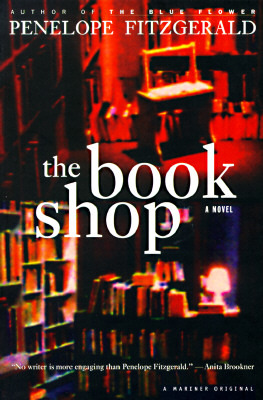
The Bookshop by Penelope Fitzgerald

British Railways delivered the copies of Lolita from Flintmarket station, twenty-five miles away.  When the carrier van arrived it drew, as usual, a ragged cheer from the bystanders.  Something new was coming to Hardborough.  Outside every public house there were parcels waiting to go out, and Raven, to save petrol, wanted a lift to the upper marshes.

Christine was aghast at the large numbers ordered.  They hadn't sold so many of one thing, not even Build Your Own Racing Dinghy.

Brent's recent post shamed me enough to get started on my own backlog of books to review.  Part of this shame is that I've been failing you, the blog-reading public--but mostly it's a shame for failing a great book like The Bookshop, which really deserves better than my warmed-over comments six weeks after I've finished.

The Bookshop is the book that gained Fitzgerald her first measure of public acclaim.  The trademarks of her later novels are here: the focus on a somewhat hermetic or fringe community, like the houseboaters of Offshore or the war-torn BBC of Human Voices; the proud and idiosyncratic hero/ine; a cast of quickly but deftly sketched characters.  The heroine here is Florence Green, who decides to open up a bookshop in Hardborough, an isolated island community.  Florence's ambitions are troubled by the seaside damp, and a poltergeist, but mostly by Hardborough's drably menacing social queen, Violet Gamart, who wants the property Florence buys for a local Arts Center.  The novel is one of modest ambitions beset by petty challenges, but Florence's steadfastness garners our admiration. 

My favorite of the minor characters population Hardborough is Christine, the ten-year old girl who Florence employs in the shop, and who approaches her job with blue-collar stolidity and a jealous possessiveness:

Christine liked to do the locking up.  At the age of ten and a half she knew, for perhaps the last time in her life, exactly how everything should be done.

The novel dwells on a long episode in which Florence mulls whether to order copies of the recently published Lolita; when she eventually does, it becomes a huge sensation in town.  I was particularly fond of this inlaid set of letters between Florence and her solicitor, responding to Violet Gamart's charges that the street activity around the Lolita display has become a public nuisance:

December 8 1959

Dear Mrs Green,
In reply to your letter of 6 December, I think we ought to abate the obstruction, by which I mean stopping the general public from assembling in the narrowest part of the High Street, before any question of an indictment arises, and I also think we should cease to offer for sale the complained-of and unduly sensational novel by Nabokov.  We cannot cite Herring v. Metropolitan Board of Works 1863 in this instance as the crowd has not assembled as the result of famine or of a shortage of necessary commodities.

Yours faithfully,
Thomas Thornton
Solicitor and Commissioner for Oaths.

December 9 1959

Dear Mr Thornton,
A good book is the precious life-blood of a master-spirit, embalmed and treasured up on purpose to a life beyond life, and as such it must surely be a necessary commodity.

Yours sincerely,
Florence Green.

December 10 1959

To: Mrs Florence Green

Dear Madam,
I can only repeat my former advice, and I may add that in my opinion, though this is a personal matter and therefore outside my terms of reference, you would do well to make a formal apology to Mrs Gamart.

Yours faithfully,

Thomas Thornton,
Solicitor and Commissioner for Oaths.

December 11 1959

Dear Mr Thornton,
Coward!

Yours sincerely,

Florence Green.

Besides being pretty funny, Fitzgerald does such a good job here of capturing these characters' voices with economy: the pedantic cowardice of the lawyer, the defiant pride of the shopowner.

To its credit, The Bookshop stops short of being inspiring; despite their enthusiasm for Lolita, the denizens of Hardborough never really rally in support of the bookshop against Violet Gamart's selfish domineering,  They patronize the shop when they want something from it, and ignore it when they don't, as they do with Florence herself.  These are people with lives of their own, with needs and ambitions equal to Florence's, and there is a bittersweet truth to the recognition that no one cares, or could ever care, about the bookshop as much as she does.  Her cold warn with Violet Gamart is, in the end, waged for relatively minor stakes.  But Fitzgerald suggests that steadfastness in your own ambitions, as private as they may be, is no small valor.

Saturday, July 28, 2012

Offshore by Penelope Fitzgerald

The Thames barges, built of living wood that gave and sprang back in the face of the wind, were as much at home as anything on the river.  To their creaking and grumbling was added a new note, comparable to music.  As the tide rose, the wind shredded the clouds above them and pushed a mighty swell across the water, so that they began to roll as they had once rolled at sea.

Nenna James lives on a houseboat, the Grace, docked at Battersea Reach, London, purchased without the knowledge of her husband, who refuses to come and live on it, too.  Her children, Tilda and Martha, are there, growing up amid the strange and motley collection of people who decide to live on houseboats: Willis, the old painter, who lives on the Dreadnought; Richard, who lives on the Lord Jim; Maurice, the prostitute who lives on the Maurice.

Their lives, like their boats, are in various states of disrepair.  Some, like Nenna's husband Edward and Richard's wife Laura, cannot understand the appeal of living on a houseboat, especially those which never sail.  They are a kind of liminal place, existing between worlds, which perhaps explains the motivations of those who love them as well as those who don't:


[Nenna said,] 'But, you know, by myself I can't make my mind up.'

'You shouldn't do it at all.'

'Why not, Maurice?'

'Why should you think it's a good thing to do?  Why should it make you any happier?  There isn't one kind of happiness, there's all kinds.  Decision is torment for anyone with imagination.  When you decide, you multiply the things you might have done and now never can.  If there's even one person who might be hurt by a decision, you should never make it.  They tell you, make up your mind or it will be too late, but if it's really too late, we should be grateful.  You know very well that we're two of the same kind, Nenna.  It's right for us to live where we do, between land and water.  You, my dear, you're half in love with your husband, then there's Martha who's half a child and half a girl, Richard who can't give up being half in the Navy, Willis who's half an artist and half a longshoreman, a cat who's half alive and half dead...'

He stopped before describing himself, if, indeed, he had been going to do so.


Fitzgerald's work has such an elegant simplicity; that's one of the things I like best about her.  (Offshore clocks in under 50,000 words.)  The other things I like about her: One, she didn't publish her first novel until she was 60, and won the Booker Prize for Offshore when she was 63.  Nice to know not everyone has to be Ned Beauman.

Two, she has a real knack for detail; Offshore, like The Blue Flower, slim as it is, offers up a couple dozen minor but wonderfully expressive, crystalline moments.  There is, for example, the moment when Nenna goes to see her estranged husband, accidentally announcing herself at the door as Grace.  Or when she, lost in the rain miles from Battersea without her purse for busfare, is accosted by a man as she leans over to fix her shoe.  For a moment it seems as if we are going to witness a sexual assault; instead he takes her shoe and throws it into the road.  Or when Maurice adorns the deck of his boat with flagstones and an antique lamp to make it look like a Venetian street corner.  Such details are minor, and often silly, but together they manage to create a vital sense of reality with a minimum of fuss.

It's a testament to Fitzgerald's skill and restraint that she grew up in a houseboat community like the one in the novel, and yet decided not to pile everything she knew about it into one massive tome.  Offshore lacks the rounded totality of The Blue Flower, and seems more like a single slice, randomly chosen, of the life of a peculiar community.  My greatest misgiving, then, is that I wish it had been a little longer.

Wednesday, March 21, 2012

The Blue Flower by Penelope Fitzgerald

He said, 'If a story begins with finding, it must end with searching.'

The Blue Flower is the story of Georg Philipp Friedrich "Fritz" Freiherr von Hardenberg, better known as the German Romantic poet Novalis. Brilliant and passionate, born into Low German nobility, trained to be a Salt Mine Inspector, Hardenberg is at the center of a blossoming of German philosophy that comprises his friends Schiller and Schlegel, and the older Goethe, under whose mysterious shadow they live. Fitzgerald gives us limited insights into Hardenberg's philosophy--poetic in nature, and preoccupied with dissolving the artificial barriers between people and things. For this reason, his philosophy is found in surprising places:

Fitz covered sheet after sheet of paper with schemes for discovering new lignite beds and improving the supervision of tile-kilns and lime-kilns, with meteorological records which might help to bring the refinement of brine to a higher standard, and with notes on the legal aspect of salt manufacture. But he also saw himself as a geognost, a natural scientist, who as he put it, had come 'to an entirely new land, and dark stars.' The mining industry, it seemed to him, was not a science, but an art. Could anyone but an artist, a poet, understand the relationship between the rocks and the constellations? The mountain ranges, and the foothills with their burden of precious metals, coal and rock salt, were perhaps no more than traces of the former paths of stars and planets, who once trod the earth.


But the most surprising place is in a twelve-year old girl, Sophie von Kuhn, with whom Hardenberg falls in love, though he is ten years her senior. He calls her, half-punning, his "Philosophy," and promises to marry her at sight, though she is neither very pretty nor passably intelligent. Fitzgerald manages to do what ought to be impossible: depict Hardenberg's love for Sophie as passionate and genuine, while never suggesting that Sophie is anything but an unremarkable child:

Sophie did not possess many books. She had her hymnal, her Evangelium and a list, bound with ribbon, of all the dogs that her family had ever had, although some of them had died so long ago that she could not remember them. To this she now added the introductory chapter of the Blue Flower.


Though Sophie probably does not realize it, she is identified with the blue flower of this story, Hardenberg has written but cannot figure the meaning of. Like the flower, which obsesses the story's protagonist though he knows not why, Sophie's worth is ineffable but unquestionable. In a great moment, Hardenberg's brother Erasmus manages to track down the aloof Goethe:

Goethe went on, 'I think I know what you want to ask me. You wonder whether Fraulein von Kuhn, when she is restored to health, will be a true source of happiness to your brother. Probably you feel that there is not an equality of understanding between them. But rest assured, it is not her understanding that we love in a young girl. We love her beauty, her innocence, her trust in us, her airs and graces, her God knows what--but we don't love her for her understanding--nor, I am sure, does Hardenberg. He will be happy, at least for a certain number of years, with what she can offer him, and then he may have the incomparable blessing of children, while his poetry--'

Erasmus desperately caught the arm of the great man in mid-speech, spinning him round like flotsam in the tide. 'But that is not what I wanted to ask you!'

Goethe stopped and looked down at him... 'I was mistaken, then. You are not concerned about your brother's happiness?'

'Not about his!' cried Erasmus. 'About hers, about Sophie's about hers!'


In the second half of the novel, Sophie takes ill. As Hardenberg says, a story that begins with finding must end with searching, and what he has found in Sophie he must search for a cure to keep. Throughout her illness, Sophie keeps her cheer, embodying Hardenberg's remarkable words:

'As things are, we are the enemies of this world, and foreigners to this earth. Our grasp of it is a process of estrangement. Through estrangement itself I earn my living from day to day. I say, this in animate, but that is inanimate. I am a Salt Inspector, that is rock salt. I go further than this, much further, and say this is waking, that is a dream, this belongs to the body, that to the spirit, this belongs to space and distance, that to time and duration. But space spills over into time, as the body into the soul, and the one cannot be measured without the other...'


I read this book because somewhere, in an article I know not where I read or when, Fitzgerald was compared to Muriel Spark, who is one of my favorite authors. To be sure, The Blue Flower reads like a Spark novel, light and clean and deceptively tidy. But Fitzgerald has strengths that Spark could never care to cultivate, like a genuine warmth toward her characters, and an unstudied air of historical expertise. I was delighted to find out, via Wikipedia, that these hilariously dull entries from Sophie's journal are historically accurate:

March 1. Today Hartenberch visited again nothing happened.
March 11. We were alone today and nothing at all happened.
March 12. Today was like yesterday nothing at all happened.
March 13. Today was repentance day and Hartenb. was here.
March 14. Today Hartenber. was still here he got a letter from his brother.


But Fitzgerald also manages to populate this slim novel with an extensive cast of sharply realized, highly individuated characters. Beyond Fritz and Sophie, I really enjoyed the cynical precociousness of Fritz's eight-year old brother, called "the Bernhard":

'I should prefer us all to be children,' said Erasmus, 'then we should have a kingdom of our own.'

'That is not at all my experience,' said the Bernhard.

When he was very young the Bernhard had believed that the six-year gap between himself and Sidonie would gradually disappear and that just as he would come to be as tall as she was, or taller, so he would grow to be the same age as she was, or older. He had been disillusioned.


In moments like this, I can see traces of Spark's crisp bluntness, but also a sense of playfulness alien to the frigid humor of her books.

Ultimately, The Blue Flower was one of those rare revelations for me, a book from an unknown author that I suspected I might like but which exceeded all of my expectations. I have expected so little from modern literature that it shocked me, too, to know that this book was written in 1995!