Showing posts with label Montreal. Show all posts

Thursday, June 13, 2019

St. Urbain's Horseman by Mordecai Richler

Sitting with the Hershes, day and night, a bottle of Remy parked between his feet, such was Jake's astonishment, commingled with pleasure, in their responses, that he could not properly mourn for his father.  He felt cradled, not deprived.  He also felt like Rip Van Winkle returned to an innocent and ordered world he had mistakenly believed long extinct.  Where God watched over all, doing His sums.  Where everything fit.  Even the holocaust, which, after all, had yielded the state of Israel.  Where to say, "Gentleman, the Queen," was to offer an obligatory toast to Elizabeth II at an affair, not to begin a discussion on Andy Warhol.  Where smack was not habit-forming, but what a disrespectful child deserved; pot was what you simmered the chicken soup in; and camp was where you sent the boys for the summer.  It was astounding, Jake was incredulous, that after so many years and fevers, after Dachau, after Hiroshima, revolution, rockets in space, DNA, bestiality in the streets, assassinations in and out of season, there were still brides with shining faces who married in white gowns, posing in the Star social pages with their prizes, pear-shaped boys in evening clothes.  There were aunts who sold raffles and uncles who swore by the Reader's Digest.  French Canadians, like overflying airplanes distorting the TV picture, were only tolerated.  DO NOT ADJUST YOUR SET, THE TROUBLE IS TEMPORARY... They were ignorant of the arts, they were overdressed, they were overstuffed, and their taste was appallingly bad.  But within their self-contained world, there was order.  It worked.

Jake Hersh is a successful television director living in London.  He's an outsider twice over, as a Canadian and a Jew, both a colonial and a stranger, but despite that, he's risen to wealth and comfort.  He has a tony house, a beautiful shiksa wife, several children.  In fact, if he hasn't achieved more, it's because he has an irritable streak and a chip on his shoulder, and often looks at his comfortable life with a kind of suspicion.  That is, until he finds himself accused of raping a young woman while his wife is out of town.  His co-defendant in the case is Harry Stein, an accountant from London's lower classes, who is like Jake's shoulder-chip personified, and mirrored by Mother England.  He's crass and perverse; he makes prank calls to starlets because he seethes with incel-ish anger that they reject, or would reject, him.  What attracts Jake to Harry may be that familiar resentment, write comically large, or perhaps there's something sobering about the way that Harry looks with jealous rage at Jake's life.  Either way, Richler implies that it's this attraction that has caused Jake's legal and marital troubles.

Harry's not the only foil that Jake has in the novel.  Jake spends much of his spare time trying to track down his cousin Joey, a charismatic ne'er-do-well who disappeared from Montreal's St. Urbain Street Jake was very young.  In Jake's memory, Joey is the only one who stood up to the escalating racial hatred of the French Canadians who boxed them in.  In his search, he's always narrowly missing him, in Israel, in Germany.  Reports of Joey differ--is he a gambler and a criminal, or the avenger of Jake's memory?  Jake believes he's tracked him to the jungles of Paraguay, where he believes that Joey--St. Urbain's horseman, tracking through the banks of the Parana River--is searching for the Nazi doctor Josef Mengele in order to exact revenge on behalf of the Jews of the world.  Like Harry, the Horseman is a foil for Jake: he is the thing Jake wishes he could be, the alternative to his pampered life of ordinary compromises.  He is another manifestation of resentment, channeled into righteous anger--the opposite of Harry's bootless pranks.

St. Urbain's Horseman has something sophisticated to say about the position of Jewish folks in the 20th century.  Clearly they have a lot to be resentful about, but is there a way to channel that resentment and make it useful?  If it is to be released, how is that done?  When a person from an oppressed group achieves success, or even bourgeois satisfaction, should they feel joy?  Guilt?  Is his father right to rage about his marriage to the gentile Nancy?  Jake has difficulty with these questions: he largely separates himself from his Jewish Canadian family, and invents another kind of family--the Horseman--in his head.

On the other hand, I cringed a little reading about the trumped-up accusations against Jake.  The "victim," a would-be starlet named Ingrid, is a character vacuum, briefly seen through a drunken haze and then sequestered behind the dais of a courtroom.  In the novel, it works, but I always feel squeamish about the way false rape narratives bolster, in even small ways, real-world suspicions about rape.  Put it alongside the joky anti-feminism of Barney's Version, and the Borscht Belt-comedian schtick of Richler's novels begins to seem hoary.

That said, St. Urbain's Horseman is very funny.  It is the most frenetic of the three Richler novels I have read, to the point of dizziness.  I was amazed by the relentlessness of the satire; I feel like most "funny" novels get credit for getting around to a joke every few pages, but in St. Urbain's Horseman, every paragraph has some incisive cutting remark or character beat.  (One of my favorite characters is a recurring cousin who's in the toilet business, and spends his whole visit to London examining, and praising, the commodes at places like Harrod's.)  I didn't think it had quite the same human element as Duddy Kravitz or Barney's Version, possibly because at heart those novels are tragedies, and St. Urbain's Horseman is about the ways in which a good tragedy can end up spoiled.  In the end, Jake gets off, his marriage a little dented, but his happy home intact--and that's something he'll have to learn to live with.

Saturday, July 14, 2018

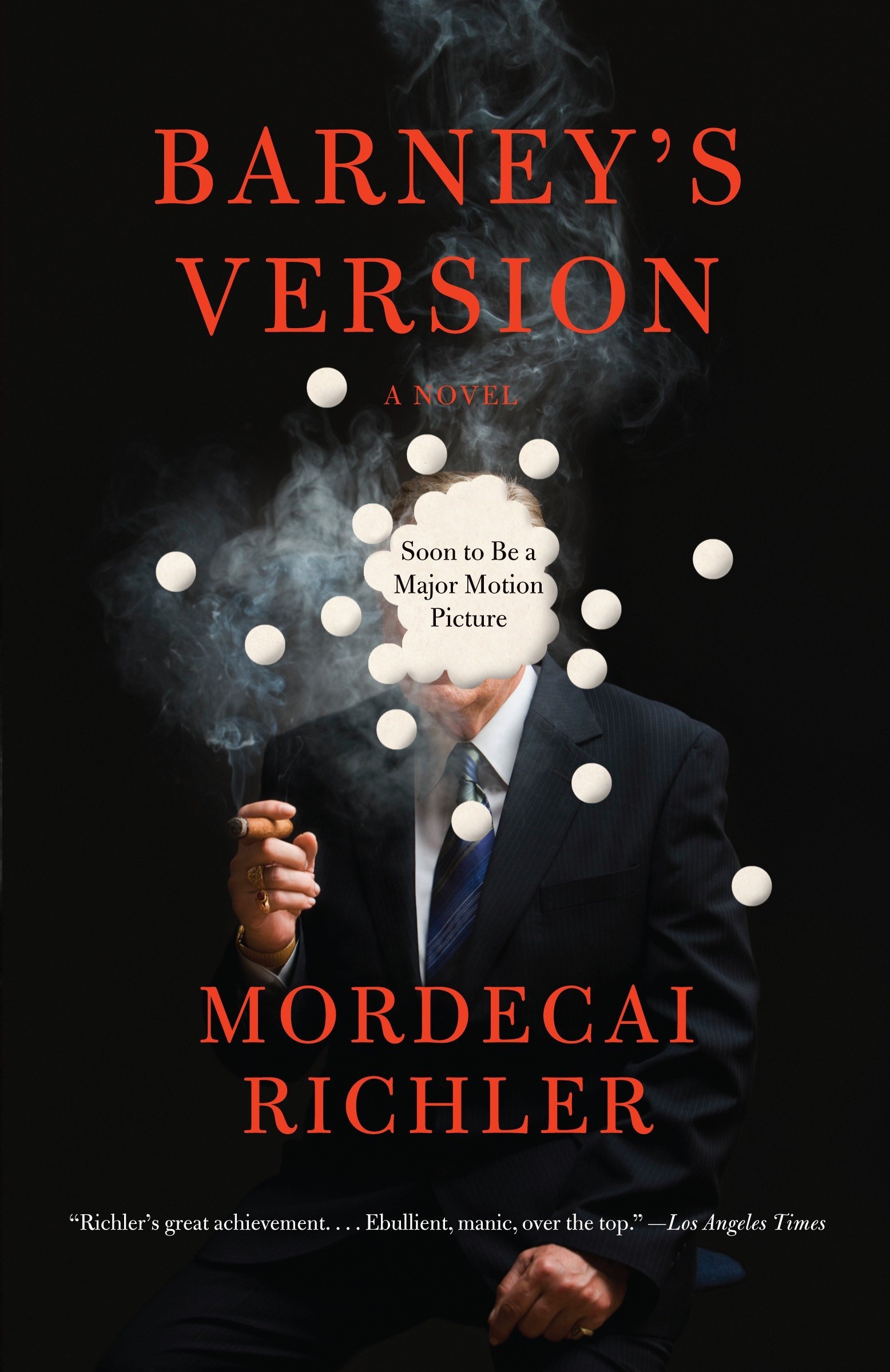
Barney's Version by Mordecai Richler

In a nutshell, I am not unaware of my failings.  Neither am I a stranger to irony.  I realize that I -- who took the Second Mrs. Panofsky's rambling conversation to be an abomination -- have consumed hundreds of pages, piling digression upon digression, to avoid getting to that seminal weekend in the Laurentians that all but destroyed my life, rendering unto me my reputation as a murderer, which is believed by some to this day.  Enter Sergeant-Detective Sean O'Hearne.  And I'm willing to swear that what follows is the truth.  I am innocent.  Honestly.  So help me God, as they say.

Okay, let's stick with the Canadians for a bit.

Barney's Version was the last novel of Montreal writer Mordecai Richler, and it reads like the novel a man writes as he faces down his own obsolescence.  Barney Panofsky, a successful television producer, wants to write and publish a firsthand account of his own life.  When he has been in the public eye, it's always been as part of someone else's sordid account: his first wife, Clara, who committed suicide before her poetry and art could make her a feminist icon; the memoir of Canadian novelist Terry McIver, who knew and despised Barney during their youth in Paris; and especially the lurid newspaper accounts of Barney's trial for killing his best friend Boogie after finding him in bed with his wife.  What Barney wants to do is not so much "set the record straight"--there's a lot of admitted culpability here--but to provide the human context that makes every story seem a little bit more deserving of empathy.  Barney's tendency to forget basic facts and details in his advanced age tends to complicate this project.

The novel is a riot, in many senses: it's extremely funny; it's propelled along by a kind of manic energy; it manages to capture the spirit of the political tension in Quebec in the latter half of the twentieth century.  At times it reads like a much funnier Philip Roth novel, preoccupied as it is with the place of the aging male in the world of sex.  The cast of characters is immense, and borrows from several of other Richler books, which make a kind of Montreal Cinematic Universe (MCU).  I was particularly happy to see Duddy Kravitz, all grown up and having finally struck it rich, needling a doctor for an underheralded disease he might become a patron of, admitting him at last into high-toned Westmount society:

"Crohn's disease."

"Never heard of it.  Is it big?"

"Maybe two hundred thousand Canadians suffer from it."

"Good.  Now you're talking.  So tell me about it."

"It's also known as ileitis or ulcerative colitis."

"Explain it to me in laymen's terms, please."

"It leads to gas, diarrhoea, rectal bleeding, fever, weight loss.  You suffer from it you could have fifteen bowel movements a day."

"Oh, great!  Wonderful!  I phone Wayne Gretzky, I say, how would you like to be a patron for a charity for farters?  Mr. Trudeau, this is D.K. speaking, and I've got just the thing to improve your image.  How would you like to join the board of a charity my wife is organizing for people who shit day and night?  Hey there, everybody, you are invited to my wife's annual Diarrhoea Ball."

Juxtaposed against colorful characters like Duddy, Barney himself pales a little.  That's by design, I think: part of Barney's deal is that he has always been adjacent to famous and outsized personalities, writers and artists, without ever becoming one himself.  Even Boogie, on the fateful day when Barney did or did not murder him, cruelly accuses Barney of being a kind of sponge on the more talented.  But Barney has his talents, including a razor sharp wit, amplified by a hot temper.  He spends much of his life writing and sending fake letters designed to get people in trouble, a bit I'm confident is borrowed at least in part from that other Canadian Jew, Saul Bellow.

One thing that troubled me a little about Barney's Version is its depiction of feminists and other liberal activists.  Barney's involvement, and supposed cruelty toward, his first wife Clara sends feminist writers his way, talking about "penis-power."  At times Barney's version seems to paint him as the victim of a kind of liberal orthodoxy that echoes a lot of modern right-wing meme culture.  These tensions are inextricably tied up with liberal support for Quebecois independence and French language laws, which Richler saw as inseparable from Francophone anti-Semitism.  But even when you think you have Richler's politics pegged, he comes into undercut them, as when Clara's father, a Canadian Jew who has recently been tossed off the board of his daughter's foundation by two black women, admits that "These women forced me to take a good look at myself."  It's a relatively minor moment in the book, but the novel's whole ethos demands that kind of criticism.  If Barney deserves his own account of his life, doesn't Clara, who never got to tell her own?  Who is it in this world whose stories aren't being told?

Barney's Version exists on shifting ground.  Barney's incipient Alzheimer's makes every detail suspect, and his account is supplemented by a series of corrective footnotes by his son, Michael.  The effect is to make Barney seem more or less trustworthy, but to inject the slightest doubt into his narrative, and to emphasize the subjectivity of our own versions of ourselves.  What do we do with a man who can remember "Velazquez's portrait of that royal family" but not that it's called Las Meninas?  Barney talks about the moment where his friend Boogie disappears as that "seminal weekend in the Laurentians that all but destroyed my life," but that's not true.  The trial succeeds in alienating Barney from his wife, whom he hates, and allowing him to marry the true love of his life, Miriam.  (In a nice comic touch, they meet for the first time on the night of Barney's wedding to the woman he calls only "The Second Mrs. Panofsky.")  It's a smaller, tawdrier moment, a night of drunken cheating, that separates him from Miriam thirty years later and really marks the ruin of his life.  It lacks the high drama of the murder charge, but it is enough to make you wonder how much Barney really understands about himself.

Richler's not really a postmodernist.  The mystery of what happened to Boogie is resolved in a way that's as satisfying as any Agatha Christie novel.  But he understands, with a comic realist's eye, just how much of what we tell ourselves about own lives is fiction, or at least fictionalized.  He understands, too, the idea that Barney's Alzheimer's, diagnosed at the very end of the narrative, represents the loss of that fiction, and it's tragic: the loss of "Barney's Version" of himself, no less meaningful because it's not entirely true.

Friday, July 14, 2017

The Apprenticeship of Duddy Kravitz by Mordecai Richler

Duddy trudged up and down through the snow with an owner's sharp eye for fire hazards and signs of mischief.  He tried the ice on the lake with his foot.  It cracked.  He urinated into a snowbank, writing his name.  It's my land, he thought.  But the wind began to cut quicker across the fields, suddenly the sun went out like a light, it was dark, and Duddy began to shiver.  Jeez, he thought, why didn't I leave the car lights on?  He buttoned up the collar and began to strike matches.  Duddy was able to trace his footsteps until the snow began to fall again, and then he was in bad trouble.  He circled round and round, his teeth chattered, and twice he began to run.  He ran and ran to no purpose until he collapsed panting in the snow.  His feet burned from the cold, his eyes felt as if they were stuffed with sand, and he began to think what in the hell am I doing lost in a blizzard, a Jewish boy?  Moses, he recalled from Bible Comics, died without ever reaching the Promised Land, but I've got my future to think of.

Duddel Kravitz is what you might call an "operator": a man with his hand in many money-making schemes, from selling pinball machines to filming bar mitzvahs.  He has his eyes set on a pristine tract of land surrounding a lake in Quebec's Laurentian Mountains, because as his grandfather tells him, "a man without land is nothing."  He buys up the parcels of land, one by one, using his older girlfriend Yvette's name because he's still too young to buy property legally--somewhere, over the course of the book, between sixteen and twenty.

I picked up this book because it's set in Montreal, where I was about to spend a couple of days.  Richler is well-known in Montreal, but his legacy is controversial because he was a longtime critic of the Quebec language policies that are designed to affirm the city's Francophone character.  As an Anglophone Jew who grew up in Montreal's Mile End neighborhood (now, like the Lower East Side, a trendy neighborhood), Richler was highly attuned to the way that the language laws enshrined Quebecker Jews as Other.  The Apprenticeship of Duddy Kravitz is steeped in Jewish culture and mannerisms, like a Malamud novel or a Woody Allen film.  It has the kind of self-deprecating humor that seems so characteristic of Jewish writing: observe how Duddy, having made friends with a goyische millionaire, can't understand why soliciting his new friend for the contract collecting scrap at his factories would be considered gauche, or that the millionaire has never heard of a Jewish criminal magnate known in Duddy's community as "the Boy Wonder."

The book is often wildly funny; at one point Duddy hires a blacklisted filmmaker to help him make his bar miztvah movies.  The filmmaker insists on total artistic control, and the film ends up a cut-rate Un Chien Andalou:

NARRATOR: Today you are a man, Bernard son of Moses.

18.  (Montage) Lightning.  Close shot of Michelangelo's statue of David.  Cartoon of a Thurber husband.  African tribal dance.  Close shot of a venereal disease warning in a public urinal.

Duddy's lust for money could, in the hands of a non-Jew or a less capable writer, make him seem like a walking stereotype.  But Duddy's greed is counterbalanced by a boyish simplicity and a sensitivity for others that even he seems not aware of.  When an epileptic he employs as a driver--a great, absurdly earnest character who considers Duddy the "Branch Rickey of epileptics" for giving him a chance--is paralyzed in an accident, he is crushed with guilt and lets his business empire go to ruin--at least temporarily.  But these qualities are often in direct competition with his greed, and his obsessive need for the land.  As his uncle writes him, "A boy can be two, three, four potential people, but a man is only one.  He murders the others."  The Apprenticeship of Duddy Kravitz, for all its excellent humor, gets is pathos from the overriding question of what man Duddy will choose to be, and which of his two selves he'll murder.