Showing posts with label Henry Green. Show all posts

Saturday, April 18, 2026

Nothing by Henry Green

"I wonder if it's why the relatives won't come."

"No Philip really. You know what their whole generation is!"

"How d'you mean?"

"Well they wouldn't let a little thing like that, I mean of going to bed, what we've just been discussing, make the slightest bit of difference would they?"

"I don't believe it is a little thing."

"No more do I."

"That's where the whole difference lies," he said "between our generations. Their whole lot is absolutely unbridled."

Philip Weatherby and Mary Pomfret are two young lovers about to announce their engagement to their parents. The problem is, their parents, Jane Weatherby and John Pomfret, are old lovers, whose affair with each other once ruined both of their marriages and threw their entire social world into upheaval. This event--like most events in Henry Green's novel Doting--is talked about only obliquely, and we are left to intuit that, beneath the layers of British gentility and emotional repression, what happened between Jane and John was rather volcanic. The two parents set about sabotaging the marriage in the way only the British can, or perhaps the way only Henry Green's characters can, without ever openly or explicitly acknowledging that they're doing so. In fact, once Philip and Mary begin to inquire with Jane and John about a little worry that has been niggling at the back of their minds--is it possible the pair are half-siblings?--it's difficult not to see the writing on the wall.

Among other things, Nothing is a book about generational differences. Jane and John come from the generation that came up between the two world wars, whereas their children are the products of post-World War II austerity. They see themselves as infinitely more sober and earnest than their parents, especially about things like love and sex, which they somehow take both more seriously and less obsessively, or so they believe. There is something inverted about the parents, primarily concerned with their flirtations and social lives, and the children, whose lives revolve around work. Jane and John are flighty and selfish, but their children are worse: they're bores. It was never quite clear to me why Jane and John are so against the marriage of their children, except that perhaps they take the possibility that Mary is John's daughter seriously. Or perhaps it's simply that the children's conception of marriage as an institution of respectability and sacrifice threatens their own open, freewheeling flirtation, which has carried on for years, much to the chagrin of the current lovers to which they seem rather lightly attached.

And this is all, of course, circumscribed with the narrowness of permitted language among the English bourgeoisie. Only Austen, I think, is able to express such a range of feeling and personality within such narrow constrictions. Like Doting, which as I understand it is often seen as a companion piece, Nothing is almost entirely dialogue. In both books, Green acts as something like an invisible eye, recording the language of the English classes that would have been familiar to him. (And it's interesting to me how well Green, a pretty posh guy, captured the voice of the middle and lower classes over his career.) Green famously wanted his dialogue to express the opacity of the human mind, and to dramatize how little we understand from someone's words just what they are thinking of feeling. But often I felt the language here does something almost opposite, unveiling and exposing people's true intentions even as they try to keep them hidden. It's genius-level stuff, but I have to admit that I liked best the moments where Green lets himself intrude upon the conversation to offer one of his paragraphs of jagged modernist language. For all that is great about both Doting and Nothing, they often felt to me like a novelist running away from the height of his own powers.

Saturday, March 22, 2025

Doting by Henry Green

They started together, fast, for the passage. Once outside, he shouted "in here" throwing open his and Diana's bedroom. There was a bathroom opened out of this, but, because the space was small, a basin with hot and cold water had been fitted by Diana's bed. It was to this that Miss Paynton ran. Turning the hot tap on, she zipped off her skirt, and stood with her fat legs starting out of lace knickers.

"Here, let me" he said, and knelt at her side.

She picked the handkerchief out of his breast pocket, drenched it in that basin, and then, putting her hand inside the skirt she had discarded, she began to rub at the stain.

And it was at this moment Diana entered.

She stood at the door with a completely expressionless face.

"Arthur" she said "when you're done, could you come outside a minute."

In a pivotal scene in Henry Green's Doting, Diana Middleton walks in on her husband kneeling at the feet of 20-year-old Annabel Paynton. Her husband, Arthur, has just knocked over a tureen of coffee onto her dress, and they have scrambled to save it, but of course, that's not what it looks like. But it is what it looks like, because Arthur has just been making out with the girl, who is slightly older than his son, and although the scene is quite comical in its irony, if the coffee had not been spilled, Diana might just as well have walked in on Arthur and Annabel sucking face. It's a great scene, the best in the book, and perhaps the only scene, strictly speaking: mostly, Doting is told entirely in dialogue.

The half-affair between Annabel and Arthur is a pathetic thing, never consummated, and for the most part barely more than a concatenation of middle-aged put-ons and half-rebuffs. Annabel finds Arthur attractive, but admires Diana; mostly she operates by a kind of young person's instinct that's only half-able to really think through the long term implications of her own desires, whatever those might be. She's having a bit of fun, but for Arthur, the affair is a desperate one, even though he deeply loves his wife. Doting, Arthur says to Annabel at one point, is not the same as loving--that is, the kind of relationship that Arthur has with Annabel, obsessive, squalid, horny, is not really even in the same universe as his relationship with his wife. Perhaps that is the way most affairs are conducted, whether it's a truthful statement or no; we love our partners even as we betray them, and need not really feel dissatisfied to be captivated by the allure of someone else.

Diana mostly turns a blind eye, even encourages Arthur in what seem to be his harmless attentions. They set up rules that are as pathetic as the affair itself--no meeting at night, no bringing her to the house--and which of course are immediately broken. Diana, miffed, begins an equally sexless flirtation with Arthur's friend Charles. Arthur, wanting out of a situation of his own making, tries to pawn Annabel off on Charles, a gambit that works too well, leaving both Arthur and Diana dejected. Annabel ends up introducing Charles to her equally young friend, and they fall in love, the end of a chain of infatuations in which Charles and Clare are the only ones who actually end up sleeping together. I don't know if Doting is the best novel Green ever produced, but it's definitely the funniest, and the deflation of every grand affair is part of its charm. All this is brought full circle by the return of the Middleton son Peter, a whinging, juvenile pest who's blind to all the stormy drama that's been going on in his absence, and whose immaturity only underlines how icky the middle-aged men of the novel really are.

Monday, May 27, 2024

Caught by Henry Green

In night clubs, it has been described, or wherever the young danced, couples passed the last goodbye hours abandoned to each other and, so Richard felt, when these girls were left behind alone as train after train went out loaded with men to fight, the pretty creatures must be hunting for more farewells. As they were driven to create memories to compare, and thus to compensate for the loss each had suffered, he saw them hungrily seeking another man, oh they were sorry for men and they pitied themselves, for yet another man with whom they could spend last hours, to whom they would murmur darling, darling, darling it will be you always; the phrase till death do us part being, for them, the short ride next morning to a railway station; the active death, for them, to be left alone on a platform; the I-have-given-all-before-we-die, their dying breath.

Richard Roe is a London aristocrat who, on the evening of World War II, does what he feels his duty: he joins the Auxiliary Fire Service, a hastily cobbled-together organization whose mission is to put out the fires started by German bombs. By a strange coincidence, his superior in the Auxiliaries is Albert Pye, whose sister has been placed in an insane asylum for having abducted a young boy from a department store--that is, Roe's child, Christopher.

The incident forms a strange, mostly unspoken relationship between the two men that colors their experience of the Auxiliaries. Neither man has initiated it, and both would be happy to divest themselves of it, but it's there, totally unlike any other relationship that might be recognizable--friend, authority, or enemy. For Richard, it's an unwelcome reminder of a life from which he has temporarily excused himself; Christopher and his wife Dy have been sent down to their country estate while he lives it up in the local and carries on an affair with a woman volunteer. For Pye, it's a threat to the authority that his been thrust upon him unwanted by the war.

Most of Caught, interestingly, takes place during the year before the Blitz, when the Auxiliary Fire Service existed only in preparation for the war to come. The firemen's day is taken up with drills and idleness. Some even stop them, who will later be considered heroes, in the street to accuse them of having joined to shirk their duty in the army. Green is less interested in war than he is the social politics of idle institutions; the firemen fight their boredom by engaging in petty gossip, of which Pye's sister's abduction of Roe's child will become of course an essential part. The ad hoc culture of the Auxiliaries is a backdrop for Green to explore the class politics of London: Roe responds to the discomfort of his aristocratic background among the Cockney firemen by standing everyone's drinks at the pub. Minor skirmishes of personality and class are circumscribed by bureaucracy; the worst possible sin is to be "adrift," that is, away without permission--a sin of which Pye, besotted with a pair of local girls, bears the greatest guilt. To be found out would be, like his sister was, the "caught" of the title.

Green is so slippery; Caught seems like many novels at once. It's a comedy of manners, rich in Cockney slang and speech, about how the war brings a collision between the upper and lower classes. Perhaps none of Green's other novels so perfectly illustrated the intense tension between his earthy ear for dialogue and his own spiked, serpentine prose. It's a war novel, too, as flash-forwards to the conflagrations of the Blitz show, written in a way that only Green could accomplish. And at times it's a novel of penetrating psychology and sexual repression that seems straight out of Green's American contemporary, William Faulkner. Pye, incensed by his sister's institutionalization (and the demand that he help pay for her upkeep), driven to instability by the pressure of his new position, forms a conviction that her impropriety is rooted in his own incest with her--something that he seems to have invented from a collection of muddled memories:

Without any warning, and with a shock that took all his breath, Pye saw the dry wood shaving creep, bent in the moonlight, the back ways to their cottage. He saw it again as though it was before his eyes, which he now tried to draw away from the doctor's. He had never before thought of his sister's creeping separate from his own with Mrs. Lane's little girl. In a surge of blood, it was made clear, false, that it might have been his own sister he was with that night. So it might have been her voice, thick with excitement and fright and disgust, that said "Will it hurt?" So in the blind moonlight, eyes warped by his need, he must have forced his own sister.

Caught's final chapter finds Roe back with his wife, having been incapacitated by a falling bomb. He tries in vain to tell her about the single night's experience in the Blitz, but he can't find the words and gets frustrated with her disinterest. (Green interrupts him from time to time to inform us that, despite his best attempts at description, the blaze was really "not like that at all.") Richard, we understand, has finally had the transformative experience that war and heroism have promised, and come back home only to find that not only can he not explain it, he barely seems to understand it himself. What makes him angriest, interestingly, is his wife's continued distrust of the (now-dead) Pye, brother to Christopher's abductor. What is it that makes him speak up in Pye's defense? Is it the bonds forged in war? Or the bonds formed in some other way, in the crucible of bureaucracy, of the institution, of the firehouse?

Tuesday, June 27, 2023

Back by Henry Green

What should he do? All he had was this suit he stood up in, which he had bought, and which the tailor had not delivered, but had kept safe till he got back. The rest was looted. Oh, he was lost in this bloody graveyard. Where could she be? Rose that he'd loved, that he'd come so far for? Why did she die? Could anyone understand anything? Perhaps it would have been best if they had killed him, he felt, if instead o a sniper's rifle in that rosebush they had pooped off something heavier at him. Rose would never have known, because she had died some time that identical week. God bless her, he thought, his brown eyes dimmed suddenly with tears, and I hope she's having a jolly good rest.

Charley Summers returns to England, repatriated from a prisoner of war camp in Germany, a little less than when he left: he's missing one leg. Nor is home the same as when he left it: his lover, Rose, has died while he was away. The loss of Rose leaves him bereft and numb, but Rose's father leaves him an address which he says conceals a "surprise"--his illegitimate daughter and Rose's half-sister, Nancy, who looks (to Charley, at least) exactly like Rose, except without her familiar red hair. In his fragile state, Charley is unable to understand what he's seeing; instead of finding in Nancy a new possibility, he convinces himself that she really is Rose, deceiving him and everyone else, and having become a "tart" while he was away.

Back must have been quite personal for Green, who served in the war, though as far as I know he came back intact. But it's a novel about how difficult it is to reintegrate oneself to home, which is never quite the home you leave, after the trauma of war. More than anything it reminded me of Mavis Gallant's terrific story "The Latehomecomer," about a man who comes back home after everyone else has moved on. "Moving on" is exactly what everyone wants Charley to do, including Rose's husband (!) James, who is one of several characters who urge Charley to get married again. And perhaps that advice is right, and Nancy takes to Charley despite the strange manner of their acquaintance, but only when Charley learns to see Nancy for who she is and not a treacherous, mutated Rose, can such possibilities be possible. For her own part, Nancy herself has also been mutilated by war: her husband Phil was shot down and killed in Egypt. Rose and Phil are like wounds that one can't help but scratch at, as much as they try to keep them taboo, they sneak into the conversation between Charley and Nancy. Interestingly, Charley's experience in the prison camp is the one thing that seems so deeply buried--because, it's suggested, it was such a hideous experience--that it rarely pokes its head into conversation.

Henry Green, man. The guy could write. Who else could see "a small crop of red apples half hidden, like sins?" Who else could get away with describing a character's feelings as "one tall question mark?" Because he loved ambiguity in dialogue, Green's novels often feel impenetrable, like smooth surfaces one can't get beneath, but then they'll hit you suddenly with an image of great pathos. In Back, it goes like this: Charley wants to send samples of Nancy and Rose's handwriting to an expert for comparison, but when he rereads Rose's letters, he realizes they give away their affair too clearly, and he can't bear to part with them anyway. Unthinkingly, he cuts them up and reassembles them into a less incriminating letter, only realizing afterward that he's destroyed the only link he has left with the dead Rose: "So, for the evening, he mourned the fact that Rose's treachery had destroyed the last there was left to him, the letters which, for all the months and years in Germany, had been what he was most afraid to find mislaid, or lost, when he got back."

Back is tremendously affecting like that, but there are a couple of other significant traits of Green's writing on display here. For one, he was a great writer about work, whether that's the tedious tasks of professional servants in Loving or the physical labor of foundry workers in Living. Here, Charley has a middle-management job producing some kind of widget for the war effort, a job of invoices and filing card systems that's reproduced in excruciating detail. And Green could be funny, too, as evidenced by a running gag about how many acronym organizations cropped up in England during the war ("We are now seriously behind with our S.E.V.B., S.E.P.Q., and S.O.M.F. contracts"). But the absurdity of English civil society in wartime only serves to deepen the powerful sense of loss experienced by Charley, Nancy, and others.

Wednesday, August 3, 2022

Blindness by Henry Green

He got up and groping towards the window opened it. As he did so there was a sudden lull in all the noise, he could only hear the clop-clop of a horse receding into the distance, and then mysteriously from below there floated up a chuckle; it was a woman and someone must have been making love to her, so low, so deep it was. He was on fire at once. Love in the street, he would write of it, love shouting over the traffic, unsettling the policemen, sweeping over the park, wave upon wave of it, inciting the baboons to mutiny in the Zoo, clearing the streets. What was the use of his going blind if he did not write? People must hear of what he felt, of how he knew things differently. The sun throbbed in his head. Yes, all that, he would write all that.

John Haye is a senior at an English public school. He's a little lazy--as we learn from the first thirty pages of the novel, which are in the form of John's diary--but of a literary bent, and prone to childish pranks as well as bookish sentimentalism. But his life changes forever when, on his way home, a stone thrown by a child shatters his window on the train, and he's permanently blinded. John returns home to his stepmother, a sort of local busybody who struggles with the idea that her stepson might become a burden to her, and who is appalled when he strikes up an attachment to Joan, the daughter of a local drunk and defrocked priest. The match is no good, though; Joan cannot give John the kind of new beginning he desires, and in the end, he and "Mamma" sell their country estate so that John can find his way as a blind man in the sound and fervor of London.

Entirely by accident, I seem to be reading a lot of first works lately. There was Gallant, then Didion, now Henry Green, who wrote Blindness while he was still at Oxford. Like those other books, it seems awfully weak in comparison to more "mature" books, but the incipient forms of a great author's style are fascinating to see. One of the strange feelings Green's novels generate is the sense of Is that all?, the feeling that you've read something in which nothing happens and whose shape is untraceable, because it was in the accumulation of details you missed while you were waiting for grand gestures. In Blindness that means the little details of country life that John may or may not have access to any longer, and which "Mamma" must feel are distinctly at risk. 

The novel's three sections are called "Caterpillar," "Chrysalis," and "Butterfly," as if to signal that Blindness is a novel not about loss, but of becoming and transformation. Joan, the undereducated, slovenly priest's daughter, is a kind of false start in that transformation. John indulges in fantasies that she will give him a new life, one that consists of walking with him to his old favorite viewpoints and describing the view--something which, as it turns out, disinterests and bewilders her. John has Joan all wrong, preferring the version he makes of her in his head; he even mishears her name at first as "June" and refuses to call her anything else. Their interactions give the novel some particularly Green-like moments of humor, the kind that can be difficult to catch. "They seem to me so lasting," John says to Joan, regarding trees, "so grave in their fat green cloaks, or in winter like naked lace." To which she replies: "There, an' I've forgotten to feed the chickens."

Only at the very end, with the arrival of John and his mother at London, does Green's modernism start to show. He seems actually quite resistant to describing the experience of being blind, preferring Mrs .Haye's viewpoint, or Joan's, to John's, until John is listening to the street noise below. This noise both frightens and excites him; for the first time he feels as if his subjectivity as a blind person has given him a way of knowing or understanding that might not be available to other people. He ends the novel in what you might call a "vision," if it weren't such an inappropriate word: a mysterious moment of ascent and elation that he calls, in the letter that ends the novel, "a fit." Green is cagey about what it is that John is seeing at last, and perhaps at the novel's end John is only beginning to see it himself, but he describes the feeling as one of true "joy."

Monday, September 27, 2021

Concluding by Henry Green

She had been looking at the other curtains, and now she rose from her place to walk daintily across. She paused an instant, then, courage in both hands, she swept these back as dramatically as the scene disclosed shone on her now smiling eyes. Because, except for what still hung over the water, the mist was evaporating fast, the first beech trees away to the right were quite freed, her Park itself was brilliantly clear, the sun up, a lovely day had opened and, as she watched, a cloud of starlings rose from the nearest of her Woods, they ascended in a spiral up to the blue sky; a thousand dots revolving on a wave, the shape of a vast black seashell pointed to the morning; and she was about to exclaim in delight when, throughout the dormitories upstairs, with a sound of bees in this distant Sanctum, buzzers called her girls to rise so that two hundred and eighty nine turned over to that sound, stretched and yawned, opened blue eyes on their white sheets to this new day which would stretch on, clinging to its light, until at length, when night should fall at last, would be time for the violins and the dance.

Henry Green's Concluding takes place over a single day at a state-run school for girls. It's Founder's Day, a holiday ending in a schoolwide dance, but in the morning two girls are discovered missing from their beds, which have not been slept in. Over the course of the day, one girl is discovered in the woods in torn pajamas; later, the still missing girl's doll--painted to look exactly like her--is discovered, too. This mystery, you might think, would wholly occupy everyone at the school, but for the most part it lurks in the minds of each behind their personal preoccupations: There's Mr. Rock, an aging scientist who has been gifted a cottage on the institute's land for his services to the state; Edge and Baker, the school principals who are set on scheming Rock out of the same cottage for the institute; Rock's granddaughter Elizabeth, staying with him while recovering from a vaguely alluded-to mental breakdown; and her lover, a charmless economics teacher named Sebastian Birt. The girl's disappearance brings these characters together, but as is typical in Green's novels, all conversation produces only crosstalk and misunderstanding; these people are too wrapped up in their own concerns to even hear each other, much less collaborate to solve an urgent mystery.

Green's toryism runs through Concluding. The institute--school seems like hardly the right word--is part of a vast future welfare state that has subsumed England. The red tape of bureaucracy circumscribes the characters' lives completely, and regulations loom over every possible action: a teacher's suggestion that they cut down fir branches instead of azaleas for the evening dance, for example, is dismissed out of hand as being against strict protocol. Regulations prevent Edge and Baker from interrogating the discovered girl, Merode, until she has been cleared by a doctor; yet they are all too happy to let the regulations prevent them from the task of finding the missing girl, Mary. Far from wanting to find the missing girls, they resent them for "laying their Institute open to the Grand Inquisition of a State Enquiry, and the horror of reports."

It's possible to read Concluding, then, as a jeremiad against the growth of the modern welfare state, which compartmentalizes moral obligation, sectioning it off as someone's--and always someone else's--parochial duty. Green is sharp in the ways that bureaucracy enables and justifies the baser ambitions of bureaucrats; the moral question of Rock's cottage, for example, is intentionally obscured by questions of protocol and paperwork. The resulting dehumanization is represented by the frustrating interchangeability of the institute's wards, all of whose names begin with M: Mary, Merode, Moira, Marion, Melissa, etc. The sixteen-year old girls, brimming with incipient sexuality and bright futures, parade through the novel as a mass dressed in white, becoming something like livestock, like Rock's white goose, white cat, and white sow. At the dance, Mr. Rock is escorted down to a mysterious basement door by a flirtatious student, and we feel that we are about to be ushered into the secret of what happened to the girls, but it's only a secret club: a place outside of the bureaucratic strictures of the institute and the state, where the girls can be at last themselves.

Concluding is a curious title: in one respect, I think it refers to the final stages of life of the aging Rock, whose retirement and residence are the urgent question that hangs over the immediate crisis of the day. It suggests also the deliberation and solution of a mystery; but--spoiler alert--the novel never comes close to revealing what happened to the absent Mary or the hapless Merode. Instead, the novel provides a series of images of occlusion: the veiling fog of the early morning, which gives way to the obliterating light of the afternoon, which in turn gives way to the difficult darkness just outside the nighttime dance. Green's world is one in which people always jump to conclusions because life and people give them so little to work with. Talking to someone else is only a variation of conversing with the version of the person we invent in our heads. We may never know what happened to Mary or why she left, but that's only a little less than we know about those in front of our faces.

Saturday, June 27, 2020

Party Going by Henry Green

Looking down then on thousands of Smiths, thousands of Alberts, hundreds of Marys, woven tight as any office carpet or, more elegantly made, the holy Kaaba soon to set out for Mecca, with some kind of design made out of bookstalls and kiosks seen from above and through one part of that crowd having turned towards those who were singing, thus lightening the dark mass with their pale lozenged faces; observing how this design moved and was alive where in few lanes or areas people swayed forward or back like a pattern writhing; coughing as fog caught their two throats or perhaps it was smoke from those below who had put on cigarettes or pipes, because tobacco smoke was coming up in drifts; leaning out then, so secure, from their window up above and left by their argument on terms of companionship unalloyed, Julia and Max could not but feel infinitely remote, although at the same time Julia could not fail to be remotely excited at themselves.

The first sentence of Henry Green's Party Going is such a classic Greenism: "Fog was so dense, bird that had been disturbed went flat into a balustrade and slowly fell, dead at her feet." Of all the sentences in the books assembled together in this collection (which also contains Loving and Living), that one might be the most characteristic of Green: the tension between obscurity and simplicity, the chopped articles mimicking the immediacy of experience, the careful positioning of past and present (notice we never see the bird being disturbed, only in the state of having been disturbed).

The bird-watcher here is May Fellowes, a middle-aged woman here to see off her niece Evelyn as she heads off on a train trip with her friends to the south of France. Miss Fellowes picks up the dead bird, washes it in the ladies' room, and wraps it neatly in brown paper, a kind of memorial rite that looks strange from the outside, and does to us too until the carefully controlled Green lets Miss Fellowes account for her feelings later on in the text. The bird's death establishes, too, the novel's central problem: the dense fog isn't letting any trains leave, and so the traveling party of Evelyn and a half-dozen of her friends is stuck in the station until something changes. All of the novel's action takes place in the station or the hotel above it, where the party is sequestered away from the regular commuters.

Party Going is a strange novel. It seems like it's going to be a "bottle episode," where a set of people are thrown together in a room where their conflicts will come to kindling. But as a matter of fact, all the characters in Party Going are almost never in the room together. Max Adey, the wealthy but capricious "leader" of the group pays for three rooms: one for the group, one for Miss Fellowes to lie down in--she takes suddenly ill in what they speculate is a pigeon-related illness--and one for him to escape to, with or without one of the women he's hooking up with.

The others come in and out of these various rooms, going to search for each other or check on luggage or go down to the hotel bar: the selfish Alex, the group outsider Angela, her jealous fiance Robin, the tensely married Claire and Robert, and helpless Julia, desperately in love with Max. Julia's hoping that the trip will cement her relationship with Max, but she hasn't counted on the unexpected arrival of Amabel, the stunningly beautiful and sort of malicious social climber who considers Max her right.

One of the interesting tensions I've noticed in Green's writing is this: Party Going is a novel written on a very human scale, and the dramas are all quite small, and entirely interior: this person wants to be liked by the group, this person wants to be loved by Max, this person wants to make her husband jealous, etc., etc. But at the same time, Green's famous for obscuring the motivations behind dialogue; he hardly ever explains the tone of voice someone uses or the face they make when they say something. It's supposed to mirror the actual experience of conversation, where nothing is ever clear, but when the entire drama of the novel centers on what people are thinking and feeling, it makes the whole thing a frustrating shell game.

The characters in Party Going are like the negative image of the characters in Loving, a novel about the Irish servants of a British castle, and Living, a novel about ironworkers in the north of England. In those novels, people struggle to make their lives meaningful within the structures that capital has created for them, but the characters in Party Going are the idle rich. When they escape to the hotel, a great steel barrier is set down in front of the door to keep the ordinary rabble from entering. The hotel is a cloistered space where the "party" can literally look down on the "thousands of Smiths" below and worry about the possibility that they'll break down the door. Almost without exception, the characters are awful: though Miss Fellowes goes out of her way to administer last rites to a pigeon, her niece and the others treat her sudden illness as a bother that might keep them from boarding the train when it finally runs. When they're not engaged in petty emotional games with each other, the whole group can't stop talking about a gossipy scandal about a socialite who may or may not have written a letter to the newspaper saying he wasn't invited to an embassy party. (This story was mostly inscrutable to me, honestly.)

Which means that, though finely wrought and impressively controlled, there's little to love in Party Going. It's a novel about bad people, and I found myself mostly hoping the train would finally depart, only to roll over all of their shins. As an expression of the way that money and class poison people's brains, it works tremendously well. But I'd rather spend time with the servants and the ironworkers.

Tuesday, June 19, 2018

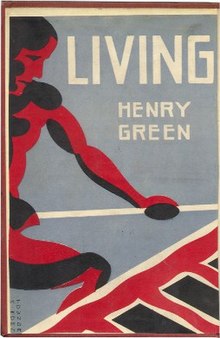
Living by Henry Green

What is a town then, how do I know?  What did they do?  They went by lamps, lamps, lamps, each one with light and dark  strung up on it each with streets these were in.  Houses made the streets, people made the houses.  People lived in them, thousands millions of lives.  Each life dully lived and the life next it, pitched together, walls between built, dully these lives went out onto streets promenaded dullness thee.  Ugly clothes, people, houses.  They went along through these, strangers to it, she did not recognize her own form of ugliness in it.

Henry Green's Living tells the story of iron foundry workers in Birmingham, England.  These men struggle, against dangerous and repressive work practices, and the monotony of everyday work, to "make a living."  But the word, when used that way, seems reduced somehow, as if the manifold experience of life has been reduced to the pettiness of living by the tedious horror of industrial labor.  Yet, they shape their lives around this experience, like the antiquated Craigan:

Mr Craigan had gone to work when he was nine and every day he had worked through most of daylight till now, when he was going to get old age pension.  So you will hear men who have worked like this talk of monotony of their lives, but when they grow to be old they are more glad to have work and this monotony has grown so great that they have forgotten it.  Like on a train which goes through night smoothly and at an even pace--so monotony of noise made by the wheels bumping over joints between the rails becomes rhythm--so the monotony of hours grows to be the habit and regulation on which we grow old.

Craigan lives with his friends and coworkers Jim Dale and Joe Gates (try keeping which is which in your head without double-checking each time, I dare you).  Gates' daughter Lily keeps the house, and Craigan sets his hopes on her marriage to Jim Dale, which will ensure the continued existence of this household in the face of the threat of financial instability.  Of course, Lily has plans of her own, and falls in love with another iron worker, Bert Jones.  Lily, too, has a kind of "living," as proscribed by the men in her life as the iron workers are by the demands of their class.  Added to this are numerous other characters of the foundry, managers and manager's toadies and son of Mr. Dupret, the heir to the foundry who's sudden accession threatens the stability of the foundry's small ecosystem.  The rich young Dupret is unhappy and bored in his wealth, and sees something to envy in the lives of the foundry workers:

Standing in foundry shop son of Mr Dupret thought in mind and it seemed to him that these iron castings were beautiful and he reached out fingers to them, he touched them; he thought and only in machinery in seemed to him was savagery left now for in the country, in summer, trees were like sheep while here men created what you could touch, wild shapes, soft like silk, which would last and would be working in great factories, they made them with their hands.  He felt more certain and he said to himself it was wild incidental beauty in these things where engineers had thought only of the use put to them, which you could touch; but when he was most sure he remembered, he remembered it had been said before and he said to himself, 'Ruskin built a road which went nowhere with the help of undergraduates and in doing so said the last word on that.'  And then what had been so plain, stiff and bursting inside him like soda fountains, this died as a small wind goes out, and he felt embarrassed standing as he did in fine clothes.

And yet there's nothing humanitarian about Dupret; his desperate need to exert control over his father's company and wrench it away from the middle managers who treat him like a neophyte produces results both good and bad for the workers.  Yes, he demands that they remove the guard who clocks the workers' bathroom time, but when the foundry comes up against financial straits, he's also the one who suggests sacking its most experienced workers, like Craigan, six months shy of their pension.  Though he envies their ability to create (paging Marx), his life is too far removed from that of the foundry workers for it to affect his decision making (paging Elon Musk).

I struggle with helping my creative writing students find the right amount of exposition.  Most amateur fiction is all exposition, elaborate setups that leave mere paragraphs or sentences for anything like conflict or action.  Green's strategy is to do away with exposition entirely; there are no explanatory paragraphs explaining who any of the novel's many characters are.  It's a bit like walking into a strange room and watching people interact and trying, and often failing, to piece together who they are and what they're about.  Added to that is this novel's particular, difficult style, which often eliminates articles entirely.  "Thousands came back from dinner along streets," the novel begins.  I read that this reflects something about the Birmingham accent, but I'm not sure of that--it certainly gives the novel, a brusque, spiked tone.

Like Loving, which contrasted the lives of nobility with their servants, Living is an effective juxtaposition of classes that reveals hard truths about the nature of the working world.  Reading it can feel a little like work, too.  But for those that can stand it, it's a rewarding labor, full of sharp insight into the world of the working class.

Thursday, March 2, 2017

Loving by Henry Green

'Oho so that's the old game,' he laughed.  'Keeping me on a string is it, to leave me to picture this and that and the other to do with you and him?'

'If you can bring your imagination to such a level you're to be pitied,' she answered tart.

'All I did was to ask,' he objected.

'You're free to picture what you please,' she replied.  I've got no hold on your old imagination, not yet I haven't.'

'What d'you mean not yet?'

'I mean after we're married,' she whispered, her voice gone husky.  'After we're married I'll see to it that you don't have no imagination.  I'll make everything you want of me now so much more than you ever dreamed that you'll be quit imaginin' for the rest of your life.'

The natural comparison point for Loving is obviously Downton Abbey: like the show, Green's novel is about the contrast in the lives of the residents of an old castle and the lives of their servants.  But whereas Downton Abbey is all melodrama, made for people with the attention spans of lizards, Green's novel demands the utmost patience, and its drama is wrought from the finer details of human life.  It's set during the war, but the war is distant, threatening--the servants at the Irish castle fretfully wonder whether they should return to their homes in England, to their loved ones, before the "Jerries" use the island as a stepping stone.  (Not like on Downton Abbey, where they have to show the pressures of war by turning the castle into a flipping soldiers' hospital.)

The novel begins with the death of the longtime head butler, Eldon.  His replacement, Charley Raunce, is by turns irascible and jovial, but the other servants (and his employer, Mrs Tennant) can see how green he is.  He's anxious to assert his new authority, but also to skim a little off the top of what he charges the household for supplies, something his predecessor did expertly for decades but which he hasn't yet learned to handle with tact or grace.  Meanwhile, he falls in love with a younger maid named Edith.  The romance between Charley and Edith proceeds sweetly but prosaically, with the happy fatalism of two people who realize, seemingly simultaneously, that they are meant to be together.  It's convincing, and somehow more affecting than it would have been with what you might call more fireworks.

Fireworks aren't Green's style.  The drama in Loving involves a missing ring, a pet peacock strangled by a bitter child, a glove full of eggs, a mouse caught in the wheels of a mechanical weathervane, a finely captured game of Blind Man's Bluff.  The house is full of characters who Green refuses to introduce with any fullness; if most people are unknowable, especially when we meet them, why should he bother?  As if to underscore this point, he names two separate young men Albert.

The result is a masterpiece of minimalism.  It seems like hardly a word is spared in Loving, nothing is extraneous.  And yet Green's sentences, often shorn of punctuation, take you on surprising, miniature journeys:

Albert laid himself under a hedge all over which red fuchsia bells swung without a noise in the wind the sure travelling sea brought with its low heavy swell.  He could watch the light blue heave between their donkey Peter's legs and his ears were crowded with the thunder of the ocean.

How can something made of such simple parts demand such attention to be understood?  That first sentence is so simple, but I swear I had to read it three times to follow it.  Not because it's a sloppy sentence, but because of its impeccable design.  Green doesn't break into these prose moments often, but often enough to seem like showing off, as if saying, I can do this, if I choose to.  Mostly the book is in dialogue, which is Green's most renowned skill.  James Wood, in How Fiction Works, praises Green for refusing to stuff his dialogue with adverbs to tell us how the characters are feeling; as with real people, our words are not as clear as we would want them to be.  In Loving, characters speak to each other like people, which is rare.

This is one of those books that I feel I haven't done justice.  Not just in this review, but in reading it; I feel like I wasn't up to its demands.  (I read this book on vacation in North Carolina; last year on the same trip I zipped through all 700 pages of Argall in the same time it took me to plod through the 200 pages of Loving.)  It's not complex, but it is exacting, and often surprising--blink and you'll miss something valuable, or extraordinary.  It's a book that ends just when you feel like you're learning how to read it.