Showing posts with label sweden. Show all posts

Sunday, October 19, 2025

Sun City by Tove Jansson

There are more hairdressers in St. Petersburg than anywhere else in the country, and they are specialists at creating airy little puffs of thin white hair. Hundreds of old ladies stroll beneath the palm trees with white curls covering their heads. There are fewer gentleman, however. In the guesthouses, they all have their own rooms, or they share with another person--some of them for only a short time in the even, healthful climate, but most of them for as long as they have left. No one is sick, that is, not in the normal sense of sick in bed. Such matters are attended to incredibly swiftly by ambulances that never sound their sirens. There are lots of squirrels in the trees, not to mention the birds, and all these animals are tame to the point of impudence. A lot of stores carry hearing aids and other therapeutic devices. Signs in clear, bright colors announce immediate blood pressure checks on every block and offer all sorts of information about things such as pensions, cremation, and legal problems. In addition, the shops have put a lot of thought into offering a wide selection of knitting patterns, yarns, games, craft materials, and the like, and their customers can be sure of a friendly and helpful reception.

The name of the retirement home at the center of Tove Jansson's novel Sun City is utterly perfect: Friendship's Rest. The old people who fill it, this retirement home in St. Petersburg, Florida--still, somehow, nearly fifty years later, the epicenter of America's old people--are sometimes friends, and sometimes at rest, but sometimes they hate each other. Eager-to-please Evelyn Peabody finds a great deal of catharsis in finally letting herself hate the bitter Catherine Frey. Thompson--one of the retirement home's few men--hates everyone more or less, but especially the gardener, on whom he loves to play cruel tricks. He also hates his wife, who shows up one day at Friendship's Rest wondering where he's been for the last twenty years. Rebecca Rubinstein, who cruises through the home like a Borscht Belt Battleship, looks down at them all with a sense of wry bemusement. Even the happy-go-lucky residents, like Hannah Higgins, who seems content to spend her final days with a pair of knitting needles in hand, follow a strict hierarchy of arrangement of veranda rocking chairs that adumbrates all the social relations at Friendship's Rest. The novel has a lot to say about what it's like to be in the last years of your life, and one such message is that you most certainly do not outgrow pettiness and resentment.

I loved Sun City. It felt like a novel that someone wrote specifically for me. And though I have loved Tove Jansson's books before, especially the lovely Summer Book, I never would have expected this particular book from her. It reminded me most of Penelope Fitzgerald: comic and insightful, with a large and slightly absurd cast of characters. Most of them, of course, are old people, but the novel has exactly two young people: "Bounty Joe," a motorcycle-driving Jesus Freak hippie who works as an ersatz swashbuckler at the HMS Bounty, a "movie ship" in St. Petersburg harbor, and his girlfriend, Linda, Friendship Rest's Mexican housekeeper. Joe is waiting for a letter to come from another group of Jesus Freaks that will summon him in the case of, I guess, Jesus Christ's return, and as the letter keeps not coming, he grows increasingly frustrated and bitter. Linda is sweet, and sort of simple-wise, and her philosophy of finding beauty in each moment contrasts with Joe's frustrated millenarianism. It struck me that, in the sense that he is waiting for an imminent world to the end, Joe is both an interesting variation on and contradiction of the old people at Friendship's Rest: they are all waiting for an end that's just around the corner, but Joe seems to think that he will be spared the full progression of life that is the inheritance of every fortunate person.

"Death is young," Peabody remarks cryptically. She is watching a young boys' chorus: "In an irrational moment she got the idea that they were harbingers of death, that they were like death itself, relentless, incomprehensible, and beautiful." Beautiful!? This sort of shocking insight, the surprising word, is the kind of thing that reminds me of Fitzgerald and one of the reasons that I found the book so satisfying. No doubt Thomas Teal's translation from Swedish has a lot to do with the book's impact as well. It's not a perfect novel where all the different threads are brought cleanly and elegantly together; in fact, the ending is kind of a mess: the residents of Friendship's Rest end up at one of Central Florida's freshwater springs at the same time that Bounty Joe and Linda are also there on a long-awaited excursion. It's a curated experience, but the Florida jungle lurks at the margins, full of shadows and monkeys. The residents get loose and lost, and the whole thing is sort of a mess, and when it was over I thought, well, what was the point of all that? But I liked the book a little bit better for that, too, for the way it denies a straightforwardly legible resolution. Because what does the end of one's life ever resolve?

Wednesday, November 1, 2023

The Sybil by Par Lagerkvist

God is merciless. Those who say he is good do not know him. He is the most inhuman thing there is. He is wild and incalculable as lightning. Like lightning out of a cloud which one did not know contained lightning. Suddenly it strikes, suddenly he strikes down on one, revealing all his cruelty. Or his love--his cruel love. With him anything may happen. He reveals himself at any time and in anything. The thunderstorm that drove me into the cave, the goat that were sent to take care of me, the scorching summer, charged with unparalleled heat, the birth in the goat cave while heaven hurled its lightning at the earth, the queer behavior of the goats, their eager interest in the birth and the baby, the vile, repugnant, inhuman events in the goat cave--what lay behind all that? Something divine? Something cruelly, savagely divine?

A traveler climbs the high, rocky cliff above the Temple at Delphi, looking for a woman he has been told can tell him his destiny. He finds her, aged and isolated, but living with her son, a mute who seems to neither speak nor understand. He is the Wandering Jew, a figure cursed to walk the earth for all eternity for refusing to let Jesus, en route to the crucifixion, rest his head against the side of his home. She is the former Sibyl, once a young virgin and priestess. He tells his story, and then she tells hers, about how she was cast out of the Temple and chased into the mountains after an affair with a young man, who impregnated her. The mute man is his offspring, or at least she once thought so--perhaps, she tells the wanderer, the father is really God, who took possession of her body over and over.

It's interesting, the way Lagerkvist brings together these figures from two different religious traditions: Greek paganism and esoteric Christianity. Both the Wanderer and the Sibyl understand that they are, in a since, like each other, cast out from God's favor, punished by providence. (It's a little funny that the tradition of the near-immortal Sibyl, aged and shrunk so badly she hangs from a jar, doesn't make it into the book--though I suppose that is a different Sibyl and a different Temple. ) The Sibyl may no longer have the gift of prognostication and cannot tell the Wanderer whether he'll ever be free of his curse. Nonetheless, she seems to have lived with her curse much longer than the Wanderer, and she shares with him a kind of wisdom from her experience: to be cursed by God, she explains, is a way of being loved by God, because it bounds one's life up with His irrevocably. The Wanderer may never be free of his curse, but he'll never be free of God, either.

"His cruel love," the Sibyl calls it. The Sibyl brings to mind Lagerkvist's Barabbas, who has no love for or loyalty to Christ, and yet who finds himself impressed into Christ's service the moment Barabbas' life is traded for his. Barabbas calls himself "God's slave," and the Sibyl and the Wanderer are, in their way, God's slaves, with all the accompanying connotations of violence and malice. But the Sibyl has learned that it does no good to hate God for his love, as the Wanderer declares he will forever, because you can't hate "the most inhuman thing there is." For Lagerkvist, God is all-powerful but beyond knowing, and this is alternatingly terrifying and enlivening. The metaphor of the sudden thunderbolt is good, because God is as surprising as he is powerful. I loved the ending of The Sibyl, in which the mute, insensible son--a kind of Christ figure who has no Christian love or interest in redeeming anyone, a Christ as moveable as a clump of earth--disappears from the cave and is taken up, perhaps into God's right hand. Is the Sibyl free? Or has she lost her only companion, God's presence in her life, no matter how inscrutable? Yes, and yes.

Friday, June 30, 2023

Mona by Pola Oloixarac

The Swedish summer light covered everything like a soft layer of dust, white material that made it look like it had just rained chalk. It was so cruel that darkness wouldn't start to fall until close to midnight. The day would remain in this pale limbo for interminable hours. It was a writers' purgatory, the white page as breathing air, where everyone was just waiting around to see who'd receive the key to paradise. How long do bruises last on the body?

Mona, a Peruvian-Argentinian writer who has recently published an acclaimed debut, has been nominated for the prestigious Basske-Wortz Prize. She's been invited to a remote compound in Sweden where she and a couple dozen other writers from around the world will hobnob and gossip, and at the end of the week, the prize will be announced. Mona thinks she stands a chance, but maybe not as much as the mercurial Icelandic poet Ragnar, or the smug French writer Philippe. But she may not last through the week, as she seems to be falling apart: mysterious bruises, whose source she cannot remember, have appeared all over her body. 

On her phone, Mona reads about the disappearance of a young Argentine girl named Sandrita. Speculation flies about the disappearance, until, towards the end of the week, Sandrita turns up dead and raped on a beach. The reader is asked to see a parallel between Mona and Sandrita, perhaps even wonder if the mysterious bruises that have appeared on Mona's body represent a kind of mystical kinship with Sandrita. And yet, Mona is many thousands of miles away; the writer's conference could not be further than the reality of Sandrita's short life if it were on the moon. The writers who get up to speak about the political in their writing end up sounding proud and ridiculous, as with the Middle Eastern writer who claims, "I will be your voice" to the voiceless of the world, or the reactionary jerk who says things like, "Our Virgin Mary is Che Guevara." And perhaps that's the point--all this talk about the significance of writing is divorced from the world it's meant to represent. "It's not that there are no more literary personalities in our era," Mona tells another writer, "it's just that now they come to places like these thinking they're writers and end up leaving as characters. The festivals are the real novels!" But if so, they're novels that speak to no one but the characters themselves.

Man, I couldn't figure this book out. How seriously am I supposed to take the Virgin Mary-Che stuff? It's too shallow to be serious, but not funny enough to be satirical, I thought. Mona is a talky novel, in which Mona engages in short conversations with her fellow writers, and in which they say things that are inscrutable, shallow, or both, and in language that no one--not even writers--drops into in the very first moments of meeting someone. How seriously am I supposed to take this, for example:

And there's nothing as womanly as incarnation. To be a woman and write is to be trans. That's why writing is trans, being fat is trans, and this whole performance of being a woman is the most trans thing in the world. Ever since Tiresias, who of course was the first trans person ever.

It's hard to write a book about writing; it's a tall order for anyone, I think. But Mona isn't a book about writing; the act of writing barely enters into it. What Mona writes about, or what her writing sounds like, we'll never know, just as we don't know anything, really, about the writing of Marco or Akto or Shingzwe or Chrystos, or whoever. But the writers themselves aren't interesting without their writing, which ought to animate this whole farce. If the thesis of the book is that writing is divorced from the world--and I think that's meeting it a little more than halfway--Mona manages to be both divorced from the world and divorced from the writing. What's left is a series of tedious conversations. Mona wants to satirize those writer's conference, but it fails because it's too convinced that the conferences themselves are inherently interesting.

Mona is a book where nothing happens, until it does: first, Mona remembers at last that her bruises are the result of a rape by Antonio, the lover whose texts she's been ignoring all week. Second, the mysterious Icelandic poet finally gets up to speak, and in doing so--spoiler alert--summons a mythical Norse serpent from the compound lake. It's a symbol, I guess, of the real--power, death, violence--intruding upon the masturbatory writers who have ignored it, despite their pretenses. As an ending to the book it feels cheap and strange.

Thursday, July 8, 2021

The Book of Eels by Patrik Svensson

An eel, silvery and fat, swims out to the ocean, setting off on its final journey back to the Sargasso Sea. How does it know where to go? How does it find its way?

When it comes to the eel, we can allow ourselves to ask banal questions, simply because the banal questions don't always have immediate answers. We can also allow ourselves to welcome this. We should be glad that knowledge has its limits. This response isn't just a defense mechanism; it's also a way for us to understand the fact that the world is an incomprehensible place. There is something compelling about the mysterious.

The European eel is one of the most mysterious, yet familiar, creatures in the world. For hundreds or thousands of years, it's been a staple of European cuisine and culture, a staple of coastal lifestyles from Spain--where the juvenile "glass eels" are considered a delicacy--to the Sweden of author Patrik Svensson's childhood home. And yet little is known about the eel, a creature that no one has ever seen mate. For centuries, the "eel question" dominated discourse among natural scientists. Some claimed the eel must be hermaphroditic, reproducing asexually, or even appearing naturally from the mud, since its sexual organs could not be found. The 18th century discovery, at long last, that eels grow sexual organs only when it's time to reproduce was an Einstein-level bombshell among biologists.

The Book of Eels is, at least partially, a history of "the eel question," and the dedicated naturalists who pursued it. Svensson details the life of Danish biologist Johannes Schmidt, who doggedly trawled the Atlantic measuring the size of willow leaf-shaped eel larvae, looking for the smallest, and who determined that eels must reproduce in the Sargasso Sea, the placid sea-within-a-sea that rests between the various ocean currents. He describes others who turned their attention to the "eel question," like a young Sigmund Freud, whose frustrated attempts to discover the reproductive patterns of eels may have helped turn his attention toward psychology, and Rachel Carson, whose description of the life of the American eel was an integral part of her advocacy for the world's oceans. And yet, The Book of Eels shows, the "eel question" has never been satisfactorily resolved. There are those who believe, because we have never seen them mate in the Sargasso Sea--or even found a sexually mature eel there!--the assumption that they breed there must be mistaken. To consider the eel question on the precipice of the 21st century is to consider the limits of our own knowledge and the persistence of mystery.

Svensson intersperses with these natural histories a loving and wistful description of his own relationship with his father, with whom he used to fish for eels in the rivers of his native Sweden. The mystery of the eel, touched by the ordinary fisherman, stands in for other, more personal mysteries, like the one that lies at the heart of the father-son relationship, and the inevitability of loss. In this way The Book of Eels reminded me of Helen Macdonald's wonderful and touching H is for Hawk. It's to Svensson's credit that the transitions from the natural history sections to the personal reflections, which might have seem forced or silly, never do. Among other things, The Book of Eels is skillfully written, deft and nimble, but never overly sentimental or tendentious. Its power comes from the simple and familiar nature of its subject, a common--and not very attractive--fish, that nevertheless evokes a deep wonder.

Tuesday, June 8, 2021

The Dwarf by Par Lagerkvist

I am twenty-six inches tall, shapely and well proportioned, my head perhaps a trifle too large. My hair is not black like the others', but reddish, very stiff and thick, drawn back from the temples and the broad but not especially lofty brow. My face is beardless, but otherwise just like that of other men. My eyebrows meet. My bodily strength is considerable, particularly if I am annoyed. When the wrestling match was arranged between Jehoshaphat and myself I forced him onto his back after twenty minutes and strangled him. Since then I have been the only dwarf at this court.

The dwarf Piccoline resides at the court of an Italian prince in the 14th century. His position there is nebulous: he is not a buffoon, he informs us, as some dwarfs are, and though he serves the Prince he does not seem to be a kind of servant. He is rather like an emanation of the Prince himself, a ghost or shadow: "Even the ignorant mob understands that the master's dwarf is really the master himself," he writes. What distinguishes Piccoline, in his eyes, is that, while others hide their monstrous nature with pomp, play, and pretend, he resembles himself. He says: "Only I am."

Piccoline's view of humanity is a jaundiced one. His position as dwarf--literally overlooked, you might say--enables him to see what others cannot or do not: the way the Princess carries on her affair with the knight Don Riccardo, for instance, or their daughter Angelica's secret love for the heir of the Prince's foreign enemy. He sees the way courtiers give themselves over to lust and gluttony, both of which nauseate him, and which he considers a kind of vanity.

And yet his cynicism keeps him from seeing everything that he might, or understanding everything. He does not understand, for instance, why the sage Bernardo dissects a corpse to learn about the composition of the human body, something he considers both disgusting and irrelevant. His bafflement and disgust at the divulgence of what's inside the human body mirrors his bafflement and disgust at human feeling: "I cannot understand the love that human beings feel for each other," he says. "It merely revolts me." Piccoline is the shadow self of the Prince, and the shadow self of all people, maybe: the small voice that speaks to us from within and tells us that life is worth so little.

I was really captivated by the steely, sour persona of Piccoline. The story he narrates is one of national advancement and decline, though what happens seems less important sometimes than the power of his point of view on these things: the Prince wages war on a foreign power, sieging their city, and then uses the pretext of a peace treaty to ambush the opposing lord. Later, the Prince finds himself sieged by his enemy's vengeful heirs, only to be ambushed by a much more powerful foe in the Black Plague. The Prince's astronomers look for a narrative in the stars, but Piccoline knows that fate is a force beyond understanding: "I sit at the dwarfs' window and gaze out into the night, exploring it as they do. I need no tubes or telescopes, for my gaze itself is deep enough. I too read in the book of night."

Early in the book, Piccoline is tasked by the Prince to lead a mass for dwarfs, a performance which he turns into a grotesque satire, and for which he is punished. "I eat my own splenetic flesh," he says, "I drink my own poisoned blood"--a religion of solipsism, you might say. But Lagervkist, who wrote of the way Christ uses even the most wretched and vile refusers in Barabbas does so also here: toward the end of the novel--spoiler alert--Piccoline whips the Princess in a fit of disgust over her philandering. Racked with guilt, it is something she has craved, but still it sends her into a coma, then killing her. After her death she begins to be revered as a saint, and Piccoline is sent to the dungeon, made to suffer for years--thus becoming the kind of Christ figure, enobling the Princess' soul through his own suffering, in which he does not believe. The Dwarf is a story of radical ecumenicism, a novel that believes even hatred can be turned to the power of divine transfiguration.

Saturday, January 26, 2019

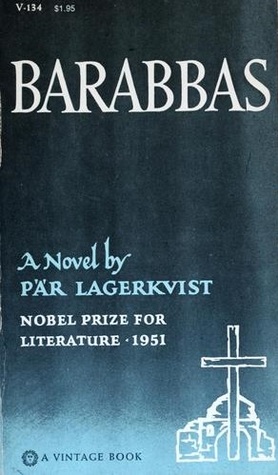
Barabbas by Par Lagerkvist

He had used his power in the most extraordinary way.  Used it by not using it, as it were; allowed others to decide exactly as they liked; refrained from interfering and yet had got his own way all the same: to be crucified instead of Barabbas.

They spoke of his having died for them.  That might be.  But he really had died for Barabbas, no one could deny it!  In actual fact, he was closer to him than they were, closer than anyone else, was bound up with him in quite another way.  Although they didn't want to have anything to do with him.  He was chosen, one might say, chosen to escape suffering, to be let off.  He was the real chosen one, acquitted instead of the son of God himself--at his command, because he wished it.  Though they suspected nothing.

In the Gospels, Barabbas is a "notorious prisoner" held by Pilate at the same time as Jesus.  Pilate asks the crowd which of the two they would like to see released as part of a Passover rite of pardon, and they choose Barabbas.  Par Lagerkvist's novel Barabbas imagines the life of Barabbas after his pardon, traveling up to Golgotha to see the man who is crucified in his stead, hanging around the empty tomb.  Barabbas is haunted by Jesus, a man he's never met, but who literalizes one of the core facets of Christianity by dying in his stead.

At first, Barabbas has a kind of didactic fable-like quality to it.  The contours of the novel seem pretty apparent: Barabbas, obsessed with this man who is linked to him by sacrifice, learns to become a Christian.  Lingering around the nascent Christian community of Jerusalem, he's told that their only ideology is "Love one another," and as hard as it is for the criminal and murderer to understand, it seems to us both simplistic and doctrinaire.  But the early Christians are not great at living this creed; they are suspicious of Barabbas, both for his connection to Jesus and his aloofness.  Is Barabbas lovable, even by the Son of Man?  It seems almost impossible, but such is the mystery of the crucifixion.

The book is best when it leaves Jerusalem, and the immediate context of Jesus' death, behind.  It flash forwards several decades: Barabbas, having returned to a life of crime, has been captured and enslaved in the copper mines of the East.  He's chained to a fellow criminal named Sahak, a Christian who has Jesus' name scrawled in Greek on the back of the golden medallion that identifies him as a slave.  One of the best things about Barabbas is its insistence that Christianity is essentially a slave religion, one that upturns traditional notions of power.  "I too have long been thinking of believing in this god," says their Roman overseer when he catches them talking about Jesus, "But how can I?  How can I believe anything so strange?  And I who am an overseer of slaves, how can I worship a crucified slave?"  We, for whom Christianity has been wedded to power for decades, if not centuries, forget that it is a slave religion at heart: disdainful of worldly power, predicated on its abnegation.  Jesus paradoxically uses his power "by not using it," as Barabbas notes.

When Sahak explains that the mark on his medallion professes Jesus as his true master, Barabbas has a realization: "Now Barabbas knew that he too was a Christian and that he was God's own slave."  But it's not the pat transformation the beginning of the book made me expect.  Sahak becomes God's slave of his own free will; Barabbas feels like Jesus' crucifixion in his stead has given him an involuntary claim over him.  When the Roman asks if, like Sahak, Barabbas is a Christian, he says no, and he doesn't lie.  He is not a believer, he doesn't want to "love one another"; his relationship to God is exactly as voluntary as his relationship to his slavers.  Barabbas lingers outside Christianity, drawn to it because of his pardon but never embracing it.  He is aloof from everything.  Can Jesus redeem such a man, Lagerkvist asks?  And if not, how do we make sense of the fact that Barabbas is the first man for whom Jesus sacrificed himself?  Is the Barabbas who claims not to be a Christian really the first one?

The novel ends with Barabbas being crucified for another crime.  Does this nullify his pardon?  Does it suggest that Barabbas, unwilling to accept his reprieve, has God's favor withdrawn from him?  At the last he speaks not to God, but to "the darkness" of death, saying, "To thee I deliver up my soul."  "Very negative ending," the former owner of my copy wrote in a very polite script.  But I'm not so sure.  Barabbas reminds me of nothing more than the whiskey priests and lapsed Catholics of Graham Greene, who somehow always find themselves loved and absolved despite their intransigence and apostasy.  Barabbas represents something of that central mystery.

Tuesday, January 2, 2018

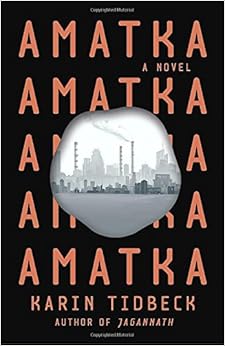
Amatka by Karen Tidbeck

Vanja emptied a box of pencils, lined them up on the shelf, and pointed at them one by one.  "Pencil, pencil, pencil."

It wasn't long before the words flowed together.  "Pencil-pencil-pen-cilpen-cilpen-cilpen-cilpen-cilpen--"

The last pencil in the row shuddered.  As Vanja bent closer to look, the shiny yellow surface whitened and buckled.  Then, suddenly and soundlessly, it collapsed into a pencil-shaped strip of gloop.  Vanja instinctively shrank back.  Her stomach turned.  She had done it.  She had said the wrong name, and the pencil had lost its shape.

In Amatka, as with the three other colonies that exist in the whole world, language keeps things together.  Not metaphorically, but literally: good citizens are reminded to frequently "mark" their belongings, both with writing and with speech, so that they remain intact.  Doors say DOOR, shoes say SHOE.  Vanja, a visitor from the capitol researching the locals' usage of hygiene products, is more careless than most.  In the first week of her visit to Amatka, she lets both her toothbrush ("TOOTHBRUSH") and her suitcase ("SUITCASE") dissolve into gloop.  It's suggested that someone who lets things fall apart that way has, deep down, a resentment toward the current order of things.

In many ways, Amatka is a conventional dystopian novel.  Vanja slowly comes to feel alienated by the repressive nature of the world government, which manages the lives of its citizens with a heavy hand and a close-watching eye.  But the odd circumstances give a heightened urgency to a tired plot.  If allowing laziness or subversion means the world will dissolve into gloop, aren't a heavy hand and a close-watching eye what's required?  Vanja is reminded that the committees are elected positions, and represents the will of the people to keep the community thriving.

Despite its clever premise, Amatka took a long time to catch my interest.  Vanja's story checks off a lot of the familiar boxes: a hidden past trauma, a sudden love affair.  It's notable that her love affair is with Nina, and that the book makes no special fanfare about the centrality of a lesbian relationship.  After all, reproduction in Amatka is divorced from its romantic and familial trappings: Nina and her male friend Ivar have children who spend the week at the Children's House, and the time they spend together on weekends seems more like duty than love.  Doing this allows Tidbeck to dismiss the historical pressure that we might expect to be exerted on a gay relationship in a repressive, community-oriented society, but it doesn't exactly make it seem more repressive, or more interesting.  And it certainly doesn't help that Nina's single noteworthy quality is a slavish sense of duty toward the community--which isn't a characteristic so much as an obstacle for the plot.

For most of its length, Amatka is weird, but not really weird enough.  I couldn't help thinking about Philip K Dick's evocative "gubbish," which is so much more terrifying than "gloop."  But by the end, when Tidbeck really lets shit get strange, I liked it more: A series of pipes and tunnels begin appearing, as if by magic, around Amatka.  Vanja deduces that a famous poet who left Amatka years ago with a band of 100 disillusioned citizens has returned, to save the colony from itself.  The poet knows that when you free yourself from repressive ideas of language--from the idea that words and their objects are inherently linked, and that words themselves can be pinned down dictionary-style--you can do almost anything.  And then you can speak pipes and tunnels into being, and change the very fabric of reality, the very fabric of your own being.  This notion leads to some really terrific, chilling scenes of visual sci-fi-horror.  The ending doesn't totally land, I think, but Amatka works because it finally trusts its own message.

Thursday, March 9, 2017

The True Deceiver by Tove Jansson

Oh, Anna Aemelin, the only thing you care about is your own conscience.  That's what you cherish.  You're a charming little liar.  A child writes, "I love you, I'm saving my money to come and live with you and the bunnies," and you answer, "How lovely.  You'll be very welcome.  And it's a lie.  The promises made by a guilty conscience acknowledge and settle no debts... You can't hide.  In the long run, you can't even try to make it easier for yourself by not daring to say no, by kidding yourself that everyone in the final analysis is nice and can be kept at a distance with promises or money... You know nothing about fair play!  You're a difficult opponent.  The truth needs to be hammered in with spikes, but no one can drive nails into a mattress!

Tove Jansson's claim to fame was the Moominland series of children's books, which must have gotten her no end of fanmail from young kids.  (I imagine them mostly as blonde European children, wearing lederhosen.)  How much of her own experience did she draw on in creating Anna Aemelin, the sensitive, aloof, guarded children's book artist of The True Deceiver?  Anna lives in her big house on the edge of town, eating tinned peas and being a hermit.  In the summer, she draws fine portraits of the forest floor, which she debases with the bunny figures her young fans adore.  The rabbits pay the bills, but it's the forest floor she really sees.

Katri Kling lives in the same town as Anna with her simple-minded brother Mats.  Whereas Anna is all politesse, devoted to the small niceties that protect--or perhaps insulate her from--human discourse, Katri is honest to a fault.  She has no regard for what she calls "the whole sloppy, disgusting machinery that people engage in with impunity all the time everywhere to help them get what they want."  But she wants something from Anna--namely her money, which she wants to use to buy Mats his own boat.

Katri slowly begins to look after Anna, starting by taking small packages and mail up to what the locals call the "rabbit house."  She ingratiates herself to Anna, becoming slowly indispensable, eventually moving in (with Mats in tow) and managing Anna's business affairs.  She's scrupulously honest, but still she thinks of her relationship with Anna as a kind of game.  Meanwhile, it's Anna, the gentle illustrator, who lies and cheats, but in a way that accords with her shyness and fear of conflict.

The question is in the title: who is the true deceiver?  Anna is the one who runs from the truth, but it's the high-minded Katri, no doubt, who uses Anna for her own needs.  These paradoxes are the terrific achievement of The True Deceiver, which wears its darkness and cynicism on its sleeve, unlike the oblique monstrosities of The Summer BookI liked that book a little bit better; ironically, it has the levity and light irony of a children's book whereas Anna Aemelin seems to occupy a vastly different universe from her rabbits with their flower-covered fur.

But I loved the way Jansson imagines these two slowly turning the screws into teach other, sometimes intentionally, sometimes because they are such vastly different people.  It's not just Katri torturing Anna--more often, it's the other way around.  At one point in the novel, Katri takes it upon herself to drag all of Anna's extraneous possessions out onto the winter ice where, when spring comes, they'll finally be disposed of.  Is it a favor or an insult?  And what happens when the bottom finally drops out?

Saturday, December 24, 2016

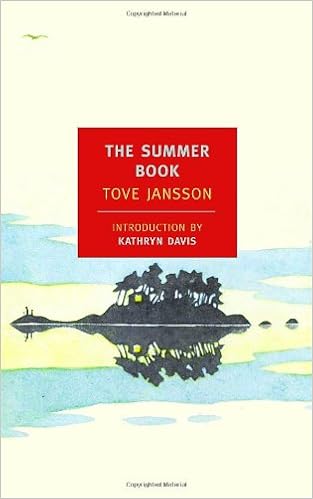
The Summer Book by Tove Jansson

One time in April there was a full moon, and the sea was covered with ice.  Sophia woke up and remembered that they had come back to the island and that she had a bed to herself because her mother was dead.

Who reads a book called The Summer Book in the middle of winter?  I do--but Brent is to blame, because he got me this slim collection of stories for Christmas.  They are by the Swedish-Finnish novelist Tove Jansson, better known for her collection of Moomintroll books for kids, and they all deal with the relationship between a young girl, Sophia, and her grandmother, on the island where they live during summers in the Gulf of Finland.

Sophia's mother has recently died--it gets one sentence in the novel--so it falls to Grandmother, a caring but prickly and reserved woman, to bring up Sophia.  Sophia's father--Grandmother's son--lurks in the corners of the narrative, planting bulbs and gathering supplies, but seems utterly distant from the girl and the old woman.  Jansson has a light, sardonic touch that helps these stories mine that relationship for simple, but profound, truths.  Grandmother indulges Sophia's childlike views on the world: in one story, Sophia prays to God for something eventful to happen because she is bored.  When a wild storm whips up, Sophia is elated, until Grandmother reminds her that people may be hurt, and Sophia is aghast: her prayer has brought the storm.  Not so fast, Grandmother says--I prayed for it first:

"You said yourself that He listens," said Sophia coldly.  "You said He hears everything you pray for."

Grandmother lay down on the herring net and said, "Yes, He does.  But you see I was first."

"What do you mean?"

"I prayed for a storm before you did, that's what."

"When did you pray?" asked Sophia suspiciously.

"This morning."

"But then why," Sophia burst out sternly, "why did you take along so little food and not enough clothes?  Didn't you trust him?"

"Yes, of course... But maybe I thought it would be exciting to try and get along without..."

Sophia sighed.  "Yes," she said.  "That's just like you.  Did you take your medicine?"

"Yes, I did."

"Good.  Then you can go to sleep and stop worrying about all the trouble you've caused.  "I won't tell anyone."

"That's nice of you," Grandmother said.

The relationship between Sophia and Grandmother is not always positive:

One evening, Sophia wrote a letter and stuck it under the door.  It said, "I hate you.  With warm personal wishes, Sophia."

All the words were correctly spelled.

But it is always rich and deep.  In one of my favorite stories, Grandmother gets Sophia a cat named Moppy, who turns out to be a savage beast, killing birds and leaving them in the family house.  Moppy returns no affection.  So Grandmother trades with a local family, Moppy for a docile cat named Fluff:

Fluff purred and stretched warm sleepy legs in all directions.  The sheet was covered with cat hair.

"Get up!" Sophia shouted.  "it's a storm!"  But the cat just turned over on its broad stomach.  And suddenly Sophia was furious.  She kicked open the door and threw the cat out in the wind and watched how it laid its ears back, and she screamed, "Hunt!  Do something!  Be like a cat!"  And then she started to cry and ran to the guest room and banged on the door.

"What's wrong now? Grandmother said.

"I want Moppy back!" Sophia screamed.

"But you know how it'll be," Grandmother said.

"It'll be awful," said Sophia gravely.  "But it's Moppy I love."

And so they traded cats again.

I also really liked a story in which Grandmother encourages Sophia, recently freaked out by having accidentally split a worm in half--and watched the two halves become separate worms--to write a book investigating the vermin of the island, so she might face her fears:

"Presumably, everything that happened to them after that only seemed like half as much, but this was sort of a relief, and then, too, nothing they did was their fault any more, somehow.  They just blamed each other.  Or else they'd say that after a thing like that, you just weren't yourself anymore..."

In each of these stories, Jansson is playing an old game: mining the immature perceptions of children for their deeper wisdom, in opposition to the received knowledge of the adult.  But The Summer Book never descends into sentimentality, and succeeds by casting an oblique eye on danger, trauma, and death.  Its prose is clean and unadorned, but often understatedly beautiful, and belies a steely intelligence.  It may be a book about summer, but it has a sobering, clear-eyed quality that--here at the end of the year, at least--seems a bit winterish to me.

Monday, February 12, 2007

Number the Stars by Lois Lowry

I have fond memories of waking up early nearly every Saturday morning and going downtown to Cincinnati's library with my family. Books were an important part of my childhood early on. Even before we could read, my brother and sister and I would pick out books for my mother to read to us each night before bed. Oddly enough, I had not heard of Number the Stars until this year. I was discussing favorite books over dinner, and Number the Stars was the first book Ann mentioned. Although she had read it as a kid, it wasn't until recently, when she read it again for a class on children's literature that she realized just how good the book was. (I wonder how much her love for the book hinges on the fact that she essentially has the same name as the protagonist.)

I took Ann's recommendation to heart; and it was indeed a great story. The book centers around the Johansen's, a Danish family living in Copenhagen during the Nazi occupation of Denmark. The family becomes involved in smuggling Jewish families over to Sweden, where they would be safe from Nazi aggression. The main character of Number the Stars is ten-year-old Annemarie, a young girl who faces her greatest fears in order to save her best friend's family. While Annemarie and the rest of the characters are fictional, many of their experiences are grounded in personal accounts from that time. In the afterword, Ms. Lowry shares excerpts from some of the documents on which her story is based. Just like the characters in the story, these real-life figures display strength and courage in the face of overwhelming adversity.

While reading the book, I was reminded of a quote by Martin Niemoller, a German Lutheran minister who spoke out against the nazification of the world around him. His powerful statement has stuck with me.
"First they came for the Communists, but I was not a Communist, so I said nothing. Then they came for the Social Democrats, but I was not a Social Democrat, so I did nothing. Then came the trade unionists, but I was not a trade unionist. And then they came for the Jews, but I was not a Jew, so I did little. When they came for me, there was no one left to stand up for anyone."
Number the Stars is a book about standing up--not for yourself, but for others. If you have not read this book, read it. Sure, it's written for children, but don't let that stop you. And who knows, maybe walking through the kid's section of the library will bring back a few good memories.