Showing posts with label Never Let Me Go. Show all posts

Tuesday, December 3, 2019

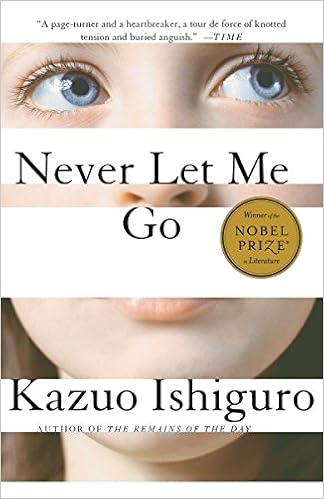
Never Let Me Go by Kazuo Ishiguro

Thinking back now, I can see we were just at that age when we knew a few things about ourselves--about who we were, how we were different from our guardians, from the people outside--but hadn't yet understood that any of it meant.  I'm sure somewhere in your childhood, you too had an experience like ours that day, similar if not in the actual details, then inside, in the feelings, because it doesn't really matter how well your guardians try to prepare you: all the talks, videos, discussions, warnings, none of that can really bring it home.  Not when you're eight years old, and you're all together in a place like Hailsham; when you've got guardians like the ones we had; when the gardeners and the deliverymen joke and laugh with you and call you "sweetheart."

I've read Kazuo Ishiguro's Never Let Me Again again to teach it again.  Once I taught it to a 12th grade AP Literature class; now to a group of talented and intelligent freshmen.  The age gap is a big one, I suppose, but the language in Ishiguro's novel is clear, conversational, relatable; I'm not worried about it being beyond their grasp intellectually.  But I do wonder about the age difference when it comes to maturity.  A senior is looking out into the future, into the world of college or work, and perhaps can understand something fundamental about the anxiety about growing up into a dangerous world that Never Let Me Go expresses.  A freshmen has made it, they've got their foot in the door and the change--triumphant or traumatic--is, in some sense, behind them.  For now.

The first time I read Never Let Me Go, I wanted to read it purely as a coming of age parable, as a universal narrative.  The students at the boarding school Hailsham--and you really shouldn't finish this sentence if you haven't read it--are clones, sure, destined to give up their vital organs so that others can be cured of terminal disease.  But are they so different than the rest of us, grappling with a future in which the only thing certain is death?  I always wanted to read that as the central irony of the novel; we yearn for Tommy, Kathy, and Ruth to fight against their fate, but we too are captives to a fate that cannot be fought.

Reading it now I'm much more prone to see the elements of privilege and class that make Never Let Me Go decidedly not a universal story.  Though the novel does much to erase them--that's Ishiguro's main trick, repression--there are people here who live vastly different lives than the student clones, and whose entire well-being is predicated on the clones' suffering and dying.  Read this way, Never Let Me Go brings to mind all the ways in which a global underclass suffers and dies for the comfort of the few, in sweatshops, in lithium mines, in hunger and in poverty.  Read this way, the proper response to Never Let Me Go is not sadness or wistfulness but rage.

There are glimpses of that rage at the beginning of the book.  As a kid, Tommy is known for his short temper and his blind, furious screaming sessions.  It takes very little to set him off, and he's widely disliked for it (though Kathy sees more or less past his bad reputation).  The anger is socialized out of him as he grows up, developing healthy relationships with Kathy and Ruth, and with the guardians at the school.  But anger is exactly what's required in the face of a great injustice, and instead the guardians divert Tommy's energy into ill-fated attempts at creativity.  Instead of shouting, he draws minutely detailed animals in his notebook, hoping they will prove something about him.  (The clones mistakenly believe that what they will prove is that he and Kathy are in love, which will be rewarded by a brief deferral of his "donations"; what they are really meant to prove is that he has a soul at all.)  One of the novel's final scenes, in which Tommy and Kathy, after failing in their milquetoast attempts to confront Hailsham's former headmistress, has Tommy making a primal scream in the woods.  All that repressed anger returns, but there's no longer the possibility of a useful outlet for it.  After all, Tommy's already made two donations.

The other thing I'm noticing for the first time is this: it's a strange thing to represent an abused underclass with the literary vocabulary of the boarding school novel.  The ostensible privilege of a place like Hailsham works to obscure the grisly nature of what is done to the clones.  You might react by indicting Ishiguro.  If you want to depict the underclass, you might say, go write a novel about a Pakistani immigrant or something, not a stuffy English boarding school.  But you might also say that Hailsham is a literal false consciousness, an ideology used to repress the reality of class-based oppression.  And in fact, Hailsham's legacy causes class fractures among the clones: among their friends at The Cottages, a kind of clone halfway house, being a Hailsham student indicates a kind of privilege.  Hailsham students, a "veteran" asserts, must know about the possibility of deferring donations; they have that kind of secret access.  False consciousness pits members against the underclass against each other to keep them from confronting, or even seeing, their real oppressors.

So what is Hailsham, exactly?  Kathy never wavers from her nostalgia for it, and it's easy to see why.  In a brief, painful, and constrained life, it offered companionship, care, education.  That's exactly what the headmistress, Miss Emily says, when Tommy and Kathy confront her at the end.  Hailsham, Miss Emily explains, was founded to prove to the outside world that clones were real people and deserved better treatment.  To that end--they provided better treatment, for some--they were successful, though the public side of their campaign was a failure.  This conversation is well-wrought and complex; you really do find yourself wondering whether Miss Emily is right.

But Hailsham reads to me now as an image of moderate pragmatism and its failures.  Think of the choice, perhaps, between advocating for better prison conditions and prison abolition.  Yes, the abolition of prisons seems like a pipe dream, but when does the pragmatic approach--by sealing off from the left the question of whether we should have prisons at all--collude with the imprisoners?  Miss Emily, in this scene, is confined to a wheelchair, but she hints at the fact that she hopes to be able to walk again soon.  Does Miss Emily tell herself, as she tells Kathy and Tommy, that she's proud of the difference she made in their lives as she's off to the clinic to receive her brand new clone-grown spleen?

That's when Tommy goes off and yells in the woods.  You wish he'd gone off and screamed in Miss Emily's face.  I do, at least, and the more I re-read the novel, my anger only grows.  But there's plenty to be angry about in the here and now, and plenty of screaming wasted.

Tuesday, April 3, 2012

Never Let Me Go by Kazuo Ishiguro

In a way, Never Let Me Go was written to be read twice. It maps the transition from childhood to adulthood--in particular, the childhoods of friends Kathy, Ruth, and Tommy at Hailsham, a kind of English boarding school--and if reading it once is like living through one's youth, compulsively guessing at what comes next, reading it a second time is like the process of memory, which recognizes the great ironies and sadnesses of such naivete. Ishiguro chooses to write in this second mode, as a series of reflections by a Kathy in her late twenties. Though it may seem silly, my sympathy for her increased since we were both, in a sense, going through the events of the book for the second time. And while knowing its "big secrets" deprived me of the satisfying shock of learning them, it rendered the characters' limited understanding of their own fate even more tragic.

For that reason, I think it's impossible to talk about this book without revealing its central mystery, so consider your self alerted for spoilers. At the time of her writing, Kathy is a "carer" who looks after "donors," and at first all we know is that she will become one herself, as Ruth and Tommy have. It's possible to unknot the scenario from that sentence alone, I think, but not its full limitations, and Ishiguro brilliantly metes out details in coffee spoons. At Hailsham, one teacher, Ms. Lucy, eventually drops the bombshell:

"If you're going to have a decent lives, then you've got to know and know properly. None of you will go to America, none of you will be film stars. And none of you will be working in supermarkets as I heard some of you planning the other day. Your lives are set out for you. You'll become adults, then before you're old, before you're even middle-aged, you'll star to donate your vital organs. That's what each of you was created to do..."


But, as Ms. Lucy says, the students have been "told and not told." We, too, have been "told and not told," and by the time Ms. Lucy spells it out, we're not sure whether we knew it all along or not. This uncertainty is, on the level of pure craftsmanship, Ishiguro's greatest achievement.

But this realization only brings more questions: What, for instance, is the purpose of the "Gallery," where Hailsham's mysterious director "Madame" takes the best of the students' artwork? Later, when Kathy cares for Tommy during his donation period, bringing out a long-gestating romance, they decide to act on rumors that former Hailsham students can receive a deferral from their donations if they can prove they're in love. The Gallery, they posit, allows the powers-that-be to look into their souls and determine if their love is genuine.

But, as the old headmaster tells them, the purpose of the Gallery was to prove that they "had souls at all." They were proof that, like "normal" people, the donors could be creative, and served in a long publicity war to establish humane homes--like Hailsham--for future donors. This floors Kathy and Tommy, and us, for whom the uncertainty seems absurd. They do what other humans do: They fall in love; they have squabbles petty and serious; they have sex; they desire independence; they create; they sell; they buy; they betray each other; they try vainly to make sense of the order of their own lives--how could they be less than human, and not have souls? I said in my previous review that Never Let Me Go asks what it means to be human, but now I see that simply to ask the question is devastatingly offensive. Kathy and Tommy are put somewhat in Shylock's position. Though they want desperately to establish human rights to love and independence, they find themselves having to earn the simple right to be human at all.

I think now that Never Let Me Go asks other questions. One is, Is it better to know or to not know? Part of Hailsham's "humane" task is to shield its students from the essential bleakness of their futures, and to give them a childhood. Ishiguro strongly suggests that denying the students' full knowledge of their own lives is a contradiction, in that it denies them also the human right to face life with their own faculties. But there is also the campfire story of the girl whose ghost roams the Hailsham woods, yearning to get back in, as Kathy yearns to recapture a more idyllic childhood.

Another is What is the proper response to injustice? In the hands of a hack writer, Kathy and Tommy would be Katniss Everdeens, raging against the machine that confines them. The sequel (Still Never Letting Go) would be all about the rebellion they lead. But they choose instead to live quiet lives, making the best of the raw deal they have been given, and confirm their humanity once again by doing so. Kathy's lack of a sense of injustice is frustrating, but it is also familiar: who among us expends any real effort to correct the (admittedly slighter) cruelties of our own social order, when it takes so much effort simply to be human?

And, in turn, does that reticence support the mission of Hailsham, which says that if we cannot eliminate injustice, we should at least approach it in comfort and dignity? Though I am still unsure if the ministers of Hailsham take the right task, at least they engage in the right questions.

Okay. I'm tired of re-reading books. Half of them I've read this year have been re-reads--mostly because of teaching them in class--but I'm done with all that. The next review, I promise, will be something new.