Showing posts with label comics. Show all posts

Tuesday, January 10, 2023

The FIintstones by Mark Russell

“We set fire to their trees. When the smoke cleared, there were dead Tree People everywhere! We participated in a genocide, Barney.”


Flintstones, meet the Flintstones. They’re the modern stone age family. From the town of Bedrock, they’re a page right out of history.


Sometimes I like to sit and think about the failed gritty reboots of times past. Power Rangers, Snow White, Superman, The Wonder Twins. In all forms of media there’s an inescapable pull that calls to young, hacky writers and says, “What if Big Bird, but a serial killer?” And those ideas generally yield about as much fruit as you might expect. Six episodes, two issues, one movie, largely forgotten except by the memelords and die-hards. And yet, the gritty reboot never really dies--right now we’re on the verge of Velma, a reimagining of Scooby Doo where Fred has a tiny penis and a dark secret. So maybe this was a good time to read Mark Russell’s Flintstones, and see how, once in a while, turning something light and fantastical into something a bit more grounded and world-weary can actually work, at least for a while.


Everyone knows the Flintstones, and everyone will find plenty here that they recognize. All the major characters show up--Fred, Wilma, Barney, Betty, Pebbles, Bam Bam--and quite a few of the secondary characters make an appearance too--Mr Rubble, The Great Gazoo, Dino. There’s even a running subplot about the secret lives of the prehistoric animals used as appliances. If you’ve ever wondered how that elephant feels about being a vacuum cleaner, or if the armadillo likes being a bowling ball, well, you can finally learn.


The storyline, which is lightly serialized but largely episodic, follows the town of Bedrock from its pre-bedrock era through its small city phase. And these progression points are largely what drives the individual storylines. We see the citizens move from a hunter-gatherer society to a consumerist one (malaise sets in as Fred collects more “crap” than he can ever use), from a powerless tribe to a pseudo-imperialist city-state, from animists to monotheists, from collectivists to capitalists. And Russell is none too optimistic about the progression.


If you’ve ever heard of this book at all, it’s likely you know it from the panel where Fred tells Barney they participated in a genocide, and it’s true. Driven by a warlike chief, the Bedrock soldiers are propagandized to fear the tree people, until even the kind-hearted Fred is taken in. We see the war in snapshots until the final battle, a Desden-like massacre, where Fred realizes he’s been lied to after he finds a doll on the “battlefield”. “What kind of army brings children to a war?” he asks Barney. Bam Bam, by the way, is adopted in this one--his parents were killed in the massacre and Barney finds him hidden in a tree. Barney doesn’t get a lot of development, though we do learn that he has slow sperm, but Fred and Wilma emerge as fully-formed characters, as does Pebbles who may be the world’s first atheist.


Religion is, in fact, a major theme of this retelling. One of the primary time markers is who the cave people are worshiping at any given time. They start with Morp, an emissary of animism, move on to worshiping an elephant and finally, to worshiping an invisible god named Gerald, renamed G-d on the final page because Gerald is too long for the church sign. While none of the social commentary is likely to sway anyone too much, it’s fascinating to see how Russell is able to work in trenchant (and dark) issues into the Flintstones’ universe without completely breaking it.


In fact, the most striking thing about Russell’s reboot is how funny it is. We meet Adam and Steve coming out of the local gay bar, Homo Erectus. Dino is recast as a narc, hated by the appliance animals. Fred gets caught up in an MLM. The town goes into panic mode when their Dr Sargon (who is visually, if not characteristically, modeled on Carl Sagan) miscalculates an asteroid’s path because mating moths keep messing up his abacus calculations, and ends up taped to a cave wall. The local pastor fights for monogamy (which the villagers protest with signs reading “God Hates Dads”) until Adam and Steve want to marry, after which he isn’t so sure (“I guess I have a lot to think about... but I probably won’t”) And there are any number of anachronistic puns along the way.


Finally, this reboot works because it’s 12 issues long. I could’ve read another 12 perhaps, but maybe the biggest lessons are that people shouldn’t handle reboots unless they have real affection for the original material, and that, by nature, these things can only be good for so long. They tend to lean heavily on familiarity with the source material, and there are only so many inversions one can take before the eye-rolling starts. But Russell nails it here. 


Tuesday, February 7, 2017

Paper Girls

Brian K. Vaughn is one of the more revered names in comics today (not that I'm an expert). His sci-fi series Saga is pretty much universally beloved, Runaways was a massive hit in its day, and I'll just assume people like his X-Men stuff. This latest series, Paper Girls, is up there with any of those. If you liked Stranger Things this past summer, Paper Girls is going to be right up your alley. It's November 1st, 1988, and four barrier-breaking twelve-year old girls are delivering their paper routes in the pre-dawn hours. Erin has nightmares with Ronald Reagan in them; George Bush for president signs are visible on lawns; Tiffany is mortified to realize how much time she wasted playing Arkanoid; Mac smokes and calls people faggots because, as a time-traveling character says, "You guys live in a fucked-up time." Basically, Vaughn nails the 80s.

As does artist Cliff Chiang, whose work here is fantastic. The detail he throws into relatively one-off gags like the aforementioned Bush campaign sign, the character that pops in the faces of each of the four girls, hell - the fact the guy has to draw so many damned bicycles. It's book 1 of an ongoing series, so I will say, don't go into it expecting resolution. But this does end on an interesting cliffhanger, and there are certainly enough questions abounding to propel the series for another couple of collected volumes, easily (oh, right, the plot, mention the plot - time traveling warlords with dinosaurs? I'm not really sure, actually). Paper Girls is a rare series where I have no qualms recommending it for people who don't even particularly like comics. It's really a great read.

Thursday, January 12, 2017

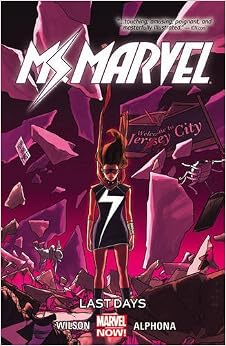
Comics 1-3, Ms Marvel volumes 4 and 5, Giant Days vol 2.

Read Harder orders a super-hero comic with a female lead, and also an all-ages comic. I was all too happy to oblige and knock a couple of the challenges out of the way early.

It broke through to the mainstream a few years back, but the current iteration of Ms Marvel is a Muslim Pakistani-immigrant teenage girl named Kamala Khan. Just typing all of that made me feel like Marvel was checking off a bunch of "let's get credit for making a bold choice" boxes, but I can say that the creative team does a fantastic job actually making Kamala all of those adjectives in their fullest sense. I read Volume 1 last year, and found it overall delightful, novel, and very interesting. It didn't do anything earth-shaking to the superhero genre, but it was obviously much, much more than a publicity stunt.

Volumes 2 and 3 weren't on the shelves of my local library, so I for no real reason picked up Volume 4, "Last Days." Some mysterious world-ending event is nigh. If you've seen a Marvel movie in the past four years, you are no doubt expecting a strange vortex forming in the sky above New York City. Marvel throws you a curve in this case; the danger is instead a strange planet approaching Earth in the sky above New York City. From that very unpromising start comes just a brilliant adventure. The world is ending, on a scale that Kamala simply cannot handle. Kamala Khan lives in Jersey City, and the town rallies to provide safe shelter for its residents as the end draws near. Kamala tries to save her her family and her friends, and is completely overwhelmed by the demands on her great powers, in the best Spider-man tradition.

In order to save her town, Kamala teams up with Captain Marvel, Carol Danvers, who is (understandably) her hero. I have not regularly read comics since the mid-90s, so I have no idea if Carol Danvers is a heavy hitter in the Marvel universe, but her presence gives Kamala the mentor figure she needs, facing her first world-ending threat as a superhero. Their interactions are well done and reminiscent of a college senior coming home from study abroad to discover that her annoying ten-year old sister has suddenly become capable and autonomous, and only needs a little direction.

The real pay-off of the book, however, comes in the last single issue collected in the volume, in which Kamala is out of costume for the entire issue. She bonds with her family, friends, and frenemies in a beautiful, all-hope-is-lost sequence. There is a sequence in which her mother tells her she knows her secret identity and "thank[s] God for having raised a righteous child." It is a lovely moment and a fantastic example of what comics can do right when they're firing on all cylinders. 

How excellent Ms Marvel is becomes even more clear when one reads the random Spider-man issues included in the collection after the main Ms Marvel story. I guess Dr. Ocotopus body-switched with Peter Parker? And there's a sexy Spider-lady? Besides being convoluted beyond all saving, the add-on story was just so tonally inconsistent with Kamala's adventures that it seems unfair to the Spider-man creative team to include it.

As excellent as Volume 4 is, Volume 5 is a mixed bag. There is a massive time skip that was very jarring. (The world-ending event was apparently part of a massive Marvel crossover, so Kamala's role was entirely in managing the Jersey City side of things. Also, evidently Kamala Khan has been invited to join the Avengers. I guess this is a really big deal.) There are some really good touches in this volume, such as Kamala's very religious brother marrying an African-American Muslim girl; an evil plot involving gentrification; Kamala's best friend and kind-of love interest dating a girl who purposefully does not embody the typical physique of a female in comics; and Kamala being stretched thin between super-heroing, helping with the wedding, and fulfilling the basic obligations of being in high school. That said, the gentrification plot veers into the overly cartoony (HYDRA has weaponized aerosol nanobots in order to reshape and take over... Jersey City?), and the answer to keeping up with the stresses of having to be in two places at once is to.. use the school's 3D printer and her best friend's physics genius to create an army of Kamala clones. Yeah  There are still some fantastic human touches in the story, but it's a definite downgrade from Volume 4. The change in artistic team doesn't help; in Volumes 1 and 4, the pencils were done by Adrian Alphona, who had a fairly realistic style and made sure to give Kamala Pakistani features. There's a rotating cast of artists in Volume 5 (including, I see, Alphona for some pages), but Kamala is much more of a manga-looking character for a lot of the book, which is not helpful.
Leon
Alphona

For my all-ages comic, I read John Allison's Giant Days 2. I've been a huge fan of Allison's since his original run of Scary-go-round in 2002, which was a huge inspiration for an online comic I used to draw. I've mostly gotten away from reading daily onlines, but I pick up some collected volumes from time to time. Giant Days features Esther, a character from Scary-go-round, now off at college! Or, rather, university, since this takes place in the UK. I don't have nearly as much to say about Giant Days as Ms Marvel - it's spritely, energetic, manic, and funny, but it's not capital I important like Ms Marvel is at its best. There is drama, misunderstanding, an evil city that's not really evil, and the interesting idea of one of Esther's roommates (or friends? I'm not really sure of the living situation) binging Friday Night Lights and bouncing between Coach and Tami Taylor personas to give various other characters pep talks. It's nice to know that even the Brits see the value in having clear eyes and full hearts!

Wednesday, January 29, 2014

Astonishing X-Men by Joss Whedon and John Cassaday

I’ve struggled with how to integrate comics into my fifty books almost since day one. I love reading comics and have for years, at least since I was in college. I mostly read superhero stuff, and, although I do pick up the occasional graphic novel or creator owned book, I find the range of stories within the superhero genre to be pretty amazing.

X-Men, however, I’ve never really been able to crack, because, as you know if you read monthlies, superheroes have loads of continuity and X-Men, with its constantly rotating cast, has lots and lots and lots of continuity. At any given time, there are probably 10-15 X-books on the market, all interlocking in some way. For a completist like me, that’s a big roadblock.

Fortunately, Joss Whedon’s run on Astonishing X-Men is self-contained for the most part, and reads just wonderfully. I’m a big Joss fan as well--I think I’ve seen everything he’s done except Firefly--and I was excited to read some of his comics. I wasn’t disappointed. Astonishing X-Men reads exactly like a season of a Whedon TV show, with all the witty banter, surprising plot twists, and rich character development that entails.

The plot of Whedon’s arc, which spans 25 issues and around 600 pages, is too sprawling to really go into here, but, at its center, a small group of heroes, including Kitty Pryde, Cyclops, Emma Frost, and some others, must come together in spite of their differences to defeat a foe too powerful for any of them to handle alone. In short, it’s about people, as nearly all the best comic books are.

I think, like most niche things, comics are either something you enjoy or you don’t, and I don’t know if anyone else here reads them. But, if you do, read this. If you don’t like comics, but you do like Whedon, read this. And if you don’t like either, well... maybe Lukacs is more your speed?

Saturday, September 29, 2012

Reinventing Comics by Scott McCloud

I haven’t read the entirety of Scott McCloud’s career-making graphic nonfiction book, Understanding Comics, to which Reinventing Comics is a partial sequel. Fortunately for me, Reinventing Comics covers mostly different ground; unfortunately for me, it was mixed bag, due partially to its datedness at points--it was published in 2000--and its sometimes dry subject matter.

But first, the good: McCloud is a remarkably versatile artist who clearly loves the medium and is adept at communicating fairly dense information in an intuitive way. I’m not sure the information in this book could have presented any better without changing its format completely. The entire book, aside from the appendices, is written in comic book form which sometimes works great, such as when demonstrating various distribution models, and sometimes doesn’t add much, as during his discussion of diversity in comics.

The downside is that a lot of the material here just isn’t that novel or interesting. One only has to walk into a comic book store, or even look at recent comic book movies, to see that the landscape is dominated by superheroes, mostly straight, male and white. McCloud’s solution to this problem--that more women, minorities, and gays be promoted in the comics world--is sensible, but doesn’t bring anything new to the table. His discussion of genre is similarly circular.

The back half of the book mostly discusses the pros and cons of creating and distributing comics on computers. Since the book was written in a largely pre-broadband time, many of McCloud’s suggestions seem quite prescient--online distribution, microtransactions, experimental layouts and formatting--but they too suffer from a little bit of been-there-done-that in 2012 (although it is notable that DC and Marvel both adopted same-day-as-print digital releases this year). McCloud’s once-exciting predictions about everything being available everywhere have been tamped down by both real-world issues, such as the complex legal weaseling necessary to move “everything” online, and by the fact that the future he talks about is largely here and doesn’t seem to have increased mainstream acceptance of comics much. Online, there are comics about everything under the sun, instantly available, but if no one new is reading them, what does it matter?

I don’t mean to be hard on Understanding Comics. It’s very well put together and I enjoyed reading it, but I’d recommend Understanding Comics or McCloud’s Zot omnibus as an introduction--Reinventing Comics is a little depressing.

Wednesday, March 7, 2012

SuperGods by Grant Morrison

It may not be the Ten Commandments, but as a set of moral guidelines for the secular children of an age of reason, the Supermen of America creed was a start. This is the story of the founding of a new belief and its conquest of the world: With a stroke of lightning, the spark of divine inspiration ignited cheap newsprint and the superhero was born in an explosion of color and action. From the beginning, the ur-god and his dark twin presented the world with a frame through which our own best and worst impulses could be personified in an epic struggle across a larger-than-life, two-dimensional canvas upon which our outer and inner worlds, our present and future, could be laid out and explored. They came to save us from the existential abyss, but first they had to find a way into our collective imagination.

I’m a fan of Grant Morrison. His run on Animal Man in the 80s (in which Animal Man SPOILERS meets his creator and convinces him to change history) expanded my vision of what comic books could do. Such postmodern conceits are so common now that even Stephen King has used them, but at the time, it seemed fresh and, reading it now, it’s still an exemplary piece of comic writing, working on both an emotional level and as a satirical look at the grim-and-gritty ethos that was devouring comics at the time, in the wake of Frank Miller’s The Dark Knight Returns.

Reading SuperGods, Morrison’s history of comic book slash autobiography, I had a realization that now colors my view of his work: writing a get-together with Animal Man was easy for Morrison because he truly believes that superheroes exist. Reading SuperGods reminded me of reading Harold Bloom, in that, while Bloom seems to want to replace religion with poetry, Morrison has, in his own life, replaced supernatural belief with belief in the ethos of the characters he creates. He speaks of the 2 dimensional comic book universe as though he’s spent as much time there as he has in the real world, and that’s not all. Morrison also practices chaos magic, writes extensively, in an almost unreadable chapter ostensibly covering his ultra-weird Flex Mentallo series, about a series of drug trips he had while traveling Asia in search of spiritual enlightenment. It’s weird stuff, interesting but also somewhat alienating.

As a history, Morrison’s book is extremely interesting. Unlike Men of Tomorrow, the comic history I read back in 2009, it doesn’t attempt to be unbiased, instead offering Morrison’s unique take on comics from the Golden Age onward. He skims over some important creators to talk about obscure characters like Killraven, and spends as much time comparing superheroes to obscure Hindu gods as does recounting milestones of the industry. It also glosses over Morrison’s feud with contemporary luminary Alan Moore, who badmouthed Morrison’s breakthrough Arkham Asylum resulting in Morrison savaging Watchmen, but time seems to have softened Morrison’s views—nearly every book mentioned in SuperGods is praised for something.

If you’re a comic nerd, you probably don’t need my recommendation to read SuperGods, and if you’re not, it probably won’t interest you no matter how good it is. It’s snappily written, packed with anecdotes, and, even though its focus is weird, so is Morrison, so it all works out.

Tuesday, November 17, 2009

Final Crisis by Grant Morrison

I'm not sure if anyone here besides me reads comics on a monthly basis, but anyone who does knows that every summer, both Marvel and DC have a major event, a storyline that crosses through nearly all their titles and, theoretically at least, has a lasting impact on their comics universe. Generally, these events don't interest me much, partially because they require constant vigilance and the purchase of many titles I'm not interested in, and also because they generally require a deeper knowledge of the universe than I actually have. There's also the minor detail that these events rarely have the long-term effects they promise. Anything the writers or fans dislike is retconned at the first opportunity, so if the story isn't good, what's the point?

Final Crisis was a little different though, because DC (rather bravely) handed the reigns of their summer event over to Grant Morrison, a writer second only to Alan Moore for "idea comics." Oh, yeah, and it was pretty common knowledge that Batman was going to die (more information than you ever wanted about Batman's death, in the comments).

So did the story live up to the hype? Well, yes and no. On the one hand, the story was strange and compelling, and, as usual, Morrison pulled some obscure characters out of the DC backpages for some big-screen heroics. On the other hand, the collection I purchased didn't have all the comics in the storyline, so there were a lot of blanks I had to fill in myself. Overall, it was well worth the read for me, but probably a hard sell for non-superhero fans.

And I know this review isn't very informative, but a) I have a lot of reviews to write and b) did anyone really want to read 5,000 words about the DC Multiverse?

Sunday, June 14, 2009

Watchmen by Alan Moore and Dave Gibbons

Dog carcass in alley this morning, tire tread on burst stomach. This city is afraid of me. I have seen its true face. The streets are extended gutters and the gutters are full of blood and when the drains finally scab over, all the vermin will drown. The accumulated filth of all their sex and murder will foam up about their waists and all the whores and politicians will look up and shout "Save Us!" and I'll look down, and whisper, "No" - Roschach

A live body and a dead body contain the same number of particles. Structurally, there's no discernible difference. Life and death are unquantifiable abstracts. Why should I be concerned? - Dr. Manhattan

I read Watchmen just in time. I finished it about a week before the movie came out. I wanted to read it first partially because I wanted to be able to compare the book and the movie, but, more importantly, it's a little embarrassing to be the last comic book fan who hasn't read Watchmen.

With all the hype surrounding Watchmen—only graphic novel in Time Magazine's 100 Best List, widely acclaimed as the best graphic novel of all time, praised and damned for helping bring about the darkening of comic books in general—I had my doubts that it would live it up to its reputation. After all, The Dark Knight Returns, another, similarly acclaimed graphic novel, was a huge disappointment when I finally read it. But, after putting it off for so long (and rambling about it for nearly as long) I've reached a conclusion: Watchmen deserves the praise.

It follows the lives of several “superheroes,” regular Joes and Janes who have no superpowers but want to help make the world a better place, at least ostensibly. In reality, they all have their own reasons, complex, human reasons that don't often show up in the pages of mainstream comics. The only truly super-powered being is Dr. Manhattan, a being with literally godlike powers, able to do everything from the standard flying and making things explode to creating entire universes out of nothing.

To me, the most interesting character in the book was Dr. Manhattan. A soft-spoken, humanitarian scientist who receives his powers through the Silver Age standby of gamma radiation, his progression throughout the book is an interesting case. When the extent of his powers is discovered, the government sends him to Vietnam as a soldier and also uses him as the ultimate failsafe against a steadily more aggressive Russia. Dr. Manhattan, on the other hand, grows more and more disconnected from the human race, gradually dissolving all ties except to the woman he loves. When he loses her, he completely severs all connections to earth and moves to the moon, preferring the solace and the undemanding company of the rocks and stars to that of humans, who think themselves something special but who, to Dr. Manhattan, are no more interesting or unique than anything else in the universe. It's a deconstruction not only of the omnipotent superhero (of whom Superman is the prime example), but also of the idea of God. Why would a being whose powers allow him ultimate freedom of action choose to spend his time interacting with a populace who largely don't appreciate him and see him only as a means to an end?

Every character in the book, from the borderline-sociopath Rorschach to the twisted humanitarian Ozymandias, could be given an extensive treatment, but I'm not going to do that. If' you haven't read Watchmen, check it out.