Showing posts with label Ya fiction. Show all posts

Wednesday, February 8, 2012

Island of the Blue Dolphins by Scott O'Dell

For a long time I stood and looked back at the Island of the Blue Dolphins. The last thing I saw of it was the high headland. I thought of Rontu lying there beneath the stones of many colors, and of Won-a-tee, wherever she was, and the little red fox that would scratch in vain at my fence, and my canoe hidden in the cave, and of all the happy days.

Island of the Blue Dolphins is a young adult novel about a young girl, Karena, who is left alone on a small island after her tribe, decimated by Aleutian fur traders, leaves for the mainland. It is, of course, a Robinson Crusoe-esque tale, which, outlandish as it sounds on paper, is actually based on the true story of a woman discovered alone on an island in the late 18th century. Unlike Karena, who narrates the novel, this real life survivor was unable to communicate with her rescuers, and so died with her island years still a mystery.

Island is a classic, but it left me a little cold. I appreciate survival stories, which is why I was interested in the first place, and I like young adult literature reasonably well, so I was a bit surprised at my neutral reaction. I can’t say exactly what was unappealing to me, but I suspect it had more to do with tone than anything. It's not really an adventure novel, like the premise leads one to suspect. Instead, it’s a thoughtful, slow-moving meditation on nature, solitude, companionship, and death.

This isn’t bad, of course—most of my favorite novels wouldn’t be described as adventure stories either—but I think I just came to the book too late to truly appreciate it for what it was. The themes it explores, while certainly worthy and meaningful, may not be extremely common in young adult fiction, but they make up the thematic material of a ridiculously large amount of adult novels. And, though it isn’t fair to compare, Island didn’t measure up to the other, more complex novels with which it shares its DNA.

Does this make it a bad book? Not at all. I didn’t dislike it, but I didn’t feel compelled to pick it back up once I put it down either. Call it unjust, ridiculous, whatever—for better or worse, Island of the Blue Dolphins is young adult literature best read by actual young adults.

Bonus: Best review on Amazon.

Thursday, April 28, 2011

The Lover's Dictionary by David Levithan


At 23, I’m still a huge fan of young adult literature. I just don’t consume as much of it as I used to. There’s something exciting for me about my favorite Y.A. authors crossing over to general fiction—which I’ve seen a lot of lately with authors like Meg Rosoff and Francesca Lia Block. Now cue in David Levithan, who wrote a book I enjoyed and reviewed for 50 Books a couple of years ago, titled The Realm of Possibility.

Levithan’s debut to the adult fiction world is The Lover’s Dictionary. It’s a novel written one definition at a time, A to Z, one definition to a page at 211 pages. Some of the entries are short, just statements. Some favorites:

celibacy, n. n/a.

exacerbate, v. I believe your exact words were: “You’re getting too emotional.”

vagary, n. The mistake is thinking there can be an antidote to the uncertainty.

Some of the definitions are full on stories… Think flash fiction or vignettes. My favorite is for offshoot, where he details going to a concert with his girl friend’s best friend. He feels like they’re doing something wrong if they discuss the one shared thing in their life (being his lover) without her being there, but they don’t have any other common ground, so the stories start flowing. At the end of it:


It wasn’t like we held hands during the concert. We didn’t go out for wine or
shots or milkshakes afterwards. But I liked that she was no longer entirely
yours. We had four hours of history without you.


I like the way that he captures the way two people come together, as well. All the little moments:

Cadence, n. I have never lived anywhere but New York or New England, but there are times when I’m talking to you and I hit a Southern vowel, or a word gets caught in a Southern truncation, and I know it’s because I’m swimming in your cadences, that you permeate my very language.

Sacrosanct, adj. The nape of your neck. Even the sound of the word nape sounds holy to me. That the hollow of your neck, the peak of your chest that your shirt sometimes reveals. These are the stations of my quietest, most insistent desire.

The ease that Levithan navigates with through his chosen (and tricky) format seems to be seamless. One moment, he’s throwing out statements about relationships that seem universally true in ways that hit you because of their humor or the eloquence or their perfect placement. The next moment, he’s fleshing out one couple’s particular details. I feel like in the wrong hands, the format would have felt like a gimmick. In this particular case, though, I feel like he delivers exactly what you need to know: all of the hard hitting moments and truths, good and bad, without the transitional fluff that usually carries you from one page to the next. That, or maybe I just liked it so much because I’ve been feeling too distracted to devote myself to anything that required an actual commitment of time and rapt attention. There’s no telling.

It’s a very modern love story. They meet online after he’s been on so many poor blind dates that he’s ready to cancel his subscription, just to realize he’s only got eight days left and there’s really no point in trying to pull out so close to the end of it. On the second to last day, that first e-mail is sent. Eventually they have to figure out whether or not they’re exclusive. They do all the typical get-to-know-your-partner things. Navigate through awkward silences. Get comfortable. She drinks too much. He’s insecure. Sometimes things happen in just the right way and they are momentarily awed by one another again. They decide to move in together. She cheats. They cope. There's also a small bit about a pregnancy that's alluded to in the beginning and once again at the end that we don't seem to have any kind of resolution for, unless I'm missing something. The storyline isn’t anything much in and of itself but I very much appreciated the way that it was delivered.

The one thing that I’m not too sure about is Levithan’s use of pop culture references. He writes about Vampire Weekend, throws out something about Green Day’s American Idiots tour in passing, etc. Maybe I’m just missing the genius of some of the bands he nods to, but I think I’d be more comfortable if he was using people/groups that have already proven they’d have lasting name recognition. I love Bon Iver right now, but you’re not going to find any of the characters in my short stories talking about them, you know what I mean? I don’t know. I guess I just thought it was ballsy. There was a Prince reference, however, that I liked:

non sequitur, n. This is what it sounds like when doves cry.

The only thing I would like better than this book as is if John Cusak could turn it into a one man stage act, which I think would be overwhelmingly appropriate.

Sunday, March 20, 2011

The Hunger Games by Suzanne Collins

In the post-Harry Potter world, it seems we may be condemned to an endless cycle of Next Big Things from the Young Adult world. Twilight was there to console us when we realized there were no more Potter books coming, and The Hunger Games has followed in that book's wake into the public consciousness. The film is already in production, of course. The loser in this new world order is probably Dan Brown, who will probably have to write a book for teenagers if he's ever going to be popular again.

I am a fan of Harry Potter but I have refused to read Twilight, which seems unbearable. One of my students asked me to read The Hunger Games, which is better written and more imaginative than Twilight, but a poor substitute for Harry Potter. Firstly, it cribs shamelessly from a Japanese novel/manga called Battle Royale: both are about teenagers being selected by a despotic government to compete in a brutal competition where the last survivor wins. In both books, this is depicted as a means of controlling the population through fear; in The Hunger Games it is also a punishment for a long-ago populist insurrection.

The protagonist of The Hunger Games, Katniss Everdeen (ugh), volunteers to go in place of her little sister, who has been chosen by lottery. As each "district" must send two competitors, she is joined by Peeta Mellark (ugh), a local baker's son, and assisted by a former winner from her district whose alcoholism renders him less than helpful. For a competition in which the competitors are chosen at random, the representatives from the other eleven district seem to be have unusually advanced combat skills.

The Hunger Games is characterized by its inconsistency, but occasionally exhibits imaginative flair. It flirts with social commentary by turning the Games into a kind of televised spectacle. The audience can contribute money to "sponsor" competitors, who receive helpful gifts by parachute; competitors from the wealthier districts naturally have an advantage. Katniss, Peeta, and their mentor Haymitch operate according to a peculiar game plan: If they pretend that Peeta and Katniss are in love, then the popularity of their televised romance will provide them with sponsors. And maybe, just maybe--spoiler alert--the "Gamemakers" will change the rules of the game so that two competitors from the same district can win.

I have two issues with this. The first is that it is stupid. Not only does it lead to an awful lot of teenage makeouts on the killing field, assuming that your romance would provide the leverage to force the hand of the all-powerful regime in the Capitol is a horrible plan. Unsurprisingly, it works.

The second problem is more significant: It thematically undermines the book. The Capitol controls the population through propaganda, of which the Games are a central part, and we are meant to be appalled by how willing people are to tune in to teenagers being murdered on their TV. But the love scheme (to the extent that it is a scheme and not the precursor of a real romance) turns Peeta and Katniss into propagandists. This dystopia is characterized by an obsession with appearances and media, why then are Peeta and Katniss' "stylists" depicted as guardian angels, who sympathize with their plight and help them win? Katniss wants to rebel against the brutality of the system, but her success in the Games looks conspicuously like a validation of that system's efficacy.

I fear that these problems are impossible to fix because the book is by nature contradictory. Yes, the system is brutal and the population bloodthirsty and shallow, but the pleasure we get out of reading about teenagers speared or burned or bludgeoned to death is uncomfortably like the pleasure the Capitol provides its audiences. If Collins were a better writer, this might be tempered by some grave reflection on death--not unheard of in children's fiction--but what minor guilt Katniss shows is fleeting and thin. Death in The Hunger Games is popcorn stuff, and will probably look spectacular on the big screen, but looking spectacular may be all it can manage.


Other reviews:

Jim
Carlton
Brent

The Hunger Games by Suzanne Collins

“Only I keep wishing I could think of a way to…to show the Capitol they don’t own me. That I’m more than just a piece in their Games”


The Hunger Games
, the newest YA literary phenom, is a dystopic young adult novel that plays like a mashup of Battle Royale, Stephen King's The Running Man and The Long Walk, and elements from pretty much every other dystopian book you can think of. That's not to be derogatory, just to let you know what you're in for: it's difficult to find a truly original element in the world of the Games.


The basic story is this: every year, the government chooses two children from each district, aged between 12 and 18, to compete in The Hunger Games. The winner is awarded wealth and comfort for the remainder of their life; the losers are dead.


The real centerpiece of the story is the narrator, Katniss, a 14-year-old girl who enters the titular games voluntarily, replacing her younger sister. She's a fairly complex character, with conflicting emotions and motivations that rarely feel less than genuine. She's smart and capable of brutality, yet tender and caring toward those she chooses. There's not a whole lot of romance, which is nice, but what there is feels a little silly compared to the rest of the story.


Calling the prose utilitarian is pretty accurate. Throughout the entire novel, I can't recall one memorable line or dialog. It's told in the first person present, which can be kind of annoying. I've read comments where people compliment the writing style as being no-nonsense or whatever, but it was probably the largest con of the book for me--I would have gotten as much out of a screenplay and it would have read even faster. Also, the ending was extremely anticlimactic, even taking into account that this is the first part of the trilogy.

I enjoyed The Hunger Games, although it might be hard to tell from this review, but I don't know if I'm going to be reading the rest. There just doesn't seem to be enough original content here to justify the hype.

Wednesday, November 24, 2010

Harry Potter and the Deathly Hallows by J. K. Rowling

So, with the release of Harry Potter and the Deathly Hallows: Part 1 last week, I decided it was time for me to finish up the Harry Potter series. I was a fairly early reader, picking up the first book right after the second came out, and, up until Order of the Phoenix released, I read them more or less as soon as they came out. Unfortunately, OotP really didn’t do it for me, and I didn’t read The Half-Blood Prince for a year or so after I finished that tome. I started Deathly Hallows soon after it came out, got bored after about 100pp, and told myself I’d get back to it eventually. I finally did.

I share the above to share this: I feel like how much one enjoys Deathly Hallows, especially the first half, is directly proportional to how seriously one takes the story; that is, I always enjoyed Harry Potter as a fun little lark with some dark edges. As the books got more serious, diminishing returns set it—although I enjoyed Half-Blood Prince, it wasn’t nearly as fun as the earlier books for me, especially Goblet of Fire, which is probably my favorite. So, now that I’ve rambled, let me address the actual book.

First, the negatives: The first half of this book was really, deathly (haha) slow. There were huge sections that felt like they could have been seriously condensed, especially the interminable setup for Harry’s escape from Death Eaters early on. Also, this book is SERIOUS. There’s little of the lighthearted humor that characterized the first few books—which makes sense thematically—but I found that it created a distance for me because, as I mentioned earlier, I never thought of Harry Potter as inherently serious. Lastly, there’s a lot of exposition. Most of this takes the form of newspaper articles, excerpts from Dumbledore’s biography, and word of mouth from other characters. There are also conversations that are basically info-dumps—in other words, a lot of telling instead of showing.

Now for the positives: by the end, I’d been won over. I underestimated connection to the characters, and when it all went down in the end, I found the various fallout, including deaths of some important characters, surprisingly effective. A couple long-standing characters get a shot at redemption, and Rowling does a good job at avoiding the various attendant clichés. The final confrontation(s) between Harry and Voldemort and well-drawn, and the entire last half of the book moves very quickly and seamlessly. I was surprised how little navel-gazing there was, pleasantly surprised since that’s basically what turned me off of the series to begin with. I was also impressed with the complexity of the plot—there were a couple times that hewed close to dues ex machine, one of the series’ most consistent problems, but for the most part the story played out organically, using characters and touchstones from throughout the seven books to draw everything to a mostly satisfactory conclusion. I even liked the Epilogue, which, although it was a little cheesy, read to me more like Rowling trying to limit the amount of post-series fanfic and mostly succeeding.

It may sound like I’m damning Deathly Hallows with faint praise, but it was probably the 3rd best book, after Half-Blood Price and Goblet of Fire. It was satisfying in a way that long-running series rarely are, and it hit the right notes when it counted.

Sunday, August 22, 2010

The Perks of Being a Wallflower by Stephen Chbosky

Dear friend,

I wanted to tell you about us running. There was this beautiful sunset. And there was this hill. The hill up to the eighteenth green where Patrick and I spit wine from laughing. And just a few ours before, Sam and Patrick and everyone I love and know had their last day of high school ever. And I was happy because they were happy. My sister even let me hug her in the hallway. Congratulations was the word of the day. So, Sam and Patrick and I went to the Big Boy and smoked cigarettes. Then, we went walking, waiting for it to be time to go to
Rocky Horror. And we were talking about things that seemed important at the time. And we were looking up that hill. And then Patrick started running after the sunset. And Sam immediately followed him. And I saw them in silhouette. Running after the sun. Then, I started running. And everything was as good as it could be.

Despite what USA Today would have you believe, The Perks of Being a Wallflower is not Catcher in the Rye. I've never read A Separate Peace, but I'm pretty sure it's not that either. But it isn't fair for us to ask it to be, when it does pretty well on its own terms.

Perks is written in the form of a series of letters written by Charlie, a freshman in high school, to an anonymous "friend" he has never met. Charlie is a fairly typical protagonist for a coming-of-age story: Shy, sort of nerdy, and quite sensitive--god, it seems like he cries every other page--but also removed from other people and not prone to "participate". Almost despite himself, Charlie ends up befriending a pair of seniors, Patrick and Sam, outsiders and nonconformists who help to pull him out of his shell.

There is no real central conflict, but a series of unrelated plot threads, some of which end up being pretty underwritten: The young first-year English teacher who encourages Charlie to read great books. Patrick's secret affair with the high school quarterback. Charlie's crush on Sam (who is a girl). Having to deal with his best friend's suicide (this one in particular is half-baked). Charlie learning about drugs, and taking up smoking. Learning about masturbation, and then sex. His sister's secret abortion. The memory of his aunt's death in a car crash some years before. Mixtapes. There are a lot of mixtapes.

But you know what? All of that adds up to something that, if it doesn't reflect what it is to be 14, it reflects something quite incisive about the imagination of 14-year-olds. I've never quite been comfortable with the way people identify with Holden Caulfield, partially because I don't think Holden would quite want people to identify with him. But Charlie is a character overwhelmed by his own passions and sensitivity toward others, and draws readers quite easily into himself. He isn't as abiding a character as Holden is--because Perks is not literature on the same plane as Catcher--but I'll be damned if he doesn't deserve that sort of attachment more.

This was the summer reading for the students I'll be teaching in tenth grade next year. Teaching Perks is a dicey proposition because of the sexual content, and especially because of the explicit homosexuality in it. I wouldn't be surprised to get a few complaints from parents. But I think that, for the students--most of whom have a deep revulsion toward homosexuality--it will end up being something that resonates strongly with them.

Here is Christine's perspective.

Tuesday, May 25, 2010

Something Wicked This Way Comes by Ray Bradbury

“Beware the autumn people...For some, autumn comes early, stays late, through life, where October follows September and November touches October and then instead of December and Christ’s birth there is no Bethlehem Star, no rejoicing, but September comes again and old October and so on down the years, with no winter, spring or revivifying summer. For these beings, fall is the only normal season, the only weather, there be no choice beyond.”

Somehow, I missed Something Wicked This Way Comes while I was scouring the children’s section of the library, and it’s probably a good thing. It’s hard to imagine how an avid Goosebumps reader would have dealt with a scary book that’s actually scary and substantial, not just for the grotesque images or the shocking twists, but for the themes it carries. There are spoilers in this review, mostly from the first third of the book.

The book opens on its dual protagonists, Jim Nightshade and Will Holloway. Both thirteen years old, they are inseparable sides of the same coin. Jim is rash and impetuous, always on the lookout for a thrill or an adventure; Will is more careful, although, as he says in the book, is often dragged into adventure by Jim whether he wants to be or not. The books opens in Autumn with the arrival of a mysterious carnival, populated by a diverse array of freaks and run by the Illustrated Man, Mr. Dark, a mysterious entity who exercises control over his freaks with his vast array of tattoos. The centerpiece of the carnival is broken down Carousel that nevertheless comes alive at night. It can spin either way, making its riders either older or younger. Soon after the carnival opens, Jim and Will see the carousel in action and make an enemy of Mr. Dark who, of course, spends the rest of the book trying to turn them into a couple of his freaks.

In addition to the boys, there’s a third, equally important character: Charles Holloway, Will’s 54 year old father. Married to a beautiful woman 20 years his junior, he struggles with feeling too old for her and too old to properly relate to his son.

Something Wicked
is surprisingly dense, and there are a lot of things I could talk about, but I’d like to focus on what seemed like the overriding themes: the elders’ fear of aging and death and the youth’s desire to speed the process along. The Carousel stands at the center of the novel, towering over even Mr. Dark in its sway over the protagonists. So let’s start with a laundry list: Will fears that, with time, he and Jim will grow apart. Jim fears that he will never grow up at all, and Charles fears that he’s already too old to relate to the people he cares most about. The thing is aging or de-aging on the carousel is no good. It rushes things, so young men end up with old men’s minds and old men are still children inside. It is the ultimate relationship breaker, because it makes relation with other people of your own age impossible—who wants to hang out with the 30 year old who still wants to play marbles, or the 16 year old who has all the worries in the world?

I don’t want to talk much more about the plot, but I will say that there are some very disturbing images, not so much because they’re graphic, but because being turned into a wax dummy is kind of terrifying. Anyway, this review is all over the place, but if you missed this as a child, it’s well worth reading. And I hear the film is pretty scary.

Tuesday, November 17, 2009

Go Ask Alice by Anonymous

I wish I were popular and beautiful and wealthy and talented.
-
My mind possessed the wisdoms of the ages, and there were no words adequate to describe them.
---

Go Ask Alice purports to be the honest-to-goodness real diary of a poor girl who starts off as a sterling, if somewhat shy, student and is gradually drawn deep into a web of drugs, alcohol, illicit sex, and suspiciously aggressive potheads. Of course, once the book became a hit, Beatrice Sparks, a Mormon psychologist and youth counselor, came forward, claiming to be the book's compiler and editor, though not it's actual author who was, of course, Alice. or, well, not really. Actually, Alice is in the book for about 3 sentences, but for simplicity's sake, I'm going to assume the anonymous diarist is named Alice as well.

Anyone who actually reads the book, however, will start suspecting early on that either Alice or Beatrice is making things up as they go along. I could buy that Alice started drinking out of peer pressure and a desire to be cool. I could buy that she started smoking pot for the same reason. I found it harder to believe that she became a voracious addict to LSD after being secretly given a spiked glass of beer. Credulity is stretched to the breaking point, however, after the second time Alice's addict friends break into her house to plant drugs then, later, inject the candy bowl at the neighbor's house with cocaine and call the police. Alice, of course, winds up on the street, alternately transcribing her pathetic sexual escapes and waxing philosophical in ways that your average teenager doesn't. In the last several entries, Alice kicks the habit but then mysteriously dies in a postscript that, presumably, was not part of the original diary.

Later, Dr. Sparks published a series of books, all with the "real-life diary" angle, dealing with a boy who falls into Satanism, a homeless teen, and a knocked-up teen. These, fittingly enough, were shelved under fiction, ensuring that their terribly contrived, retarded, didactic stories will never be taken as seriously as Alice's. Sparks's most recent book? Open and Say Ah: The Story of a Lying Psychologist.

Sunday, October 25, 2009

Tears of a Tiger by Sharon M. Draper

Teacher A: The first book we have to teach for the freshmen is Tears of a Tiger.
Teacher B: Okay, what do we do the second week?

--actual conversation between two teachers at my school

--Hey Rob! Live game, man. You be flyin' with the hoops, man! Swoosh! Ain't nobody better, 'cept maybe me.
--Yo, Andy, my main man! I see you been eatin' bull crap for dinner again! You only
wish you was as good as me! I, Robert Orlando Washington, will be makin' billions of dollars playin' for the N.B.A.! Want me to save you a ticket to one of my games?

--actual opening lines of Tears of a Tiger


Apparently, years ago, when my school first opened, none of the English teacher positions were actually filled by English teachers and so when it came time to choose books to teach someone decided on something called Tears of a Tiger, which may actually be the worst book I have ever read all the way through.

The story is this: Andy Jackson and Rob Washington are best friends and basketball teammates at Hazelwood High. One night, after a win, they go out and celebrate a little too much and Andy, who is driving drunk, crashes into a retaining wall, killing Rob. (From the locker room to the hospital, according to the time-stamp before each chapter, is an hour-and-a-half. Beer bong, anyone?) The rest of the story details Andy's grief, the deterioration of his relationships with his family and friends, and his eventual suicide.

The entire book is written without any sort of action or description, trading off between chapters of confusing, unattributed dialogue, and some sort of epistolary sections cobbled together from letters, homework assignments, and diary entries. Which would be fine, if it made any sense and weren't completely tone-deaf as to the way young people talk, even back, I'm sure, in the mid-90's when it was published.

I also have two much larger, moral issues with the book (Oscar Wilde be damned)--first of all, as if it weren't enough to chronicle Andy's internal struggle, Draper goes to great lengths to describe the kind of social ills that young black students face, like the teacher who predicts that Andy will be fine because "black kids are tough" and the conflict that Andy has with his father about what Andy feels is his dad's toadyism with regards to his white bosses. The book boasts an ensemble cast of Andy's friends and classmates, so we frequently are privy to their racial sensitivities as well, including the character who would get rid of band-aids because they're not the color of his skin, and Andy's little brother, whom he chastises for preferring dolls with blonde hair. Thematically, it's oddly out of place and serves only to minimize Andy's grief by placing it on the same level. Furthermore, Draper's tone-deafness in the way that she airs these greivances had many of my students convinced that the book as a whole was quite racist.

Secondly, and worse, is the treatment that Andy's suicide receives. The event is clumsily foreshadowed multiple times, including an instance in which Andy runs out of the classroom when one of his classmates observed that Lady Macbeth probably deserved her death at her own hands (cue bewildered white and clueless teacher). Yet, when after the act the school counselor recommends that Andy's friends and family write letters to him, not a single one offers any pity or sympathy toward him, but all show some variation on this sort of condescension:

You know what really pisses me off? You! You're a coward and a sellout! You decided to end your life, without saying good-bye to anybody, without asking anyone for help. You deserted your friends and family--the people who love you the most. Suicide is the coward's way out. Brave men face their problems. So what does that make you?

..I hate you for leaving me here. I hate you for making me feel like this. I hate you for making me cry. And I hate you for making me face death again so soon.


Does anyone really think this kind of intimidation is effective in keeping kids from suicide? Andy maintains that no one understands his grief and his guilt, and in the end he's right; no one does. The book is, at the very least, emotionally manipulative, and ultimately comes off as an anti-suicide screed that lacks any sort of insight into what might make a young man kill himself. It is clearly also written by a person that has never considered suicide and has no sympathy for anyone who has.

Worse even still, the book is almost devoid of anything that ought to be taught in English class--there is no figurative language, no deeper meaning, and the characters are paper thin. But I taught the damn thing--where's my Teacher of the Year award, Obama?

Monday, August 10, 2009

Speak by Laurie Halse Anderson

The next thing I saw was the telephone. I stood in the middle of a drunken crowd and I called 911 because I needed help. All those visits from Officer Friendly in the second grade paid off. A lady answered the phone, "Police, state your emergency," and I saw my face in the window over the kitchen sink and no words came out of my mouth. Who was that girl? I had never seen her before. Tears oozed down my face, over my bruised lips, pooling on the handset. "It's OK," said the nice lady on the phone. "We have your location. Officers are on the way. Are you hurt? Are you being threatened?" Someone grabbed the phone from my hands and listened. A scream--the cops were coming! Blue and cherry lights flashing in the kitchen-sink window. Rachel's face--so angry-- in mine. Someone slapped me. I crawled out of the room through a forest of legs. Outside, the moon smiled goodbye and slipped away.

I walked home to an empty house. Without a word.


(Spoiler alert: This book is difficult to talk about without revealing certain things.) There is a canon of literature that belongs solely to middle and high schools that I didn't even know about until I became a teacher, at least here in New York. Some texts, like Catcher in the Rye and To Kill a Mockingbird overlap with that other canon, the canon of American universities; others, like The Giver and other YA books are relatively popular and well-known otherwise. But there are some books--like Sandra Cisneros' House on Mango Street--that, for whatever reason, seem to exist only in schools, or at the very least, have a popularity as educable texts that vastly outweigh their presence in bookshops.

Speak is one of those books. I had never heard of it until I started teaching; now, it seems to be everywhere. Part of this, I imagine, is because it is a narrative that takes place mainly in a high school, covering the freshman year of a girl named Melinda Sordino. Sordino is an Italian world that means "mute" or "dumb," and appropriately so, as Melinda has problems with communication in general--unable to talk in class, unable to make friends, unable to communicate with her parents. She enters high school viciously unpopular. All of this can be traced back to an incident that happened at the end of the previous school year, when Melinda went to a party where she became intoxicated and was sexually assaulted by an older boy, a boy who happens to go to her new high school and winks at her whenever she walks by. Her former friends, some of whom got into trouble when the cops arrived at the party, have turned her into a pariah.

This is heady stuff. I liked this book a great deal because it does away with one of the most insidious misconceptions about youth: that childhood is a simpler time, an idyll where real problems don't exist. Middle and high school, in case you have forgotten, can be devastating, and to go through an issue like Melinda's is certainly crippling. Anderson deserves all the credit in the world for writing a book for young adults in which an issue like rape is seriously discussed. No wonder that the book is frequently challenged, as if the rush to insulate our children from evil does anything but teach them they have nowhere to turn in times of real crisis.

I read this book in about an hour and a half, but as brief as it was, I felt it was very powerful. I am considering teaching it next year, depending on the grade to which I am assigned.

Monday, July 20, 2009

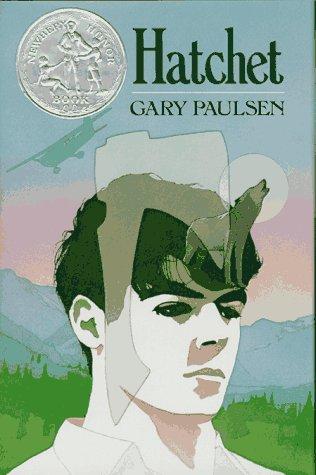
Hatchet by Gary Paulsen

Destroyed.

The word came. I would have been destroyed and torn and smashed. Driven into the rocks and destroyed.

Luck, he thought. I have luck, I had good luck there. But he knew that he was wrong. If he had had good luck his parents wouldn't have divorced because of the Secret and he wouldn't have been flying with a pilot who had a heart attack and he wouldn't be here where he had to have good luck to keep from being destroyed.

If you keep walking back from good luck, he thought, you'll come to bad luck.


I wanted to read Hatchet because I was a big fan of Dogsong, which I thought stood out as one of the best pieces of YA fiction I'd ever read. Hatchet is cut much from the same cloth: it is essentially about a boy having to survive in the wilderness, and through that survival he comes to what I suppose you could call manhood, or at least a greater understanding of himself and his world.

In Dogsong, the main character was trying to recover a way of life lost to his Eskimo kin; here in Hatchet, survival is an unwelcome necessity: Brian Robeson is on his way to visit his father in the Canadian oil fields when the pilot of the single-engine plane carrying him has a heart attack and Brian is forced to land the plane in a lake. All Brian has with him is a hatchet, with his mother--quite fortuitously, I might add--gave to him for his birthday. He also carries with him, in the metaphorical sense, a Terrible Secret that actually turns out to be a Pretty Banal Secret: He saw his mom kissing another man, which he knows (but his father does not) is the reason for his parents' impending divorce.

That causes him some added discomfort at the lake, but soon it fades into the background as Brian is forced to learn how to survive on his own--he quickly figures out how to forage for berries, and through a long, painstaking, incremental process figures out how to use the hatchet to build shelter, start a fire, catch and cook food. By the end of his ordeal, which lasts for a couple of months, Brian is a tanned, fit survival expert. It's like Survivor Man for the tween set.

There was a mystical element to Dogsong that helped it transcend its genre; Hatchet could have used something similar. What Paulsen accomplishes--a gripping YA book almost completely without dialogue--is arresting enough, but it seems awfully plain in the other novel's shadow. Its most glaring flaw is the awful subplot about Brian's parents and their divorce, which is completely useless, wisely dropped early on, and never resolved--only briefly referenced in the postscript. Still, it has a pretty solid pedigree as a YA book; but as I told Brent, don't waste your time if you haven't read Dogsong, which is its superior in every way.

Thursday, March 12, 2009

The Hunger Games by Suzanne Collins

"Katniss, it's just hunting. You're the best hunter I know," says Gale.
"It's not just hunting. They're armed. They think."
"So do you. And you've had more practice. Real practice," he says. "You know how to kill."
"Not people," I say.
"How different can it be, really?" says Gale grimly.
The awful thing is that if I can forget they're people, it will be no different at all.

Katniss Everdeen lives in District 12 of Panem, the dictatorship that rose from the ashes of the United States. The Capitol of Panem is surrounded by 12 districts, which it rules with an iron fist, a "fist" that obliterated the revolutionary District 13. District 12 mines coal, and seems to would no doubt at one time been called Apalachia. As a reminder of its power, the Capitol hold the annual Hunger Games. Two teenagers are chosen from each district to fight to the death in a place referred to as "the arena." The last man or woman standing gets to live out the rest of his or her life in relative luxury. Katniss little sister is chosen during this draft, but Katniss volunteers to go in her stead. The other teenager "reaped" from District 12 is Peeta Mellark, who has a bit of history with Katniss. Of course, this is someone who Katniss must view with a kill-or-be-killed mentality.

This book is equal parts: Running Man, Survivor, and Lord of the Flies, with just a dash of teenage romance. The relationship between Katniss, Peeta, and her "friend" from District 12, Gale fits into the YA fiction model. That is to say, it is not very interesting, nor noteworthy. The action that takes place within the arena, however, is worth mentioning. The book is incredibly violent. Blood is nearly its own character. Children are impaled, stung to death, and eaten alive -- not by other contestants, cannibalism is one of the few no-nos in the Hunger Games.

The novel reads quickly, in large part because there are no flourishes to Collins prose. It is fairly straight forward and to the point. Most of the plot moves rapidly, mimicking the pace of its characters as they attempt to outrun and outsmart each other. The second half slows down a bit, with Katniss trying to nurse Peeta back to health. I am sure that Collins was trying to make a statement about the effects of violence and war on children, but there was not enough psychological development of her characters for this to be effective. There were some minor plot points that I simply had to look over. For example, these "games" were supposedly televised to the entire country of Panem, but at no point does Katniss mention seeing a camera. There were other similar plot devises that while annoying did not have a huge effect on my enjoyment of the book.

For YA fiction, this was pretty good.

Sunday, February 1, 2009

Dragonwings by Laurence Yep

I read about fifty pages of this book waiting for the freaking dragons to show up. When, around page 100, they finally did, it was one dragon in a dream sequence and it didn't breath fire on any villages or gobble up any damsels or anything like that, and didn't appear for the rest of the book. What.

Dragonwings is one of Yep's Golden Mountain series, a collection of books that follow the stories of a loosely related group of Chinese immigrants from the 19th century to modern times. As you would know if you were in my honors English class, "Golden Mountain" is a term that Chinese immigrants of the turn of the century used to denote America, which is either a serious mistake or a metaphor. This story in particular is about Moon Shadow, a young boy who is sent over to San Francisco from China to join his father, whom he has never really known.

His father, Windrider (ugh), confides in his son that he had a dream in which it was revealed to him that he used to be a dragon--in fact, the physician to the king of dragons--and that is why he's so skilled in repairing machines and why he has an insatiable desire to fly, if not in the dragon way than in the way of the Wright Brothers who have recently flown their first airplane.

I think the conflict is interesting enough--Windrider dreams of building a functional airplane, while facing rank prejudice and abject poverty--but the whole novel has an Afterschool Special vibe to it that's very off-putting. Windrider and Moon Shadow are wafer-thin as characters, and spend a lot of time learning Very Special Lessons about the world around them. The prose is blandly undescriptive and spends a lot of time over-explaining cultural phenomena, and as a result reads more like a textbook than a novel. I'm pretty sure that if I were twelve I would have put this book down long before I finished it. Unless, like I did at twenty-two, I read through the entire thing waiting for some more freaking dragons.

Side note: Statistically speaking, Laurence Yep is the second-most famous Asian person with an interjection for a surname, after Bond villain Dr. No.

Wednesday, January 7, 2009

Dogsong by Gary Paulsen

Out.

Into the sweeps, into the great places here the land runs to the sky and into the sky until there is no land and there is no sky.

Out.

Into the distance where all lines end and all lines begin. Into the white line of the ice-blink where the mother of wind lives to send down the white death of the northern storms.

Out.

Into the mother of wind and the father of blue ice.

Russel went out where there is nothing, into the wide center of everything there is.

Into the north.


As far as pure writing goes, I think there are very few young adult books I've read better than Dogsong--it's a powerful book and very poetic. I'm on record as saying that the tightness of young adult literature is routinely superior to adult fiction; postmodern books often seem to me to be weighted down by their own breadth and lack of focus. But YA books tend to be shallow and clumsy as well, so it's refreshing to read a book like this one that's well-written and lacks pandering.

Dogsong is the story of Russel Susskit, a native Eskimo boy who feels uneasy with the way his people have appropriated the ways of outsiders; you might say he has an old soul. His father is a chain-smoking Jesus freak but nevertheless senses the way his son feels and suggests he go visit with Oogruk, an old man who owns the village last dogsled. Oogruk lives in the old way, using seal oil for lamplight instead of electricity and covering his floor with skins. Oogruk teaches Russel to drive the dogsled--though his advice is less technical and more like "Be the dogs, Russell--be the dogs."

Eventually Russel comes to understand that he must take the dogs north on a survival trip. Not to anywhere particular, but just to do it, to recapture the spirit of his ancestors. I don't know, it sounds less cheesy when Paulsen writes it. He begins to have strange dreams of himself grown up, but in ancient times hunting mammoth, prophetic dreams prowhich lead to him saving the life of a young pregnant girl out on the ice.

There is a scene--and here is a major spoiler, so skip it if you like--where Russel helps the girl deliver her baby in their skin tent, and it is stillborn. I think it is a testament to Paulsen's ability that, unlike the deaths in Tuck Everlasting and Bridge to Terabithia, there is real sadness but also real understanding about the natural process that causes such a tragedy to occur.

I had to assign independent reading to my kids and, having never read this, assigned Call of the Wild to a few of the male students I thought needed real lessons in what it means to "be a man." I think that if I had to go back and do it again I would save a few slots for them to read Dogsong.

Sunday, January 4, 2009

Holes by Louis Sachar

My middle schoolers love this book, which I think is a feat in itself because I would have guessed that they would have giggled so uncontrollably at a book called Holes that they never would have read it. But Louis Sachar is the kind of author who possesses a child's imagination or at least the ability to create characters and situation children will find appealing.

We read some of Sachar's Wayside School stories the other day, and I was impressed how well their absurdity stood up--like the story about how the teacher brings in Janie-flavored ice cream and everyone loves it but Janie, for whom it tastes like nothing because it's what she tastes all the time. That's just clever enough to make me smile while still being a simple enough twist that a sixth grader can understand it; it manages to be surreal but not random.

Holes, I found, has too few of the moments that make the Wayside stories so enjoyable and relies instead on a Santa's bag of quirks, gimmicks, and nonsensicalities that don't really cohere. It's a shaggy dog story about a kid named Stanley who is wrongly accused of stealing a basketball stars' shoes and is sent to a camp where he's made to dig holes, supposedly to build character but in fact so that he might discover a treasure buried in the area by notorious outlaw Kissin' Kate Barlow. There are poisonous lizards, a kid named Zero, a gypsy curse, a deadly nail polish, and all manner of ridiculous details that might have worked well in the constraints of a short story. In a novel, however, they come off as the literary equivalent of flipping through the channels; though you might catch the conclusion of each show it doesn't mean you've really absorbed the material. Sachar jumps through innumerable hoops to tie the plot together at the end, but the focus that is one of juvenile fiction's strongest traits is sorely lacking.

Of course, you might say that I'm making the mistake of approaching this book as an adult--when, really, the proof of its success is in the fact that it can make a room of hormone-mad seventh graders quiet, if only for a few brief minutes.

Saturday, January 3, 2009

The Giver by Lois Lowry

I liked the feeling of love. Of course,” [Jonas] added quickly, “I do understand that it wouldn't work very well. And that it's much better to be organized the way we are now. I can see that it was a dangerous way to live.”


Spoilers.


One thing I enjoy about reading Young Adult books is their relative lack of complexity. Strong YA fiction generally has one or two themes and communicates them simply and clearly, sometimes eliciting a stronger visceral reaction than some more complex but less immediate works. That's how The Giver was for me.


The Giver is the story of Jonas, an eleven-year-old boy living in a perfect community. In this community, no one is ever sad, sick, or hurting. Everyone is always well-fed, and no one ever dies. Unwanted children and the elderly are “released” in a beautiful ceremony that almost no one ever gets to see.


On their twelfth birthdays, children in the community are assigned positions within the hierarchy. There are birthers, caretakers, speakers, and so on. Jonas, however, is assigned to a special position, that of Receiver. The job of the receiver is to receive memories, feelings, and experiences from the past and keep them inside himself to protect the others in the community from the pain and unpleasantness they might bring. These experiences are given to Jonas by the previous Receiver, or the Giver from the title. As more and more experiences are revealed to Jonas, he begins to see the dark underbelly of his society, particularly “Release,” which is revealed to be a code word for involuntary infantacide and euthanasia.


In his excellent review, Christopher noted that the problem with dystopian societies is that most of them do not represent realities in which any normal person would wish to live. He includes in his assessment the society in The Giver, but I'm not so sure I agree. Without politicizing this commentary, I'd simply note that the ideas of euthanization for the elderly and infanticide for the unwanted child are not unheard of, and a society in desparate pursuit of happiness at any cost might well adopt similar (albiet less extreme methods of dealing with unpleasant realities.


Anyway, regardless of your view of the society it projects, The Giver is an impactful book, full of powerful scenes that work even when you can see them coming, such as the revelation that Rosemary, a failed Receiver who chose to euthanize herself rather than live with the knowledge she had received, is the current Giver's daughter. Also, the depiction of Jonas's father cheerily euthanizing an unwanted child while Jonas watches is chilling.


As it stands, The Giver is a solid dystopian story with a strong human aspect. It's also a really quick read and well worth the hour it'll take to get through it.

Carlton's Review of The Giver

Saturday, December 13, 2008

The Realm of Possibility by David Levithan


"Here's what I know about the realm of possibility-/it is always expanding, it is never what you think/it is. Everything around us was once deemed/impossible. From the airplane overhead to/the phones in our pocket to the choir girl/putting her arm around the metal head./As har as it is for us to see sometimes, we all exist/within the realm of possibility. Most of the limits/are of our own world's devising. And yet/every day we each do so many things/that were once impossible to us."

There seems to be a recent outbreak of YA fiction novels being written entirely in poetry, because like the Sones book I reviewed not too long ago, there isn't any prose to be found here, either. Levithan has created twenty different complex and believable high school students with interconnected story lines who each offer us up just one poem to summarize their situation. What I think was the most interesting about the way that the book was put together was the success with which Levithan carefully crafted the poems so that the style of each would match the fictional author's voice and personality. It's easy enough to create different characters, sure, but to each give them a different style of writing without any overlaps is another story all together. It goes without saying that in some of these poems work better than others.

My favorite of all the poems involved one of the squares (involved in Honor Club, Quiz Bowl, etc.) buying marijuana for her mother who was undergoing chemotherapy and then watching her mother laugh for the first time in ages and turn the music up so that she could get out of bed to dance. The poem continues on to the next day where the dealer offers her more pot and she declines saying she can't afford it and he insists she take it anyway, without saying too much letting her know that he knows it isn't for her and what it's for, thus challenging her assumptions about him through his strange show of kindness. One of the more amusing poems was written about how someone felt he was losing his girlfriend to Holden Caulfield, because after reading The Catcher in The Rye about a thousand times she decided that everyone, including him, was a phony that could not be trusted. I think at some point or other every book nerd falls hard for the ideology of one of their favorite authors or fictional characters but I don't know anyone that goes around lecturing others about it. (I'm partial to Atwood girl, myself.)

I wasn't wild over The Realm of Possibility but I think it did a great job of exploring a very diverse group of students--from the choir girl to the goth to the gay couple to the anorexic girl to the school jock that seems to have it all together to the angry goth chick writing things like "YOU ARE IMPLICATED" and "YOU ARE FOOLISH IN YOUR UNHAPPINESS" over lockers and desks throughout the school.

The most frustrating thing about the book is that it isn't organized very well and it's often hard to tell who is speaking due to the structure Levithan employs. It is divided into five different sections and each section has a page that has the names of the characters who are in that section in the order that they appear, but their names are not anywhere to be found on the poems themselves, so I had to keep flipping backwards to figure out what was going on.

Tuesday, December 9, 2008

I Am the Cheese by Robert Cormier

Spoilers.


I Am the Cheese may be the best thriller I've read in years. Whether this is a strong compliment because it's officially a YA novel, or faint praise because I don't read many thrillers, I'm not sure. Regardless, IATC gripped me from the second chapter and I finished it just a couple hours later.


The story, already summarized nicely by Chris and Carlton, follows the events surrounding Adam, a young man whose family is an inductee into the witness protection program. The narrative of the book is split, with about half consisting of transcripts of taped interviews and half chronicling Adam's bicycle journey from his home to Rutterberg, Vermont to see his father in the hospital. Things are not as they seem, however, and the final section of the book (along with a couple pages of government paperwork to clarify) turns everything on its head. For a YA book, the ending is somewhat ambiguous. At first glance, it appears that Adam's journey has been entirely fabricated in his mind, probably to deal with the trauma of losing his parents, but Cormier leaves open a couple other possibilities as well. It is possible that Adam is reliving something that actually happened at one time, and it seems equally possible that Adam is just mental and none of the book's events happened at all. It's never made explicit, and somehow that makes the last chapter even more chilling.


After reading The Chocolate War and I Am the Cheese, I'm impressed with Cormier's books. I'm planning to read a couple more of them, although I'm curious if they all hold to the nihilistic worldview presented in the books I've read. I'll touch more on the specifics in my review of The Chocolate War.


Also, I'm pretty sure this is the worst cover this book has ever had.

Sunday, November 2, 2008

How I Live Now by Meg Rosoff


When I was younger, books sucked me in and held me in a safe place when the world around me seemed like it was about ready to burn itself down. I could live between the pages easily, an outsider watching other peoples’ lives unnoticed, while my own life buzzed around me while I read, oblivious. Since the age twelve or thirteen, though, I’ve not been able to have quite that same relationship with my reading now that my coping mechanisms have at least somewhat improved. The relationship I have with Meg Rosoff’s novel How I Live Now is the closest I’ve come to the relationship I had with the books that I loved when I was younger and hiding from reality. The book didn’t make me feel safe at all—it was quite the opposite, but I could still live inside of it. I read it in one sitting and can’t stop thinking about it now that it’s over.

How I Live Now is a crossover novel that was originally considered standard fiction but is currently also being shelved with young adult fiction. I don’t know if I agree with the inside of my copy that says it is appropriate for ages twelve and up, but what do I know about anything? The novel shook me and made me uncomfortable and took me out of my own life in a way that was terrifying. I don’t know if my middle school self could have dealt with all of the material and the way that it was handled.

If I tried to give you a plot summary of the novel, you would gather that the main character struggled with anorexia and selfishness and cynicism but went through a coming of age in the middle of a future war where the identity of The Enemy was a big question mark and no one even knew what the war was over. You would know that book dealt with incest and the breaking of the taboo in major ways. You would know that there was a touch of magic, a splattering of telepathy, a continual string of events that were either brushes with insanity or out of body experiences that happened because of love and shared consciousness. Giving you the skeleton of the novel in the form of a basic summary would not speak to how chilling the novel was or tell you that Rosoff seems as much like a witch woman as she is a gripping author.

Honestly, I don’t know what to say about the novel at all except that you should read it. As one of my other favorite authors (Mark Haddon) says on the front cover, the novel is “Magical and utterly faultless.”

My last word on this is that Rosoff’s novel is the most original work of fiction I’ve read in a long time, or maybe in my life time. What started off seeming like it would be just another book about an angry and displaced adolescent finding their way turned into something much bigger. I realize that most of you 50 bookers are probably a lot more well read than I am and have read a lot more truly significant novels (whatever that means) than I have, but I feel like this book will probably join the ranks of revered reading and that Rosoff will find her place beside the Atwoods of the literary world over time.

And that’s all I have to say about that.

Monday, October 27, 2008

I Am the Messenger by Markus Zusak


"Before I even mention me, I should tell you some other facts: 1. At nineteen, Bob Dylan was a seasoned performer in Greenwich Village, New York. 2. Salvador Dali had already produced several outstanding artworks of paint and rebellion by the time he was nineteen. 3. Joan of Arc was the most wanted woman in the world at nineteen, having created a revolution. Then there's Ed Kennedy, also nineteen... No real career. No respect in the community. Nothing."

I enjoyed the actual process of reading this book but once it was over and I discussed it with some people in my Young Adult Lit class, I realized how sloppy the novel actually was. Despite some problems that I had with a few major plot points, the novel was still redeemable up until the final chapter where everything came together in a way that was far too neatly packaged and a bit too didactic for my likings. I will give Zusak this, though-- the novel plays out in a way that made me see each event unfold as it happened, and it was a lot more like I was watching a movie than it was like I was reading a book. Maybe that's common for other people and my imagination is lacking, but that doesn't happen for me very often.

The main character, Ed, is in a bank depositing his paycheck from the cab company he works for when a bank robbery goes down. Although he is an unlikely hero, Ed still manages to save the day. After his short fifteen minutes of fame end, he goes back to his normal life sharing his shack with his dog the Doorman, chasing his best friend Audrey who is too busy being a tart to acknowledge his affinity for her, and playing cards with his underachiever friends when he's not carting people around town in his cab. Everything is fine until the cards start coming in the mail, where he must "protect the diamonds, survive the clubs, dig deep through the spades, and feel the hearts." He becomes The Messenger, delivering people what they need and not knowing who is sending him or why. Without giving the plot away, I'll just say this-- I Am the Messenger reminded me a lot of a toned down version of The Boondock Saints without any of the murder. Sometimes he's helping lonely old women and priests, but other times he's beating the snot out of young punks and pistol whipping abusive men. You never really know what he is or isn't capable of or what he's going to have to do next. Since the instructions on the cards sent to him are vague, he has to assess situations himself and find out how to make life better for the people he has to protect. If he doesn't take care of a situation in an appropriate or timely matter, he knows his life is at stake.

Zusak has a YA bestseller set during the Holocaust called The Book Thief that I want to read, but I think I'll wait a while before picking one of his books up again.