Showing posts with label australia. Show all posts

Sunday, April 26, 2026

Tracks by Robyn Davidson

And it was perhaps the cold desolate lovelessness of the place that threw into sharp focus the magical and life-affirming qualities of the country around it. To enter that country is to be choked with dust, suffocated by waves of thrumming heat, and driven to distraction by the ubiquitous Australian fly; it is to be amazed by space and humbled by the most ancient, bony, awesome landscape on the face of the earth. It is to discover the continent's mythological crucible, the great outback, the never-never, that decrepit desert land of infinite blue air and limitless power. It seems ridiculous now, to talk of my growing sense of freedom given the feudal situation I was living in, but anything could be mended, anything forgotten, any doubt withstood during a walk through those timeless boulders, or down that glittering river-bed in the moonlight.

In the late 1970's, Robyn Davidson moved to Alice Springs, the town at the center of Australia's Outback, with one goal in mind: to obtain and train a group of camels in order that she might walk from the center of the country to the Western Australia coast. The trip, as Davidson describes it, is not just about getting to know the country, but getting to know oneself: alone for long stretches of time with only the camels and her dog, walking across some of the most featureless and inhospitable landscape on Earth, Davidson becomes not just independent and self-sufficient, but in tune with herself in a way that's not possible in Brisbane, or even in old ramshackle Alice. This is a kind of book that has become popular in recent memory--I'm thinking of Cheryl Strayed's Wild--but whereas those books always seem to be a kind of marketing strategy, when Davidson writes about self-actualization, I tended to believe her, not least because of the incandescent rage she expresses toward the demons of the press that want to turn her into tomorrow's headline.

Close to half the book is taken up with the preparations for the trip, which involve taking small jobs in restaurants and ranches in Alice Springs. I was really interested in Davidson's discussion of anti-Aboriginal racism in Tracks: the Alice Springs of the 1970's she describes is a place where whites drop slurs as easily as spitting on the ground. (It's also a place disproportionately filled with men, who frequently threaten young women like Davidson with rape.) Davidson paints herself as kind of a hothead who often leaps to the defense of Aboriginal Australians, and it's this fervor that really makes her seem honest and impolitic, though I would suggest there's a kind of blindness, too, in the way she throws around suggests of Aboriginal "demise." Later, on the trip itself, she's briefly joined by an Aboriginal man named Eddie who takes her through some of the track that she would not, and in fact would not be allowed according to Aboriginal tradition, traverse on her own. These sections, which depict a kind of free camaraderie despite a real language barrier, are some of the most charming of the novel. When Eddie leaves and Davidson faces the last, deadliest stretch of the trip, the book's tragic elements return to the forefront.

If this were a book about traversing an American desert, you might expect some stunning descriptions of landmarks, well-known and not. But the Australian desert is not like the American one; it's featurelessness is part of the essential nature that draws Davidson to it, and it's not possible--or so I gather, and so I understood as I crossed it by air a few weeks back--to impose a mental geography on it, unless perhaps you are an Aboriginal Australian moving along a songline, perhaps. So the focus, for the most part, becomes on Davidson herself, her self-sufficiency and stubbornness. (Though I really liked her description of what was then called "Ayers Rock," which she explains that no tourist mob could ever really reduce or diminish.) I thought it was especially funny how Davidson spent 100 pages talking shit about the clueless photographer that National Geographic sent to snap photos of her, right up to the point where she sleeps with him. That kind of hotheadedness and brashness is what makes you like Davidson, and what makes you believe in her.

Sunday, April 19, 2026

The Orchard Thieves by Elizabeth Jolley

Never let fear come into your life, someone had said to her when she was still a schoolgirl. She had never forgotten this, and here she was, a threatened and frightened woman after being fearless all her life, simply because a daughter, the middle one, without warning and without explanation, had come home seeking sanctuary. When she thought about it, there was no safe place in her house if someone should come, the hunter or the huntress, after the middle sister. Nothing closed properly in the house, the windows were loose in their frames, any keys which still remained would not turn in the locks. She never tried to lock up the house. At night the household was especially vulnerable with three women and three small children and one unborn child sleeping there. She had to understand that she had been afraid for almost four weeks, ever since the arrival of the middle sister.

The woman at the center of Elizabeth Jolley's The Orchard Thieves is known simply as "the grandmother." The other characters, too, are reduced to their familial roles: "the youngest daughter," "the grandsons," "the aunt"--that is, the eldest and childless sister. Into this web arrives the middle daughter, known as, you guessed it, "the middle daughter," returning to Australia from England with her daughter ("the cousin") in tow and a baby in the oven. The middle daughter has experienced something harrowing, perhaps related to a lover, perhaps the father of the baby, although it's also hinted at that she has relationships with women. What it is, the grandmother is never permitted to know; her role is to provide sanctuary without question, and the reader is never permitted to know either. But the grandmother's anxiety is ignited: how can she protect her middle daughter if she doesn't know where the threat lies?

In the above passage, the grandmother claims to have been "fearless all her life" until this moment, but we can see that this is not true. Until the arrival of the middle daughter, her primary concern is for her three grandsons, who act in the story as a unit, and who are always up to some mischief or peskiness. A bowl of fruit, sitting in the kitchen, is too beautifully arranged for anyone to take from it in the daylight, but at night the grandsons sneak in to steal apples and grapes, one by one--the orchard thieves of the title. The grandmother is entirely aware of this, and fascinatingly, her fear for her grandsons centers on the knowledge that they will be, at some time in their life, the thief, rather than the victim. But the "Orchard Thieves" also refers to the adult children, including the youngest daughter's husband, who seize on the opportunity to discuss despoiling the grandmother of her home. Does the grandmother see this greed in them, too, as she sees it in the young children? Does she excuse it, even nurture it, also? Is it cruelty, or a natural way of things that must be endured?

Jolley is always such a cryptic writer. In a way, The Orchard Thieves is the most straightforward of her novels, which always feel like they either have a piece missing, or perhaps one added in. Here, it's what has happened to the middle daughter--keeping that information back is, I think, a remarkable kind of authorial restraint. But the story from the narrow perspective of the grandmother is not cryptic at all, though its narrowness is a kind of limitation of the kind that Jolley seems to like. The reduction of the characters to their family roles turns it into a kind of fable or parable about aging and motherhood. One's reminded of those spiders who offer their bodies as refuge for the eggs of parasitical wasps, only to be eaten up after they hatch, piece by piece.

Sunday, April 12, 2026

Six Books About Australia

The Fatal Shore by Robert Hughes
Voss by Patrick White
The Welcome to Country Handbook by Marcia Langton
Walkabout by James Vance Marshall
Connardoo by Katharine Susannah Prichard
The Children's Bach by Helen Garner


One prisoner, a former actor named William Hunt, "who in his younger days had belonged to a company of strolling mountebanks," disguised himself as an enormous "boomer" or male kangaroo. He nearly got across to Forestier's Peninsula before two picket-guards, thinking he really was a kangaroo, spotted him and gave chase, leveling their muskets. "Don't shoot, I am only Billy Hunt," the nervous marsupial squeaked, in their consternation."

On my recent trip to Sydney I visited the Hyde Park Barracks, basically a housing unit for convicted English criminals who were sentenced to "transportation," that is, exile to Australia for their crimes. The barracks are barracks, not a prison--Australia was the prison. But what does it mean for a whole continent to be a prison? Robert Hughes' history The Fatal Shore details the Australian transportation system from the landing of the "First Fleet" in 1788 to its end in the late 19th century. I was searching for a general history of Australia, but one thing Hughes' book makes clear is that, as far as European settlement goes, the history of transportation is the history of Australia, which makes it all the more incredible that, according to Hughes, the social stigma around the "Stain" made it impossible to talk about Australia's convict past for most of the 20th century. Australians might take comfort in Hughes' point that, in creating one of the world's safest countries, with one of its highest standards of living, the nation is proof against the eugenicist belief that "criminality" is a heritable trait.

Hughes makes pointed comparisons between the transportation system and the Russian gulag of the 20th century, both attempts to deal with social problems wholesale by exiling "problematic" sections of society. Transportation, Hughes notes, precedes Bentham's idea of the modern penitentiary, and its invention was an attempt to deal with what seemed like an insoluble problem: where do we put all these criminals? The First Fleet of 1788 dealt with a grueling eight-month ocean crossing to find themselves on the other side of the world in a poor harbor racked with disease and little arable land; with these meager tools they were meant to build their own society. Early Sydney was hell for soldier and prisoner both, and many soldiers remarked on how little difference there seemed to be between them. As free settlers begin to make their way to Australia, the "System" grows in its cruelty, becoming more punitive and violent, perhaps to make the class distinctions more obvious and iron-clad. A basic fact that I didn't understand is that convicts would be leased out as workers to free settlers. And yet, a prisoner who did well could receive a "ticket of leave" to work for themselves, and once their time was up, many stayed, becoming themselves powerful landowners who were sought after as masters by other convicts, being more understanding.

Hughes describes a 19th century Australia whose key social distinction is between "Exclusives" and "Emancipists"--that is, free settlers seeking to maintain their social superiority and freed convicts who had been elevated to the ranks of polite society. Although the elevation of "Emancipists" ended with the relatively liberal government of Lachlan Macquarie, whose successors were those who hardened and strengthened the penal system, this conflict seems to have shaped Australian society up until the moment that transportation ended and, embarrassed by "the Stain," everyone agreed to forget all about the System. Hughes tells an interesting anecdote about a former prison ship that briefly opened as a public attraction before being sunk by irate Tasmanians, whose former colony of Van Diemen's Land was the harshest and longest-lasting of the various colonies. As an aside, I thought that Hughes' book was really well-written for a general history, full of interesting anecdotes and a dry sense of humor that made it a real pleasure to read.


'Voss did not die,' Miss Trevelyan replied. 'He is there still, it is said, in the country, and always will be. His legend will be written down, eventually, by those who have been troubled by it.'

'Come, come. If we are not certain of the facts, how is it possible to give the answers?'

'The air will tell us,' Miss Trevelyan said.

The class distinctions between Exclusive and Emancipist provide an interesting window into Patrick White's classic novel of Australian exploration, Voss: Bonner, the explorer's wealthy patron, is a free settler whose "subscription" to the exploration is a kind of social expense meant to distinguish him as a gentleman. Bonner, like most of Australia's free settlers, is a mediocrity who takes advantage of the fresh country to make an attempt at a gentility that he wouldn't have had in England. The household servant, Rose, whose illegitimate pregnancy causes the family so much trouble, is an emancipated convict; in Laura's attempt to adopt Rose's baby (after her death) one can see the porous borders of early Australian society, and the desperation of those like the Bonners to keep them hardened. The novel's other Emancipist is Judd, the former convict who is Voss' foil on the expedition. Judd, having made his claim to the new country by toil and suffering, has a kind of practicality that Voss lacks; it's no coincidence that he alone survives the expedition. And yet, White makes it clear that Australia "belongs" to Voss, and not to Judd, by right of a kind of vision that Judd lacks, perhaps because Voss is outside the system that has so circumscribed the roles of Judd, Bonner, and Rose.

Voss' outsider-ness makes him, perhaps, more akin to the aboriginal people who make up such an important part of the exploration. Hughes describes how, among prisoners, Aboriginal Australians were thought of as being on the side of the jailers, since they had legal protections the prisoners did not, and were often used as "trackers" to bring back escapees. Judd ends up in a party with the older Dugald and younger Jacky, perhaps an uneasy union. But the country they enter into clearly belongs to those Aboriginal people who have never, like Dugald and Jacky, entered into a compact with white society--I recall easily one of my favorite scenes, where Dugald, having rejoined a tribe of Aboriginal kinsmen, rips apart the letters entrusted to him, whose pieces the tribe watches fly away in wonder. Voss and co. eventually find themselves in the keeping of another such group. Physically depleted by their journey, they are neither prisoners nor wards; they simply have nowhere else to go. There's a kind of mysticality at work here, a suggestion that the Aboriginal Australians belong to a kind of metaphysically different world, but I would argue that what is clearest is that "Country" belongs to them. Voss, by the power of his own vision and separateness, comes closest to achieving what has been natural to them for millennia.

There's something risky about revisiting your favorite books. Voss was my first of White's novels, and one thing that surprised me is that it is, prose-wise, rather ordinary compared to some of his other stuff, which tends toward the grotesque and the physical in ways that are not present here. It struck me actually as the most readable of White's books, which was a huge shock. But I was gratified to find it as good as I remembered. The psychic connection between Voss and Bonner's niece Laura produces the novel's most genius passages; the way that White manages to persuade the reader that Laura is present with Voss in the Outback even as she is physically in her Sydney estate takes one's breath away. And it was a special experience to read this novel just before my own trip to the Outback, where I got a great sense of the vastness of the hostile country from the hotel lobby bar where I spent much of my time sitting.


Why should we learn about the history of human life and the environment in this country in the time before the British arrived? Because most of the human history on this continent is that of the First Peoples, who lived here for tens of thousands of years. Their descendants--the Aboriginal and Torres Strait Islander Peoples--continue to follow and respect the ancient traditions and customs that make this country unique. It is likely that these are the oldest continuous living cultures surviving anywhere on the planet.

I turned to Marcia Langton's The Welcome to Country Handbook to help me understand a little more about the Aboriginal cultures that are, in a real sense, at the heart of Voss. As Langton points out, it is possible for Aboriginal people to make a remarkable claim to being the oldest living culture, perhaps up to 60,000 years old. Hughes describes the Aboriginal peoples encountered by the First Fleet as stunningly primitive compared to Native American societies encountered by settlers in North America; it is a wholly other perspective to consider that what the First Fleet found was a culture that had evolved in tandem with the continent over incalculable generations. Langton's book is an introduction to Aboriginal peoples for curious tourists, and hits some of the highlights one might expect: the 20th century renaissance and market for Aboriginal artwork, the political conflicts between Aboriginal Australians and the federal government, the diversity of Aboriginal languages and societies, etc.

I found this book mostly disappointing. First of all, 90% of what it cites are websites. It's written, too, like a website, perhaps one belonging to some kind of NGO: "Through storytelling, history, beliefs and knowledge about people, places and the world are relayed to each new generation." OK. To be generous, it seems to be written for a curious tourist who knows very little not just about Aboriginal Australians but Indigenous peoples, or race and culture more generally. That's fine, perhaps, but it means that there is a limit to the depth it is able to accomplish. Is it necessary to sit through a chapter that describes what racism is, or race?

But when the book does manage to say something specific, I found it pretty fascinating. I enjoyed learning, for instance, about the complex ordering of Yolŋu society, in which everything is considered to be one of two "moieties," even people, and marriage must be endogamous across these two moieties. Langton describes a highly ordered society in which dozens of familial relationships are recognized, if not more, and I got the sense--perhaps only through implication--that other Aboriginal groups have similar practices. Furthermore, I was interested in the way that Aboriginal Australians seem to share meaningful qualities with Native Americans and Black Americans, both as the original inhabitants of the country who were the victims of attempted genocide, and as a racialized class whose "blackness" forms a meaningful structure of their identity.


She felt compassionate: charitable: virtuous. Like a dignitary bestowing some supremely preciosu gicft, she handed her panties to the naked Aboriginal.

He took them shyly: wonderingly: not knowing what they were for. He put the worwora down, and examined the gift more closely.  His fingers explored the elastic top. It flick-back was something he didn't understand. (Bark thread and liana vine didn't behave like this.) He stretched the elastic taut; tested it; experimented with it, was trying to unravel it when Peter came to his aid.

'Hey, don't undo 'em, darkie! Put 'em on. One foot in here, one foot in there. Then pull 'em up.'

Now let me turn to two novels that explore interactions between white European-Australians and Aboriginal people. The first is Walkabout, James Vance Marshall's novel about two young children who survive a plane crash on their way to Adelaide. Foolishly, the children begin to walk in the direction of what they believe to have been their destination, although they're still in the Northern Territory--and will never survive. They are saved when they come across a young Aboriginal boy on "walkabout," cast here as a traditional rite of solo exploration (but which, as I understand it, really refers to the period in which Aboriginal people employed on cattle stations would return to their communities in the off season). The Aboriginal boy has skills that the two white children desperately need; he shows them how to procure water from below the dirt and which plants are edible, as well as how to catch and kill wallabies and echidnas. The two children, who are from Charleston, South Carolina, refer to their new friend as "darkie."

Of the two, the young boy Peter adjusts most easily to their new reality, choosing to go naked as the Aboriginal boy does. The older girl, Mary, has more misgivings, and her embarrassment for the boy's nakedness leads her to make a gift of her own panties, which he puts on with much good humor. (What a moment there is here for scholars of both race and gender!) In this way, Walkabout presents what seems to my eye a pretty typical conflict between "civilization" and its antithesis. Mary's unthinking hierarchies are challenged by the Aboriginal boy, even as the novel reifies the difference between them. It must be said that the fate of the Aboriginal boy seems to reflect the tragedies of Australian history: he catches Peter's cold and dies, having sacrificed himself to save them. Interestingly, Marshall ascribes the boy's death partially to an Aboriginal belief that death is inevitable once it has chosen you, and must be faced with equanimity: even before he catches Peter's cold, the boy sees in Mary's hostility a kind of "evil eye" that presages his death. Whether there's any basis for this belief, I don't know, but I saw it again in the case of one of the hired hands of the next novel, Coonardoo.


She was like his own soul riding there, dark, passionate and childlike. In all this wide empty world Coonardoo was the only living thing he could speak to. Hugh knew; the only creature who understood what he was feeling, and was feeling for him. yet he was afraid of her, resented a secret understanding between them.

But Coonardoo the playmate--Coonardoo whom he had seen long ago under the shower, young and slender, her lithe brown body, wet and gleaming, brown eyes laughing at him, her hair, wavy and sun-burnished, lying in wet streaks about her head. Coonardoo? Why should he hurt her by a harsh, indifferent manner he showed nowhere else?

Coonardoo is set on a cattle station in Western Australia in the early 20th century. It centers on Hugh Watt, the owner of the station Wytaliba. The life of a white man in the remote bush is a strange one, and Hugh struggles to find a white woman who will accept such a life. His first choice, Jessica, goes back home after a week, and his eventual wife, Mary, becomes so embittered by the experience that she takes their six daughters and moves back to the nearest town. Hugh finds brief comfort in a dalliance with Coonardoo, an Aboriginal housekeeper who he has entrusted, like his mother before him, with the station's management. The back of the book describes this dalliance as a kind of forbidden love, but I wonder if that's true--it might have been, perhaps, if Hugh's own ideological commitment to racial separation hadn't kept him from suppressing his feelings for Conardoo. In either case, the brief affair produces a son, Winni, whose favor by Hugh is what tips Mary off to her husband's infidelity.

Coonardoo is an interesting document on interracial relationships. It must have been quite scandalous when Katherine Susannah Pritchard published it in 1926, when I can only imagine that relationships between whites and Aboriginal people would have been rather outside the pale of literature. But Pritchard shows how such things might be possible on a remote station in the Australian bush, far from the polite society of town, where a white man might spend his life among the Aboriginal people attached to his station (they seem to be neither enslaved or employed, but associated somehow) while his nearest white neighbors might be a day's ride away. The villain of Conardoo is a station owner named Sam Geary who lives openly with his "gin" (I think this term is now considered offensive), who desires Conardoo for his own, and keeps pressing Hugh to sell his rights to her, whatever those might be. Is Geary's sin the way he treats his own Aboriginal wife, Sheba, or merely his openness about it?

After Mary leaves, Hugh finally accepts Coonardoo as his "woman," something that he had been loathe to do, but even then treats her coldly, never returning to her bed after the one sexual encounter that produced Winni. Part of me wants to read Coonardoo as a novel of repression about a man whose racial ideology is so strong he can never let himself embrace the one relationship that might have made him happy. But I wonder, too, if Pritchard herself is able to imagine this relationship, or if it remains elusive for the writer in her period. More troubling yet is that Coonardoo herself seems kind of an absence in the middle of the text, a character that the novel is really unable to look squarely at or understand--at least, that is, until the final chapter, when an older and disillusioned Coonardoo returns to Wytaliba at the end of her life to look up on its ruin, and think about what might have been.


What do tourists do? They walk, they stand, they look, they buy. They fumble for money on buses, not knowing whether to pay the driver or the conductor.  They visit famous monuments, fountains, old houses full of stone and shutters and anachronistic lace. They notice that the day without duty passes with the slowness of a dream. They know that their existence is without point. They envy those who go arm in arm, who have a home to go to.

Finally, a novel of modern Australia. Helen Garner's novel The Children's Bach is set in suburban Melbourne, where the reunification of two old college friends, Dexter and Elizabeth, causes a disruption in both their lives. Dexter is a family man, brash and outlandish, who rails against "Americanisms" while his wife Athena takes care of their two children. Elizabeth is more adrift, unmarried, cynical, living in an unfurnished loft. When the two run into each other, Elizabeth brings two new presences into the life of Dexter's family. The first is Vicki, Elizabeth's much younger sister, who finds in their suburban home a foothold in life that Elizabeth's loft will never provide. The other is Philip, Elizabeth's sometimes boyfriend, a rock musician who persuades Athena to run away with him on a holiday to Sydney, much to the obvious chagrin of Dexter.

I admit I didn't see the pivot in this one coming. Vicki describes Athena as "perfect"--the perfect woman, the perfect wife. And early on, she seems to have a kind of stolid devotion to Dexter and their life; Vicki admires the pair of them for their frankness with each other. But an early sign that all is not well with Athena is the way she talks about their disabled son, Billy. "Don't bother getting romantic," Athena tells Vicki, "There's nobody in there." She admits, "I'm just hanging on till we can get rid of him," and says, "I've abandoned him, in my heart." In a novel that is otherwise quite small, filled with minor domestic gestures, the cruelty on display here really stands out as shocking, as does the moment that Vicki and Athena bond over the impulse they share to push the boy in front of an oncoming car. Billy, such as he is, seems to represent a kind of problem, a challenge to the kind of life that Dexter and Athena live, that can only be solved by exile. Athena's sudden abandonment of Dexter makes sense in this context, then: "Perhaps there was a world where people could act on whims, where deeds could detach themselves cleanly from all notion of consequences. Perhaps this never-quite-present Philip might be that mythical creature, a man who was utterly scrupulous and who was yet prepared to do anything. Perhaps she too might never apologise, never explain."

Back in Melbourne, Dexter commiserates by getting drunk with--and sleeping with--Vicki. This is a huge blow to his self-conception as a nobler person: "Tis was modern life, then, this seamless logic, this common sense, this silent tit-for-tat. This was what people did. He did not like it. He hated it. But he was in his moral universe now, and he could never go back." But it seems to me what Dexter fails to understand is that he's always been in this moral universe, however much he feels as if he has been above it, and Athena's abandonment of him for Philip is only proof that this is true. There's something very antiquated in Dexter's attempt to find moral absolution in the suburban family life, rather than its epitome, and he may be the only one surprised that such an attempt could fail.

I really enjoyed this one. Brent said there's something Muriel Spark about it, and though there might be a "Guy whose only seen Boss Baby" element to that, I think it's true. In its reticence, its cultivation of the opacity of these characters--which is what allows Athena's desperate move to shock us--I saw a bit of Henry Green as well. And part of that opacity is that I feel like there's something that eludes me about the novel, and makes me want to return to it; I don't think this will be the last book of hers I read.

So, this is an interesting place to end up: Australia's penal past makes it unique among world countries, but in its persecution of an Indigenous racial underclass, it ends up following familiar forms, especially to those of whose who are American. And in the end, though Dexter may hate the way that American culture imposes its ideas on Australians, it presents a 20th century story of suburban anomie that us Americans find utterly recognizable.

Sunday, March 22, 2026

Praiseworthy by Alexis Wright

Widespread Planet, same person as that piece of work Cause Man Steel, while thinking clear-headed higher rather than thinking low, was confident about how he would survive the climate emergency. He avoided the crowd--which meant humanity--and chose to be as some kind of crepuscular man, moving around the isolated bush by himself in the twilight hours in pursuit of his business venture, to put into action far more grandiose plans about how to make real money.

The aboriginal town of Praiseworthy in Australia's Northern Territory has been covered with an impenetrable haze. It's making everyone irritable, but it puts an idea into the head of one Cause Man Steel, who anticipates the worsening of climate change and the need for radical change: he'll collect a herd of feral donkeys that can be used for transport when fuel is no longer available. Cause, also known as Widespread and Planet--because he's. you know, everywhere--is especially in search of a special platinum-colored donkey he thinks will be the key to the whole scheme, for not particularly clear reasons. But the noisy, stinky donkeys only make Cause unpopular in town, and worsen the fractures in his own family: his wife Dance dreams of moving to China; his son Aboriginal Sovereignty commits suicide by drowning himself after being torn away from the younger girl who was his betrothed; his younger son Tommyhawk goes full-on "fascist" and tries to make his dreams of being adopted by the country's white minister of Aboriginal Affairs come true.

Above all, Praiseworthy is a satire on the paternalistic attitude of the Australian government towards Aboriginal people. The book presents a series of complaints, none of which I knew before: the government identified an epidemic of pedophilia among the country's outstation communities, banned pornography, keeps Aboriginal assets on a kind of controlled credit card with major restrictions. Aboriginal Sovereignty, a young man betrothed to a teenager (we never see her) is a victim of this paternalism, whereas his brother Tommyhawk absorbs the government propaganda wholeheartedly, considering everyone in Praiseworthy, including and especially his own father, a pedophile. And the "death of Aboriginal Sovereignty" has its own obvious secondary meaning, though Ab. Sov.'s death is more enigmatic and less final than such a phrase would seem. Cause, though short-sighted and selfish, represents a kind of trickster figure who stands against this paternalism, desperate to eke out a bit of autonomy and agency in a world that wishes to convince him it's better to play along.

This is the second book of Wright's I've read after Carpentaria, and I think I liked this one more, though it's possible that I was just better prepared for it. Wright's prose is still somewhat baffling to me, wordy and junky, full of cliches and weird circumlocutions. Nouns become adjectives and vice versa, and some of them even become verbs. I wondered more than once when reading both books if there's something about the strange, dense language that reflects Aboriginal dialect, but that would only be speculation on my part. I don't think I can get to the level of the writing being good, but it certainly works on its own terms, and the experience of diving into this 600-page tome is pretty brainmelting. I enjoyed it, but I'm glad to put it behind me, because it's one of those books that does something to your own words, you know? And moreso than in Carpentaria, I thought Praiseworthy reached more than once a feverish state where the clunky prose was transformed into something strikingly modernist, especially in the scenes where Aboriginal Sovereignty is described as mingling among the traditional spirits of the sea. Praiseworthy is one of those books I don't think I'd ever recommend, but if you get it, you get it.

Saturday, March 15, 2025

The Burnt Ones by Patrick White

At first it was impossible to believe their personal lives could be reduced by a shuffle of history, which is what happened, monetarily at least, on the deck of the destroyer, after the sack of their city. Because it had been personally theirs, which was now burning by bursts, and in long, funneling socks of smoke, and reflections of slow, oily light. As he ran looking for that other part of him which was lost, he gashed his shin on a companionway. But he did not know. Calling her name. None of that rabble of sufferers--wet, dry, singed, bleeding, deformed by the agony of their first historic situation--none of them knew any more, as they stood in their fashionable rags and watched their city burn.

My favorite story in Patrick White's collection The Burnt Ones is "Down at the Dump." Set in the suburban Sydney town of Sarsparilla, it tells the story of two young people finding an unexpected connection. One, a young girl, is at the cemetery for the funeral of her eccentric aunt. The other, a boy, is from a family of poor bogans who go searching for things to sell in the dump. It just happens that the cemetery and the dump are right next to each other, separated by only a fence, across which the two teens meet and connect, or not quite, and then over which they start making out. It's a perfect Patrick White story, about the rottenness and spoil beneath suburban gentility. There's a fantastic moment when the spirit of the dead aunt looks out over her mourners, symbolically mixing the spiritual realm with literal trash. And there may be no more setting where White is more at home than the dump, which he describes in his characteristic way: "At the last dip before the cemetery a disembowelled mattress from the dump had begun to writhe across the road. It looked like a kind of monster from out of the depths of somebody's mind, the part a decent person ignored."

About half the stories are set in Sarsparilla, about another half are set in Greece or are about ex-pat Greeks. The title The Burnt Ones refers to the Burning of Smyrna, a moment in which the Turkish regime set a massive fire to the Greek quarter of what is modern Izmir, killing tens of thousands. Nearly all of the Greeks in the novel experienced this, and it colors their experience of their new homes, whether in Greece, Australia, or America, and the immediacy of its horrors contrasts with the petty psychodramas of the collection's suburban Australians. Yet, we see too how easily the Greeks, having fled this "shuffle of history," are re-subsumed into polite schemata of respectability and repression. (White writes often about Greece and Greeks, presumably inspired by his longtime partner, a Greek named Manoly Lascaris.) My favorite of these stories was "Being Kind to Titina," about a boy who tortures an awkward young girl whom he has been instructed to be kind to. She grows up and, of course, turns out to be hot, and though she only remembers him as being kind, his own cruelty tortures and keeps him from being with her. It's a story that reminds you that White can be funny:

But Titina stuck. She stuck to me. It was as if Titina had been told. And once in the garden of our house at Schutz, after showing her my collection of insects, I became desperate. I took Titina's blue bead, and stuck it up her left nostril.

'Titina,' I cried, 'the holes of your nose are so big I'd expect to see your brain -- if you had any,' I shouted, 'inside.'

But Titina Stavridi only smiled, and sneezed the bead in to her hand.

Other stories I liked: "A Cheery Soul," about a woman who annoys everyone she comes in contact with; "Clay," about a boy whose mother worries about him being unusual--a bourgeois anxiety, of course, but then he turns out to be legitimately mad. And I especially liked "Miss Slattery and Her Demon Lover," about a young female door-to-door salesman who chucks everything for a slovenly Bulgarian she meets on her route, and who turns out to have a huge fetish for being whipped. I didn't think it was as strong, generally, as his other story collection The Cockatoos, though it's been many years since I've read that one. Sadly, I can see my stock of White's books dwindling--three leftover stories, a half-finished novel, and his memoirs are all I have left. 

Tuesday, September 24, 2024

The Transit of Venus by Shirley Hazzard

On any day of the year Grace Thrale might be smiled at in the street by an elderly couple or by some young mother herding her noisy brood: saluted, that is, as a kindred spirit. Caroline Bell never attracted this delectable complicity. There were times when Grace wished the world were not so sure of her, so confident that boredom had claimed her. Yet in her daily existence feared the smallest deviation form habit as an interruption that might bring chaos. Grace no more wanted adventure than Dora wanted peace. She did not convince herself, as some women do, that she retained capacity for a wholly different existence ruled by exalted and injurious passions: Grace knew perfectly how the practised conformity of her days gratified her own desires. Yet one might cling to security and still be bored by it. In its first appeal, security offered an excitement almost like romance; but that rescue might wear down, like any other.

Grace and Caroline Bell are sisters from Australia, and orphans, whose parents have died in a ferry accident. By the time The Transit of Venus begins they have already been shuffled off to England, looked after by their depressive aunt Dora and an astronomer named Sefton Thrale. Caro is the beautiful one, the one who enchants; Grace is beautiful, too, but a more practical and everyday kind of beauty. She marries quickly, to Sefton's son Christian, a bland bureaucrat who offers stability and security. It's Caro that sweeps Ted Tice, a junior astronomer who arrives to work with Sefton Thrale, off of his feet, sparking an ardor that he will cherish and nurse all of his life. He tells Caro he will meet any requirement, but Ted's unwavering loyalty is not that kind of love that Caro is looking for; she drifts instead to Paul Ivory, a playwright and rake who is, in addition to being kind of a jerk, married. Her affair with Paul flowers and dies, and eventually she marries another bureaucrat, an American, but Ted's love survives even this marriage, survives her husband.

Is Ted pathetic or heroic? You can't say he's a romantic, really, except in the narrowest sense. His love resembles a train, something set on a track from which it can never be moved. We learn late in the novel that, in the very beginning of Caro's relationship with Paul, Ted learned a terrible secret about Paul, one that could have destroyed his life. Though Ted might have used this secret to his advantage, he never does, and perhaps this is the final statement about love as virtue: it's Ted alone, in the novel, whose love seems not like a kind of self-gratification. His abasement before Caro may not seem dignified, but it is love, and perhaps the purest kind. The Transit of Venus follows the two sisters in their separate lives, growing older, having affairs or merely fantasizing about them, having kids. Ted is kept off the page for long stretches, but it seems to me that his love for Caro forms the novel's spine and gives it a kind of shape. It's always there, lurking in the background.

I really enjoyed the writing in The Transit of Venus, which is lush, luxurious, and full of sharp detail. It's the kind of book that forces you to go slow; skip over a line and you run the risk of having missed the key to something. But I wasn't sure about the whole of the novel. It strikes me as one of those books where every page works, but the whole feels like it's lacking something. I never felt like Caro or Grace resolved into a psychological whole, or even a collection of traits that added up to something terribly interesting. (Caro, I think, is one of those characters who are magnetic and charismatic because they are magnetic and charismatic; we are asked to take Ted's love as a kind of credit on her personality.) The novel's attempts to situate its characters in a post-World War II Anglosphere--Australia, Britain, Canada--struck me as sort of half-baked and unpersuasive.

Here's the thing that annoyed me the most: the way The Transit of Venus waits until the end of the novel for a "big reveal" that's supposed to recontextualize the entire thing. To explain it, I have to give a spoiler alert. But here's what happens, more or less: Paul Ivory, years after their affair, confesses to Caro that he had affairs with men as well as women. He was being blackmailed by a lover whom, in a strange incident, he let drown. This is the secret that Ted Tice, having seen Paul and the lover--on the bank of a river that Paul soon learns is downstream of a broken dam, about which he does not warn the blackmailer--could hold over Paul if he wanted to. Paul's affair with Caro is a way of striking back at Ted Tice, who never even struck first. This is all very interesting in the way it makes us reconsider Ted, and confirms our worst ideas about Paul, but I found the "reveal" inorganic and wedged in, and very strange in the context of a book that is otherwise mostly bare of "incident." It felt cheap and a little condescending. Worse is the very ending of the book, in which Caro finally accepts Ted's love, only to board an airplane that immediately crashes, leading to Ted's suicide. We are asked to read between the lines to pick up these details: Hazzard tells us 100 pages previous that Caro's ophthalmologist will die in a plane crash en route to Rome, then Caro sees him on the plane. I thought this ending rather lame, and I found the suggestion that I was supposed to piece it together kind of stupid. I liked the book a little better, actually--for its richness, its depiction of the ebb and flow of ordinary lives--before I pieced it together.

Monday, August 19, 2024

A Boat Load of Home Folk by Thea Astley

After Lake reached what should have been structure, he found an aching gap. There were chunks, of course, of wall and roof and immense spaces filled with thrown trees. A statue of Our Lady of Sion lay face down among the grasses. the whiteness of it was like light. It all seemed amusingly symbolic though he had not the heart to see it thus while custom nudged him past towards the presbytery, now only a flattened jumble of timber walls and passion-vine streamers torn out in the high wind. They flew steadily and crazily over the rubble, over the banana-trees that had one stood in a grove near the front door. As Lake went by he picked at a frond of these whose suave leaves lay in his hand without emotion and added to his sense of aloneness. The rain was cutting his skin like bullets, pasting his hair across his eyes. But he opened his mouth to the rain the way he used to do as a boy and felt the tearing of it across his tongue.

Thea Astley's A Boat Load of Home Folk focuses on a group of people who disembark from a ship on a Pacific island which is, I think, supposed to be Vanuatu. Among them are an unhappily married couple, the Seabrooks; Stevenson, a local official dogged by his own relationship wit his young son; a pair of elderly companions, Miss Paradise and Miss Trumper, on vacation; and a gruff priest with a mysterious errand. None of them know that, before the day is over, a terrible cyclone will rip through the island, exposing their frailties and insecurities in the same way that it rips the roofs from the buildings.

The priest, Greely, turns out to be sent from the diocese (or whatever) to discipline a local priest, Lake, who has recently been caught in flagrante delicto with a young native boy. Lake is arguably the center of the novel, and its most interesting character, an ineffectual and disillusioned priest right out of a Graham Greene novel. When the elderly Miss Trumper is stricken by a nervous attack--brought on by a rift with her companion Miss Paradise, and the psychological horror of, I guess, seeing a native Pacific Islander for the first time--Lake is pulled out of the bar where he is drinking himself stupid in order to perform the last rights. If this were Greene, perhaps, Lake would do this begrudgingly, and have to face the truth that God works his ways with human agents even despite their own inadequacies and failures. But Lake doesn't give Miss Trumper her last rights; in fact, he wakes up in the eye of the cyclone to find that she has died, unshriven. This, Lake decides, is his ultimate failure; that the inquisitor Greely cares less about this failure than he does the homosexual dalliance is the ultimate indictment of the authority that seeks to punish him. (I also really liked Lake's confession to Greely that, while drunk, he consecrated an entire truck of bread.)

I found the stories of the other characters difficult to penetrate. Like Astley's other novels, A Kindness Cup and The Acolyte, I felt as if I were missing something, as if unable to get through to some essential nature of the book that was veiled. Which is strange, because the fundamental premise of the book seems rather straightforward: the terrible cyclone, the failing relationships, etc--a natural disaster as the exposer of things that we'd prefer to hide is almost a cliche. I did find a renewed appreciation for Astley's prose, and I liked how she refuses to pull punches with the strength of the hurricane, which really does rip things up, sink the boat, destroy houses, and kill people. After all, if you want your life to be radically different, you first must destroy it.

Friday, August 16, 2024

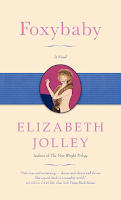
Foxybaby by Elizabeth Jolley

There are times, Miss Porch thought, in life when one might be walking towards oneself. Either the child towards the other way around. Either way it was a passing confrontation, not recognizable until it was over.

Elizabeth Jolley's Foxybaby begins with the protagonist, novelist Alma Porch, driving into a parked bus and being rammed, in turn, by a pair of cars behind her. She's arrived in a remote section of the Australian bush to teach a summer drama class to overweight women as part of the "Better Body Through the Arts Program." Her class, such as it is, involves filming a "treatment" of her novel-in-progress, Foxybaby, about a man desperately trying to save his daughter and her child from a life of heroin addiction. But the school is a strange place, and she is trapped there. The bus, it seems, has been placed there by Miles, the school handyman who will sell any object that's not nailed down to anyone, and who provides himself with additional income by cooking succulent midnight dinners for the starving dieters. The whole place is run by a strange woman named Miss Peycroft, who has her own ideas about how Foxybaby ought to go, and among the portly matrons of the Better Body Through the Arts Program sexual energies, lesbian and otherwise, are fiercely bubbling.

What are we supposed of Foxybaby, the novel-within-the-novel, and its treatment? It seems to be a lurid and humorless melodrama set to "rock and disco" (which doesn't stop Miss Peycroft from pulling out her cello). Is it the regular kind of bad, or is it the Elizabeth Jolley kind of good? Good or bad, the participants throw themselves wholeheartedly into the creation of the treatment, and at each night's reflective "symposium," they overflow with suggestions about how to tweak or enliven the script. Thematic connections between the novel and the scenario of the "true" novel seem scant, but not to the participants: at the novel's climax, the regally jovial Mrs Viggars, who plays the part of the father Steadman, has decided to adopt the ragged, pregnant girl who plays the daughter Sandy. The two novels, the one within and the one without, share a kind of exaggerated tone and style, but not much else, and yet the matrons seem to find ways of relating to it; perhaps this is the novel's ultimate point about the power of fiction. At the end, in the novel's most surreal scene, when the class is gathered on a field trip to the beach to film the final section of the treatment, Mrs Viggars points out a trio of figures that Miss Porch can barely see at first, walking along the sand: Steadman, Sandy, and Foxybaby, having emerged from fiction into real life.

Jolley is such a strange writer. Foxybaby turned out to be one of my very favorite kinds of books, one that seems either like a work of genius or a bizarre failure. I enjoyed the ragtag group of matronly participants, from Mrs Viggars to the annoyingly grandmotherly Jonquil Castle (insane names here) to the prim and vicious Miss Harrow, who recruits Miss Porch for what she thinks will either be a feast or an orgy, but which turns out to be an art exhibit. The wild pieces I thought would never come together eventually did, or at least they felt they did; I even found myself moved, ultimately, by the melodrama of Foxybaby. Maybe that's the point of the novel, in the end, that novels don't have to make sense, and sometimes it's better that they don't, or to hover somewhere outside of sense. They just have to move you.

Thursday, June 13, 2024

The Sun Walks Down by Fiona McFarlane

So, look, the plain rises to meet the lower slopes of the ranges--but be sure to show that the ranges are the stubs of mountains, the shoulders of mountains, they're so worn down. Exhausted by the sun. The rhythm here is horizontal--fallen mountains, fallen trees. Long lines--like this. Only the sky is vertical. The sun lifts it. A low horizon, then? No, he likes the idea of a small sky that nevertheless crowds everything else--it feels true. How else to express the feeling of standing on this empty country, knowing how big it is because you've travelled weeks from the sea and haven't yet reached the centre? (God, what he wouldn't give to paint--or eat--a fleshy little oyster!) And then the sky comes along an flattens you, overwhelms you, but without ever making the country shrink. The sky pulls the land up to it. It involves the land. How to get this feeling out and onto paper?

It's the late 19th century, in the Flinders Ranges of South Australia. A dust storm rolls in on a little boy playing outside his house; caught in its bewilderingness, he becomes lost. His disappearance will last for seven days, and bring together the whole town to search for him: his mother and father, their five daughters, including headstrong Cissy, their Aboriginal servants; the local constable and his new wife, who's been snogging a Swedish painter; the painter and his English wife; an Australian army sergeant and his Black trackers; the rich old sheep station family for whom the mountains in which the boy is lost are named; a group of sheep shearers; and even an Afghan camel driver. The boy Denny, lost and delirious, imagines himself at the whim of strange gods, half-invented and half-borrowed from Aboriginal legend.

The Sun Walks Down is one of those books that seeks to capture a particular place at a particular moment in history. Author Fiona McFarlane's Australia is a frontier in its second generation; already books have been written about the sheep-rearing patriarch who has only just recently died, painting him, for right and wrong, as a hardscrabble pioneer of a new nation. Sheep-station Australia, of course, relies on labor procured by certain degrees of coercion. I liked one small detail in which the rich old widow covets a finely woven shawl that one of the Black trackers uses to cover his withered arm, and which she tries to procure by any underhanded means. Billy spars with his master, Denny's father Matthew, every day, but he knows that he must hold back his true strength and skill; he harbors a resentment toward the rich sheep mogul, his former master, who prevented him from journeying into the interior to complete the ritual that would make him a man. It's to the book's credit, I think, that there isn't a single representative of Aboriginal existence, but several, with their own positions and motivations, and who are pointedly drawn from different tribal communities, not even speaking each other's language. The class distinction between the Axams and Wallaces speaks just as loudly--here, in the clash between Black and White, Anglo-Australian and Foreigner, Capital and Labor, McFarlane captures the truth that occurs alongside the origin of national myth.

McFarlane's Australia is a big place, and red: its garish red sunsets match its red landscapes, and it's those that the Swedish painter Rapp has come to paint. His attempts to make sense of the hostile, alienating landscape that has recently swallowed the young boy, that landscape called Australia, are some of the book's most interesting moments, I think. I also rather liked the sections with Denny himself, drawn into that landscape by his own fevered, boyish imagination. But the rest of the book I thought just didn't do enough with its raw materials. McFarlane makes certain feints at drama and escalation--the sergeant begins to settle on a theory that the town's dopey vicar has abducted the boy--but the story is mostly motionless, eventless. We are told of intense histories, like Minna's dalliance with Rapp, Billy's humiliation at the hands of his master, but for the most part history never seems to erupt into the present, only simmer. When Denny is found safe--if a little touched--at the end, I felt let down, as if I had been waiting for a climax that never comes. 

Saturday, November 4, 2023

The Sugar Mother by Elizabeth Jolley

It was not only the baby, the little boy, his child; it was Leila and her mother too. It was the sugar mother family. During the year, because of that impossible thing of having to tell someone something and being unable to, he had been living in two separate worlds, which had now come together. He did not want to give up on his new life, not at all. Plans made by people, from their ideas, often neglected, he supposed, their feelings. There was no planning possible for feelings, for the emotions, as they would be called in a tutorial discussion. It was never, or hardly ever, possible to anticipate how someone might feel. He had never imagined his present feelings as being a possibility.

Edwin Page, a professor of literature living in a quiet Australian suburb, says goodbye to his wife Cecilia, a doctor who is leaving for a year to study in England and Canada. Not long after she heads to the airport, he hears a tapping at the window: his new next door neighbors, a taciturn young woman named Leila and her mother, have been locked out of their house. He lets them in and offers to let them stay the night--and then they never leave.

What are Leila and her crude, colorful mother up to? Jolley keeps them at a distance, but we sense that their objectives have something to do with a plan the mother invents: Edwin will impregnate Leila, then keep the resulting child. When his wife returns in a year, she'll have a surprise three-month-old, and the marriage will no longer be childless.  Leila will be the "sugar mother"--the mother's mistaken interpretation of the phrase "surrogate mother." This is, frankly and obviously, an insane thing to suggest. But Edwin embraces the plan wholeheartedly, his powers of reason having been warped by falling in love with Leila.  As the plan hurtles forward, he finds himself increasingly at odds with Cecilia, avoiding her phone calls, even unplugging the phone in the middle of a conversation, wanting desperately to avoid telling her what he knows he needs to tell her. He grows distant from their friends at home, tasked with keeping him company--as it turns out, they've always been swingers, so "company" has some novel and specific meanings--so that he begins to live a desperate double life.

Jolley is a weird writer. Like The Well, a novel about two women that throw a would-be thief into a well on their property, The Sugar Mother is exceedingly strange at a basic conceptual level. The fundamental idea of it--two women insinuate themselves into a stranger's home--sounds reasonable enough, but Jolley seems to have a talent for wrenching a plot like these just a little askew of reason. How can it be possible that the rational, stolid Edwin gets taken in by Leila's unpleasant mother, or Leila herself, who is as verbal and engaging as carpet? Love, maybe, or simple lust. The Sugar Mother, like The Well, is a portrait of an inner psychology of alienation and estrangement. The new life that Edwin enters into, gulled by his own feelings, is one that's less domestic than entirely internal; the romance he has with Leila is hardly real, rather a fantasy of his own compulsions.

What makes Leila's mother such a frightening character, I think, is the intimation that she has planned the whole thing, knowing just how Edwin--who she seems to have been studying from afar--will react to the insanity of the sugar mother plan. We spend the entire novel gripped with fear and anticipation: what will happen when Cecilia returns home, or finds out another way? Jolley rather cruelly keeps Cecilia from arriving until after the book's end; by that time--spoiler alert--Leila, her mother, and the baby have disappeared, having presumably got what they'd wanted for whatever mysterious reasons they had.

Sunday, July 23, 2023

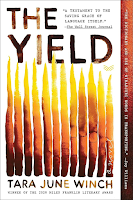
The Yield by Tara June Winch

yield, bend the feet, tread, as in waling, also long, tall -- baayanha  Yield itself is a funny word--yield in English is the reaping, the things that man can take from the land, the thing he's waited for and gets to claim. A wheat yield. In my language it's the things you give to, the movement, the space between things. It's also the action made by Baiame, because sorrow, old age, and pain bend and yield. The bodies of the ones that had passed were buried with every joint bent, even if the bones had to be broken. I think it was a bend in humiliation, just like we bend at our knees and bow our heads. Bend, yield--baayanha.

August Gondiwindi is an Aboriginal Australian woman living in London. When her father dies, she races back to the small bush town where she grew up, and finds herself facing new traumas and old ones: there's the death of her father, of course, among the new, but also a new mining operation is threatening to push her widowed mother out of her house and destroy the land. Among the old traumas is the decades-past disappearance of August's sister Jedda, who still haunts the land. August finds herself prodding through the earth for clues once again, and even imagining that the funeral will bring her sister back at last. What August discovers, though, is that her father had been writing a dictionary of their language, Wiradjuri--and its record of "Native title" over the area might just be enough to stop the predations of the mining company.

Tara June Winch's The Yield is made up of three strands: the story of August's return; a long letter by an early 19th century German missionary that explains the history of oppression and violence the local Aboriginal people have faced; and excerpts from her father's dictionary. Of these, the dictionary is the most compelling; although I can think of other literary dictionaries (like Ambrose Bierce's), I don't think I've ever seen someone tell a story that way. August's father, in a kind of antipodean pique, goes through the English-to-Wiradjuri backwards, starting with yarran tree and ending with--what else--Australia. The definitions are reflective and personal, and not only manage to express something of an Aboriginal perspective on the world, but dole out, in pieces, bits of a powerful secret: his knowledge about Jedda's disappearance and his killing of the man who perpetrate it.

The other parts of the story didn't work as well for me. August never felt as real or interesting to me as her father, perhaps because the power of her grief gets crowded out by the plotty stuff about the mining company and the quest to save her mother's house and land. The story of Jedda, which gets told in such a fascinating way in the dictionary parts, never really gets integrated into the "main story," and the letter from the missionary seemed to me to be an awfully clunky and distracting way of providing the necessary historical context. Still, I was struck by the power of the novel's use of indigenous language as an instantiation of history and values; one thing The Yield makes clear is that the loss of the Wiradjuri vocabulary is as threatening as the loss of the land itself.

One thing I did find interesting about the novel is its exploration of syncretic Christian-Indigenous religion. August's father is a Christian who takes a lot of comfort in reading the Bible, but his dictionary reveals tensions between his Christian beliefs and traditional animist ones. The missionary, Greenleaf, describes intentionally blurring the lines between Christianity and traditional Aboriginal religion, allowing himself to describe Jesus as the "son of" the creator God Baiame. Toward the end of his letter, he expresses regret for this, describing it as a kind of lie. August's father describes, in his entry for "Biyaami's son," learning from an ancestor that they do not worship Biyaami or his son, but "the things He made, the earth." Biyaami's son "Gurra-gali-gali was just a son, a coincidence." This seemed to me to be an interesting contrast to novels in a North American Indigenous tradition, like House Made of Dawn, that often position syncretism as a kind of resilience.

Friday, July 21, 2023

The Vivisector by Patrick White

So far he had conceived in paint no more than fragments of a whole. If he were only free of women who wished to hold somebody else responsible for their self-destruction; more difficult still: if he could ignore the tremors of his own balls, then he might reach his resisted objective, whether through mottled sausage skins, or golden chrysalides and splinters of multi-coloured glass perhaps purposefully strewn on a tessellated floor, or the human face drained to its dregs, or the many mirrors in which his sister Rhoda was reflected, or all of these and more fused into one--not to be avoided--vision of G O D.

Art novels are always a challenge, primarily because words are not images, as much as we like to think of them that way. Novels about art that insist on giving detailed ecphrasis--that old Greek word for when Homer lingers on the reliefs on a shield for eighty lines--always fall flat, because the effectiveness of the art lies outside the capability of words to capture it. Better to leave it to someone like Patrick White, who writes about a successful and tortured Australian painter named Hurtle Duffield in his novel The Vivisector. White always has one foot in the world of vision and the world of the physical, even bodily and gross; an artist, of course, being tasked with bridging these two worlds and putting vision on the page. (In a way Hurtle is an extended riff on the Aboriginal artist Alf Dubbo of Riders in the Chariot, who struggles to paint the vision he shares with three others--except Hurtle's vision isolates him and leaves him alone.) And White is elliptical enough, too, never quite giving us a glimpse at what Duffield's paintings look like.

Hurtle is born to a poor washerwoman and her family; as a child he insinuate his way into the mansion of the Courtney family for whom she works. He's captivated by the aesthetic fineness of their life, symbolized by the grand prism of the chandelier and the rich aromas of Alfreda Courtney's wardrobe, into which she shoves his face. As it happens, the rich woman is so taken with the precocious Hurtle that she essentially buys him from his tearful mother for $500. This section is pointedly borrowed from Great Expectations; at one point, Hurtle's new sister Rhoda even looks at him and says, "You're common." But Rhoda is no Estella, designed to entice and torture; she's a sickly and disfigured hunchback who haunts Hurtle's life. A stolen glimpse at Rhoda without her clothes becomes a subject that Hurtle will attempt to paint for the rest of his life.

It's cruel, being an artist: you see what others wish, in many cases, that you didn't. An artist is the vivisector, opening up the guts of his subject and portraying them to the world. (Alfreda, who makes Hurtle pretentiously call her Maman, literalizes her own repression and hypocrisy by bankrolling anti-vivisection activism.) Hurtle vivisects Rhoda in his paintings as surely as he does when he paints the suicide of his pathetic tutor on the walls of his room. As Hurtle ages, the novel offers up a parade of women who become Hurtle's lovers and confidants, and in many cases, subjects: Nance Lightfoot, a genial prostitute who dies in a horrible accident near Hurtle's bushland cabin; Olivia Boo Davenport, a childhood crush who becomes Hurtle's lover and benefactor; Hero Pavloussi, a beautiful and doomed Greek woman who leaves her husband for Hurtle; Kathy Volkov, a piano prodigy who becomes Hurtle's "spiritual prodigy." (The aging Hurtle does indeed have sex with a thirteen-year old Kathy, which is in keeping with White's belief that all love is a kind of incest, and which means the YA book Twitter people can never find out about White.) Even, ultimately, Rhoda, who moves into Hurtle's home toward the end of both their lives after a long absence.

An artist, in White's telling, is cruel, but the cruelties are compelled: Hurtle is no more able to control the urge to paint something than he can control his sexual urges. Yet, the vivisection can be hurtful and even destructive. There's something voyeuristic about an artist; at one point Nance tells Hurtle that his landscape paintings even show him "pervin' on rocks." But God, too, according to Hurtle, is an artist and a vivisector, and life--vulnerable, painful, and strange--is God's art, God's vivisection. After a stroke, Hurtle finds himself struggling physical to paint, but still he hacks away at enormous boards with mangled hands, trying to paint his ultimate vision. At a retrospective of his work at Sydney's National Gallery--a chorus of priggish and philistine patrons whose conversations rank among White's funniest scenes--a rumor begins to spread that Hurtle Duffield is trying to paint God. For White, that's what painting is: not just an attempt to pin God to the canvas and make him visible, but to emulate God through the process of translating vision into the realm of the physical.

Wednesday, March 29, 2023

Field Notes by Barry Lopez

That winter I dreamed four times about wolverine. I decided I was going to go up there when spring came, regardless. I've never been able to learn what I want to know about animals from books or looking at television. I have to walk around near them, be in places where they are. This was the heart of the trouble that I had in school. Many of the stories that should have been about animals, about how they live, their different ways, were never told. I don't know what the stories were, but when I walked in the woods or out on the prairie or in the mountains, I could feel the boundaries of those stories. I knew they were there, the way you know fish are in a river. This knowledge was what I wanted, and the only way I had gotten it was to go out and look for it. To be near animals until they showed you something you didn't imagine or you hadn't seen or heard.

The characters in Barry Lopez's story collection are often academics or researchers: the Arctic voyager of "Pearyland," the fossil expert working at the American Museum of Natural History in "The Open Lot," the anthropologist in "The Entreaty of the Wiideema." They are collectors of knowledge, in a way, but their methods have a way of foundering against unknowns, mysteries which require different methods of seeing and knowing. That anthropologist seeks out the Wiideema, an unstudied (and totally invented) indigenous group in Australia because he's seeking that kind of knowledge, and finds more than he bargained for: when a Wiideema woman speaks to him for the first time, he quickly understands that it's not English she's speaking but a kind of universal language that emerges from sheer being. He can communicate with her, and them, as long as he doesn't try too hard to understand, anthropologist-like, to figure out just how it is they are communicating in the first place. In this way, the Wiideema represent something like the wolverines of "Lessons from the Wolverine," who also have their own language for speaking. The lesson they teach is that real knowledge emerges from existence, from being among the immediacy of the earth, its places, its animals; it cannot be found in systems, schemata, or books.

Over and over again Lopez contrasts this kind of knowledge with the bookish kind: the fossil expert "sees" the fossil within the rock better than any of her peers, but she never advances because she refuses to systematize or generalize. The narrator of "The Negro in the Kitchen" is a fitness-obsessed retiree who finds--as the title suggests--a strange black man in his kitchen one day, having set a place at the table for them both. The man, it turns out, is walking across the United States from the East Coast to the Pacific, searching for an intimacy with his own country. In a telling moment, the narrator gets up to examine a bird at the window and check it off his life list--a solitary vireo. His guest, who has learned birdsong by the hundreds, corrects him: it was a ruby-crowned kinglet. The man is disappointed--he's already spotted a kinglet--and when his guest leaves, he goes not to the window but to his bird book to read. Despite his air of smug (white) paternalism, he's failed to learn the lesson the "Negro in the Kitchen" has borne to him.

Field Notes is best when Lopez zeroes in on the details of place; he has a Willa Cather-like skill at describing the simple features of a landscape in way that allows us to see it with freshness, ranging from the Arctic to the American desert to rocky creeks of Colorado. He's better at places than people, which is why the story "Conversation"--in which a conservationist begs her brother, the Secretary of the Interior or something, to place the ferruginous hawk on the endangered species list--such a wooden mistake. The introductory piece, "Within Birds' Hearing," towers over the rest of the collection: a strange and hallucinatory account of a man who leaves his home in the Mojave without a map or supplies, or a clear reason, walking toward a distant creek. The man's journey is so reckless I thought for several pages Lopez was describing the migration of a bird. But maybe that's the point; we have grown incapable of following a birdlike instinct, if we ever were--in the end it is a group of mourning doves who save him by siphoning water into his mouth when he is close to death.

Sunday, October 2, 2022

A Kindness Cup by Thea Astley

What is the point, any point, in a return?

My filled days, he thinks ironically, my filled days. With walks along the front, a shambles to the pier and along it to the point where winds knot green swirl of sea and gull and fish and some crumbling other man casting his lines. Back to the figged park and the bottle-lollied picnic kiosk, and an hour or so beneath broad leaves pecking at book or paper. Barney Sweetman. The bastard, he says. And Buckmaster. Buckmaster and Sweetman. Knighted for milking God's earth. Knighted for handling the sugar strikes. Knighted for owning more acres of sweet grass in the north than any man had right to control. But not knighted for that noon at Mandarana--how the names come back now!--the virtue guards with rifles kicking their unwilling horses up the runty slopes while the natives scuttled like roos from bush to bush until the high plateau. Or after. The down-curve through hot air and the body whizzing.

Former schoolmaster Tom Dorahy is returning to The Taws, the town in Queensland, Australia he left twenty years ago. Dorahy left town because of an act of terrible violence: a vigilante group slaughtered six Aborigines they suspected of pilfering from their farms. A seventh, cornered by the men, threw herself from a cliffside, clutching her baby, who, unlike the mother, miraculously survived the fall. A sick old man was gunned down at the home of a white farmer trying to protect him; the farmer is tied to the dead body for a week, and loses a leg from a gangrenous infection. The men who committed acts never faced justice; in fact, they've prospered, becoming knights and elected officials. But Dorahy is intent on using the town's homecoming to expose them at last.

A Kindness Cup is a novel about colonial violence and willful ignorance. Everywhere Dorahy goes, irritated locals ask him, why not let it go? It was so long ago. But of course, this is how colonial violence works; if you escape justice in the aftermath--and of course you do--time springs up to indemnify you, and the murdered natives, those still suffering from expulsion and grief, are relegated behind the barriers of history. Dorahy has no strategy, as with the trial many years ago, whose scenes pepper the novel, he can't keep himself from exclaiming the truth. In this way he acts as a kind of guilty conscience, the heart battering from beneath the floorboards. Dorahy's forthrightness gathers allies, all mostly unwilling, like a local news editor. On the other hand, those who committed violence in the past prove all too willing to commit violence in order to keep the story from coming to light.

Astley is a strange writer. I don't know that I was prepared for The Acolyte, which I read last year. Her style is very elliptical, and her writing at times has that quality (which she shares with my Australian fave Patrick White) where you're not sure whether it's amazing prose or terrible prose. Maybe I just knew what I was getting into, but I thought that The Kindness Cup was a better use of that strangeness. The scenes of violence stand out vividly, though I felt at times that they overshadowed the "story proper" of Dorahy's return. And I wonder if it might have made better use of the victimized Aborigines, who are largely mute. (There's something unintentional about the way that Konawha, the suicide, is placed beyond the narrative by her death, while the white farmer Lunt remains to suffer for our sympathy.) Still, A Kindness Cup does with a cutting sharpness what it sets out to do: slice through the myths of Australian pioneerdom to show how, like all settler colonial myths, they are predicated on murder and enforced silence.

Monday, May 30, 2022

Memoirs of Many in One by Patrick White

Nothing is honest that isn't explicit. Shit is no longer a dirty word, it's a realistic expletive. Now that the press has brought us together, now that we know one another intimately, in bed and out, at breakfast, dinner, and on the dunny, we have nothing more to expect, nothing to fear. So why are we afraid, particularly of one another?

I, who have no need of any media bounty, remain afraid. I have been everywhere. I know all. Am all, I am the creator. Perhaps for that very reason I am afraid of what I have let loose, of what I have created.

Alex Xenophon Demirjian Gray--a name like a character in a YA novel, don't you think--has had many lives, has been known by many other names. She has been an acclaimed actress and socialite, and I guess in two totally different circumstances, a nun. Now she's elderly and living outside Sydney, under the care of her daughter Hilda and her old friend Patrick White, who is a writer of some kind. She is writing her memoirs, which she is entrusting to Patrick as editor, although she is not done with living yet, and frequently escapes the weary eye of her daughter to go roaming around their suburb.

Memoirs of Many in One is unique among Patrick White novels. For one, there's the postmodernist/metafictional elements of it, what with White writing himself in as a character--something that dozens of White's contemporaries did all the time but which seems, somehow, stylistically unusual. Even the cover puts Alex's name at the top with "edited by Patrick White" beneath (though the relative font size gives the game away). There's the first person narration, which I don't think White does in any of his other books. And there's the fact that it's under 200 pages. All in all, Memoirs of the Many in One gives the suggestion that it is a kind of literary joke, a setup without a punchline or vice versa. And it is pretty funny, especially in surface-level ways that White's other novels never really bother with. It's funny when, for example, the increasingly senile Alex insinuates her way into a neighbor's house where she wets the bed, or when she picks up a homeless man from the nearby park, calling him "The Mystic," and locks him in Hilda's crawlspace with a tinned meat pie.

But Memoirs of Many in One also explores several of White's common themes. Like The Eye of the Storm, it's a book about aging: the fantastic and outrageous Alex is increasingly hamstrung by the effects of aging, both in a mental sense and in the sense that she is confined to the dullness and conformity of the Sydney suburb that her daughter embodies. "No one is old," she tells a policeman who arrests her for stealing a lipstick and a handbag: "It's only their bodies. And then not always." And, like The Twyborn Affair, it's a novel about the many identities we have within us: "I could have done almost anything if I had an identity, like the furniture inside this house or the dahlias on the other side of the window. But I hadn't found the frame which fitted me." Memoirs of Many in One brings these themes together in a way that suggests to me a shocking theory about senility: as we age, senility is brought on by the fact that we are no longer able to keep up the pretense that we are a single person with a single identity. We fall apart because we always have been in pieces.

Still, the flashbacks are the weakest part of Memoirs. Alex relives her acting days, her socialite days, her two different experiences as a nun (What's up with that? Am I not reading it right? What's the point?), but none of these has the space or development to make it ring true. Much better are the contemporary sections, which are some of White's best explorations of the contrast between the immensity and multiplicity of the human soul and the dull-eyed stupidity of bourgeois suburban living. Like Alex herself, it has its bits of majesty, but it doesn't really hang together.

Wednesday, May 5, 2021

I'm Dying Laughing by Christina Stead

'Haw-haw-haw.' The house rang with her gigantic laughter. 'Ha-ha-ha, oh-hoho.' She got up and tried to walk about, 'Stephen -- oh-hoho, save me!' She fell on the bed and turned on her side trying to stifle her laughter. 'Haw-haw-haw, oh, my God, oh-ho-ho, I shall die!'

She sobbed, struggled, strangled, shouted, screamed with laughter, strong, immense laughter, it seemed, not hysterical, the great roaring of big lungs and a strong heart.

Stephen turned on the light and sat up. Her face was crimson, tears poured out of her eyes. Her bosom heaved convulsively. He said, 'Stop it! You'll have convulsions. Stop. Stop it!' He slapped her.

She stopped, still heaving, and sat up to glare ferociously at him, 'Don't you dare touch me. I'll kill you.'

Stephen Howard is a walking contradiction: a rich Communist. He has inherited his wealth from his mother, or perhaps only the prestige of wealth, given the tightness of her purse strings, and yet he wears the contradiction on his sleeve. It has made him both an intellectual and a hothead, that is, a writer. On a transatlantic crossing, he meets Emily Wilkes, a spirited young fellow traveler who grew up poor in Arkansas and has scraped her way to a journalistic career. Stephen is a scarecrow, sour and bony, like Cassius; Emily is fat and full of life, yet they complement each other perfectly. They are married immediately.

I'm Dying Laughing is the last book in a small challenge I set for myself to read Australian writers. But unlike those others, Stead seems never to write about Australia; her settings are cosmopolitan. I'm Dying Laughing follows Stephen and Emily from Los Angeles to Connecticut to France, where they run to escape the Puritanical American Communist Party, who cannot stand the way the Howards court heterodoxy whenever they run their mouths. One of the best set-pieces in the novel is an early chapter where the Howards' putative friends host a dinner party as a pretext for reading a soon-to-be-published denunciation of the couple, even going so far as to say they plan on petitioning the court against the Howards' custody of their daughter Olivia. I'm Dying Laughing is about what it was like to be a Communist intellectual in the post-war period, a label riddled with its own contradictions and doubly endangered--first by Party disciplinarians and then by the scourge of McCarthyism.

Most of the novel follows the couple in France, where they settle with their four children. In France Stephen and Emily court the friendship of continental Communists and former members of the French Resistance, and yet are hyper-aware of their own hypocrisy: they are unable to live within their means, spending like capitalists and talking like Communists. They are true believers, but unable to even consider what it might look like to turn talk into action. You never know how you'll react when the crisis hits and the fascists come to power, one Resistant tells them, but such is the dilemma of the post-war American Communists: prosperity means they'll never have to put their values into practice. Stephen goes in and out of favor as a writer of polemics; Emily has far more success as a humorist, writing Mencken- or Thurber-style novels with mutedly radial politics.

Emily longs to write a serious novel, but humor and bombast are her only natural modes. She is a voluminous talker--something like 95% of this novel is dialogue, dialogue, dialogue--and prone to flights of chatter that issue from her before her thoughts are complete, and we get to see her change her mind over and over in real time:

I don't want to live this way in the bright lights, going to the gilded palaces, unable to tolerate a waiter who's been eating sour cabbage, or a waitress who hasn't washed, unable to bear a hotel if the manager doesn't scrape to me, suffering if my girl doesn't change her dress twice a day. I don't want to be like that. I am like that. Why? Because I see the funny side, I'm a wise guy. I've got the angles. I know the score. How despicable! Money's filthy. It is filthy, Stephen. Don't look down your nose. And when you think that my humour, which is me, I admit, is really the way I see things, laugh at everyone, sneer at everyone's troubles -- I really am cruel. I often wake up in the night, Stephen, to think out what I am. I'm like a doll with two faces glued together. They used to have those. I disliked them. One back, one front.

In the three novels of Stead's I've read since since The Man Who Loved Children, Emily strikes me as the closest thing to the outrageous Sam Pollitt in that novel: like Sam, her eccentricities put her beyond reason and beyond accommodation. She is incisive, a skilled wordsmith, but prone to strange and unshakeable beliefs: one of the complaints made by the American Party hacks who ambush her is that she "thinks all birds are snakes." (She does think this, and says so repeatedly, probably misunderstanding the fact that all birds are descended from dinosaurs--while snakes are not.)

Stephen, too, is outrageous, but Emily's outrageousness outpaces and overwhelms him. One of the few moments that get close to the dysfunctional family horror of The Man Who Loved Children comes when Emily, having caused a miserable Stephen to temporarily flee, begins to obsess--romantically and/or sexually, I'm not sure which--over her adopted son, Christy. Only Stead could write a scene like that, where the dream of the nuclear family turns itself inside out, and becomes grotesque melodrama. Other people try, I guess, but nobody really does it like her. Nobody captures the way such horrors emerge, without or noticing, from the commonplaces of love and family.

The Man Who Loved Children is like watching a bunch of people on a train headed toward a crash everyone but the conductor can see coming. I'm Dying Laughing is also a tragedy, ineluctably led toward bloodshed, but it's not quite the same. It's more like a party you can't leave, a party where everyone's just a little too drunk, and you know it's only a matter of time before somebody does something to bring the good feelings to an end.