Showing posts with label patrick white. Show all posts

Sunday, April 12, 2026

Six Books About Australia

The Fatal Shore by Robert Hughes
Voss by Patrick White
The Welcome to Country Handbook by Marcia Langton
Walkabout by James Vance Marshall
Connardoo by Katharine Susannah Prichard
The Children's Bach by Helen Garner


One prisoner, a former actor named William Hunt, "who in his younger days had belonged to a company of strolling mountebanks," disguised himself as an enormous "boomer" or male kangaroo. He nearly got across to Forestier's Peninsula before two picket-guards, thinking he really was a kangaroo, spotted him and gave chase, leveling their muskets. "Don't shoot, I am only Billy Hunt," the nervous marsupial squeaked, in their consternation."

On my recent trip to Sydney I visited the Hyde Park Barracks, basically a housing unit for convicted English criminals who were sentenced to "transportation," that is, exile to Australia for their crimes. The barracks are barracks, not a prison--Australia was the prison. But what does it mean for a whole continent to be a prison? Robert Hughes' history The Fatal Shore details the Australian transportation system from the landing of the "First Fleet" in 1788 to its end in the late 19th century. I was searching for a general history of Australia, but one thing Hughes' book makes clear is that, as far as European settlement goes, the history of transportation is the history of Australia, which makes it all the more incredible that, according to Hughes, the social stigma around the "Stain" made it impossible to talk about Australia's convict past for most of the 20th century. Australians might take comfort in Hughes' point that, in creating one of the world's safest countries, with one of its highest standards of living, the nation is proof against the eugenicist belief that "criminality" is a heritable trait.

Hughes makes pointed comparisons between the transportation system and the Russian gulag of the 20th century, both attempts to deal with social problems wholesale by exiling "problematic" sections of society. Transportation, Hughes notes, precedes Bentham's idea of the modern penitentiary, and its invention was an attempt to deal with what seemed like an insoluble problem: where do we put all these criminals? The First Fleet of 1788 dealt with a grueling eight-month ocean crossing to find themselves on the other side of the world in a poor harbor racked with disease and little arable land; with these meager tools they were meant to build their own society. Early Sydney was hell for soldier and prisoner both, and many soldiers remarked on how little difference there seemed to be between them. As free settlers begin to make their way to Australia, the "System" grows in its cruelty, becoming more punitive and violent, perhaps to make the class distinctions more obvious and iron-clad. A basic fact that I didn't understand is that convicts would be leased out as workers to free settlers. And yet, a prisoner who did well could receive a "ticket of leave" to work for themselves, and once their time was up, many stayed, becoming themselves powerful landowners who were sought after as masters by other convicts, being more understanding.

Hughes describes a 19th century Australia whose key social distinction is between "Exclusives" and "Emancipists"--that is, free settlers seeking to maintain their social superiority and freed convicts who had been elevated to the ranks of polite society. Although the elevation of "Emancipists" ended with the relatively liberal government of Lachlan Macquarie, whose successors were those who hardened and strengthened the penal system, this conflict seems to have shaped Australian society up until the moment that transportation ended and, embarrassed by "the Stain," everyone agreed to forget all about the System. Hughes tells an interesting anecdote about a former prison ship that briefly opened as a public attraction before being sunk by irate Tasmanians, whose former colony of Van Diemen's Land was the harshest and longest-lasting of the various colonies. As an aside, I thought that Hughes' book was really well-written for a general history, full of interesting anecdotes and a dry sense of humor that made it a real pleasure to read.


'Voss did not die,' Miss Trevelyan replied. 'He is there still, it is said, in the country, and always will be. His legend will be written down, eventually, by those who have been troubled by it.'

'Come, come. If we are not certain of the facts, how is it possible to give the answers?'

'The air will tell us,' Miss Trevelyan said.

The class distinctions between Exclusive and Emancipist provide an interesting window into Patrick White's classic novel of Australian exploration, Voss: Bonner, the explorer's wealthy patron, is a free settler whose "subscription" to the exploration is a kind of social expense meant to distinguish him as a gentleman. Bonner, like most of Australia's free settlers, is a mediocrity who takes advantage of the fresh country to make an attempt at a gentility that he wouldn't have had in England. The household servant, Rose, whose illegitimate pregnancy causes the family so much trouble, is an emancipated convict; in Laura's attempt to adopt Rose's baby (after her death) one can see the porous borders of early Australian society, and the desperation of those like the Bonners to keep them hardened. The novel's other Emancipist is Judd, the former convict who is Voss' foil on the expedition. Judd, having made his claim to the new country by toil and suffering, has a kind of practicality that Voss lacks; it's no coincidence that he alone survives the expedition. And yet, White makes it clear that Australia "belongs" to Voss, and not to Judd, by right of a kind of vision that Judd lacks, perhaps because Voss is outside the system that has so circumscribed the roles of Judd, Bonner, and Rose.

Voss' outsider-ness makes him, perhaps, more akin to the aboriginal people who make up such an important part of the exploration. Hughes describes how, among prisoners, Aboriginal Australians were thought of as being on the side of the jailers, since they had legal protections the prisoners did not, and were often used as "trackers" to bring back escapees. Judd ends up in a party with the older Dugald and younger Jacky, perhaps an uneasy union. But the country they enter into clearly belongs to those Aboriginal people who have never, like Dugald and Jacky, entered into a compact with white society--I recall easily one of my favorite scenes, where Dugald, having rejoined a tribe of Aboriginal kinsmen, rips apart the letters entrusted to him, whose pieces the tribe watches fly away in wonder. Voss and co. eventually find themselves in the keeping of another such group. Physically depleted by their journey, they are neither prisoners nor wards; they simply have nowhere else to go. There's a kind of mysticality at work here, a suggestion that the Aboriginal Australians belong to a kind of metaphysically different world, but I would argue that what is clearest is that "Country" belongs to them. Voss, by the power of his own vision and separateness, comes closest to achieving what has been natural to them for millennia.

There's something risky about revisiting your favorite books. Voss was my first of White's novels, and one thing that surprised me is that it is, prose-wise, rather ordinary compared to some of his other stuff, which tends toward the grotesque and the physical in ways that are not present here. It struck me actually as the most readable of White's books, which was a huge shock. But I was gratified to find it as good as I remembered. The psychic connection between Voss and Bonner's niece Laura produces the novel's most genius passages; the way that White manages to persuade the reader that Laura is present with Voss in the Outback even as she is physically in her Sydney estate takes one's breath away. And it was a special experience to read this novel just before my own trip to the Outback, where I got a great sense of the vastness of the hostile country from the hotel lobby bar where I spent much of my time sitting.


Why should we learn about the history of human life and the environment in this country in the time before the British arrived? Because most of the human history on this continent is that of the First Peoples, who lived here for tens of thousands of years. Their descendants--the Aboriginal and Torres Strait Islander Peoples--continue to follow and respect the ancient traditions and customs that make this country unique. It is likely that these are the oldest continuous living cultures surviving anywhere on the planet.

I turned to Marcia Langton's The Welcome to Country Handbook to help me understand a little more about the Aboriginal cultures that are, in a real sense, at the heart of Voss. As Langton points out, it is possible for Aboriginal people to make a remarkable claim to being the oldest living culture, perhaps up to 60,000 years old. Hughes describes the Aboriginal peoples encountered by the First Fleet as stunningly primitive compared to Native American societies encountered by settlers in North America; it is a wholly other perspective to consider that what the First Fleet found was a culture that had evolved in tandem with the continent over incalculable generations. Langton's book is an introduction to Aboriginal peoples for curious tourists, and hits some of the highlights one might expect: the 20th century renaissance and market for Aboriginal artwork, the political conflicts between Aboriginal Australians and the federal government, the diversity of Aboriginal languages and societies, etc.

I found this book mostly disappointing. First of all, 90% of what it cites are websites. It's written, too, like a website, perhaps one belonging to some kind of NGO: "Through storytelling, history, beliefs and knowledge about people, places and the world are relayed to each new generation." OK. To be generous, it seems to be written for a curious tourist who knows very little not just about Aboriginal Australians but Indigenous peoples, or race and culture more generally. That's fine, perhaps, but it means that there is a limit to the depth it is able to accomplish. Is it necessary to sit through a chapter that describes what racism is, or race?

But when the book does manage to say something specific, I found it pretty fascinating. I enjoyed learning, for instance, about the complex ordering of Yolŋu society, in which everything is considered to be one of two "moieties," even people, and marriage must be endogamous across these two moieties. Langton describes a highly ordered society in which dozens of familial relationships are recognized, if not more, and I got the sense--perhaps only through implication--that other Aboriginal groups have similar practices. Furthermore, I was interested in the way that Aboriginal Australians seem to share meaningful qualities with Native Americans and Black Americans, both as the original inhabitants of the country who were the victims of attempted genocide, and as a racialized class whose "blackness" forms a meaningful structure of their identity.


She felt compassionate: charitable: virtuous. Like a dignitary bestowing some supremely preciosu gicft, she handed her panties to the naked Aboriginal.

He took them shyly: wonderingly: not knowing what they were for. He put the worwora down, and examined the gift more closely.  His fingers explored the elastic top. It flick-back was something he didn't understand. (Bark thread and liana vine didn't behave like this.) He stretched the elastic taut; tested it; experimented with it, was trying to unravel it when Peter came to his aid.

'Hey, don't undo 'em, darkie! Put 'em on. One foot in here, one foot in there. Then pull 'em up.'

Now let me turn to two novels that explore interactions between white European-Australians and Aboriginal people. The first is Walkabout, James Vance Marshall's novel about two young children who survive a plane crash on their way to Adelaide. Foolishly, the children begin to walk in the direction of what they believe to have been their destination, although they're still in the Northern Territory--and will never survive. They are saved when they come across a young Aboriginal boy on "walkabout," cast here as a traditional rite of solo exploration (but which, as I understand it, really refers to the period in which Aboriginal people employed on cattle stations would return to their communities in the off season). The Aboriginal boy has skills that the two white children desperately need; he shows them how to procure water from below the dirt and which plants are edible, as well as how to catch and kill wallabies and echidnas. The two children, who are from Charleston, South Carolina, refer to their new friend as "darkie."

Of the two, the young boy Peter adjusts most easily to their new reality, choosing to go naked as the Aboriginal boy does. The older girl, Mary, has more misgivings, and her embarrassment for the boy's nakedness leads her to make a gift of her own panties, which he puts on with much good humor. (What a moment there is here for scholars of both race and gender!) In this way, Walkabout presents what seems to my eye a pretty typical conflict between "civilization" and its antithesis. Mary's unthinking hierarchies are challenged by the Aboriginal boy, even as the novel reifies the difference between them. It must be said that the fate of the Aboriginal boy seems to reflect the tragedies of Australian history: he catches Peter's cold and dies, having sacrificed himself to save them. Interestingly, Marshall ascribes the boy's death partially to an Aboriginal belief that death is inevitable once it has chosen you, and must be faced with equanimity: even before he catches Peter's cold, the boy sees in Mary's hostility a kind of "evil eye" that presages his death. Whether there's any basis for this belief, I don't know, but I saw it again in the case of one of the hired hands of the next novel, Coonardoo.


She was like his own soul riding there, dark, passionate and childlike. In all this wide empty world Coonardoo was the only living thing he could speak to. Hugh knew; the only creature who understood what he was feeling, and was feeling for him. yet he was afraid of her, resented a secret understanding between them.

But Coonardoo the playmate--Coonardoo whom he had seen long ago under the shower, young and slender, her lithe brown body, wet and gleaming, brown eyes laughing at him, her hair, wavy and sun-burnished, lying in wet streaks about her head. Coonardoo? Why should he hurt her by a harsh, indifferent manner he showed nowhere else?

Coonardoo is set on a cattle station in Western Australia in the early 20th century. It centers on Hugh Watt, the owner of the station Wytaliba. The life of a white man in the remote bush is a strange one, and Hugh struggles to find a white woman who will accept such a life. His first choice, Jessica, goes back home after a week, and his eventual wife, Mary, becomes so embittered by the experience that she takes their six daughters and moves back to the nearest town. Hugh finds brief comfort in a dalliance with Coonardoo, an Aboriginal housekeeper who he has entrusted, like his mother before him, with the station's management. The back of the book describes this dalliance as a kind of forbidden love, but I wonder if that's true--it might have been, perhaps, if Hugh's own ideological commitment to racial separation hadn't kept him from suppressing his feelings for Conardoo. In either case, the brief affair produces a son, Winni, whose favor by Hugh is what tips Mary off to her husband's infidelity.

Coonardoo is an interesting document on interracial relationships. It must have been quite scandalous when Katherine Susannah Pritchard published it in 1926, when I can only imagine that relationships between whites and Aboriginal people would have been rather outside the pale of literature. But Pritchard shows how such things might be possible on a remote station in the Australian bush, far from the polite society of town, where a white man might spend his life among the Aboriginal people attached to his station (they seem to be neither enslaved or employed, but associated somehow) while his nearest white neighbors might be a day's ride away. The villain of Conardoo is a station owner named Sam Geary who lives openly with his "gin" (I think this term is now considered offensive), who desires Conardoo for his own, and keeps pressing Hugh to sell his rights to her, whatever those might be. Is Geary's sin the way he treats his own Aboriginal wife, Sheba, or merely his openness about it?

After Mary leaves, Hugh finally accepts Coonardoo as his "woman," something that he had been loathe to do, but even then treats her coldly, never returning to her bed after the one sexual encounter that produced Winni. Part of me wants to read Coonardoo as a novel of repression about a man whose racial ideology is so strong he can never let himself embrace the one relationship that might have made him happy. But I wonder, too, if Pritchard herself is able to imagine this relationship, or if it remains elusive for the writer in her period. More troubling yet is that Coonardoo herself seems kind of an absence in the middle of the text, a character that the novel is really unable to look squarely at or understand--at least, that is, until the final chapter, when an older and disillusioned Coonardoo returns to Wytaliba at the end of her life to look up on its ruin, and think about what might have been.


What do tourists do? They walk, they stand, they look, they buy. They fumble for money on buses, not knowing whether to pay the driver or the conductor.  They visit famous monuments, fountains, old houses full of stone and shutters and anachronistic lace. They notice that the day without duty passes with the slowness of a dream. They know that their existence is without point. They envy those who go arm in arm, who have a home to go to.

Finally, a novel of modern Australia. Helen Garner's novel The Children's Bach is set in suburban Melbourne, where the reunification of two old college friends, Dexter and Elizabeth, causes a disruption in both their lives. Dexter is a family man, brash and outlandish, who rails against "Americanisms" while his wife Athena takes care of their two children. Elizabeth is more adrift, unmarried, cynical, living in an unfurnished loft. When the two run into each other, Elizabeth brings two new presences into the life of Dexter's family. The first is Vicki, Elizabeth's much younger sister, who finds in their suburban home a foothold in life that Elizabeth's loft will never provide. The other is Philip, Elizabeth's sometimes boyfriend, a rock musician who persuades Athena to run away with him on a holiday to Sydney, much to the obvious chagrin of Dexter.

I admit I didn't see the pivot in this one coming. Vicki describes Athena as "perfect"--the perfect woman, the perfect wife. And early on, she seems to have a kind of stolid devotion to Dexter and their life; Vicki admires the pair of them for their frankness with each other. But an early sign that all is not well with Athena is the way she talks about their disabled son, Billy. "Don't bother getting romantic," Athena tells Vicki, "There's nobody in there." She admits, "I'm just hanging on till we can get rid of him," and says, "I've abandoned him, in my heart." In a novel that is otherwise quite small, filled with minor domestic gestures, the cruelty on display here really stands out as shocking, as does the moment that Vicki and Athena bond over the impulse they share to push the boy in front of an oncoming car. Billy, such as he is, seems to represent a kind of problem, a challenge to the kind of life that Dexter and Athena live, that can only be solved by exile. Athena's sudden abandonment of Dexter makes sense in this context, then: "Perhaps there was a world where people could act on whims, where deeds could detach themselves cleanly from all notion of consequences. Perhaps this never-quite-present Philip might be that mythical creature, a man who was utterly scrupulous and who was yet prepared to do anything. Perhaps she too might never apologise, never explain."

Back in Melbourne, Dexter commiserates by getting drunk with--and sleeping with--Vicki. This is a huge blow to his self-conception as a nobler person: "Tis was modern life, then, this seamless logic, this common sense, this silent tit-for-tat. This was what people did. He did not like it. He hated it. But he was in his moral universe now, and he could never go back." But it seems to me what Dexter fails to understand is that he's always been in this moral universe, however much he feels as if he has been above it, and Athena's abandonment of him for Philip is only proof that this is true. There's something very antiquated in Dexter's attempt to find moral absolution in the suburban family life, rather than its epitome, and he may be the only one surprised that such an attempt could fail.

I really enjoyed this one. Brent said there's something Muriel Spark about it, and though there might be a "Guy whose only seen Boss Baby" element to that, I think it's true. In its reticence, its cultivation of the opacity of these characters--which is what allows Athena's desperate move to shock us--I saw a bit of Henry Green as well. And part of that opacity is that I feel like there's something that eludes me about the novel, and makes me want to return to it; I don't think this will be the last book of hers I read.

So, this is an interesting place to end up: Australia's penal past makes it unique among world countries, but in its persecution of an Indigenous racial underclass, it ends up following familiar forms, especially to those of whose who are American. And in the end, though Dexter may hate the way that American culture imposes its ideas on Australians, it presents a 20th century story of suburban anomie that us Americans find utterly recognizable.

Saturday, March 15, 2025

The Burnt Ones by Patrick White

At first it was impossible to believe their personal lives could be reduced by a shuffle of history, which is what happened, monetarily at least, on the deck of the destroyer, after the sack of their city. Because it had been personally theirs, which was now burning by bursts, and in long, funneling socks of smoke, and reflections of slow, oily light. As he ran looking for that other part of him which was lost, he gashed his shin on a companionway. But he did not know. Calling her name. None of that rabble of sufferers--wet, dry, singed, bleeding, deformed by the agony of their first historic situation--none of them knew any more, as they stood in their fashionable rags and watched their city burn.

My favorite story in Patrick White's collection The Burnt Ones is "Down at the Dump." Set in the suburban Sydney town of Sarsparilla, it tells the story of two young people finding an unexpected connection. One, a young girl, is at the cemetery for the funeral of her eccentric aunt. The other, a boy, is from a family of poor bogans who go searching for things to sell in the dump. It just happens that the cemetery and the dump are right next to each other, separated by only a fence, across which the two teens meet and connect, or not quite, and then over which they start making out. It's a perfect Patrick White story, about the rottenness and spoil beneath suburban gentility. There's a fantastic moment when the spirit of the dead aunt looks out over her mourners, symbolically mixing the spiritual realm with literal trash. And there may be no more setting where White is more at home than the dump, which he describes in his characteristic way: "At the last dip before the cemetery a disembowelled mattress from the dump had begun to writhe across the road. It looked like a kind of monster from out of the depths of somebody's mind, the part a decent person ignored."

About half the stories are set in Sarsparilla, about another half are set in Greece or are about ex-pat Greeks. The title The Burnt Ones refers to the Burning of Smyrna, a moment in which the Turkish regime set a massive fire to the Greek quarter of what is modern Izmir, killing tens of thousands. Nearly all of the Greeks in the novel experienced this, and it colors their experience of their new homes, whether in Greece, Australia, or America, and the immediacy of its horrors contrasts with the petty psychodramas of the collection's suburban Australians. Yet, we see too how easily the Greeks, having fled this "shuffle of history," are re-subsumed into polite schemata of respectability and repression. (White writes often about Greece and Greeks, presumably inspired by his longtime partner, a Greek named Manoly Lascaris.) My favorite of these stories was "Being Kind to Titina," about a boy who tortures an awkward young girl whom he has been instructed to be kind to. She grows up and, of course, turns out to be hot, and though she only remembers him as being kind, his own cruelty tortures and keeps him from being with her. It's a story that reminds you that White can be funny:

But Titina stuck. She stuck to me. It was as if Titina had been told. And once in the garden of our house at Schutz, after showing her my collection of insects, I became desperate. I took Titina's blue bead, and stuck it up her left nostril.

'Titina,' I cried, 'the holes of your nose are so big I'd expect to see your brain -- if you had any,' I shouted, 'inside.'

But Titina Stavridi only smiled, and sneezed the bead in to her hand.

Other stories I liked: "A Cheery Soul," about a woman who annoys everyone she comes in contact with; "Clay," about a boy whose mother worries about him being unusual--a bourgeois anxiety, of course, but then he turns out to be legitimately mad. And I especially liked "Miss Slattery and Her Demon Lover," about a young female door-to-door salesman who chucks everything for a slovenly Bulgarian she meets on her route, and who turns out to have a huge fetish for being whipped. I didn't think it was as strong, generally, as his other story collection The Cockatoos, though it's been many years since I've read that one. Sadly, I can see my stock of White's books dwindling--three leftover stories, a half-finished novel, and his memoirs are all I have left. 

Tuesday, May 21, 2024

The Living and the Dead by Patrick White

Conversation with the Spaniard returned to him, the evening in the street after the party at Adelaide's, and his own retreat from what had been too pertinent. As if the Spaniard were presenting the choice of the two ways, of the living or the dead. You wanted instinctively to close the eyes, like Adelaide or Gerald, like Muriel, or the ranks of red suburban houses, smothered in a plush complacency. Because the alternative, to recognize the pulse beyond the membrane, the sick heartbeat, or the gangrenous growth, it was too much, even at the risk of sacrificing awareness, and the other moments, the drunken, disorderly passions of existence, that created but at the same time confused.

The Standishes are a familiar upper middle-class London family: matriarch Catherine has been left to raise her two children alone by the death of her husband in the "Great War," and to rediscover her own sensuality and desire later in life. Her daughter Eden is headstrong and proud, flirting with men and politics. Son Elyot is more reserved, more aloof, unable to form a connection to the various women who demand his attention, to the people which populate his life, or to the social and political questions that engage his sister.

Elyot's dilemma is the central question of the novel: what does it mean to be alive, and what does it mean to be dead? White's setting is England between two world wars, a time of putative peace, and yet that peace is dogged by intimations of foreign war--the Spanish Civil War. White suggests perhaps that the English peace of the interwar years was a false promise, predicated on ignoring the conflicts of the larger world, ones that later exploded into the wave of fascism that swallowed Europe. The novel's simple conscience is found in Joe, a working-class laborer with whom Eden has a brief affair. Joe, shocked by the news from Spain, decides to join the war effort, even at the risk of his own life:

There was a time, said Joe, when I could read the papers and keep things in their place. That's where they belonged, in the papers. It was other people's business. It was foreign names. Then it got to being part of yourself. You couldn't keep out your feelings no more. It got mixed up with what you did. I can't think clear. I got to go, you see? There's no use, Julia says, there'll be time enough, and troubles of your own, without fighting other people's wars. As if you can keep it parcelled out. Because it's right here, Elyot, sure as ever there's right and wrong.

It's this attitude that Elyot admires but cannot adopt, even in versions less extreme than Joe's. Is Joe one of the living of the title, because by embracing his common humanity with the oppressed in Spain, he becomes truly alive, while aloof, uncommitted Elyot lives a death-in-life? Or is Joe one of the dead--because by leaving for Spain he essentially signs his life away? The power of The Living and the Dead, such as it is, is in the way White explores the connection between the political and the metaphysical, the way the soul roots itself in its relations with others, one-on-one and en masse. Except for Riders in the Chariot, which is very much a post-World War II novel, it might be White at his most consciously political (although this is, in typical fashion, somewhat hidden behind the fractious prose and streams of consciousness.)

The Living and the Dead, as far as I can tell, is the only one of White's novels to take place entirely in England. As such, it brings into relief some of White's English forebears, like Henry Green and D. H. Lawrence, not to mention Henry James. It makes it easier to see how White transformed those traditions and pointed them toward the colonial landscape, the English writers made alien and strange. It was White's second novel, and far more psychological and less plotted than Happy Valley, the novel about a backwoods Australian sheep station town that preceded it. Yet I think it holds less interest and insight than Happy Valley, and is probably his weakness overall. Still, it does interesting things--none of his other novels slides so easily, like a lubricated eye, from one consciousness to another--and some of its characters, like the hapless and moon-eyed Connie Tiarks and the crass American big band musician Wally Collins, are among White's best. I don't have any of White's novels left, now--just a few short story collections--and though I suppose it makes sense that a minor work would end up last, it mostly made me hungry for White's masterpieces, which all wisely leave England behind.

Friday, July 21, 2023

The Vivisector by Patrick White

So far he had conceived in paint no more than fragments of a whole. If he were only free of women who wished to hold somebody else responsible for their self-destruction; more difficult still: if he could ignore the tremors of his own balls, then he might reach his resisted objective, whether through mottled sausage skins, or golden chrysalides and splinters of multi-coloured glass perhaps purposefully strewn on a tessellated floor, or the human face drained to its dregs, or the many mirrors in which his sister Rhoda was reflected, or all of these and more fused into one--not to be avoided--vision of G O D.

Art novels are always a challenge, primarily because words are not images, as much as we like to think of them that way. Novels about art that insist on giving detailed ecphrasis--that old Greek word for when Homer lingers on the reliefs on a shield for eighty lines--always fall flat, because the effectiveness of the art lies outside the capability of words to capture it. Better to leave it to someone like Patrick White, who writes about a successful and tortured Australian painter named Hurtle Duffield in his novel The Vivisector. White always has one foot in the world of vision and the world of the physical, even bodily and gross; an artist, of course, being tasked with bridging these two worlds and putting vision on the page. (In a way Hurtle is an extended riff on the Aboriginal artist Alf Dubbo of Riders in the Chariot, who struggles to paint the vision he shares with three others--except Hurtle's vision isolates him and leaves him alone.) And White is elliptical enough, too, never quite giving us a glimpse at what Duffield's paintings look like.

Hurtle is born to a poor washerwoman and her family; as a child he insinuate his way into the mansion of the Courtney family for whom she works. He's captivated by the aesthetic fineness of their life, symbolized by the grand prism of the chandelier and the rich aromas of Alfreda Courtney's wardrobe, into which she shoves his face. As it happens, the rich woman is so taken with the precocious Hurtle that she essentially buys him from his tearful mother for $500. This section is pointedly borrowed from Great Expectations; at one point, Hurtle's new sister Rhoda even looks at him and says, "You're common." But Rhoda is no Estella, designed to entice and torture; she's a sickly and disfigured hunchback who haunts Hurtle's life. A stolen glimpse at Rhoda without her clothes becomes a subject that Hurtle will attempt to paint for the rest of his life.

It's cruel, being an artist: you see what others wish, in many cases, that you didn't. An artist is the vivisector, opening up the guts of his subject and portraying them to the world. (Alfreda, who makes Hurtle pretentiously call her Maman, literalizes her own repression and hypocrisy by bankrolling anti-vivisection activism.) Hurtle vivisects Rhoda in his paintings as surely as he does when he paints the suicide of his pathetic tutor on the walls of his room. As Hurtle ages, the novel offers up a parade of women who become Hurtle's lovers and confidants, and in many cases, subjects: Nance Lightfoot, a genial prostitute who dies in a horrible accident near Hurtle's bushland cabin; Olivia Boo Davenport, a childhood crush who becomes Hurtle's lover and benefactor; Hero Pavloussi, a beautiful and doomed Greek woman who leaves her husband for Hurtle; Kathy Volkov, a piano prodigy who becomes Hurtle's "spiritual prodigy." (The aging Hurtle does indeed have sex with a thirteen-year old Kathy, which is in keeping with White's belief that all love is a kind of incest, and which means the YA book Twitter people can never find out about White.) Even, ultimately, Rhoda, who moves into Hurtle's home toward the end of both their lives after a long absence.

An artist, in White's telling, is cruel, but the cruelties are compelled: Hurtle is no more able to control the urge to paint something than he can control his sexual urges. Yet, the vivisection can be hurtful and even destructive. There's something voyeuristic about an artist; at one point Nance tells Hurtle that his landscape paintings even show him "pervin' on rocks." But God, too, according to Hurtle, is an artist and a vivisector, and life--vulnerable, painful, and strange--is God's art, God's vivisection. After a stroke, Hurtle finds himself struggling physical to paint, but still he hacks away at enormous boards with mangled hands, trying to paint his ultimate vision. At a retrospective of his work at Sydney's National Gallery--a chorus of priggish and philistine patrons whose conversations rank among White's funniest scenes--a rumor begins to spread that Hurtle Duffield is trying to paint God. For White, that's what painting is: not just an attempt to pin God to the canvas and make him visible, but to emulate God through the process of translating vision into the realm of the physical.

Monday, May 30, 2022

Memoirs of Many in One by Patrick White

Nothing is honest that isn't explicit. Shit is no longer a dirty word, it's a realistic expletive. Now that the press has brought us together, now that we know one another intimately, in bed and out, at breakfast, dinner, and on the dunny, we have nothing more to expect, nothing to fear. So why are we afraid, particularly of one another?

I, who have no need of any media bounty, remain afraid. I have been everywhere. I know all. Am all, I am the creator. Perhaps for that very reason I am afraid of what I have let loose, of what I have created.

Alex Xenophon Demirjian Gray--a name like a character in a YA novel, don't you think--has had many lives, has been known by many other names. She has been an acclaimed actress and socialite, and I guess in two totally different circumstances, a nun. Now she's elderly and living outside Sydney, under the care of her daughter Hilda and her old friend Patrick White, who is a writer of some kind. She is writing her memoirs, which she is entrusting to Patrick as editor, although she is not done with living yet, and frequently escapes the weary eye of her daughter to go roaming around their suburb.

Memoirs of Many in One is unique among Patrick White novels. For one, there's the postmodernist/metafictional elements of it, what with White writing himself in as a character--something that dozens of White's contemporaries did all the time but which seems, somehow, stylistically unusual. Even the cover puts Alex's name at the top with "edited by Patrick White" beneath (though the relative font size gives the game away). There's the first person narration, which I don't think White does in any of his other books. And there's the fact that it's under 200 pages. All in all, Memoirs of the Many in One gives the suggestion that it is a kind of literary joke, a setup without a punchline or vice versa. And it is pretty funny, especially in surface-level ways that White's other novels never really bother with. It's funny when, for example, the increasingly senile Alex insinuates her way into a neighbor's house where she wets the bed, or when she picks up a homeless man from the nearby park, calling him "The Mystic," and locks him in Hilda's crawlspace with a tinned meat pie.

But Memoirs of Many in One also explores several of White's common themes. Like The Eye of the Storm, it's a book about aging: the fantastic and outrageous Alex is increasingly hamstrung by the effects of aging, both in a mental sense and in the sense that she is confined to the dullness and conformity of the Sydney suburb that her daughter embodies. "No one is old," she tells a policeman who arrests her for stealing a lipstick and a handbag: "It's only their bodies. And then not always." And, like The Twyborn Affair, it's a novel about the many identities we have within us: "I could have done almost anything if I had an identity, like the furniture inside this house or the dahlias on the other side of the window. But I hadn't found the frame which fitted me." Memoirs of Many in One brings these themes together in a way that suggests to me a shocking theory about senility: as we age, senility is brought on by the fact that we are no longer able to keep up the pretense that we are a single person with a single identity. We fall apart because we always have been in pieces.

Still, the flashbacks are the weakest part of Memoirs. Alex relives her acting days, her socialite days, her two different experiences as a nun (What's up with that? Am I not reading it right? What's the point?), but none of these has the space or development to make it ring true. Much better are the contemporary sections, which are some of White's best explorations of the contrast between the immensity and multiplicity of the human soul and the dull-eyed stupidity of bourgeois suburban living. Like Alex herself, it has its bits of majesty, but it doesn't really hang together.

Tuesday, April 13, 2021

Happy Valley by Patrick White

All this was taking place in Happy Valley the same autumn, which was superficially the same as any other autumn, as far as its natural details were concerned. But as I have said before, one of the most noticeable features of Happy Valley was its apparent remoteness from the human element, or perhaps an ironical half-recognition, laying a trap in the shape of its own activities and then letting things slide. Autumn was a season of preliminary cold and suppressed winds. Nothing much appeared to happen besides, though a lot was really happening all the time. Because it was at this moment that Amy Quong felt those dormant and really frightening passions begin to stir, that Clem Hagan was coming into town of an afternoon and going to Moriarty's house, that Moriarty felt things closing in, all those eyes and faces at the school, and Sidney Furlow was trying to suppress the realization of her own desires. They each had their own problem, and nobody else had theirs, which is only natural perhaps, it is usually like that. And all the time Happy Valley was preparing for winter, and those that were afraid of winter had begun to be afraid, which those who have not experienced Happy Valley in winter-time will certainly not understand. If you have you will know, you will realize the extreme brutality to which man can be subjected, whatever you may have experienced of this, of brutality I mean, in winter at Happy Valley it seems to be epitomized.

Happy Valley is a remote sheep farming outpost in New South Wales, where the winters are particularly harsh and the people, it may not surprise you to find out, are not particularly happy. "I often think," says the debutante Sidney Furlow to her family's hired man Clem Hagan, "it'd be rather fun to blow out one's brains." Some of the people in Happy Valley, like the doctor's wife Hilda Halliday or the doctor's mistress Alys Browne, have convinced themselves that Happy Valley themselves is the source of their unhappiness, that perhaps they can leave their unhappiness behind if they can leave Happy Valley behind. They make plans to move to Queensland, or to California, but what ails them, White suggests, is simply what ails most people in the world: that all human beings are essentially alone. The doctor himself, Oliver Halliday, describes it this way:

I dare say most of us are afraid, he said. Not of the same things perhaps. We start off being afraid of the dark. Then your fear probably moves its centre to something more tangible. And most of it rises out of a feeling of being alone. Being alone is being afraid. perhaps one day we'll all wake up to the fact that we're all alone, that we're all afraid, and then it'll just be too damn silly to go on being afraid.

This is one of White's Big Themes: that life is really what goes on in people's heads, and that it is rare, perhaps even impossible, to make that life known outside of one's own skull. It's rare to see a character state the idea so plainly, and though Halliday's words seem rather wise to me, I wonder if White himself is so sanguine about the idea that we will one day "all wake up to the fact that we're all alone," and that this will be somehow meaningful.

The story of Happy Valley is the story of intersecting love affairs: Halliday and Alys Browne, the piano teacher; the rough jackaroo Clem Hagan and the teacher's wife Vic Moriarty; Clem Hagan and Sidney Furlow. I suppose you can throw in the relationship between Halliday's nine year old son Rodney and Margaret Quong, the thirteen year old daughter of the Chinese Grocer. (Interesting to see White depict Chinese characters, whom the Happy Valley bigots invariably call "Chows," but race hovers at the edges of a lot of White's work, as with the Aboriginal man and refugee Jew who make up two of the protagonists in Riders in the Chariot.) White is so skilled at depicting the passion of love, constructed from materials wholly within one's own psyche and which seems to have little to do with the beloved at all. All of these affairs are open secrets, more or less, and yet knowledge of each pales in comparison with the intensity of it as lived.

These separate affairs collide at the novel's end in a way that is both macabre and satisfying, though perhaps a little neat for the novelist that White would become. According to the jacket copy, White never allowed Happy Valley, his first novel, to be republished while he was alive. I wonder what about it evoked his displeasure; his uncanny style seems to emerge almost wholly intact to me, though I don't find the novel as engaging as some of his others. There is a reliance here on unpunctuated bursts stream-of-consciousness that reveals White's indebtedness to Joyce (Happy Valley isn't even two decades separated from Ulysses) but which he seems to have later abandoned. And there's little of the unnerving physicality of his later novels, the gross materiality, that anchors their psychic qualities and provides their essential irony. But already in Happy Valley one can see the sui generis style that White would produce for another fifty years.

Wednesday, October 28, 2020

The Tree of Man by Patrick White

At the time Stan Parker was torn between the images of gold and ebony and his own calm life of flesh. He did not wish to take his hat from the peg and say, Well, so long, I'm off to see foreign places. This did not bring the sweat to the backs of his knees. He had a subtler longing. It was as if the beauty of the world has risen in a sleep, in the crowded wooden room, and he could almost take it in his hands. All words that he had never expressed might suddenly be spoken. He had in him great words of love and beauty, below the surface, if they could be found.

But all he said was, again, 'The Gold Coast, eh?' And reached for the bottle.

"The soul remains anchored," Patrick White writes in The Tree of Man. "It is a balloon tied to a branch of bones. Still, it will tug nobly." Life, real life, is an event that happens within, not without. It's for this reason that people are not really admitted into each other's lives, which are inaccessible, even people on the most intimate terms, like a husband and wife, like Stan and Amy Parker, the two protagonists of the novel. The novel begins when Stan inherits a piece of property in the Australian bush, on which he builds a rudimentary home to bring his new bride. Both Stan and Amy are what you might call "simple" people, and they live a "simple" life, but a complex life rages within them that they are unable to share with each other, or their children. Our lives, White says--I'm remembering here, because I've lost the page--do no join, only touch.

That seems sad, and it is, but in White's novels, the mysterious and incommunicable life within is also that which is susceptible to visions. It's that life that touches God. It's there, for instance, in the piece of crimson stained glass, held by little boy rescued by Stan from a flood, who saves it to look through and see the world transformed, and then disappears. It's there when Stan saves a rich and beautiful woman from a burning house--the flood and the fire being both symbols that link the raw bush to Eden, symbols of God's destructive power as well as his obscure guidance.

The most White-like symbol of all is a series of grotesque paintings, done by the husband of the postmistress, who reveals them to Amy only after he has hanged himself. The postmistress' husband is a cousin to Alf Dubbo, the aboriginal painter who is one of the title characters of White's novel Riders in the Chariot, whose art is an attempt at recording the moment of divine vision. The paintings are grotesque: a brutalized Christ, a naked woman, but they reveal to Amy the divine in simple things, too, as White shows with what I think is dry humor: "So also a bottle can express love. She had never before seen a bottle of adequate beauty. This one tempted her to love her neighbour."

Do the paintings work? Do they communicate the ineffable? The man's suicide may be a clue. But they are attempts, at least, of the kind that the Parkers fail to make over and over. Amy tries to make a gift of a blank notebook to her dissolute son, Ray, then to Stan, and then to her grandson--also Ray--but each of them is unable to think of anything to write. Stan, a farmer of few words, feels that he has "great words of love and beauty" in him, and yet the notebook remains blank, even to the end of the novel. It's no wonder that his children and their children can't find the words either, but there is something poetic in the getting and raising of children, too, a propagation of the "green shoots" in the title "tree of man."

There's always something uniquely sad about novels that stretch the bulk of a character's whole life. They confirm, I think, what we sometimes suspect or fear: that life is shorter than we realize, and perhaps adds up to less. (If you can fit a life between the covers of a book, what is it, really?) Children ease that worry a little, which is what makes it so difficult for Stan and Amy to grapple with Ray's bitterness and criminality. Toward the end of his life, reflecting on how poorly Ray has turned out, Stan says what might be the most poignant line in the whole book: "What else are we intended to do if we have failed in this?" (He conveniently forgets that the Parkers also have a daughter, Thelma.)

But White suggests that the last stages of life really may offer the vision that Stan and each in his or her own individual soul have been searching for. When an evangelist comes by the house to convert Stan in his failing age, Stan spits on the earth and says about the spittle, "There is God." The evangelist takes this as an insult, but it's not: what Stan has recognized is that God is in that life within, the "balloon tied to a branch of bones."

Thursday, March 28, 2019

The Eye of the Storm by Patrick White

Without much thought for her own wreckage, she moved slowly down what had been a beach, picking her way between torn-off branches, great beaded hassocks of amber weed, everywhere fish the sea had tossed out, together with a loaf of no longer bread, but a fluffier, disintegrating foam rubber.  Just as she was no longer a body, least of all a woman: the myth of her womanhood had been exploded by the storm.  She was instead a being, or more likely a flaw at the centre of this jewel of light: the jewel itself, blinding and tremulous at the same time, existed, flaw and all, only by grace; for the storm was still visibly spinning and boiling at a distance, in columns of cloud, its walls hung with vaporous balconies, continually shifted and distorted.

The aged, dying woman at the heart of The Eye of the Storm is the perfect vehicle for Patrick White's preoccupations and style.  He's so obsessed with the minutiae of the body, its various colors, smells, textures, effluvia, but he's no materialist; there's always the possibility of metaphysical transcendence.  Perhaps transcendence is, for White, what the everyday experience of living is made of, and death its ultimate expression.  So he has a field day with the body of Elizabeth Hunter, the eighty-six year old socialite, motionless and mostly blind, but often tricked out by her nurses in gaudy makeup, inherited jewels, and a lilac wig.

Sensing the end, Elizabeth Hunter's adult children return to Sydney to provoke a little bit of money from their mother, and hopefully shunt her off to a home.  Her daughter Dorothy, the Princess des Lascabanes, needs an infusion of cash to keep up the lifestyle she leads in France after her husband leaves her.  Her son Basil, a famous theater actor in London, wants to fund a misbegotten modern theater piece.  (There is something here about Australian anxiety toward the culture of Europe; something the materialistic children are drawn to, but not their mother.)

Both Dorothy and Basil despise their mother, who they consider to be cold and cruel, though this seems to be a matter of interpretation.  While not warm, White gives Elizabeth Hunter a kind of aloof wisdom, and suggests perhaps that the spiritually stunted children are incapable of seeing what is remarkable in their mother.  Among other things, she insists that she can and will die at the exact moment she wills it.  It's her night nurse, Sister de Santis, who really understands her.  Another nurse, the delightfully named Flora Manhood, is as drawn to Elizabeth as she is repelled; she cracks a plan to have the visiting Basil impregnate her for obscure reasons.  Nurses, housekeepers, cooks, the lawyer: these hangers-on make up a kind of family that supersedes Dorothy and Basil.

I couldn't help but think of May Sarton's Mrs. Stevens Hears the Mermaids SingingBoth novels are about older women trawling through memories: dead husbands, incomprehensible love affairs.  "The past has been burnt into me, I suppose," she says, "like they do with cattle."  But it's The Eye of the Storm that's really a novel about genius, partially because White's bizarre writing really is genius, and partially because it has no need to use the word genius: it abides there in the metaphysics.  The central transcendental moment is the eye of the titular hurricane; as Elizabeth Hunter recalls, abandoned on a remote island by her daughter, she hid in a bunker during a typhoon and experienced, all alone, the strange magic of the eye.  The transcendence of it--described by White in typically sensual fashion, above--is predicated on a kind of lesson of contingency.  Elizabeth sees the storm, and knows that she exists by grace only, and it only follows that such a grace cannot be permanent.  To know these moments of heightened life is to know, also, death.  No wonder Dorothy remains forever jealous of the experience.

When she does die, as she obviously must, it's on the toilet.  White's old body-obsession and potty humor.  But the moment is described as a kind of becoming, a fulfillment rather than a loss.  It slips rather beautifully into Elizabeth's point-of-view: "Till I am no longer filling the void with mock substance: myself is this endlessness."  I don't know if it's a good death, like the Archbishop's, but it seems beside the point; earlier in the novel she tells us that dying ought to be the hardest thing you ever do; that's the point of it.  It's not beautiful either; White's books never are, but it has a kind of power and truth I never find anywhere else.

Sunday, April 22, 2018

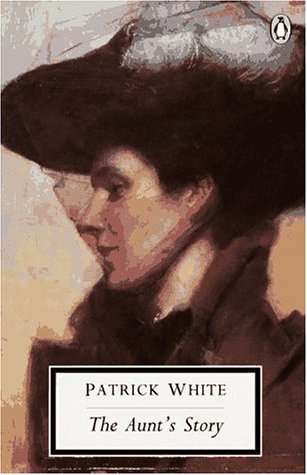
The Aunt's Story by Patrick White

'You'll see a lot of funny things, Theodora Goodman.  You'll see them because you got eyes to see.  And they'll break you.  But perhaps you'll survive.  No girl that was thrown down by lightning on her twelfth birthday, and then got up again, is going to be swallowed easy by rivers of fire.'

And now Theodora began to think that perhaps the man was a little bit mad, but she loved him for his madness even, for it made her warm.

Theodora Goodman has never married, has never quite seemed the point of entering into the great formal propriety that is marriage: "This thing a spinster, she sometimes mused, considering her set mouth; this thing a spinster which, at best, becomes that institution an aunt."  The institution is a way of making sense of people who do not quite fit into the ordinary boxes, of labeling the unlabeled.  Theodora's mother thinks, "Life would be simpler, neater, more consoling, if we could take the hearts of those who do not quite love us"--like Theodora--"and lock them in a little box, something appropriate in mother-o'-pearl.  Then I would say: Theodora, now that you are hollow,my words will beat on your soul for ever so that it answers regularly as an African drum, in words dictated by myself, of duty and affection."  But when Theodora's cruel mother finally dies, she is released, free to follow her own predilection for independence, which she indulges by traveling to France where she stays in a hotel populated by a strange cabal of permanent guests who invite her into the complexity of their lives.

The Aunt's Story is split into three parts.  The first follows Theodora's childhood at her Australian estate of Meroe.  Theodora loves the place and has no desire to ever leave it, but at the same time, she is fascinated by the intermittent intrusions of another, more exotic life: the traveling Syrian who comes peddling wares in a wagon, the lightning that throws her down on her twelfth birthday, the wandering beggar who is given his dinner on the side porch and who becomes, in her mind, and with a lovely artistic touch from White, The Man who was Given his Dinner.  Theodora is self-complete, and throughout her life she consistently rejects the entreaties of people who would invite her into her life, like the rich man who proposes marriage.  But at the same time she seems attracted by the lives of others, especially when they seem to operate outside the oppressive boundaries of social propriety.

The second part takes place at the Hotel du Midi on the French Riviera, whose cabinet of strange characters include Mrs. Rapallo, an American who has invented a daughter who is a princess to increase her own social standing, and General Sokolnikov, a Russian emigre who seems to think Theodora is his murdered sister.  These two have a bitter enmity that comes to a head when Rapallo buys a beautiful chambered nautilus that Sokolnikov has been admiring in a shop window.  If that sounds strange, it is perhaps the least strange thing about this middle section, which is as incomprehensible as anything I've ever read.  During it, Theodora goes more or less insane.  She begins imagining the lives of these people lead when she's not around, but the lines between the real world and the background that she fills in is not always clearly.  She imagines, for example, that she really is Ludmilla Sokolnikov, going so far as to experience, by imagining, her own murder.  At least, that's what I think she's doing.  It's so impossibly confusing and confused that it's not quite possible to really give a faithful summary.

And do you know what?  I've decided I don't really care.  As a younger reader I might have been frustrated by the opacity of this section, and chalked it up as a flaw in the book.  (In doing so, I might have been expressing also a frustration with myself for not measuring up to the complexity of the prose.)  But I find these days that there are pleasures that lie beyond the simple comprehension of a plot, especially when the language is so fine, and The Aunt's Story is probably the most poetic of all the books I've read by White, whose language is so close to poetry all of the time.  You really have to wander through the book at a slight remove, like Theodora:

She walked through the hotel, choosing to lose herself, or not choosing, in the Hotel du Midi there was no alternative.  And especially at night.  At night there was the space of darkness, a direction of corridors, stairs which neither raised nor lowered the traveller on to a different plane.  In this rather circular state, Theodora walked with her hands outstretched, to ward off flesh or furniture if the occasion should arise.

It probably sounds pretentious to say all of that, and I wouldn't blame you for not buying it.  I don't blame the many people on Goodreads who say this book was just too confusing.  I think it takes a lot of patience, and a particular frame of mind, to enjoy a book that refuses to be clear, and I'm not trying to be an egotist when I say there are very few people in the world who would like a book like this.  I think White's books are brilliant, but I'm not going to go around recommending them for book club.

The third part, so short it might be an epilogue, finds Theodora in America.  She's riding a train, which she sneaks off of into the countryside.  This was cool to read, because I've never read White's peculiar prose style applied to the U.S., rather than Australia or Europe:

All through the middle of America there was a trumpeting of corn.  Its, full, yellow, tremendous notes pressed close to the swelling sky.  There were whole acres of time in which the yellow corn blared as if for a judgement.  It had taken up and swallowed all other themes, whether belting iron, or subtler, insinuating steel, or the frail human reed.  Inside the movement of corn the train complained.  The train complained of the frustration of distance, that resists, that resists.  Distance trumpeted with corn.

Theodora wanders into a town and out of it, meeting helpful strangers, but not wanting to stay, because each household threatens with the suffocating institutionality of, well, the household.  She ends up in an abandoned house, where she's visited by a stranger who calls himself Holstius, and who seems to know her intimately.  He explains her current madness, if that's the right word, and tells her that "true permanence is a state of multiplication and division":

In the space that Holstius spread throughout her body and the speckled shade of surrounding trees, there was no end to the lives of Theodora Goodman.  These met and parted, met and parted, movingly.  They entered into each other, so that the impulse for music into Katina Pavlou's hands, and the steamy exasperation of Sokolnikov, and Mrs Rapallo's baroque and narcotized despair were the same and understandable.  And in the same way that the created lives of Theodora Goodman were interchangeable, the lives into which she had entered, making them momently dependent for love or hate, owing her this portion of their fluctuating personalities, whether George of Julia Goodman, only apparently deceased, or Huntly Clarkson, or Moraitis, or Lou, or Zack, these were the lives of Theodora Goodman, these too.

If I could venture a reading of the central theme of the novel, it'd be this: the institutions that seem like they organize human relationships, like marriage, the home, "aunthood," really kill them, by limiting the expansiveness of what it means to be human.  In the absence of them people really can enter into each other's lives, each other's beings, through the power of their imagination, but to really do so means the dissolution or fracturing of the self, and something that looks to the world like madness.  At the end of the novel, a well-meaning housewife comes up to Theodora's door with a doctor who clearly is going to institutionalize her--with all the secondary meanings of that word in tow.  Essentially, White is asking: what would it really mean to know other people, to share our personhood with others?  Would it be wonderful, or terrible, or both?

But it's possible I haven't understood anything at all.  The mystical opacity of White's prose always seems to suggest that we're never capable of understanding the things we wish to understand, or maybe even to comprehend the very questions we ought to be asking.  I found The Aunt's Story very rewarding, but the reward is one that I'm afraid might look to a lot of readers like torture.

Sunday, April 30, 2017

The Twyborn Affair by Patrick White

She would have had to admit she had not existed in any of her several lives, unless in relationship with innocents, often only servants of ignoble masters, or those who believed themselves her parents or lovers.  She was accepted as real, or so it appeared, by the girls she farmed out for love, and who, if she were to be honest, amounted to fragments of a single image.  Yet whatever form she took, or whatever the illusion temporarily possessing her, the reality of love, which is the core of reality itself, had eluded her, and perhaps always would.

To read descriptions of the plot of The Twyborn Affair, all of them out of date, you might expect something psychologically supernatural, like the connection between Laura and Voss in VossThe back of the book speaks of "a single soul" living "three different lives."  I was expecting reincarnation.  But in truth The Twyborn Affair is about something much more realist, and more familiar to us than it might have been when White wrote the novel: it's about being transgender.

When we first meet the protagonist, Eudoxia Vatatzes, she's a young woman renting a house in the French Riviera with her older husband, a Greek named Angelos who suffers from fits where he thinks he's a Byzantine Emperor.  Probably Angelos is based on White's lover, the Greek Manoly Lascaris.  In the second part, Eudoxia has resumed her birth name, Eddie Twyborn.  (Twice-born, that is--once as a man and once as a woman; or perhaps tri-born, for the three parts of the book.)  Eddie, back home in Australia and living as a man, becomes a hired laborer in the Outback, where he gets caught up in affairs with both his boss' wife and the male manager of the ranch.  In the third, thirty years later, Eddie has escaped to London where he has become the madame of a brothel under the Eadith Trist.  (No analysis on that surname needed, I think.)

Although like all of White's novels the line between the mental world and the real one is pretty blurred, it seems clear to me that The Twyborn Affair was ahead of its time in thinking about the psychological and social travails of a transgender woman.  The old reviews shy away from it, but there is a genuine pathos in Eudoxia/Eddie/Eadith's search for an identity that stands out among White's darker psychological explorations.  Eudoxia records her sense of rootlessness in a diary:

My olive-tree is standing.  The garden would seem an argument for permanence--only one or two insignificant, dispensable branches lying uncouth amongst the silver tussocks, the hummocks and cushions of lavender, dianthus, southernwood, and thrift.  My rented garden.  Nothing is mine except for the coaxing I've put into it.  For that matter, nothing of me is mine, not even the body I was given to inhabit, nor the disguises chosen for it -- A. decides on these, seldom without my agreement.  The real E. has not yet been discovered, and perhaps never will be.

Is "the real E." ever discovered?  There's a nice scene at the end where Eadith meets her estranged mother by chance in London.  Her mother, speechless, writes on thy flyleaf of a prayer book: "Are you my son Eddie?"  And Eadith writes back, "No, but I am your daughter Eadith."  Of course, White can't leave it at that; the end has to be less sentimental and more ghoulish.  But he allows his protagonist a moment of recognition, face-to-face with the mother with whom she has long identified herself, a mother with her own history of conflicted gender identity and sexuality.  Neither the Eddie nor the Eadith portions are as vivid or as captivating as the first section, but this moment feels true because the sensual and adventurous Eudoxia still remains in the body of Eadith, searching for "the real E."  It makes you wonder, without wanting too much to project the work onto its author, what path White himself might have taken in a different time and place.

Sunday, April 23, 2017

Voss by Patrick White

Every man has a genius, though it is not always discoverable. Least of all when choked by the trivialities of daily existence. But in this disturbing country, it is possible to more easily discard the inessential and attempt the infinite. You will be burnt up most likely, you will have the flesh torn from your bones, you will be tortured probably in many horrible and primitive ways, but you will realize that genius of which you sometimes suspect you are possessed, and of which you are sometimes afraid.

What a book. I can't say Voss was the most moving or powerful book I've read this year (that would probably be the sadly-unreviewed Invisible Man), and I can't say it was an easy read. But what I can say is that it is like nothing I've ever read. The back cover blurb makes it sound like a western set in 1800s Australia, and a longer summary would read like a "love in spite of obstacles" story in the vein of Castaway, but in reality, Voss--named after the protagonist, a fiercely internal and independent man who leads an expedition to fill in the massive blank spot that is the outback--often barely reads like a novel at all, as White chooses words and images that evoke while often barely making logical sense, as he elides over the most desperate and disturbing happenings on Voss' excursion in favor of long passages of obscure poetry and often leaves the expedition entirely to focus on Laura Trevelyan, Voss' once-met love--but I digress.

So the plot is this--Johann Wilhelm Voss is patronized by Laura's uncle to lead the aforementioned expedition to the Outback, at the time a complete mystery. While at the kick-off party for the expedition, Voss meets Laura, an intelligent girl who has recently decided she doesn't believe in God and doesn't understand her family. After one incidental and fairly confrontational conversation about those two topics, Voss and Laura gradually realize that they are connected--in love--even as Voss and his party move further from civilization and toward almost-certain death.

The love story is an interesting construction. Not only do Laura and Voss have only one conversation, but 1/3 of the way through the book they communicate in words for the last time, as their letters start meeting ignominious fates before reaching their targets, but as Voss draws nearer to his ultimate destiny and Laura grows sick in tandem, they begin sharing psychic experiences--awfully disorienting to begin with, since White just starts talking about them as if they're together and never explains--but that's the way Voss is. Even after spending hours with the text, it's easy to slip out of concentration and miss something really important, like a death, a healing, or even a decapitation. Like Cormac McCarthy, White has little interest in the shocking for its own sake--a particularly grisly death is given less time on the page than Laura's shorn head, post-sickness haircut--and more interest in the crushing cruelty of the unloving land.

So there's so much material to unpack here, I can't even begin to do it justice, but I wanted to include a couple more samples of White's writing. As good as the book is narratively, his prose is the biggest draw. At times reminding me of McCarthy, Austen(!) and Dostoevsky, White nevertheless has a singular style that doesn't easily fit into any boxes I own. Here's Laura at a funeral:

But Laura was calm rather than cold, as, all around her, the mourners surrendered up their faces to the fear of anonymity, and above, the clouds were loading lead to aim at men. After the first shock of discovery, it had been exhilarating to know that terrestrial safety was not assured, and they solid earth does eventually swirl beneath the feet. Then, when the wind had cut the last shred of flesh from the girl's bones, and was whistling in the little cage that remained, she began even to experience a shrill happiness, to sing the wounds her flesh would never suffer. Yet, such was their weakness, her bones continued to crave earthly love, to hold his skull against the hollow where her heart had been. It appeared that pure happiness must await the final crumbling, when love would enter into love, becoming an endlessness, blowing at last, indivisible, indistinguishable, over the brown earth.

And here's Voss, facing his fear of death:

He himself, he realized, had always been most abominably frightened, even at the height of his divine power, a frail god upon a rickety throne, afraid of opening letters, of making decisions, afraid of the instinctive knowledge of in the eyes of mules, of the innocent eyes of good men, of the elastic nature of the passions, even of the devotion he had received from some men, and one woman, and dogs.

Afraid of the devotion he had received from men, a woman, and dogs. That's a whole character--maybe a whole novel!--right there in one line. Great stuff.

Saturday, July 18, 2015

The Solid Mandala by Patrick White

In the first corner, as a prelude to all that he had to reveal, he danced the dance of himself.  Half clumsy, half electric.  He danced the gods dying on a field of crimson velvet, against the discords of human voices.  Even in the absence of gods, his life, or dance, was always prayerful.  Even though he hadn't been taught, like the grocer, to go down on his knees and stick his hands together.  Instead, offering his prayer to what he knew from light or silences.  He danced the sleep of people in a wooden house, groaning under the pressure of sleep, their secrets locked prudently up, safe, until their spoken thoughts, or farts, gave them away.  He danced the moon, anaesthetized by bottled cestrum.  He danced the disc of the orange sun above icebergs, which was in a sense his beginning, and should perhaps be his end.

The Solid Mandala begins by introducing its pair of protagonist twins, Arthur and Waldo Brown, when they are very old, and walking along the streets of their Sydney suburb hand in hand.  Those who see them from the bus think they are odd, and so they are:

Then Mrs Dun did resentfully noticed the two old men, stumping, trudging, you couldn't have said tottering -- or if so, it was only caused by their age and infirmities -- along what passed for pavement between Barranguli and Sarsparilla.  The strange part was the old gentlemen rose up, if only momentarily, blotting out the suburban landscape, filling the box of Mrs Dun's shuddering mind.  She was still shocked, of course, by Mrs Poulter's thoughtless alarm.  It could have been that.  But she almost smelled those old men.  The one in the stiff oilskin, the other in yellowed herringbone, in each case almost to the ankle.  And as they trudged, or tottered, they were holding each other by the hand.  It was difficult to decide which was leading and which was led.  But one was the leader, she could sense.  She sensed the scabs, the cracks which wet towels had opened in their old men's skin.

Ew!  White has a knack for turning the human body into a kind of gross poetry.  From there, the narrative bifurcates: one section detailing Waldo's life, followed by one detailing Arthur's, which pretty much covers the same narrative ground from another vantage point.  The brothers depend on each other all their lives, though they are very different: Waldo is insecure, a failed intellectual, who resents the burden he perceives his brother to be.  Arthur is unable to grasp the politics of the social world, but filled with a wisdom and a kind of mystical love.  When Waldo is working at a library, he discovers his brother in the reading room, perceived by others to be a kind of lurking creep, and so he shoos him away, but it is Arthur, we find out, who is reading and pondering the episode of the Grand Inquisitor from Dostoyevsky.  For all of Waldo's pretensions--he jealously guards the book he has been writing for seventy years--it is Arthur who has a kind of true understanding.

Arthur keeps a set of four marbles in his pocket.  He thinks of them as mandalas, the Buddhist symbol which represents the universe:

It was himself who was, and would remain, the keeper of mandalas, who must guess their final secret through touch and light.  As he went out of the room his lips were half-open to release an interpretation he had not yet succeeded in perfecting.  His body might topple, but only his bod,y as he submitted the marble in his pocket to his frenzy of discovery.

Arthur gives one of these to each person in the book he loves, including one to Waldo. They are a recognition that each person is a universe unto themselves, patterned the same way as existence itself and therefore harmonious with it.  Waldo, of course, cannot understand this.  Just as Mrs Dun cannot tell who is leading whom, but knows that one brother leads the other, so Waldo is unable to submit to his brother's wisdom because he remains convinced that he is doing the leading.

Arthur is a familiar kind of trope: a holy fool, a Shakespearean "natural," so called because they were perceived to be closer to the nature of things and uncorrupted by the pretensions of society.  But White is really good at this kind of mysticism, partly because of the intense obscurity of his style.  Though I liked the "Waldo" section--a long and detailed account of a very failed man--it was the shorter "Arthur" section that really made The Solid Mandala work for me.

Wednesday, August 22, 2012

The Cockatoos by Patrick White

She switched aside the blind from a bow-window, to see whether the cockatoo.  There were two of them.  Stamping and striding around the tree.  Her heart was beating.  Sometimes the birds got so angry, she could hear them screeching through the glass.  She wouldn't have dared open the window: she might have frightened the cockatoos.  Who tore at the lawn with furious beaks, or calming down, composed their crests along their heads, eyes tender with a wisdom which, like most wisdom, threatened to become obscure or irrelevant.

The titular birds of White's short story "The Cockatoos," which in turn gives its name to the whole collection, capture the attention of an entire neighborhood.  It's not hard to see why--there's something mystical and beautiful about a flock of wild cockatoos that contrasts the inertness of 20th century suburban living, something otherworldly.  They mean something slightly different to each neighbor: an ornamentation, a talisman, a nuisance, a memory, a promise of reconciliation for an estranged couple.  Like White's stories, their significance hovers somewhere beyond the threshold of comprehension, and yet each character longs to possess them, to call them "his birds" or "her birds."  Unsurprisingly, like with so many human attempts to understand and possess the unknowable, violence erupts.

"The Cockatoos" is the last story in the collection, and the most perfectly realized, though it draws from the same well as many of the others.  White's protagonists are typically older couples, the wife explored more fully than the husband, happy with each other or unhappy, but mired in long-established routines into which the mystical, like the cockatoos, continually threatens to break in.  In "Five-Twenty," an elderly woman watches the afternoon traffic with her crippled husband, comforted by the timeliness of a single man in a single car, until her husband dies and she embarks on a chance sexual adventure with the commuter.  Sexual affairs are linked to the mystical, too; in "Sicilian Vespers" another old woman cheats on her husband in an Italian church.

These stories are well wrought, and manage both a strong realistic power and a metaphysical presence, but "The Cockatoos" is clearly the best of them.  Almost as enjoyable are a pair of stories that don't fit this mold: "The Night the Prowler," about a young woman's supposed sexual assault, and my other favorite, "The Full Belly," about a Greek family under the Nazi Occupation.  Near starvation, the protagonist Costa receives a vision of Mary urging him to take food from his dying aunt, only to find that his other aunt has gotten to it first.  They fight and Costa wins, but they have become something primal, animalistic:

When his aunt had gone, Costa Iordanou plumped on the carpet, intent on stuffing his mouth with rice.  If only the few surviving grains.  Sometimes fluff got in.  Or a coarse thread.  His lips were as swollen as cooked rice.  The grains stuck to the tips of his fingers, the palms of his hands.  He licked the grains.  He sucked them up.  The splinters of porcelain cutting his lips.  The good goo.  The blood running.  Even blood was nourishment.


What a great, minimalist sentence: "The good goo."

I wasn't sure that White's mysticism and lyricality, which work so well in his historical novels Voss and A Fringe of Leaves, would translate to contemporary settings, but The Cockatoos left me pleasantly surprised.

Sunday, June 27, 2010

A Fringe of Leaves by Patrick White

Whether today or tomorrow's or yesterday's [march] it was all one by now, a continuous seamless tapestry, its details recurrent and interchangeable. Giant, wooden birds stalked the earth, or paused to consider the similar movements of the apparitions confronting them, or flumped towards safety if some more than usually grotesque gesture destroyed their sense of security.

There was an occasion when she fell down, scattering skywards a cloud of ashen parrots. She would have continued lying on the ground and perhaps become her true self: once the flesh melts, and the skeleton inside it is blessed with its final articulate white, amongst the stones, beneath the hard sky, in this country to which it can at last belong.

But he had got down, and was beating on her skull with his fists. 'Come on, fuck yez!' he was shouting. 'Wotcherthinkwereerefor? To die?'


I admit to picking up A Fringe of Leaves because it seemed similar to Voss, which I adored, and if I liked it less than the latter I blame White only partially, saving some fault for whoever wrote this atrocious dust-jacket synopsis for Penguin:

Returning home to England from Van Diemen's Land, the Bristol Rose is shipwrecked on the Queensland coast and Mrs Roxburgh is taken prisoner by a tribe of Aborigines, along with the rest of the passengers and crew. In the course of her escape, she is torn by conflicting loyalties--to her dead husband, to her rescuer, to her own adoptive class.


The myriad sins of which are, in descending order: 1.) The ship is not called the Bristol Rose, but the Bristol Maid. 2.) Mrs Roxburgh is not taken prisoner "along with the rest of the passengers and crew," because "the rest of the passengers are crew" are killed by the aborigines. 3.) Revealing that her husband dies is a pretty egregious spoiler for the back of the book. 4.) The events described here take place roughly two-thirds of the way through the book, and as such cannot really be considered what the book is about.

Let me try to do better. Yes, Ellen Roxburgh is shipwrecked and taken prisoner by a group of aborigines, but A Fringe of Leaves is one of those books that presents itself as being about one thing and then suddenly, in the middle of the narrative, rips the proverbial rug out from beneath the reader and becomes about something else. I think this particular custom, while rare, needs a name. The only other book I can think of that does this is J. M. Coetzee's Disgrace--Can anyone else think of one?

Rather, the book is about Ellen, who was plucked from the Cornish lower classes by a young, aristocratic lodger named Austin Roxburgh. Austin is in poor health, and they exhibit a kind of co-dependence--Austin has provided a way of escape from the poverty of Ellen's youth, and in return she takes care of him. Yet they seem to truly love each other. Their trip to Van Diemen's Land--what we now call Tasmania--is to visit Austin's brother Garnet Roxburgh, who is his brother's opposite: strong, adventurous, domineering. Ellen dislikes him but, perhaps responding to the restrictive nature of her marriage to Austin, lets Garnet bed her in a moment of weakness, thrown from her horse in the Tasmanian countryside.

The jacket is right, however, when it notes that the book is about "conflicting loyalties." Ellen exists in the overlap between opposite groups--the high class and the low, the "civilized" English and "uncivilized" aborigines. Because she belongs to everywhere she belongs nowhere. She is isolated, a stranger to the blacks and once again to the whites, who view her suspiciously after her escape:

Mrs Roxburgh again received the impression that they visualized her as the naked survivor, who doubtless t he moment before had finished defecating behind a clump of their father's bamboos.

So she smoothed her dress before appealing to them, 'You will breakfast with me, I hope, and give me courage to face the morning.'

It was too strange for them to contemplate for long.


Those described here are children, but as is so often the case, they represent the sentiments of their elders more boldly presented. So the push and pull exhibited on Ellen by the elements of English civilization and the elements of aboriginal civilization mirror the push and pull of Austin's class and her Cornwall origins, and the push and pull of Austin himself and his rakish brother.

It is also a book about responsibility and power--though Ellen is a position of service toward her husband, she, as his keeper, holds a great power over him. (So one might read her giving of herself to Garnet as an expression of her desire to forsake power.) This paradox--the power of the servant--is expressed again when the aborigines try to force her to breastfeed a child who has fallen sick. Again, when she is rescued by an escaped prisoner who has fallen in with the aborigines, she tries to promise a pardon for his help, an offer of life against death, even at her lowest point. That these efforts are fruitless--she is too dry to breastfeed; the frightened convict abandons her as soon as they come to the settlement--force Ellen to come to terms with powerlessness.

White's style is strangely schizophrenic: When among the English, his prose has the sort of intricate formality that the Victorians had, and he saves his most exotic writing for exotic places and situations, like the passage I've copied at the beginning of this post. My biggest complaint about Voss was that it seemed to develop with painful slowness, but that the sections situated in the Outback were well worth the wait. Because of the synopsis on the back, I was expecting the same from A Fringe of Leaves, and so perhaps I didn't give this book the patience that it required. Had I read the excellent assessment by the Complete Review, which begins, "It is misleading to describe this as the story of a shipwreck," I might have liked it quite a bit more.