Showing posts with label western. Show all posts

Saturday, April 29, 2023

The Collected Works of Billy the Kid by Michael Ondaatje

Garrett's voice near me on the skin whats wrong billy whats wrong, couldnt see him but I turned to where I knew he was. I yelled so he could hear me through the skin. Ive been fucked. Ive been fucked Ive been fucked by Christ almighty god Ive been good and fucked by Christ. And I rolled off the horse's back like a soft shell-less egg wrapped in thin white silk and I splashed onto the dust blind and white but the chain held my legs to the horse and I was dragged picking up dust on my wet skin as I travelled in between his four trotting legs at last thank the fuckin christ, in the shade of his stomach.

I picked this book up years ago at a shop in Tucson, and I didn't think of it again until I was in Mesilla, New Mexico, the town where Billy the Kid was tried, sentenced to death and later escaped. Tucson, too, is a place that Billy fled, and in that part of the world you can follow Billy's footsteps across the desert: the Billy the Kid Scenic Byway, the Billy the Kid Gift Shop, the Billy the Kid Casino. Fleeing is part of Billy's legend, the thief and murderer, barely more than a child, who eluded the officials of the Old West until a single man, an obsessive sheriff and former friend of Billy's name Pat Garrett, finally brought him down. As is sometimes but not always the case with the figures of the old west, it's the outlaw who ends up myth, and the lawman ends up fairly suspect. That's certainly the case with Michael Ondaatje's The Collected Works of Billy the Kid, a pastiche of prose and poetry that captures Billy's flight and his last days.

Ondaatje's Billy is a charmer, well-dressed and well-liked, in opposition to the famous photograph of Billy looking rather ragged and buck-toothed. You can't say he's a reluctant criminal, but he's certainly an uncertain one; in one of my favorite prose passages Ondaatje imagines Billy hiding in an abandoned barn at peace with the animals there: "There were animals who did not move out and accepted me as a larger breed. I ate the old grain with them, drank from a constant puddle about twenty yards away from the barn. I saw no human and heard no human voice, learned to squat the best way when shitting, never ate flesh or touched another animal's flesh, never entered his boundary." But Billy's peaceable kingdom collapses when a group of flesh-hungry rats gets drunk on fermented grain and he's forced to take his shotgun to them. Billy's life is like that; he is compelled to the violence he commits. It is inevitable.

Pat Garrett, on the other hand, is depicted as a strange and untrustworthy figure who can "kill someone on the street and walk back and finish a joke." He keeps exotic birds but he is "frightened of flowers because they grew so slowly he couldnt tell what they planned to do." He is "[o]ne who had decided what was right and forgot all morals." His pursuit of Billy is not only a betrayal of an easy companionship they once shared at the home of a cattle rancher, but something strange and monomaniacal. Ondaatje's no McCarthy, but Garrett shares a little bit of DNA with the Judge from Blood Meridian, only this time under the self-righteous patina of law.

The poetry is... fine. Sometimes it works, and sometimes it doesn't. None of it, I'd say, rises to the level of the prose pieces, which are richly evocative and sometimes even a little grotesque. They are as poetic, perhaps, as the poetry, not least because they're not interesting in giving any real historical account of Billy the Kid's life as much as a series of impressions from it. The book works best if you know a little about Billy already, I think, or if you, as I did, pause in the middle of it and go read through the guy's Wikipedia page. There you might learn that Billy's life, like Ondaatje's book, was fairly short and full of troubles, but it produced a legend that lives on.

Saturday, April 22, 2023

Pity the Beast by Robin McLean

What's the earth to a horse? A place to place the hoof, a cradle of grass, a prop to rest his nose while rippling grass out by the roots. And the Herd would have had no interest in eons. Seasons maybe, days maybe, the change of the wind certainly, the daylight hours on their pelts. No interest in geysers. In salt licks, maybe. Horse was a watcher, a minder of his own business, with eyes screwed in on the side of his tin-can skull, peripheral observer, yes, but what of those objects right in front of his nose? Expert in grass and wind, in the locations where rodents bored their holes, since such pits would break a forelock with one misstep. And then Horse would be left by his Herd. And then Wolf would come.

A mare is giving birth; the foal is too big, because she's been impregnated by the neighbor's immense Percheron horse. The couple who own the ranch work together to save the life of mare and foal, but they can't stop bickering, because the Percheron isn't the only neighbor who's been where he shouldn't be: Dan has recently discovered that his wife Ginny has been sleeping with the next door rancher. As the work continues, more people show up, partly to help with the mare, but partly to insult Ginny and upbraid her for her infidelity, among them her own sister Ella and Ella's husband Saul. The insults turn to violence when this crew beats and gang-rapes Ginny and throws her in the lime pit which is meant to dissolve the bodies of dead animals. But Ginny isn't dead; she climbs out and rides away, with her pursuers on the trail behind her.

I was blown away by the first part of Pity the Beast. The way that McLean slowly amplifies the anger and hatred the others have toward Ginny, at the same time they are ostensibly working together to save the mare and foal, is rich in irony and crackling with hate. It's easy to see the influence here of Cormac; the West in Pity the Beast is depicted as a point in eternity's long arc, and we are made to understand the hatred of Dan and others as something that is primeval. At the same time, there are suggestions that the West has become a diminished place, performative in nature rather than real: among Ginny's other pursuers are a deputy from New Jersey who writes postcards to his mother about his cowboying (and how he thinks Ginny must be single now), and a young teen in a ridiculous Western get-up called "the Kid."

That said, I thought the remainder of Pity the Beast failed to live up to the promise of the first section. The pursuit goes on for days, weeks, months; it goes on so long we are no longer supposed to wonder in any literal sense how long it is taking. The characters have reentered the West of myth. But this flight into myth leaves the narrative rather obscure, sometimes almost impossible to read for plot. For every interesting or novel touch, like the bits of "Mule thoughts" shared among the pursuers' mule pack, there's one that is impenetrable: I have no idea, for example, what's up with the short science fiction passages where a future scientist is doing a census of the world's cedar trees. In the end, the novel makes the same error as Dan, Ella, Saul, their tracker and their mule driver: it never should have followed Ginny into the wilderness in the first place.

Monday, April 17, 2023

Cimarron by Edna Ferber

His past, before his coming to Wichita, was clouded with myths and surmises. Gossip said this; slander whispered that. Rumor, romantic, unsavory, fantastic, shifting and changing like clouds on a mountain peak, floated about the head of Yancey Cravat. They say he has Indian blood in him. They say he has an Indian wife somewhere, and a lot of papooses. Cherokee. They say he used to be known as "Cimarron" Cravat, hence his son's name, corrupted to Cim. They say his real name is Cimarron Seven, of the Choctaw Indian family of Sevens; he was raised in a tepee; a wickiup had been his bedroom, a blanket his robe. It was known he had been one of the early Boomers who followed the banner of the picturesque and splendidly mad David Payne in the first wild dash of that adventurer into Indian Territory. He had dwelt, others whispered, in that sinister strip, thirty-four miles wide and almost two hundred miles long, called No-Man's-Land as early as 1854, and, later, known as the Cimarron, a Spanish word meaning wild or unruly.

Yancey Cravat is a living, breathing avatar of the Wild West: fearless, adventurous, a crack shot with an enormous head like a buffalo. The five years he spends cooped up in Wichita are the worst of his life, but he stays to woo his wife Sabra, the scion of a well-to-do Kansas family. When the territory that's now Oklahoma is opened at last, Yancey is among those "boomers" who race across the border to drive a stake into their chosen lot; and though he's outwitted by a clever madam, he brings Sabra and their son Cimarron to the newly established town of Osage anyway. Sabra, for her part, is mortified by their new life, by the filth and want of Osage, and by the Indians lurking around. The Indians, in fact, are one of the greatest points of disagreement between Sabra and Yancey: she refuses to have anything to do with them, but he uses his newly formed newspaper--the Oklahoma Wigwam--to advocated for better treatment of the Osage, the Kaw, the Cherokee, and others.

Cimarron has the same skeleton as Ferber's Giant, cast back several decades in time. Yancey is like Texas rancher Bick Benedict; he has the West in his bone. Sabra is like Benedict's new wife Leslie, cast into a world that frightens her, one she doesn't understand, though Sabra bucks against Yancey's designs more than Leslie ever does.

With whom are we to sympathize? On one hand, we admire Yancey's high spirits and his advocacy for the Indians, and Sabra's race repulsion makes her an unpleasant character. But Yancey's adventurousness makes him a bad husband: when the "Cimarron Strip"--the Oklahoma panhandle--is opened up, Yancey insists on taking up his family and heading farther west. When Sabra refuse, he goes anyway, and is gone five years, while she stays at home running and growing the newspaper. Though Yancey returns, it's never for long; he's gone to Alaska, or to war in the Philippines, or in France. The spirit of the west begins to look a little selfish; it looks like recklessness and abandonment. Sabra, on the other hand, represents a kind of feminine and civilizing principle. She stewards the newspaper and helps birth Oklahoma's version of "society." Yancey's name is floated time and time again for governor, but it's no surprise that it's Sabra, actually, who becomes a congresswoman from the newly minted state. If Yancey represents the spirit of the west, it's people like Sabra who made sure that the West was more than a spirit.

Is Cimarron a subversive book? Yancey is so larger-than-life; it's hard not to see him as another bit of mythmaking about "How the West Was Won." Cimarron traffics in some embarrassing racial stereotypes: the shiftless Indian, the Jewish peddler. Don't get me started on the fawning "black Isaiah" who accompanies them from Wichita, and then suffers a death of grotesque cruelty at the hands of the Osage. Part of me wonders if the effect of a character like Yancey, who enters in the land run but scorns the government policies of theft and depredation that made it possible, serves mostly to assuage the guilt of "Boomers." But Yancey's cruelty and recklessness go far in puncturing those myths as well. In the end, Cimarron struck me as a more straightforwardly Western novel than Giant, but you can't say it doesn't have its complexities.

Tuesday, July 5, 2022

Lonesome Dove by Larry McMurtry

Life was finally starting, Newt thought. Here he was below the border, about to run off a huge horse herd, and in a few days or weeks he would be going up the trail to a place he had barely even heard of. Most of the cowpokes who went north from Lonesome Dove just went to Kansas and thought that was far--but Montana must be twice as far. He couldn't imagine what such a place would look like. Jake had said it had buffalo and mountains, two things he had never seen, and snow, the hardest thing of all to imagine.

Okay, first of all: Three-fourths of Lonesome Dove doesn't even take place in the town of Lonesome Dove on the Texas-Mexico border. The whole point of the massive novel is leaving Lonesome Dove. Two aging Texas Rangers, garrulous Gus McCrae and stern Woodrow McCall, decide to give up their livery stable, which has led to a too-easy life, to lead a final cattle drive all the way from Texas to the Montana, arriving in the rich grasslands with their thousands-strong herd before other homesteaders and ranchers get there for them. Along for the ride are a motley crew of cowpokes: young Newt, who hasn't figured yet out figured out that he's Call's illegitimate son; Deets, the black tracker of preternatural skill; Jake Spoon, an unreliable gambler and womanizer; Lorena, a former prostitute in Lonesome Dove who sees Jake as her ticket to a better life in San Francisco; Dish Boggett, a talented cattle driver who is madly in love with Lorena. The story of these cattle drivers intersects with others: the Arkansas sheriff and his deputy who are looking to hang Jake Spoon, the sheriff's wife, who absconds with a group of rough-and-tumble buffalo hunters, and Gus' old flame Clara, long since settled on the Platte with her now-disabled husband.

Gus is the central character of Lonesome Dove. He's a skilled ranger and lawman, but he prefers to talk, and his incessant joking and chattering is the bane of his laconic partner, McCall. In fact, Gus gives the first couple hundred pages of Lonesome Dove, the part where the "outfit" is making plans for their cattle drive, a kind of broad comic quality that make the sudden death of a young Irish cowboy by a nest of water moccasins even more unsettling. It took me a long time to adjust my expectations for the novel; the juxtaposition of its comic tone and the brutality of the trail felt to sour to me, at times. The nadir of this, for me, was the introduction of a mysterious and barefoot young girl, with almost feral outdoor skills, who takes up with the hapless deputy Roscoe and who is--spoiler alert--almost immediately killed off in the most brutal manner, and not alone. But as the novel goes on, Gus' humor begins to seem more like a reasonable response to a life filled with unpredictable cruelty. The Irishman, the girl, are buried, and the cattle drive moves on.

Lonesome Dove seems, in many ways, like the quintessential western. For one, it's truly epic: 850 pages long and covering several thousand miles, as well as a couple dozen different character viewpoints. It's a snapshot of the American West at a moment when it seems empty, Native Americans driven back, the buffalo thinned out to near-extinction, but before the great droves of settler wagons and cattle drives that Call and McCrae know are coming. Sometimes, the Western tropes are a little too strong. I didn't like the depiction of Blue Duck, the unusually vicious Comanche outlaw who kidnaps Lorena and sells her to a group of Indians and Comancheros to be beaten and raped. Though Lonesome Dove makes some gestures toward ambivalence about Native Americans--Gus is supposed to have a more compassionate demeanor toward them than many of his peers--but Blue Duck seems like a monster straight out of American myth, the kind that has long been used to justify genocide and displacement. And I was troubled by the character of Lorena, too, who is headstrong at first, and who becomes terrified and helpless after her ordeal. Vicious Native Americans, helpless damsels.

But ultimately, I was engrossed by the vividness of the characters, and the sweep of the novel's great drama. The novel gets stronger, I think, the farther the outfit goes, and the wider its scope becomes. It's sort of a marvel, actually, that the novel doesn't falter as it brings in the Arkansas sheriff, July Johnson, or the story of Gus' old love Clara, a headstrong woman who has lost two children and whose husband now has been rendered braindead by the kick of a horse. But the novel is something like Gus and Call themselves: stifled by the lazy, talk-heavy life of a Lonesome Dove horse trader, and needing the great open space of the West in order to thrive. By the time the cattle drive arrives in Montana, it has become a legend in its own right, but the costs have been great: lives lost, men buried in unmarked graves in impossible to find places. Every real Western needs to have a measure of ambivalence about the West, and this is Lonesome Dove's. Has it been worth it, to reach Montana? Is the myth worth the men it leaves behind?

Tuesday, September 7, 2021

Riders of the Purple Sage by Zane Grey

Conscience thundered that she should be grateful on her knees for this baptism of fire; that through misfortune, sacrifice, and suffering her soul might be fused pure gold. But the old, spontaneous, rapturous spirit no more exalted her. She wanted to be a woman--not a martyr.

Jane Withersteen is a beautiful and wealthy Mormon homesteader in Cottonwoods, Utah. She is well known for her generosity to those who "ride" for her, driving and protecting her cattle, even those who are "Gentiles." Elder Tull has his eye on her, desiring to add her to his stable of wives, and her extensive property to his. His methods are underhanded: "calling in" the Mormons among her riders, and partnering with the notorious cattle rustler Oldring to drive her herds away. Into this tense atmosphere rides the gunman Lassiter, an avowed Mormon-hater on a mysterious mission of vengeance. Jane vows that she can soften him toward her people, but can he save her from Tull and the conniving Bishop Dyer?

Riders of the Purple Sage is one of the first and most important western novels of the early 20th century. It's got all the elements: cattle rustling, gunmen who live by their own code, damsels in distress. It strikes me as a link in a long chain of popular culture that runs from Shakespeare to the MCU: scenes of action and tension are actually subordinate to cornier and more maudlin elements. There's even an adorable little child who says things to Lassiter like, "Will oo be my favver?" Christ. On the other hand, the book has an almost hilariously sour view of Mormons, who are consistently depicted as sneaky and cruel. Jane is the exception to the rule, and though she vows to make Lassiter give up his Mormon-hating ways, it's him that drives her out of the church in the end. (The novel paints Jane as intensely devout, but the thinness of detail about the religious life of a 19th century Mormon makes me think that Grey knew very little about their practices.)

I actually preferred what you might call Riders of the Purple Sage's "b-plot": one of Jane's riders, Bern Venters, is exiled by the Mormons of Cottonwoods. Riding out, he encounters the cattle rustler Oldring and shoots a notorious lieutenant known only as "the Masked Rider," only to discover that the Masked Rider is really a young woman named Bess who Oldring has disguised. Venters nurses Bess back to health in a secret canyon decked with ancient Pueblo cliff dwellings. These sections really give Grey license to do what he does best, which is describe in affectionate detail the striking landscape of southern Utah. Here Bess and Venters' meditations on the long-gone cliff dwellers--"What was the good of their living at all!" Bess asks, "They're gone! What's the meaning of it all--of us?"--briefly elevate the book above melodrama.

Sunday, August 5, 2018

Warlock by Oakley Hall

For are we not, perhaps, here in Warlock, sitting in upon the childbed of a Legend?  Are we watching such a momentous birth all unknowingly, and, unknowingly, too, this one or that one of us helping it along, acting as midwife, boiling the water, holding the swaddling clothes, etc.?  As time goes on and if the infant does not die (literally!) and continues to grow, will not this cheap and fabulous account in this poor excuse for a magazine become, on its own terms, a version much more acceptable than ours, the true one?  It is a curious thought, how much do these legends, as they outstrip and supersede their originals, rest upon Truth, and how much upon some dark and impenetrable design within Man himself?

The town of Warlock, somewhere in the Southwestern United States in the late 19th century, has a problem with road agents and cattle rustlers.  Petty crime carries with it the constant threat and reality of violence.  Warlock's political situation contributes to the unease: the sheriff in the larger nearby town considers Warlock not a part of his jurisdiction, but a senile old governor drags his feet on incorporating Warlock as the seat of a new county.  There is no peace in Warlock because there is no law in Warlock, literally.  A committee of businessman hires a famed gunman named Clay Blaisedell as marshal to defend the town against the cowboys, led by the notorious red-headed Abe McQuown.

Warlock begins this way, with a classic Western setup.  Blaisedell is the whitehat, McQuown is the blackhat, and the novel is a speeding train running toward their final confrontation.  The truth is that Westerns have been picking apart the myths and legends of the Wild West since the west really was wild, but Warlock does it with incredible subtlety and narrative force.  Blaisedell is a good man, and he believes in the work he's doing, but no man can be quite as good as the myth that a man like Blaisedell carries with him.  All the characters in Warlock, except the very vilest of McQuown's cowboys, are are committed to a kind of stringent code: no "backshooting," no firing until you're drawn upon, etc.  Blaisedell is the avatar of this code, and it's no surprise that he quit marshaling and takes it back up several times over the course of the novel; he's constantly being made to face the limitations of his own ability to be such an avatar.

"We do not break so simply as some think into the two camps of townsmen and Cowboys," writes the storeowner Henry Goodpasture, whose diaries are interspersed throughout the narrative.  "We break into the camps of those wildly inclined, and those soberly, those irresponsible and those responsible, those peace-loving and those outlaw and riotous by nature."  But McQuown's cowboys see themselves on the side of the "responsible" and "peace-loving" as much as Blaisedell does.  In fact, they object that Blaisdell's tactic of "posting" a man out of town under penalty of death is a miscarriage of justice, perpetrated out of sheer animus or dislike.  When a strikebreaking mine owner hires McQuown's cowboys as a group of Regulators to threaten and cajole the miners, it gives them the same kind of specious authority, given by moneyed interests in the absence of real political law, enjoyed by Blaisedell.  It's no surprise when McQuown posts Blaisedell out himself.  Warlock never goes so far as to suggest that McQuown and Blaisedell are on equal footing, legally or morally, but it does just enough to trouble the conditions of Blaisedell's employment to muddy the waters.  The mythmaking that Goodpasture sees occurring in real time conceals those moral complexities utterly.

It isn't really McQuown who is Blaisedell's antithesis, but the town's nominal sheriff's deputy, John Gannon.  Gannon's power comes from the absentee sheriff, not the business owners, and if there's any legal power at all in Warlock, it's his.  He's also an old associate of McQuown's, grown disgusted by the cowboys' behavior, and that makes him a kind of liminal figure in Warlock.  The townspeople, by and large, think that he's working subterfuge for McQuown, and McQuown's men consider him a traitor.  It's not a comfortable place to be.  And yet it's a lack of partisanship that allows Gannon to do the work of peacekeeping with moral clarity.  Gannon leaves his brother to die at Blaisedell's hand when his brother is in the wrong; Blaisedell, on the other hand, has his authority challenged and nearly undone by his personal affection for his violent friend, Tom Morgan.  Blaisedell is the myth, but is bound to collapse under it; Gannon is the image, or perhaps the omen, of the law in the West, beholden to no one and nothing but its own principles, and likely to be forgotten in the shadow of mythical figures like Blaisedell.  McQuown is a red(-headed) herring; the final confrontation is, as it has to be, Blaisdell and Gannon, myth against reality.

Even that's more clearly put than Hall suggests.  For one, the law doesn't look so great when it comes in at the end of the novel in the figure of the territorial government intervening on behalf of the mine owners against the strikers.  But Warlock describes in fine detail the difficult choices involved in building a civilization up out of the inhospitable desert of the American frontier.  And it's a page-turner, too: I finished the nearly 500-page book in three days because I just couldn't put it down.  Even though it picks apart the myths of the American West with ruthlessness, it still offers incredibly satisfying variations on the classic moments of Western novels and films: the duel, the stage robbery, the gambling hall dust-up, the cowboy riding off into the sunset.

Tuesday, May 22, 2018

Warlock by Oakley Hall

"Bitter?" he heard Kate say. above the humming in his ears. "Why yes I am bitter! Because men have found a way to crucify every decent man, starting with Our Lord. No, it is not even bitter--it is just common sense. They will admire him because he killed a man they wouldn't've had the guts to go against. But they will hate him for it, because of that."

I cut my grown-up reading teeth on Westerns, mostly Louis L'Amour and numerous knock-offs. I can recite the structure of those books now. It's a bonding ritual amongst those who've read many. A loner comes to town, usually with a dark past. The town is run by the seemingly benevolent but actually malevolent "largest rancher in the valley". There's a grudging gunfight as a cowboy who's had too much to drink can't help but throw iron on the stranger. There's at least one fistfight that usually ends with the stranger taking his bruises, and then a final gunfight against overwhelming odds. And there's usually a girl there to help pick up the pieces. Within this framework, there's a lot of fun stuff that can happen, but the structure is sacrosanct.

Warlock, one of the numerous award winners that NYRB has rescused from obscurity, has a full-length blurb from the rarely terse Thomas Pynchon on the back cover, and that might lead you to believe that it's the sort of book that would wildly buck those conventions--an ambiguous ending, perhaps? Historical characters behaving anachronisitically? Or, at a minimum, a modernistic nihilism like Unforgiven. But you'd be wrong, because in many ways, Warlock follows the aforementioned structure to a T. The way it follows it is sometimes surprising, sometimes moving, sometimes predictable, but after finishing and taking a step back, it's not hard to see the contours of L'Amour and John Wayne.

Where it bests most Westerns though, is the thoroughness with which it examines the mining town of Warlock and its denizens. Although most of the book focuses on hired-gun sheriff Clay Blaisdell, black-sheep former outlaw John Gannon, amoral drifter Morgan, and the mysterious Kate, plenty of other citizens get moments of focus to make them more than the cardboard cutouts that tertiary characters in these sorts of books tend to be. We get a side-plot about the organizers of a miner's strike, a look at the politics in the little big Bright's City and their uncaring--and half crazy--beauracracy, and about 1/4 of the book is told through the diary entries of Henry Holmes-Goodpasture, a put-upon store owner who, in a clever bit of metacommentary on the genre, keeps getting his front window smashed.

But Gannon and Blaisedell form the beating heart of Warlock. Blaisdell has killed so many men that he can't seem to stop, in spite of the wear on his spirit. And Gannon reluctantly but unwaveringly takes up the office of deputy after Blaisedell steps down early in the novel, after killing Gannon's brother. Though the gunman-stranger is usually--and even here, is--the magnetic center that holds everything together, Gannon gets the most character work, starting the book regretting a massacre he participated in and ending it... well, there's a fistfight and a gunfight, but anything more would be telling.

Warlock is able to sustain its tight-broad paradoxical focus because Hall recognizes that the town itself is too small for anyone or anything to really be a sideplot. Often we learn about events after the fact second-hand, and while there's no real unreliable narrator here, that level of remove is engaging in a way that a straightforward telling might not be. There are plenty of frontier ruminations on the nature of society, and of man, but in the end, it comes down to guns and fists because the land, the people, the government, the mines, they are brutal. It takes a certain constitution to make it through with both life and soul intact, and Hall expertly breaks down his archtypical characters until they feel like real people. Then, in an epilogue, he tells what ultimately became of them all, bringing the archetypes to the foreground and showing us that the cycle never really ends. It's only the geography that's different.
To my mind, Blaisdell is only a small and temporary blight on the body politic; with all else healthy and aright he will automatically disappear. Like the rest of us, but perhaps for different reasons, he too is no longer interested in the Citizens Committee. I am apathetic of his ambitions; I am contemptuous of his optimism. The old, corrupt, and careless god has been replaced in his Heaven, and so, he feels, all will be well with the world, which is, after all, the best of all possible ones. It is a touching faith. But I am more drawn to those who wander the night not with excitement but with dread for it.

I see many of them through my window, unable to sleep now that the fire is out. For what fire is out, and what is newly lighted and what will burn forever and consume us all? How can men live, and know that in the end they will merely die?

Wednesday, March 14, 2018

The Beetle Leg by John Hawkes

It was a sarcophagus of mud.  It filled the gap between the lesser hills and prevented, by raising spit and shoals to sight, the flag flying traffic of river boats where a few had glittered in the night and crawled before.  The dam caused to be beached the homemade leaking skiffs of ranchers whose land backed up to the mud colored misty fathoms trailing seaward.  Where once bleak needles and spines had popped crookedly from the banks and a few flowers increasingly withered into the plain and disappeared, only the dust from the southward slope, swirling into the air, and a few animal bones and tin cans from a still deeper generation, survived.  One small city of the plain lasted to welcome the tourist trade and issue reports on the depth of the almost foreign, dark pan of water.

The beetle leg of The Beetle Leg is the infinitesimal tilt of the dam outside the western town of Government City: "Visitors hung their mouths and would not believe, and yet the hill eased down the rotting shale a beetle's leg each several anniversaries."  The dam has come to define the lives of the people living in the area.  Its mutability is a threat, a reminder that the settlements they have built are impermanent on a less than cosmic scale; eventually the dam will fall and the towns will be destroyed.  It's already claimed one life: that of Mulge Lampson, who is obsessively remembered by not only his brother Luke, who spends his days spreading flower-seeds upon the hill that swallowed up is brother in the Great Slide, and Mulge's widow Ma, but everyone in town.

McCarthy fans will recognize in The Beetle Leg an appealing combination of the Western and the grotesque.  One character is a thirty-year old man beset by so many deformities that he looks three times his age.  His grotesqueness, we understand, is because he was cut out of the belly of his deceased mother, and he is "drawn to the expressionless genitals of animal."  Okay.  Another character, Cap Leech, is a quack medicine man who travels around in a baroque red wagon that serves as office and home.  There is a menacing group of bikers called the Red Devils around town, gunning their motorcycles and generally up to no good.  Like a good Western, The Beetle Leg culminates with the Sheriff rounding up a posse to take out the Red Devils, though it's never clear whether the Red Devils deserve to be taken out, or whether the posse is a manifestation of senseless animal violence spurred by the existential vacuity of life beneath the dam.

But I found a more meaningful similarity between Hawkes and Djuna Barnes, whose Nightwood, like The Beetle Leg, often left me with the singular response, What the fuck did I just read?  The language, while spare and sere in the familiar McCarthy style, is deliberately obscure, eliding obvious referents, throwing up clauses like boulders fallen on desert roads, and focusing on the evocative at the expense of the realistic.  But Barnes' tricky, slippery novel has at its heart a real human yearning.  Hawkes, who famously said that the "enemies of the novel" were "plot, character, setting, and theme" refuses to provide any recognizable human motivations to anyone.  The realest emotions belong to the women: Mulge's mother Hattie, who is buried at her request upside down in the hill so that she can look down at her son lost in the earth, and Ma, who wanders the hill trying to find her lost husband's burying place: "Miles from the Lampson place, seated quietly in the middle of acres which only Luke dared tread upon in daylight, Ma moaned and nodded as if she had lost him only the day before."

Too often I found myself unsure of the very basic facts of what I was reading.  Is a scene late in the book when Luke, fishing, hooks a dead infant, meant to be taken literally?  I'm not even sure why he's fishing in the first place, or how he got to the lake from where he just was.  I guess this is what is meant by "experimental fiction."  I don't mean to be snide.  I think if you read The Beetle Leg ten times, you might come to a fine appreciation of its sheer weirdness, its slippery prose, its bleak vision of a Western frontier bleached of the mythological grandeur of the human spirit we often apply to it.  But the first reading left me frustrated more than fascinated.

Sunday, April 23, 2017

Voss by Patrick White

Every man has a genius, though it is not always discoverable. Least of all when choked by the trivialities of daily existence. But in this disturbing country, it is possible to more easily discard the inessential and attempt the infinite. You will be burnt up most likely, you will have the flesh torn from your bones, you will be tortured probably in many horrible and primitive ways, but you will realize that genius of which you sometimes suspect you are possessed, and of which you are sometimes afraid.

What a book. I can't say Voss was the most moving or powerful book I've read this year (that would probably be the sadly-unreviewed Invisible Man), and I can't say it was an easy read. But what I can say is that it is like nothing I've ever read. The back cover blurb makes it sound like a western set in 1800s Australia, and a longer summary would read like a "love in spite of obstacles" story in the vein of Castaway, but in reality, Voss--named after the protagonist, a fiercely internal and independent man who leads an expedition to fill in the massive blank spot that is the outback--often barely reads like a novel at all, as White chooses words and images that evoke while often barely making logical sense, as he elides over the most desperate and disturbing happenings on Voss' excursion in favor of long passages of obscure poetry and often leaves the expedition entirely to focus on Laura Trevelyan, Voss' once-met love--but I digress.

So the plot is this--Johann Wilhelm Voss is patronized by Laura's uncle to lead the aforementioned expedition to the Outback, at the time a complete mystery. While at the kick-off party for the expedition, Voss meets Laura, an intelligent girl who has recently decided she doesn't believe in God and doesn't understand her family. After one incidental and fairly confrontational conversation about those two topics, Voss and Laura gradually realize that they are connected--in love--even as Voss and his party move further from civilization and toward almost-certain death.

The love story is an interesting construction. Not only do Laura and Voss have only one conversation, but 1/3 of the way through the book they communicate in words for the last time, as their letters start meeting ignominious fates before reaching their targets, but as Voss draws nearer to his ultimate destiny and Laura grows sick in tandem, they begin sharing psychic experiences--awfully disorienting to begin with, since White just starts talking about them as if they're together and never explains--but that's the way Voss is. Even after spending hours with the text, it's easy to slip out of concentration and miss something really important, like a death, a healing, or even a decapitation. Like Cormac McCarthy, White has little interest in the shocking for its own sake--a particularly grisly death is given less time on the page than Laura's shorn head, post-sickness haircut--and more interest in the crushing cruelty of the unloving land.

So there's so much material to unpack here, I can't even begin to do it justice, but I wanted to include a couple more samples of White's writing. As good as the book is narratively, his prose is the biggest draw. At times reminding me of McCarthy, Austen(!) and Dostoevsky, White nevertheless has a singular style that doesn't easily fit into any boxes I own. Here's Laura at a funeral:

But Laura was calm rather than cold, as, all around her, the mourners surrendered up their faces to the fear of anonymity, and above, the clouds were loading lead to aim at men. After the first shock of discovery, it had been exhilarating to know that terrestrial safety was not assured, and they solid earth does eventually swirl beneath the feet. Then, when the wind had cut the last shred of flesh from the girl's bones, and was whistling in the little cage that remained, she began even to experience a shrill happiness, to sing the wounds her flesh would never suffer. Yet, such was their weakness, her bones continued to crave earthly love, to hold his skull against the hollow where her heart had been. It appeared that pure happiness must await the final crumbling, when love would enter into love, becoming an endlessness, blowing at last, indivisible, indistinguishable, over the brown earth.

And here's Voss, facing his fear of death:

He himself, he realized, had always been most abominably frightened, even at the height of his divine power, a frail god upon a rickety throne, afraid of opening letters, of making decisions, afraid of the instinctive knowledge of in the eyes of mules, of the innocent eyes of good men, of the elastic nature of the passions, even of the devotion he had received from some men, and one woman, and dogs.

Afraid of the devotion he had received from men, a woman, and dogs. That's a whole character--maybe a whole novel!--right there in one line. Great stuff.

Monday, April 16, 2012

All the Pretty Horses by Cormac McCarthy

Rawlins sucked on the cigarette.  They sat for a long time.  Finally he pitched the stub of the cigarette into the fire.  I'm goin to bed, he said.


Yeah, said John Grady.  I guess that's a good idea.


They spread their soogans and he pulled off his boots and stood them beside him and stretched out in his blankets.  The fire had burned to coals and he lay looking up at the stars in their places and the hot belt of matter that ran the chord of the dark vault overhead and he put his hands on the ground at either side of him and pressed them against the earth and in that coldly burning canopy of black he slowly turned dead center to the world, all of it taut and trembling and moving enormous and alive under his hands.


Well damn.  I didn't know what to think when I started this, and I'm forever grateful to the friends who gave it to me.  I'd read The Road, and knew how lyrical and cold and beautiful Cormac McCarthy's writing can be, but damn.  He loves something about bleak landscapes, or they bring out the best in his style, which is so spare most of the time that it just knocks you dead in passages like this.  John Grady's just fallen for the daughter of the hacendado who owns the ranch he's started working on in nowhere, Mexico, but instead of lovestruck ramblings he feels the earth 'taut and trembling and moving enormous and alive under his hands.'

It's like Cormac McCarthy uses his protagonists to express something about the ideal of real manhood, and this time the ideal involves stoicism, extreme self-reliance, and riding horseback into Mexico with a rifle and no absolutely no plan.  This may be my new favorite book (I think I say that too often), just because of the lyrical, dark beauty that comes out of an empty, scrub-desert landscape and follows a man and his horse.  If you need me I'll be in Mexico.

Thursday, April 5, 2012

The Sisters Brothers by Patrick DeWitt

Charlie and Eli Sisters are notorious hired guns from Oregon Territory.  In 1851 they're sent to San Francisco for a job and end up involved in a sort of alchemical get-rich-quick scheme.  The book charts their trip from Oregon to complete the job from the perspective of Eli Sisters, the larger and kinder of the two.  Once they set out the story turns into this sort of series of vignettes of all the bizarre people and situations they encounter on the way.  The only continuous thread is this final job and the rising tension between the two brothers now that Charlie has been put in charge of operations.

I was a little disappointed by this book.  It was way too episodic for my taste, bouncing around from very vivid mini-plots with almost no segue between them.  Charlie and Eli encounter 'the crying man' twice, randomly, in Oregon and again in California, without every discovering why he's sobbing uncontrollably.  They may or may not have been cursed by an old woman who may or may not have been a witch.  Then Eli's horse gets attacked by a bear.  I think the intention was to have these be smaller pictures of a bigger, magical West with a capital W during the Gold Rush, but it ended up just making the whole book seem disjointed.

It's an entertaining read but don't expect to be blown away by an epic gunslinging tale.  I also don't think I buy Patrick DeWitt's assumption that everyone out west in that 1800s talked like a polite robot that doesn't understand contractions:
'What are you doing?' he asked me.
'You are giving me this?' said the boy.
'What do you think you are doing?' Charlie asked. 
Which isn't to say that it's without its high points.  It reminded me of The Yiddish Policeman's Union in that they're both reasonably captivating and good, easy reads, but lacking real substance, or connective meaning.
My very center was beginning to expand, as it always did before violence, a toppled pot of black ink covering the frame of my mind, its contents ceaseless, unaccountably limitless.  My flesh and scalp started to ring and tingle and I became someone other than myself, or I became my second self, and this person was highly pleased to be stepping from the murk and into the living world where he might do just as he wished.  I felt at once both lust and disgrace and wondered, Why do I relish this reversal to animal?  I began exhaling hotly through my nostrils, whereas Charlie was quiet and calm, and he made a gesture that I should also be quiet.  He was used to corralling me like this, winding me up and corralling me into battle.  Shame, I thought.  Shame and blood and degradation. 
 

Tuesday, December 29, 2009

Buffalo Bill's Wild West Show by Joy S. Kasson

Buffalo Bill’s Wild West is a study of the creation of celebrity and popular memory. The life of William F. Cody is at the center of this study. In the late 19th and early 20th centuries, his Wild West show enthralled people the world over. Joy S. Kasson makes the case that Buffalo Bill’s Wild West was instrumental in creating popular memory about the American West, and ultimately shaping the American national identity.

In 1869, Edward Zane Carroll Judson, writing under the name Ned Buntline, published the first part of his serial novel Buffalo Bill, The King of the Border Men in the New York Weekly. Judson was a writer of dime-novels, a type of publication known for its clichéd characters and “good guy vs. bad guy” plots. Some of these novels were turned into plays. This created a public persona for William Cody that he would not have otherwise had.

American was still divided in the postbellum environment from which Buffalo Bill’s Wild West emerged. The West was a new place where boundaries between the North and South did not exist in the same way that they did in the East. In 1883, when Cody created Buffalo Bill’s Wild West, the western part of the United States was a place that many people had not experienced first hand. The Wild West show gave them a chance to experience the West in a safe and entertaining way. Audience members who had never seen a real Indian before got to see them, charging around the arena in their headdresses and war paint. Among other things, Buffalo Bill’s Wild West fulfilled the public’s desire for the exotic.

Buffalo Bill could be described as the first, world-wide celebrity. He sold himself and his show to the world, and the world bought both. Kasson equates him with General Philip Sheridan, President Theodore Roosevelt, and John Wayne. According to Kasson, “The success of Buffalo Bill’s Wild West was a triumph of good luck, good management, and good timing.”

Using a wide variety of sources, Kasson tells an interesting story of the intersection between history and entertainment, frontiersman and showman.

Wednesday, April 16, 2008

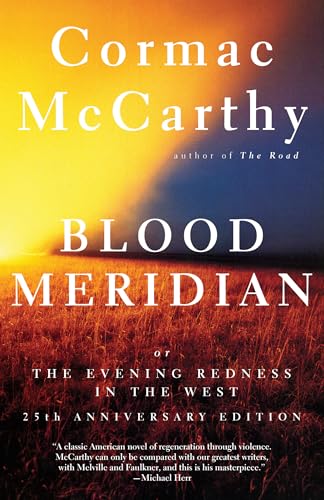
Blood Meridian by Cormac McCarthy

Then about the meridian of that day we come upon the judge on his rock there in that wilderness by his single self. Aye and there was no rock, just the one. Irving said he'd brung it with him. I said that it was a merestone for to mark him out of nothing at all. He had with him that selfsame rifle you see with him now, all mounted in german silver and the name that he'd give it set with silver wire under the checkpiece in latin: Et in Arcadia ego. A reference to the lethal in it.

Et in Arcadia ego:
"And I am even in Arcadia." That is to say that I, Death, am present everywhere--even in utopia.

I have read three of his books now (this one, The Road, and No Country for Old Men) and I can say with assurance that no one, horror writer or otherwise, writes books as terrifying as Cormac McCarthy. The Road was a post-apocalytpic tale of of a man and his son set out in a barren wasteland, No Country a tale of violence strewn across the Texas-Mexico border in 1980. Blood Meridian is much like that--even set in the same place--but 130 years ago. The plot is simple to describe: An unnamed teenager called "the kid" heads out West and joins up with a group of scalphunters under John Joel Glanton. Glanton and his associates are historical figures, and McCarthy uses as his principle source a book called My Confession by Samuel Chamberlain, a firsthand account of the travails of the Glanton gang.

Chamberlain's book describes the principle villain of Blood Meridian, Judge Holden--usually just called "the judge"--this way:

The second in command [. . .] was a man of gigantic size called ‘Judge’ Holden of Texas. [. . .] He stood six feet six in his moccasins, had a large fleshy frame, a dull tallow face destitute of hair and all expression. His desires was blood and women. [. . .] Holden was by far the best educated man in northern Mexico; he conversed with all in their own language, spoke in several Indian lingos, at a fandango would take the Harp or Guitar from the hands of the musicians and charm all with his wonderful performance, and out-waltz any poblano of the ball. He was ‘plum centre’ with rifle or revolver, a daring horseman, acquainted with the nature of all the strange plants and their botanical names, great in Geology and Mineralogy, in short another Admirable Crichton, and with all an arrant coward. (Chamberlain 271-72)


McCarthy's judge is that and more; he is a mysterious cipher devoted to violence and destruction. He is extremely intelligent, forever sketching and taking notes of local flora and fauna in his notebook, but wherever he goes, children end up disappearing and are found later assaulted and mutilated. The quote I opened the post with is his creation myth, in a way; it describes how the Glanton gang came upon him out in the desert one day, sitting on a rock--the only rock--just waiting for them. As they are out of gunpowder, he leads them on a multi-day trek to gather guano and sulfur from the mouth of a volcano to make some just in time to massacre a pursuant band of Indians.

Noted critic Harold Bloom called the judge "the most frightening figure in all of American literature." Is that true? It might well be. Blood Meridian didn't quite terrify me in the way that The Road did with its undending bleakness and its refusal to offer any glimmer of hope, but the judge very well might be the most terrifying character that I can think of. He is the unstoppable force, hyper-intelligent, hyper-amoral, and assuredly immortal; when he and the kid butt horns there can be no doubt that the conflict will end in the judge's favor. Let's say that in rereading The Road, I wouldn't be surprise to find the seven-foot hairless likeness of the judge staggering through that terrible wilderness.

As to which is better, this or The Road, I have not decided. I think that The Road will stay with me longer because of its sheer terror, but it may be that Blood Meridian is the deeper, more complete book. To call it, as some have, a "Gnostic" novel, is to barely scratch its complex commentary on the intersections of knowledge, humanity, and destruction, while The Road--and to a much more extreme extent, No Country--seem content to look upon their respective horrors more as observers than commentators.

Friday, April 11, 2008

Flint by Louis L'Amour

Complete this SAT analogy. Hardy Boys Casefiles were to Carlton Farmer as Louis L'Amour books were to ____________. Duh...my grandpa, stupid. Test-taking must not be your thing. Much like myself with Franklin W. Dixon's masterpieces (I realize that it is a nom de plume and that the man doesn't really exist) my Grandpa read pretty nearly every single Louis L'Amour book. I had not read one, so I decided that I should give them a try.

I have no clue where Flint fits within the body of L'Amour's work. I doubt it really matters. It is a somewhat typical Western. Most of the characters are archetypal. Jim Flint is the lone cowboy who decides to help out a women homesteader who is being vexed by big cattlemen (men who drive cattle, not half-human, half-bovine monstrosities). This sounds kind of simple and straightforward, but throughout the novel, L'Amour lets you in on some back story, which makes things much more interesting. Jim Flint is really James T. Kettleman, an extremely wealthy New York businessman. Before that he was a boxer. Before that he was an orphan, who was salvaged by a gunfighter named Flint, who was eventually shot down in a saloon, right in front of the boy.

So why did Kettleman the financier decide to come out west to New Mexico? He was told by a doctor in New York that he had cancer and was going to die soon. He new of a secret hideout that Flint the gunfighter used. He thought that it would make a good place to die. Those that he tangles with -- from the unscrupulous cattlemen to his murderous wife who comes from New York in search of him -- quickly find out that a man who has readied himself for death has nothing to lose.

Good book. And good call, Pa-paw.

Thursday, November 29, 2007

No Country for Old Men by Cormac McCarthy

THAT is no country for old men. The young
In one another's arms, birds in the trees
- Those dying generations - at their song,
The salmon-falls, the mackerel-crowded seas,
Fish, flesh, or fowl, commend all summer long
Whatever is begotten, born, and dies.
Caught in that sensual music all neglect
Monuments of unageing intellect.

--Sailing to Byzantium, Wm. Butler Yeats

I told Nathan I wouldn't see the Coen Brothers' film No Country for Old Men until I had read the book, which I did in a couple of days during my vacation to Cancun. It didn't take long at all, maybe two or three total hours, but a lot of that has to do with McCarthy's unique style. No Country contains a lot of paratactical sentences with very few quotation marks ("Chigurh did this and did this and did this and did this and did this"). The result is stark, much starker than The Road, which was comparatively intricate and detailed, and gives No Country a style which I have not seen successfully replicated in any novel. But also it makes the reading go very fast, sometimes to the point where I would read a page in thirty seconds and then realize that my brain had not had enough time to absorb what I had read, and I would have to go on and read it again.

In No Country for Old Men, we get the story of Llewellyn Moss, a rather ordinary young Texan with a wife named Carla Jean who happens to chance upon the result of a drug deal gone wrong while hunting in the desert. There are bodies everywhere, and abandoned vehicles, and a big bag of cocaine and a shitload of cash in a suitcase. Moss, in a rather nonplussed way, takes the money, but this sets of a chain of events in which Moss is hunted down by a cold and ruthless professional killer named Anton Chigurh who uses an air-powered steergun (it shoots out a tab which punctures a cow's skull and then pulls it back in lightning-quick) to kill his victims. Chigurh is the kind of villain that thiller writers try to create every time they write a thriller but rarely succeed: emotionless, austere, living both simultaneously outside of the law and in accordance to a strict interior moral code. The italicized monologues of aging Sheriff Bell, who relates his own horror at the deterioration of the county which he protects, are woven throughout.

In fact, No Country is a thriller through and through, but avoids the platitudes that so often come together to make good triumph over evil before the credits roll: the plucky hero cannot out-clever the professional killer; he doesn't play some cheap psychological trick (I'm looking at you, Vincent D'Onofrio) that goads the killer into violating his own methodicalness or let his guard down. The most important death and ostensibly the book's climax happens "off-screen;" what traditional thriller would be content with not allowing the reader/viewer to see that moment? And most importantly, there is no intimation that, even if Moss is able to beat Chigurh--which I will not say if he does or not--that this would mean anything, because even Chigurh, as fascinating and unique as he is, is simply a cog in a faceless, evil, all-consuming machine. The insinuation of the title is that even if you can prevent single crimes and tragedies, you cannot prevent humankind from succumbing more and more to its primeval urges; that is why Bell becomes so alienated and disillusioned. If The Road is a book about the way that humankind carries hope when hope makes no sense, No Country for Old Men is a book that screams, "Hope is lost," and in that way might even be more depressing.

I did like this book, but after The Road it was a little disappointing. I think I will read Blood Meridian, a more traditional Western.