Showing posts with label Montana. Show all posts

Thursday, January 16, 2025

The Indian Lawyer by James Welch

Now, as he remembered to look out at the small crowd, he saw the posters bobbing over the faces, red and blue with white lettering, YELLOW CALF FOR CONGRESS, and the large buttons on topcoats and wool jackets, and he became excited by what he was actually doing. All the planning, the strategy, the issues, which had seemed so academic to him, gave way to the reality that he was actually running for office, that he was qualified, not in the politician's way but in his own beliefs and values. He felt a great wave of anticipation through his body and he thought, I am on my way, I will make a difference because I am Sylvester Yellow Calf and I do count. He suddenly felt as though his life had inexorably led him to this moment and he wanted it to be momentous.

Sylvester Yellow Calf is a successful lawyer in Helena, Montana's capital. As a teenager, he was the star of the high school basketball team in Browning, on the Blackfeet reservation; this success marked him as a leader and made him what he is--which is to say, it got him off the reservation. Now he's on the precipice of considering a run for Congress, in which he hopes to become a strong advocate for the issues that affect Indians like those back home. But Yellow Calf also sits on the parole board, and a devious inmate named Jack Harwood has cooked up a plan to obtain his freedom by convincing his wife, Patti Ann, to seduce Yellow Calf and blackmail him.

It's interesting to compare Yellow Calf to the protagonists of James Welch's four other novels. (This is his fifth, and last--sad for me.) There are the historical figures of Fools Crow and Charging Elk, both caught in moments of great upheaval and change. Then there are the heroes of Winter in the Blood and The Death of Jim Loney, whose life on the reservation seems never-changing, only a dead end. Yellow Calf, by contrast, is the one who got out and made something of himself, but with the success comes the conflicted feelings of having left one's community behind. This is underlined for Yellow Calf when he sits on the parole board for another Indian his own age, whom he distantly remembers from the reservation. This man is not, perhaps, a frightening reminder of what might have been, but a reminder that not everyone had Yellow Calf's luck, or ability to shoot a basketball, and that success has meant becoming somewhat alien to the community whose hero he once was.

As a political thriller, The Indian Lawyer isn't much. It might have benefitted from a James Patterson-type, who could have turned the blackmail into something that fits a little better the desperation and deviousness we are meant to see in Harwood. Welch does try to ratchet up the intensity of the conflict; Harwood loses control of his scheme when a pair of reckless accomplices decide to take matters into their own hands. Harwood himself, though, provides an interesting contrast to Yellow Calf. Whereas we're told that Yellow Calf did all he good to "make good" on his difficult upbringing, Harwood is a shrewd, intelligent man--and a white one--who seems to have turned to crime out of pure pique. He's neither as stupid nor violent as his accomplices, but he's made an active choice to embrace criminality, perhaps for no better reason than he can. Together, the two of them seem to illustrate that the limitations of one's birth--geographic, economic, racial--are not absolute.

I don't know much about Welch as a person, but I wonder if this image of a fellow Blackfoot who transformed himself by leaving the reservation behind resonated with him. I wonder if Sylvester's success, and his grappling with it, emerged from Welch's own relative success and prestige as a writer. In any case, it's not Welch's best novel (it's probably the least interesting and effective of the five), but it's worth reading for the way it stands alone.

Saturday, November 23, 2024

Winter Wheat by Mildred Walker

It's just winter wheat to the people who raise it, only to me it means more than that. It means all the winter and all the cold and the tight feeling of the house in winter, but the rich secret feeling I have, too, of treasure in the ground, growing there for us, waiting for the cold to be over to push up strong and green. They sound like grim words without any comfort to them, but they have a kind of strength all their own.

Ellen Webb, the heroine of Mildred Walker's Winter Wheat, grows up in the wheat country of Montana. The mountains are not so far away, but not visible; the house her father built lies at the bottom of a remote coulee, and all around them the fields of wheat. It's a scene she treasures, but when her college boyfriend Gil comes to see her, the visit becomes tense and awkward. She sees her life from the outside out for the first time: how lonely the house in the coulee must be, how marked by hard labor and the brutal chance of the weather. Gil sees, too, something she has never really seen, a simmering resentment between her father, a native New Englander who came west to farm, and her mother, a Russian peasant girl he picked during World War I.

After Gil leaves, Ellen overhears her parents arguing, and learns a bitter revelation: her mother had pretended to be pregnant to get her father to marry her and take her to the States. This revelation colors not only Ellen's understanding of her parents, but her understanding of her whole life, and casts a pall over the life that she loves. Suddenly, the Cather-like pastoralism of the novel is tinged everywhere with sadness. Ellen reaches to her familiar wheat to understand every new and unfamiliar thing; at the college she observes that the fried eggs are "like daisy heads with their yellow centers and white petals"; she describes her disconsolate suitemate as resembling a "bum lamb that's going to die." The lovely pastoral prose of Winter Wheat is the kind of thing you might call "a love letter to rural Montana," but Ellen's dislocation from her family and her life shade them with sad and subtle layers.

The wheat harvest does not come in; Ellen's experience at college ends after a year. Instead, she takes a position as a teacher in a one-room schoolhouse in a place even more remote. She becomes close to the father of one of the pupils, and becomes entangled in their own drama of alienation and discontent--the young boy identifies with his evangelical mother and distrusts his father for his (relatively mild) drinking habit. The book is punctuated by a moment of utter tragedy when (spoiler alert) a "feeble-minded" student disappears in the middle of a raging snow storm and is frozen to death. Her attempts to find him are heroic, bordering on recklessness, but she cannot save him, and the death of the boy seems to come at the hand of the same cruel chance that kills the wheat at the root.

I really enjoyed this. I'm just a sucker for Cather, and while she is, of course, the goat, it seemed to me that Walker shares something of that keen eye that sees the fine distinctions in a landscape that might seem featureless to the rest of the world. I thought the story was simple, sweetly sad, and persuasive.

Tuesday, August 29, 2023

English Creek by Ivan Doig

All I am trying to work into words here is that my father was a man born into the land, in a job that sometimes harnessed him to a desk, an Oliver typewriter, a book of regulations. A man caught between, in a number of ways. I have since come to see that he was of a generation that this particularly happens to. The ones who are firstborn in a new land. My belief is that it will be the same when there are births out on the moon or the other planets. Those firstborn always, always will live in a straddle between the ancestral path of life and the route of the new land. In my father's case the old country of the McCaskills, Scotland, was as distant and blank as the North Pole, and the fresh one, America, still was making itself. Especially a rough-edged part of America such as the Montana he was born into and grew up in.

Driving through Montana this summer, I got to see my first forest fire. It didn't look like much; it wasn't a big pillar of fire: just a few white curls of smoke up on a hill, though you could see on the state' digital map that it was quite large. More unsettling, in fact, was another day, when the yellow smoke drifted overhead from a fire we couldn't see and blotted out the sun. At the U.S. Forest Service Museum outside Missoula, we learned about how central fire prevention was to the organization from the very beginning: the vast resources and manpower committed to keep the forests of the west from blowing up. Just such a conflagration is the setting for the final third of Ivan Doig's English Creek, about a boy coming of age in exactly the Montana foothill country we passed through.

Jick McCaskill is fourteen years old. His father is a ranger in the Forest Service. It's the Great Depression. His older brother, Alec, has foreswore the college education his parents have planned for him in order to marry the beautiful Leona, and has taken a job as a cowboy with the area's largest rancher, and their parents are incensed. To Alec, cowboying seems an old Montana tradition, but his parents seem to understand that working for a huge ranch like the Double W is really another, more frightening version of the country's future, in which smallholding sheep and cattle ranches have been pushed out and consolidated. For Jick, the break between Alec and his parents is destabilizing, and he fears the dissolution of his family.

Alec's disappearance is one of two events casting a shadow over Jick's fifteenth summer. The other happens when Jick and his father, checking on the region's remote sheep ranchers, come across an old Forest Ranger named Stanley Meixell. Stanley is "camptending," delivering supplies to the ranchers' remote camps, and he's hurt his hand; Jick's father volunteers Jick's services for reasons that are unclear to the teenager. On the trip, Jick comes to understand that the history between his father and Stanley goes back much farther and deeper than he realized, and he spends the remainder of the summer trying to pry into that history. The ultimate revelations are rather less than shocking, but for Jick the knowledge stands in for a wider history of Montana and the "Two Medicine" district he grew up in; to understand Stanley--who, among other things, was the rancher who established the national forests' very first boundaries--might be to understand the world in which he was brought forth.

English Creek is one of those novels that might be described as a "love letter" to its particular locale. You know the ones--a love letter to Albania, a love letter to the Pacific Northwest, a love letter to Columbus, Ohio. Though the "Two Medicine" is a made-up pastiche, Doig's deep knowledge and love for western Montana is clear. You come out of English Creek knowing not just how to fight a forest fire, but how to pen sheep and harvest a hay crop. One thing it does well is capture just how fleeting our sense of a place really is: the Two Medicine country that Jick knows was more or less created by men like Stanley and his father, and in the hands of the big ranchers, it's already passing away. At the end of the novel, Hitler's invaded Czechoslovakia, and we understand that both Jick and Alec, at prime fighting age, will come to live very different lives than the ones they had anticipated.

Saturday, August 5, 2023

The Surrounded by D'Arcy McNickle

He knelt at his mother's head, thinking as he did so of the night in her tepee on Fourth of July night. The sparks flew up, expired, and he had wished that a person might find oblivion as easily. It was a different matter now. People grew into each other, became intertwined, and life was no mere matter of existence, no mere flash of time. It was time that made the difference. The time that was consumed in moving one's feet along the earth, in learning the smell of coming snow, in enduring hunger and fear and the loss of pride; all that made a difference. And a still greater difference was this entangling of lives. People grew together like creeping vines. The root of beginning was hard to find in the many that had come together and spread their foliage in one mass.

Archilde Leon is a "breed" in the classic archetype of Native fiction: half-Spanish, on the side of his ambitious but proud father, Max, and half-Flathead Salish on the side of his mother. He has been gone from the Flathead reservation in Montana a long time, playing his fiddle in Portland, and he expects his return will be a short one. The reservation he returns to is a tough place: his mother is no longer living in his father's house, his brother Louis wanted for horse thieving, his much-younger brothers Max and Narcisse are threatening to grow up the same way. The reservation has imposed idleness and dependence on the young men of the tribe, and bad behavior, it seems, follows. But Archilde is cautious and thoughtful; there is the hope, for a moment, that he might reconcile himself to his father and take over the extensive ranch. But such hopes are threatened when Louis is shot in the mountains by a game warden, and the game warden axed by their mother--a crime that will come back to haunt Archilde.

The Surrounded is a remarkably early book, by the standards of Native fiction in North America. Written in 1936 by D'Arcy McNickle, a Cree-Metis scholar who grew up among the Salish in Montana (there's an echo here of Momaday, who was Kiowa but wrote about the Pueblo communities where he grew up), The Surrounded captures a specific moment in the life of tribal relations in the U.S. The Indian wars are over, and the reservation era has been around for a generation or two. The marriage of Archilde's parents, it's intimated, has something to do with the Dawes Act that split communal land into allotments that could be sold--or stolen--that is, Max married Archilde's mother Catherine so that he might use her land. The arrangement, it seems, has gone sour: Catherine, a once devout Jesuit, has "gone back to the blanket" and returned to Salish customs and religion, for which she has been tossed out of the household.

The Surrounded depicts the Salish as having invited the arrival of the Jesuits in their country, foretold by visitors from the Iroquois to the east. The power of the Jesuits, totemized by the "two crossed sticks" of the cross, was seen by Catherine's generation as a force that might offer reprieve from the depredations of the U.S. Army and the violence, amplified by plentiful guns, of wars with the Blackfeet. When Catherine kills the game warden, Catholic confession fails to assuage her guilt; so instead she turns to the Salish chief and the ancient tradition of whipping. Catherine, in her disillusion and return to her traditions, is maybe the most interesting character in the novel, but I was also really taken by Archilde's father Max, whose practical attitude toward ranching and the land has curdled into a sour resentment not only of Catherine but all Indians, including his own children, who he regards as shiftless and untrustworthy.

There's an interesting element, too, in the story of Mike and Narcisse, who are sent on orders of the Indian Agent to the Residential School, where the unruly Mike becomes so terrified of the divine horrors threatened by the Jesuit instructors that he becomes traumatized and unable to ride a horse. It's a far cry, maybe, from the real horrors that we now know were perpetrated at residential schools, but the theme is clear: whatever the Salish hoped would happen when the Jesuits arrived has not come to pass, and things have gotten worse. Nevertheless, the novel takes many pains to show that some of the Jesuits are well-meaning and kind, like Father Grepilloux, Max's friend who promises to pull strings to offer Archilde training in the violin in Europe.

Archilde, the protagonist, is pulled in many directions: back to Portland, and a simple life of playing the fiddle and reading baseball scores, toward Europe and the violin, toward the land in front of him that his father, Max, wants him to cultivate. He is pulled, too, toward his mother, whom he feels like has never known or understood, and whose return to traditional ways kindles new possibilities in his mind. Archilde puts himself in danger to protect Catherine, but she is covered "by the whip" while he must still face the guilt of the warden's death and the threat of imprisonment long after Catherine dies. Like Tayo from Ceremony, like David from Night of the Living Rez, and countless other characters besides, Archilde's status as a "breed" epitomizes the feeling of being caught between worlds: white and Indian, Catholic and traditional, even, perhaps, past and future. His essential thoughtfulness separates him from his brother and the other idle young men of the reservation, but as McNickle shows, the weight of the contradictions threatens to destroy him anyway.

I liked The Surrounded; it has something of the style of McNickle's contemporary Willa Cather. There is a simplicity of language the is appropriate to the setting, and belies a depth of melancholy and despair. There's a sense of heavy-handedness to the plot--it seems more thematically necessary than organic that Archilde, on his brief stop at home, suffers the death of both of his parents--but perhaps it's true that Cather only conceals those things better. What the novel really does well is capture the sense of being surrounded--the crisis closing in, and avenues of hope closing. For Archilde, that feeling becomes, in the novel's final moments, sadly literal.

Sunday, June 25, 2023

Crazy Horse: The Strange Man of the Oglalas

Sometimes it was days before visiting warriors saw the man they had come to follow, for often Crazy Horse kept far from the noise and the drumming, perhaps making a fast, hoping for a vision or a dream to tell him what must be done. It seemed if he could make himself more a part of the earth and the sky and the things between that a way would come to save the people. He even tried the medicine things of the Old Ones, and for two days he looked unmoving towards the Black Hills, overrun as by ants digging up the rocks and the cool green valleys and the slopes red with the grass berries so sweet to the tongue. But it was no more than a wind in the gully and n his way back to camp he saw that the buffalo chips were indeed becoming few, the trees no longer rubbed smooth by the backs of the shedding herds.

What a nice coincidence to be able to write this review on the anniversary of the victory of a coalition of Lakota and Cheyenne fighters at the Little Bighorn, or as they call it, the Battle of the Greasy Grass. During that fight, the larger force of Indian fighters utterly destroyed the forces of General George Armstrong Custer, killing Custer and almost every other American soldier. By the time of the battle, the Lakota leader called Crazy Horse was at the peak of his renown, having already distinguished himself as an especially courageous warrior in actions against the American forces, including, ten years earlier, leading a decoy action in the "Fetterman Fight" that led to the greatest losses suffered by American forces--greatest, that is, until Little Bighorn. Just a few years later, Crazy Horse's band of holdouts against reservation life would be drastically reduced, and then, once he himself surrendered to the Red Cloud agency in Nebraska, he himself would be killed by a military guard with a bayonet.

Mari Sandoz, the great Nebraskan writer, depicts Crazy Horse as the "Strange Man of the Lakotas." Crazy Horse was marked as unusual from his birth by his fine blond hair which earned him, long before he took the name of his father, also called Crazy Horse, the name "Curly." But Crazy Horse was also "strange" in the sense that he was aloof and unsociable, and cared little for the scalps and war trophies that dominated the Lakota idea of what it meant to be renowned in battle. Crazy Horse, instead, is driven by an obsessive passion for the survival of the Lakota, rather than personal gain or fame:

Their blankets held out around them, as was customary, they went on as women do, about this Hunkpatila so often in their camp, with hair summer-bleached to the color of an elk's rump. Nor was he a big man, as a Lakota leader should be; instead he stood slender as a young warrior, almost a boy when riding beside the seven-foot Touch the Clouds. He did not sing or dance as a Lakota should, and never made the ordeals of the sundance to give himself fortitude and courage. It was true that he was strong in the fighting, but he brought in no scalps for the women to dance and no stories of coups counted or deeds done. He was indeed a Strange Man.

Sandoz' depiction of Crazy Horse's life is a compelling one, animated by the central drama of the warrior's "strangeness." His early life is dominated by the difficulty of his love for Black Buffalo Woman who marries another man, No Water. In Lakota culture, a woman may divorce her husband freely by moving her things from her husband's lodge to another man's, but when Black Buffalo Woman leaves No Water for Crazy Horse, No Water responds by shooting Crazy Horse in the face; a controversy for which Crazy Horse is "unshirted," losing his authority among the leaders of the Lakota. 

That theme--Crazy Horse's conflict with Lakota leaders--is picked up later as Crazy Horse becomes the avatar of the "hostile" Lakota, who want to pursue resistance against the American forces, as opposed to the "friendlies" who prefer to accommodate the Americans by giving up their freedom of movement in exchange for food and supplies provided by their reservation Indian agencies. This conflict is not, as Vollmann depicts it in The Dying Grass, merely driven by differing perspectives on what is best for the people, but the greed and short-sightedness of Lakota leaders, who benefit from the Americans' authority. Red Cloud comes in for special criticism here, sacrificing the Lakota's autonomy by signing the "peace paper" in exchange for being designated the "paper chief" of all the Lakota, a role which had never existed among the highly decentralized bands. Red Cloud is Crazy Horse's foil in Sandoz' telling, a selfish and greedy man who sacrifices the interests of his people for his own.

What makes Crazy Horse such a compelling tragedy is that, in the end, it's a betrayal story: the Americans could never defeat the Strange Man of the Lakota, but the Lakota could, and in the end it's a constellation of jealous Indians who bring about Crazy Horse's death. These Judases have their own fascinating figures, like Little Big Man, who holds Crazy Horse's arms down for both No Water and, later, the military guard who bayonets Crazy Horse; and Woman's Dress, a childhood rival of Crazy Horse's whose name refers to his flamboyant, over-decorated appearance. I was especially interested in a figure called "the Grabber," a part-Lakota, part-Black scout and translator whose real name was Frank Grouard. It's the Grabber who seals Crazy Horse's fate by badly mistranslating his agreement to assist the whites in their war against Chief Joseph: Crazy Horse promises to fight until not a single Nez Perce is left standing, but the bumbling--or malicious--Grabber translates this as "not a single white is left standing."

I'm not equipped to judge Sandoz' ability to enter into the Lakota perspective and render a faithful rendition of the Lakota leader, but from where I stand, I find the book's wholesale rejection of the colonial white narrative pretty remarkable. Vine Deloria writes in his introduction about being persuaded by the book, despite initial skepticism. One reason the book is so convincing, though, I think, is that it relies on firsthand testimony: Sandoz relies on interviews she made herself in the 1930s with Crazy Horse's friends and associates, like the loyal He Dog, and White Calf, a witness to the great warrior's tragic murder. Though Crazy Horse himself might have found Black Elk Speaks author John Neihardt's description of the book as "the story of a great American" objectionable, it's hard to deny that Sandoz captures a spirit of greatness. After Little Bighorn, a popular myth about Custer sprang up in the USA which depicted him as a valiant man who fought to the last moment in the face of certain doom--but isn't that a better and truer description of Crazy Horse, the Strange Man of the Oglalas?

Tuesday, July 5, 2022

Lonesome Dove by Larry McMurtry

Life was finally starting, Newt thought. Here he was below the border, about to run off a huge horse herd, and in a few days or weeks he would be going up the trail to a place he had barely even heard of. Most of the cowpokes who went north from Lonesome Dove just went to Kansas and thought that was far--but Montana must be twice as far. He couldn't imagine what such a place would look like. Jake had said it had buffalo and mountains, two things he had never seen, and snow, the hardest thing of all to imagine.

Okay, first of all: Three-fourths of Lonesome Dove doesn't even take place in the town of Lonesome Dove on the Texas-Mexico border. The whole point of the massive novel is leaving Lonesome Dove. Two aging Texas Rangers, garrulous Gus McCrae and stern Woodrow McCall, decide to give up their livery stable, which has led to a too-easy life, to lead a final cattle drive all the way from Texas to the Montana, arriving in the rich grasslands with their thousands-strong herd before other homesteaders and ranchers get there for them. Along for the ride are a motley crew of cowpokes: young Newt, who hasn't figured yet out figured out that he's Call's illegitimate son; Deets, the black tracker of preternatural skill; Jake Spoon, an unreliable gambler and womanizer; Lorena, a former prostitute in Lonesome Dove who sees Jake as her ticket to a better life in San Francisco; Dish Boggett, a talented cattle driver who is madly in love with Lorena. The story of these cattle drivers intersects with others: the Arkansas sheriff and his deputy who are looking to hang Jake Spoon, the sheriff's wife, who absconds with a group of rough-and-tumble buffalo hunters, and Gus' old flame Clara, long since settled on the Platte with her now-disabled husband.

Gus is the central character of Lonesome Dove. He's a skilled ranger and lawman, but he prefers to talk, and his incessant joking and chattering is the bane of his laconic partner, McCall. In fact, Gus gives the first couple hundred pages of Lonesome Dove, the part where the "outfit" is making plans for their cattle drive, a kind of broad comic quality that make the sudden death of a young Irish cowboy by a nest of water moccasins even more unsettling. It took me a long time to adjust my expectations for the novel; the juxtaposition of its comic tone and the brutality of the trail felt to sour to me, at times. The nadir of this, for me, was the introduction of a mysterious and barefoot young girl, with almost feral outdoor skills, who takes up with the hapless deputy Roscoe and who is--spoiler alert--almost immediately killed off in the most brutal manner, and not alone. But as the novel goes on, Gus' humor begins to seem more like a reasonable response to a life filled with unpredictable cruelty. The Irishman, the girl, are buried, and the cattle drive moves on.

Lonesome Dove seems, in many ways, like the quintessential western. For one, it's truly epic: 850 pages long and covering several thousand miles, as well as a couple dozen different character viewpoints. It's a snapshot of the American West at a moment when it seems empty, Native Americans driven back, the buffalo thinned out to near-extinction, but before the great droves of settler wagons and cattle drives that Call and McCrae know are coming. Sometimes, the Western tropes are a little too strong. I didn't like the depiction of Blue Duck, the unusually vicious Comanche outlaw who kidnaps Lorena and sells her to a group of Indians and Comancheros to be beaten and raped. Though Lonesome Dove makes some gestures toward ambivalence about Native Americans--Gus is supposed to have a more compassionate demeanor toward them than many of his peers--but Blue Duck seems like a monster straight out of American myth, the kind that has long been used to justify genocide and displacement. And I was troubled by the character of Lorena, too, who is headstrong at first, and who becomes terrified and helpless after her ordeal. Vicious Native Americans, helpless damsels.

But ultimately, I was engrossed by the vividness of the characters, and the sweep of the novel's great drama. The novel gets stronger, I think, the farther the outfit goes, and the wider its scope becomes. It's sort of a marvel, actually, that the novel doesn't falter as it brings in the Arkansas sheriff, July Johnson, or the story of Gus' old love Clara, a headstrong woman who has lost two children and whose husband now has been rendered braindead by the kick of a horse. But the novel is something like Gus and Call themselves: stifled by the lazy, talk-heavy life of a Lonesome Dove horse trader, and needing the great open space of the West in order to thrive. By the time the cattle drive arrives in Montana, it has become a legend in its own right, but the costs have been great: lives lost, men buried in unmarked graves in impossible to find places. Every real Western needs to have a measure of ambivalence about the West, and this is Lonesome Dove's. Has it been worth it, to reach Montana? Is the myth worth the men it leaves behind?

Saturday, January 29, 2022

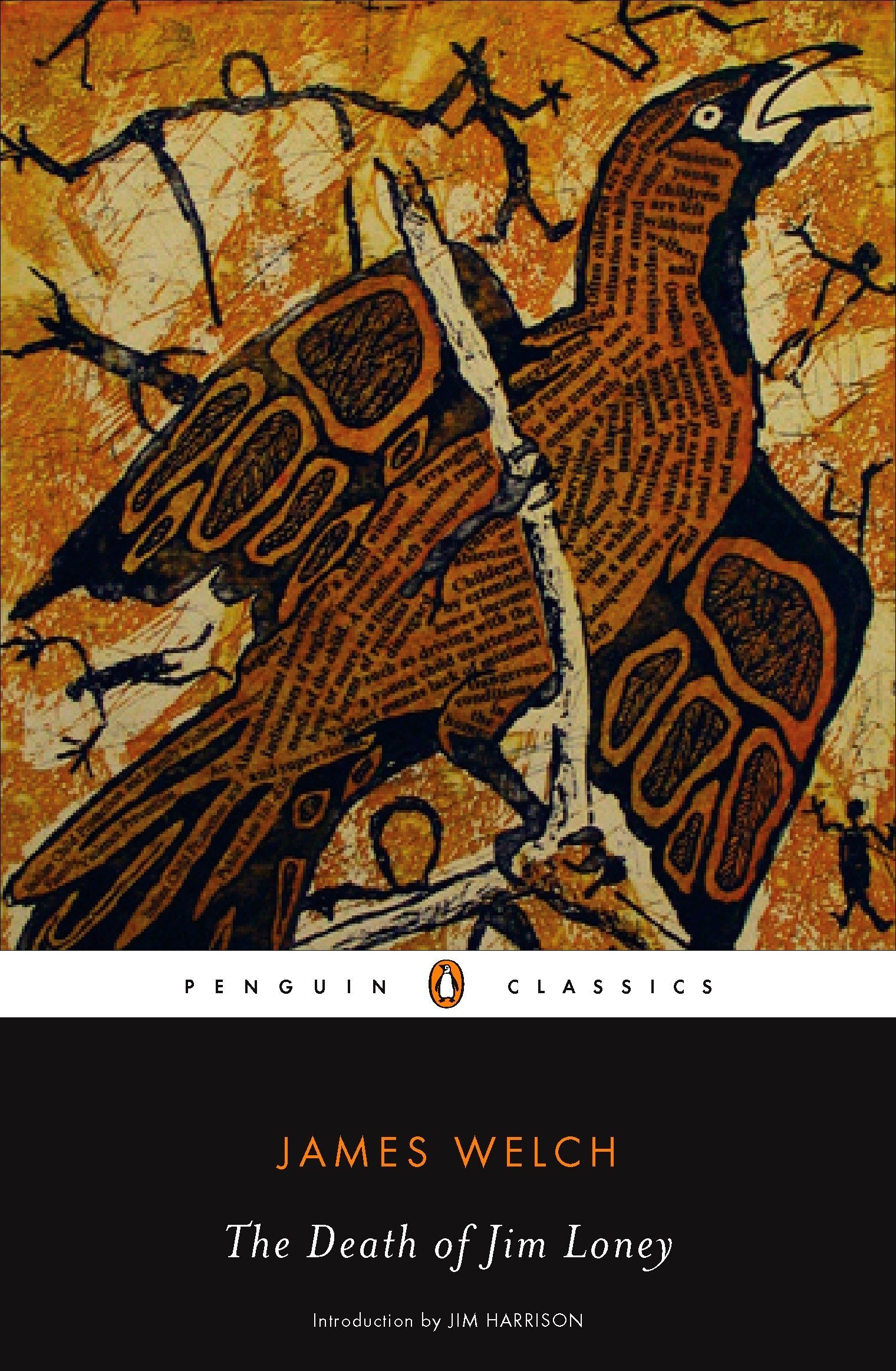
The Death of Jim Loney by James Welch

As he tried to strike another match to light a cigarette, he realized that his hands were trembling. He wanted to believe that they trembled because of the cold, but he knew without thinking it that they trembled because there was no real love in his life; that somehow, at some time, everything had gone dreadfully wrong, and although it had something to do with his family, it had everything to do with himself.

Jim Loney lives a quiet life at the edge of the Blackfoot reservation in Montana. Once a star high school basketball player, his life has shrunk down to almost nothingness. He feels detached from it, detached from himself; he feels, as the protagonist of Welch's Winter in the Blood does, "as distant from myself as a hawk from the moon." Materially, things are not so bad for him: he doesn't seem to be especially hard-up or poor, and is well-liked--his old teammate Myron Pretty Weasel is constantly trying to get him to go hunting--and he has a beautiful, intelligent girlfriend, a white Texan named Rhea. And yet these things seem unable to penetrate the solitude of his spirit.

In one sense, The Death of Jim Loney is a "half-breed" story like Solar Storms or Ceremony: about a half-white, half-Indian person trying to find their place in a divided world. Rhea believes that it must be sort of nice to have two sets of ancestors: "you can be Indian one day and white the next. Whichever suits you." But Loney feels just the opposite, unable to connect to either of his lineages, not the family of his alcoholic white father, nor his absent Indian mother and the "reservation families, all living under one roof, the old ones passing down the wisdom of their years, of their family's years, of their tribe's years, and the young ones soaking up their history, their places in history, with a wisdom that went beyond age." There is a parallel to this divided life in the way that Rhea and Loney's sister Kate, a successful bureaucrat in Washington, D.C., spend the middle of the book in a cold war over who will get to take Loney away from Montana. Rhea wants to move to Seattle, Kate to take him home to D.C.; and Loney is split between two coasts (two Washingtons) even.

But Loney is unmoved; he doesn't want to go to either place. He is already in the place he feels he needs to be to figure out the nature of his life and his self; he is home, and yet these things remain hidden to him. In a sense, The Death of Jim Loney is a rejection of the "half-breed" narrative, in which resolution and healing can be found in embracing one's indigenous side. In Winter in the Blood, the narrator returns to himself by returning home and helping to dig a horse out of the mud (think I'm remembering that right), but the people who need Loney are all headed elsewhere.  Being in Montana, that ancestral homeland, provides no answers:

He had been thinking of his life for a month. He had tried to think of all the little things that added up to a man sitting at a table drinking wine. But he couldn't connect the different parts of his life, or the various people who had entered it and left it. Sometimes he felt like an amnesiac searching for the one event, the one person or moment, that would bring everything back and he would see the order in his life. But without the amnesiac's clean slate, all the people and events were as hopelessly tangled as a bird's nest in his mind, and so for a month he had been sitting at his table, drinking wine, and saying to himself, "Okay, from the very moment I will start back--I will think of yesterday, last week, last year, until all my years are accounted for." But the days piled up faster than the years receded and he grew restless and despondent. But he would not concede that his life had added up to nothing more than the reality of a man sitting and drinking in a small house in the world.

I suspect there's something of a feint happening here, that The Death of Jim Loney suggests that these healing processes are not so easy. While both an earlier and a simpler book than Winter in the Blood, it seems almost like a response or refutation. We start to suspect that Loney has been sold, through cultural osmosis somewhere, a kind of lie, that knowledge of your past will make you whole. He searches for the name of the woman who took him in after his mother left and his father abandoned, but knowing it does nothing for him. He sees his father in the bar every day, but when they finally speak after decades, nothing is revealed. And in the process Loney passes up on not one but two opportunities to take control of his life and make it into something different. The result is not that Loney gets to know himself better but that he gets to know the world less, and the preordained "death" of the title--spoiler alert, a violent suicide-by-cop--is the result of a fundamental misunderstanding about his own deeds and their relationship to the law, to the world of others.

Saturday, August 14, 2021

The Dying Grass by William T. Vollmann

It must be here that the loneliness of the Indian country of which we have merely commenced to take possession, and at that so nominally that nothing but violence will save our claims from being laughed away, begins to march along with us, very quick and correct in its movements, although uncouth in the gaze and teeth it turns upon us, proposing to nibble us up before we notice, our desire consequently being to ride away from here , but now as long as we continue forward, everywhere we go will be again here in the dying golden grass of what is not yet America even though it will certainly become so, which is why we pursue Joseph as far as we must, our Springfields ready with a round in the chamber and our faces fixed as we seek earth stained by his sign, riding east now toward our dear United States, the general watching us without imparting anything but affable trivialities; we will carry Joseph to the gallows, and if that isn't good enough, we will kick him down to Hell.

The Nez Perce, like so many of the indigenous tribal nations of the 19th century in the land that is now the United States, were "good Indians" until they weren't. They cooperated with the U.S. government and the Army, they were friendly with settlers--even intermarrying with them--and signed a treaty agreeing to a large reservation in the land that now lies at the intersection of Washington, Idaho, and Oregon. But of course there isn't a single Indian treaty that the United States didn't break, and the thief treaty was the same: the Nez Perce saw their reservation chiseled away to a tiny fraction of what it had been. Many Christianized Nez Perce stuck to the reservation, took English names, and began the process of assimilation, but several bands totaling about 750 people decided to refuse the terms of the treaty, touching off a war of attrition that lasted from June to October of 1877. The Nez Perce led the Army on a strategic retreat through Idaho, Wyoming, and Montana, before finally being routed just a few miles south of the Canadian border.

William T. Vollmann's novel The Dying Grass tells the story of the Nez Perce War from beginning to end, from both the perspective of the Nez Perce, and the Department of the Columbia that pursued them. It is the longest of Vollmann's five written Seven Dreams novels about conflict between settlers and Native Americans--at 1200 pages it is almost certainly, by page count at least, the longest book I have ever read--but also the most stylistically adventurous. When a perspective shifts--perhaps from one character to another, or from what someone is saying to what they are really thinking, or just from the action to a description of its natural surroundings--Vollmann indents that section or set of lines. The result looks and often reads like poetry, but it also reminded me of the "stacks" of computer code (sorry Brent that's probably not right). The result is that The Dying Grass seems uniquely polyphonic, woven from hundreds of different voices. More than any of the other Seven Dreams books, The Dying Grass captures the sheer breadth of the conflict and its many actors.

On the white side, Vollmann's main character is the General Oliver Otis Howard, known by his detractors as "Uh Oh Howard" for his defeat at the Battle of Chancellorville. Many of Howard's soldiers also call him "General Prayer Book" because of his piousness, and rankle under his proscription of alcohol and his friendliness toward Indians and blacks. Howard's virtues are indeed very virtuous: his sincere concern for black Americans--something that could not be said for many other Union generals--led him to found Howard University and steer the Freedman's Bureau. His attitude toward the Nez Perce is similar: when he says he had counted them friends and is aggrieved by their rebellion, we believe him, but he is blind to the limits of his own paternalism. He wants for the Nez Perce what he wanted for the Negroes--a little bit of land and assimilation into the social order of the United States--but cannot see how such largesse entails the destruction of the nation's cultural history and way of life. 

Only one of the soldiers, Howard's aide-de-camp Erskine Wood, slowly comes to believe that the Army's pursuit of the Nez Perce is a moral outrage; Vollmann's depiction of him is second only to Howard in its richness and sensitivity. And yet even Wood's protest remains in his heart only; his creeping doubt does not spur him to reject his Army commission or aid the Nez Perce (though we find, in a true and fascinating fact, that later in life Wood sent his son to learn "how to be an Indian" from the captured Nez Perce Chief Joseph). Wood's foil might be Ad Chapman, the volunteer interpreter who knows how to speak Nimipuutimt from his marriage to a Nez Perce woman. Crude, mercenary, and untrustworthy, it might be said that the whole war is Chapman's fault because he fires first on the Nez Perce, and yet his position between two worlds makes him indispensable. In a touch that is both meaningful and historically true, it's Wood and Chapman, dissident and bigot, who pen the famous translation of Chief Joseph's surrender speech: "From where the sun now stands I will fight no more forever."

Howard's counterpart on the Nez Perce side is Chief Joseph himself, called by his true name, Heinmot Tooyalakekt. The Nez Perce's strategic retreat bestows upon Joseph the title of the Red Napoleon, but this relies on a grave misunderstanding: Joseph is the chief of his own small band of Nez Perce, but he's never made war chief, a role given to Looking-Glass (named for the shard of mirror he keeps around his neck) or Lean Elk. Jane Smiley's review of The Dying Grass suggests that Vollmann is so sympathetic to the Nez Perce that it verges on "noble savage" ideology, but not only is this a poor moral judgment--a kind of bothsidesism projected onto the past--I'm not sure how she could have read about the great disagreements between the restrained Joseph and the more militant members of the Nez Perce party, like the "Three Red Blankets" or the bloodthirsty Toohoolhoolsote, and came away with that conclusion. One thing Vollmann, who wrote an 800-page treatise on the nature of violence, does well is to show the way violence cycles out of control, no less among the Nez Perce than the Army: their rebellion against the "Bostons" becomes all too easily an excuse to raid and murder uninvolved white settlers.

For his part, Joseph always advocates for surrender and peace, though his stature is not such that he's often heeded. But among the many disputing chiefs Joseph emerges as the most virtuous because he unerringly thinks of the welfare of his people, and women and children especially, before abstract concerns like honor. The Dying Grass suggests that the American press might have it right when they imagine Joseph to be supreme among the Nez Perce:

now his heart begins too late to understand

--although many other best men dispute this, preferring White Bird, who planned our victory a Sparse-Snowed Place and led us across the Medicine Line--

that our greatest chief was Heinmot Tooyalakekt,
he who never had hope,

desiring only to help our women, children, and old ones:

Yet The Dying Grass echoes an idea that first came to me by way of Dee Brown's history of the Indian Wars, Bury Me at Wounded Knee: in the end, the various responses to removal mattered very little. The Bannocks and Cheyennes who help the "Bluecoats" stomp out the Nez Perce will find themselves at the barrel of their guns within a year, and even the disputation between the various Nez Perce chiefs seems, in the end, meaningless: "The prudent and trusting submission of Looking-Glass," Volmann writes, "the violent resistance of the Three Red Blankets, the flight of White Bird and the restraint of Chief Joseph all produced the same result. So did General Howard's kindheartedness and General Sherman's pitiless fury." It is interesting to think of Howard and Sherman--and Wood and Chapman, perhaps--in the same boat, one which rises on the tide of history but which can barely be guided or steered. Did the rush of settlement in the latter half of the 19th century mean that the cruelty of the Indian Wars and the reservation system were foregone conclusions? In Fathers and Crows, Vollmann wrote of the Jesuit conversion of the Haudenosaunee, "If it had to be done, it could have been done differently." Is that true here, too? Or is Howard right when he tells Wood that there's no other way?

Either way, The Dying Grass is a tremendous panorama of those caught in the rush of history. Beyond Howard, Wood, Chapman, Joseph, Looking-Glass, and Toohoolhoolsote there are dozens and dozens of individual characters whose interior lives are thoughtfully imagined and evoked by the unusual structural choices of the novel. It's a novel as big and breathtaking as the mixed-grass prairie, or the mountain valley, or the camas meadows over which that history moves.

Tuesday, January 5, 2021

Winter in the Blood by James Welch

I had had enough of Havre, enough of town, of walking home, hung over, beaten up, or both. I had had enough of the people, the bartenders, the bars, the cars, the hotels, but mostly, I had had enough of myself. I wanted to lose myself, to ditch these clothes, to outrun the burning sun, to stand beneath the clouds and have my shadow erased, myself along with it.

The unnamed narrator of James Welch's Winter in the Blood returns home to his mother's house on the Ft. Belknap Reservation in Montana with a hangover and a bum knee. His girl has left him, running off with his gun and his electric razor. His mother is set to marry a man who covets her land more than he does her, and she may be a little too close to a white priest who refuses to set foot on the reservation. He barely knows or understands his aging grandmother, referred to mostly as "the old lady," and who was once the teenage bride of a renowned Blackfoot chief. In this inhospitable environment there is, unsurprisingly, no rest, no solace, and he cruises back out into the street again. He zips between small towns like Malta and Havre, looking for his girl, his gun, and his razor, drinking too much and slipping into bed with strange women.

More than anything, the middle of Winter in the Blood reminded me of the kind of drugged-out spacemen you find in the books of Denis Johnson. The narrator's wanderings are episodic, peripatetic; he does things without giving a reason, or without having one. In a barroom a man offers to give him a car if he'll drive him to Calgary, where he can elude the police; they plan it as they play the bar's punchboard game, winning box after box of chocolate-covered cherries. Welch skirts close to stereotypes about Native Americans and alcohol, but like any good novelist, imbues his narrator with a specificity and detail that brings the link between alcohol abuse and trauma--both personal and historical--to life. "They were the same faces I had memorized so many years before," the narrator says of the wanted posters at the Havre post office. "Only the names were different."

The secret to Winter in the Blood is that the scattered nature of the narrator's boozing and bar-hopping conceals a more conventionally causal story, running through it like an underground stream. The clue is in the title: although the novel itself takes place during a stiflingly hot summer, the narrator cannot shake the memory of a fatal wintertime accident--involving a horse and a car--that took his brother's life. His grandmother, too, the "old lady" has "winter in the blood"--she carries with her the experience of being blamed, after her husband's death, for the wintertime starvation of her people, the Gros Ventre. This story goes untold until the narrator hears it from the blind hermit Yellow Calf, who turns out to know more--and be more entangled--with the narrator's family history than he knew. In this you get glimpses for the first time of the mythic-historical epic that Welch would later write in Fools Crow, which seems otherwise like a very different book.

I didn't realize it while reading, but looking back, I see that Winter in the Blood is, at least in some part, about the narrator's need to reconcile himself with the women in his life. His relationships with them are largely rotten: he's ambivalent at best toward the girl he claims to be searching for, and the sexual dalliances he gets into during his bar-hopping are pathetic, even violent. He claims to have "no particular feelings" toward his mother or grandmother, and he identifies that disinterest as a distance with himself: "But the distance I felt came not from country or people; it came from within me. I was as distant from myself as a hawk from the moon."

Yellow Calf's story points the way forward, but still his grandmother dies before he can talk with her about her experience. The novel ends, not with a final engagement between grandmother and grandson, but with the narrator rescuing a wayward cow from drowning in the mud. There's something there about the feminine principle, about women as the physical links to history and lineage--the cow's calf looks on, panicked--but the symbolism seems slippery, partial, troubling. It seems not enough, and perhaps that's why it's so perfect for such a slippery and troubling book.

Saturday, April 4, 2020

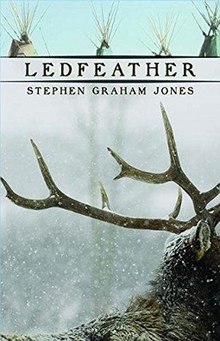
Ledfeather by Stephen Graham Jones

The only fitting sentence for his crimes would be to live as they did, as they had.  As an Indian.

It was why the girl he'd kissed up against the wall had black hair instead of blonde, and those perfect, heavier-than-the-world fingertips.

It was why he'd been remembering another's life.

It was his punishment, to become Blackfeet, to be Piegan.  To live on the reservation he'd created, the situation he was already leaving behind.  To replace his own life with an Indian one, and thus know firsthand the end result of his policies.  An end result generations away from last Winter, just so he could see the scope of what he'd done, that it still had a traceable effect.  So that, in a sense, he could be inflicting it upon himself.

Doby Saxon is a teenager living on the Blackfeet reservation that abuts Glacier National Park in Montana.  Doby is a down-and-out kid in a down-and-out place: he's missing three fingers from the time he and his father tried to poach elk from the park, and his father fell from his snowmobile and died.  He has a run of untold luck at a casino, then loses it all, and causes a violent scene that ends up putting his mother in jail.  He fails to save his friend from overdosing in a concrete tipi; he tries to kill himself in a hundred unsuccessful ways.

But Doby is also extraordinary: he discovers a cache of letters from a white Indian agent that lived on the reservation a century ago, and then begins to see the agent in visions.  Doby is torn between these two realities, and we come to learn that Doby might be the Indian agent himself, reborn as a Blackfeet Indian through a curse that condemns him to live as those he had a part in starving.

There's much to admire about Ledfeather.  It's a novel with one very good idea at its heart, but it's also a novel of terrific detail and writerly skill.  Unlike Moon of the Crusted Snow, which I bring up only because it seems to fit in the box of indigenous science fiction, though the context and community is much different, Ledfeather seems to understand that community life thrives in specifics.  Ledfeather, among other things, is a lovingly rendered version of what is often a difficult life on the Blackfeet reservation: it gives life to casinos, game wardens, schools, hospitals, chintzy little museums, basketball courts.

But I also have to admit that I found the whole thing extremely hard to follow.  Jones' novel has, if I'm counting correctly, at least four different narrative modes: 1.) first-person narratives by various people on the reservation about Doby, which ask us to piece together an understanding of him (these sections often refuse to identify clearly who the narrator is, in a way that seems self-consciously literary) 2.) the unsent letters of the Indian agent Francis Dalimpere to his wife Claire 3.) third-person accounts of the Indian agent flashing "forward" in time, 4.) second-person (!) accounts of Doby's life.  I could have managed maybe two of those, but not three, and certainly not four.  Ledfeather's not a long novel, but it just has one too many tricks up its sleeve, and I felt like some streamlining might have made it more readable.

As a result, I felt like the novel's many good ideas didn't land with enough emotional power for me.  And they are very good: I liked especially the novel's motif of self-sacrifice, which comes in both noble and misbegotten stripes.  One of the subplots of the modern narrative is that the local school's star basketball player has a terrible kidney disease, and young people from all over the reservation rush to commit suicide in order to give him their kidneys.  There's kind of grim, very grim, humor that works because it sits aside other kinds of sacrifice: the Indian agent's, for example, who first kills a herd of U.S.-owned cattle for the starving Blackfeet, knowing that he'll be put in prison, and then later "sacrifices" himself by becoming Doby Saxon.  Or Doby's mother, who goes to jail protecting her son in that casino fiasco.  These stories of self-sacrifice are linked by the image of the elk that Doby and his father go hunting:

The story, too, it was a joke mostly, like all of Earl's stories, was that one time an elk had found a white man lost and dying in the storm, and they'd talked to each other, and finally the elk, because it knew the man needed to live, to be warm, it took pity and laid on its side and let the man cut it open and crawl inside, and stay warm like that even though the snow piled up all around them for days and days and even years, only when the man finally crawled out again, everything was different, because that elk you crawl into, it's not the same one you crawl back out of, right?

In the end, Ledfeather is a hopeful kind of book, one that shows that nobility and selflessness are alive on the reservation, and that even has hope for white people, like Dalimpere, who think to make amends.  So much so that you might forgive it for asking a little too much of its readers.

Monday, February 11, 2019

Fools Crow by James Welch

"Where are the seizers now?"  Fools Crow's voice was sharp.  Anger welled up within him, an aner that was directed at the futility of attempting to make the seizers pay.  He had always thought that the Pikunis would fight these hairy-faces.  He had prepared himself for this fight, he was ready to die a good death to defend this country.  Now he knew that his father had been right all along--the Pikunis were no match for the seizers and their weapons.  That the camps were laid low with the white-scabs disease did not even matter.  The disease, this massacre--Sun Chief favored the Napikwans.  The Pikunis would never possess the power to make them cry.

I've been trying to read more Native American literature.  I'm thinking about teaching a class on contemporary Native writers next year, if I can figure out how to do it with sufficient humility and respect.  Again and again, the news seems to serve as a chorus to my reading: the Dakota Pipeline fight, the derecognition of the Wampanoag, and now the President's crude "Trail of Tears" joke about Elizabeth Warren.  For Donald Trump, the genocide of hundreds of thousands is dumb joke material, as fundamentally unserious as, say, the life of Pocahontas.  Meanwhile, I was reading James Welch's novel Fools Crow, a book about what genocide looks like from the ground.  It's a reminder that the atrocity of the Trail of Tears is only part of the larger story of American genocide against Native Americans, a story that continued after the civil war with westward expansion.  Fools Crow tells the story of the Pikuni Blackfeet of Montana, who were decimated by white expansion and smallpox, culminating in the massacre of a non-hostile community at the Marias River in 1870.

Fools Crow is the story of White Man's Dog, a Blackfoot brave of the Lone Eaters band.  When the novel begins the white settlers, called Napikwans or "seizers," are more rumor than anything else, and we are given a glimpse into the traditional life of the Blackfeet before their decimation.  They survive by hunting buffalo, here called "blackhorns" (as distinguished from "whitehorn" cattle, imported by Napikwans), but they aren't exactly the peaceful close-to-the-earth people that Native American fetishists imagine: the Pikunis are horse-takers, and the first third of the book is taken up by the thrilling account of a horse-stealing raid against the enemy Crow people.  In that raid, one of the leading chiefs, Yellow Kidney, is taken prisoner and his fingers cut off, an act that brings cascading repercussions to the Lone Eaters.  White Man's Dog gets his new name--Fools Crow--during the raid that is revenge for Yellow Kidney's dismembering, when he kills a Crow after seeming to be dead.  Welch brings the same kind of ambiguity and nuance to the Lone Eaters' violent excursions that we might expect from a modern war narrative:

Fools Crow.  The naming ceremony.  Three Bears had named him Fools Crow after hearing how he had tricked Bull Shield into thinking he was dead and then risen up to kill the Crow chief.  But was that how it was?  The story of how he had earned that name had been greatly exaggerated, despite his initial protests, until many thought he had tricked the whole Crow village, that his medicine contained some magic that made another man's eyes see wrong.  The story of how Fools Crow had killed and scalped the man who had mutilated Yellow Kidney was even more embellished.  Now Fools Crow had made the man cry, had laughed and spit on him, had made love to his wife, then killed him and stuffed his bloody genitals in his mouth.  The men of the warrior societies laughed and kidded Fools Crow, but in their eyes he had become a man of much medicine.

The conflict with the Crow--and the careful identity-making among the Blackfeet that is predicated on that conflict--is quickly supplanted by conflict with the Napikwans.  A rogue band of Pikunis led by Owl Child (a historical figure) and Fools Crow's old friend Fast Horse leads violent raids against the white settlers.  Reading Fools Crow is like reading a fictionalized version of Dee Brown's Bury My Heart at Wounded Knee.  We know that debate will rage among the Pikunis, deliberating between war and appeasement, and that in the end these arguments won't matter one bit: the U.S. Army will attack innocent Pikunis for what Owl Child has done, and ultimately, that's exactly how the massacre occurs.

Fools Crow reads, in some respects, like a fantasy epic: Fools Crow is the young underdog destined to lead his people, the Napikwans are the forces of Sauron.  But we know that there's no possible way that the story can end with victory for Fools Crow and the Pikunis, and that makes the novel a deflated, ragged affair.  It never recaptures the thrilling nature of the Crow raid at the beginning; no real showdown with the Napikwans ever comes (the massacre occurs "off-stage"); in the end, it's the slow massacre of smallpox that does Fools Crow's people in.

Instead, Fools Crow asks, how does a man lead his people through defeat?  Like Erdrich and Silko, Welch treats the myths and traditions of the communities he writes about with literal seriousness; toward the end of the novel, Fools Crow is compelled by a dream to travel to the house of Feather Woman, a mythological figure who shows him a vision of the future.  It's bleak.  Fools Crow sees the massacre, the smallpox, and the ultimate assimilation of his people through boarding school regimes.  But Fools Crow also sees that he and his ancestors will survive, and that there is a victory of sorts in remembering, and in that way the vision becomes Fools Crow's argument for itself: that as long as the story of the Blackfeet is told, then the victory of white Napikwan society can never be entirely complete.  It's small comfort, but it's what's available.  And while it's a different story, a different massacre that the President thinks is funny, Fools Crow is a reminder that it's important to remember what actually happened and just how horrible it was.