Showing posts with label Native American. Show all posts

Saturday, January 24, 2026

The Names by N. Scott Momaday

The events of one's life take place, take place. How often have I used this expression, and how often have I stopped to think what it means? Events do take place; they have meaning in relation to the things around them. And a part of my life happened to take place at Jemez. I existed within that landscape, and then my existence was indivisible with it. I placed my shadow there in the hills, my voice in the wind that ran there, in those old mornings and afternoons and evenings. It may be that the old people there watch for me in the streets; it may be so.

When I visited Walatowa, the main settlement at the Jemez Pueblo in northern New Mexico, a couple summers ago, I told the guide at the visitor center that I was interested in the life of author N. Scott Momaday, who had grown up at Jemez. He took me into their small museum and showed me a huge photograph of Momaday's mother, Netachee, who had come with Momaday's father to teach at the Jemez Day School. A similar photograph, or perhaps even the same one, is printed in Momaday's memoir The Names, an illustration of the community that adopted Momaday and his family, inviting him into the place about which he writes, "My spirit was quiet there." As in House Made of Dawn, Momaday writes so beautifully about the landscape of Jemez, and it's clearer here than ever that it's a loving eye that produces such descriptions. It's the voice of a man writing about his home.

The Names begins with accounts of Momaday's ancestors, including his namesake Mammedaty, and Pohd-lohk, who gave Momaday his "Indian name," Tsoai-talee, which is derived from the name of Bear Lodge, or Devils Tower, in Wyoming. On his mother's side, Momaday describes a heritage that is part Cherokee but mostly white Kentuckians. His father's side is Kiowa, and here as in The Way to Rainy Mountain, Momaday writes with affection about his Kiowa family in Oklahoma. These places and heritages combine to make Momaday who he is, but not all equally; you can see that Momaday writes with respect and reverence for the Kiowa of Oklahoma, and with a mystic detachment about Bear Lodge, but much more ardently about Jemez. Between these there is a sojourn to Gallup, the colorful, largely Native city of western New Mexico, and Hobbs on the state's northeastern side, where Momaday's account of his life might be difficult to distinguish from any of the other children, whose big themes are school and sports, bullying and being bullied. This section contains a long section of stream-of-consciousness that captures the point-of-view of young Momaday, and is some of the memoir's most experimental and unusual writing.

What struck me when the novel turns to Jemez was the feeling that Momaday has of being an outsider. The hero of House Made of Dawn (and I did read much of The Names through the lens of this novel) is a native of Jemez, made an outsider by his alcoholism and the alienating experiences of war, but the novel is also interested in true outsiders, like the white woman Angela and the priest, Father Olguin. Here, as in the novel, Momaday writes of the Pecos Pueblo people who were given refuge at Jemez when their pueblo was destroyed. But only here in the memoir did I understand how much Momaday identifies with those people: refugees. The Names illuminates other parts of the novel, too. Here, for example, is an old and admired man named Francisco, who no doubt has become the Francisco of the book, and here is an account of the strange ritual where men try to pluck a buried chicken from the ground on horseback. Momaday describes it here as an ancient tradition that has degenerated, becoming a game for boorish young men; this really recontextualizes the scene in House where Abel kills the man who has embarrassed him at it.

More than anything, I thought The Names was beautiful. Momaday has a way of writing that feels utterly sincere. I guess it's not true that there's no room for irony here--Momaday's account of growing up in Hobbs makes great use of a child's narrow and self-involved worldview--but when Momaday grows up, or when he talks about Jemez, or the land, there's none of that, no detachment. I think of it as the prose of a writer who is deeply engaged with the world, and who speaks only when he has something to say. He really was remarkable.

Thursday, January 15, 2026

Two Novels by Brandon Hobson

How do you lose a child to gun violence and expect to return to a normal way of life? This was the question I struggled with the most. My son was a victim. The officer who shot him--now retired--lived in our town, and there were many sleepless nights when I wanted to drive to his house and kill him myself. I wanted to hit him as hard as I could, so that he could feel pain. Yes, yes, I have always known grief is difficult and that forgiveness takes many years. I still haven't learned to completely forgive. I could only put it in the will of the Great Spirit.

I have reread Brandon Hobson's excellent novel, The Removed, so that I might teach it in the spring. I think--or hope--that it will hit the sweet spot for students: a book that is challenging in ideas, sometimes in prose, but mostly is made up of a kind of plain but sophisticated everyday language. It resonates, too, with topics that are on the mind of students today, like police violence, which it places in the context of the larger history of Indian Removal and dispossession. The story centers on the Echota family, whose son Ray-Ray was shot a decade prior by a cop. They take in a young foster boy, Wyatt, whose eerie similarity to Ray-Ray seems to reverse father Ernest's creeping Alzheimer's. Another son, Edgar, is lost in a fantastical "Darkening Land" of addiction and suicide, and where a sinister friend threatens to turn him into the bounty for an Indian-hunting game. What will students make, I wonder, of the book's mixture of realism and fantasy, and its refusal to cohere into something logical and explainable?

One thing I had a greater appreciation of this time around is the way that Hobson weaves the various timelines and narratives together. There are four third person narrators--mother Maria, sister Sonja, Edgar, and the legendary Cherokee rebel Tsala--and the story of each is punctured with visions and epiphanies in which the others seem to break through. This complicates, for example, the story of Wyatt, whom we are otherwise willing to believe is only strangely similar to the dead Ray-Ray. But when Wyatt's stories prove to have a kind of oracular insight, it becomes clear that we must take seriously the belief that Wyatt is Ray-Ray resurrected. I can already hear the students now--Well, is he?--but the answer, of course, is that he is and he isn't, that Hobson gives us a kind of Schrodinger's cat whose waveform threatens to collapse if you look too closely. This matters because the novel wants to give us models of resurrection and return that are larger than the realm of the materially possible. What "the removed" search for is not a literal return to Cherokee homelands--not in this book anyway--but some other kind of restitution or redemption that is not one-for-one. The last image of the book, with the family gathered for a memorial bonfire, watching a mysterious figure approach, underlines this nicely: is it Edgar? Wyatt? Tsala? Or somehow Ray-Ray himself? Yes, Hobson suggests, yes, yes, and yes.


The instances when Milton would wake in the middle of the night feeling like he was suffering in a bed of putrefaction, his dreams digested and visible as the glow of the school in flames, he could smell the sour gunpowder and dead bodies lying in pools of blood, their foreheads marked with the number of the beast while the rest of the students cried out in a panic, yet all he could hear were the voices of the dead buried in the land all around, rising out of their graves and asking him for an account of his decision to shoot and kill, and for the remainder of the night his sleep was restless and uneasy, full of their shrieking voices and hollow moans, because he worried about bearing the weight of all that guilt. In his notebook for English class, Milton had written down the following quote from Shakespeare: "Suspicion always haunts the guilty mind."

Hobson's new novel, The Devil is a Southpaw, opens with a note that the author has received a manuscript in the mail from a former classmate, or cellmate, having both been institutionalized in a juvenile detention facility long ago. The manuscript, which makes up the bulk of the book itself--very 19th century--is a novel with the same name by Milton Muleborn, and it draws on those experiences at the facility, which it describes as a kind of phantasmagoria of demons, witches, and sinister captors. Much of the novel focuses on Matthew Echota (the same last name as the characters of The Removed), a fellow student-inmate who, we're told, is the most intelligent and talented of them all, a gift for which he is sometimes praised by the prison guards, and sometimes isolated and brutally tortured. We intuit quickly that the author, Milton, is and has always been deeply jealous of Matthew, who it seems not only has a kind of artistic genius that Milton lacks or feels himself to lack, but who also had been dating his ex-girlfriend. Milton's jealousy and enmity toward Matthew is of the kind that only very similar people can share--both are sensitive, artistic, writerly souls trapped inside the harshness of the juvenile detention center--to the extent that part of me wondered if the two wouldn't prove to be the same person in the end.

Milton's detention center is a strange and frightening place, where a mysterious woman paints skulls at night and a freakish Dr. Strangelove type rules with an iron fist. Its cruelty verges on the fantastical, and the swamp that surrounds it seems to be filled with creatures and spirits. Parts of it, of course, are recognizable, drawn no doubt from the same experiences supporting troubled youth that inform The Removed and Where the Dead Sit Talking: the rancid food and forced isolation, the stultifying effects of institutionalization of childhood creativity. But in Milton's telling, these aspects become heightened into pure dreamland horror: the novel moves toward a shared escape, in which Matthew and Milton move through a literal underworld where they encounter, among other things, the spirit of Salvador Dali to guide them.

To me, the most interesting thing about The Devil is a Southpaw is the prose. I wonder how people will take Milton's Grand Guignol-isms, his general wordiness and clumsiness. To me, I thought this was all very recognizable. Though Milton is supposed to have written this novel as an adult, I recognized in it something I see often: the language of a talented and creative teenager who has limited control over his style and vocabulary. It's not supposed to be "bad," per se, but the language here is meant, perhaps, to show the fine degree of difference that separates the genius and talent of Matthew--who, as we learn, grows up to be an acclaimed but trouble painter--and the mere creativity of someone like Milton.

I can tell you that reading the prose of teenagers reorders your brain, and after a while you must take a break from it to regain clarity; I felt the same thing while reading The Devil is a Southpaw. It's a bold move, to write a book in prose that is ostensibly flawed in the same ways as its narrator. To me, the voice works as a reflection of Milton. What it means in the end for the novel as a whole is another matter--though Hobson make some gestures at other voices--a second half written by Milton in a more sober, reflective mode, and an interview with the adult Echota--but I walked away thinking that it all remained too claustrophobic in the end. There's really no getting around or outside of it--and maybe that's the point.

Wednesday, August 13, 2025

Books and Islands in Ojibwe Country by Louise Erdrich

My travels have become so focused on books and islands that the two have merged for me. Books, islands. Islands, books. Lake of the Woods in Ontario and Minnesota has 14,000 islands. Some of them are painted islands, teh rocks bearing signs ranging from a few hundred to more than a thousand years old. So these islands, which I'm longing to read, are books in themselves. Then there is a special island on Rainy Lake that is home to thousands of rare books ranging from crumbling copies of Erasmus in the French and Heloise's letters to Abelard dated MDCCXXIII, to first editions of Mark Twain (signed) to a magnificent collection of ethnographic works on the Ojibwe that might explain the book-islands of Lake of the Woods.

Books and Islands in Ojibwe Country begins with author Louise Erdrich piling into a blue minivan with her newborn daughter, Kiizhik. This is an unconventional trip, and at 46 years of age, she's an unconventional mother. The destination is the lake country of northern Minnesota and southern Ontario, Lake of the Woods and Rainy Lake, vast freshwater lakes that are dotted with islands, a place that is still home to the Ojibwe. Erdrich herself is a "plains" Ojibwe, from the eastern stretches of North Dakota, and so the place still retains some of its strangeness, but there's home here, too, not least because she is meeting the mysterious father of her infant, a medicine man named Tobasonakwut. (One reads between the lines to see that the pair are not quite a conventional couple; elsewhere I've read that he was a married man.) In these islands she sees something akin to the books that are her lifelong passion: numerous, inviting, mysterious, and even, in some cases as she explains above, legible.

What a precious object this book is for me. I picked it up at Erdrich's own Minneapolis bookstore, Birchbark Books, after a week of exploring the Ojibwe lands around Lake Superior. We never quite got up to where Erdrich describes in this book, but we did end up a stone's throw from Rainy Lake, at Lake Kabetogama, also now a part of Voyageurs National Park. But I recognized something, just a little, of the awe that suffuses that place, where the islands really do fan out and multiply in an impossible way. The book is just a book, it isn't even signed, but it lies at the crossroads of my own experiences and that of an author who has meant a lot to me. Maybe there's even a small touch of the numinous in the way of Erdrich's visit to the cabin of explorer and naturalist Ernest Oberholtzer, where she sleeps among his vast library, making herself known to his immense store of books.

Beyond that, I was really touched by this book. I've only read Erdrich's fiction, which can be fanciful and goofy, but reading her in this mode, a mix of memoir, naturalism, and travelogue, was really fascinating. She's always had a way of persuasively writing about the way that myth and magic appear in everyday life, and she manages to make the ancient stone glyphs of the Lake of the Woods seem as mysterious and meaningful as anything from Tracks or Bingo Palace. And I was struck by the gentle, strange relationship between herself and Tobasonakwut, as well as the late-coming child, who seems to have a natural attraction for the lake's animals: sturgeon, otters, moose. Even the principle metaphor of the book, which ought to be silly--a book is like an island--seems natural and persuasive in Erdrich's hands. I really enjoyed seeing this other side of a great writer.

Sunday, August 10, 2025

Laughing Whitefish by Robert Traver

It was one of those glorious Northern evenings I was learning to love, the tall reddish sky shot and aflame with great soaring rays and reflections from the dying sun. The Creation must have been something like this, I thought. As my rented horse plodded along the dusty ore-stained road I reflected about this elusive thing called success and material attainment. Who was ever to say with confidence that the Marjis of this world were failures? By and by I found myself thinking about the complex new legal situation in which I suddenly found myself--my first big case--thinking about it and all of its ramifications, thinking, too, about my new client, the withdrawn and aloof but strangely exciting young Indian woman, Laughing Whitefish.

Robert Traver was the pen name of John Voelker, a distinguished judge from the Upper Peninsula of Michigan who parlayed his work into a career of popular early legal fiction, including the novel Anatomy of a Murder, later turned into a film by Otto Preminger. Laughing Whitefish, like Anatomy of a Murder, is based on a real legal case that occurred in the Upper Peninsula, though in this case, in the late 19th century: an Ojibwe woman named Charlotte Kobogum sued a mining company for the shares owed to her father, Marji Kobogum, promised to him for showing the mining company the location of a vein of ore. Charlotte's claim hinged on whether or not she could be proved to be her father's legal heir: she was born of his second polygamous wife and raised, after that wife's death, by a third.

To this story, Traver adds a green young defense attorney, William Poe, who has the case fall in his lap after another attorney comes to him wishing to wash his hands of the case. Poe is eager to help the young woman, whose Ojibwe name (in the novel--I don't think in real life, but I could be wrong) is Laughing Whitefish, also the name of a river near Marquette. Poe's eagerness becomes mixed up with an increasing affection for Laughing Whitefish, who returns his affections by the novel's end--a progressive-enough marriage for the civilized outpost of Marquette in the late 19th century, and maybe even in the mid-century when Traver wrote the novel.

Laughing Whitefish is breezy, readable, and largely artless. It suffers from being, in a way, ahead of its time: at the time it was written, we were not yet awash in legal dramas, and the courtroom scenes feel stagey and quaint. Similarly, the legal genius of Poe's ultimate strategy suffers from being entirely obvious with the aid of modern hindsight. Seeing that the opposing counsel tries again and again to settle, he senses that there is something that he's missed about the case that makes it winnable. That turns out to be the supremacy of U.S. treaty law: the American treaty with the Ojibwe, which promises recognition of all traditional Ojibwe relationships, ratifies Laughing Whitefish's claim to be her father's rightful heir. That Poe has to "discover" this bedrock fact of Indian law suggests, perhaps, that this jurisprudence was not quite obvious to everyone in the late 19th or even the early 20th century; after all, the United States has always had a way of forgetting stipulations in its supposedly "supreme" treaties when convenient. Still, Laughing Whitefish is interesting in the way it captures a moment in the changing legal landscape of the frontier, and it's hard not to see the symbolism in the generational shift from the drunk, dissolute Marji to his civilized, shrewd daughter, Laughing Whitefish--Charlotte.

Thursday, January 30, 2025

Native New Yorkers: The Legacy of the Algonquin People of New York by Evan T. Pritchard

I think that if the Munsee and the other nations of New York are all honored once again and given their proper place in U.S. history, it will be a good sign that, in the words of the old Munsee blessing, "The sun will shine on our wigwams, and our moccasins will not get wet." We will then begin the great healing of all our people that must take place--the red, white, yellow, and black nations coming together as four parts of the hoop of life. Only then can the earth be healed. As the Cree say, "Animals don't have problems, we do!" It's our healing that will ensure a more bountiful earth and a better place for children to grow up. And that's something we can all do for each other.

At one point in Mi'kmaq author Evan T. Pritchard's Native New Yorkers, he tells the reader that the Algonquin people who call New York their homeland trust in visions, in which respected family members or guides often appear. He then tells us about one such vision of his own, walking around Manhattan. It's a clear sign that, while scrupulously and doggedly researched, Native New York is not quite like other books you might have read about Indigenous history. It is, among other things, a book that takes seriously the power of life as it was lived among the Munsee Lenape, and takes seriously the idea that it might provide a kind of schema for us to live by in the future. A good antidote, actually, to the stale land acknowledgements who present Indigenous presence as something long gone and never to return.

Mostly, Native New Yorkers is what its title promises: a compendium of Indigenous history and geography in New York State. Pritchard takes us through a tour of nearly all of New York State, from the city to the Hudson Valley to the Capital Region to Long Island--western New York is conspicuously left out--describing the names and locations of tribes, villages, and pathways. I was interested to learn that Manahatta, the island we now know as Manhattan, was not really a densely populated place, thanks to its rockiness, but instead often served as a kind of meeting place for the various tribes of the area. I was impressed by the level of detail here. A different book might have tried to pick and choose a few places to illustrate larger themes, and while that might have been (sorry to say) a slightly more readable book, there's something awe-inspiring, and informative, about seeing every single Lenape, Mohican, or Haudenosanuee village mapped out. It's impossible to read Native New Yorkers and come away thinking that Dutch colonists sailed into a "fresh, green breast" empty of people.

In between the geography, Pritchard fills in the gaps with chapters on history and culture. I really enjoyed his attempts to capture the shape of what life might have been like among the pre-colonial Lenape, and the section on "Lenape exodus" really cleared up for me a lingering question about how the Lenape got from New York to their reservations in Oklahoma and Wisconsin. (Much of the story, which I did not know, involved a gradual migration to Pennsylvania and then further into the Ohio River Valley, where they were absorbed by the Shawnee of the great rebel Tecumseh.) And although I wasn't always persuaded by the parallels that Pritchard tries to draw between history and the present--like when he insists that the chess tables of Washington Square Park are somehow a continuation of the "outdoor gaming contests" of the Lenape--they often made me laugh, and think a little more deeply about the fundamental humanity of those who once stood where I am standing.

Saturday, January 25, 2025

Two Books about Cherokee Removal

Our grandfathers followed a stick to northern Georgia. It was an old migration. The Great Spirit led us here. How can the soldiers drive us from our land? Maybe it was because we worshiped the Earth instead of God, Reverend Mackenzie preached. Maybe it was because some of us had black slaves, Reverend Bushyhead said. Maybe it was because of gold and our cornfields, the men said.

Maybe the Great Spirit just calls us to the beyond where he lives. Maybe he's going to show us another world.

But who wants another world?

The Trail of Tears looms large in our memory as one of the country's greatest moral crimes: thousands upon thousands of Native Americans, uprooted from their homes in the Southeast, and forced to march for months to what is now Oklahoma. And yet, I think Diane Glancy's novel Pushing the Bear is the first time I've seen anyone try to show, in art, what the trail was like for those who underwent it, how they suffered to leave their homes behind, how they became sick and weak and died, how they had to hurriedly bury their own before being rushed off to the next unfamiliar place. Glancy's novel, which focuses on a group of Cherokee from North Carolina, takes a multivocal approach, trading first person narratives at a half-page clips. By taking a wide view, Glancy shows a fundamental diversity among the Cherokee, who brought with them their resentments and rivalries with other bands, who brought traditional religions and Christianity, who brought different ideas about how best to respond to the forced removal. It's not not a testament to the resilience of the human spirit, but the Cherokee of Pushing the Bear do not manage to come together in inspiring ways. A crisis, Glancy tells us, has a way of prying open all our divisions.

The two central voices of the novel are a married couple, Maritole and Knobowtee. Maritole loses everything and everyone on the trail, beginning with her cabin: she is allowed to return briefly to fetch a few items and finds, chillingly, a white family has already moved in. On the trail, she gives birth to a baby who dies, and then loses her mother and father; her brother fled to the woods and will never be seen again. When she needs Knobowtee the most, he abandons her, failing to provide any comfort or companionship. We learn that Knobowtee, a widower, has married Maritole for her farm, and now that Maritole no longer owns a farm, what is the foundation of their relationship? Maritole becomes close to a white soldier, who shows a puppyish interest in the Cherokee in their ways, but their relationship invites the scorn of the other Cherokee, driving her further to the margin of the march. "I gave him my life in the dark," Maritole says of her first sexual liaison with the soldier, "I let him feel my hurt. My wounds inside. I would always be cut in two. Part of me in North Carolina. Part of me in the new land. I held open my wounds for him to soothe."

It's Maritole who coins the title phrase: in periods of madness and distress, she feels as if she is pushing away a giant bear that nibbles at her. The bear is a symbol of the march itself, a beast that would devour her whole if she let it, and which requires constant effort and attention to push away, though of course, it always comes back. Over the course of the march, Maritole and the marchers begin to approach a zen-like resignation, not of defeat, but of openness to the possibility that their lives can be rebuilt anew. "Maybe that was the Great Spirit's lesson," one Cherokee writes, "I could receive and lose in the same breath. The burden the white man carried was that he didn't know the lesson yet." This, to me, may be the central truth of Pushing the Bear: that those who are unable to believe that history might work on them, rather than others, are in a dangerous place.


We are speakers of the dead, the drifters and messengers, the old and the young, lurking in the shadows of tall trees at night, passing through the walls of abandoned buildings and houses, concrete structures, stone walls and bridges. We are the ones watching from underwater, rising up like mist, spreading like a rainstorm, over fields and gardens and courtyards, flying over towers and rooftops and through the arched doorways of old buildings with spider cracks in their walls. We reveal ourselves to those who will look. It has been said we are illusions, nightmares and dreams, the disturbing and tense apparitions of the mind. We are always restless, carrying the dreams of children and the elderly, the tired and sick, the poor, the wounded. The removed.

Diane Glancy's Cherokee find themselves, at the end of the novel, facing a new life at Fort Gibson in modern-day Oklahoma. The characters in Brandon Hobson's The Removed may be their descendants, Cherokee living in an Eastern Oklahoma town called "Quah" (a lightly fictionalized version, one might guess, of the Cherokee capital of Tahlequah). As its name suggests, Hobson's novel asks the question: is Indian removal a historical process that is completed and over? Or does it live on, in some form or another, to today?

The Removed centers on the Echota family, whose name evokes the Treaty of New Echota, made between the United States and the Cherokee prior to the Trail of Tears. Sixteen years prior to The Removed, the eldest Echota brother, Ray-Ray, was shot and killed by a white police officer. In the present, we see through alternating first-person narratives--a method that recalls Pushing the Bear, though without Glancy's brisk switching--how the murder continues to effect each member of the family today. Mother Maria has agreed to serve as an emergency foster parent for a young Cherokee boy whose wisdom and sense of humor remind her of Ray-Ray. The boy, Wyatt, makes an even stronger impression on her husband Ernest, who becomes convinced that Wyatt really is Ray-Ray reincarnated, and it's hard to say he's wrong. The arrival of Wyatt reverses the symptoms of Alzheimer's in Ernest, who suddenly finds himself reconciled to his memories and whole for the first time in years. Daughter Sonja spends her time seducing a single father named Vin, a pursuit of singular and baffling obsessiveness that makes little sense--until it's revealed that Vin is the son of the cop who killed Ray-Ray.

The most interesting section, though, belongs to son Edgar, whose disillusionment and despair have led him into a life of addiction. Edgar imagines--or perhaps is--followed around by an aggressive "red fowl" whom he nursed as a chick and who has turned against him. A symbol of drug addiction, maybe? Edgar decides at the last minute to return home for a yearly bonfire in Ray-Ray's memory, but he finds himself waylaid with his friend Jackson in an eerie town known only as the "Darkening Land." Is this a real place, or a limbo-like place where, it's suggested, suicides live? Edgar's friend Jackson says he's making a video game about Jim Thorpe, and keeps wanting to capture Edgar's "Indian" likeness as a reference. This, we learn later, is a lie; Jackson has designed a video game that allows players to hunt Indians, and the line between the holograms who are the targets and real Indians like Edgar is frighteningly blurry. It's a bit of a groaner when we learn that Jackson's last name is Andrews--Jackson Andrews, get it?--but I think that, through the skillful creepiness of the setting, Hobson earns it.

How many ways can one be removed? Ray-Ray's death gives us one way. Addiction, provoked by poverty, might be another. There is a suggestion, too, that the foster system encourages a kind of removal; Hobson brought his longtime professional experience with the Oklahoma foster system to bear in his (excellent) novel Where the Dead Sit Talking, and does so again here. All of this suggests that Indian Removal is a process that plays out again and again, when Native Americans are ground out of the systems that identify them as dependents or threats. And yet, the novel gives us visions of reconciliation and restoration, too, in the arrival of Wyatt, the living memory, and in the way that Sonja is forced to abandon her quixotic and half-baked plan of revenge. The final voice threaded with Maria's, Edgar's, and Sonja's is that of Tsala, a 19th century Cherokee folk hero who fought against removal and saved the Eastern Band of Cherokee (and who appears briefly in Pushing the Bear as "Tsali"). Tsali, like Ray-Ray, was a martyr, but his spirit could not be conquered.

Tuesday, January 21, 2025

Maud's Line by Margaret Verble

Maud began to feel a growing hatred for who she was and where she lived. She was sick to death of dirt, sick of chickens, sick of guns and snakes, and, most of all, sick of dead bodies gnawed by animals. Her only chance for escape had been that bright blue canvas rocking her way. She cursed Booker out loud. She stormed at his character until she remembered he'd left her a letter. She just didn't know what it said. But that didn't really matter. He hadn't come back for their wedding. That told the words.

Maud Nail is a Cherokee woman living in Oklahoma during the Great Depression. She's just turned eighteen, and several of the local boys have their eye on her, but she's drawn to Booker, a traveling salesman whose bright blue wagon tokens a wider world. Booker is drawn to Maud in turn, but he has entered her life at a moment when many changes come in to complicate things. First, her father disappears, implicating himself in the murder of a pair of white farmers who have been known to have designs on the Nail allotment. Her brother Lovely has become what my relatives would call "touched," seeing visions of the dead, and Maud fears that the culprit might be a case of rabies, brought on by the carcass of a dead dog deposited in the house by the aforementioned farmers. One by one, the men in Maud's life leave, first her father, then Lovely, and then finally Booker, leaving her alone on her allotment to fend for herself, and to face the prospect of an unexpected pregnancy.

One interesting thing about Maud's Line is that it tells a story about Native life that is adjacent to a more familiar one, the killing of the Osage that's depicted in Killers of the Flower Moon. Verble makes a single off-hand reference to the Osage driving around in Cadillacs. Maud is Cherokee, not Osage, and her allotment holds no oil, and yet it is the target of white mischief all the same. The machinations of the white farmers are a backdrop to a much deeper story about individual determination, and--since, after all, they are quickly murdered--less integral to the story than I was first expecting. But the novel also presents a lot of interesting and subtle suggestions about the way that early 20th century Cherokee did and did not fit into the larger systems of white society that surrounded them. The disappearance of Maud's father and brother, for instance, seem to take place in a context in which itinerancy is more expected, and where her uncles are always "laying out," that is, shacking up at the house of their current love interest. There's a kind of fluidity and freedom in Maud's life that I suspect would seem unacceptable in white households of the time. When Booker leaves, it's because (he says) he struggles morally with the way she lies to protect her father from the sheriff, but I get the sense, too, that he is reacting to something in her way of life that is to him both unfamiliar and difficult to put into words.

Maud's Line is competently, briskly written; it is bracingly forward about violence and sex. There's a hardbitten realism to it--I expected, for example, that the murder of the white farmers would turn out to be a deeper mystery, but we learn in the end that Maud's father really was involved. Later (spoiler alert spoiler alert), Lovely commits suicide, forestalling any idea that the novel will be about pat reconciliations or restitutions. Still, in the end, Booker does come back, though perhaps a little dimmer in our eyes, and a little less the worldly traveler that we once saw him as. In the end, Maud leaves with Booker, headed to a life of motherhood in Oklahoma's version of the city, and to do this she must abandon her allotment, that portion of land afforded to her by her citizenship in the Cherokee nation. It's a moment of great ambiguity, and only possibly a happy ending.

Thursday, January 16, 2025

The Indian Lawyer by James Welch

Now, as he remembered to look out at the small crowd, he saw the posters bobbing over the faces, red and blue with white lettering, YELLOW CALF FOR CONGRESS, and the large buttons on topcoats and wool jackets, and he became excited by what he was actually doing. All the planning, the strategy, the issues, which had seemed so academic to him, gave way to the reality that he was actually running for office, that he was qualified, not in the politician's way but in his own beliefs and values. He felt a great wave of anticipation through his body and he thought, I am on my way, I will make a difference because I am Sylvester Yellow Calf and I do count. He suddenly felt as though his life had inexorably led him to this moment and he wanted it to be momentous.

Sylvester Yellow Calf is a successful lawyer in Helena, Montana's capital. As a teenager, he was the star of the high school basketball team in Browning, on the Blackfeet reservation; this success marked him as a leader and made him what he is--which is to say, it got him off the reservation. Now he's on the precipice of considering a run for Congress, in which he hopes to become a strong advocate for the issues that affect Indians like those back home. But Yellow Calf also sits on the parole board, and a devious inmate named Jack Harwood has cooked up a plan to obtain his freedom by convincing his wife, Patti Ann, to seduce Yellow Calf and blackmail him.

It's interesting to compare Yellow Calf to the protagonists of James Welch's four other novels. (This is his fifth, and last--sad for me.) There are the historical figures of Fools Crow and Charging Elk, both caught in moments of great upheaval and change. Then there are the heroes of Winter in the Blood and The Death of Jim Loney, whose life on the reservation seems never-changing, only a dead end. Yellow Calf, by contrast, is the one who got out and made something of himself, but with the success comes the conflicted feelings of having left one's community behind. This is underlined for Yellow Calf when he sits on the parole board for another Indian his own age, whom he distantly remembers from the reservation. This man is not, perhaps, a frightening reminder of what might have been, but a reminder that not everyone had Yellow Calf's luck, or ability to shoot a basketball, and that success has meant becoming somewhat alien to the community whose hero he once was.

As a political thriller, The Indian Lawyer isn't much. It might have benefitted from a James Patterson-type, who could have turned the blackmail into something that fits a little better the desperation and deviousness we are meant to see in Harwood. Welch does try to ratchet up the intensity of the conflict; Harwood loses control of his scheme when a pair of reckless accomplices decide to take matters into their own hands. Harwood himself, though, provides an interesting contrast to Yellow Calf. Whereas we're told that Yellow Calf did all he good to "make good" on his difficult upbringing, Harwood is a shrewd, intelligent man--and a white one--who seems to have turned to crime out of pure pique. He's neither as stupid nor violent as his accomplices, but he's made an active choice to embrace criminality, perhaps for no better reason than he can. Together, the two of them seem to illustrate that the limitations of one's birth--geographic, economic, racial--are not absolute.

I don't know much about Welch as a person, but I wonder if this image of a fellow Blackfoot who transformed himself by leaving the reservation behind resonated with him. I wonder if Sylvester's success, and his grappling with it, emerged from Welch's own relative success and prestige as a writer. In any case, it's not Welch's best novel (it's probably the least interesting and effective of the five), but it's worth reading for the way it stands alone.

Saturday, January 11, 2025

The Ancient Child by N. Scott Momaday

What he saw, not once but recurrently, was a dark, impending shape on a dark field of the sky. It seemed very slowly to revolve and approach. At a certain distance it was seen to be a beast, massive and indefinite. It was disintegrated, distorted, changing. The head was twisted in a severe, unnatural attitude, as if the neck were broken. It described a terrible mutation and suffering, a pain so great so to have become desperation and rage, and profound helplessness. There were faint blue facets upon the grotesque head and limbs, elongated like the quick strokes of a brush. But these only intensified the darkness of the thing and gave to it the illusion of light within, of a deep, steady, central life. The sky beyond was murky and splotched with light, not points of clear bright light, but random forms like beads of amber in which were ancient and delicate debris. And closer, the eyes of the beast glinted and were pierced with dull opalescence, and the great misshapen mouth gaped and flamed. Set had the terrifying conviction that when the beast drew near to him, within reach, it would crack open with pain and all its shining, ulcerous insides, its raveled strings and organs, its slime and blood and bile would fall and splash upon him, and he would dissolve in the hot contamination of the beast and become in some extreme and unholy amalgamation one with the beast.

Locke Setman--Set--is a successful artist living in the Bay Area. He has a beautiful girlfriend, a thriving  career, a loving adoptive father. One day he gets a cryptic message from Oklahoma: his grandmother, from the Kiowa side of his family that he knows little about, is dying. He rushes to Oklahoma out of curiosity and compulsion, but he's too late. His grandmother, who he never had a chance to meet, is dead. But there is another woman there, a beautiful young medicine woman named Grey, who gives him the bundle of bear medicine that is his birthright. Returning, stymied, to California, his life begins to fall apart. He suffers a series of nervous breakdowns; he becomes violent. His artwork is better than it's ever been, but unsellable. He comes to understand that he must return to Oklahoma, to Grey, that a life that he thought he was severed from by the fact of his adoption. It's only this return by which he might rescue himself.

Momaday's House Made of Dawn is a book that means a lot to me. The first time I read it--in Truth or Consequences, New Mexico--I was captivated by its slipperiness, its difficult language and shifting genres, though it is only through teaching it and letting the book unfold as an experience over many readings that I feel like I understand it. I was reluctant, a little, to read Momaday's only other novel, The Ancient Child, because what if it wasn't as good? There is something a little more recognizably written and human about The Ancient Child, perhaps because it's a novel of the 80s and not the 60s, but it shares with House Made of Dawn the qualities that make it both a challenge and a joy. 

At bottom, there's a story I recognize: a Native American, alienated from his heritage and culture by the forces of political modernity, becomes whole by traveling to the place of his ancestors. That's the story of House Made of Dawn, too, though in both novels Momaday gives us protagonists who have multiple heritages, different tribes and European heritages overlaid into the same identity, so it's not a simple matter of tracing back one's blood. The central myths of the novel are about bears. There's the Kiowa story about the boy who was transformed into a bear and chased his sisters into the sky; his scratching of a great tree created what's now known as Devil's Tower and the sisters become the Pleiades. But there's another story, too, from the Piegan tradition, in which a little boy appears in the village out of nowhere, and then leaves. His appearance, we're told, is so strange and hard to understand that the villagers suppress the memory: it must have been a bear that visited them. The madness and despair that stalk Set are like the spirit of the bear that transforms the boy against his will--simple enough--but the Piegan story undermines the story of the bear, and suggests perhaps it is only a way of smoothing over a deeper and more troubling truth.

Then there's Grey, who flouts most literary expectations for "medicine women" by being beautiful and young. Grey's status as medicine woman is depicted as a kind of holy innocence; we are told over and over again that she "never had to quest for visions"; they simply come upon her. She's a skilled horse rider, who can snatch a match from the ground on horseback without falling, and in one pivotal scene she ties the hands of a man who tries to rape her with barbed wire and circumcises him. For the most part, Grey's visions bring her back to the Wild West, where she becomes the lover of Billy the Kid. This is so strange, but clearly important; Billy is a significant character in the story, and he exists in a kind of timeliness with Grey where he is able to converse with her about the famous circumstances of his own death. Grey is in love with him--are we supposed to read this as a suggestion that even Indigenous people can fall in love with the myths of the American West? I'm still wondering what it is that Billy is doing in this novel, but I love him here; I love the way the pieces refuse to fit neatly together. I do see that Set's return to Oklahoma means that Grey must learn to let Billy go; I see that she's not just a magical healer for Set (like, for example, the medicine woman Ts'eh in Ceremony) but someone who herself must find a way to live wholly.

One last thing that stuck out to me: Set is an artist. The novel's biggest flaw, I think, is that it has trouble conceptualizing Set's art, because it really isn't interested in it as art, but rather as a symbol for a way of seeing. The novel is separated into sections called "Lines," "Planes," and "Shapes," pointing toward the fleshing out of vision, of visual elements coming together into a whole. It seems to me that Set's art picks up some of the yearning to see that characters profess in House Made of Dawn; I was reminded of the white woman Angela wanting to see "beyond the mountain," which I read as a kind of modernist desire to see beyond the intervening stages of art, words, interpretation. What interests me and troubles me about The Ancient Child is the way it adds myth to the list; myth points to the deeper truth of what happens to Set and Grey, but it can never be real, it can never satisfy. The novel ends with Set, gone on a pilgrimage to Devil's Tower, encountering and becoming the bear, the real, at last.

Sunday, January 5, 2025

The Mighty Red by Louise Erdrich

After crossing the Red River sometime in the 1830s, a priest climbed a tree seeking a spot where he could safely observe an approaching herd of buffalo. There he witnessed a deranging spectacle--the buffalo stretched all the way to where they disappeared into the line between sky and earth. He was forced to stay in the tree for three days as they passed, passed and migrated, three days of horizon-to-horizon buffalo. He nearly died of thirst. 'You may judge now the richness of these prairies,' he wrote later. There was no end to the beasts. Just like it seems there is no end to us, in our billions. But everything on earth can be eliminated under the right conditions.

Kismet Poe is torn between two men: one is Gary Geist, a local football star whose chief attraction seems to be that he is desperately in love with her. His desperation, we learn, has something to do with a horrible accident that killed two of Gary's friends, and which Kismet's proximity seems to allay. The other is Hugo, an oafish redhead who works at the local bookstore. Hugo is sensitive, clever, kind, though he lacks some of Gary's sex appeal. Gary presses Kismet again and again, in quite coercive and abusive ways, into marrying him, but after the wedding, Kismet feels trapped in his parents' large farmhouse. In the margin, other crises rear their heads. Kismet's father disappears, leaving a mysterious mortgage on their property. And the dirt that has supported the local sugar beet crop--from which the Geists derive their fortune, and which supports just about everyone in the region--has become hostile through the overuse of pesticides.

Traditionally, I read fiction by Indigenous authors in January, to get into the mindset of my second semester senior class. In practice, that means I almost always start the year with Louise Erdrich, who is more or less unrivalled among Native American authors still writing in the U.S.A. Erdrich has been going through a kind of late period Renaissance lately, publishing a novel nearly every other year, winning the Pulitzer Prize. I was pleased to get to hear her read from The Mighty Red a few months ago in Brooklyn, and the church hall where she read was entirely full. And yet, The Mighty Red confirmed for me a feeling that Erdrich's late novels haven't quite matched up to her earlier ones, though they share much of the same superficial trappings. A couple of pivotal scenes in The Mighty Red, in which the parents of Hugo and Gary confront one another regarding Kismet's affections, take place at book clubs meetings. (Funnily, the first book is Eat Pray Love and the next The Road.) But it also gave me an unpleasant feeling that The Mighty Red is not unlike the kind of book you might read at a book club (sadly, derogatory).

It's hard to say why I felt this book was so unsatisfying. It might be that the most intriguing theme here--the depletion of the soil because of the deleterious practices of big agribusiness, which is linked to the kind of dystopian future captured in The Road--never gets fully drawn into the light. The central focus is on Kismet's mistake of marrying Gary, and while this story has its highlights, it left the book feeling sort of static and motionless to me, because of the way Kismet is borne along by Gary's desire, unable to assert herself or make any positive choices. A subplot in which Kismet's father, Martin, reappears as a bank robber who dresses in a different theatrical outfit--old lady, elf, nun--for each robbery points toward some of Erdrich's boldness and humor. Short chapters and quickly shifting vantage points left the book feeling rather unfocused to me, and I never really thought that Erdrich was able to bring together all the novel's various strands into something that felt whole.

This is the eleventh (!) of Erdrich's books that I've read. It's probably the least satisfying. But that's OK. It's always a pleasure to return to Erdrich's North Dakota, even if it's not the best of visits. One of my hopes is that sometime she'll return to the historical fiction that feels, at least to me, her strength.

Thursday, March 7, 2024

House Made of Dawn by N. Scott Momaday

Later, when the sheep had filled into the arroyo and from the bank he could see them all, he dropped a little bread for the snake-killer dog, but the dog had quivered and laid back its ears. Slowly it backed away and crouched, not looking at him, not looking at anything, but listening. Then he heard it, the thing itself. He knew even then that it was only the wind, but it was a stranger sound than any he had ever known. And at the same time he saw the hole in the rock where the wind dipped, struck, and rose. It was lager than a rabbit hole and partly concealed by the chokecherry which grew beside it. The moan of the wind grew loud, and it filled him with dread. For the rest of his life it would be for him the particular sound of anguish.

I don't usually re-read books before teaching them, especially if I've taught them more than once. But N. Scott Momaday's House Made of Dawn is an exception. Perhaps it's just because the book is too dense, too rich, to get away with "faking it." But maybe it's because I love it, and it feels to me like one of those books whose wonders never cease to unfold. This time around, it feels especially poignant, given that Momaday himself died earlier this year at age 89. This time around, it has the feeling of a great legacy--wisdom, maybe, from the next world.

I don't have much to say about it here because I'm sort of doing a running thread about it on Twitter. One thing that did stand out to me, that I hadn't really noticed before, is the passage above, where a young Abel is spooked by a hole in the rock through which the wind is moaning. This stood out to me for a few reasons. One, it reminded me of a similar moment in Death Comes for the Archbishop in which the bishop Latour is guided, in a snow storm, to a secret cave by an Indian guide, where he hears a great moaning coming from within its inaccessible recesses. It reminded me so much of it, actually, that I wondered if Momaday was pointedly referencing it: a moment of the Other, which in Cather is racialized and exotic. That it should strike Latour that way is no surprise, but Abel--always half an outsider because of his uncertain parentage--is, or ought to be, different.

It also brought to mind certain vague aspects of the Pueblo religion, which, like many Native American religions of the West, supposes a number of worlds laid one on the other. Many of these religions hold that humankind came up from another world through a hole like this one; some of them, like the Lakota, can even pinpoint the exact hole. The sipapu, the ceremonial hole in the sacred kiva of the Pueblo religion, represents this place of emergence. Perhaps what Tayo is hearing here--and what terrifies him so--is the sound of that other world: the unmediated touch of the real, which other characters (like Angela) long for, and seek to find in Indian country.

I loved re-reading House Made of Dawn this year. I don't know why, but it felt cleaner, simpler to me, more manageable and recognizable and familiar. Maybe having tackled some of its knottier aspects--its strange place-shifting, its many voices, its modernist structural tricks--what's left is the purity and simplicity of Momaday's language.

Sunday, January 28, 2024

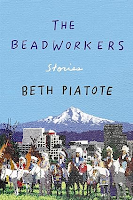
The Beadworkers by Beth Piatote

A few years ago one of these unextinct Sinixt men killed an elk in his homelands. Then he called the game officials in Canada and turned himself in. They took the bait. When the province pressed charges against him for taking big game without a license, he pleaded not guilty. He cited his aboriginal rights to hunt in his own territory. And now that case is in court, and Canada will have to look at that man, standing in the middle of the room, and all his people around him, and Canada will have to admit that the Sinixt are not extinct. The Sinixt man is very brave. And so is the elk who gave himself. That man and that elk knew each other from long ago; they met in dreams and sweat, blood and forest. The man needed the elk; the people need the elk. Without the elk, there would be no case, no path home, no court for the man to present himself to the state and say: we are alive.

In August, I visited Big Hole National Battlefield in Montana, where American forces ambushed a group of Nez Perce who were in the midst of a "fighting retreat," trying to make their way to the Canadian border to escape confinement on reservations. Big Hole is hallowed ground, still a cemetery, where the bodies of Nez Perce leaders were buried. It's a place you want to walk through quietly. I bought Beth Piatote's book The Beadworkers in the gift shop there. I hadn't remembered it at the time, but I'd read some of Piatote's work in Poetry; I had been struck by the power in her appropriation of Walt Whitman's "Song of Myself." Her collection The Beadworkers is a lovely kind of extended coda to a quiet walk through Big Hole: a loud assertion that the Nez Perce are still here, and their living stories are worth as much attention as their silences, their absences.

The pieces in The Beadworkers are a diverse bunch: some are relatively straightforward, like "Fish Wars," which might be my favorite. In "Fish Wars," a young girl worries that the tense conversations she overhears between her parents mean that, like her friend's parents, they're headed for divorce. When her father is arrested, her white schoolmates taunt her--just another drunk Indian--but the truth is that he's been arrested for illegal fishing, an act of civil disobedience in the "Fish Wars" of the 1970s and 80s in which tribes around Puget Sound pressured the government to recognize their treaty rights. "Falling Crows" tells the story of a young Indian who comes back from Afghanistan missing an arm and leg, and his extended family's attempts to help him adjust to his new existence.

But others are more experimental, like the trio of pieces labeled "Feast I," "Feast II," and "Feast III" that open the book. "Feast I" is a poem that, littered with Salish words, at first estranges and alienates a casual reader. But "Feast II" provides a kind of dictionary or key, elaborating on each term. We read the section quoted above and now we know what it means when Piatote writes, "where wewukiye bugle / in fog-mantled mornings. "Feast III," a story about a pair of women living on the Nez Perce reservation of the early 20th century, seems rather slight and uneventful on its own, but when paired with the other two parts we see the way that the poem, the unfamiliar Salish words of "Feast I," the piecemeal anecdotes of "Feast II," combine in the actual living of a life. 

The most unusual piece in The Beadworkers is "Antikoni," a dramatic retelling of the Antigone myth. In Piatote's version, the brother Polynaikas is a set of remains held in a tribal museum, and the king Kreon is the tribal chief who punishes Antikoni/Antigone for stealing the remains and ceremonially burying them. Interestingly, the piece depicts Kreon as rather understandably trying to navigate the demands of the tribe and the demands of the federal government; NAGPRA--the Native American Graves Protection and Repatriation Act--is depicted as a kind of bureaucratic force that keeps tribal members like Antikoni tied up in red tape and reinforces the very practices it's supposed to solve. Tribal politics are a repeated theme of The Beadworkers; in "wIndin!" a woman works to create a tongue-in-cheek board game that satirizes the greed and self-interest of tribal government. Kreon is something of an accommodationist, who thinks he's doing the best he can for his people under the law, but Antikoni makes it clear that in doing so he has alienated himself from them: "I do pity you, Uncle, for you have long ago admitted yourself / To this prison, a darkness of another name."

Thematically, this is one of the most interesting things about The Beadworkers: its political approach is as much about tribal government as it is the federal government. Given the extent to which Indigenous writers know they are writing for a largely non-Indigenous audience, tribal government tends to be more or less ignored. Piatote does a great job of making a critique that's understandable, even universal. And she does so with a great deal of creativity and innovation.

Friday, January 26, 2024

Calling for a Blanket Dance by Oscar Hokeah

"Kiowas always wear red on the left," I told them. I wanted to teach them about their culture. I knew Turtle and Lila were always busy with work. I didn't know how much time the spent at the gourd dances.

"What color do Cherokees wear?" Ever asked.

"Cherokees don't have a color."

"Mom is not going to like that," Quinton aded.

"No, I mean in the gourd dances there are two colors. Red for Kiowa and blue for Comanche."

"My dad's a Comanche," Quinton said. He was almost to the end of his popsicle.

"Your dad is Kiowa and Comanche," I told Quinton.

"Do Mexicans have a color?" Ever asked.

"No, Mexicans don't have a color."

"How come I saw three colors on a big blanket at my house?" Ever asked. "Red, white, and green."

"That was a flag, Ever."

Ever Geimausaddle is like a lot of people growing up in Oklahoma, the crossroads of Indian culture in the United States: a mix of cultures. His mother Turtle is Kiowa and Cherokee and his father Everardo is Mexican. Though Everardo is an abusive brute, made bitter by a beating he receives at the hands of Mexican border agents, Ever himself has a large, rich extended family to support him during what turns out to be a coming of age made difficult by poverty, addiction, and violence. Calling for a Blanket Dance is a polyphonic novel, a collection of stories that capture a snapshot of Ever's life from childhood to adulthood, each one narrated by a different person in his life--mother, auntie, cousin, girlfriend, son.

The central story, to me, was the one narrated by Ever's most distant relative, Opbee--the niece of his grandfather Vincent. In this story, the title "blanket dance" is performed at a powwow for Ever and his family, in which they are surrounded by dancers, symbolizing the support of the larger community--who also toss cash onto their blanket. Later, Opbee realizes that a quilt she's purchased from Ever after the powwow is one knit by his grandmother Lena for her great-grandchild. Opbee travels around the area searching for the blankets, sold out of necessity, to re-purchase them and collect them so they can be returned to Ever and his children. There's a neat symbolism to the quilt, itself a woven object, and the act of "knitting up" committed by Opbee, who literally ties together the loose strands of Ever's life and gathers them back together. One of the strengths of Calling for a Blanket Dance is its insistence that all the strands of one's life and heritage are important. The passage above, from when Ever is a child, is pretty funny, but it also captures some of the difficulty of navigating the many facets of one's identity--Mexican, Kiowa, Cherokee, Comanche, each with its own gifts, and its demands.

Calling for a Blanket Dance is interested, too, in the ways young men grow up. Men like Ever's father Everardo and his grandfather Vincent never grow out of their destructive patterns, or, as in the case of Vincent, who gives up alcohol to late to save his health and his life, grow out of them too late. Ever, too, must fend off the allure of gang violence and drug addiction; his first wife, Lonnie, is ravaged by meth. Ever seeks a refuge in the army, but even this proves to be a false start; discharged, he returns home. Ultimately, it's fatherhood that saves him, first by adopting a troubled teen named Leander (whose casual and sarcastic voice is one of the novel's best artistic strokes) and then having children of his own.

Funnily, Calling for a Blanket Dance covers some of the same ground as Brandon Hobson's novel of the Oklahoma foster system, Where the Dead Sit Talking. But the comparison reveals the limitations of Calling for a Blanket Dance. When, in Hobson's novel, Sequoyah imagines grinding his thumb into the face of his sleeping roommate, we believe him; we are convinced that he may lash out in violence he cannot control. When Leander feels like lashing out, we are certain that social worker Ever's solution--"When you get angry, I want you to draw"--will help Leander channel his impulses into positive behavior. There's never any other narrative possibility; though marginal characters like Vincent and Lonnie may suffer, we are sure that Ever and his immediate family will be knit back into health and safety. When, in the final story, narrated at last by Ever, he camps out overnight waiting for a crack at a foreclosed house being distributed by the Cherokee Nation, is there any doubt that he'll receive one--or that, in a gesture toward the possibility of loss, that he'll be the last person in line to get one? Still, the many voices of Calling for a Blanket Dance are a difficult feat, and are what make it worth reading.

Sunday, January 21, 2024

Blood Run by Allison Adelle Hedge Coke

Civic, ceremonial, elegant effigy--Snake--
our purposes funerary, fundamental, immaculate.

Until sons of Orpheus, fools of fortune,
looters, anthros, squatters--their tractors, rakes--
altered, removed on superiority-driven raids.

When the animals leave this place,
now without protective honorary sculpture.
When River returns with her greatest force.

When flora, fauna will themselves back,
here where we all began ago, long for.
When our people return, to the place
offerings kept free, balanced, hallowed,

when The Reclaiming comes to pass,
all will know our great wombed hollows,
the stores of Story safely put by.
All will come to truth.

I first read about Allison Adelle Hedge Coke's poetry cycle Blood Run in Chadwick Allen's book Earthworks Rising about the literary uses and abuses of Native American mounds. Allen approached Hedge Coke's poems, at least in part, as a numerological exercise, counting the many voices and their place in the narrative: the Mounds, the River, the Deer, the Skeletons, the Ghosts, the Beaver, etc., etc. It all seemed a little silly to me, but I was interested in what Allen had to say about the importance of the voices themselves, which represent the different aspects of the Blood Run Mounds in Iowa's far northwest corner, how the act of letting the mounds themselves speak--as opposed to being spoken for by white historians and anthropologists--constitutes a radical act.

I wish I hadn't left Allen's book at work, because I'd like to go back and read through what it is he said about Hedge Coke's poems, and not rely on my former review, or on memory. For myself, what struck me most about the poems is the unfolding of their chronological structure: first, the Mounds speak from memory, from prehistory, and then they witness--along with the animals and the skeletons and the ghosts--the cataclysmic arrival of settlers, who tear the Mounds to pieces and interrupt the wholeness of the ecology of which the Mounds are a part. I liked the Serpent, a snake-shaped mound like the famous one in Ohio that has since been obliterated, who predicts his own return: "Though my body / suffered sacrifice / to railway fill, / my vision bears/ all even still. / Be not fooled. / Be not fooled. / I will appear again. / Sinuous, I am." And true to form, the poem then moves toward a narrative of future return, in which the river and the mounds are made whole again.

As poetry, it felt a little clunky to me. I love the sinuousness of the snake, the turning of its simple lines, but other poems struck me as being rather plodding. Perhaps that's all right, perhaps they're meant to be solid and earthlike. I did laugh when I got to the cycle's only rhyming poem, narrated by "The Jesuits"--Europeans who brought their ways of poetry with them as surely as their religion and their ways. But in the end I did enjoy the sense of the land speaking, and the interconnectedness of things, and the cycle's proud insistence that things which many have insisted are lost might return again, to their rightful place.

Saturday, January 20, 2024

Where the Dead Sit Talking by Brandon Hobson

No matter what, I could not bring myself to think of Rosemary any less. Little by little, the days were like thieves, stealing parts of me, including any courage I had to confront my feelings toward people: my growing interest in Rosemary, my hatred for Nora Drake, my friendship with George. At night I began to think more and more about my mother, as her court hearing grew closer. I worried about her release. I worried about her remaining locked up. And I worried the days were taking my feelings, how the more I thought about everyone, the more dead I felt inside.

Sequoyah is fifteen years old, Cherokee, caught up in the faceless indifference of the foster system. His mother is in prison, perhaps up for parole soon, but in the meantime he's been placed with the Troutts, a well-meaning couple who live out in the sticks of rural Oklahoma. Life with the Troutts, at least, is better than life in juvenile detention, or some of the other foster homes that Sequoyah has been in and out of. He finds a friend in George, another foster kid who prefers to write messages than to speak, and who clearly has some kind of autism. But it's the Troutts' third foster kid, an older girl named Rosemary, who really captivates Sequoyah. Like him, she's Cherokee, she's disaffected, she's not like other kids. "I feel a weird connection to you," she tells him. "I mean like you're a lost soul from a thousand years ago who's here to deliver something to me."

Maybe that sounds heartwarming, or worse, banal, but it's not. What Rosemary and Sequoyah really have in common is that they've both been deeply damaged by troubling childhoods, and they are both strange, dark, and prone to antisocial behavior and violent thoughts. We come to understand that people are actually afraid of Sequoyah; when George wakes up bleeding from his mouth during a bad sleepwalking spell, he assumes that it's Sequoyah that has hit him in his sleep. When Rosemary's girlfriend (perhaps in both senses) Nora tells her that the way Sequoyah looks at Rosemary is creepy, are we sure that she's wrong? Sequoyah's affection for Rosemary is both a desire to be with her and a desire to be her; he sneaks into her room when she's not around and wears her clothes. Rosemary, for her part, steals money and things and disappears for days; she gives and then cruelly retracts her affection for Sequoyah and talks openly of suicide.

What I liked best about Where the Dead Sit Talking, I think, is that Hobson manages to make Sequoyah and Rosemary poignantly empathetic, rather than repulsive or frightening. We see quite easily how they've been shaped by their difficult circumstances; Sequoyah literally bears scars on his face from an episode of his mother's negligence. As teenagers, they feel real; in the afterword, Hobson talks about how the book was inspired by children he knew working in Oklahoma's foster system. In fact, one of my biggest reactions to Where the Dead Sit Talking was jealousy: I've been working on my own book about disaffected teens, and I wish I had Hobson's talent for detail. Time and time again Hobson has Sequoyah, Rosemary, George, or even some rando at their shared school, do or say something that I bookmarked to steal--or, I should say, for inspiration.

Where the Dead Sit Talking is a grim book. It's narrated by a slightly older Sequoyah, looking back at this transformative experience in his life. We know from the beginning that things haven't gotten better for him; the book's first line is "I have been unhappy for many years now." Sometimes he'll interrupt the narrative to let us know how a particular character dies: "on October 12, 1999 of mysterious causes," or, "who later died on January 19, 2003 of strangulation." These asides are never justified or explained; we're not meant to think something as gruesome and manipulative as that Sequoyah has become a serial killer or anything. But he is someone who grew up surrounded by loss and death, who sees death. On a narrative level, Where the Dead Sits Talking avoids overarching narratives in favor of something more vignette-like. When climactic things happen--the one moment of grand violence in the novel is the one moment that feels a little off--they both grow out of and interrupt the persistent ebb and flow of hope and despair that characterize the life of a foster child like Sequoyah.

This is the fourth year in a row that I have dedicated January to reading books by Native American authors, and Where the Dead Sits Talking is one of the most rewarding discoveries from the experience. Sequoyah's Cherokee identity isn't exactly central to the narrative, but neither is it incidental. Looking back, I was struck by his desire to be like his "great-grandfather," who saw spirits in every thing. It's not such a big leap from there to a teenager who yearns for the mystical experience of a soulmate like Rosemary: "My great-grandfather claimed to have met a beautiful spirit woman... Her eyes were fire. She held my great-grandfather's gaze, kissed his hands, and fell into a long, deep sleep with him." Perhaps we are invited to see a connection between the kinds of displacement that the Cherokee suffered and the displacement that kids in the foster system suffer. Maybe not. But at the very least, Hobson reminds us that displacement--alienation, isolation, and loss--have many forms, and each is more enduring than we might hope to believe.

Monday, January 15, 2024

The Sentence by Louise Erdrich

Many books and movies had in their plots some echoes of my secret experiences with Flora. Places haunted by unquiet Indians were standard. Hotels were disturbed by Indians whose bones lay underneath the basements and floors--a neat psychic excavation of American unease with its brutal history. Plenty of what was happening to me happened in fiction. Unquiet Indians. What about unquiet settlers? Unquiet wannabes? According to Penstemon, the earth's magnetism directs many actions in an unseen world. Maybe the bookstore itself was located on some piece of earth crossed by mystical lines. These invisible runes had touched during what... a shift, perhaps cosmically... a solar storm--something had jostled reality.

What is a sentence? In one sense, it's a judgment, like the sentence handed down to Tookie, the narrator of Louise Erdrich's novel The Sentence, which unjustly keeps her locked up for many years. In another sense, of course, it's a string of words, one of the units from which a book is made, like the books that Tookie sells in a Minneapolis bookstore after her release. For Tookie, the bookstore--the real-life Birchbark Books in Minneapolis, owned and operated by Louise Erdrich herself, who appears in the novel--is quite literally a lifesaver. It's a place where she's given a second chance, and one surrounded by the very things, books, which kept her alive during her time in prison. But perhaps these two kinds of sentence are the same in the end: after all, our words have power to pass powerful judgments, even kill, as one seems to have recently killed a bookstore patron named Flora. But in Tookie's case, words have the power to save, to cleanse, and to heal as well.

The problem in The Sentence is not so much that Flora has died, but that she has come back and is haunting the bookstore, and Tookie specifically. Flora was a Pretendian, a white woman desperate to claim an indigenous identity. When Flora's spirit tries to forcibly enter Tookie, in an event Tookie describes as being zipped open and put on like a wetsuit, the imagery is clear enough. But both Tookie and Erdrich have a kind of sympathy for Flora as well, even in her misguided desperation, and Tookie's investigation into Flora's death suggests that she was killed by a sentence in a historical book that exposed the truth about her racial and cultural heritage. What Erdrich suggests is that, if settlers and Pretendians act on Indians like ineradicable spirits, impossible to fully exorcise, so do they haunt themselves, or cannot keep themselves from being haunted by the truth of their relationship to the world as it is.

The Sentence is almost certainly the most personal book that Erdrich has ever written. By writing herself into the book, Erdrich joins a long list of greats, including Patrick White and Martin Amis, who have fashioned themselves into characters in their own books. But The Sentence has a ripped-from-the-headlines quality, too, that follows those momentous events of 2020: the onslaught of COVID-19, which closes the bookstore and gives Flora the ghost more freedom to prod Tookie, and the killing of George Floyd, which brings a conflagration to Minneapolis. I wouldn't say I loved these parts of the book, mostly because the protests seem to bring a stop to the central plot of Flora's haunting, but given how cringey it might have been and how little I think most of us really want to read a book about this stuff, it seems remarkable that they work at all. Ultimately, Erdrich brings it all back together, and we come to understand that the injustice of Floyd's death, the violent reaction to the protests by the Minneapolis police, even the negligence that leads to COVID running rampant, these are all manifestations of the same specters that haunt our country, like Flora haunts the bookstore. And it doesn't sound as cheesy coming from Erdrich.

What really makes it work, though, is the voice of Tookie: brash, brazen, playful, and profound. The first thirty pages, which detail the madcap scheme that got Tookie sent to prison in the first place--a scheme involving a refrigerated truck and a dead body with cocaine taped beneath its armpits--are some of the best writing to come out of Erdrich's pen in many years. The Sentence can't sustain that momentum. Perhaps it's unsustainable, but it certainly establishes a great reserve of goodwill the novel draws from in its more tedious moments. In keeping with other Erdrich books, there are a few other plot threads I haven't mentioned, including Tookie's marriage to the tribal policeman who arrested her and her stepdaughter's new baby by a Canadian Metis man who may or may not be a wolf creature known as a Rougarou. It's that voice, lively and fresh, which brings all of these together and makes The Sentence worth reading. It's a book that understands that words have power.

Friday, January 12, 2024

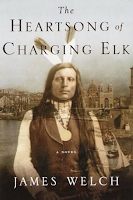
The Heartsong of Charging Elk by James Welch

Then, looking down into the hand mirror on the box of drawers, he lifted the brush to his hair, then stopped, shocked to see that his hair had been cut off to just around his ears. Of course, he had touched the short hair in disbelief many times since yesterday morning, but to see it now filled him with fear. How would Wakan Tanka know him? Charging Elk suddenly felt ashamed of himself. He had gone from being a wild Indian to this creature in the mirror. He glanced down at his new clothes, his new rough shoes. What had happened to him? Just a few sleeps ago, he had possessed his father's hairpipe breastplate, his own badger-claw necklace, his skin clothing--above all, the long hair that had never been cut. Even when he put on the washichu's blouses and pants, he wore brass armbands, earrings, and the two eagle feathers in his hair. He wore moccasins and wrapped his braids in ermine and red yarn. Now, this creature that looked back at him in the mirror didn't look like the Oglala from the Stronghold. The face had grown thin, the eyes seemed unsure, and the mouth looked weak. How would Wakan Tanka know that it was Charging Elk? How would Charging Elk again become the man he once was?

 A man wakes up in a sick ward in Marseille. He doesn't understand where he is, and no one can tell him, because he doesn't speak their language. He is Charging Elk, a young Lakota man who has traveled to Europe with Buffalo Bill and the famous Wild West Show, pretending to hunt buffalo--and Custer--for admiring audiences. But he takes ill, the Wild West Show leaves Charging Elk behind, and through a series of legal mishaps and a great deal of mutual misunderstanding, it seems no one can figure out how to get him back to America, or even Rome, where Buffalo Bill is. It's the beginning of a long exile for Charging Elk, who will spend at least the next sixteen years of his life in France.

The Heartsong of Charging Elk reminded me a great deal of Caroline Dodds Pennock's book On Savage Shores, which I read last year, and which is about the experiences of Indigenous people from the Americas visiting Europe. In a way, it turns colonial narratives on their head: here, it is Marseille that is the strange and exotic place and the Indigenous man the traveler. But no, not quite, because the prejudice that Charging Elk experiences in Marseille is colonial to its core; even those who seek to help him are convinced that he is a "savage" who will never be able to adjust to civilized European life. And they are right insofar as life in Europe is bewildering for Charging Elk, one to which he has much trouble adjusting, especially because he knows no French (and of course there is no one in France who speaks Lakota). He ends up in the home of a kindly fishmonger, who adopts him as a kind of second son, and little by little Charging Elk finds himself adopting French ways--chiefly, drinking wine.

When he arrives in Europe, Charging Elk is young, and has little experience with women, even back home in America. As many of the Lakota in the Wild West Show, he has a profound interest in European women. Out of both deep lust and deep loneliness, he begins patronizing a prostitute named Marie, even falling in love with her, but she is blackmailed by an unscrupulous restaurateur into drugging Charging Elk so that he might rape him. During the act, Charging Elk wakes up and stabs the man to death. At his trial, he struggles to explain himself: though a sympathetic jury looks to him to explain the mitigating circumstances, he is only able to say that he killed a siyoko, an evilness, as any Lakota might have done. This, of course, is taken as more proof of savagery, of an incompatibility with the civilized world. Ironically, Charging Elk becomes a cause celebre in the papers; most of the French seem to believe that he has been unfairly charged, and yet this is only enough to save him from the guillotine, not a sentence of life imprisonment. The French may sympathize with him, or pity him, but there is no one who truly understands him.

Welch passes over the many years that Charging Elk spends in prison with relative swiftness. Eventually, he's released on a grimly ironic technicality--something about him not being an American citizen and thus not able to be tried. (I forget.) Life improves for him after prison: he is placed with a farmer, and eventually falls in love with the farmer's daughter, and marries her. It is a bittersweet development; Charging Elk finds love at last, and someone in this immense and frightening continent who understands him, but he knows all too well that to marry a French woman means to give up the dream of return. It means to become, irrevocably, French--to live between two worlds. The novel treats this with a touching ambiguity, which suggest perhaps that there is much to be gained by becoming "civilized," though much, too, is lost. The novel's most affecting moment comes at the end, when the Wild West Show returns after sixteen years and Charging Elk finds himself among a new generation of Lakota. The story they tell is a horrible one, of boarding schools and forced assimilation, of the desperation of the Ghost Dance and the death of both Charging Elk's father and the great Sitting Bull. The bitter irony is that the home Charging Elk left is rapidly being Europeanized, and that there's no guarantee that, had he stayed in the Badlands, he might not have been forced to cut his hair and adapt to European ways anyhow. Here, in Marseille, at least, he has his wife and child-to-be waiting.

Monday, January 8, 2024

Two Old Women by Velma Wallis

On their way back to the camp, Sa' heard something skitter lightly along the bark of a tree. She stood very still, motioning her friend to do the same. Both women strained to hear the sound once more in the silence of the night. On a tree not far from them, silhouetted in the now-silvery moonlight, they saw an adventurous tree squirrel. Sa' slowly reached to her belt for the hatchet. With her eyes on the squirrel and her movements deliberately slow, she aimed the hatchet toward this target that represented survival. The animal's small head came up instantly and as Sa' moved her hand to throw, the squirrel darted up the tree. Sa' foresaw this, and, aiming a little higher, ended the small animal's life in one calculating throw with skill and hunting knowledge that she had not used in many seasons.

In Alaska, a band of Athabascans are struggling with the onset of winter. Without enough food to go around, and few opportunities to hunt, they make a difficult decision: to abandon two burdensome old women. Not only are the old women--Sa', meaning Star, and Ch'idzigyaak, meaning Chickadee--unable to contribute to the band's survival, they are always griping and complaining. Still, their children and grandchildren are among those who must move on as the old women are left in the snow, certainly to starve or freeze to death. But then, left to their own devices, the two old women decide they must commit themselves to their own survival, activating long-dormant lessons about how to hunt and survive in the difficult Alaskan winter, and soon they find themselves with a new passion for old ways.

Alaska Native writer frames Two Old Women as a story told to her when she was a girl, and it has the simplicity and straightforwardness of an instructive tale for children. By the time the band returns to their former hunting grounds, the situations have reversed: it is the women who have stored a cache of dried fish that they are generous to share with the larger band, who have only continued to struggle. The lesson is two-fold: one, in such difficult conditions, each member of the band must work together, and no one can be left behind; those you believe to be a burden may turn out to be an asset. It's easy to see how such a lesson, passed down from generation to generation, would provide important guidance for a culture that lives in some of the harshest conditions known to man. But the other lesson is that the old ways must not be forgotten: once Sa' and Ch'idzigyaak are abandoned, it is traditional methods of hunting and shelter-building that turn out to be their saving grace, and it is perhaps no coincidence that they are elders, who are meant to be repositories of old wisdom and knowledge.

As literature, Two Old Women isn't much. It has a pleasing clarity of voice, and honed but simple language that well reflects the nature of the story, as well as the landscape. It's most interesting, perhaps, as a reflection of the difficult choices made by those living traditionally in the Alaskan interior, and the way these communities prosper and thrive even in conditions that seem, to us down here, entirely unliveable.