Showing posts with label Ontario. Show all posts

Wednesday, August 13, 2025

Books and Islands in Ojibwe Country by Louise Erdrich

My travels have become so focused on books and islands that the two have merged for me. Books, islands. Islands, books. Lake of the Woods in Ontario and Minnesota has 14,000 islands. Some of them are painted islands, teh rocks bearing signs ranging from a few hundred to more than a thousand years old. So these islands, which I'm longing to read, are books in themselves. Then there is a special island on Rainy Lake that is home to thousands of rare books ranging from crumbling copies of Erasmus in the French and Heloise's letters to Abelard dated MDCCXXIII, to first editions of Mark Twain (signed) to a magnificent collection of ethnographic works on the Ojibwe that might explain the book-islands of Lake of the Woods.

Books and Islands in Ojibwe Country begins with author Louise Erdrich piling into a blue minivan with her newborn daughter, Kiizhik. This is an unconventional trip, and at 46 years of age, she's an unconventional mother. The destination is the lake country of northern Minnesota and southern Ontario, Lake of the Woods and Rainy Lake, vast freshwater lakes that are dotted with islands, a place that is still home to the Ojibwe. Erdrich herself is a "plains" Ojibwe, from the eastern stretches of North Dakota, and so the place still retains some of its strangeness, but there's home here, too, not least because she is meeting the mysterious father of her infant, a medicine man named Tobasonakwut. (One reads between the lines to see that the pair are not quite a conventional couple; elsewhere I've read that he was a married man.) In these islands she sees something akin to the books that are her lifelong passion: numerous, inviting, mysterious, and even, in some cases as she explains above, legible.

What a precious object this book is for me. I picked it up at Erdrich's own Minneapolis bookstore, Birchbark Books, after a week of exploring the Ojibwe lands around Lake Superior. We never quite got up to where Erdrich describes in this book, but we did end up a stone's throw from Rainy Lake, at Lake Kabetogama, also now a part of Voyageurs National Park. But I recognized something, just a little, of the awe that suffuses that place, where the islands really do fan out and multiply in an impossible way. The book is just a book, it isn't even signed, but it lies at the crossroads of my own experiences and that of an author who has meant a lot to me. Maybe there's even a small touch of the numinous in the way of Erdrich's visit to the cabin of explorer and naturalist Ernest Oberholtzer, where she sleeps among his vast library, making herself known to his immense store of books.

Beyond that, I was really touched by this book. I've only read Erdrich's fiction, which can be fanciful and goofy, but reading her in this mode, a mix of memoir, naturalism, and travelogue, was really fascinating. She's always had a way of persuasively writing about the way that myth and magic appear in everyday life, and she manages to make the ancient stone glyphs of the Lake of the Woods seem as mysterious and meaningful as anything from Tracks or Bingo Palace. And I was struck by the gentle, strange relationship between herself and Tobasonakwut, as well as the late-coming child, who seems to have a natural attraction for the lake's animals: sturgeon, otters, moose. Even the principle metaphor of the book, which ought to be silly--a book is like an island--seems natural and persuasive in Erdrich's hands. I really enjoyed seeing this other side of a great writer.

Sunday, December 3, 2023

The Lyre of Orpheus by Robertson Davies

"Oh, somebody in a book! All you people like Nilla and the Cornishes and that man Darcourt seem to live out of books. As if everything was in books!"

"Well, Schnak, just about everything is in books. No, that's wrong. We recognize in books what we've met in life. But if you'd read a few books you wouldn't have to meet everything as if it had never happened before, and take every blow right on the chin. You'd see a few things coming. About love, for instance."

The Lyre of Orpheus, the third book in Robertson Davies' "Cornish Trilogy," brings the story back to the characters of the first novel, The Rebel Angels. In the latter, a bunch of professorial types and arts patrons, including are trying to figure out how to deal with the estate of the late art critic Francis Cornish. The trilogy's middle book, What's Bred in the Bone, serves as a biography of Cornish, who turned out to be a successful faker of Renaissance art. Here, the patrons are back, and they've decided to spend some of their money on a young doctoral student named Hulda Schnakenburg, who wants to complete an unfinished opera about King Arthur by E. T. A. Hoffmann.

The third in a trilogy of trilogies: though Davies wrote a couple other, largely unheralded, toward the end of his life, it's tempting to see The Lyre of Orpheus as the rounding of a career. If that's so, I think I'm glad to put Davies away for a little while, though one day I might go and read those ancillary novels. The Lyre of Orpheus is just too Davies; all the magic and the tricks here are reduced, I felt, to their most recognizable forms. As with The Rebel Angels, the professors and the patrons are all exhaustingly alike, even though Davies takes care to sketch them with different temperaments: they all finish each other's quotations from Hoffmann, or Sir Walter Scott, or Keats, or wherever. Even the new characters, like the demanding lesbian doctoral adviser Dr. Gunilla Dahl-Soot, arrive on the scene knowing just how to play these literary games. The effect, after nine novels, is of an especially well-read man talking to himself. This is easy enough to ignore, even enjoy, when the novels provide real drama, but a novel about the staging of an opera is a hard ask. (It's also, I observe, strangely similar to the plot of A Mixture of Frailties, where another group of patrons pays for the education of a lower-class singer.)

Davies' novels all suggest the same relationship between life and art. In each book, there is a central work or story, and the events of the work exert some kind of explanatory power on the events of the novel. It's Jungian, maybe, or it's just what the Welsh actor Geraint Powell says to the beleaguered "Schnak," quoted above: "If you'd read a few books you wouldn't have to meet everything as if it hadn't happened before." Here, it's the story of King Arthur that becomes manifested in the life of the characters, like an ur-myth emerging into life: Maria-slash-Guinevere allows herself to be briefly seduced by Geraint-slash-Lancelot, and ends up pregnant. They are both forgiven by Arthur-slash-Arthur, who is, like the Arthur in the play, the "magnanimous cuckold" whose generosity of spirit ennoble them all. (Never mind that this affair is out of character for Maria, and one of the falsest moments in all of Davies' books.) Davies loves to add a little spectral flourish, too. In What's Bred in the Bone, it's the pair of angels who bicker over Francis' soul; here, it's the spirit of E. T. A. Hoffmann, who looks down on the completion of his opera with excitement and trepidation.

The "Cornish Trilogy" is without a doubt the weakest of the three trilogies that Davies wrote. Yet, its middle book, with its exploration of art forgery and its traddy insistence that sometimes old forms are the best ones available to explore types of human feeling and experience we no longer pay attention to, is among Davies' best standalone novels. It's no coincidence, I think, that the most interesting parts of The Lyre of Orpheus have to do with Darcourt's discovery that the masterwork The Marriage at Cana is an original painting by Francis, and not from the 16th century, and his work revealing Francis' genius to the world at last. It made me wish The Lyre of Orpheus had a little bit more of Francis' spirit, and ability to find real truths in the falsehoods.

Sunday, May 7, 2023

Friend of My Youth by Alice Munro

Trouble began, perhaps, as soon as they said that they loved each other. Why did they do that--defining, inflating, obscuring whatever it was they did feel? It seemed to be demanded, that was all--just the way changes, variations, elaborations in the lovemaking itself might be demanded. It was a way of going further. So they said it, and that night Georgia couldn't sleep. She did not regret what had been said or think that it was a lie, though she knew it was absurd. She thought of the way Miles sought to have her look into his eyes during lovemaking--something Ben expressly did not do--and she thought of how his eyes, at first bright and challenging, became cloudy and calm and sombre. That way she trusted him--it was the only way. She thought of being launched out on a gray, deep, baleful, magnificent sea. Love.

In "Oranges and Apples," a story in Alice Munro's collection Friend of My Youth, a man named Murray comes home to see his wife suntanning by the pool, and Victor, his friend who has been staying in the pool house after a rough split with his wife, watching her through binoculars. Something in her body language makes Murray certain Barbara is aware of Victor, even arranging herself for him to sea. Murray spins this moment into a rage-inducing fantasy of betrayal, even going so far as to arrange for Victor and Barbara to be alone together, as if to confirm his own nightmare by forcing it to become true. In "Goodness and Mercy," young Averill listens to the captain of a passenger ship tell a story of an elderly woman who once died on board, and whom he buried at sea. Averill becomes convinced he is talking about her; after all, she is on board with her elderly and terminal mother, both of whom suspect she may expire before journey's end. Somehow, without even uttering a word, Averill comes to believe she is collaborating with the captain in a fantasy in which, her mother having been discarded, she is free to be seduced by him.

Friend of My Youth is probably the most subdued of all the collections of Munro's I've ever read. Some disasters remain--a drowning, a boy blinded by a rake, and any number of tawdry affairs--but they are somehow less real than the things that do not happen; the lives that people live in their own head, simply because the ones they really do lead are too narrow, or because everyone really wishes they could lead more than a single life at a time. This is the impulse that leads to the cuckold fantasy of "Oranges and Apples," and the dead-mom-sex-with-the-boat-captain fantasy of "Goodness and Mercy." "Differently" is another version of "Oranges and Apples" in which Georgia abandons her closest friend because of a notion--not even a belief or a conviction, it doesn't even quite get that far; it doesn't need to--that she has bedded Georgia's lover. In "Hold Me Fast, Don't Let Me Pass," a woman travels at last to the small town in Scotland where her now-dead husband spent the happy years of his deployment, only to discover that no one remembers him and he probably invented the relationships he had with every one of them.

Perhaps it's this impulse that leads Munro's characters, especially women, to pursue affairs with men they know are unattractive, and don't really like.  Perhaps this impulse leads to the many lies that are told. In one of my favorites in the collection, "Pictures of the Ice," an elderly minister goes around showing his parishioners a photo of the woman in Hawaii he plans on marrying, and describing the life he'll live out there in retirement. Meanwhile, his true intentions are to take a position exactly like the one he has now, in an even more frigid and remote part of Ontario. Or maybe he's the inverse of all the others: the man who loves his single life so much he wants to live a version of it forever, and must pretend to have dreams for the sake of others.

Fantasies, lies, telling stories. Many of the stories are really about telling stories. The narrator of the title story hears second-hand, from her mother, a story about a woman who gives up her fiancé when he impregnates her own sister. In the mother's version, the woman is saintly, self-sacrificial; but the narrator wants to write the version wherein the woman is proud and controlling, all too happy to have her sister and former lover under her roof to arrange their lives according to a logic of guilt and shame: "a Presbyterian witch." Of course, we never are to know who the "real" Flora was; such questions are barely worth mentioning. What the story is really about is the writing of the story--though it is also about her mother, and about mothers. In "Meneseteung," an unnamed narrator tells the story of an underappreciated Ontario writer who lived a life of spinsterhood; though the details are drawn from the writer's journals, we are keenly aware that the gaps are filled with supposition and invention. There's no other way. Even stories that don't seem to be about stories are: Georgia of "Differently" is told by a creative writing instructor, in a nice Munrovian touch, that her stories contain "Too many things": "The instructor said that she expected too much, of herself and of the process, and that she was wearing him out."

Sometimes Munro's stories are set in Vancouver or Victoria or Toronto, but they're most often set in small-town Ontario, and those that are always feel as if they are set in the very same place. Maybe they are. In Lives of Girls and Women, the town is called Jubilee; in Friend of My Youth, it's Walley. One of the secondary themes of all the stories is that way that Walley has changed, the way that towns change, and the way the 1950's housewife world has passed into something different--and not necessarily better. People return to Walley and see its changes, as they make note of the changes in their old friends, and in themselves. I think you have to squint a little, dig a little deeper, to find the richness and drama in Friend of My Youth, like you do with a town like Walley. When I think back on Munro's stories, I don't know that any of the ones from this collection will be on the forefront of my mind. Small towns are like that, too: sometimes they blend together, and sometimes you forget them altogether. But they are still out there, full of life and living.

Friday, November 25, 2022

What's Bred in the Bone by Robertson Davies

So you stood by him to the end, brother, said the Lesser Zadkiel.

--The end is not yet. Though he sometimes defied me, I obey my orders still, said the Daimon Maimas.

--Your orders were to make him a great, or at least a remarkable man?

--Yes, and posthumously he will be seen as both great and remarkable. Oh, he was a great man, my Francis. He didn't die stupid.

--You had your work cut out for you.

--It is always so. People are such muddlers and meddlers. Father Devlin and Aunt Mary-Ben with their drippings of holy water, and their single-barrelled compassion. Victoria Cameron with her terrible stoicism masked as religion. the Doctor with his shallow science. All ignorant people determined that their notions were absolutes.

--Yet I suppose you would say they were bred in the bone.

--They! How can you talk so, brother? Of course, we know it was all metaphor, you and I. Indeed, we are metaphors ourselves. But the metaphors that shaped the life of Francis Cornish were Saturn, the resolute, and Mercury, the maker, the humorist, the trickster. It was my task to see that these, the Great Ones, were bred in the bone, and came out in the flesh. And my task is not yet finished.

What's Bred in the Bone is the second in Robertson Davies' "Cornish Trilogy," coming after The Rebel Angels, which deals with the aftermath of the death of Francis Cornish, a wealthy patron of the arts, and his estate. Rebel Angels always seemed a bit funny, the way it establishes a central character who never appears; What's Bred in the Bone is the novel that fills in Cornish's life: how he went from an upper-crust but provincial childhood in the small Ontario town of Blairlogie to become a world-renowned art expert, as well as--something no one in The Rebel Angels seems to know--a British spy.

Young Francis is a tormented child: tormented by the moralistic pictures that dominate his childhood bedroom, tormented by his peers, who see him as weak and strange (and what's worse, rich), tormented by the surprising revelation that his older brother, a mentally disabled boy also named Francis, has been kept secreted away in the attic for many years, while a nearby grave lets the world believe that he's dead. Francis learns to draw from a book, and his early talent is given room to practice when he's allowed to accompany the local mortician and sketch the bodies. After an Oxford education and a disastrous marriage to a reckless but sexy cousin (!), Francis becomes the assistant to Tancred Saraceni, a world-famous art restorer who recruits Francis into a scheme to fake old German paintings so they might be traded to the Nazis for legitimate world treasures. Saraceni's education is technical--and in true Davies style, the art of a restorer and forger is intimately and convincingly detailed--but also spiritual, and as a final project for his master, Francis produces an original painting in the style of the German masters that is so convincing it becomes the talk of the art world. Funnily, it's this painting that destroys Francis' ambition to be a painter: to paint in this style, the only style he really can, would be to out himself as the forger.

As the title suggests, the big theme of What's Bred in the Bone is how one becomes the person they are meant to be. Davies intersperses scenes from Francis' life with a conversation between his guardian angel and the animating "daimon" who guided Francis' development. The daimon explains to the angel how the qualities that already existed in Francis had to be brought out by the external influences in his life: his luckless brother, the kindly mortician, the wily forger. Like Dunstan Ramsay of The Fifth Business, who makes a cameo appearance here, Francis must be content with being something other than great, or great in a way that is different than how he conceives it. Francis can never be a painter, never an old master, but in his capacities as a forger, a restorer, a critic, a benefactor, he can become something else. If that something else is not quite what one dreams of, still it is something the world needs, and which represents the fulfillment of his capabilities. (Of course, self-actualization takes a lot of money, something that Davies never seems to want to interrogate that closely.)

What stands out to me, though, is the way that Francis is presented as something of an old soul: he might have been one of those German masters, if he had been born in the right time and place. Nearly all of Davies' protagonists are anachronisms, people who live by moral and aesthetic codes that have been sent to the rubbish bin by modern life. Davies has this kind of quality, too, I think, but his models aren't really Renaissance painters, or even the pre-Raphaelites that Francis loves, or even the medieval thinkers that preoccupy Dunstan Ramsay. Instead, they strike me as callbacks to a kind of early 20th century Oxford don: fussy, cloistered, small-c conservative. Like Francis, Davies is an old soul working in a modern medium, searching for greatness in a genre that no longer allows for it.

Thursday, January 20, 2022

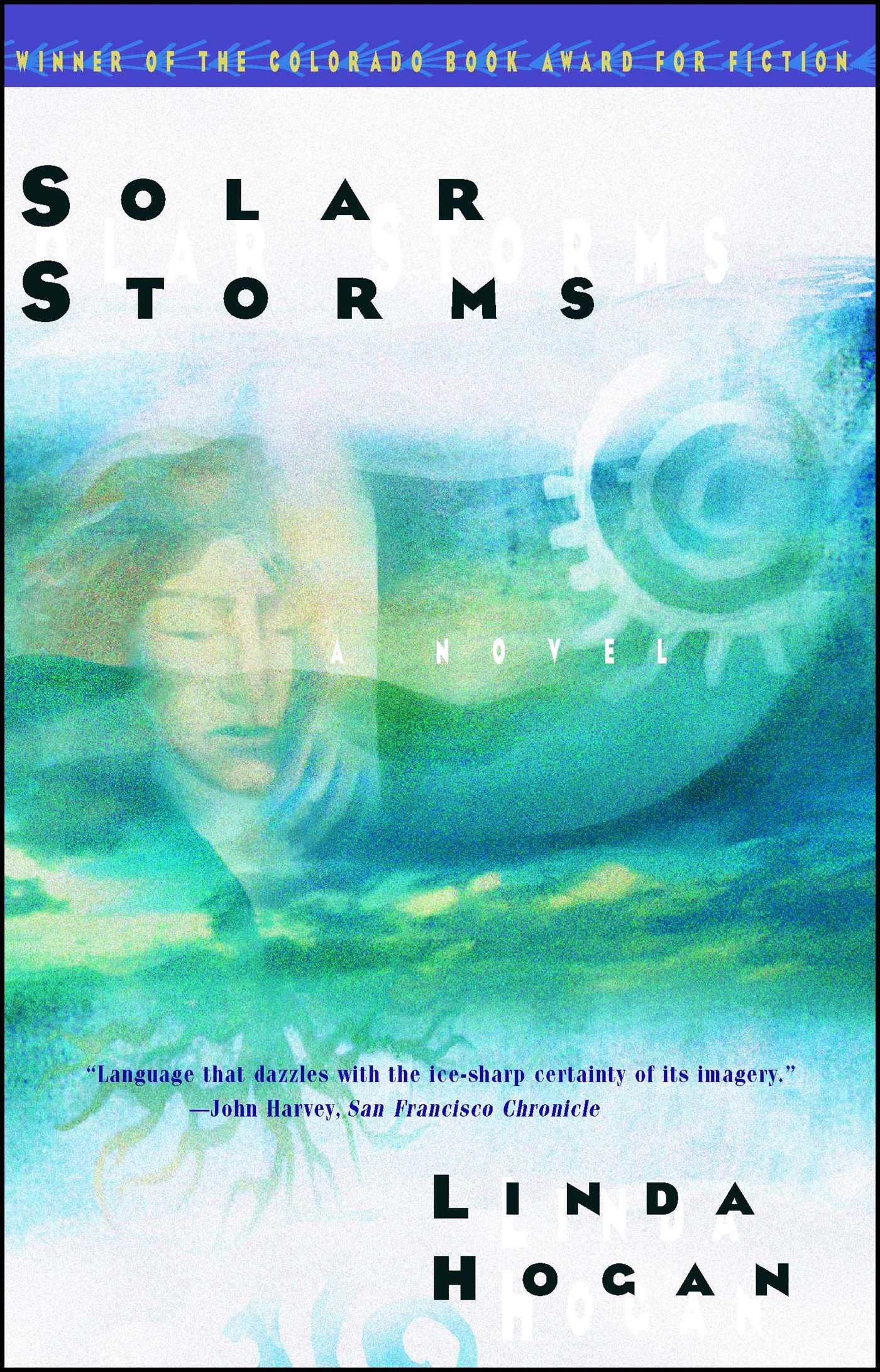
Solar Storms by Linda Hogan

People say that in the beginning was the word. But they have forgotten the loneliness of God, the yearning for something that shaped itself into the words, Let there be. Out of that loneliness, light was conceived, water opened across a new world, and people rose up from clay, there were dreamers of plants and deer. It was this same desire in me, this same longing for creation, and Bush's spare words were creation in itself. I had been empty space, and now I was finding a language, a story, to shape myself by. I had been alone and now there were others. I was suspended there on the island of snails and mosses, snow and windstorms, and I was quiet for days on end, but like Bush's wolverine bones, I was partaking of sacred meal and being put back together.

My Indijanuary continues with Linda Hogan's Solar Storms, a book about a young woman who moves in with her indigenous family on the Boundary Waters between Minnesota and Canada. Angel arrives with half her face scarred for reasons unknown, knowing only that it was her tempestuous mother who somehow afflicted her with them many years ago. Her mother is away in far northern Canada, but when she arrives at the Boundary Waters, she finds a whole family waiting for her: Bush, the former wife of her grandfather and adoptive mother, Agnes, her great-grandmother, and--get this--Dora-Rouge, her ancient and wheelchair-bound great-great-grandmother. Over and over, Angel describes the experience of returning to this place "moving toward herself," and in the company of these women she's able to recapture an identity rooted in her family, and the lands and waters that surround them.

There is a particular story I see again and again in these books by indigenous authors: an indigenous person, often of mixed heritage, must resolve a battered psyche by returning home and reconnecting with their family and homeland. It happens in Ceremony; it happens in A House Made of Dawn; it happens in Winter in the Blood; it happens to some extent in Joy Harjo's poetry collection An American Sunrise. What these stories know is that the psyche is not an independent actor, but one constrained by context; it cannot be healed except by being integrated into community and a relationship with the world. Furthermore, they know that individual traumas are the tail-end results of capitalism and commodification. The healing process always has a geographic character, one that goes in reverse, undoing diaspora, and maybe even reversing Indian removal. (Other books do this, too, like Song of Solomon, except that a return to a teleological homeland--Africa--can only be gestured toward at the end of that book.)

In Solar Storms, this movement-in-reverse carries Angel in several stages: first to the Boundary Waters, and then farther out onto the remote spit of land where Bush lives called Adam's Rib. There, Bush engages in a kind of literal healing, piecing together models of animal skeletons to be sold to museums. But soon the process carries her, along with Bush, Agnes, and Dora-Rouge, in a canoe up through the rivers of what seems to be Ontario, back toward the "Fat-Eaters" who are Dora-Rouge's--and thus Angel's--original community. (Hogan is careful to make the characters seem indigenous-ish, but never gives them a specific tribal identity. They're not Cree, not Ojibwe; as best I can tell the "Fat-Eaters" are totally made up. This gives the novel a sort of blurred spiritual nature I decline to evaluate.) Their goal is to take Dora-Rouge here so that she can die where she was born. It also happens to be where Angel's mother lives.

There's a too-easy version of this story, one I was dreading when I saw Barbara Kingsolver's blurb on the back of the book. But the return north is not easy or simple. Instead of heading toward healing, the trip leads the women into crisis. The rivers of the north are being dammed and diverted, one by one, threatening to obliterate towns by flooding, or drain the lakes that people have relied on for time immemorial. The damming threatens not only the tiny towns of the north, but Bush's house at Adam's Rib, which will be destroyed even though it's a two-week canoe ride away. (Appropriately, I was reading this part at the same time I came across this article describing Canada as a front for destructive resource extractors.) Angel and her forbears become embroiled in a desperate protest against the dams, and the personal becomes political. How can Angel be healed by a return to her ancestral community when the community itself is so existentially threatened? It's this question, perhaps, that makes the book so rich and so fraught, and distinguishes it from similar ones.

Angel's mother, too, is something of a bust, too spiteful and toxic to provide any kind of closure, though her daughter has traveled so far to find her. Her mother, Hannah, becomes a kind of twin to the forces of destruction that dam the rivers, a senseless and devouring force that no one has been able to contain. (We discover that Angel's scars are bite marks.) Strangely, Hannah's malice seems to come from a deeper, darker place than the evil of the river-dammers. It's a mystical, even supernatural evil, without rhyme or reason. Can Hannah heal by returning? Of course not--she's been there all along. Is her kind of evil worse, or scarier somehow, than the river-dammers'? Or is she a force of nature, an expression of its balance, that is equally endangered, like the legendary whirlpool at Adam's Rib that swallows drunks and skidoos?

Anyway, this book was a pleasant surprise. I set my expectations low because of the "healing company of women" stuff; that one's probably on me. But I was surprised by its complexity and its rejection of simple narratives. 

Saturday, October 23, 2021

The Rebel Angels by Robertson Davies

It's not that I wanted to know a great deal, in order to acquire what is now called expertise, and which enables one to become an expert-tease to people who don't know as much as you do about the tiny corner you have made your own. I hoped for a bigger fish; I wanted nothing less than Wisdom. In a modern university if you ask for knowledge they will provide it in almost any form--though if you ask for out-of-fashion things they may say, like the people in shops, 'Sorry, there's no call for it.' But if you ask for Wisdom--God save us all! What a show of modesty, what disclaimers from men and women from whose eyes intelligence shines forth like a lighthouse. Intelligence, yes, but of Wisdom not so much as the gleam of a single candle.

Maria Magdalena Theotoky is a grad student at the Toronto college of St. John and the Holy Ghost, affectionately called Spook. She's been made the research assistant of Prof. Clement Hollier, with whom she is madly in love, after a previous tryst on the professor's office couch, but her hopes to pursue their relationship further prove difficult: Hollier is taken up with the task of executing the will of another professor who left an enormous collection of manuscripts and artwork, along with two others: the insipid Urquhart McVarish (a Davies name if there ever was one) and the genial priest Simon Darcourt. While Hollier is away, Maria's new office is invaded by an old friend of Hollier's, a cruel and hideous genius of a defrocked monk named John Parlabane.

These characters make up The Rebel Angels, Davies' crack at the classic campus novel. Davies, who was the founding and longtime dean of the University of Toronto's Massey College, knew a thing or two about campus life, and The Rebel Angels beams with affection for the Life of the Mind that it provides. Maria's first-person chapters alternate with those of Darcourt, who tells us that he left a life of priestly service for the kind of mental and spiritual contemplation available to a university professor--a transition that both Darcourt and Davies admit is out of fashion, but indicative of the novel's ardor for what it sees as unfashionable and discarded Wisdom, capital W.

One of the central motifs of The Rebel Angels is poop. It is feces, for example, that animates the work of Spook's science superstar Ozy Froats, who insists that there is much to be learned about the nature of the human body by studying its waste. There is a prudish pushback to Froats' work, though this detail seems a little strange to me, given that stool samples have been an important part of medical testing for a long time. But Davies' point seems to be that the things we think are worthless are often anything but: Maria's mother, a Romany woman she calls "Mamusia," is a celebrated violin repairer whose secret trick is to pack old instruments carefully in goat manure. The Rebel Angels is a novel about the synthesis of dualities: mind and spirit, past and present, ego and id. Parlabane tells Maria that everyone has, like a tree, both a crown and root, and it is the root that provides sustenance to the crown; the former must be nurtured for the latter to grow. Our poop--the things we wish to bury or ignore--is what fertilizes us.

The Rebel Angels might be the most Davies-like of any of the Davies novels I've ever read. Though the characters are well-drawn and vivid enough, they are all wits, and they all talk like each other, which is to say they talk a lot, and they're always doing things like quoting Rabelais and Paracelsus, or finishing each other's quotes by Rabelais or Paracelsus, or telling each other they haven't quite understood what it was Rabelais and Paracelsus were talking about. As a novel, it tends toward fustiness, but it really shines when it focuses on Maria's Romany heritage and family, which is something she has yearned to hide from her more sophisticated university associates. Mamusia--secretive, superstitious, sly, larger-than-life--is also a font of wisdom, the kind of which is typically ignored by the university, and its the scenes with her and Maria's uncle Yerko where the novel really comes to life. I have no idea whether it's an honest or accurate depiction of Romany life, but it's certainly an affectionate one, and in its way it proves the central idea of the novel: Wisdom is often to be found in the places one least expects.

Sunday, January 10, 2021

Indian Horse by RIchard Wagamese

When I released myself to the mystery of the ice I became a different creature. I could slow down time, choose the tempo I needed whenever I launched myself into learning a new skill. I could hurtle down the ice at full speed and then bend time in upon itself to slow the turn, every muscle, every tendon, every sinew in my body remembering the movement, learning it, making it a part of me.

As a child, Saul Indian Horse has a vision: at his family's ancestral home at Gods Lake in northern Ontario, he sees his ancestors, living the way they once did at the water's edge. He sees his great-grandfather, the original Indian Horse who first brought horses to the local tribes from the plains Ojibwe. But Saul's vision is of little help when his parents disappear, taking his little brother's body--he has just died of tuberculosis--to a distant priest, never to be seen again. He and his grandmother travel painstakingly through the dead of winter the closest town, where Saul is taken by the whites who find him and placed into one of Canada's notorious residential schools.

If nothing else, Richard Wagamese's Indian Horse presents a damning account of the brutality of the residential schools, where students are beaten, tormented, and killed. Children, stolen from their parents, punished with long bouts of solitary confinement inside the freezing "Iron Sister," hands tied behind their back, forced to work, respond by breaking, even committing suicide. Deaths are a frequent occurrence, but never mentioned; children's bodies are dumped into an anonymous grave and the nuns move on. It would be tempting to say that Wagamese's account is overly dramatic, if you didn't know that such things really did happen with great frequency.

One priest, a Father Leboutilier, takes to the young Saul, allowing him to serve as a kind of manager for the school's hockey team. Enamored of the older boys and the NHL Leboutilier shows him on TV, Saul practices in the early morning when no one is watching, and he turns out to be preternaturally talented: the vision that showed him his ancestors can show him the space of the ice and the movement of the game. I'll say this about Indian Horse: it's a good hockey novel. The descriptions of Saul's exploits in the game are easy to follow and exciting, without being impenetrable or repetitive, as sports writing might be, but Wagamese is well served by the simplicity and lucidity of his style. Perhaps hockey, the reader thinks, can bring Saul a life to replace the one he lost.

But as another Native coach tells him, the white people of Canada think hockey is "their game." Saul is coveted for his talent and moves up the ladder of amateur hockey, but he's resented for his Indianness by his teammates and mocked by fans. He responds by becoming a fighter, a goon. If it's a savage they want, he reasons, it's a savage they'll get, and the results reverberate off the ice: Saul quits hockey and begins to drift. As the novel opens, he makes it clear that he's writing from a rehab facility.

The biggest gut-punch in Indian Horse--here's the spoiler alert, folks--is when, toward the end of the novel, Saul remembers what he has suppressed: Father Leboutilier, the man who taught him hockey, the man who told him he was "a glory," the only one at the residential school who seemed to care if he lived or died, sexually abused him for years. It's a moment that takes your breath away. How can hockey save Saul when it's inextricable from the torture he received, and the brutality of white Canadians? Indian Horse is, at its heart, about the repercussions of that cruelty, and whether what it breaks can ever be remade. 

Friday, November 27, 2020

Solomon Gursky Was Here by Mordecai Richler

When Callaghan returned, he settled into his chair, reached for the bottle and said, "Let me put it this way. Canada is not so much a country as a holding tank filled with the disgruntled progeny of defeated peoples. French-Canadians consumed by self-pity; the descendants of Scots who fled the Duke of Cumberland; Irish the famine; and Jews the Black Hundreds. Then there are the peasants from the Ukraine, Poland, Italy, and Greece, convenient to grow wheat and dig out the ore and swing the hammers and run the restaurants, but otherwise to be kept in their place. Most of us are still huddled tight to the border, looking into the candy store window, scared by the Americans on one side and the bush on the other. And now that we are here, prospering, we do our damn best to exclude more ill-bred newcomers, because they remind us of our own mean origins in the draper's shop in Inverness or the shtetl or the bog. What was I talking about?"

"Solomon."

Moses Berger is consumed by two things: alcoholism and Solomon Gurksy. Solomon was--or is--a member of the infamous Gursky family, who rose from obscurity to conquer the bootlegging industry in Canada, eventually becoming powerful and respected men of business. Solomon, embroiled in a bitter rival with his brother Bernard, the company's CEO, died years before in a mysterious crash on his way to the Arctic. Moses, whose association with the Gurskys goes back to his childhood, when his poet father was hired as a speechwriter for Bernard, has become obsessed with the question of what happened to Solomon. Was he murdered? If so, by whom? And why was his body never found? And who's ominously leaving dead ravens everywhere, and is it the same person secretly buying up shares of Gursky stock under the name "Corvus?"

Solomon Gurksy is based on the real-life Bronfman family, who turned a bootlegging operation into the Canadian conglomerate now known as Seagram, one of the largest liquor companies in the world. But Richler takes an interesting story and turns it into an epic, stretching across the length of the Canadian continent and the breadth of history. The history of the Gursky family is inextricable from the history of Canada: Solomon's grandfather Ephraim, sources suggest, was a member of John Franklin's ill-fated expedition to find the Northwest Passage, and the only one who survived (by stowing away Jewish soul food, naturally, and avoiding the poisoned lead cans that drove the others insane). In the Inuit communities of Arctic Canada, Berger discovers, there are those who still go by the surname Gor-ski or Ger-ski, Ephraim's descendants. More surprising still, Ephraim seems to have inculcated in his Inuit friends a nascent branch of Orthodox Judaism.

We learn that, when Solomon was a child, Ephraim took him on a trip to the Artic Ocean from which Solomon was forced to return alone, without assistance or supplies. Solomon, if only in spirit, is Ephraim's true heir: an adventurous spirit, willing to do anything it takes to survive and advance. But it's Bernard who manages to muscle Solomon out of the way, supplanting him with a shrewder, more modern sense of business, where intrigue happens in the boardroom, rather than on the tundra, or in an illegal Manitoba distillery.

There's something of The Adventures of Augie March in Solomon Gursky: Bellow, though he was a Canadian Jew like Richler, tried to imagine a story that would weave Jewishness permanently into the American fabric. Richler does the same here for Canada: in Ephraim, Richler makes a European Jew one of the very first Canadian colonizers, for good and bad. (The way in which Richler insinuates Jewishness into Inuit religion may or may not be intentionally suspect; I'm not sure.) In Solomon, he illustrates the way in which the pioneering spirit of Jewish Canada is marginalized, attacked, and eliminated by social climbers who prefer to forget that Canada is the "disgruntled progeny of defeated peoples."

All this seems undeniably cool. So why did this book leave me so cold? Solomon Gursky, I felt, ends up far less than the sum of its parts, and there are so many parts. My description above leaves out at least two dozen semi-major characters: the third Gursky brother, Morrie; their father, Aaron; Berger's lovers Lucy and Beatrice; Solomon's son Henry, living as a devout Hasid in the Northwest Territories; Henry's  resentful son Isaac; Bernard's consigliere Harvey; Berger's mentor Hyman Kaplansky; several rough-and-tumble French Canadians; a customs inspector; a Chinese hotel owner in Alberta; a pair of North Carolinian furniture magnates; a bush pilot; I don't know who else. Richler jumps between the perspectives of these in a way that's meant to build tension around the novel's central mysteries, and to conceal important information for a later reveal, but which in practice I found utterly bewildering. I still have no real idea of why Moses was so obsessed with Solomon, and while I'm pretty sure I understand what happened to him in the end, if I'd have blinked, I would have missed it. Solomon Gursky may still be alive, but when he's in set down the middle of this Where's Waldo diptych of a novel, what does it matter?

In some ways, Solomon Gursky a pastiche made from Richler's other, better novels. Gursky himself is a version of the titular avenging Jew of St. Urbain's Horseman; the mystery of his murder isn't nearly as satisfying as the one in Barney's Version. Solomon Gurksy adds to these novels a sweeping, epic scale, but for me, it swept away much of what made those novel's work.

Saturday, May 23, 2020

A Mixture of Frailties by Robertson Davies

"The terrible truth is that feeling really does have to be learned. It comes spontaneously when one is in love, or when somebody important dies; but people like you and me--interpretive artists--have to learn also to recapture those feelings, and transform them into something we can offer the world in our performances. You know what Heine says--and if you don't I won't scold you: 'Out of my great sorrows I make little songs.' Well--we all do that. And what we make out of the feelings life brings us is something a little different, something not quite so shattering but very much more polished and perhaps also more poignant, than the feelings themselves. Your jealousy--it hurts now, but if you are as good an artist as I begin to think you are, you'll never have to guess at what jealousy means again, when you meet it with music."

A Mixture of Frailties is the third book in Davies' Salterton trilogy, and it's so tenuously connected to those others, it sort of seems like a cheat: it begins with the death of the mother of Solly Bridgetower--who's the protagonist of Leaven of Malice, if not also the ensemble novel Tempest-Tost--who leaves Solly and his wife Veronica a substantial trust which they cannot use until Veronica bears a son. The "dead hand" of Solly's mother decrees that, until that happens, all the money will be used to finance the artistic education of a local girl in Europe. The trustees scramble to find the right beneficiary, settling with some hurry and trepidation on a girl named Monica Gall, who is a singer in a local evangelical choir. Monica is sent to Europe to become a polished singer--but mostly to satisfy the cumbersome demands of the trust--and A Mixture of Frailties is the story of her growth as an artist and a person while in London.

A Mixture of Frailties has all those qualities which make a Davies novel seem so antiquated, but in a good way, like intellectual comfort food. Every character is an artistic genius, and everyone seems to have a readymade speech about the importance of art or music or high culture, and they never flub the quotations. Part of what makes A Mixture of Frailties so anachronistic in particular is that it really does believe in the value of high culture, of opera and classical music and all that. Monica's musical guide, the composer Benedict Domdaniel, sends her not just to voice lessons but to French lessons, Spanish lessons, musical culture and history lessons, and through this process of refinement Monica learns to connect with her own moral sense, and extricate it from the earnest but simple evangelicalism of her Canadian mother and father. (This is one of those Canadian books where the cultural gap between Britain and the "Dominions" is very important.) Music, as articulated by Domdaniel and others, offers a way of meeting and understanding one's feelings and transforming them into moral judgment. It's through music that Monica must meet her feelings of inadequacy and her raging love for her cultural teacher, Giles Revelstoke.

Giles is the chaotic element in the novel, Davies' version of a dissolute musical genius. (Who is the archetype I'm trying to think of here? There must be a musical equivalent, but what Giles reminds me of most is the brilliant, selfish, womanizing Percy Shelley.) Monica falls in love with him, even though he treats her like dirt, and justifies it to herself by acknowledging with a newly developed clarity that he's treating her like dirt. She filches from the trust to fund his groundbreaking opera, The Golden Asse. The golden ass, of course is not Giles, who is an ass, but Monica, who undergoes her own transformation over the course of the novel. The problem is, of course, that when you change and succeed other people want to take credit, and Giles lashes out cruelly at Monica as his own creation. Though a brilliant composer, Giles is wrong: music, as Domdaniel supposes, has only given Monica the ability to be herself.

Funnily, A Mixture of Frailties doesn't quite have the same balance between the serious and comic that the other two novels in the trilogy do. It seems more of a piece, honestly, with the Deptford novels, which are also about Canadians exploring Europe, developing their own sensibility for high culture and religious mystery. But like all Davies' novels, it's a highly satisfying book, sensible enough to offer a story of spiritual and moral growth but also a climax of gothic, plotty proportions, like the showstopping number at the end of an opera.

Sunday, March 1, 2020

Hateship, Friendship, Courtship, Loveship, Marriage by Alice Munro

Young husbands were stern, in those days.  Just a short time before, they had been suitors, almost figures of fun, knock-kneed and desperate in their sexual agonies.  Now, bedded down, they turned resolute and disapproving.  Off to work every morning, clean-shaven, youthful necks in knotted ties, days spent in unknown labors, home again at suppertime to take a critical glance at the evening meal and to shake out the newspaper, hold it up between themselves and the muddle of the kitchen, the ailments and emotions, the babies.  What a lot they had to learn, and so quickly.  How to kowtow to bosses and how to manage wives.  How to be authoritative about mortgages, retaining walls, lawn grass, drains, politics, as well as about the jobs that had to maintain their families for the next quarter of a century.  It was the women, then, who could slip back--during the daytime hours, and always allowing for the stunning responsibility that had been landed on them, in the matter of the children--into a kind of second adolescence.  A lightening of spirits when the husbands departed.  Dreamy rebellion, subversive get-togethers, laughing fits that were a throwback to high school, mushrooming between the walls that the husband was paying for, in the hours when he wasn't there.

The first and title story of Hateship, Friendship, Courtship, Loveship, Marriage, a collection for which, no matter how hard you try, you'll never remember how the title words are ordered, is uncharacteristically optimistic.  I don't mean to say that Munro's stories are bleak or sad, but they are honest about the realities of fortune; adulterers and new spouses take big gambles on happiness, which pay off incompletely, if at all, but the chance of illness and disease are surer bets.  "Hateship" is a story in which fortune works out with almost comic grace: a pair of young girls play a cruel trick on their housekeeper, writing letters as if they are a distant acquaintance, claiming to be head over heels in love with her.  When the housekeeper throws caution to the wind, quits her job, and climbs upon a train to Saskatchewan with an entire trousseau packed away in the next car, we expect disaster.  But when she arrives she finds her "beau" catastrophically ill with fever, and once she's nursed him back to health, he's wise enough not to question why or how she arrived.

It's a charming story, and intriguingly structured: Munro follows one point-of-view character at a time, "handing off" the story to the next when they are encountered in the narrative, from the trainyard clerk to the housekeeper to the girls to their father, and so on.  It's a method that seems cribbed from film, which is funny, because few short story writers seem as cinematic as Munro.  The other stories have few surprises--beyond the surprises of life that Munro relishes, I mean--and for the first time I felt a dim sense that these stories were deeply familiar.  Something of the freshness of Munro has worn away for me, replaced by a very different sensation, that of settling into something friendly and familiar--an old worn armchair feeling.

Many of her usual themes are evident here.  There are fewer bad men than usual, but there is Mr. Vorguilla in "Queenie," a demanding and cruel old widower who whisks the narrator's young half sister away to Toronto in a misbegotten marriage.  Adultery is all over the place, from the imagined ("Post and Beam") to the brief and epiphany-like ("Floating Bridge," "What is Remembered," "Nettles") to sustained and life-altering ("Queenie," "Comfort," "The Bear Came Over the Mountain").  There's lots of illness and death: in "Comfort," Munro invents a hardcore atheist schoolteacher, Lewis, who is dying of ALS.  He's a prig and a boor, but his values are sincere and deeply held, not unlike Del's mother in The Lives of Girls and Women, and his wife struggles with how to honor her husband's skepticism at the end of his life, when the idea of his immortal soul would be of great comfort.  In "The Bear Came Over the Mountain," maybe the collection's best story and one of Munro's most anthologized works, Grant places his wife of fifty years, Fiona, in a nursing home because she is suffering from Alzheimer's.  When he visits, she seems only to dimly remember him, and yet he has to watch as she forms an intense bond, even a love, for another patient.

Another story, "Family Furnishings," tells of an eccentric old aunt, estranged from the narrator, who learns only late in life that her aunt was deeply offended by the way the narrator seized on a stray remark of hers and used it in her fiction.  Like "Material," one of my favorite stories of Munro's, it deals with the ethical question of using real life people in our writing: real life, of course, being the only resource we have, and yet even though the aunt's words have been totally recontextualized, something essential has been betrayed.  More than any of the stories here, I wondered if "Family Furnishings" was drawn from an experience in Munro's own life.  Is it permissible to use other people in our stories?  We already do, Munro answers, all the time, in the kind of narratives we construct around our lives, which always serve ourselves more than those who are supporting characters; in our memory we tell stories that real people--like Fiona, for example--will always betray.  That's a sure bet as anything.  But like in the title story, sometimes the stories we tell have a way of coming true.

Monday, January 20, 2020

Moon of the Crusted Snow by Waubgeshig Rice

"Yes, apocalypse!  What a silly word.  I can tell you there's no word like that in Ojibwe.  Well, I never heard a word like that from my elders anyway."

Evan nodded, giving the elder his full attention.

"The world isn't ending," she went on.  "Our world isn't ending.  It already ended.  It ended when the Zhaagnaash came into our original home down south on that bay and took it from us.  That was our world.  When the Zhaagnaash cut down all the trees and fished all the fish and forced us out of there, that's when our world ended.  They made us come all the way up here.  This is not our homeland!  But we had to adapt and luckily we already know how to hunt and live on the land.  We learned to live out here."

Evan Whitesky is an Anishinaabe man living on a reserve in Ontario's far north with his wife and children.  When the power goes out, he's a little annoyed, but used to it: living so far away, the tribal council is more than prepared to survive a few weeks, perhaps even the whole winter, without internet, without television, without food shipments from the south.  But when a pair of local boys who've been away studying in college arrive with stories of looting, violence, and social dissolution, everyone realizes this is more than a temporary outage.  The Anishinaabe (Ojibwe) on the reserve are suddenly an outpost of civilization in a world where civilization has disappeared.

Who said that indigenous people have already experienced all the things we are afraid of when we write post-apocalyptic fiction?  Pandemic, exile, violence, genocide, disappearance.  The elder in the passage above makes that explicit: our world ended, she says, when white Europeans destroyed the land and forced us northward.  But for Rice, and for Evan, the end of the world offers an opportunity also.  If the Anishinaabe on the reserve are to survive the winter, they'll need to rely on traditional ways of hunting and trapping.  At home, Evan's young children discover that they don't need the television to pass the time; suddenly they are more excited, curious, and fulfilled than ever.  Evan dreams of his children, all grown up and living on the land once again.  Moon of the Crusted Snow inverts the old historical tale; here, the end of the white world means rebirth for the Anishinaabe.

Into this promise comes a white man, Scott, looking for refuge from the world to the south--although you would think he'd be safe enough with the number of guns he's carrying.  (Why don't they demand he give up his guns in exchange for safe passage?)  Scott is brash, cocky, not entirely realistic, but he does animate the novel in a way it badly needs.  He's a representation of white violence and greed; although he promises to pitch in by hunting and trapping, he makes vague and insidious threats about finding other ways to keep from starving, threats we understand to be suggestions of cannibalism.  Evan dreams of him as a horrible, black-eyed monster, as the Wendigo.  Can one white interloper ruin the promise of the Anishinaabe's rebirth?

Moon of the Crusted Snow offers a compelling vision of the "apocalypse."  I don't take any joy in saying it, but I wish the writing were better.  To work, the novel needs to show in vivid, real-seeming detail how the Anishinaabe are different from their white neighbors to the south, but instead there are a lot of paragraphs like this one:

Despite the hardship and tragedy that made up a significant part of this First Nation's legacy, the Anishinaabe spirit of community generally prevailed.  There was no panic on the night of the first blizzard, although there had been confusion in the days leading up to it.  Survival had always been an integral part of their culture.  It was their history.  The skills they needed to persevere in this norther terrain, far from their original homeland farther south, were proud knowledge held close through the decades of imposed adversity.  They were handed down to those in the next generation willing to learn.  Each winter marked another milestone.

Too much of the novel seems like pamphletese, a primer on Anishinaabe life that says nothing of real substance because its primary function is not mimesis but public relations.  What's the use of a paragraph like this one, when the novel opens with a patient, plainspoken description of Evan stalking and killing a moose?  Those paragraphs say all the one above says and much more, and I wish the book had had more like them.

Friday, July 20, 2018

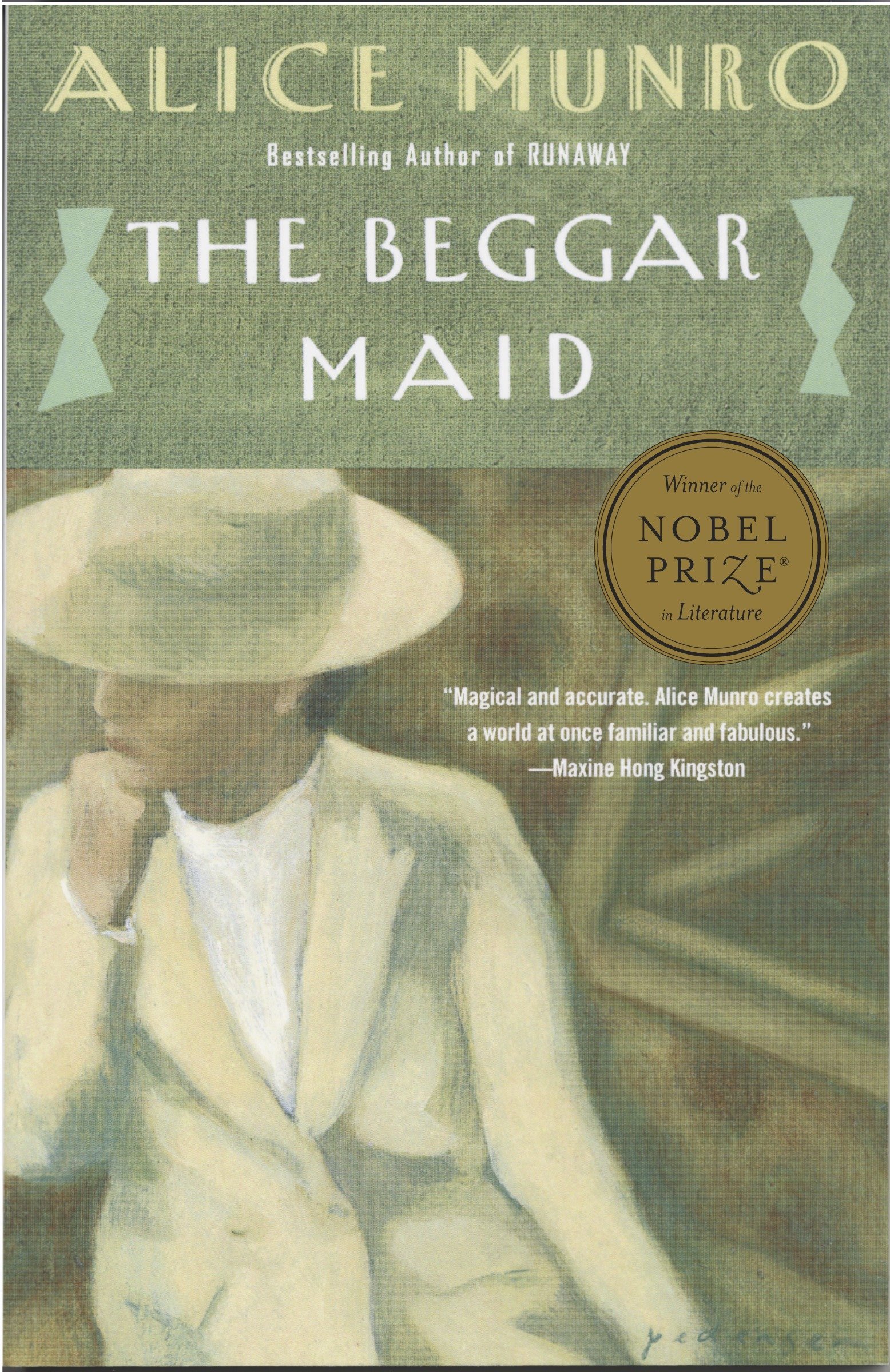
The Beggar Maid by Alice Munro

She could not turn Patrick down.  She could not do it.  It was not the amount of money but the amount of love he offered that she could not ignore; she believed that she felt sorry for him, that she had to help him out.  It was as if he had come up to her in a crowd carrying a large, simple, dazzling object--a huge egg, maybe, of solid silver, something of doubtful use and punishing weight--and was offering it to her, in fact thrusting it at her, begging her to take some of the weight of it off him.  If she thrust it back, how could he bear it?  But that explanation left something out.  It left out her own appetite, which was not for wealth but for worship.  The size, the weight, the shine, of what he said was love (and she did not doubt him) had to impress her, even though she had never asked for it.  It did not seem likely such an offering would come her way again.

Rose grows up, like all of Alice Munro's characters, in a little town in Ontario, this one called Hanratty.  It's not far from Toronto, but it sure feels far, and the first trip to Toronto is always a moment of mysterious ritual, a moment in which one's life changes for good.  It's a testament, I think, to Munro how similar Rose is to someone like Del Jordan from Lives of Girls and Women, but still so real and alive.  Nothing in her seems like a pale imitation.

The distinguishing mark given to Rose is her poverty.  Not that Del isn't poor, or essentially working class, but this collection of stories revolves around Rose's childhood poverty like an orbiting planet.  Poverty's at the heart of the stories that her stepmother Flo peddles about hard-luck locals: vigilante mobs, cruelly treated dwarves, incestuous siblings.  Reflecting on her stepmother, Rose maintains that poverty is the source of not just horror but also pride: "It meant having those ugly tube lights and being proud of them.  It meant continual talk of money and malicious talk about new things people had bought and whether they were paid for.  It meant pride and jealousy flaring over something the new pair of plastic curtains, imitating lace, that Flo had bought for the front window."

Rose ends up at school in Toronto, where she meets Patrick, the wealthy heir to a set of BC department stores.  Their love is no Romeo and Juliet story; it's an unflinching portrait of people whose capacity to understand each other is so limited as to doom their marriage from the very beginning.  Patrick romanticizes Rose's poverty, likening her to the Beggar Maid in a painting: "She studied the Beggar Maid, meek and voluptuous, with her shy white feet.  The milky surrender of her, the helplessness and gratitude.  Was that how Patrick saw Rose?  Was that how she cold be?"  The novel, or collection of stories, follows Rose through her tumultuous marriage and out the other side, after which she becomes a lonely and single actress and television presenter.  (So much of the latter stage of Rose's life seems like an alternate version of Juliet from the three-story cycle in Runaway.)  I particularly liked this observation about Patrick and Rose's daughter of Anna, a canny insight into the life of children of divorce:

Yet for Anna this bloody fabric her parents had made, of mistakes and mismatches, that anybody could see ought to be torn up and thrown away, was still the true web of life, of father and mother, of beginning and shelter.  What fraud, thought Rose, what fraud for everybody.  We come from unions which don't have in them anything like what we think we deserve.

Eventually, the story returns to Hanratty and Flo.  Of course, Rose's experience outside the world of Hanratty means she can never really go home again.  It's left her behind as much as she has.  Life in Hanratty has been pretty bitter for those who stayed, but it hasn't been a cakewalk for Rose, either.  Flo ends up in a home.  I loved this passage especially, about a blind old woman whose only way of interacting with the world is spelling words that she's given by a nurse:


There she was sitting waiting; waiting, in the middle of her sightless eventless day, till up from somewhere popped another word.  She would encompass it, bend all her energy to master it.  Rose wondered what the words were like, when she held them in her mind.  Did they carry their usual meaning, or any meaning at all?  Were they like words in dreams or in the minds of young children, each one marvelous and distinct and alive as a new animal?  This one limp and clear, like a jellyfish, that one hard and mean and secretive, like a horned snail.  They could be austere and comical as top hats, or smooth and lively and flattering as ribbons.  A parade of private visitors, not over yet.

Too good.  Like this woman, like Flo maybe, stricken with dementia, there is a great and painful loss in losing the knowledge and experience of your youth.  But maybe there's an opening, too, to see life as a child again, to remake and remold oneself.  Or at least, to believe that such a thing is possible.

Sunday, July 16, 2017

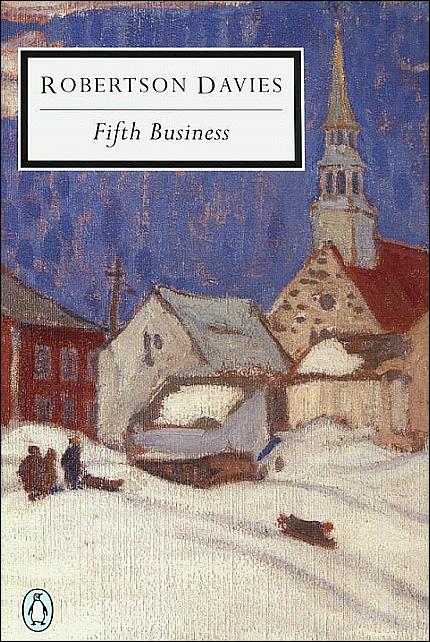
Fifth Business by Robertson Davies

This is one of the cruelties of the theatre of life; we all think of ourselves as stars and rarely recognize it when we are indeed mere supporting characters or even supernumeraries.

As a young boy, Dunstan Ramsay carefully evades a snowball thrown by a rival.  The snowball hits Mary Dempster, the pregnant wife of the small Ontario town's minister, and causes her to go into labor early.  She comes out of the labor in a state some might call "touched"--a kind of simplicity en route to madness that makes her the subject of the town's whispers.  Dunstan grows up feeling protective of her, and her son Paul, whom he teaches the rudiments of stage magic.  Paul grows up and leaves home to become a famous magician, while Ramsay becomes convinced that the near-mad Ms. Dempster is a kind of saint, complete with three miracles.  Meanwhile, the boy who actually threw the snowball, a rich kid actually called Boy, suppresses the act past remembrance.

Writing all that out, I'm struck by the fragile complexity of Robertson Davies' Fifth Business.  All that is really the set-up; the novel follows Ramsay through his entire life, first as an accidental war hero in World War I (one of Mrs. Dempster's "miracles" is appearing in the face of a Madonna at the battlefield at Passchendaele) and then a respected teacher and scholar on the saints.  But Davies has a true novelists' touch in plotting, and though it takes a long time for the form of the narrative to take shape, the snowball turns out to have serious and far-reaching consequences for both Paul and Boy that resonate throughout their lives.

And for Ramsay, too, but in a different way.  A woman tells him that he is a part of the "Fifth Business": the fifth character in an opera, separate from the two main couples, without whom the plot cannot function.  It's a sad idea, to think of yourself as a minor character in the story of your own life, but it comes with it a kind of power and a kind of freedom from the mechanisms of fate.  The novel ends as it begins, with Paul, Boy, and Ramsay, but Ramsay's peculiar position means he comes out of the scenario relatively unscathed by the ponderous history the two others share.

Fifth Business speaks also to the importance of myth and legend in the world.  Ramsay isn't really a war hero, except by accident, but he accepts the role when he wakes up in a European hospital, sans one leg, and tries to occupy it the best he can.  There's a moment where, having a medal pinned on him by the King of England, he feels a twinge of recognition and sympathy for the King: neither is quite what myth demands of them, but they recognize the importance of sustaining the myth for others.  This regard for myth becomes Ramsay's interest in the saints, and his desperate need to have Mrs. Dempster's sainthood recognized by others.  A priest tells him:

Oh, miracles!  They happen everywhere.  They are conditional.  If I take a photograph of you, it is a compliment and perhaps rather a bore.  If I go into the South African jungle and take a photograph of a primitive, he probably thinks it a miracle and he may be afraid I have stolen a part of his soul.  If I take a picture of a dog and show it to him, he does not even know what he looks like, so he is not impressed; he is lost in a collective of dogginess.  Miracles are things people cannot explain.  Your artificial leg would have been a miracle in the Middle Ages--probably a Devil's miracle.  Miracles depend much on time, and place, and what we know and do not know.

Miracles are conditional, Davies tells us, but that does not cheapen their value.  Instead, it should alert us to the possibility of miracles in the everyday, and resist the kind of shallow realism that thinks it can escape the importance of context.  Even when you're the fifth business--a supernumerary in your own story--miracles can still happen for you, and their meaning need not be validated by anyone else.

Sunday, May 15, 2016

Lives of Girls and Women by Alice Munro

People's lives, in Jubilee as elsewhere, were dull, simple, amazing and unfathomable--deep caves paved with kitchen linoleum.

One of the most fulfilling things about this project, for me, is the revelation that comes when you are totally blown away by a book or an author you had not expected.  Marilynne Robinson's Housekeeping was like that, and Penelope Fitzgerald's The Blue Flower, and so is Alice Munro's Lives of Girls and Women.  It's not just that these books are better than I had expected them to be, but that they remind me of how good books really can be; they belong, if you ask me, among the very best fiction the modern era has produced, and without this project I would have likely never have read them.  It's nice to have your suspicions confirmed--that there are great authors out there, still in a way hidden like veins of oil or ore, underground.  The fact that all three of them are women may be a coincidence, and it may be further evidence that women authors still lack the kind of cultural prestige they deserve.

I have to admit that the title of Munro's collection didn't compel me to read it.  Lives of Girls and Women brings to mind a lot of sentimentalist genre fiction, or something that might be adapted by the Lifetime Channel.  And to be sure, that is what the book is about.  The mother of these stories' narrator, Del Jordan, employs the phrase in a characteristic piece of advice:

"There is a change coming I think in the lives of girls and women.  Yes.  But it is up to us to make it come.  All women have had up till now has been their connection with men.  All we have had.  No more lives of our own, really, than domestic animals.  He shall hold thee, when his passion shall have spent its novel force, a little closer than his dog, a little dearer than his horse.  Tennyson wrote that.  It's true.  Was true.  You will want to have children, though."

That was how much she knew me.

What Del's mother says, of course, is true.  But in its dry, encyclopedic manner it fails to understand the experience of what it means to be a girl in love, and the deep attraction to the mystery of sex.  Del is smart and ambitious, but she in her turn falls in love with a local rustic named Garnet French.  Garnet is no intellectual match for Del, but he is raw and physical and she has her first intercourse with him in the yard outside of their home:

In the morning I went around the broken peonies and a little patch of blood, yes, dried blood on the ground.  I had to mention it to somebody.  I said to my mother, "There's blood on the ground at the side of the house."

"Blood?"

"I saw a cat there yesterday tearing a bird apart.  It was from a big striped tom, I don't know where it came from."

"Vicious beasts."

"You should come and take a look at it."

"What?  I've got better things to do."

Del knows, like her mother, that there is something deeper in the relationship between men and women than the stiff intellectualism her mother--who travels around the county selling encyclopedias--will allow.  She knows that this depth is part of a story that plays out timelessly even in the provincial Ontario backwater of Jubilee that is there home.  As she says in the passage I quoted above, the lives of people everywhere are like "deep caves paved with kitchen linoleum."  In this way she counters male critics who have no patience for stereotypically "feminine" writing (I'm thinking of V. S. Naipaul's dismissals of Jane Austen).  Munro knows that--for men as well as women--domestic life is just life, and that life itself has its profundity and mysteries wherever it is found.

The sexual themes of Lives of Girls and Women don't really appear until the second half, though, when Del is old enough to ponder them.  The first few stories of the book, when Del is younger, deal with old literary mainstays like family, death, and faith.  With a book this good, it's best, maybe to just get out of the way and let it speak for itself.  Here's young Del considering the corpse of a cow in the woods:

Being dead, it invited desecration.  I wanted to poke it, trample it, pee on it, anything to punish it, to show what contempt I had for its being dead.  Beat it up, break it up, spit on it, tear it, throw it away!  But still it had power, lying with a gleaming strange map on its back, its straining neck, the smooth eye.  I had never once looked at a cow alive and thought what I thought now: why should there be a cow?  Why should the white spots be shaped just the way they were, and never again, not on any cow or  creature, shaped in exactly the same way?  Tracing the outline of a continent again, digging the stick in, trying to make a definite line, I paid attention to its shape as I would sometimes pay attention to the shape of real continents or islands on real maps, as if the shape itself were a revelation beyond words, and I would be able to make sense of it, if I tried hard enough, and had time.

Another story, "The Age of Faith," is one of the best stories I've ever read about religious life:

If God could be discovered, or recalled, everything would be safe.  Then you would see the things that I saw--just the dull grain of the wood in the floor boards, the windows of plain glass filed with thin branches and snowy sky--and the strange, anxious pain that just seeing things could create would be gone.  It seemed plain to me that this was the only way the world could be borne, the only way it could be borne--if all those atoms, galaxies of atoms, were safe all the time, whirling away in Gods' mind.  How could people rest, how could they even go on breathing and existing, until they were sure of this?  they did go on, so they must be sure.

As Del grows older, these themes don't so much disappear as become incorporated into the themes of womanhood and sex, as if Munro is making us aware that death and faith are as much a part of that pair as anything else.  Like Fitzgerald, she peoples Jubilee with a set of distinct, fascinating characters--a literary feat that I think is often taken for granted, so difficult it is--and like Robinson, she understands and communicates the powerful death of ordinary life.  However removed our petty existences might seem from the most powerful mysteries of the universe, Munro says, in truth they are our only way of confronting them, and for that they deserve savoring.

Saturday, May 7, 2016

Tempest-Tost by Robertson Davies

In the production of every play there comes a low point of rehearsal, after which the piece climbs to whatever climax it is destined to reach.  There could be no doubt about it, the day Geordie killed the horse marked that point for The Tempest, as produced by the Salterton Little Theatre.

I brought two books with me on my Canadian trip: Anne of Green Gables, and The Fifth Business, by Thamesville, Ontario's favorite son, Robertson Davies.  Davies, like the Tragically Hip, seems to be one of those Canadian cultural icons that never quite made it across the border into the United States, so I was eager to find out what I had been missing.  But before I left, a coworker told me that her favorite Davies book was actually Tempest-Tost, about an amateur production of Shakespeare's The Tempest in a rural Ontario town, which is exactly the kind of thing I'm into, so when I found a copy of it in a used bookstore in Charlottetown, P.E.I., I figured I'd go ahead and read it instead.

Amateur theater is always marked by a measure of pretension.  Shakespeare is for all people, as Harold Bloom loves to say, but the puffed-up cultural cache surrounding him is at odds with the very idea of the amateur, and the image of small-town people taking themselves seriously as actors is ripe for satire.  In this Davies doesn't disappoint, but he also has a great sympathy for the people of Salterton--the fictitious Ontario town where Tempest-Tost, and two sequel novels, take place--who engage in petty vanities and squabbles against the backdrop of the production.

Davies reminds me of Penelope Fitzgerald in his ability to create a large cast of characters with highly individuated, and interesting personalities, though perhaps he doesn't have quite her subtlety or inventiveness.  There's Professor Vambrace, whose overinflated ego makes him perfect for the role of Prospero; Nellie Forrester, the head of the Little Theatre who takes herself, and the organization, far too seriously; Geordie Shortreed, the practical-joke lover playing Caliban who accidentally kills a beloved old horse by driving him over an exposed electrical cable; Humphrey Cobbler, the eccentric but canny musician who provides music for the play; the vain and idle, but oddly perceptive, Griselda Webster, playing Ariel, with whom half the rest of the cast falls in love.  One of my favorite minor characters is a busty young woman who most people just call "The Torso."

The main character, to the extent that the novel has one, is Hector Mackilwraith, a mathematics teacher who has little in the way of culture or artistic skill, but who chases a wild impulse to act, and takes the role of Gonzalo.  Hector has credited his success as a teacher, though his sphere is small, to "planning and common sense," which he applies to every situation.  Hector's the kind of guy who makes a pro and con list before he does anything, and the "con" column for his decision to take up acting includes entries like, "Couldn't take part of lover, clown or immoral person -- plays full of these -- Shakes often vulgar."  Davies makes it clear that Hector has no feeling or understanding for The Tempest, or art in general:

He found The Tempest somewhat baffling.  He had supported the suggestion that the Little Theatre present a Shakespearean play, for he was strongly in favour of plays which were "worth while"; it was widely admitted that Shakespeare was worth while.  But in what precise union of qualities this worthwhileness lay was unknown to him.  His first encounter with The Tempest was like that of the man who bites a peach and breaks a tooth upon the stone.

In the very first scene, for instance, there was a coarse reference to the Female Functions.  He read it again and again; he consulted the notes, but they were unhelpful; in spite of a conviction held over from school days that poets were people who hid their meaning, such as it was, in word puzzles it seemed clear enough that in this case Shakespeare meant to be Smutty.  Obviously this was a play to be approached with the utmost caution.  He might even have to change his mind about acting.

Hector doesn't change his mind, but when he, like many others, falls in love with the 19-year old Griselda, he discovers that even planning and common sense are little help in seducing a woman, or even understanding the profound suffering of love.  There are certain thematic overlaps there with The Tempest, but mercifully, that's it.  Davies declines to force parallels between the plot; there is no elderly statesman with a grievance against his brother, no cloistered young Miranda who is introduced to a "brave new world, with such people in it."  Instead, Davies mines the contrast between the grand drama of the play and the small-town players for humor and pathos.  Hector isn't a wizard, or a shipwrecked sailor, but his petty griefs are stirring enough in their own way.

Anyway, I'll end this review with a great paragraph, spoken to Hector by the musician Humphrey Cobbler, which I think is good advice and doesn't fit elsewhere in this post:

Well, allow me to introduce myself to you as an advocate of Ornamental Knowledge.  You like the mind to be a neat machine, equipped to work efficiently, if narrowly, and with no extra bits or useless parts.  I like the mind to be a dustbin of scraps and of brilliant fabric, odd gems, worthless but fascinating curiosities, tinsel, quaint bits of carving, and a reasonable amount of healthy dirt.  Shake the machine and it goes out of order; shake the dustbin and it adjusts itself beautifully to its new position.