Showing posts with label Manitoba. Show all posts

Tuesday, December 19, 2023

Wild Geese by Martha Ostenso

As she jogged along in the cart, her eyes idled across the flat, unsurprising earth that went on and on into the north with scarcely a perceptible undulation. Here was the bush land, without magnificence, without primitive redundance of growth, here was the prairie, spare as an empty platter -- no, there was the solitary figure of a man upon it, like a meagre offering of earth to heaven. Here were the little wood trails and prairie trails that a few men had made on lonely journeyings, and here the crossings where they had met to exchange a word or two. The sky above it all was blue and tremendous, a vast country for proud birds that were ever on the wing, seeking, seeking. And a little delicate wind that was like a woman, Jude thought to herself, but could in a moment become a male giant violating the earth.
The prairies of Manitoba: Lind Archer, having recently taken a job as a village schoolteacher, arrives to live with the Gare family. She finds them all--sons Martin and Charlie, daughters Ellen and Judith, wife Amelia--cowering under the thumb of the malicious Caleb Gare, a man who cares about nothing beyond his farm. Caleb has no intention of allowing any of his family to leave the farm; he wages a kind of psychological warfare against each one to keep them tied to the land, to enrich himself by holding onto their labor. For his wife Amelia, it means threatening to reveal that she is really the mother of the dashing young caretaker Mark Jordan, who believes he is the son of deceased gentlefolk. For daughter Ellen, it means keeping her away from her beau, Malcolm. Ellen submits meekly, but Judith has no intention of being like her sister: she, at least, fights her father at every turn.

Wild Geese, as I understand it, is a classic of "Can-Con." It won some kind of prize for its portrayal of the small farming villages of northern Manitoba, filled with Anglo farmers like the Gares, but also Hungarians, and Icelanders. At its best, it its reminiscent of Willa Cather's version of the American prairie, another remote outpost that turns out to be, in its own strange way, a crossroads of the world. In fact, Wild Geese seems to ask the question of what kind of place the Manitoba prairie will become: is it a land where Catholic Hungarians, Nordics, English settlers, and Cree Indians come together to create villages, governed by shared law and custom? Or is it a place where the law of the small stakeholder rules, where Caleb Gares go to exert their will on their dependents as much as the land, remote from the eye of the church and the law? (Wild Geese is actually a muddled book in this regard, as evidenced by Caleb's rather unbelievable assertion that he will have Judith tried in Winnipeg for tossing an axe at his head--though it rings true that the devilish Caleb would use law for his own ends, when possible.)

Wild Geese is reminiscent of Cather, but it hardly comes near Cather's Nebraska novels in quality. It resembles a lot of early 20th century fiction--including some novels of Cather's, to be fair--in its love of sheer melodrama. (Edna Ferber might be an even better American analogue.) Wicked Caleb is the book's most interesting and enduring creation, and the headstrong Judith is second, but the whole novel balances on an implausible secret of questionable import. Even allowing for the customs of a different time, it's hard to imagine the secret that Caleb hangs over the head of Amelia--that Mark Jordan, having recently attached himself to the beautiful schoolteacher Lind, was born out of wedlock--mattering all that much in the end. In fact, this "secret" seemed so weak that I kept waiting for some other secret to emerge, thinking that it couldn't be the entire story. The best part of the whole thing is probably when Judith throws that axe at Caleb's head, but such moments are few and far between. The ending, in which--spoiler alert--Caleb dies in a fire, sucked into his own precious mud, trying to save his flax, works more on a symbolic level than a practical one. 

Friday, November 27, 2020

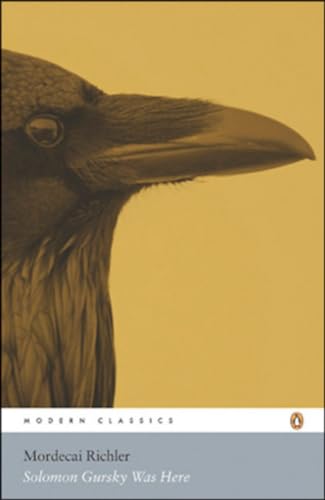
Solomon Gursky Was Here by Mordecai Richler

When Callaghan returned, he settled into his chair, reached for the bottle and said, "Let me put it this way. Canada is not so much a country as a holding tank filled with the disgruntled progeny of defeated peoples. French-Canadians consumed by self-pity; the descendants of Scots who fled the Duke of Cumberland; Irish the famine; and Jews the Black Hundreds. Then there are the peasants from the Ukraine, Poland, Italy, and Greece, convenient to grow wheat and dig out the ore and swing the hammers and run the restaurants, but otherwise to be kept in their place. Most of us are still huddled tight to the border, looking into the candy store window, scared by the Americans on one side and the bush on the other. And now that we are here, prospering, we do our damn best to exclude more ill-bred newcomers, because they remind us of our own mean origins in the draper's shop in Inverness or the shtetl or the bog. What was I talking about?"

"Solomon."

Moses Berger is consumed by two things: alcoholism and Solomon Gurksy. Solomon was--or is--a member of the infamous Gursky family, who rose from obscurity to conquer the bootlegging industry in Canada, eventually becoming powerful and respected men of business. Solomon, embroiled in a bitter rival with his brother Bernard, the company's CEO, died years before in a mysterious crash on his way to the Arctic. Moses, whose association with the Gurskys goes back to his childhood, when his poet father was hired as a speechwriter for Bernard, has become obsessed with the question of what happened to Solomon. Was he murdered? If so, by whom? And why was his body never found? And who's ominously leaving dead ravens everywhere, and is it the same person secretly buying up shares of Gursky stock under the name "Corvus?"

Solomon Gurksy is based on the real-life Bronfman family, who turned a bootlegging operation into the Canadian conglomerate now known as Seagram, one of the largest liquor companies in the world. But Richler takes an interesting story and turns it into an epic, stretching across the length of the Canadian continent and the breadth of history. The history of the Gursky family is inextricable from the history of Canada: Solomon's grandfather Ephraim, sources suggest, was a member of John Franklin's ill-fated expedition to find the Northwest Passage, and the only one who survived (by stowing away Jewish soul food, naturally, and avoiding the poisoned lead cans that drove the others insane). In the Inuit communities of Arctic Canada, Berger discovers, there are those who still go by the surname Gor-ski or Ger-ski, Ephraim's descendants. More surprising still, Ephraim seems to have inculcated in his Inuit friends a nascent branch of Orthodox Judaism.

We learn that, when Solomon was a child, Ephraim took him on a trip to the Artic Ocean from which Solomon was forced to return alone, without assistance or supplies. Solomon, if only in spirit, is Ephraim's true heir: an adventurous spirit, willing to do anything it takes to survive and advance. But it's Bernard who manages to muscle Solomon out of the way, supplanting him with a shrewder, more modern sense of business, where intrigue happens in the boardroom, rather than on the tundra, or in an illegal Manitoba distillery.

There's something of The Adventures of Augie March in Solomon Gursky: Bellow, though he was a Canadian Jew like Richler, tried to imagine a story that would weave Jewishness permanently into the American fabric. Richler does the same here for Canada: in Ephraim, Richler makes a European Jew one of the very first Canadian colonizers, for good and bad. (The way in which Richler insinuates Jewishness into Inuit religion may or may not be intentionally suspect; I'm not sure.) In Solomon, he illustrates the way in which the pioneering spirit of Jewish Canada is marginalized, attacked, and eliminated by social climbers who prefer to forget that Canada is the "disgruntled progeny of defeated peoples."

All this seems undeniably cool. So why did this book leave me so cold? Solomon Gursky, I felt, ends up far less than the sum of its parts, and there are so many parts. My description above leaves out at least two dozen semi-major characters: the third Gursky brother, Morrie; their father, Aaron; Berger's lovers Lucy and Beatrice; Solomon's son Henry, living as a devout Hasid in the Northwest Territories; Henry's  resentful son Isaac; Bernard's consigliere Harvey; Berger's mentor Hyman Kaplansky; several rough-and-tumble French Canadians; a customs inspector; a Chinese hotel owner in Alberta; a pair of North Carolinian furniture magnates; a bush pilot; I don't know who else. Richler jumps between the perspectives of these in a way that's meant to build tension around the novel's central mysteries, and to conceal important information for a later reveal, but which in practice I found utterly bewildering. I still have no real idea of why Moses was so obsessed with Solomon, and while I'm pretty sure I understand what happened to him in the end, if I'd have blinked, I would have missed it. Solomon Gursky may still be alive, but when he's in set down the middle of this Where's Waldo diptych of a novel, what does it matter?

In some ways, Solomon Gursky a pastiche made from Richler's other, better novels. Gursky himself is a version of the titular avenging Jew of St. Urbain's Horseman; the mystery of his murder isn't nearly as satisfying as the one in Barney's Version. Solomon Gurksy adds to these novels a sweeping, epic scale, but for me, it swept away much of what made those novel's work.