Showing posts with label Anishinaabe. Show all posts

Tuesday, January 10, 2023

Noopiming: The Cure for White Ladies by Leanne Betasamosake Simpson

Know this: After two years, the best parts of me are still frozen in the lake--my limbic system; its best friend, the prefrontal cortex; and the hollow, pumping organ in which I keep benevolence. The only one that regularly comes to visit it Akiwenzii. In the winter they park their truck on the ice, drill a hole with the auger in the ice and fish until the cold makes their bones crack. As soon as the ice is off the lake, Akiwenzii is back in their boat, with a torch and a sort of pitchfork for spearing pickerel. In the dead of summer, Akiwenzii sneaks back before first light in their canoe, before the cottagers and their jet skis are out. In the fall, they sprinkle tobacco around me and sing.

A figure named Mashkawaji lies frozen in a lake. Immobile, waiting, they watch their friends go about their lives. Each of these friends is also a representation of a part of Mashkawaji: the old man Akiwenzii is their will, the old woman Mindimooyenh their conscience, the maple tree Ninaatig their lungs, giant Sabe their marrow, Adik the caribou their nerves, and a pair of humans named Asin and Lucy, their brain. All these figures, who live in more-or-less contemporary urban Toronto, are described as "they," as Mashkawaji is, even when their gender is clear. They are all, in many ways, fluid, and the borders between their identities are porous. They are individuals, but also part of a whole, and Mashkawaji, perhaps, represents a way of being that binds them, one that is frozen, but waiting for a future in which the wholeness can be truly whole again.

Noopiming is what one might call "experimental" fiction. That describes the characters and their relationships--don't think too hard, for instance, about how a maple tree climbs aboard a boat, or goes shopping. But it also extends to the printed page: many of the pages of Noopiming are a single sentence long, oriented at the top of a long, blank page. This captures Mashkawaji's plodding, patient perspective, but I imagine it must have spurred some cost-benefit analysis at the University of Minnesota Press. The reader is forced to slow down, to take each idea as it comes, and not get caught up, perhaps, in the bustling urban life that surrounds the characters. It sits sometimes in pleasant tension with the novel's contemporary language, and sometimes exposes it as clunky or silly. And sometimes one turns the page to find pure cringe, as when we learn the old woman Mindimooyenh as her "notifications turned on for Palestine." OK.

Noopiming didn't quite work for me. I liked best the character Asin, who spends his days at Tommy Thompson Park on Toronto's Lake Erie Shore, birding. Asin is not interested in expanding his life list (to each their own), but they must rely on eBird like the other birders; they, unlike Akiwenzii and Mindimooyenh, have lost the natural connection to the cycles of the earth that would tell them when the birds will arrive and when they will depart. As the book expands, it takes on additional consciouses, like that of Esiban the porcupine. I liked the long(-ish) discussion by a group of Canada Geese planning for their migration. Though it's not said, we are perhaps asked to imagine that these, too, are manifestations of Mashkawaji, parts of the frozen whole.

Thursday, January 21, 2021

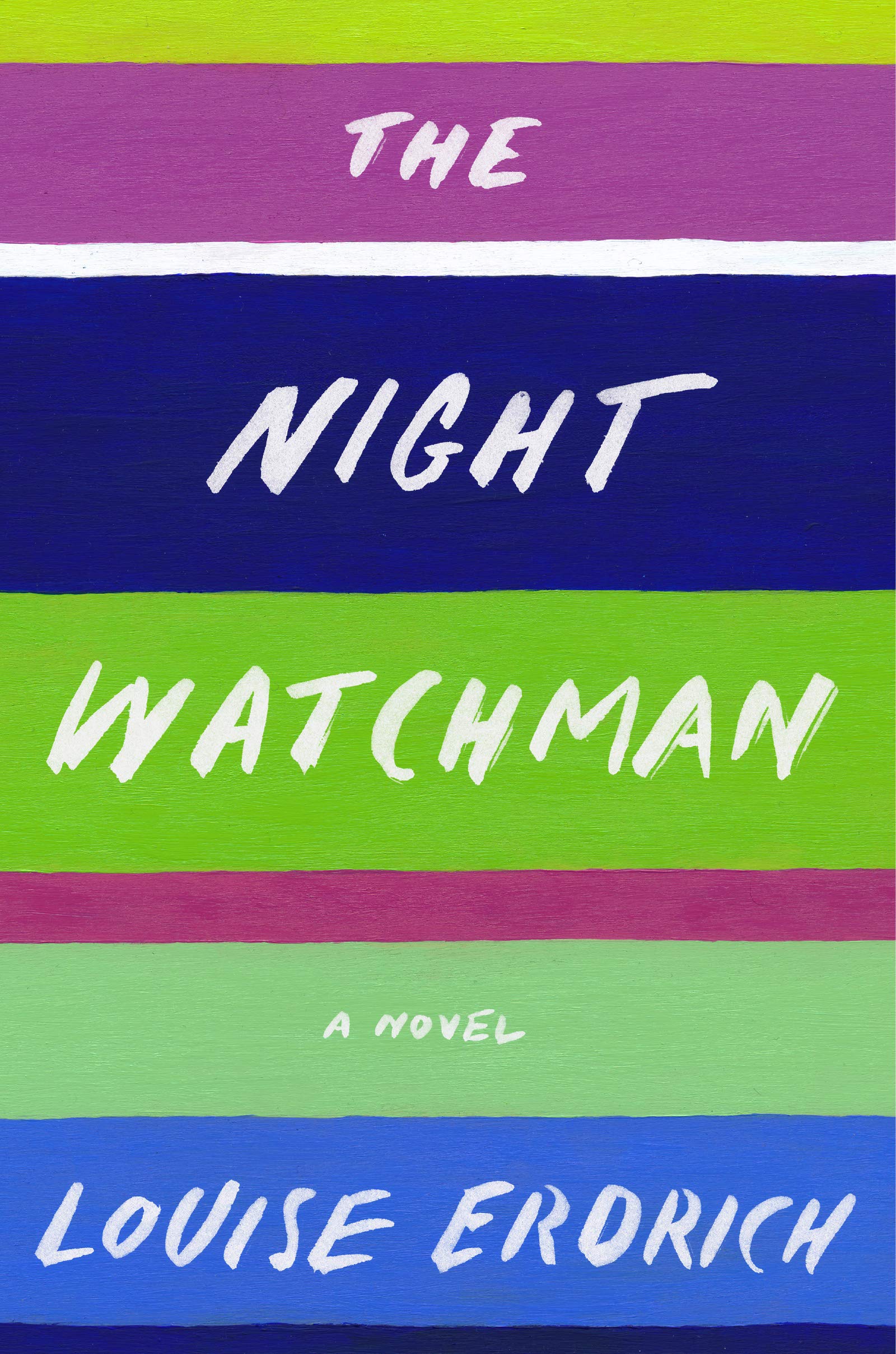
The Night Watchman by Louise Erdrich

He had been night watchman for seven months. In the beginning, his post as chairman of the Turtle Mountain Advisory Committee could be dealt with in the late afternoons and evenings. He'd been able to sleep most mornings after his shift. When lucky, like tonight, he even grabbed an additional catnap before driving to work. But every so often the government remembered the Indians. And when they did, they always tried to solve Indians, thought Thomas. They solve us by getting rid of us. And do they tell us when they plan to get rid of us? Ha and ha. He had received no word from the government. By reading the Minot Daily News, he'd found out something was up. Then Moses had to pry the papers out of his contact down in Aberdeen. It had taken precious time to even get confirmation, or see the actual House Resolution stating, as its author said, that the Turtle Mountain Band of Chippewa was targeted by the United States Congress for emancipation. E-man-ci-pation. Eman-cipaton. The word would not stop banging around in his head. Emancipated. But they were not enslaved. Freed from being Indians was the idea. Emancipated from their land. Freed from the treaties that Thomas's father and grandfather had signed and that were promised to last forever. So as usual, by getting rid of us, the Indian problem would be solved.

Overnight the tribal chairman job had turned into a struggle to remain a problem. To not be solved.

Thomas Wazhashk is the night watchman at a jewel bearing plant on the Turtle Mountain Reservation in North Dakota. His name means muskrat, the humble creature who, in Ojibwe myth, descended to the bottom of the waters that covered the world at its birth and retrieved a bit of earth when no other animal could. As night watchman, and as the reservation's part-time chairman--a thankless and unpaid role--Thomas is like his namesake, doing the unseen work that maintains the reservation and its residents. Thomas is about to face his, and the reservation's, greatest challenge in decades: termination.

In his history book The Heartbeat of Wounded Knee, David Treuer describes the Termination era as one of the epochs of Indian history after the Wounded Knee Massacre. It comes after the boarding school era, in which Indian children were forced to attend assimilationist schools that would expunge the Indian from them, and termination, too, is a kind of erasure: it would dissolve the reservation completely, forfeiting the responsibility for the land and its people to the state rather than the federal government, and relocating many of its impoverished residents to large cities. Termination, like so much shitty conservative policy today, was justified by arguments about self-reliance. "You learn to walk by walking," a pro-termination Senator tells Thomas on the Senate floor. Thomas thinks: "We didn't get to the Turtle Mountains by riding in a covered wagon." The hard work of countering termination--persuading the residents it's a bad idea, making petitions, commissioning studies--is Thomas' version of descending to the bottom of the waters of the world.

Though he's the title character, Thomas' story is often overshadowed by that of Patrice "Pixie" Paranteau, his niece and an employee at the jewel bearing plant. Patrice, dogged and determined, is worried about her sister Vera, who has disappeared into Minneapolis among pimps and addicts. On a trip to find her, it looks for a moment as if Patrice may follow into her footsteps, impulsively taking a job as an erotic dancer in a lumberjack-themed bar, where she's dressed as Babe the Blue Ox. (It's weird.) Vera's disappearance, and the threat to Patrice, are like sirens warning against what might happen if termination is allowed to go through: forced relocation to the city, to addiction, to crime, to dissolution. Returning home, Patrice's story becomes about her difficulty managing several suitors, including a charismatic Ojibwe boxer and a clueless white math teacher--but I didn't think these storylines had nearly as much energy or cleverness as her odyssey in the city, which ends, I felt, much too soon.

It's touching to know that Thomas is based on Erdrich's grandfather, who really was the night watchman at the jewel bearing plant, and who really did spearhead the campaign--a successful campaign--to save Turtle Mountain from termination. But it's Patrice who interests Erdrich most, I think, the headstrong young woman who is on the precipice of deciding who she is and what she wants. How could someone like Patrice do something like that, torn from the community in which she was born, where she knows the names and uses of the plants, where she lives with her mother by the "old ways," where she can sleep in a cave alongside a hibernating bear, where she can see the spirits of her ancestors as the Northern Lights in the sky? Thomas might be the novel's heart, but Patrice represents its stakes.

Erdrich's early novels and stories are interconnected, featuring a huge cast that appears and reappears from different angles in a way that make you feel as if you are deepening your understanding of them the more books you read. Her later work, like this novel and the two before it, LaRose and The Future Home of the Living God, seem like attempts to reproduce the breadth of those early books with fresh faces. Though it doesn't always work, and never as persuasively as in Tracks or The Bingo Palace, The Night Watchman is probably the most successful of these attempts. I hope she'll consider writing more about Patrice and Thomas, the humble muskrat.

Monday, January 20, 2020

Moon of the Crusted Snow by Waubgeshig Rice

"Yes, apocalypse!  What a silly word.  I can tell you there's no word like that in Ojibwe.  Well, I never heard a word like that from my elders anyway."

Evan nodded, giving the elder his full attention.

"The world isn't ending," she went on.  "Our world isn't ending.  It already ended.  It ended when the Zhaagnaash came into our original home down south on that bay and took it from us.  That was our world.  When the Zhaagnaash cut down all the trees and fished all the fish and forced us out of there, that's when our world ended.  They made us come all the way up here.  This is not our homeland!  But we had to adapt and luckily we already know how to hunt and live on the land.  We learned to live out here."

Evan Whitesky is an Anishinaabe man living on a reserve in Ontario's far north with his wife and children.  When the power goes out, he's a little annoyed, but used to it: living so far away, the tribal council is more than prepared to survive a few weeks, perhaps even the whole winter, without internet, without television, without food shipments from the south.  But when a pair of local boys who've been away studying in college arrive with stories of looting, violence, and social dissolution, everyone realizes this is more than a temporary outage.  The Anishinaabe (Ojibwe) on the reserve are suddenly an outpost of civilization in a world where civilization has disappeared.

Who said that indigenous people have already experienced all the things we are afraid of when we write post-apocalyptic fiction?  Pandemic, exile, violence, genocide, disappearance.  The elder in the passage above makes that explicit: our world ended, she says, when white Europeans destroyed the land and forced us northward.  But for Rice, and for Evan, the end of the world offers an opportunity also.  If the Anishinaabe on the reserve are to survive the winter, they'll need to rely on traditional ways of hunting and trapping.  At home, Evan's young children discover that they don't need the television to pass the time; suddenly they are more excited, curious, and fulfilled than ever.  Evan dreams of his children, all grown up and living on the land once again.  Moon of the Crusted Snow inverts the old historical tale; here, the end of the white world means rebirth for the Anishinaabe.

Into this promise comes a white man, Scott, looking for refuge from the world to the south--although you would think he'd be safe enough with the number of guns he's carrying.  (Why don't they demand he give up his guns in exchange for safe passage?)  Scott is brash, cocky, not entirely realistic, but he does animate the novel in a way it badly needs.  He's a representation of white violence and greed; although he promises to pitch in by hunting and trapping, he makes vague and insidious threats about finding other ways to keep from starving, threats we understand to be suggestions of cannibalism.  Evan dreams of him as a horrible, black-eyed monster, as the Wendigo.  Can one white interloper ruin the promise of the Anishinaabe's rebirth?

Moon of the Crusted Snow offers a compelling vision of the "apocalypse."  I don't take any joy in saying it, but I wish the writing were better.  To work, the novel needs to show in vivid, real-seeming detail how the Anishinaabe are different from their white neighbors to the south, but instead there are a lot of paragraphs like this one:

Despite the hardship and tragedy that made up a significant part of this First Nation's legacy, the Anishinaabe spirit of community generally prevailed.  There was no panic on the night of the first blizzard, although there had been confusion in the days leading up to it.  Survival had always been an integral part of their culture.  It was their history.  The skills they needed to persevere in this norther terrain, far from their original homeland farther south, were proud knowledge held close through the decades of imposed adversity.  They were handed down to those in the next generation willing to learn.  Each winter marked another milestone.

Too much of the novel seems like pamphletese, a primer on Anishinaabe life that says nothing of real substance because its primary function is not mimesis but public relations.  What's the use of a paragraph like this one, when the novel opens with a patient, plainspoken description of Evan stalking and killing a moose?  Those paragraphs say all the one above says and much more, and I wish the book had had more like them.