Showing posts with label North Dakota. Show all posts

Sunday, January 5, 2025

The Mighty Red by Louise Erdrich

After crossing the Red River sometime in the 1830s, a priest climbed a tree seeking a spot where he could safely observe an approaching herd of buffalo. There he witnessed a deranging spectacle--the buffalo stretched all the way to where they disappeared into the line between sky and earth. He was forced to stay in the tree for three days as they passed, passed and migrated, three days of horizon-to-horizon buffalo. He nearly died of thirst. 'You may judge now the richness of these prairies,' he wrote later. There was no end to the beasts. Just like it seems there is no end to us, in our billions. But everything on earth can be eliminated under the right conditions.

Kismet Poe is torn between two men: one is Gary Geist, a local football star whose chief attraction seems to be that he is desperately in love with her. His desperation, we learn, has something to do with a horrible accident that killed two of Gary's friends, and which Kismet's proximity seems to allay. The other is Hugo, an oafish redhead who works at the local bookstore. Hugo is sensitive, clever, kind, though he lacks some of Gary's sex appeal. Gary presses Kismet again and again, in quite coercive and abusive ways, into marrying him, but after the wedding, Kismet feels trapped in his parents' large farmhouse. In the margin, other crises rear their heads. Kismet's father disappears, leaving a mysterious mortgage on their property. And the dirt that has supported the local sugar beet crop--from which the Geists derive their fortune, and which supports just about everyone in the region--has become hostile through the overuse of pesticides.

Traditionally, I read fiction by Indigenous authors in January, to get into the mindset of my second semester senior class. In practice, that means I almost always start the year with Louise Erdrich, who is more or less unrivalled among Native American authors still writing in the U.S.A. Erdrich has been going through a kind of late period Renaissance lately, publishing a novel nearly every other year, winning the Pulitzer Prize. I was pleased to get to hear her read from The Mighty Red a few months ago in Brooklyn, and the church hall where she read was entirely full. And yet, The Mighty Red confirmed for me a feeling that Erdrich's late novels haven't quite matched up to her earlier ones, though they share much of the same superficial trappings. A couple of pivotal scenes in The Mighty Red, in which the parents of Hugo and Gary confront one another regarding Kismet's affections, take place at book clubs meetings. (Funnily, the first book is Eat Pray Love and the next The Road.) But it also gave me an unpleasant feeling that The Mighty Red is not unlike the kind of book you might read at a book club (sadly, derogatory).

It's hard to say why I felt this book was so unsatisfying. It might be that the most intriguing theme here--the depletion of the soil because of the deleterious practices of big agribusiness, which is linked to the kind of dystopian future captured in The Road--never gets fully drawn into the light. The central focus is on Kismet's mistake of marrying Gary, and while this story has its highlights, it left the book feeling sort of static and motionless to me, because of the way Kismet is borne along by Gary's desire, unable to assert herself or make any positive choices. A subplot in which Kismet's father, Martin, reappears as a bank robber who dresses in a different theatrical outfit--old lady, elf, nun--for each robbery points toward some of Erdrich's boldness and humor. Short chapters and quickly shifting vantage points left the book feeling rather unfocused to me, and I never really thought that Erdrich was able to bring together all the novel's various strands into something that felt whole.

This is the eleventh (!) of Erdrich's books that I've read. It's probably the least satisfying. But that's OK. It's always a pleasure to return to Erdrich's North Dakota, even if it's not the best of visits. One of my hopes is that sometime she'll return to the historical fiction that feels, at least to me, her strength.

Thursday, January 5, 2023

The Round House by Louise Erdrich

Nanapush looked into his mind and saw a building. He even saw how to make the building. It was the round house. The old female buffalo kept talking.

Your people were brought together by us buffalo once. You knew how to hunt and use us. Your clans gave you laws. You had many rules by which you operated. Rules that respected us and forced you to work together. Now we are gone, but as you have once sheltered in my body, so now you understand. The round house will be my body, the poles my ribs, the fire my heart. It will be the body of your mother and it must be respected the same way. As the mother is intent on her baby's life, so your people should think of their children.

When Joe Coutts his thirteen, his mother is attacked and raped. In the aftermath of the crime, she becomes skittish and withdrawn, a ghost of her former self. Joe's father, a tribal judge, sets out to find the perpetrator, scouring over the files of the people who have appeared in his court. Joe is allowed, sometimes, to share in his father's search, but for the most part he must look on from the outside, following his own suspicions, and perhaps even taking justice into his own hands. Though Joe's father tries to conceal it, suspicion soon falls on Linden Lark, a malicious white man who works for North Dakota's governor. There's a who, a what, and a why, but the where is what makes things hairy: Joe's mother was blindfolded, and can't remember where exactly the crime occurred, though she knows it's on the grounds of the round house the Ojibwe use for traditional purposes. These grounds are crossed by ornate lines of ownership--reservation land, federal land, private land--and without knowing the precise spot, no one know whose jurisdiction might be invoked to bring Lark to justice.

The Round House suggests at first it will be a kind of mystery novel, in which the reader is invited to follow along as Joe puts clue to clue. But, despite a false start or two, suspicion falls immediately on Linden, a man Erdrich paints as utterly vicious and amoral. The jurisdiction, instead, is the mystery, and it's an intractable one. The Round House presents a version of a story that plays out time and time again on reservations: when non-Natives commit violent crimes against Natives, tribal jurisdiction is powerless to pursue them, and state and federal lawmakers simply don't care. When Joe decides to punish Linden himself, he cuts through the red tape that protects violent rapists. And if we expect Joe to think better, or to disavow vigilantism in the end, we are sorely disappointed: there's no sense of regret or remorse here, because Joe's solution is the only one by which true justice can be done.

Talking in his sleep, Joe's grandfather tells the story of how Nanapush, the lustful, ancient trickster of many of Erdrich's other novels, built the round house on the instructions of the buffalo. The house is a symbol of the buffalo, whose hide and bones protected Nanapush in a snowstorm, and a symbol also of the mother, inside of whom we grow and who surrounds and protects us. When Linden rapes Joe's mother Geraldine, the violation is also a violation of Ojibwe sovereignty and memory, something that is depicted in The Round House as explicitly maternal. The round house is utterly unlike the land on which it sits: its value and ownership are clear and unambiguous. Perhaps this is why Linden chooses it to be the site of his violence.

There's another angle to Linden's story, which is rather convoluted: at birth, Linden's twin sister was left by his mother to die because of a birth defect. But instead she was adopted by a Native janitor, and enrolled as Ojibwe. Linda's story is an inversion of a more familiar one: Linden is helping the governor adopt a Native baby away from her mother. (It's this that seems to have sparked his ire against Joe's mom, a social worker.) Linden and Linda are part of the novel's interest in doubles, doppelgangers, wendigos, but the story also adds to the sense that The Round House is more relevant than ever. The questions of tribal jurisdiction are reflected in the recent McGirt decision, which asserted tribal jurisdiction over a huge section of Oklahoma. And the two adoptions presage a case currently in front of the Supreme Court that may strike down the Indian Child Welfare Act, meant to prevent the kind of child-snatching that Linden--dark father, evil twin--wants to perpetrate.

The Round House is one of Erdrich's straighter novels. Supernatural elements are few--though I enjoyed Joe's grandmother telling Nanapush's story in his sleep--and there's little of the sense of jubilant excess that you find in many of her other novels. But it stands among the best of her work in its depiction of cruelty and grief. And it isn't just limited to Lark: the moment where Joe himself blackmails his (unrelated) aunt to watch her strip is one of her more disconcerting moments. The aunt, Sonja, accuses him of being another vicious creep, another Linden perhaps, a wendigo who consumes human flesh. And the wendigo can take the form of anyone.

Friday, July 22, 2022

Northland by Porter Fox

At sunset, the sky turned dark blue. I tried to remember the color of the stones, the cool air, the auburn sunlight touching my forehead. I thought about the first day of the trip at West Quoddy Head in Maine and tried to memorize the dark spires, rounded massifs, and marshmallow flanks of Mount Baker's glaciers. I thought about all the parts of the northland--oceans, rivers, lakes, plains, cities, reservations, towns--and how they linked from east to west. It was indeed its own territory: a forgotten belt of wild, old America delineated by iron monuments, rock piles, and clear-cuts.

We ended our trip through the Pacific Northwest last week at the Peace Arch, a monument that stands on the border between the towns of Blaine, Washington and Douglas, British Columbia. A tall white arch stands in the middle of a green park that stretches between both countries, with the entry lines on either side of it, the Canadian to the left, the American to the right. The monument is supposed to be a monument to peace between the two countries; in the middle, there is a ceremonial gate attached to the wall below a sign that reads MAY THESE GATES NEVER BE CLOSED. Just beyond the arch, a sign on the Canadian side reads, "Park Closed."

We saw a woman enter idly from the Canadian side and walk to the American, where she was collected by an official looking man who might have been from either country and directed toward a booth, presumably to be sent off to a black site. A few feet away the park becomes a stretch of carefully tended flowers and picnic benches (and the Peace Arch Park Snack Shack) on the American side. On the Canadian side, the border follows a street where a row of houses look out in to America, their residents only needing to make a few steps out of their door to enter another country. These houses made the stern theater of the border crossing stations seem performative and silly.

Porter Fox ended his journey along all 4,000+ miles of the USA-Canadian border at the Peace Arch, too. By then, the peculiar logic that exists at the Peace Arch has appeared many times: the world's longest peaceful border has, since 9/11, become hardened in ways that have sundered communities and put an end to the free travel that was once common between the two countries. The "Park Closed" signs we saw were, no doubt, the vestiges of Canadian COVID-19 policy, which has hardened the border even more--in many places, trains still can't pass through it. But even a few years ago, when Fox took up the project of canoeing, hiking, boating, and driving from the border's eastern terminus in Maine to its western one in Washington, the border was increasingly contentious.

The thesis of Fox's book is that the area around the border has its own particular identity and existence, as a region he calls "The Northland." He wants to explore the Northland, a region that is, with some exceptions, remarkably rural and remote, and understand how the border has shaped this identity. He begins in Maine, canoeing along the St Croix river, then hitches a ride on a Great Lakes tanker that takes him all the way from Lake Erie to Lake Superior. From there, he drives across the oil-rich boomlands of North Dakota, making a quick and timely sojourn into the protest camps at Standing Rock, which are not really near the border--though the oil in the pipeline is. His journey continues along the "Medicine Line," as the Native Americans who were pushed across it in the 19th century call it, stopping in at the Blackfeet Reservation and through Glacier National Park. In the North Cascades, he sleeps in a fire tower, as Jack Kerouac once did, during one of his most prolific periods.

The book is part travelogue, part social commentary, part history. As Fox travels, he recounts the history of the border, which has always been a contentious one. The 18th and 19th century politicians who negotiated the border really had no idea about the geography of the land they were dividing, and time and time again, created impossible borders that would lead to more contention, and more need for tenacious explorers and surveyors. The creation of Minnesota's Northwest Angle, for instance, the little chopped-off bit on the other side of the Lake of the Woods, exists because the agreed border point--the headwaters of the Mississippi--is a hundred miles south of where the negotiators thought it was. Fox adds to this history a sympathetic portrait of Angle Inlet, the Angle's only community, where schools and businesses have closed over the last few decades because of the stubborn and increasing difficulty of crossing the border--twice. And similar stories are told in Maine and along the Great Lakes.

I appreciated Fox's focus on Native Americans, for whom the border takes on a special relevance. Fox's sojourn to Standing Rock fits uncomfortably with the book's overall thesis (I mean, Google it, it's mostly in South Dakota) but along with his stop at the Blackfeet Nation, it gives an effective portrait of the way the border was placed over the existence of tribal nations, and which has profoundly shaped their existence. Even before the Indian Wars of the 19th century, the border was an indigenous problem, as Fox explains in his recounting of the alliance between Jesuit explorer Champlain and the Hurons against the Iroquois.

We crossed the border four times on our trip: twice by airplane, once by boat, and once on the road. But we experienced only one small part of its four thousand miles. I loved reading Northland while on this trip because it gave me a sense of exploring something larger; not merely of stepping over an imaginary line but passing through a real place on which history works its considerable, sometimes transformative, sometimes brutal efficacy.

Thursday, January 21, 2021

The Night Watchman by Louise Erdrich

He had been night watchman for seven months. In the beginning, his post as chairman of the Turtle Mountain Advisory Committee could be dealt with in the late afternoons and evenings. He'd been able to sleep most mornings after his shift. When lucky, like tonight, he even grabbed an additional catnap before driving to work. But every so often the government remembered the Indians. And when they did, they always tried to solve Indians, thought Thomas. They solve us by getting rid of us. And do they tell us when they plan to get rid of us? Ha and ha. He had received no word from the government. By reading the Minot Daily News, he'd found out something was up. Then Moses had to pry the papers out of his contact down in Aberdeen. It had taken precious time to even get confirmation, or see the actual House Resolution stating, as its author said, that the Turtle Mountain Band of Chippewa was targeted by the United States Congress for emancipation. E-man-ci-pation. Eman-cipaton. The word would not stop banging around in his head. Emancipated. But they were not enslaved. Freed from being Indians was the idea. Emancipated from their land. Freed from the treaties that Thomas's father and grandfather had signed and that were promised to last forever. So as usual, by getting rid of us, the Indian problem would be solved.

Overnight the tribal chairman job had turned into a struggle to remain a problem. To not be solved.

Thomas Wazhashk is the night watchman at a jewel bearing plant on the Turtle Mountain Reservation in North Dakota. His name means muskrat, the humble creature who, in Ojibwe myth, descended to the bottom of the waters that covered the world at its birth and retrieved a bit of earth when no other animal could. As night watchman, and as the reservation's part-time chairman--a thankless and unpaid role--Thomas is like his namesake, doing the unseen work that maintains the reservation and its residents. Thomas is about to face his, and the reservation's, greatest challenge in decades: termination.

In his history book The Heartbeat of Wounded Knee, David Treuer describes the Termination era as one of the epochs of Indian history after the Wounded Knee Massacre. It comes after the boarding school era, in which Indian children were forced to attend assimilationist schools that would expunge the Indian from them, and termination, too, is a kind of erasure: it would dissolve the reservation completely, forfeiting the responsibility for the land and its people to the state rather than the federal government, and relocating many of its impoverished residents to large cities. Termination, like so much shitty conservative policy today, was justified by arguments about self-reliance. "You learn to walk by walking," a pro-termination Senator tells Thomas on the Senate floor. Thomas thinks: "We didn't get to the Turtle Mountains by riding in a covered wagon." The hard work of countering termination--persuading the residents it's a bad idea, making petitions, commissioning studies--is Thomas' version of descending to the bottom of the waters of the world.

Though he's the title character, Thomas' story is often overshadowed by that of Patrice "Pixie" Paranteau, his niece and an employee at the jewel bearing plant. Patrice, dogged and determined, is worried about her sister Vera, who has disappeared into Minneapolis among pimps and addicts. On a trip to find her, it looks for a moment as if Patrice may follow into her footsteps, impulsively taking a job as an erotic dancer in a lumberjack-themed bar, where she's dressed as Babe the Blue Ox. (It's weird.) Vera's disappearance, and the threat to Patrice, are like sirens warning against what might happen if termination is allowed to go through: forced relocation to the city, to addiction, to crime, to dissolution. Returning home, Patrice's story becomes about her difficulty managing several suitors, including a charismatic Ojibwe boxer and a clueless white math teacher--but I didn't think these storylines had nearly as much energy or cleverness as her odyssey in the city, which ends, I felt, much too soon.

It's touching to know that Thomas is based on Erdrich's grandfather, who really was the night watchman at the jewel bearing plant, and who really did spearhead the campaign--a successful campaign--to save Turtle Mountain from termination. But it's Patrice who interests Erdrich most, I think, the headstrong young woman who is on the precipice of deciding who she is and what she wants. How could someone like Patrice do something like that, torn from the community in which she was born, where she knows the names and uses of the plants, where she lives with her mother by the "old ways," where she can sleep in a cave alongside a hibernating bear, where she can see the spirits of her ancestors as the Northern Lights in the sky? Thomas might be the novel's heart, but Patrice represents its stakes.

Erdrich's early novels and stories are interconnected, featuring a huge cast that appears and reappears from different angles in a way that make you feel as if you are deepening your understanding of them the more books you read. Her later work, like this novel and the two before it, LaRose and The Future Home of the Living God, seem like attempts to reproduce the breadth of those early books with fresh faces. Though it doesn't always work, and never as persuasively as in Tracks or The Bingo Palace, The Night Watchman is probably the most successful of these attempts. I hope she'll consider writing more about Patrice and Thomas, the humble muskrat.

Monday, January 27, 2020

The Last Report on the Miracles at Little No Horse by Louise Erdrich

Father Damien was both a robber and a priest.  For what is it to entertain a daily deception?  Wasn't he robbing all who looked upon him?  Stealing their trust?  Shameful, perhaps, but Agnes was surprised to find that the thought gave her only satisfaction.  She felt no guilt, and so concluded that if God sent none she would not invent any.  She decided to miss Agnes as she would a beloved sister, to make of Father Damien her creation.  He would be loving, protective, remote, and immensely disciplined.  He would be Agnes's twin, her masterwork, her brother.

In 1996, Father Damien Modeste of the North Dakota outpost of Little No Horse, who has spent his life ministering to the Ojibwe who live there, is visited at last by a representative from the Church.  It's just a priest from nearby Argus, but that's all right; he's been writing to the Pope for decades now.  The visitor, another father named Jude Miller, has come to investigate the possible sainthood of a local nun, Sister Leopolda.  He pries into her history, but the history he gets is really that of Father Damien, who harbors a secret much more shocking that any miracle wrought by Leopolda: for nearly eighty years, he has really been a woman named Agnes.

Reading Erdrich's interconnected novels can sometimes feel like you've missed out on some essential, original text.  Who's Mary Kashpaw again, and how is she different from Margaret Kashpaw?  And who's just Kashpaw?  But there is no ur-text to guide you; you have to take these novels as pieces of the whole.  The more I read of them, the more satisfying they are, and the more these characters come into life for me.  The only one that has remained bell-clear is Nanapush, the lusty, elderly trickster who is modeled on the first man of the Ojibwe religion, Nanabozho.  In this book Nanapush dies of severe flatulence, but that hardly seems like a spoiler when he returns in so many other novels.  (Or given the fact that he "wakes up" twice, once to let out one more unholy fart, and then again to get laid one last time.)

Little No Horse is best read, however, next to Tracks, the first of Erdrich's novels that I ever read.  That book centers on Fleur, the beautiful and wild woman adopted by Nanapush.  I don't remember if Father Damien features much in it, but I do remember the murderously pious character of Pauline Puyat, who--as we learn in Little No Horse--becomes the famed Sister Leopolda.  Leopolda's reputation for holiness has spread throughout the church, but only Damien/Agnes understands the truth about her vindictiveness and her violence.

Damien/Agnes is drawn as an explicit contrast to Leopolda.  She may be a fake as a man, but not as a religious adept, having been a nun before the extraordinary circumstances that led to her donning the guise of Father Damien.  (I won't recount them, since they're not so material to the book as a whole, but they are really fun--some of Erdrich's best magical realism.)  She, too, is pious; her main worry in being found out is not damage to her personal reputation but the possibility that all the work she has done, the baptisms, the confessions, the sacraments, will be wiped clean as invalid.  Unlike Leopolda, who is only ever respected or feared, Damien/Agnes becomes loved by the Ojibwe--one of those who Robin Wall Kimmerer might compare to the plantain, or "white man's footsteps," a non-indigenous plant that integrates productively into indigenous ecologies.

Over time, in fact, something strange happens: as she lives among the Ojibwe, she finds herself being converted to the Ojibwe religion by friends like Nanapush.  Damien/Agnes calls conversion "a most loving form of destruction," which is true in both directions; while settler Catholicism threatens some of the most fundamental qualities of Ojibwe life, Damien/Agnes' conversion to the Ojibwe religion goes hand in hand with the dismantling of her old self and the creation of something new.  Though Erdrich is hypercritical of the Jesuitical severity of Pauline/Leopolda, she fashions in this novel and others a kind of convincing syncretism between indigenous and European religion.  Toward the end of the novel, Father Miller has a vision of world religion as a tree, "the branch of his own beliefs, the dogma and history of the Catholic Church not even a branch but a twig not strong enough for a bird to perch on, just a weak and slender shoot."

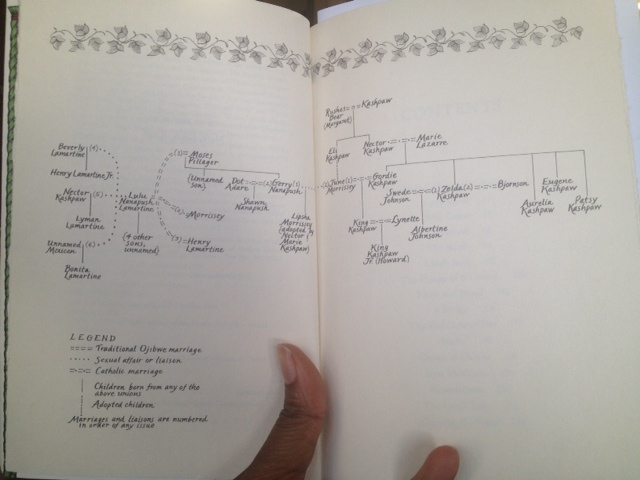
I think Little No Horse, along with The Bingo Palace, might be my favorite of the Erdrich novels I've read.  It's Erdrich at her funniest and most poignant, and her prose is at its most accomplished.  Its scale, which occupies eighty years of Damien/Agnes' life, allows a wider scope on the knotty genealogies that animate these novels, and create an epic tone that fits the magical realist elements perfectly.  I'm still thankful for the family tree printed on the flyleaf, though.

Monday, January 14, 2019

Love Medicine by Louise Erdrich

All through my life I never did believe in human measurement.  Numbers, time, inches, feet.  All are just ploys for cutting nature down to size.  I know the grand scheme of the world is beyond our brains to fathom, so I don't try, just let it in.  I don't believe in numbering God's creatures.  I never let the United States census in my door, even though they say it's good for Indians.  Well, quote me.  I say that every time they counted us they knew the precise number to get rid of.

One of my favorite stories to teach is Louise Erdrich's "The Red Convertible."  It's about Lyman Lamartine, a Chippewa in North Dakota, and his brother Henry who goes to the Vietnam War.  Before the war, Lyman and Henry co-own a beautiful red convertible that they take on a road trip to Alaska.  After the war, Henry is different, violent, darkened.  Lyman tries to bring Henry back to life by banging up the convertible, pretending he's neglected it, and letting Henry fix it.  For a while, it works.  But then Henry admits that he knew all along it was a ruse, and like all ruses it falls apart once named, and the car follows Henry into the river after he drowns.

It's a beautiful story and good for students.  It has a strong voice and a clear central image worth unpacking.  It has a clear beginning, middle, and end.  I like to use it to talk about narrative economy: no sooner does the hitchhiker they pick up tell Lyman and Henry she's from Chicken, Alaska, than they're up there: "We got up there and never wanted to leave."  2,500 miles compressed into three words--here's an author who knows what matters.  The story is as efficient as the convertible itself, and as familiar to me as the car is to Lyman.

I enjoyed seeing it with new eyes, then, in the context of Erdrich's debut collection, Love Medicine.  The back of the book calls it a novel, and you could make that argument, since the handful of stories here end up dwelling on a few events from different angles.  But maybe because I knew "The Red Convertible" first, I was unable to see it as anything but a collection of loosely connected stories.  It begins with "The World's Greatest Fisherman," in which June Morrissey--Lyman's cousin, if I'm reading the Byzantine family tree correctly--dies in a snowbank.  June's death brings together her large extended family, the Kashpaws and Lamartines all recognizable from Erdrich's other novels.  I found the cast of characters as difficult to keep straight here as in all those sequels--is Gerry the charismatic criminal who keeps escaping from the pen, or is that Gordie?--but I'm amazed how completely developed the whole set was from the very beginning.

If there's something like a central narrative to these stories, it's the love triangle between Nector Kashpaw, his wife Marie, nee Lazarre, and Lulu Lamartine.  As a teen, Nector is in love with Lulu, but a chance encounter with Marie, a white girl and ward of the local nunnery, hooks him for life.  Yet he returns to Lulu, even as an old man, and at one point sets her house on fire by accidentally dropping a cigarette ash into a love letter he's brought around.  It's the fire, not the snowbank, that the book really revolves around: we get to see it from the perspective of each of the three characters.  The title story, narrated by Lipsha Morrissey, the lucky and magical narrator of The Bingo Palace, is a masterpiece of high farce in which Lipsha's attempts to return the attentions of Nector, his now senile grandfather, to Marie from Lulu.  (Nector ends up choking to death on the turkey heart meant to snare him--I guess you'll have to trust me that that's funny.)  I liked Lipsha's canny observation about love among the elderly:

I saw that tears were in her eyes.  And that's when I saw how much grief and love she felt for him.  And it gave me a real shock to the system.  You see I thought love got easier over the years so it didn't hurt so bad when it hurt, or feel so good when it felt good.  I thought it smoothed out and old people hardly noticed it.  I thought it curled up and died, I guess.  Now I saw it rear up like a whip and lash.

I really like Lipsha's voice--casual, a little undereducated, but humble and wise.  It's part of what makes The Bingo Palace my favorite of the Erdrich novels I've read.  And it really sells "Love Medicine," as well as the final story, in which Lipsha is a third party to a tense standoff between his half-brother King and Gerry the escaped criminal (not Gordie) who is angry at King for snitching on him--and by the way is Lipsha's real father.  (See what I mean about the family tree?)  The image of the car comes back, this time a sportscar purchased with June's life insurance.  Lipsha wins the car in a card game, and drives Gerry to safety across the border, in a car suffused with the spirit of June, his mother.  It all feels a little bit like one of those vaudeville routines where ten minutes of setup is required for the punchline, but it's so elegant and effective you can't help but marvel at it.  And it works because Erdrich isn't hasty to get there; each story has its own cohesion and independence, but they build on each other in effect--would that final story be as effective if we hadn't the lovely character sketch of the three-hundred pound Gerry, who can disappear like a ghost when the cops come around, in the story "Scales?"

In the end the book's friability, the ease with which it can be separated into parts, ends up making it seem a little less than a novel.  The multiplicity of perspectives in Tracks and The Bingo Palace seems a little bit more to a purpose.  But perhaps it's more accurate to think of those novels as all part of a greater piece, like the stories here are also.

Wednesday, March 21, 2018

LaRose by Louise Erdrich

There are five LaRoses.  First the LaRose who poisoned Mackinnon, went to mission school, married Wolfred, taught her children the shape of the world, and traveled that world as a set of stolen bones.  Second, her daughter LaRose, who went to Carlisle.  This LaRose got tuberculosis like her own mother, and like the first LaRose fought it off again and again.  Lived long enough to become the mother of the third LaRose, who went to Fort Totten and bore the fourth LaRose, who eventually became the mother of Emmaline, the teacher of Romeo and Landreaux.  The fourth LaRose also became the grandmother of the last LaRose, who was given to the Ravich family by his parents in exchange for a son accidentally killed.

In all of these LaRoses there was a tendency to fly above the earth.  They could fly for hours when the right songs were drummed and sung to support them.  These songs are now waiting in the leaves, half lost, but the drumming of the water drum will never be lost.  This ability to fly went back to the first LaRose, whose mother taught her to do it, when her name was still Mirage, and who had learned this from her father, a jiisikid conjurer, who'd flung his spirit all the way around the world in 1798 and come back to tell the astonished drummers that it was no use, white people covered the earth like lice.

Landreaux Iron goes out one day to shoot a buck he's seen wandering around his property.  He misses the buck and instead shoots five-year old Dusty, the son of his neighbor and friend, Peter.  Overcome with guilt, Landreaux and his wife Emmaline return to the traditional ways of their Ojibwe community--the sweat lodge--and are given a solution: they must give their son LaRose, who was Dusty's friend, to Peter and his wife.

That's a killer setup, and it all happens in the first ten pages of so of Louise Erdrich's novel LaRose.  The boy at first is confused, unsure why he's suddenly been exiled from his family and absorbed into another.  But as it turns out, LaRose has a gift for kindness and rehabilitation, given to him as part of a long line of LaRoses, whose stories are woven throughout the book.  It is LaRose that helps Dusty's sister Maggie comprehend her grief, and LaRose who studiously watches over Dusty's mother Nola to make sure that she doesn't commit the suicide she is contemplating.  It doesn't take long before the two families work out an uneasy arrangement that essentially makes LaRose the shared son of both, and LaRose seems to accept it as his duty as peacemaker.  It's a long process, but you can see where it's going: it's LaRose that will bring these two families together and help them reintegrate, both within themselves and each other.

LaRose asks, how can we atone for what we've done?  It is, to borrow a Christian word that doesn't always fit the traditional Ojibwe religion of the novel, about grace.  The question plays out in the central narrative, but also in a number of subplots, including the sexual assault of Maggie and the jealous contrivance of a loner named Romeo to wreak revenge on Landreaux for a decades-old act of crueltyThe point gets made, but it's hard not to feel like the novel is overstuffed with these variations on a theme.  Would the novel have worked equally well without the presence of Hollis, Romeo's son, who Landreaux has raised for unclear reasons?  Probably.

I find that I like Erdrich's work best when it's historical in nature.  LaRose is set in the early 2000s and it reminds you of that fact by making repeated distracting allusions to the Iraq War.  Peter is a Y2K doomsday prepper, which might have been, but is not, a useful angle.  But most importantly, a tone of falsity creeps into the novel because of the material culture of the new millennium, perhaps because it accentuates an essential mundanity to the lives of these characters.  I mean, there's a whole passage that milks the drama of a girl's high school volleyball game, and it just doesn't work for me.  I don't know what makes that happen, but I don't think Erdrich is the only novelist who struggles to make the contemporary work.

In fact, the section of LaRose I found most compelling was the interstitial chapter that tells the story of Romeo and Landreaux, who escape from a white-run school for Native Americans and live with the homeless on the streets of Minneapolis in the 1970's.  Landreaux sees one of their teachers everywhere, thinking she's come to drag them back to the school which seeks to erase their identity, as if she stalks the earth like the spirit of white paternalism.  There's a lot about "Indian schools," actually; all the incarnations of LaRose seem to have been forced to attend one.  Perhaps the most powerful thing about the novel's investigation of grace is the idea that it might be projected onto a national scale, and applied to the broken and bloody relationship between the United States and her native peoples.

But at its heart, LaRose is about the possibility of healing between two families in the face of the most profound tragedy that any family can face.  It avoids bromides and easy answers even as it affirms that such healing really is possible.

Wednesday, September 6, 2017

The Bingo Palace by Louise Erdrich

He knew from sitting in the still eye of chance that fate was not random.  Chance was full of runs and soft noise, pardons and betrayals and double-backs.  Chance was patterns of a stranger complexity than we could name, but predictable.  There was no such thing as a complete lack of order, only a design so vast it seemed unrepetitive up close, that is, until you sat doing nothing for so long that your brain ached and, one day, just maybe, you caught a wider glimpse.

What does a Native American fiction look like?  Louise Erdrich's terrific The Bingo Palace answers that question with a lot of what seem like cliches: first, the Indian casino, here a bingo parlor where the protagonist, Lipsha Morrissey, works when he returns to his reservation town and rides an incredible streak of luck.  Second, there's a lot of mysticism, including dreamcatchers and a spirit animal in a vision--a skunk telling Lipsha, who's scheming to sell a plot of land where his grandmother lives to casino interests, this ain't real estate.  Oh yeah, that's the third thing: the importance of land, a theme imported from Erdrich's Tracks.

But those things aren't mere cliches; the idea of the Native American being close to the land is the cultural reward given to her for the wholescale theft of Native lands and the bottling-up of her people in reservations on little islands of land.  The spirit-skunk reminds Lipsha that Native land is important because it's what they've managed to hold on to, despite all odds, through centuries.  And the mysticism is not so different from the magical realism of Latin American writers (though more palatable for me personally), yet it imbues the old stale canards about Native Americans with new vitality and specificity.


When Lipsha returns home, he falls in love with an old acquaintance, Shawnee Ray.  Unfortunately for him, Shawnee Ray is living with Lipsha's uncle Lyman, the proprietor of the Bingo Palace, though she, too, feels a surprising attraction to the vagabond Lipsha.  He makes his money riding that luck-streak at the bingo parlor, and his luck is part of the same force that drives him and Shawnee together, despite the unlikely odds:

Fateful coincidence.  Things happen you can't deny.  Good advice speaks from graves and love hints from the hearts of trees.  Bags of light float through open windows on a summer night.  Horses count with the knock of their hooves.  Children are born who can add up unbelievable numbers.  These things happen.

Chapters narrated by Lipsha alternate with chapters about the "luck" of various members of Lipsha's family--Shawnee, Lyman, Shawnee's toddler son, Lipsha's dead mother, his convict father, his grandmother Fleur, one of the characters from Tracks--in which the luck, good or bad, is not always clear.  But the message seems to be that the spiritual forces that animate Lipsha's luck and his love for Shawnee are ones that run deep through one's ancestors, that they are enacted by the passing of generations.  There's little elegance to this structure--the book is a mess.  (It would be easier, perhaps, if one were to read the series from beginning-to-front, starting with, I think, Love Medicine.)  And it ends weirdly, cut off in a strange moment with little closure.  But it's unified by the subtle beauty of Erdrich's prose, often hovering just past the mark of clarity, and the sharpness of her insight.