Showing posts with label non-fiction. Show all posts

Thursday, July 16, 2026

Slouching Towards Bethlehem by Joan Didion

Later, when I was living in New York, I would make the trip back to Sacramento four and five times a year (the more comfortable the flight, the more obscurely miserable I would be, for it weighs heavily upon my kind that we could perhaps not make it by wagon), trying to prove that I had not meant to leave at all, because in at least one respect California--the California we are talking about--resembles Eden: it is assumed that those who absent themselves from its blessings have been banished, exiled by some perversity of the heart. Did not the Donner-Reed Party, after all, eat its own dead to reach Sacramento?

The title essay in Joan Didion's Slouching Towards Bethlehem precedes itself. About the hippie convergence on the Haight-Asbury neighborhood of San Francisco, it stands in for a popular recognition of the era's failures, and its curdling into something more dissolute and sinister. A step on the road from Woodstock to Altamont. And before reading it I had a general idea that it reflected in some way Didion's own brand of conservatism, which in turn reflected the nation's rightward turn as the ideals of the 60's petered out. But reading it, it must be said that what is most remarkable about it is the way that Didion absents herself from the narrative, declining to pass judgment or evaluation on the hippies with whom she's embedded, as if San Francisco were Fallujah. It is the hippies, instead, who implicate themselves, as with one couple whose faith in psychedelic drugs extends to doping up their toddler. Of course, this is all a kind of feint, a maneuver that reveals just how good a writer Didion really was--a way of hiding her hand. One must admit that, when some of the Haight-Asbury "Diggers" refuse to share information because they fear Didion to be a "media poisoner," that they have something of a point.

One point that Didion makes--or perhaps suggests by assemblage and arrangement, because she often demurs from making points as we typically think of them--is that the hippie movement was a children's movement. A considerable number of the people who converged on Haight-Asbury were literal runaways, and in Didion's telling, it seems to be this that gives the movement is sense of hope and energy, like a children's crusade. But Didion also depicts it as a children's world, bereft of adult pragmatism and sagacity. Even those adults who appear in "Slouching Toward Bethlehem," like the couple that give acid to their toddler, have a kind of childlike innocence, which is to say stupidity. "We were seeing the desperate attempt," Didion writes, "of a handful of pathetically unequipped children to create a community in a social vacuum. Once we had seen these children, we could no longer overlook the vacuum ,no longer pretend that the society's atomization could be reversed." Which is to say, yes, these people are idiot kids, but who let them out of the house?

One way of reading "Slouching Toward Bethlehem" is one vignette in a series of essays about California, along with "Some Dreamers of the Golden Dream," about a woman who may or may not have set her husband on fire in San Bernardino, and "Notes From a Native Daughter," an exploration of growing up and leaving Sacramento that is, I think, the collection's best piece. "John Wayne: A Love Song," another of the collection's highlights, is also a California story, though about the California that infiltrates our dreams through the engines of Hollywood. (Like the hippies, Didion gives Wayne and his hangers-on the rope to hang themselves; the image is of an aging star surrounded by sclerotic yes-men.) No doubt Didion writes best about California because it's what she knows best, but I think her best pieces are all about place, including "Letter From Paradise," which explores the way that the burgeoning tourist vision of Hawaii conceals a Hawaii that is deeply entangled with the military and the prospect of war. I also really enjoyed a typically acerbic essay called "Seacoast of Despair," about the grand mansions of Newport, Rhode Island. Didion's sense of place isn't unimpeachable--I thought her essays about the Southern U.S. in North and South were a strange misfire--but it must be said that she has a way of peeling back one understanding of a place to reveal something else underneath, whether it's California, Hawaii, Rhode Island, or Sonora, Mexico.

That said, I am developing an annoying and contrarian take on Didion that I think few will agree with: her fiction is better than her non-fiction.

Sunday, February 1, 2026

America, América by Greg Grandin

It is a maxim in both electrical engineering and international relations theory that power needs a ground. For a long many years, Latin America to the lightning-like United States: its persistent opposition to intervention and conquest, and its unwavering demand for the recognition of absolute national sovereignty, obliged Washington to learn how to discipline itself, to control its energies, letting its power flow more efficiently and evenly.

America, América, Greg Grandin's new history of the "New World," traces the history of both Anglo-America and Latin America together, instead of as separate histories. What would we learn, Grandin suggests, if we were to understand the forces that shaped the United States (and Canada) alongside the forces that shaped the rest of the Americas, from Mexico down to the tip of Patagonia? Should we understand the Spanish and English processes of colonizing the Americas as separate and distinct, or do they share certain important qualities that continue to tie their successor states together?

First of all, I appreciated the way that Grandin laid out the differences between English and Spanish colonization in ways that I have sensed but not been able to articulate. As Grandin describes it, as horrible and violent as the Spanish were--and they were very violent--Spanish colonial society identified a place for the Indigenous in its hierarchy, at the bottom, whereas English and later American colonies conceived of Indigenous people as outside the political order, thus needing to be either ignored or eliminated. You can trace a direct line from this distinction to the idea of mestizaje that dominates the self-conception of Mexico, in contrast with the reservation-and-sovereignty model of the United States. I was also very interested to read about how Spanish colonial society birthed the New World's first civil rights movement, spearheaded by Bartolome Las Casas and other Dominican priests. I had long heard of Las Casas as a kind of contrast to Columbus, and proof that it was possible even at the time to conceive of Indigenous rights, but I had no idea how powerful or influential, or, truly, courageous, he really was.

Las Casas' conception of Indigenous, even equal rights, were later picked up on by social reformers in the colonial Americas, like Marti and Bolivar. America, América does an amazing job showing how ideas of liberty and social change were shared by revolutionaries and thinkers on both sides of the Anglo-Latin divide--the book even opens by focusing on Francisco de Miranda, a Venezuelan who fought in the American Revolutionary War. In the crucible of the revolutionary 18th and 19th centuries, it was possible for people on both sides to imagine a transcontinental republic that would stand in opposition to the old ways of European monarchy. Sometimes that looked like Americans imagining a United States that encompassed Mexico, Central America, and the Caribbean, but sometimes it looked like a "Pan-American" republic that would be for all people. It's hard, reading America, América, to shake the idea that it was Miranda, Bolivar, and Marti who best epitomized the "Sons of Liberty" that we imagine in guys like George Washington.

Such Pan-Americanism failed to prosper in the United States, but it seems to never have really died in Latin America. In the latter portion of the book, Grandin describes how Latin America acted as a counterweight to the United States, birthing International Law and ideas of non-intervention and collaboration that would come to define 20th century. Grandin never quite spells it out, but it's easy to read a direct line from Las Casas to Bolivar to the Pan-Americans of the 20th century, who time and again did their best to force the United States to come to to the bargaining table and submit to treaties of peace and collaboration. Grandin puts heavy emphasis on a series of Pan-American conferences in the early 20th century that found brief success with Wilson and FDR, but later reaction produced the American-backed right-wing dictatorships of Pinochet, Somoza, and countless others.

One thing I liked best about America, América: Grandin skips over the stuff he thinks we already knows. The Cuban revolution, for example, gets basically skipped over as a footnote. Instead, we're treated to the story of Jorge Eliécer Gaitán, the Colombian socialist leader whose strange assassination (reminiscent, in its breeding of conspiracy theories, of JFK's) set off a violent reaction called El Bogotazo. I, of course, had never heard of that. Grandin does this again and again, treating lightly things he thinks his audience may know a little about already--the Civil War, the Republic of Texas, etc.--to focus on the things we don't. It's a bold strategy that asks a lot of his audience, but I thought it really made the book worth reading. 

Monday, January 26, 2026

Ice Rivers by Jemma Wadham

The entwining of spirituality and water intrigued me. I was very taken by the idea that glaciers and springs were the realm of living goddesses with the power to cleanse and give life--for I had recently started to catch myself wondering, while trudging through the landscapes of Patagonia, whether there might be something more, something beyond what I could see, touch and sense? In these icy wastelands I had at times felt close to some kind of vitality that was neither human nor born of the terrain--a playfulness in the breeze as it ushered clouds up and over the soaring peaks, or the momentary warmth from the sun as it rose to quell dark, cold shadows, or (occasionally) an almost animated presence lurking at the fringes of a glacier. These were fleeting moments, lasting a mere millisecond, but long enough to spark a sense that, just maybe, there was a higher being at work.

Glaciers, scientist Jemma Wadham explains, are really "ice rivers": masses of water that move, slowly but inexorably. Their "snouts" may melt and stay where they are, or, in the climate change era, retreat backward, but the ice itself is always moving forward, though it may seem to stand still even as you are standing on it. It's easy to see why glaciers, which seem so much larger than we can comprehend in time as well as space, might capture someone's imagination. Wadham's science-book-slash-memoir takes the reader from the Alps to Greenland to Patagonia to the Himalayas to Antarctica, detailing not only the different glaciers found there, but the kind of research that Wadham has done, measuring the flow of water through the glacier and looking for small microbial life that might leave deep beneath, at the bottom of glaciers.

I did find the glaciers fascinating. The book is also deeply personal to Wadham, who braids the stories of the glaciers with her own personal troubles, beginning with the death of her mother and continuing with a series of headaches and blackouts that culminate in emergency brain surgery. (The glossy inset photographs of glaciers also include a pretty gnarly pic of Wadham's neck and skull stapled back together.) I don't know if this kind of book started with H is for Hawk, but it certainly reminds me of it. Wadham even describes how, for a long time after the surgery, she was unable to write the kind of logical scientific prose required of a researcher, turning instead to creative writing of the sort that clearly produced this book. I could have used either a bit more of this autofiction or a bit less, but I don't want to nitpick; in the end, Ice Rivers manages to balance well the small life of one dedicated human and the larger life of the glaciers.

Sunday, July 20, 2025

A Sand County Almanac by Aldo Leopold

Conservation is a state of harmony between men and land. By land is meant all of the things on, over, or in the earth. Harmony with the land is like harmony with a friend; you cannot cherish his right hand and chop off his left. That is to say, you cannot love game and hate predators, you cannot conserve the waters and waste the ranges; you cannot build the forest and mine the farm. The land is one organism. Its parts, like our own parts, compete with each other and co-operate with each other. The competitions are as much a part of the inner workings as the co-operations. You can regulate them--cautiously--but not abolish them.

Aldo Leopold's A Sand County Almanac is one of those books that stands at the heart of the modern conservation movement. You might stretch it back further to Walden, but there is a kind of awakening in conservation--indeed, a kind of invention of the idea of conservation itself--that is invented in the mid-twentieth century, and A Sand County Almanac is one of its pillars, perhaps alongside only Silent Spring. It's interesting to read now, because much of what is there seems so familiar to us now, but I found there was a great deal in it that still felt fresh and invigorating. 

A Sand County Almanac is essentially named after the first of several parts. The first, titular section, is a series of essays that follow the months of the year at Leopold's humble farm in "Sand County," which is really the area around Madison, Wisconsin. The fields flood, the birds retreat and return, ice and snow form, wildflowers grow and die. The pleasure of this section is like the pleasure of exploring a landscape with someone who knows it very well, down to the smallest organism, and who knows moreover how that organism fits into the whole. One of the most impressive things about it is Leopold's ability to narrate backward from the state of a landscape: what assemblages of plants and animals indicate clear-cutting, or flooding, or different kinds of farming and harvesting. One of the most fascinating moments, in fact, is when he describes sawing down an old lightning-blasted tree, going through each ring and describing what was happening in the landscape of Wisconsin at that time, back hundreds of years. It's a nice reminder that history is more than just human history, that the landscape, too, has its own history, and it's a history that is legible to those who know how to read it.

The next section, "The Quality of Landscape," is arranged geographically, rather than annually, and takes the reader through a series of well-observed vignettes from Wisconsin to Iowa and Illinois, all the way down to New Mexico and Arizona, where Leopold was a forester who helped establish the Gila Wilderness, and even into Chihuahua and Sonora. But the most interesting stuff in the whole book, I thought, were the more polemic essays that come after, where Leopold lays down his theories of conservation, including the idea of a "land ethic." Leopold, a believer in progress, argues that human history is an exercise in developing superior ethics, that move from nationalism into democratic equality, and that the next necessary ethic that man must develop is a "land ethic" in which he recognizes himself as part of a larger ecosystem. Probably Leopold would be outraged by much of what we've done to the earth (how hard it is to read these old conservationists who had no idea what were doing to the climate), but I wonder if he'd see this as an idea that's been easily and widely accepted. Of course, we have our reactionaries, and they're definitely in charge right now, but it's crazy to read A Sand County Almanac and understand just how little purchase this kind of thinking really had.

For Leopold, exercising this "land ethic" begins with cultivating the kind of visual acuity and sensitivity that's so impressive in the first part of the book. "Like all real treasures of the mind," he writes, "perception can be split into infinitely small fractions without losing its quality. The weeds in a city lot convey the same lesson as the redwoods; the farmer may see in his cow-pasture what may not be vouchsafed to the scientist adventuring the South Seas. Perception, in short, cannot be purchased with either learned degrees or dollars; it grows at home as well as abroad, and he who has a little may use it to as good advantage as he who has much." Good words worth remembeiring.

Wednesday, June 25, 2025

They Flew: A History of the Impossible by Carlos Eire

What are we to make of such a saint or his levitations? And we are referring here to the saint, not the man. The saint can be encountered in many documents, but the man himself is much harder to find. Saint Joseph not only levitates more frequently than an other saint in Christian history but also rises higher off the ground. He not only hovers but actually flies--not just indoors, where it is relatively easier to employ wires or other props and fool people, but also outdoors, where such trickery is relatively more difficult or impossible. And he flies forward and backward too. Unlike Saint Teresa of Avila, whose levitations ceased after she complained to God about them, Joseph's gravity-defying ecstasies continued to occur up until the last few days of his life. Moreover, his levitations often point beyond themselves: while they are always carefully described as a side effect of sudden ecstasies brought on by God, rather than as events willed by Joseph himself, they often serve practical purposes and thus are much more than mere wonders.

They Flew, Carlos Eire's survey of flying miracles in medieval and Renaissance history, comes with a readymade pitch. If you've read a review of the book, you probably know it: Eire takes the flights seriously. That is to say, the book remains open to the possibility that what is said about those holy figures who were known to fly is true, and refrains from seeking alternative explanations, or a "true story." In some cases, as Eire explains, this is mere parsimony. As with the case of Saint Joseph of Cupertino, a 17th century friar, there are simply too many eyewitnesses not to remain open to the possibility. And perhaps to assume that the flights really happened is to deal with the people of the past on their own terms. Even Protestants and the skeptics of the Inquisition, Eire explains, believed that these miracles happened: the only difference is that they assumed it was the devil, not God, who gave people these powers. The impossibility of human flight as a rationalist stance simply was not in the cards. And yet, it might be said that this pitch is just that, a marketing ploy, and that the much-advertised credulity of the book only distinguishes it from alternative accounts in superficial ways. Still, it's a lot of fun.

They Flew offers up three case studies of flying saints: Saint Teresa of Avila, Saint Joseph, and Maria de Agreda, known as Maria de Jesus or simply "Sor Maria." Saint Teresa, in Eire's telling, was a reluctant levitator, prone to ecstasies of divine communion that lifted her off the ground, embarrassing her so totally that she eventually asked God to cut it out. Saint Joseph, Eire describes, flew much more often and more happily, but his levitations seemed to have been tied up with his simplicity and incompetence as a monk: they are the miracles of someone transported not by ambition or calculation, but pure joy in the Holy Spirit. It must be said that these are the only two "pure" levitators on which the book focuses; the third, Sor Maria, levitated in the process of "bilocation," in which she was transported during her ecstasies to the New World, where she ministered to the Indigenous people of Spain's New Mexican territories. Although I didn't feel that bilocation was quite within the thematic framework of "flying," I enjoyed Sor Maria's story the most. Later, the book deals with a certain number of "cheats" and frauds who confessed their flights were made with the help of demons, and then with more pointedly "wicked" levitators like witches.

These sections don't quite have the focus that makes the three case studies so engaging; I spent some time wondering when it was, exactly, that Eire was going to get to the parts about flying. But these sections do offer the opportunity to put the flying in a larger context about belief and our changing relationship to it, which might be said to be the "true" thesis of the book. The epilogue, for instance, argues for approaching history with certain post-rationalist or post-materialist methods that are, as Eire suggests, outside the mainstream. One thing that interested me among these discussions is how, far from being credulous, those who lived in the world of Teresa, Joseph, and Maria, could be skeptical in the extreme. All three were, in different fashion, mobbed by attention, both by their admirers and their detractors. The Inquisition, for instance, examined claims of miracles with great skeptical intensity. They would do things like lock nuns who claimed to be able to survive with no food but the eucharist (a common miraculous claim) in their cells until they revealed their fraud by nearly starving to death. In the case of Joseph of Cupertino, the saint's flights were such a political headache that the authorities shuffled him around from monastery to monastery, eventually shutting him up in a cell by himself and letting no one enter. Ironically, this skepticism emerges from an attitude, as Eire shows, of taking these possibilities seriously.

Eire points out that some of these flights are basically happening at the same time as the Enlightenment, and encourages the reader not necessarily to think of them as in tension, but part of similar fronts in a changing relationship to belief. Did they fly? Who knows. Why not. Maybe it doesn't matter. But as the book shows, their flights, "real" or whatever, had a political, cultural, and theological reality that reveals the fault lines of doctrine and power.

Sunday, June 15, 2025

Silk by Aarathi Prasad

I have heard it said that scientific study can take away a sense of wonder because science reduces a miraculous organism into mere mechanical parts. I have never found that to be true. Perhaps I find miracles in mechanisms. But however I looked at them--these insects, their metamorphosis, their silken threads--all were still miracula, true "objects of wonder." Over centuries, the transformation of insects through metamorphosis had proved so inexplicable a mystery, and the silks that came of it so extraordinary, that women and men have studied it with the kind of fervor that cost some their eyesight, others their health, and a few their lives. And yet it is an obsession that persists.

Silk is kind of weird when you think about it. That stuff comes from a bug's butt. But there's no arguing with results: few fabrics are as lustrous, or soft, and, as Aarathi Prasad describes in her book about the natural history of silk, strong: for a long time it was even used to stop bullets. Human beings have long known the value of silk, as attested by the fact that the silk moth, Bombyx mori, is one of the earliest known domesticated animals we have, going back thousands upon thousands of years. The humble silk moth lost its ability to fly in the process of domestication, and now exists, like cows and chickens, almost entirely at our service. But there are other silks than moth silk, and the most interesting parts of Prasad's book are actually about the attempts to farm silk from other organisms, most of which met insurmountable challenges: the fine hairs of certain mollusks, and the ultra-strong silk of spiders. (As it turns out, it's harder to farm spider silk at scale because, unlike moths, spiders like to eat each other.)

Prasad's book is organized by personality, rather than chronology. Each chapter highlights, more or less, an important personage in the production or understanding of silk. There's Maria Sibylla Merian, whose artistic renderings of silk moth cocoons helped us understand the transformation process of silk moths for the first time. There's René Antoine Ferchault de Réaumur, whose experiments with farming spider silk were so popular they were translated into Chinese for the emperor. And then, toward the end of the book, there are the modern researchers who are using the technology of silk to build stronger fabrics and materials for the modern age, including those using gene-splicing technology to produce spider silk in goats. What this organizing strategy lacks in chronological sense--I had a hard time separating out the where and when, because the chapters jump around in time as well as place--it makes up in human interest. For Prasad, the story of silk is the story of human beings, and specifically those obsessive scientists and naturalists who advanced our knowledge of the production and nature of silk--as opposed to, perhaps, a broader sense of the larger social dynamics of the silk trade.

What I enjoyed most about Silk is the way that it sits at the nexus of several different types of book: it's a history book as well as a natural history book, and it balances history and science well. Prasad is a skilled writer, and the book felt breezy and readable--for the layman. And it left me wanting to get my hands on a pair of spider-silk socks.

Thursday, June 5, 2025

Radio Treason by Rebecca West

It is undignified for a human being to the be the victim of a historical predicament. It is a confession that one has been worsted, not by a conspiracy of enemies, nor by the hostility of nature, but by one's environment, by the medium in which one's genius, had one possessed such a thing, should have expressed itself. As harsh as it is for an actor to admit hat he cannot speak on a stage, for an artist to admit he cannot put paint on canvas, so the victims of historical predicaments are tempted to pretend that they sacrificed themselves for an eternal principle which their contemporaries had forgotten, instead of owning that one of time's gables was in the way of their window and barred their view of eternity. But William Joyce pretended nothing at his trials. His faint smile said simply, 'I am what I am.'

William Joyce was better known among the British public as "Lord Haw-Haw," so named for the affected poshness of the voice by which he broadcast radio propaganda from Germany. Author Rebecca West, after the war's end, was dispatched to report on Joyce's trial, which ended pretty much as one might expect: Joyce was found to have been a traitor, and became the last person in Britain to be hanged for treason. For a minute, it looked as if Joyce might get off on what might be seen as a technicality: born to an Irish father in the United States, he may never have owed true allegiance to the crown, making his propaganda not technically treason. The prosecution argued that Joyce affirmed his allegiance when he took out a British passport, but the complicated nature of the argument--on both sides--seems to have generated more than a little public sympathy for Joyce, whose pathetic stature, along with the silliness with which Britons regarded the broadcasts, made his ultimate death sentence seem, perhaps, disproportionate.

West structures her book on Joyce in an interesting way: the trial and execution comes first, and only afterward does she back up to detail Joyce's life from the beginning. (This probably has something to do with the fact that, as the foreword describes, West wrote and published the account of trial first before continuing the book.) Joyce's life seems to have been unremarkable, but telling: the son of well-to-do Irish unionists, unable to find a place for himself in the world, or reproduce the success of his parents. A failed marriage, a scuttled military career. Joyce was attracted to fascism at an early age, and rose to a high position with Oswald Mosley's British Union of Fascists. Yet, even there, it seems he was largely disliked. How familiar does this sound? A man who may have grown up to believe that the world owed him success and prestige, and when these failed to materialize, turned toward a fascism that allowed him to punish and control others. A curdled patriotism, perverted to justify an attack on the very nation he professed to love--sound familiar? All he needs is the facepaint and the horned helmet, and Joyce is a January 6er.

I really enjoyed West's writing. I can think of many similar figures one might write a book about today, but it would be impossible to write them outside of a narrow journalistic style, overloaded with facts, figures, footnotes, quotes. And there'd be no space for the kind of thoughtful extemporizing of the kind that West makes so eloquently in the quoted passage, or the critical but forthright judgments that West passes on Joyce and his motives. The foreword (by Katie Roiphe) describes her as a kind of proto-non-fiction writer of the kind whose books we devour today, but I think there's something here that we've lost the ability to do. I probably would never have picked this book up on my own, but I got it in the first shipment of a subscription to McNally Press Editions my wife got me for my birthday, and I'm glad I did.

Tuesday, April 8, 2025

Animals Strike Curious Poses by Elena Passarello

Though his name is listed on the title of every Kinetoscope movie, it's unlikely Edison had much to do with the short films of Edison Studios. The War of Currents was basically over and alternating current had triumphed, so it's possible he had no clue about the plans to make Electrocuting an Elephant. The film is a minute-long, live short of the first elephant--and the second female of any species on the planet--to be condemned to electrocution for her crimes.

In the yards around Coney Island's Luna Park, the condemned elephant places each foot onto a copper plate. Once ignited with over 6,000 volts of alternating current, they smoke beneath her planted feet. The smoke rises around her body, her trunk goes rigid, and all five tons of her list forward.

The best part of Elena Passarello's Animals Strike Curious Poses, a collection of essays about animals given names by human beings, is "Jumbo II," a history of the elephant who was executed by Thomas Edison's motion picture studio at the turn of the century. In this essay, Passarello ties together several different currents--excuse the pun--that came together to result in Jumbo's execution. One such current is the history of elephants in the new world, another the adoption of electric current as a source of power. At the Pan-American Exposition in Buffalo, an attempt to electrocute an earlier elephant is botched; it's at the same exposition where President McKinley will shortly be killed by an assassin. That assassin, Leon Czolgosz, will end up in the electric chair himself, starring in a short film of his execution filmed by--of course--Edison studios. In this way, Passarello brings together those kind of rhymes that history bears, and captures a moment of American history marked by cruelty and violence as much as progress and scientific advancement.

The second best part of the book is a two-page sketch in which Koko the gorilla uses her sign language to deliver a version of the famously vile joke "The Aristocrats":

"Ingrid hole smoke-ring blow. Mother-gorilla hole blow harmonica. Father-gorilla dance, balloon-on-noodle. Baby-gorilla clowntime, balloon-on-tadpole. Ingrid hole smoke-smoke. Around together skateboard do--smoke noodle balloon harmonica ride all! Harmonica hole play 'Purple Rain' All MAYONNAISE RAIN! All finished! Thank you."

Mustache-man tell: "Wow. What name show?"

Father-gorilla tell: "WE WONDERFUL SNOB PEOPLE!"

A note in the back of the book informs that the essay is constructed by only using words that were in Koko's vocabulary. You might say something like, the essay shows us how communicative Koko was within the limits of her language, and reveals how closer animals are to the human than we sometimes think. But mostly, it's just really, really funny.

I didn't think every essay in Animals Strike Curious Poses worked. I was less patient with essays on Yuka the frozen mammoth, the Wolf of Gubbio that befriended St. Francis of Assisi, and Mike, the Headless Chicken. At times I thought the essays verged a little too much on the literary, when what I really craved was a much more straightforward explanation of who this animal was, which sent me more than once to Wikipedia. That said, some of the swinging-for-the-fences pieces are the most successful and interesting, as with the Renaissance-era poem about the cat Jeoffry which is missing, apparently, a left-hand side of the page, and which Passarello reinvents. Other animals that appear include wartime messenger pigeons, the horse that broke Christopher Reeve's back, Arabella, the spacefaring spider, and a maneating crocodile named Osama.

"Jumbo II" worked best, I thought, because in the end it had something to say: as the targets of human cruelty, animals often end up mixed up with our human histories in ways they may never really be able to understand. And yet, this fact entails upon us a kind of obligation to consider them more deeply than we do. Topsy--the "bad elephant" electrocuted at Coney Island--was put on trial much like the human being who killed the president, and yet our attempts to understand Topsy pale in comparison with our attempts to understand why a human being like Czolgosz would do such a thing. We name animals because we see in them reflections of ourselves, but perhaps we should try harder to see and understand them on their own terms.

Saturday, September 9, 2023

The Next Great Migration by Sonia Shah

Among migrants, Homo sapiens is king. And yet we have little consensus on why we move around the way we do. The findings of continuous migrations throughout our deep past have upended the idea that we moved only once in the past, attracted by empty lands, but have left the central question intact: Why? Why venture into the oxygen-starved Tibetan plateau or set off on outrigger canoes into the waves of the Pacific? Why leave the comforting certainties of life in Africa, where food and water and other resources abound to this day?

Just the other day, New York mayor Eric Adams declared that migrants, which the city has struggled to house and provide for, could "destroy the city forever." His words were roundly praised by neo-Nazis and white supremacists, and run-of-the-mill Republicans rushed to wag their fingers: even progressives are starting to realize that immigrants are a destructive force, invading our homes and mutilating our way of life. The rhetoric is shocking, but it's also tedious, because people have been saying exactly the same kind of thing for centuries, before New York was New Amsterdam. We are so familiar of this language of "invasion," as if people who want to live among us are actually conquerors, or perhaps viruses, but according to Sonia Shah's The Next Great Migration: The Beauty and Terror of Life on the Move, such language is rooted in the mistaken assumption that our borders mark static places that contain natural populations which "belong there."

Much of The Next Great Migration is devoted to an intellectual history of migration, both human and animal, starting with Carl Linnaeus, whose system of binomial nomenclature reflected a belief that animals are rooted to the specific environments in which he found them. It's impossible to read these chapters without marveling at just how stupid we've been for so long. We used to think that birds spent the winter underground, until a stork showed up in Germany with an African arrow through its neck--in the spring of 1822. What Shah does really well is trace an intellectual history that shows how anti-immigration ideology is inextricable from scientific racism. The conviction of Linnaeus and others that animals don't move, when applied to human beings, long enabled the belief that migration is an unnatural act undertaken by the malicious or the desperate, and would result racial hybridization and the loss of genetic white superiority. These ideas show up again in later maniacs, like eugenicist Madison Grant and overpopulation hawks like Thomas Malthus and Paul Ehrlich, and Shah shows pretty convincingly that they represent an ideological chain that goes all the way to modern-day goblins like Stephen Miller.

What archaeological and genetic evidence really shows, Shah explains, is that migration is a fundamental part of being human. The longstanding belief that modern populations are the descendants of ancient populations that did not move, or moved in brief spurts and never again, is totally backward: the world populations that exist today are the result of millennia spent moving in every direction and by any means. Ancient humans moved over long distances and across difficult barriers, across mountain ranges and immense seas, peopling, for instance, the islands of the Pacific long before mainstream thinkers thought such intentional seafaring was even possible. (And evidence keeps accumulating even since the publication of The Next Great Migration in 2020: a set of footprints at White Sands National Park strongly suggests that humans arrived in North America long before the opening of the Bering Land Bridge.)

What is so remarkable about The Next Great Migration, I think, is that it addresses the scientific racists--who are still quite numerous and influential--on their own terms. It would be easy enough to reject Linnaean claims that human beings make up discrete populations whose survival is threatened by easy migration by saying that human beings are not like other animals, but Shah situates the human capacity for migration specifically in the context of plant and animal movement. The implications of this rebound against not only immigration restrictionists but invasion biologists: movement is a crucial part of the ecological history of plants and animals as much as it is human beings, and our ideologies about "invasive species" may do no better representing the truth about ecosystems than ideologies about invasive human beings.

For Shah's presumably leftish audience, this has to be the most difficult part of the book to accept. But Shah is really persuasive in saying that what you accept about humans you have to accept about plants and animals as well. Just as immigration restrictionists--and Eric Adams--exaggerate the potential harms of migration and minimize the potential benefits, so we ignore that movement replenishes biodiversity. Even some of the most maligned invasives, like zebra mussels, turn out to be excellent at filtering and cleaning the water of the Great Lakes. All of that is not to say that we should ignore the risks of introduced species--especially in more self-contained ecosystems like Pacific islands--but that a smarter approach might be more discerning about what the risks really are, and from which species. It might be one that understands that plants and animals have always moved around the globe, even without the help of human beings, and it might jettison the creepy language and assumptions of the GOP.

It's hard to ignore the silent term in the title: The Next Great [Climate Change] Migration. The next century promises to be one in which the world changes, ecologically and politically, faster than ever before. To face it, Shah suggests, we'll need to let go of stale ideas. We will have to decide what it means for a plant to be "native" in an ecosystem that has gone from having a continental climate to a subtropical one. We will also have to figure out how accommodate the millions of people who will be on the move, doing what humans have always done, but perhaps in even greater numbers and a faster pace. Will we welcome them with a place to sleep, or razor wire? Will we fear them as destroyers or welcome them as neighbors? 

Saturday, April 15, 2023

Coyote America by Dan Flores

I've lived in the urban-wildlands zone--in West Texas, Montana, and now New Mexico--for much of my adult life, surrounded by coyotes in each location. Living among them, I have never felt a threat of any kind. They've functioned for me more as part of the occasional magic show of life, like whales breaching an ocean surface or the Galilean moons, glimpsed through a telescope, swinging around Jupiter over the course of a starry winter night. They coyote's remarkable resilience doesn't just put me in mind of us; it operates as shorthand for the greatest story ever told, the miracle of ongoing evolutionary adaptation to an endlessly changing world. Coyotes are the perfect expression of how life finds a way. They are also one of the iconic life-forms birthed in our part of the globe, an American original that makes us more American the more we know them. We and they are similar success stories in our shared moment on Earth. That's how I, at least, see the coyotes around me. How they see me, I can't know. But I do know this: when I make eye contact with a coyote, I can see the wheels turning inside her head. If I have a theory of mind, so does she.

Camping in the wilds of far west Texas last week, we were surrounded at night by the calls of coyotes from all sides. It's a little eerie, because the coyotes don't simply arrive at dusk. They were there the whole time, slipping through the open desert where you simply didn't notice them. At night they speak to each other, but it's almost as if they are speaking to you, reminding you they're there. As it turns out, I hadn't needed to go all the way to Texas to get a dose of coyote magic: while I was there, a coyote was fished out of the East River here in New York City. Coyotes now inhabit all the continental states, and they've become more prevalent over time, appearing not just in the rural parts of America but in its suburbs and urban centers. What does it mean to share our spaces, and our lives, with these animals?

Dan Flores' Coyote America is a "natural and supernatural" history of the coyote, perhaps even a kind of biography, rooted in stories of Native American religion, in which Coyote figures as a kind of wise trickster figure, and early American legends and tall tales. The Coyote of Indigenous stories is clever and shrewd; he overcomes his enemies and pursuers by the power of his intellect and wit, though he can also be sort of a clown. In Flores' description, this well fits the coyote as a natural specimen, which has been hunted doggedly by ranchers and government officials, but which has somehow managed to thrive no matter what we've tried to do to eradicate it. And I do mean eradicate: one of the things I didn't realize is that, during the late 19th and early 20th centuries, the U.S. Fish and Wildlife Service set out to extirpate the coyote as completely as it did the wolf. Millions of coyotes were killed in the west by poisons, but it is in the nature of the coyote to survive--even by naturally adjusting the size of its litter to compensate for the persecution.

The extent to which the United States government sought to eliminate an entire species seems shocking to a modern-day reader. We take for granted the perspective of early conservationists like Aldo Leopold, who believed that predator species have the right to exist, a purpose for which the early national parks were set aside. (I didn't know that either--wolves, coyotes, and bears seem to have had free reign within Yellowstone, Glacier, etc.) We know now, too, that eliminating predators monkeys with the balance of ecosystems in strange ways; in one area successfully voided of wolves and coyotes Flores describes roads slick with the roadkill of small mammals to the point where driving was made impossible. But mostly, we just never proved equal to the task of eliminating the wily canids. Flores hypothesizes that, by eliminating their senior competitor, the wolf, we actually set the stage for the coyote to fill in the vacuum and take over the whole of the United States. In any case, Flores draws a comparison between coyotes and human beings, two species marked by their profound adaptability, and, if urban coyotes are any sign, two species living closely intertwined lives.

I was really struck by a chapter on on the "threat" that coyotes pose to the red wolf, a small species of wolf that has been reduced to a couple dozen animals living in North Carolina's Great Dismal Swamp. Red wolves hybridize so easily with coyotes that the wolves' stewards have gone to extreme lengths, trapping and killing coyotes en masse to protect the red wolves' genetic purity. This struck me as a great example of the kind of oft-unthinking tradeoff that Emma Marris writes about in Wild Souls: if the wolves want to breed with the coyotes and vice versa, who are we to stop them, and how many coyote lives equal a reasonable cost? Flores goes on to note that genetic evidence suggests that red wolves, like their larger cousins, have a significant portion of coyote DNA already--that perhaps the hybridizing is not a kind of bastardization but a reflection of a pattern that is much older than we are. Like in all things, it's proof of the coyote's ability to adapt.

I didn't always love Flores' ham-fisted style, but I did enjoy the thoroughness with which Flores sketches the profile of a single species. Coyote America makes a convincing case that the coyote ought to be considered a kind of American icon: ancient, resourceful, clever, and brave.

Wednesday, February 1, 2023

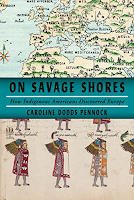
On Savage Shores: How Indigenous Americans Discovered Europe by Caroline Dodds Pennock

Once the first shocks of invasion were past, the Native men (and occasionally women) who crossed the Atlantic for political purposes were ordinarily not isolated pioneers striking out into the unknown. They were sophisticated diplomats, aware of the nuances of what we would all international law (the foundations of which were being laid in this period, often in response to the challenges of indigenous diplomacy), and able to draw on the experience and support of previous travellers, legal advocates and colonial officials.

I'm looking forward to when, in a couple weeks, my friends and I return to Ocracoke Island in North Carolina, where we've been going every February for over a decade. The island is already rich with history--it was the favorite haunt of Blackbeard--but when I go this time, I'll be thinking of a story Caroline Dodds Pennock tells in her history On Savage Shores: Manteo and Wanchese, two Croatan men who had traveled to England in the late 16th century to meet Sir Walter Raleigh and Queen Elizabeth I, were on their way home when, off the shore of Ocracoke, then called Wococon, their ship ran aground and begun to sink. "We can only imagine the feelings of Manteo and Wanchese," Pennock writes, "after nearly a year away, fearing that they would die only metres from the soil of their homeland."

Today, Manteo and Wanchese are the names of the two towns on Roanoke island: Manteo "nicer" and Wanchese, perhaps, more "rustic." There's something in that that matches the separate paths of their lives; Manteo stayed loyal to the English and their interests in the New World, whereas Wanchese turned against the English and fomented resistance among the Croatan. What must have Wanchese seen in England that turned him against his former friends? Was it, like a Powhatan man who accompanied Matoaka (Pocahontas) on her journey, that he was shocked by the abundance of corn and wheat among the English who putatively had arrived in North America looking for resources? Or, as many other Indigenous sources report on their sojourns, was he aghast at the rampant inequality among Europeans? Or was he simply feeling jealous of the greater prestige given to Manteo who--as I did not know, despite having learned all about Manteo and Wanchese as a kid in North Carolina--helped to create the first Algonquin alphabet while in England?

As Pennock shows, we often think about the arrival of Europeans in the New World as a one-way endeavor: they arrived, took root, did some rather dirty deeds, and stayed. Our historical narratives, too, tend to face from west to east, looking through the eyes of the Europeans at a strange world full of resources and plunder. Rarely do we think about how Indigenous people looked back at Europe, or what they saw when they traveled there. As they did, apparently, in numbers that might seem to us surprising. Pennock splits these narratives up into six categories: "Slavery," which tells the stories of those who were forcibly removed from North America and whose labor was exploited in Europe; "Go-Betweens," for those who, like Manteo and Wanchese, acted as interpreters and envoys for European colonizers; "Kith and Kin," for those Indigenous people who married into European families and their children, who inherited lineages from two hemispheres; "The Stuff of Life," about the many resources, including tomatoes, potatoes, and tobacco, that crossed the Atlantic during the Columbian exchange and those who supplied them; "Diplomacy"--rather self-explanatory--; and "Spectacle and Curiosity," which tells stories like the tale of the Inuk man who wowed crowds by fishing in the Thames with a spear.

Just to consider the chapter titles is to understand how diverse the experiences of Indigenous people in Europe were. Some arrived in chains, but others arrived in full regalia, and were treated--after some prodding--as the kings they were. On Savage Shores recently attracted some negative attention from the kind of people who are devoted to coloring-book notions of European colonialism. Too bad they didn't really read it, because if they had, they might have noted that several stories in Pennock's book resist easy lefty narratives about colonial violence. Many Indigenous people were quite happy to ally themselves to European power for assistance in conquering their local enemies; others were simply politically def. For example, the city of Tlaxcala was pretty Machiavellian in the way it used Cortes and the Spanish to bring down its rival, Tenochtitlan; the Inca ensured some measure of survival by doing what European powers did, marrying into Spanish families. Which is not to say Pennock is anything but clear about the horrors of colonialism; one of the book's great challenges is to tease out stories and voices that were intentionally elided from the historical record. While factually scrupulous, Pennock engages in a necessary amount of supposition--What must Manteo and Wanchese have seen? Of course, what the book's malcontents really object to is the inclusion of Indigenous voices at all.

Here's one specific thing I didn't appreciate until reading On Savage Shores: not only did the Spanish really get to the Americas before the English and French, their approach to the Indigenous people they found there was totally different. They weren't any less brutal, really, but Indigenous people were assimilated into Spanish society more readily than that of their northern rivals. Sometimes that meant forced enslavement--I was shocked to read about how many Indigenous slaves there were in Spain, and how often they sued for their freedom by arguing that their enslavement was illegal, not to mention how often they succeeded--and sometimes it meant intermarriage. That alone goes a long way in explaining the contemporary differences between American and Canadian relationship to Indigenous people and Mexican or Latin American ones. I had often wondered why Mexican culture values the idea of mestizaje--a shared Indigenous heritage--in a way that's totally foreign to us up here.

The best thing I can say about On Savage Shores is this: it's one of those history books that seems so obviously needed, you wonder why nobody's written it before. Its simple reframing--what did Europe look like through Indigenous eyes?--turns so much of what we think we know about history on its head.

Wednesday, November 16, 2022

Six Walks by Ben Shattuck

The idea to follow Henry David Thoreau's walks came while I was standing in the shower at dawn one May morning, listening to the water drill my skull and lap my ears, wondering what I could do to stop the dreams of my past girlfriend. This was years ago, in my early thirties, when I couldn't find a way out of the doubt, fear, shame, and sadness that had arranged a constellation of grief around me. In this last dream, the one that got me into the shower at sunrise, she was in labor. I dreamt that she had a husband--dark-haired, wearing a red shit with sleeves rolled to his elbows--show stood bedside, gripping her hand while she breathed. I stood against the wall, touching a white handkerchief I wanted to offer them.

My wife and I went to Cape Cod last weekend, her first time, my second. It stretches out in the shape of an flexed arm, with the long sand beaches of the Outer Cape running from the knuckle to the elbow. They are beautiful beaches, cream-colored running beneath tall ochre cliffs, looking out on an eternal sea dotted with gulls and eiders and kittiwakes as white and numerous as the little caps of the waves. You're guaranteed to see a seal, and if you're a little lucky, a whale. But only someone who is deeply strange, or deeply damaged, could imagine walking the entire stretch of the Outer Cape, someone like Henry David Thoreau, with a touch of the misanthrope. For Ben Shattuck, who sets out to trace Thoreau's footsteps, the walk offers a way to step out of oneself, out of the sleeplessness of a bad breakup and the chronic misery of Lyme disease. Shattuck is in a bad place when he starts his walk: at the Truro cliffs he eats a bar of clay like a hunk of chocolate.

The Cape Cod walk will become the first in a series of six walks that Shattuck takes, each in the footsteps of Thoreau, who recorded his walks in his journals. The second is a hike up Mt. Katahdin, the towering axe-head in Maine that lies at the terminus of the Appalachian trail. The third is an MDMA-laced trip to the top of Massachusetts' Wachusett Mountain, now a ski resort. The fourth is a walk from Shattuck's Massachusetts' home across the Rhode Island border, in the spirit of a walk that Thoreau took due southwest from his house, not knowing what he'll find. The fifth is a paddle up the Allagash River in far north Maine to a place where Henry camped, one of the few spots that seems to remain true wilderness, and the final one is a return to Cape Cod.

By the time Shattuck makes his return, his life is changed. The first three walks are records of misery, desperate attempts to outrun fatigue and depression. They seem often recklessly unplanned: Shattuck ends up spending the night with a pair of gracious Cape Codders who live near Thoreau's old property, but only by luck and happenstance. The MDMA on Wachusett mountain fails to bring the required transcendence, but it does lead to a moment of détente with a porcupine. But years pass between the first three walks and the second, and in the meantime Shattuck has conquered his Lyme disease and gotten a new girlfriend, an actress named Jenny who, as I was forced to curiously Google, turns out to be SNL alum Jenny Slate. (Honestly: Good work, Ben.) As Shattuck's life improves, the tone of the essays changes; the walks go from being flights from human life to deep engagements with the natural world.

Shattuck is a visual artist, and the essays are dotted with evocative black-and-white charcoal drawings of his walks. He brings an artist's visual sense to the landscapes he and Thoreau share: imagining the heart "the size of a chestnut" in the porcupine: "There's a heart at the center of all animals. Everything is soft underneath." In Henry's words: "A very suitable small fruit." There's the "black wedge" of a whale's mouth, and the way sunlight "raked across" the tops of Wellfleet houses. A coastline is "crenellated." And often Shattuck's language works in service of profound meditations on loss and grief: the most successful of the essays might be the Allagash one, in which Shattuck ties together an alien abduction reported in the area in the 1970's and Henry's loss of his own brother. Henry's guide, a Penobscot Indian named Joe for which Thoreau has little respect, also lost a brother, probably at the hands of whites, and agrees to serve as guide so he can go looking for him, but Thoreau is unable to cross the boundary of race to see a common kinship. These threads, along with Shattuck's own griefs and losses--chief among them the loss of a fingertip on his writing and painting hand--become a strong rope.

I really enjoyed Six Walks. I love reading books set in the places I travel to, and sometimes there is a resonance, but often not. Six Walks made me look at the Cape Cod landscape a little differently: I saw, standing on the thin fringe of beach, how someone might feel at the edge of their life there. I saw the cliffs at Truro, but I didn't stop to eat any of the clay. And I also saw how, standing with my wife and watching a seal roll around in the surf, how different it might be to be at that edge with someone loved.

Monday, October 10, 2022

The Park and the People by Roy Rosenzwieg and Elizabeth Blackmar

On October 13, 1857, just two weeks after the park dwellers left their homes, the Board of Commissioners of the Central Park offered prizes of four hundred to two thousand dollars for the four best proposals for "laying out the park." This notice for the first important landscape design competition in the United States elicited thirty-three varied proposals, which revealed the influence of English and continental traditions of landscape design as well as more eclectic vernacular ideas about what would make this public place appealing. But when the commissioners opened the proposals six months later, they found one curious entry. Plan 2 by an anonymous contestant was nothing but a pyramid.

I love Central Park. For a while, I worked basically on its doorstep: two short blocks after work and I was at the beautiful Onassis reservoir. I'm a little farther away now, but a short subway ride in the afternoon takes me to one of many favorite spots: the Loch, a creek of still green water running through the North Woods, or the Ramble, a bird-filled jumble of looping paths designed to let you get lost. These are my spots, but what I've always loved about the park is how it is many things to many people. Someone else might gravitate toward the Great Lawn, or the Sheep Meadow, or the Harlem Meer, or the Bethesda Fountain, or the Nature Sanctuary, or one of the tennis courts of ballfields, or Belvedere Castle or Delacorte Theater, or the zoo, or one of the two world-class museums fit snugly inside of it: the Metropolitan Museum of Art and the American Museum of Natural History. So varied is the immense park that it's almost a surprise to learn just how contested a space it has been since it's very conception, as historians Roy Rosenzwieg and Elizabeth Blackmar show in their history of Central Park, The Park and the People.

Rosenzwieg and Blackmar begin their history with the contentious political battle over the park's location and design. Central Park was very nearly not central at all: early politicos wanted a spot on the East River known as Jones Wood for the city's first park, going so far as snatching it from its wealthy owners by the force of legislative decree, but years of jockeying led to the abandonment of the Jones Wood site in favor of a truly "central" park, then located far uptown from the city center. The design contest that led to the selection of Frederick Olmsted and Calvert Vaux's Greensward plan is the stuff of legend, though Rosenzwieg and Blackmar note that Olmsted had been selected as the park's director before the contest had even begun, putting his thumb on the scale somewhat. Still, Olmsted was a young unknown at the time, and with the development of Central Park, he and his architect partner Vaux basically invented the field of landscape architecture.

In the latter half of the 20th century, the historians note, Olmsted's historical reputation has grown tremendously. And to be fair, much of what is so stunning about the park can be traced back to its original design: when walking through the Ramble, you are walking more or less through the park as it was first design, and the section first opened to the public, tracing history in a literal way. But the historians show how the contested nature of the park space can be traced back even to the rifts between Olmsted and Vaux. Olmsted put more pride in his position as the park's managing director than he did as its designer, and believed that a firm hand was needed in managing the public's use of the park, instituting a number of draconian rules, including a prohibition on walking on the park's grass. Vaux, for his part, had a more generous opinion of the public, and believed that a beautiful space like Central Park would inspire New Yorkers to be the most elevated versions of themselves.

It would be a little too neat to say that Olmsted was the avatar of future park stewards who felt it was their duty to defend the rustic nature of the park against the creep of recreational uses, or that Vaux was the avatar of those who imagined a changing park that reflected the value of public opinion. Both men rejected outright those designs that would turn the park into a popular "pleasure garden," a kind of pre-amusement park that was popular at the time. But Vaux's bohemian spirit seems to me in keeping with the best elements of Central Park, and it is undeniably true, though it really goes unsaid in the book, that Vaux doesn't get nearly enough credit for his contributions to the park's design: the Greensward plan is drawn in Vaux's hand after all, not Olmsted's. Even in his own era Vaux complained to Olmsted time and again that he wasn't being given the credit he deserved, and he seems to have been right.

In any case, both men (and especially Olmsted) remained in official positions at the park for most of the latter 19th century, defending their control, sometimes successfully and sometimes not, against the city's powerful Tammany Hall machine. In the 20th century, Olmsted's strong hand would be rivalled by Robert Moses, who opened up the park to playground and car traffic, and who ruled the city's parks department with an iron fist. In between Olmsted and Moses, the park remained in states of waxing and waning, of being well-funded and well-maintained, then underfunded and in disrepair. In either state, the park's use was always contested: should it host concerts? The Puerto Rican day parade? Political demonstrations? Presidential speeches? Museums? Restaurants? Ice skating and baseball? Horse-drawn carriages? Automobiles? And as Rosenzwieg and Blackmar show, these battles often emerged from larger, competing ideas of what the city should do and be. Even in its very beginning, one sees the specter of American political upheaval in the clearing out of poor New Yorkers (especially the black community of Seneca Village, only belatedly memorialized in the park) to build it.

The Park and the People was written in 1992. When it ends, the boathouse at Harlem Meer is still in disrepair. A shady businessman named Donald Trump has just swooped in to renovate the Wollman Rink. (Though the book mentions the Central Park jogger rape case, no mention is made of Trump's famous "Bring Back the Death Penalty" ad.) The historians wonder what the increasing prevalence of private partnerships for park maintenance will do to the park as a place for all people. (Yeah, how did the privatization push of the 80's and 90's work out for us?) The Central Park Conservancy is barely a decade old. How nice it would be to have an updated version that would trace the last thirty years of Central Park, which doubtless lies at the center of all our conflicts about gentrification and urban renewal. Of course, we might learn only what has always been true: that Central Park is the heart of New York City, for good and bad.

Wednesday, September 28, 2022

The Wichita Lineman by Dylan Jones

That, for me, is 'Wichita Lineman,' a song I heard as a boy that has stayed with me all my life. I like it now for the same reasons I liked it then. I liked it because it took me to places I hadn't been, to places nowhere near me, places unknown. It was a complete escape. It may have been a song full of longing, full of anxiety and want, yet to me it seemed to announce a vortex of calm.

I love "Wichita Lineman." Who doesn't? It's a perfect song: only sixteen lines long, but perfectly balanced, a song about loneliness and longing on the high prairie in which the wistful lyrics are matched perfectly by the sweep of the music itself. Dylan Jones calls it the perfect imperfect song, because it wasn't finished when songwriter Jimmy Webb sent a demo off to Glen Campbell to see if he liked it. Campbell, knowing a sure thing when he heard it, recorded it within weeks, not waiting for Webb to add to--or perhaps monkey with--what was already one of the finest country songs ever written. And it was huge. Campbell outsold the Beatles that year, 1968, largely thanks to the success of "Wichita Lineman." It's a song that seems divorced from the social upheaval that was coursing through the country in 1968, but it tapped into something timeless about the United States of America, a large and lonely place.

Dylan Jones' book is an ode to "Wichita Lineman," which Jones treasured as a child in the U.K. and only belatedly learned, after years of private regard, that just about everybody in the world likes it, too. The Wichita Lineman is a history of a song, of how the lightning got bottled, and to write that history Jones writes the history of the Webb and Campbell, two men who were thrust together by a kind of destiny. Both grew up poor, in the parts of the country that don't get covered in popular music--Webb in Oklahoma and Campbell in Arkansas--but the buttery polish of both men's styles was formed in the studios of Los Angeles. As Jones describes it, each man was to the other a kind of revelation: while still a young man in Oklahoma, Webb heard one of Campbell's songs on the radio, and was so struck he declared he'd write for the man with that voice one day. And he got his chance when Campbell, hearing a lesser artist's version of "By the Time I Get to Phoenix" on his own car radio, slapped the steering wheel and decided he could make it a hit. He did, but it's no surprise that the greatest collaboration between the two of them was the one that Webb wrote specifically with Campbell in mine. (Jones goes on, naturally, to discuss the longstanding partnership between them, which produced a small handful of masterpieces, like another favorite of mine, "Where's the Playground, Susie?")

One of the things I enjoyed most about The Wichita Lineman was learning the history of Campbell's career, which was even more far-reaching than I knew. As a member of the legendary session group called the Wrecking Crew, Campbell had a hand in half of the biggest popular hits of the 1960's; you can hear him playing guitar--he was known as a guitar virtuoso as well as a terrific singer--on "You've Lost That Loving Feeling" and "I'm a Believer." (In fact, because the musicians were rarely credited, it's impossible to know for certain how extensive Campbell's contributions were.) He played on Pet Sounds and briefly subbed for a post-breakdown Brian Wilson on tour with the Beach Boys, in exchange for which Wilson gave Campbell the song "Guess I'm Dumb," maybe his best song not written by Jimmy Webb. Webb, of course, is still alive, and his interview with Jones that ends the book helps put the song in its proper context, but there's a certain mysteriousness to Campbell's career that seems amplified now that he's dead.

As you might expect with any book about a single song, it feels a little padded. Jones' musical knowledge and passion are on display, and his reflections on how "Wichita Lineman" fit into his own personal musical history are part of what makes the book compelling. But you don't have to go far to find him suddenly going on about like, Neu! or Prefab Sprout for pages at a time. Perhaps you couldn't publish it, but one gets the sense that the book might have been better if, like "Wichita Lineman" itself, had done a little less. But I will say this: there just aren't that many songs you wouldn't get tired, if you had to read a whole book about them, of hearing on a loop in your head. That as much as anything is why The Wichita Lineman is successful.

Sunday, August 28, 2022

Jesus and John Wayne by Kristin Kobes Du Mez

Those lamenting evangelical's apparent betrayal of "family values" fail to recognize that evangelical family values have always entailed assumptions about sex and power. The evangelical cult of masculinity links patriarchal power to masculine aggression and sexual desire; its counterpoint is a submissive femininity. A man's sexual drive, like his testosterone, is God-given. He is the initiator, the piercer. His essential leadership capacity outside the home is bolstered by his leadership in the home, and in the bedroom. The responsibility of married women in this arrangement is clear, but implications for women extend beyond the marriage relationship. Women outside of the bonds of marriage must avoid tempting men through immodesty, or simply by being available to them, or perceived as such. Within this framework, men assign themselves the role of protector, but the protection of women and girls is contingent on their presumed purity and proper submission to masculine authority. This puts female victims in impossible situations. Caught up in authoritarian settings where a premium is placed on obeying men, women and children find themselves in situations ripe for abuses of power. Yet victims are often held culpable for acts perpetrated against them; in many cases, female victims, even young girls, are accused of "seducing" their abusers or inviting abuse by failing to exhibit proper femininity.

The evangelical church I grew up in prided itself on being "seeker friendly," which meant that, in practice, it avoided a lot of the topics that were otherwise important to the Southern Baptist Convention, of which it was a member, though it avoided having "Baptist" in its name--because that might scare away the seekers. We heard a lot about husbands and wives forgiving each other, and how to manage household finances, but sexual purity and the roles of men and women were not topics for the pulpit (which was really a Plexiglas lectern). But I got the message of complementarianism--that men and women are inherently different, and have different roles, usually with men at the "head" of the marriage--in other places, and at other times: at church camp, at retreats, in videos and books. It only took a couple of weeks of attending an evangelical church with me in college--a place I expected to be equally "seeker-friendly"--for my girlfriend at the time to hear that wives should submit to their husbands, and decide that she was done with this Christian stuff more or less for good. For my part, I didn't know what to do with these beliefs; they weren't important to me, nor did they make much sense, but I was never presented with any alternative.

Kristin Kobes Du Mez's Jesus and John Wayne is a history of the evangelical movement in the United States, and how its commitment to complementarianism, and a network of associated ideas about race and gender, were developed. One thing that Du Mez makes clear is that it might have been otherwise; even back in the heyday of arch-evangelical Billy Graham, a more liberal strain of evangelical Christianity--anti-war, pro-abortion, anti-segregation--competed for dominance. Individual evangelical leaders, including Graham himself, even mixed these strains, but with the election of Ronald Reagan, a more militant and sexist version of evangelicalism crowded out its ideological competitors.

In a way, I knew the broad strokes of this history, because I lived inside of it. But there are few things that Du Mez's book made me appreciate, which I'll list here in no particular order. For one, the title isn't just a catchy bit of alliteration; Du Mez persuades that the swaggering machoism of John Wayne really has served as a symbolic lodestar for the evangelical movement. (Every fucked-up Christian bestseller Du Mez describes and analyzes seems to name check him as an antidote to a "feminized" culture, or feminized Christianity, that they see as ascendant.) For Du Mez, Wayne, a misogynist and racist, thoroughly enmeshed with Hollywood and not particularly religious, becomes a kind of avatar for later evangelical icons like Reagan and Donald Trump. None of these men was Christian in any real sense, but through their appeal to aggressive masculine values, they captured evangelical hearts. It's a mistake, Du Mez writes, to think of evangelicalism as a specifically, or even particularly, theological movement; as these men show, its accompanying cultural values or as important, if not more.

Secondly, I was struck by how much much of a business the evangelical movement is. Ideologically, Du Mez traces evangelical roots back to Bruce Barton's The Man Nobody Knows, a 100-year old bestseller that imagines Jesus as an executive. Practically, the evangelical movement is driven by a handful of enormous corporate entities, some of which are non-profits, like James Dobson's Focus on the Family, but also mega-corporation Hobby Lobby and the Christian bookstore Lifeway, without which there is no evangelical movement, and which has immense power to push evangelicals in ideological directions by what it chooses to sell and promote.

Thirdly, I was really shocked by the enmeshment between the evangelical movement and the American military. I've always been aware of the way that the evangelical movement pushes "military values," though seeing all the seminars and bestselling books collected in on place, with their language about being a "warrior for Christ," is stomach-turning. More than that, though, I don't know that I had considered how the evangelical movement has captured the military. Du Mez presents a picture of the U.S. military and evangelical Christianity as mutually supportive entities: military values of violence, self-sacrifice, and authoritarianism are transformed by churches into a form of Christianity that the military then promotes among its members. Put this way, the culpability of evangelical Christianity in the worldwide violence wrought by the U.S. military after 9-11 is especially troubling.

Unsurprisingly, Du Mez's book has made her a popular target for evangelicals on Twitter, and elsewhere. But I had actually been expecting, and hoping for, something a little more polemical: though Du Mez's sympathies are not hidden, Jesus and John Wayne is mostly a straightforward history of an ideological movement. It does a great job of examining the way that patriarchal values came to be so defining of the evangelical worldview; on the topic of race--the book's subtitle is How white evangelicals corrupted a faith and fractured a nation--it actually has far less to say. (Which is fine, I think--perhaps a topic for another book.) But in the end, the facts speak for themselves: Du Mez devotes the book's final chapters to the recent spate of sexual abuse scandals that have rocked evangelical churches and their governing bodies, like the SBC. These victims, Du Mez shows, are not the victims of Christians who have "betrayed" their values, but Christians who have lived out the very patriarchal and violent values which the churches have embraced.

Friday, July 22, 2022

Northland by Porter Fox

At sunset, the sky turned dark blue. I tried to remember the color of the stones, the cool air, the auburn sunlight touching my forehead. I thought about the first day of the trip at West Quoddy Head in Maine and tried to memorize the dark spires, rounded massifs, and marshmallow flanks of Mount Baker's glaciers. I thought about all the parts of the northland--oceans, rivers, lakes, plains, cities, reservations, towns--and how they linked from east to west. It was indeed its own territory: a forgotten belt of wild, old America delineated by iron monuments, rock piles, and clear-cuts.

We ended our trip through the Pacific Northwest last week at the Peace Arch, a monument that stands on the border between the towns of Blaine, Washington and Douglas, British Columbia. A tall white arch stands in the middle of a green park that stretches between both countries, with the entry lines on either side of it, the Canadian to the left, the American to the right. The monument is supposed to be a monument to peace between the two countries; in the middle, there is a ceremonial gate attached to the wall below a sign that reads MAY THESE GATES NEVER BE CLOSED. Just beyond the arch, a sign on the Canadian side reads, "Park Closed."

We saw a woman enter idly from the Canadian side and walk to the American, where she was collected by an official looking man who might have been from either country and directed toward a booth, presumably to be sent off to a black site. A few feet away the park becomes a stretch of carefully tended flowers and picnic benches (and the Peace Arch Park Snack Shack) on the American side. On the Canadian side, the border follows a street where a row of houses look out in to America, their residents only needing to make a few steps out of their door to enter another country. These houses made the stern theater of the border crossing stations seem performative and silly.

Porter Fox ended his journey along all 4,000+ miles of the USA-Canadian border at the Peace Arch, too. By then, the peculiar logic that exists at the Peace Arch has appeared many times: the world's longest peaceful border has, since 9/11, become hardened in ways that have sundered communities and put an end to the free travel that was once common between the two countries. The "Park Closed" signs we saw were, no doubt, the vestiges of Canadian COVID-19 policy, which has hardened the border even more--in many places, trains still can't pass through it. But even a few years ago, when Fox took up the project of canoeing, hiking, boating, and driving from the border's eastern terminus in Maine to its western one in Washington, the border was increasingly contentious.

The thesis of Fox's book is that the area around the border has its own particular identity and existence, as a region he calls "The Northland." He wants to explore the Northland, a region that is, with some exceptions, remarkably rural and remote, and understand how the border has shaped this identity. He begins in Maine, canoeing along the St Croix river, then hitches a ride on a Great Lakes tanker that takes him all the way from Lake Erie to Lake Superior. From there, he drives across the oil-rich boomlands of North Dakota, making a quick and timely sojourn into the protest camps at Standing Rock, which are not really near the border--though the oil in the pipeline is. His journey continues along the "Medicine Line," as the Native Americans who were pushed across it in the 19th century call it, stopping in at the Blackfeet Reservation and through Glacier National Park. In the North Cascades, he sleeps in a fire tower, as Jack Kerouac once did, during one of his most prolific periods.

The book is part travelogue, part social commentary, part history. As Fox travels, he recounts the history of the border, which has always been a contentious one. The 18th and 19th century politicians who negotiated the border really had no idea about the geography of the land they were dividing, and time and time again, created impossible borders that would lead to more contention, and more need for tenacious explorers and surveyors. The creation of Minnesota's Northwest Angle, for instance, the little chopped-off bit on the other side of the Lake of the Woods, exists because the agreed border point--the headwaters of the Mississippi--is a hundred miles south of where the negotiators thought it was. Fox adds to this history a sympathetic portrait of Angle Inlet, the Angle's only community, where schools and businesses have closed over the last few decades because of the stubborn and increasing difficulty of crossing the border--twice. And similar stories are told in Maine and along the Great Lakes.

I appreciated Fox's focus on Native Americans, for whom the border takes on a special relevance. Fox's sojourn to Standing Rock fits uncomfortably with the book's overall thesis (I mean, Google it, it's mostly in South Dakota) but along with his stop at the Blackfeet Nation, it gives an effective portrait of the way the border was placed over the existence of tribal nations, and which has profoundly shaped their existence. Even before the Indian Wars of the 19th century, the border was an indigenous problem, as Fox explains in his recounting of the alliance between Jesuit explorer Champlain and the Hurons against the Iroquois.

We crossed the border four times on our trip: twice by airplane, once by boat, and once on the road. But we experienced only one small part of its four thousand miles. I loved reading Northland while on this trip because it gave me a sense of exploring something larger; not merely of stepping over an imaginary line but passing through a real place on which history works its considerable, sometimes transformative, sometimes brutal efficacy.

Wednesday, July 6, 2022

Wild Souls by Emma Marris

As a conservationist, I had long been comfortable with the suffering of individual animals in "the wild." But with humans increasingly taking active management roles in "the wild," the premise that we had no ethical obligations to the animals there seemed harder to maintain. If we reintroduced the wolves and managed their numbers and whereabouts, it seemed to me that we were in some way responsible for their welfare and maybe even for the deer they preyed upon. But if that was true, then what about animals whose lives are shaped by us unintentionally by climate change, land development, and species we have moved around? Would they be our responsibility too? The thought induced a kind of intellectual vertigo. Could humans possibly have ethical obligations to all the untold millions of animals on Earth, to every sparrow and ground squirrel and city rat and white-tailed deer? I was overwhelmed.

What do we owe non-human animals? This question is at the heart of Emma Marris' Wild Souls, subtitled "Freedom and Flourishing in the Non-Human World." Those two words, freedom and flourishing, are central to Marris' exploration of these ethical obligations, and in some ways, they are surprising. Though we think of animals as being wild--a word Marris disdains--how often do we think of them being free, not just in the sense of not being captive, but as having autonomy, agency, and free will? We consider the ways that individual animals might suffer and die, and the threats to entire species and ecosystems, but what does it mean to say an individual--or a species--is not just alive or unthreatened but flourishing? These questions are more complex than one might think, and one of the central themes of Marris' book is that the modern conservation movement, for all its best intentions, runs afoul of them.

I'm already on board with many of Marris' values, some of which might reasonably be considered countercultural. I agree with Marris that there's no real value to terms like naturalness and wilderness, which reify environments as they were at arbitrary moments in time, and which diminish millennia-old indigenous practices of reciprocity and care. I agree that thinking of species as "invasive" is insidious and counterproductive. But many of the ethical dilemmas Marris highlights really did make me uncomfortable and uncertain. How, Marris asks, do we balance the desire to conserve species with the often brutal methods required to do so? We believe by instinct that a particular species of albatross must be preserved, but how do we balance that against the killing--by excruciating methods--of hundreds of thousands of human-introduced rats, who after all, have no idea that they're in the wrong place? A species, Marris points out, is merely a category, it has no subjectivity and cannot feel pain, and cannot be said to invoke ethical obligations.  

And how does this calculus change when we observe that the albatross species is so genetically similar to a species on a neighboring island that some consider them the same species? One of the most thought-provoking details in the book, for me, was the observation that some species are surviving by hybridizing with their nearest relatives. Spotted owl conservationists in the Pacific Northwest, for example, have been killing barred owls who venture into the spotted owl's range for decades, because the two owls hybridize too easily. But if the spotted owls can flourish by mating with barred owls, why should we stop them? When we say that a "species"--a human term that is more or less meaningless to an owl--must be protected, for whom is it true? Us or them? As human impact on the natural world becomes more and more profound, especially in the era of anthropogenic climate change, these moral questions become more and more difficult to abstain from.

Many of the ethical dilemmas here involve killing in the name of conservation, but not all: was it ethical, Marris wonders, to capture the entire dwindling population of California condors to be bred in zoos? The species has made a remarkable comeback because of these methods, but do they justify the imprisonment and immiseration of the individual condors, who might otherwise have lived full lives ignorant of their species' imminent extinction? The claims made by zoos regarding the importance of their breeding and conservation programs come into especially sharp scrutiny.

I appreciated the humility Marris brings to these ethical dilemmas. She frames the book as kind of investigation that takes her across the world, chatting with conservationists from Peru to New Zealand, and who sometimes have diametrically opposed views of how conservation should be done. She talks with a trapper known for his ability to eradicate rats and other introduced species from islands, a man who has killed thousands upon thousands of animals in the name of conservationists, as well as those who think that killing any animal in the name of conservation is a moral error. Some of the most fascinating conversations are with folks who believe their obligation to these animals means they must put their thumb on the scale of animal behavior: Australians who try to breed bilbies to fear rats and stoats, and geneticists who believe they can use CRISPR to dampen the fertility of introduced species at the genetic level to the point where they will simply disappear. She also includes insights from ethical philosophers like Peter Singer and Martha C. Nussbaum, whose competing ideas about right and wrong lead to very different judgments. In each instance, Marris weighs her own moral reasoning against her intuitions, and is often comfortable saying she's not sure what the right answer is. It seems to me we would all benefit from a little more humility like that in our interactions with the animal world.

Tuesday, March 29, 2022

Voices from Chernobyl by Svetlana Alexievich

There, at the cemetery, it doesn't say Natasha Ignatenko. There's only his name. She didn't have a name yet, she didn't have anything. Just a soul. That's what I buried there. I always go there with two bouquets: one for him, and the other I put in the corner for her. I crawl around the grave on my knees. Always on my knees. [She becomes incomprehensible.] I killed her. I. She. Saved. My little girl saved me, she took the whole radioactive shock into herself, she was like the lightning rod for it. She was so small. She was a little tiny thing. [She has trouble breathing.] She saved... But I loved them both. Because--because you can't kill something with love, right? With such love! Why are those things together--love and death. Together. Who's going to explain this to me? I crawl around the grave on my knees.

Svetlana Alexievich's Voices from Chernobyl begins and ends with two monologues by women whose husbands were killed by radiation poisoning as a result of the Chernobyl nuclear disasters. Lyudmilla Ignatenko's husband was a fireman; Valentina Pasanevich's, a liquidator--those tasked with cleaning up the disaster, and whose roles ranged from disposing of tons of radioactive graphite at the reactor site to shooting the dogs and cats abandoned in the evacuated town of Pripyat. Their stories are mirrors of each other: their husbands conscribed by duty, then subjected to horrible death. Ignatenko describes her husband's skin sloughing off like a glove; Pasanevich, rivers of blood that pour out like holes in a milk bucket. Ignatenko's husband died within weeks of the disaster; she hid her pregnancy from the doctors and nurses because she knew she wouldn't be allowed to see him; her daughter was stillborn. Pasanevich's husband died years later, the last of his squadron to do so, the cancer having disfigured his face so badly as to be unrecognizable.

Sometimes, words fail the women, but more miraculously, words come. Famously, Alexievich is the standard-bearer for the oral history, a collection of first-person monologues around a central topic or event. What is so remarkable about Voices from Chernobyl, I think, is just how eloquently the "normal people" Alexievich interviewed are able to speak about their experiences--Ignatenko calling her stillborn daughter a "lightning rod," or the way one speaker remembers the puddles of yellow and green water from acid rain, like paint. The amount of trust, and humility, required for a writer to give their project over like that must be immense. What emerge are stories that have been told and retold, but also stories that have been suppressed and ignored, as if the "Chernobylites" have been waiting behind the veil of the reactor's zone of exclusion for a chance to say how it was.

They are firemen and liquidators, but also ordinary peasants and farmers living in the contaminated area from Ukraine to Belarus, scientists, photographers, politicians. In some of the most powerful sections, Alexievich interviews refugees from war-torn Soviet republics like Tajikistan and Kyrgyzstan who had to flee, with nowhere to settle but the ruined land of Chernobyl no one else would occupy. Alexievich herself seems to disappear within the text, feeding questions, perhaps, that are erased, leaving the impression of unbroken monologues. When an interviewee does turn their attention to Alexievich, it creates a sense of shock, so thoroughly have we forgotten she's there: "Can you help?" one enraged subject asks. "No! Then why did you come here? To ask questions? To touch us? I refuse to trade on their tragedy. To philosophize. Leave us alone, please. We need to live here."

Like the HBO series Chernobyl, which drew heavily from Alexievich's book, Voices from Chernobyl suggests that the tragedy of the disaster was an especially Soviet one. Dozens of the liquidators describe feeling unable to say no to the bureaucrats who sent them in to "the Zone" to get sick and die; partly they desire to become heroes of the Soviet Union, but partly they describe a feeling that the State is more important than an individual life, and that the idealism of Communism mean their lives were forfeit to a "greater good." They describe a bureaucratic state expert only at keeping secrets, more concerned with stamping out panic than saving the millions who live in the path of the radioactive cloud from its life-altering harms.

But I was struck by how much these stories resonate with our own American response to COVID. (I said this about White Noise, too, but in many ways White Noise's "Airborne Toxic Event" reads eerily like a prediction of Chernobyl's radioactive cloud, which emerged a year after it was published.) Our American individualism isn't much like the Soviet ideology of collectivism, but similar themes emerge: the insistence on maintaining a "normal life" in the face of a disaster that can't be seen, the sense that victims have of being ignored and distrusted. I was struck, too, by how deeply the response to Chernobyl was shaped by two wars--World War II, for older "Chernobylites," and the war in Afghanistan, in which many of the young liquidators served--and how the metaphors of war and heroism warped the ability of the Soviets to understand what was happening. (More than one interviewee tells Alexievich something along the lines of, "We don't even know what Chernobyl was.") In much the same way, I think, American myths about our wars--World War II, yes, but also our post 9/11 insistence that maintaining normality was itself a victory over Islamic terrorism--warped our ability to confront our own disaster, our own lethal cloud. 

The presence of a writer can give us a sense of detached safety, a barrier between us and the terror of the world, someone who will shape the facts and filter them through a reassuring consciousness, and prevent us from having to do it ourselves. The radical power of Voices from Chernobyl, I think, has to do with the sensation of unfiltered experience--unfiltered grief, unfiltered fear, unfiltered pain, unfiltered anxiety, unfiltered love. It was, at times, so intense I had to close the book while reading it on the train to keep myself from being overwhelmed.

I had a vague sense that Chernobyl had deleterious effects all throughout Europe. but I didn't realize how close it was to the Belarussian border and how intensely, therefore, it affected Belarus as well as Ukraine--in fact, 70% of the fallout drifted to Belarus, Alexievich's home country. With the addition of Belarus, my "countries read" list is up to 64.