Showing posts with label Massachusetts. Show all posts

Sunday, October 25, 2026

Subtraction by Mary Robison

I would say to myself that Raf kept me strung so tight I sometimes believed I felt the earth turning under my show soles. This is no gift that he brings, I would say, and remember how he came at me in bed--with such heat-as if each chance were our last on the very last night of the world. Every time with Raf, I would think--before he chased the thought away--"This is so scary!"

He had begun to disappear that spring just as the landscape was softening after the violence of Boston winter; just as green and gold and a little warmth were coming through the window screens. He'd be gone a week, ten days. then he'd be back, and he'd have new scars, new stories, no excuses.

Paige follows her wayward husband Raf from Boston to Houston, but he doesn't seem to want to be found. Her ally in this is Raf's friend Raymond, who has a few ideas where he might be, but in the search, Paige and Raymond become closer. While tinged with personal disgrace--an affair that has severed him from his wife and child--Raymond seems to have certain qualities, like responsibility and reliability, that the freewheeling, magnetic Raf lacks. Paige's search for Raf ends up turning her into something like him, dissolute, a wanderer, but back home in Boston she's a respected poet teaching at Harvard. When she finally does find Raf, things only get more complicated. In classic style, Paige struggles over whether to stick with this man who, while a complete piece of shit, she's deeply drawn to.

Subtraction is recognizably Mary Robison: it's fast-paced and wry, and very, very funny. Paige resembles in a lot of ways the protagonist (I forget the name) from the wonderful Why Did I Ever: frazzled, unlucky in love, torn between impossible choices. Subtraction is much more of a straightforward novel than Why Did I Ever, with its sections like stabs, or Oh!, with its broad family farce. For that, it suffers a little next to these stranger books. One thing that set it apart, and which I thought was interesting, were its class aspects. Paige the poet is out of her element in the seedy strip clubs and dive bars of Houston, but hell, Raymond and Raf met at Princeton. What are these intelligent, elite people doing slumming it in Texas, talking like roofers? Are they escaping not only their complicated love lives but versions of themselves that have grown burdensome and wearying?

When Subtraction really persuaded me was at the end, when Paige returns to Boston, hoping that Raf will follow her. She stays with her mother at a hotel she runs in the gloriously stupidly named "Cape Head" (some mash-up version of Cape Cod and Cape Ann), where a snowstorm kicks up. The storm pours dozens upon dozens of people into the hotel, lost and trapped, including a bus load of young people who play "theoretical music" without instruments. Even Raymond himself shows up. The only person who is unable to make it, in fact, is Raf, despite what seem to be honest efforts. I liked that: the way Robison sets up a roadblock to the easy resolution, the change of heart. 

Sunday, January 1, 2023

Infinite Jest by David Foster Wallace

It now lately sometimes seemed like a kind of black miracle to me that people could actually care deeply about a subject or pursuit, and could go on caring this way for years on end. Could dedicate their entire lives to it. It seemed admirable and at the same time pathetic. We are all dying to give our lives away to something, maybe. God or Satan, politics or grammar, topology or philately--the object seemed incidental to this will to give oneself away, utterly. To games or needles, to some other person. Something pathetic about it. A flight-from in the form of a plunging-into. Flight from exactly what? These rooms blandly filled with excrement and meat? To what purpose? This was why they started us here so young: to give ourselves away before the questions why and to what grow real beaks and claws.

The "Infinite Jest" of Infinite Jest--that video cartridge that causes a viewer to become so entertained, they give up all will to live and become catatonically glued to their screen, even to the point of starvation and death--is called, by the Quebecois separatists and American operatives who search for it "the Entertainment." Entertainment is the subject--if anything can be said to be the subject--of this sprawling novel, itself a kind of Infinite Jest, meant to draw you in and keep you trapped. Like Finnegans Wake, it loops, bringing you from the "end" to the "beginning." The cycle starts afresh, and good luck getting out of it.

Although Infinite Jest sprawls over 1000+ pages and perhaps a couple hundred characters, it seemed to me that, ellipse-like, it has two main foci: the Enfield Tennis Academy, perched on a high Boston hill, and Ennet House, a recovery house for substance abuse addicts at the base of the very same hill. (The similarity of the names is surely no coincidence; maybe someone's written about what it means for the tennis kids to be "in" the "field" while the addicts are "in" the "net.") Enfield is the home of Hal Incandenza, whose father James, former head of the academy and amateur filmmaker, created the Entertainment prior to his suicide. Ennet is the realm of Don Gately, a recovering addict and warden of the halfway house.

The irony is that Enfield is as filled with addicts as Ennet: Hal and his pusher accomplice Michael Pemulis have saturated the academy with dope, and Hal himself is hopelessly addicted. The only difference, except that of class, between the academy on the hill and the halfway house beneath it is that the residents of the halfway house are in recovery. Quietly courageous beefcake Gately is, perhaps, an alternate version of Hal who emerged in different social circumstances; no coincidence, I think, that it's Don to whom Hal's father appears, in a hospital-induced fever, like Hamlet's father's ghost. ("A fellow of infinite jest," after all, is Hamlet's description of old, dead Yorick.)

Drugs and sports are both a kind of entertainment. The big theme of Infinite Jest, as I understand it, is the way we can be betrayed by the pleasure centers of our brain. Entertainment intensified becomes competition, becomes addiction; "The Entertainment" is a symbol of the harms we visit upon ourselves in the name of having fun. The novel emphasizes this, I think, in a million little ways. The new supranational order that forms the novel's political backdrop is called the Organization of North American Nations, or O.N.A.N., a rather crude but on-theme joke about Onan, the figure known for being the Bible's most infamous masturbator. And the president who presides over this order is a former crooner named Johnny Gentle--DFW probably would not have been surprised by the number of 21st century world leaders, from Trump to Bolsonaro to Zelenskyy, who got their start as television actors. 

The politics-as-entertainment bit is underscored by Eschaton, the tennis-slash-nuclear-holocaust game that might be the novel's most enduring image. In one way, Eschaton is a classic Borgesian "map vs. territory" joke--by hitting a player with a ball, are you striking against something that exists in the world of Eschaton, or something outside of it? When it snows on the Eschaton map, is it snowing in the Eschaton world?--but in the context of the book as a whole it's another instance of geopolitics getting mixed up with the muddiness of entertainment. The consequences of this muddiness in the world of Infinite Jest are grim: New England has become almost entirely a toxic wasteland. The need to be entertained, too, opens up opportunities for capitalist grifters: in this world, years are named for corporate sponsors; Infinite Jest takes place mostly in the "Year of the Depend Adult Undergarment."

Infinite Jest is so capacious, so many-layered, has such an anything-goes spirit, you would think it wouldn't be able to surprise you. But I was genuinely surprised by the appearance of James Incandenza's ghost, or "wraith," who, we learn in the novel's late chapters, has been hanging around trying to push Hal toward some kind of personal growth. James, we learn, created "the Entertainment" for Hal, as a way of drawing him out of himself. Hal is cerebral, a skilled talker and wordsmith, but feels very little; he had no relationship with his father to speak of and feels nothing for his mother, not even anger at her sexual affair with the academy's #1 teen star. The immense world of Infinite Jest is suddenly contracted, and it becomes--as maybe it always was--a story about one dysfunctional family. The alcoholic James was never able to communicate with Hal when alive, but in death he hopes to pass some wisdom onto Hal at last. Entertainment, Wallace says, is good. It can be perverted and misused; we can become overly attached to it, even addicted; we can become blind to its boundaries, but ultimately, it allows us to connect with the world. To feel something.

I have to admit, I'm not a huge fan of the way Wallace writes. I have a soft spot, actually, for the sections of Infinite Jest (and in his short fiction) where he tries on other voices, ventriloquisms, even when they sometimes border on--shall we say--political incorrectness. He had that gift really great writers have of being able to listen to people and reproduce the particularities of their language. But his own natural language strikes me as flaccid, recursive, overstuffed with numbers and abbreviations, with jargon and bad jokes. It has a natural ugliness that accurately reflects something contemporary, but which is ugly nonetheless. But it's perfectly pitched for this weird, wild, unwieldy story, and I felt more captivated by it by the end of the two weeks it took me to read Infinite Jest. Like Brent suggested, I had to flip back to the first thirty pages to really understand the import of the ending--which leaves Don and Hal both largely incapacitated, and the wheelchair assassins of Quebec about to descend on the tennis academy in search of the master of the killer tape. I could feel Wallace inviting me to begin the novel again, to get caught in its net. But I'm ready to move on to something else.

Wednesday, November 16, 2022

Six Walks by Ben Shattuck

The idea to follow Henry David Thoreau's walks came while I was standing in the shower at dawn one May morning, listening to the water drill my skull and lap my ears, wondering what I could do to stop the dreams of my past girlfriend. This was years ago, in my early thirties, when I couldn't find a way out of the doubt, fear, shame, and sadness that had arranged a constellation of grief around me. In this last dream, the one that got me into the shower at sunrise, she was in labor. I dreamt that she had a husband--dark-haired, wearing a red shit with sleeves rolled to his elbows--show stood bedside, gripping her hand while she breathed. I stood against the wall, touching a white handkerchief I wanted to offer them.

My wife and I went to Cape Cod last weekend, her first time, my second. It stretches out in the shape of an flexed arm, with the long sand beaches of the Outer Cape running from the knuckle to the elbow. They are beautiful beaches, cream-colored running beneath tall ochre cliffs, looking out on an eternal sea dotted with gulls and eiders and kittiwakes as white and numerous as the little caps of the waves. You're guaranteed to see a seal, and if you're a little lucky, a whale. But only someone who is deeply strange, or deeply damaged, could imagine walking the entire stretch of the Outer Cape, someone like Henry David Thoreau, with a touch of the misanthrope. For Ben Shattuck, who sets out to trace Thoreau's footsteps, the walk offers a way to step out of oneself, out of the sleeplessness of a bad breakup and the chronic misery of Lyme disease. Shattuck is in a bad place when he starts his walk: at the Truro cliffs he eats a bar of clay like a hunk of chocolate.

The Cape Cod walk will become the first in a series of six walks that Shattuck takes, each in the footsteps of Thoreau, who recorded his walks in his journals. The second is a hike up Mt. Katahdin, the towering axe-head in Maine that lies at the terminus of the Appalachian trail. The third is an MDMA-laced trip to the top of Massachusetts' Wachusett Mountain, now a ski resort. The fourth is a walk from Shattuck's Massachusetts' home across the Rhode Island border, in the spirit of a walk that Thoreau took due southwest from his house, not knowing what he'll find. The fifth is a paddle up the Allagash River in far north Maine to a place where Henry camped, one of the few spots that seems to remain true wilderness, and the final one is a return to Cape Cod.

By the time Shattuck makes his return, his life is changed. The first three walks are records of misery, desperate attempts to outrun fatigue and depression. They seem often recklessly unplanned: Shattuck ends up spending the night with a pair of gracious Cape Codders who live near Thoreau's old property, but only by luck and happenstance. The MDMA on Wachusett mountain fails to bring the required transcendence, but it does lead to a moment of détente with a porcupine. But years pass between the first three walks and the second, and in the meantime Shattuck has conquered his Lyme disease and gotten a new girlfriend, an actress named Jenny who, as I was forced to curiously Google, turns out to be SNL alum Jenny Slate. (Honestly: Good work, Ben.) As Shattuck's life improves, the tone of the essays changes; the walks go from being flights from human life to deep engagements with the natural world.

Shattuck is a visual artist, and the essays are dotted with evocative black-and-white charcoal drawings of his walks. He brings an artist's visual sense to the landscapes he and Thoreau share: imagining the heart "the size of a chestnut" in the porcupine: "There's a heart at the center of all animals. Everything is soft underneath." In Henry's words: "A very suitable small fruit." There's the "black wedge" of a whale's mouth, and the way sunlight "raked across" the tops of Wellfleet houses. A coastline is "crenellated." And often Shattuck's language works in service of profound meditations on loss and grief: the most successful of the essays might be the Allagash one, in which Shattuck ties together an alien abduction reported in the area in the 1970's and Henry's loss of his own brother. Henry's guide, a Penobscot Indian named Joe for which Thoreau has little respect, also lost a brother, probably at the hands of whites, and agrees to serve as guide so he can go looking for him, but Thoreau is unable to cross the boundary of race to see a common kinship. These threads, along with Shattuck's own griefs and losses--chief among them the loss of a fingertip on his writing and painting hand--become a strong rope.

I really enjoyed Six Walks. I love reading books set in the places I travel to, and sometimes there is a resonance, but often not. Six Walks made me look at the Cape Cod landscape a little differently: I saw, standing on the thin fringe of beach, how someone might feel at the edge of their life there. I saw the cliffs at Truro, but I didn't stop to eat any of the clay. And I also saw how, standing with my wife and watching a seal roll around in the surf, how different it might be to be at that edge with someone loved.

Monday, November 14, 2022

The Wedding by Dorothy West

When she got lost, she was lost altogether, her identity deserting her, her name on doubting tongues, and her wholeness hanging by a tug of hair. There was no one to help her orient herself, and she could not communicate her need for help. In a world where everyone was adult and articulate, she was overwhelmed by the handicap of having to be a child. That she would ever coalesce into something concrete, with more sense than lack of it, seemed beyond the promise of prayer. She was still bits and pieces of other people: a frown she had no use for, a phrase stuck in a senseless sentence, a grunt like Gram's when the weather tied a knot in her back, walking like Gram when she had to place her hand on her hip to ease the pain of a rainy day, and echoing Liz's yeas and nays when half the time she felt just the opposite. Like most children, Shelby spent her days and hours trying on the most transparent parts of other personalities, gradually growing aware of their insufficiencies. Then slowly, at a snail's pace, and with a snail's patience, she would thread her frailties and fears, her courage and strength, her hopes and doubts, into the warp and woof that would cloak her naked innocence in a soul of her own.

The Oval is a community of black vacationers on Martha's Vineyard, proud and exclusive, named for the oval shape of the ring of inward-facing houses that compose it. Many of these "Ovalites" are descending on the island to attend the wedding of one of their daughters, Shelby Coles, to a white jazz musician named Meade. The marriage sets off old racial anxieties: could it be that, as Shelby's father and sister suspect, Shelby's upbringing among the light-skinned Ovalites has taught her to hate her own race? A neighboring interloper, a dark-skinned man named Lute whose presence on the Oval is suspect, decides he will get revenge on the Ovalites who spurn him by making a conquest of Shelby on the week of her wedding. Will Shelby, testing her own deep-seeded racial feelings, use Lute to conquer her own suspicions about herself?

I'm reading Passing right now with my juniors; I was struck by what a companion piece The Wedding makes. The Wedding is a late work by Dorothy West, one of the last surviving doyennes of the Harlem Renaissance, and it takes up many of the same questions about race, color, and class that Passing does. West keeps Meade--and the wedding--off stage, instead using it as a pretext to comb through the family history of the branches that have come together to make Shelby: Gram, the disappointed white matriarch; her desperate and sickly daughter who marries the self-made Hannibal; on the other side, the kindly doctor Isaac and his charity-crusader wife. And of course, Shelby's parents, including her father, who married a light-skinned woman like himself, though he has kept a darker mistress for decades. Like Passing, The Wedding understands the intimate relationship between colorism and racism: "passing" is, for the black upper class, a mark of unparalleled distinction. But chasing it requires a tightrope act: you can marry another light-skinned person for it, but to marry white threatens a wholesale dilution of the family's blackness. Ironically, perhaps, such distinctions are predicated on the same kind of one-drop blood quantum laws that kept white families' whiteness intact.

The strongest and most interesting part of The Wedding was, I thought, an extended flashback in which the young golden-haired Shelby chases off after a stray dog and becomes lost. The Ovalites are alerted, and then the larger Vineyard community, but even when Shelby is found, wearing the outfit in which she was reported missing, her rescuers assume that she must be a different lost child, a white one. Shelby herself is unable to make sense of this mystery, because she herself doesn't know if she's black or white. She knows she has a white grandmother, and black family, but how to cobble an identity out of these parts, no one has ever told her. This formative experience is an early wound in Shelby's identity, and reveals the shakiness at the heart of the racial logic that serves to keep the boundaries of the Oval tight. While each of the parts of the novel--which at times resembles a collection of stories, linked only in the sense that they are each about a member of the family--is good, I found myself wanting more of that central presence, Shelby's, to anchor the book more soundly.

Sunday, October 9, 2022

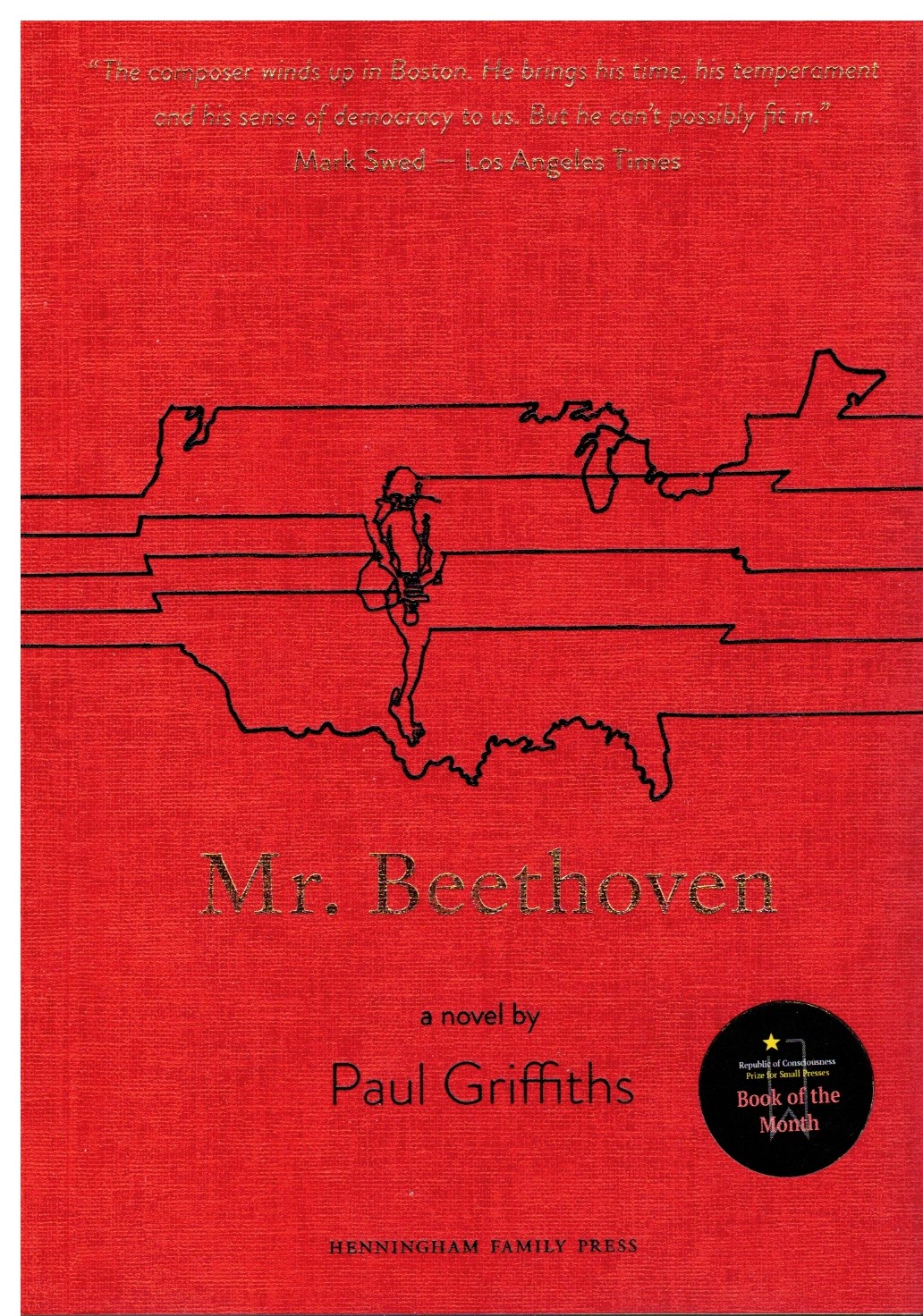
Mr. Beethoven by Paul Griffiths

We have come this far largely in silence. We have played the game. We have done our part. But we cannot go on keeping quiet when you continue to withhold what we most want to know, which is not the facts of the matter but the fiction. Is Beethoven really stalling? If so, why? Or has he in fact (as it were) almost finished the score? Or has he hit a block? Most of all, what is the supposed subject of this supposed oratorio? You must know. We have been patient long enough. Over to you. Get on with it.

Suppose that Beethoven did not die in 1827 but lived a few more years. And suppose that he came to the United States, where he spent six months in the vicinity of Boston, writing a brand new oratorio at the bequest of the Haydn and Handel Choral Society. Unable to speak with his benefactors--he's deaf, after all, in this timeline, too--he is introduced to a woman named Thankful, who teaches him the style of sign language that emerged in the 19th century on Martha's Vineyard. This is the story of Paul Griffiths' Mr. Beethoven, another of those novels that enters upon the life of a real historical person (feels like I've read a million of these this year, because I love them) but one that does it with more self-consciousness than most. Griffiths makes the artifice as much the subject of the novel as Beethoven himself, laying out the sources he draws from, building up scenes and then revising them, fretting over whether questions of what might really have been.

One of the book's central ironies, I think, is this: Mr. Beethoven is a novel about interpolation, the transmutation of historical fact into historical fiction. Griffiths, or the narrator who takes his place, broadcasts certain scruples about precision and accuracy. All of Beethoven's dialogue, for example, is taken directly from his real-life letters. But after introducing Thankful, who literally interpolates Beethoven's language by reporting his words in English, she becomes hidden, occluded: watch Beethoven, for example, carry on a flirtatious conversation with a widow. The dialogue looks like dialogue, and we forget that it's all really Thankful, expressing in sign language what Ms. Hill says to Beethoven, and in English (funnily, a language Beethoven does not speak) what Beethoven says to Ms. Hill. In this way, Mr. Beethoven is sort of a funny meditation on the mediating forces, sometimes visible and sometimes not, that lie between fact and interpretation.

All that is very interesting. But often I felt, as the imagined reader feels in the quoted passage above, that I wanted to know "not the facts of the matter but the fiction." The novel opens with incredible slowness, futzing around for a while with questions of sourcing and historical accuracy, while Beethoven the character does little more than sit in empty rooms, not writing an oratorio. Much more interesting, I thought, was the later novel, which has its metafictional tricks--a chapter made up of a single long sentence, for example--but which has a better story, the story of the composition and performance of the fictional oratorio, which is based on the Biblical story of Job.

I especially liked a scene, apparently based on a real life event, in which a Massachusett Indian elder is invited to observe the rehearsals for Beethoven's oratorio, but shows an interest only in the pipe organ, which she takes, quite correctly, to be a holy object in which spirits, after a fashion, live. I also liked the way that Griffiths fashions a very literal artistic lineage between the old world classicism of Beethoven and the art of the new world: an interview of Beethoven by a young Walt Whitman is very funny, and it is suggested that a young Emily Dickinson is in attendance for the oratorio's premiere, and that perhaps she even takes from its simple, honed language inspiration for her adult poetry. (The oratorio itself, printed in full, might be the novel's most inspired production.)

In the end, I thought Mr. Beethoven was more interesting than engaging. Maybe I'm just one of those impatient readers who wants the fiction, and not to be reminded of the facts.

Wednesday, March 31, 2021

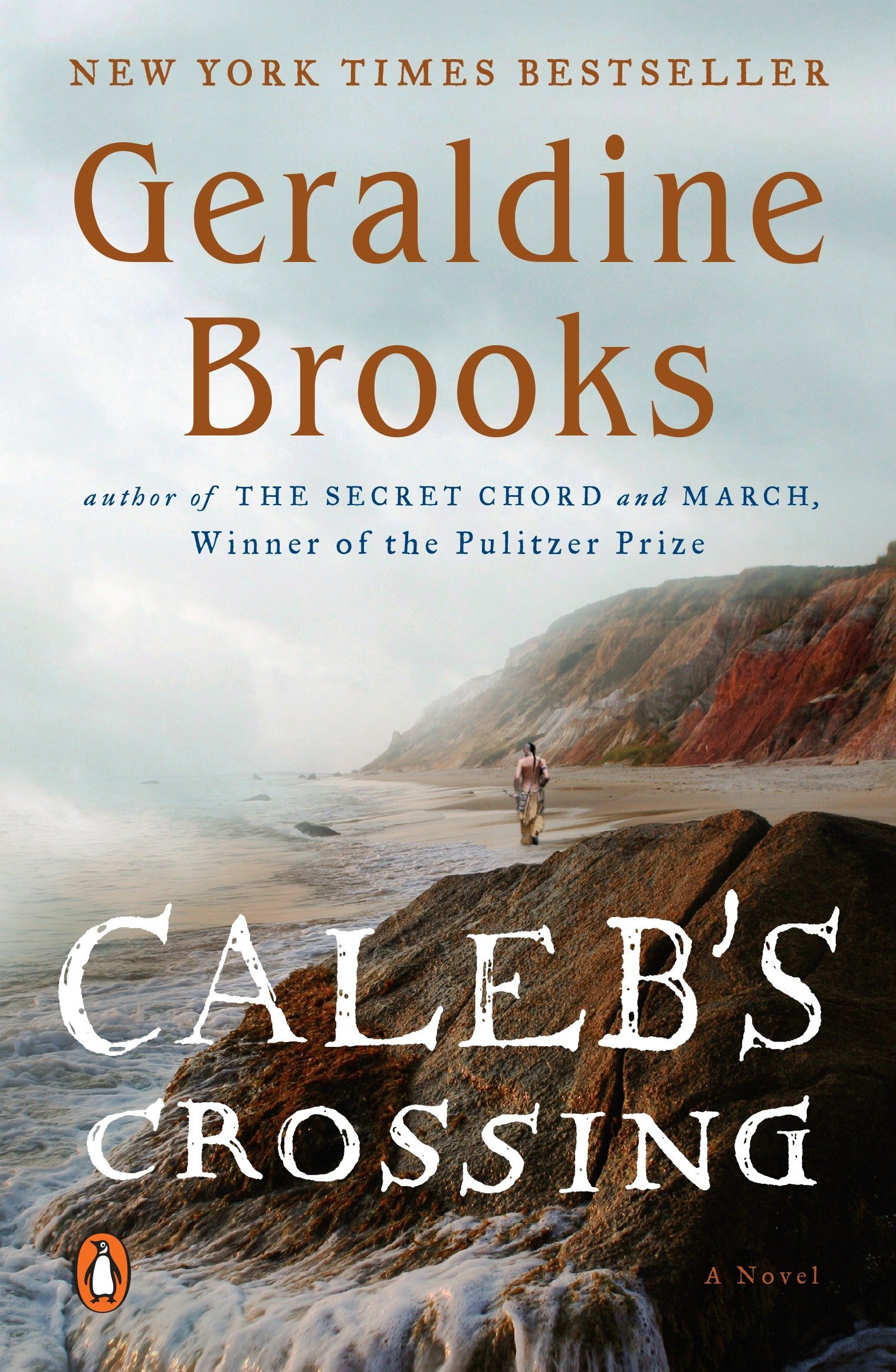
Caleb's Crossing by Geraldine Brooks

At first, I followed this wild boy hungering after his knowledge of the island--his deep understanding of everything that bloomed or swam or flew. Soon enough, a curiosity about an untamed soul had kindled, and this, too, caused me to seek him out. But it was his light temper and his easy laugh that drew me close to him, over time, until I forgot he was a half-naked, sassafras-scented heathen anointed with raccoon grease.

Martha's Vineyard, in the late 17th century, is a backwater outpost of a backwater outpost: Bethia Mayfield lives with her father, the Reverend Mayfield, and her brother Makepeace, live on the edge of a wilderness, having retreated from the strict Puritanism of the Massachusetts Bay Colony.  But there are others, of course, for whom the island--as Bethia calls it--is no wilderness at all, but their home for millennia: the Wampanoag, with who the white Islanders have a tense and tenuous peace. Bethia's father sees himself as a missionary to the Wampanoag, and although he is respected by them, his mission is made difficult by the "wizard" Tequamuck, a powerful healer who agitates against the Christian religion among the Wampanoag.

Bethia's life is a proscribed one: she will grow up and marry, probably a local farmer. Yet she has a sharp mind and a gift for languages: while her lazy brother Makepeace struggles with his Latin and Greek, she listens on, learning twice as fast as he. From her father's dealings she even learns to speak the language of the Wampanoag, a feat that enables her to make secret friends with a Wampanoag boy she names Caleb. Caleb, the son of the sonquem, or chief, and nephew to the wizard Tequamuck, and Bethia are drawn to each other, despite their differences; though Bethia learns from her father to be suspicious of the Wampanoag religion--which they consider Satanic--she finds there is much to admire in it, like the way that Caleb awakes before the dawn to greet the personified sun. In their secret meetings, they spar curiously over these different ways of seeing the world. Bethia begins to fear for her own soul, but it's Caleb that should be worried: a plague of smallpox ravages the Wampanoag, and on his death bed the sonquem concedes to the Christianization of his people and asks Reverend Mayfield to take Caleb into his home.

Caleb is an interesting character, based on a real person, the first Native American to graduate from Harvard. His father's death and his adoption by the Reverend places him in an uneasy place, caught between two worlds. He learns quickly that he can never be Christian enough for the Puritans of Harvard, where is constantly suspected and belittled. He acquits himself with talent and integrity, but are his talent and integrity being used to raise himself up, or destroy his people? These are interesting and powerful questions.

And yet the major flaw of Caleb's Crossing is that Caleb grapples with these things "off screen." Once Caleb joins Bethia's household, and then later at Harvard, their lives are too proscribed for them to continue their meetings, and somehow Caleb vanishes from the narrative right under our noses. Caleb never leaves Bethia's orbit, but as the viewpoint character she becomes focused on other things, like a pair of competing marriage proposals from a local farmer and the son of a Harvard master, and the mistreatment of a young Nimpuc woman who comes to stay with them at Cambridge. The interests of the book turn from the alienation of the indigenous to the contradictions of life as a woman, and while it does these themes justice, they seem to me much more familiar, perhaps too familiar.

At the novel's climax, Bethia must travel back to the island to consult with the dreaded Tequamuck to find a cure for a disease that has struck Caleb--a disease we suspect may be more of the spirit than the body--and yet this moment, which should bring resolution to the schisms of Caleb's psyche, seem to be the ending to a book we didn't actually get. You know, a while back I told myself I should try harder to review the book as it is, rather than imagining a book that doesn't exist that I might have liked better. That's something I do a lot. But the book is called Caleb's Crossing, and I think the way the novel holds Caleb at arm's length is ultimately unsatisfying.

Sunday, March 24, 2019

Mrs. Stevens Hears the Mermaids Singing by May Sarton

"Odd, isn't it?  How these quarries, blasted open by dynamite, the scene of so much violence, so much lifting and carrying too, after they are abandoned, become magic places, deep ponds."  She paused, probing the image which had been spoken before she really saw what she had been given.  "Rich and peaceful," she said.  "As far as I can see, it's not a question of fidelity, of the violent encounter with no possible future against some unimaginable lasting fatigue.  No, what is important is dept.  Hell is very deep, as well as Heaven, so we can almost never quarrel with Hell."  She looked out over the tranquil deep water, a dark green, opaque, she noticed today, under the overcast sky.  How to speak to a wound?

May Sarton's (absurdly titled) Mrs. Stevens Hears the Mermaids Singing tells the story of a day in the life of poet F. Hilary Stevens.  Hilary has been a novelist and a poet all her life, once to some acclaim, but it's only now in her old age that one of her new collections has become a hit.  (The fact that, in this novel, a collection of poems is a bestseller ought to tell you exactly how contemporary it is.)  The fame is unexpected, its rewards more dubious perhaps than those of the poems themselves.  But it results in two interviewers being sent to her Cape Ann home.  The interview, by stepping chronologically through her past publications, dredges up all the old memories that are the context of the poems: a dead husband, several abortive lesbian love affairs, a long stay of convalescence in the hospital.

Along the way, Mrs. Stevens explores several aspects of what it means to be a writer, and a woman writer particularly.  The metaphor of the quarries above suggests that poems are the result of an encounter with violence that produces depth.  Poetry has an alchemical power to transform life, and it enjoys a freedom that feeling unmediated never can:

Everything could now be said--this was the intoxicating discovery Hilary made.  She could go the limit with her feeling; she could come to terms with it by analyzing it through the written word.  She could praise, rage, despair, love, in peace.  No one could say her nay: even the self-imposed censor could be quelled.

For Hilary, one of the biggest questions is how to be both a woman completely and a writer completely; when her husband was alive it didn't seem possible, but we learn that his death, while tragic, opened her up to new possibilities.  The affairs she has with women underline the novel's queer themes; its bookended by visits from a young Cape Ann teen who is struggling with his own same-sex yearnings.  During all these revelations, Hilary keeps slipping out of the interview room to stare out of windows and grapple with the intensity of her memories.

There's a strange melodrama to these scenes: Did she forget about her husband's death?  The hospital?  Far from being a "descent into hell" of feeling, the interview seems largely cerebral.  It's conducted by a knowledgeable, if somewhat overbearing, man and a younger, less knowledgeable but clearly more intensely sensitive, woman.  They're meant to represent Hilary's masculine and feminine aspects, no doubt, and as a result the interview mostly feels like a single brain talking to itself.  There's not enough tension to make the torrent of feeling believable, no sense that Hilary is really being challenged from the outside at all.

But mostly--and maybe this is a harsh thing to say--the book falls flat for me because I don't really trust it to say something valuable about literary genius.  It's a well written book, with sharply observed characters, but genius isn't there, and that would be all right enough if it didn't present itself as being about genius in the first place.  This seems connected to the book's insistence on describing Hilary's poetry without ever presenting any verse at all.  Did Sarton, who must have felt some identification with her character, feel unequal to the task of writing the poems themselves?  It's not about the poems, I guess, but about Hilary's creative life, but it seems to me like a mistake to pretend the two are separable.

Sunday, June 4, 2017

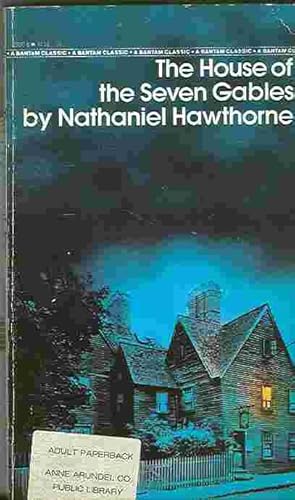
The House of Seven Gables by Nathaniel Hawthorne

"For example, then," continued Holgrave.  "A dead man, if he happen to have made a will, disposes of wealth no longer his own; or, if he die intestate, it is distributed in accordance with the notions of men much longer dead than he.  A dead man sits on all our judgment seats; and living judges do but search out and repeat his decisions.  We read in dead men's books!  We laugh at dead men's jokes, and cry at dead men's pathos!  We are sick of dead men's diseases, physical and moral, and die of the same remedies with which dead doctors killed their patients!  We worship the living Deity according to dead men's forms and creeds.  Whatever we seek to do, of our own free motion, an icy head obstructs us!  Turn our eyes to what point we may, a dead man's white, immitigable face encounters them, and freezes our very heart!  And we must be dead ourselves before we can have our proper influence on the world, which will be no longer our world, but the world of another generation, with which we shall have no shadow of a right to interfere.  I ought to have said, too, that we live in dead men's houses; as, for instance, in this of the Seven Gables!"

In Puritan New England, Colonel Pyncheon manages to swindle the poor Matthew Maule out of a plot of land that Pyncheon uses to build a great, seven-gabled house.  Maule, accused of witchcraft, uses his last breath before he is hanged to curse the house and the Pyncheon family, declaring, "God hath given them blood to drink!"  And true enough, on the day of his housewarming party, Colonel Pyncheon is found dead in his study as if by an unseen hand.

The main narrative of The House of Seven Gables occurs 150 years later, as the Pyncheon family, having come down in the world, still struggles under the weight of Maule's curse.  The only inhabitants of the House of the Seven Gables are Hepzibah, an elderly woman forced to open a store to make ends meet, and a daguerreotypist named Holgrave who rents a room.  To this are quickly added the sunny, saintly Phoebe, a Pyncheon cousin, and Clifford Pyncheon, released after thirty years of wrongful imprisonment and unsurprisingly maladjusted to the outside world.  A wealthy cousin, Judge Jaffrey Pyncheon, lurks at the edge of the story with some very vague evil intent.

Once you take Hawthorne's prose with a grain of salt, his books are a lot of fun.  He violates that first principle of modern writing--show, don't tell--with such gleeful abandon and wordiness that I often laugh.  At the same time, his writing is not very difficult, on the level of the sentence, and there's something delightful about the sheer weirdness and silliness he's capable of.  (I particularly like the detail of the old chicken family, made imbecile by inbreeding, that Hawthorne uses as a representation of the Pyncheons.)  And he also manages to capture really finely nuanced human emotions and relationships in a way that the modern show-don't-tell-iness leaves intentionally vague.

The best parts of The House of Seven Gables are all historical: the story of Colonel Pyncheon and Matthew Maule, and another interstitial story about a descendant of Maule who uses his powers of mesmerism to bind young Alice Pyncheon to him for life.  The "modern-day" narrative, which tries to show us how the curse lives on in the penury of Hepzibah and the injustice done against Clifford, shies away from a direct approach of the supernatural and puts more demands on the reader's patience.  The novel's major flaw is that Hawthorne jealously reserves two pieces of crucial information until the end--spoiler alert: that Holgrave is a descendant of Matthew Maule, and that it's Jaffrey Pyncheon who committed the murder for which Clifford took the fall.  Hawthorne reserves these facts to give us a kind of typical Gothic reveal at the end, but I wonder if knowing these things wouldn't deepen the relationships between Holgrave and Phoebe--thrust together from warring families like Romeo and Juliet--or Clifford and Jaffrey.  (It seems typically Hawthornean that Jaffrey's whole role in the story is to walk past the house and be menacing, then finally get inside and immediately die in an arm chair.)

The big theme of The House of Seven Gables is the past: the way that it exerts an effect on the living, and the possibility of escape or reconciliation.  Holgrave's marriage to Phoebe and the death of Jaffrey, who looks exactly like the portrait of old Colonel Pyncheon, put the curse to rest once and for all.  In this way it doesn't have the complexity or conflicted nature of The Scarlet Letter.  Like a lot of Gothic novels, it really has a heart of pure sunshine.

Friday, August 29, 2014

Walden by Henry David Thoreau

I went to the woods because I wished to live deliberately, to front only the essential facts of life, and see if I could not learn what it had to teach, and not, when I came to die, discover that I had not lived.  I did not wish to live what was not life, living is so dear, nor did I wish to practice resignation, unless it was quite necessary.  I wanted to live deep and suck out all the marrow of life, to live so sturdily and Spartan-like as to put to rout all that was not life, to cut a broad swath and shave close, to drive life into a corner, and reduce it to its lower terms, and, if it proved to be mean, why then get to the whole and genuine meanness of it, and publish its meanness to the world; or if it were sublime, to know it by experience, and be able to give a true account of it in my next excursion.

 Small guy, small house.

Apparently John Updike wrote about Walden that it "risks being as revered and unread as the Bible."  That's a good line, but not as good as a lot of lines in Walden that those who revere it are missing.  On the other hand, I think the opposite has become an equally valid risk: that Walden has become a book that is unread and mocked.  It seems like there's always some jagoff wanting to point out that Thoreau's cabin was, like, a mile from town, and that he went into Concord and ate at restaurants and stuff all the time.  (Am I the only one that hears that stuff a lot?)  Both attitudes--the mockery and the reverence--are silly because they misapprehend what Walden is about, and having not read it, I think I misapprehended it a little as well.

First of all, it isn't really transcendentalist in the way that I think of Emerson as being.  Thoreau gets a lot out of Nature, but there's no Wordsworthian sense that a communion with nature lifts Thoreau to a higher plane of existence.  Rather, living the kind of simple life that Thoreau leads in his two-year experiment at Walden Pond allows him to observe his natural surroundings more closely, and to appreciate them more intensely.  Some of the most beautiful passages of Walden are Thoreau's description of animal life.  I especially like his account of a war between red and black ants:

Looking farther, I was surprised to find that the chips were covered with such combatants, that it was not a duellum, but a bellum, a war between two races of ants, the red pitted against the black, and frequently two red ones to one black.  The legions of these Myrmidons covered all the hills and vales in my wood-yard, and the ground was already strewn with the dead and dying, both red and black.  It was the only battle which I have ever witnessed, the only battle-field I ever trod while the battle was raging; internecine war; the red republicans on the one hand, and the black imperialists on the other.  On every side they were engaged in deadly combat, yet without any noise that I could hear, and human soldiers never fought so resolutely.

But again, communion with nature isn't really the point of Thoreau's experiment.  He says: "If I were confined to the corner of a garret all my days, like a spider, the world would be just as large to me while I had my thoughts about me."  Thoreau goes to the woods to rely on himself as much as possible, and to reduce his need to depend on other people as much as possible.  Walden is really an experiment in hyperindividuality, part and parcel with the irascible libertarianism of "Civil Disobedience."  As he writes, "I would have each one be very careful to find out and pursue his own way, and not his father's or his mother's or his neighbor's instead."


Thoreau's grave, Concord, Mass.

Thoreau's version of this philosophy is quite extreme.  Sometimes it leads him to (hilarious) crankism.  Among the things he hates are: farms, politics, post offices, clothes, philanthropy, and other people.  But elsewhere it leads to observations of persuasive beauty:

I have a great deal of company in my house; especially in the morning, when nobody calls.  Let me suggest a few comparisons, that some one may convey an idea of my situation.  I am no more lonely than the loon in the pond that laughs so loud, or than Walden Pond itself.  What company has that lonely lake, I pray?  And yet it has not the blue devils, but the blue angels in it, in the azure tint of its waters.  The sun is alone, except in thick weather, when there sometimes appears to be two, but one is a mock sun.  God is alone,--but the devil, he is far from being alone; he sees a great deal of company; he is legion.  I am no more lonely than a single mullein or dandelion in a pasture, or a bean leaf, or sorrel, or a horse-fly, or a bumble-bee.  I am no more lonely than the Mill Brook, or a weathercock, or the north star, or the south wind, or an April shower, or a Jaunary thaw, or the first spider in a new house.

That paragraph indicates to me a strength of mind I know I don't possess.  Thoreau only managed to live like this for a couple of years before he rejoined society--but that's more than I think I'm capable of.  Certainly others have tried, some extremely so, and failed.  But I do think Thoreau's experiment is worth admiration, and Walden worth reading.

Monday, March 9, 2009

The Wordy Shipmates by Sarah Vowell

As an undergrad majoring in history, I took a class called American Ideas. In the class we explored the ideas upon which the United States was established. As you can imagine, much of the class focused on Puritan ideology. But the end of the quarter we had made our way to some of the writings of the Founding Fathers. But even they were heavily influenced by the early colonists. The Puritans were a bizarre and interesting bunch, but no one can doubt the effect that they had on what would ultimately become the United States.

As Vowell points out, most Americans have a passing knowledge of the Puritans because of grade school Thanksgiving Day pageants, The Scarlett Letter, and the witch hunts that took place in Salem. Of course, Vowell rightly argues that this limited exposure paints an inaccurate picture of Puritan society. The Wordy Shipmates is about a specific group of Puritans. As Vowell says, it is about "those Puritans who fall between the cracks of 1620 Plymouth and 1692 Salem." She is referring to the the Puritans of the Massachusetts bay Colony and later those of Rhode Island.

I have always liked Sarah Vowell. The first time I heard of her was years ago on Conan. She was a guest (a last minute fill in, no doubt) and all they talked about was how cool Abraham Lincoln was. At the end of the interview Conan asked her if she had anything to plug, and she replied that she really didn't. So Conan mentioned that she was a regular contributor to NPR's The American Life and was the author several books. I read Take the Canoli a few weeks later. Last year I read Assassination Vacation. I am drawn to the quirky darkness in Vowell's writing. She is also a history nerd, which is cool.

While The Wordy Shipmates has the same slightly-skewed take on American history as Vowell's other works, it lacked any real structure. The book was loosely organized around the aforementioned group of Puritans, focusing heavily on John Winthrop. But this allows for a wide variety of topics: Puritan ideas of justice and punishment, Roger Williams, Anne Hutchinson, etc. Vowells jumps from one topic to the next, making much of the book feel disjointed. This could probably be blamed on the lack of chapters and the headings that usually come with them. I'm not sure what made Vowell choose to structure here book in this way, but I found it a little disorienting. However, this did not stop me from enjoying the book and actually learning quite a few things that I either didn't know who had forgotten about. Overall, The Wordy Shipmates was worth the read.

Saturday, March 3, 2007

Ethan Frome by Edith Wharton

I normally don't read the back covers of books if I have not already read the work itself. While I didn't read the brief synopsis on the back of Ethan Frome, the one-sentence description at the top caught my eye. "The classic novel of despair, forbidden emotions, and sexual undercurrents set against the austere New England countryside." This is a very good description of Ethan Frome.

As Brent pointed out in his review of this book, the plot is not all that complicated, noting that it could be described as a character study. I also agree with Brent on the subject of Wharton's prose. At times I found it completely arresting. The images that her words conjured up were amazing.

As I was reading the book, I thought numerous times of the Woody Allen film, September. Ethan Frome and September share many of the same themes, such as forbidden love, depression, and complicated relationships. But the strongest connection between the two is the setting. Edith Wharton's vivid descriptions of the fictitious Starkfield, Massachusetts make the town an active character in the story. Often the town, and the weather associated with it, do as much to progress the plot as any of the characters do. In September, the setting is not a town, but a house--a house which Woody Allen has described as the most important character in the film.

Another film that Wharton's novella brought to mind was Lost in Translation. I would find it hard to believe that Sophia Coppola had not read Ethan Frome prior to making the film. Besides the general melancholy feel of the movie, some of the characters are quite similar to those in Wharton's work.

Note: If you have not read Ethan Frome, leave the introduction that accompanies this edition until the end. If you read it before, it will ruin what little twists and turns of plot the story does have.