Sunday, June 4, 2017
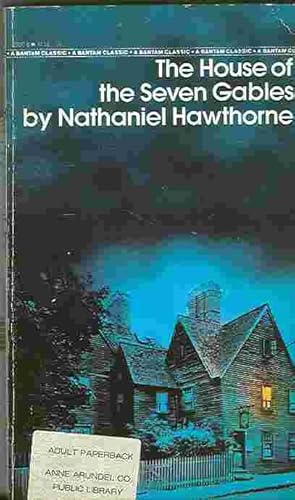
The House of Seven Gables by Nathaniel Hawthorne
In Puritan New England, Colonel Pyncheon manages to swindle the poor Matthew Maule out of a plot of land that Pyncheon uses to build a great, seven-gabled house. Maule, accused of witchcraft, uses his last breath before he is hanged to curse the house and the Pyncheon family, declaring, "God hath given them blood to drink!" And true enough, on the day of his housewarming party, Colonel Pyncheon is found dead in his study as if by an unseen hand.
The main narrative of The House of Seven Gables occurs 150 years later, as the Pyncheon family, having come down in the world, still struggles under the weight of Maule's curse. The only inhabitants of the House of the Seven Gables are Hepzibah, an elderly woman forced to open a store to make ends meet, and a daguerreotypist named Holgrave who rents a room. To this are quickly added the sunny, saintly Phoebe, a Pyncheon cousin, and Clifford Pyncheon, released after thirty years of wrongful imprisonment and unsurprisingly maladjusted to the outside world. A wealthy cousin, Judge Jaffrey Pyncheon, lurks at the edge of the story with some very vague evil intent.
Once you take Hawthorne's prose with a grain of salt, his books are a lot of fun. He violates that first principle of modern writing--show, don't tell--with such gleeful abandon and wordiness that I often laugh. At the same time, his writing is not very difficult, on the level of the sentence, and there's something delightful about the sheer weirdness and silliness he's capable of. (I particularly like the detail of the old chicken family, made imbecile by inbreeding, that Hawthorne uses as a representation of the Pyncheons.) And he also manages to capture really finely nuanced human emotions and relationships in a way that the modern show-don't-tell-iness leaves intentionally vague.
The best parts of The House of Seven Gables are all historical: the story of Colonel Pyncheon and Matthew Maule, and another interstitial story about a descendant of Maule who uses his powers of mesmerism to bind young Alice Pyncheon to him for life. The "modern-day" narrative, which tries to show us how the curse lives on in the penury of Hepzibah and the injustice done against Clifford, shies away from a direct approach of the supernatural and puts more demands on the reader's patience. The novel's major flaw is that Hawthorne jealously reserves two pieces of crucial information until the end--spoiler alert: that Holgrave is a descendant of Matthew Maule, and that it's Jaffrey Pyncheon who committed the murder for which Clifford took the fall. Hawthorne reserves these facts to give us a kind of typical Gothic reveal at the end, but I wonder if knowing these things wouldn't deepen the relationships between Holgrave and Phoebe--thrust together from warring families like Romeo and Juliet--or Clifford and Jaffrey. (It seems typically Hawthornean that Jaffrey's whole role in the story is to walk past the house and be menacing, then finally get inside and immediately die in an arm chair.)
The big theme of The House of Seven Gables is the past: the way that it exerts an effect on the living, and the possibility of escape or reconciliation. Holgrave's marriage to Phoebe and the death of Jaffrey, who looks exactly like the portrait of old Colonel Pyncheon, put the curse to rest once and for all. In this way it doesn't have the complexity or conflicted nature of The Scarlet Letter. Like a lot of Gothic novels, it really has a heart of pure sunshine.
Saturday, April 22, 2017
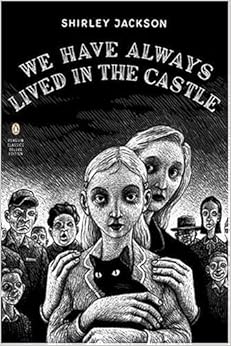
We Have Always Lived in the Castle by Shirley Jackson
The Blackwoods are hated in town. When the youngest, Mary Katherine--Merricat, to her sister Constance and Uncle Julian--descends from their isolated mansion to do the shopping, she's jeered at and threatened. As it turns out, the townspeoples' antipathy can be traced back to the murder of most of the Blackwood family by arsenic poisoning, a crime that Constance was acquitted for many years ago. Constance is too afraid of the public eye to go out, and old Uncle Julian is confined to his wheelchair, poring over his memoirs which describe the night of the fateful murders. Into this hermetic household comes a distant cousin, Charles, whom Merricat distrusts, and rightly so, since he seems to be mostly after the Blackwood riches.
We Have Always Lived in the Castle is a slim but creepy little book, which succeeds because of the strength of the voice of Merricat's narration. Merricat is devoted to Constance, and employs a number of different forms of sympathetic magic to protect her from the roiling anger of the townspeople. Books nailed to trees, silver dollars buried in the field. She treats her cat Jonas like a mercurial human, and we early begin to suspect that it might not have been the guileless, naive Constance who slipped the arsenic into the food of her family many years ago.
In many ways, We Have Always Lived in the Castle seems like an old-school Gothic novel, the kind that passed out of fashion in the 20th century. Jackson leans into the melodramatic and the sinister, but the novel never seems as silly as it might, because of the careful, attentive detail given to Merricat and her many totems. The plot avoids heading in the direction you might suspect--Merricat murdering Charles--and instead uses Charles' presence in the house as a kind of spark to ignite the latent tensions between the Blackwoods and the town around them, to great effect. In fact, the novel reminded me of no one so much as that other master of 20th century Gothic, Daphne du Maurier, and the final chapter of the book borrows one of its most intense dramatic elements from Rebecca, who borrowed it in turn from Jane Eyre. Except--time for the spoiler alert--when the house burns down, unlike du Maurier and Bronte, Jackson has her two sisters go on living there, happy in the ruins of their former glory, because they only need each other.
Saturday, March 14, 2015
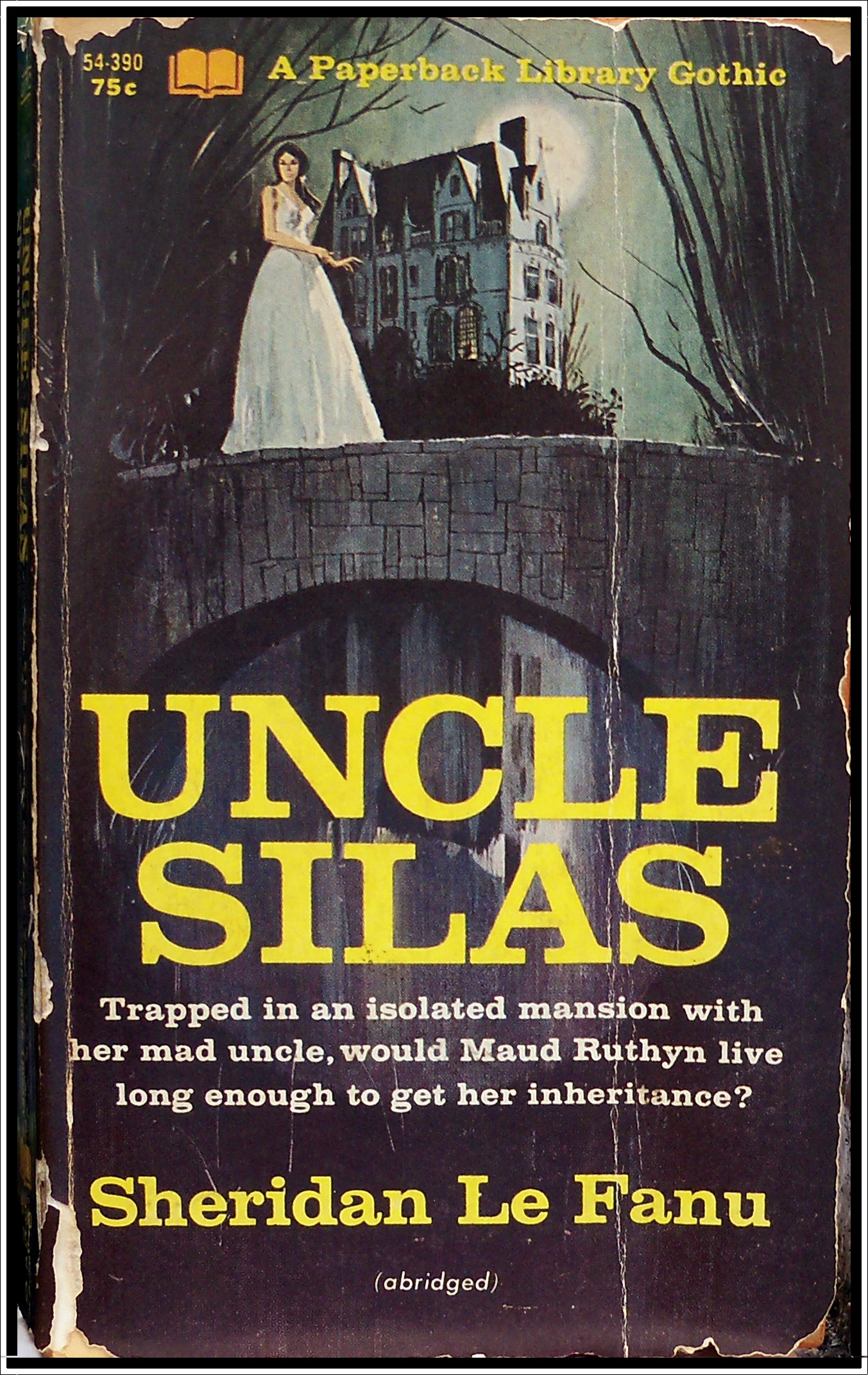
Uncle Silas by Sheridan Le Fanu
The title character of Sheridan Le Fanu's Uncle Silas doesn't appear in the novel for more than 200 pages, but he's always a presence, casting a shadow. The protagonist, plucky young Maud Ruthyn, obsesses over his portrait--she's never met her uncle--and imagines him as mysterious and debonair. Silas' brother, Austin, confesses to his daughter Maud that Silas was once rumored to have killed a man to whom he owed money: the man was found dead in a room that locked from the inside, but suspicions against Silas have turned him into a sickly recluse. When Austin dies in the middle of the novel, his will stipulates that Maud will live under Silas' care, hoping that Silas' kindness toward Maud will soften his public image (ignoring, for some reason, the fact that Silas ignores his own two children so severely that they've grown up with the cockney accents of their servants.)
What Austin fails to realize in his will is that Silas stands to inherit all of the family's fortune if only he can get rid of Maud somehow, and putting her in Silas' hands might be too much of a temptation for his possibly murderous brother to withstand. The question of Silas' true nature hangs over the second half of the novel--is Maud in danger, or not? (Is Uncle Silas a bait-and-switch horror book, like Northanger Abbey or Scooby Doo? Or is something real at stake?)
Uncle Silas is the kind of book that builds its suspense on bumps in the night and sinister conversations half overheard. It's the kind of book in which adults only ever partially explain things to Maud, saying things like "I will tell you more in due time, Maud," but without any good reason beyond keeping the reader guessing. But it's awfully good at that, and manages to be quite a page-turner despite being artificial and silly in the way a lot of Gothic fiction tends to be. Among the book's better creeps is Maud's malevolent governess Madame de la Rougierre, a shriveled old crone in a wig who speaks with a comically bad French accent and whose subtle malignity toward Maud is never fully explained. Uncle Silas has a lot of reverence for the British manor system which provides Austin's riches, and has no reserve when it comes to associating Madame's foreignness with evil.
But probably the best thing about the book is Maud, who is both headstrong and regular-strong, and provides a compelling voice unlike the kind of damsel-in-distress that you might find in Radcliffe. Those looking for well-developed heroines in spooky stories would do a lot better to read Uncle Silas than your Twilights and your Hunger Games and whatnot.
Thursday, July 31, 2014
The Marble Faun by Nathaniel Hawthorne
The Marble Faun is about three American artists in Rome, a city that would be unrecognizable to anyone who has visited in the sprawling metropolis in the 21st century. Until the Industrial Revolution, Rome was underpopulated, described by Hawthorne as a city of mostly ruins, freighted with an intense heritage of music and art but also prone to summer outbreaks of debilitating malaria. The artists--Miriam, Hilda, and Kenyon--are joined by a fourth friend, an Italian Count with a carefree personality named Donatello, who is the uncanny likeness of the Greek sculpture the Faun of Praxiteles:
| Hey baby. |
Donatello's similarity to the titular faun is one of those quasi-mystical touches Hawthorne likes that he never bothers to explain; think of the meteor shaped like the letter "A" in The Scarlet Letter. The Marble Faun borrows heavily from the Anne Radcliffe school of Gothic Romance, including the Roman setting, but refuses to explain away its ghosts Scooby Doo-style, like Radcliffe does. On the other hand, there's is nothing as explicitly supernatural as in Dracula or The Monk--rather, Hawthorne employs these mystical flourishes so matter-of-factly that it seems beside the point to ask for any sort of rational explanation at all.
The other mystical touch in The Marble Faun is a doozy: Miriam gets lost on a group outing to the Roman Catacombs, and when the others find her again, she is in the company of a sinister stranger who may or may not be a thousand-year old phantom haunting the catacombs:
"Inquire not what I am, nor wherefore I abide in the darkness," said he, in a hoarse, harsh voice, as if a great deal of damp were clustering in his throat. "Henceforth, I am nothing but a shadow behind her footsteps. She came to me when I sought her not. She has called me forth, and must abide the consequences of my re-appearance in the world."
[Spoiler alert for the following paragraph.] From then on, the stranger follows Miriam everywhere, stalking constantly at the edge of every room. Miriam, in a strange and ill-advised move, bargains with him that she can convert him to Christianity on penalty of her immortal soul. One night, Donatello, who has fallen deeply in love with Miriam, pushes the stranger over a cliff to his death. The rest--in fact, the bulk--of the novel deals with the consequences of this action, as the guilt from this deed destroys Donatello's once-cheery personality and chases Miriam out of Rome.
Ultimately The Marble Faun becomes a story like The Scarlet Letter, about a single misdeed that becomes a psychological torment to more than the one or two who actually committed it. But where the pyrotechnics of guilt in The Scarlet Letter are enhanced by the repressive Puritan society that proscribes adultery, Miriam and Donatello's guilt seems discordant in spooky, malarial Rome. I didn't find that their anguish--or Hilda's virginal shock--was enough to carry the plot after the intriguing first few chapters. It doesn't help that the novel is padded with material from the journal Hawthorne kept when in Rome, stopping the plot to opine on architecture, painting, sculpture, and other travelogue-type stuff. Though The Marble Faun comes to a satisfyingly creepy ending, set in a masquerade-style carnival, I had already lost interest.
Wednesday, June 18, 2014
The Scarlet Letter by Nathaniel Hawthorne
Of course, it's not too surprising that The Scarlet Letter doesn't connect with most high-schoolers. For those unfamiliar, the story concerns Hester Prynne, a single woman in a strict Puritan community, who is discovered to be pregnant and sentenced to spend the rest of her life wearing a red letter "A"--for adultery--as punishment for her transgression. As for the father, well, that's the Reverend Arthur Dimmsdale, the town's most respected citizen and the next thing to an angel in the eyes of the townfolk.
What follows from this is a long meditation on sin, guilt, the nature of love and religious belief, all written in Hawthorne's typically slow-moving and flowery prose. Oh, and the book opens with a fifty-page framing story about an accounting house where the record of The Scarlet Letter is found, to discourage the rare kid who found the adultery story compelling.
And, in spite of all this, I loved it. It might be the best thing I've read so far this year.
Some of this is just my literary taste--I love Hawthorne's baroque verbiage and slow pace, but I can see how it could be a turn off--but there's more to the story than that. For one thing, the novel is full of ambiguity. As I recall, it never even spells out that Rev. Dimmsdale was the father until the very end of the novel, although the reader is expected to have intuited it pretty early. The meaning of the scarlet "A" is never explicitly mentioned either, and those are two of the main plot points of the book! They aren't hard to discern but it does demonstrate the confidence Hawthorne has in his readers.
Hand in hand with the plot ambiguities, Hawthorne allows a lot of moral wiggle room as well. Until a short speech at the end, which feels shoehorned in to please censors, Hawthorne casts no shade on Hester. In fact, as the story progresses, she sometimes seems like the only moral person in a town full of hypocrites. Knowing how Hawthorne felt about Puritans, it seems likely that he DID feel this way, but it's still strange to see a woman have an illegitimate child and come out of the situation better then she went in. I don't know that I've ever read a book this old that was so loath to pass judgement on its characters.
Also, despite its stuffy rep, The Scarlet Letter is a deeply strange book. Occurrences throughout--Hester's vindictive ex, a vision in the sky, Dimmsdale's ever-increasing torment, and Hester's possibly-demented daughter--point to supernaturalism without ever spelling it out. At points, it feels almost like a Gothic novel, with "ghosts" everywhere, and skeletal hands behind the scenes pushing things along, except in this case, the hands are God's and the devil is a disgruntled ex.
Monday, May 27, 2013
The Private Memoirs and Confessions of a Justified Sinner by James Hogg
The Private Memoirs and Confessions of a Justified Sinner is a first hand account of religious fanaticism as told by the fanatic, who sees his deeds as divinely inspired. It is also an account of the fanatic's mental, physical, and spiritual destruction, perhaps at his own hands, perhaps at the hands of darker forces. Its narrator, Robert Wringhim Colwan--the "justified sinner"--is consumed, in both senses, by his fanaticism.
Legally, Robert is the son of the wealthy Laird Dalcastle, but his probable father--Robert calls him "my spiritual father"--is the Reverend Robert Wringhim, a severe Puritan Calvinist preacher who serves as the Lady Dalcastle's spiritual adviser. Brought up in this strict Puritanism, Robert Jr. is well instructed in the tenets of Calvinism, which say that only the elect, those whom God has predestined, will be redeemed, and Robert wavers between a profound anxiety regarding his redemption and a snobbishness toward those he knows to be unchosen reprobates, like the Lord Dalcastle and his half-brother George.
One day, Robert meets a stranger in the woods who calls himself Gil-Martin and looks strangely like himself:
'My countenance changes with my studies and sensations,' said he. 'It is a natural peculiarity in me, over which I have not full control. If I contemplate a man's features seriously, mine own gradually assume the very same appearance and character. And what is more, by contemplating a face minutely, I not only attain the same likeness, but, with the likeness, I attain the very same ideas as well as the same mode of arranging them, so that, you see, by looking at a person attentively, I by degrees assume his likeness, and by assuming his likeness I attain to the possession of his most secret thoughts.'
What is Gil-Martin? Is he a projection of Robert's own mind? Is he, as is frequently suggested, a demon? The novel is not particularly interested in providing answers to these questions. Whatever he is, Gil-Martin has a knack for echoing Robert's own theology back to him in a way that strikes Robert as slightly askew, even as it seems to agree with him precisely. Gil-Martin helps to assure Robert of his position in the elect, and persuades him that the Lord has chosen him to "cut off" the wicked by murdering those who are not along God's elect, including his father and half brother.
Justified Sinner is a parody of antinomianism--the idea that the elect are exempt from God's moral law because they are already redeemed, and their sins cannot affect their redemption. But Robert's position in the elect looks increasingly like a membership in a group of one (or two, if you discount the fact that Gil-Martin frequently seems little more than a shadow of Robert's own self) and ultimately none, as Robert himself begins to unravel. He begins to black out, losing long periods of time where he is told that he has been doing some serious sinning, including seducing a young girl and bringing about her ruin--and possibly murdering his own mother. His self divorced, as antinomianism dictates, from his own deeds, he begins to dissolve:
Immediately after this I was seized with a strange distemper, which neither my friends nor physicians could comprehend... I generally conceived myself to be two people. When I lay in bed, I deemed there were two of us in it; when I sat up, I always beheld another person, and always in the same position from the place where I sat or stood, which was about three paces off me toward my left side... The most perverse part of it was that I rarely conceived myself to be any of the two persons. I thought for the most part that my companion was one of them, and my brother the other; and I found, that to be obliged to speak and answer in the character of another man, was a most awkward business at the long run.
Ultimately, Robert tries to run from his "companion," Gil-Martin, but he is unshakeable, because, as Gil-Martin tells him, "I am wedded to you so closely, that I feel as if we were the same person. Our essences are one, our bodies and spirits being united, so, that I am drawn towards you as by magnetism, and wherever you are, there must my presence be with you." There is no avoiding the tormentor, because Robert's tormentor may as well be himself. The final scenes of Robert's account are feverish, terrifying visions of demonic torture that directly parody the book of Revalation.
Robert's account is book-ended by "The Editor's Narrative," in which the scientific-minded Editor tries to make some sense the story. He dismisses the possibility of any supernatural truth, but his own biases hardly equal an objective take, and so the novel lies on shifting, indeterminate ground. This quality--as well as a very strange and funny cameo by the author himself as a rustic shepherd--have led some to claim Justified Sinner as a precursor to the postmodern novel.
That's a fair description--and in fact, of all the books I read for my class on the 19th-century Romantic novel, this is the one that seems most attuned to 21st Century sensibilities, and one of only two I'd say are really worth reading (the other being The Monk). But it also obscures the way that Justified Sinner is deeply invested in its own time and place, and what it meant to be a Calvinist in Scotland in the 1800's.
Monday, March 25, 2013
The Monk by Matthew Lewis
Ambrosio, the title character of Matthew Lewis' The Monk, is the most renowned man in Madrid, a man so virtuous that he never ventures out of the walls of his monastery, except once a week to deliver a sermon to the people of the city. He's so virtuous that someone jokes that he "knows not the difference between man and woman"--but this naivete becomes the breeding ground for his corruption. Ambrosio, seduced by a devoted female follower who gains access to the monastery by pretending to be a monk, slowly but surely gives himself over to his insatiable lust, which leads him to kidnap, rape, and murder.
The Monk caused quite a scandal. Samuel Taylor Coleridge lamented that a member of Parliament could write such a book. It shocked Ann Radcliffe, because its method is so different from hers--instead of teasing us with the spectral suggestion of horrible events, Lewis makes us face the gruesome head-on. This works because Lewis has a sense of humor, and even when writing about the most shocking material, he seems to understand that its fundamental ridiculousness. I said in my review of Radcliffe's The Italian that I don't think her work holds up in the 20th century because the bar of what shocks us is so much higher, but The Monk remains engaging because, while it doesn't really shock either, it remains a terrific black comedy:
As She uttered these last words, She lifted her arm, and made a motion as if to stab herself. The Friar's eyes followed with dread the course of the dagger. She had torn open her habit, and her bosom was half exposed. The weapon's point rested upon her left breast: And Oh! that was such a breast! The Moon-beams darting full upon it, enabled the Monk to observe its dazzling whiteness. His eye dwelt with insatiable avidity upon the beauteous Orb.
In fact, what makes this passage and others like it so great is the way that it treats this material with so little seriousness: I can understand why the Coleridges and Radcliffes of the world found such a dark mixture of violence and sexuality disturbing, but the winking pretentiousness of the phrase "beauteous Orb" seems like it ought to deflate such revulsion.
(One exception to this--and here I'll issue a SPOILER ALERT--is the episode late in the novel when a pregnant woman named Agnes, separated from her lover and forced into the nunnery, is locked in the dungeon by the evil Prioress where she gives birth. Without food, the child dies and Agnes begins to waste away, but she is unable to part from the body of the child, so she holds on to it until it becomes a "mass of putridity." That I found legitimately shocking.)
Lewis uses the story of Ambrosio as a back-drop for a collection of Gothic tales he's collected from other sources: There's the kindly homeowner who murders the travelers who pass the night in his house, and the ghost of the Bleeding Nun, who appears at the stroke of one every five years. There are incantations of Lucifer, who appears as an attractive young man. (Lewis himself was more or less openly homosexual.) Each of these stories is really fantastic (and if I hadn't just written a fifteen-page paper on the novel, I'd have a lot more to say about them). You get the sense that, even though the Gothic tradition he was working in wasn't something as codified or established as we think of it today, Lewis was really interested in pushing the boundaries of the expectations of the genre, and his frenetic, voracious use of these tales is surprisingly seamless.
Ultimately, Lewis was taken to court, and forced to republish The Monk without murder, rape, descriptions of nudity or accounts of witchcraft. (All that was left, I imagine, was the introductory poem.) Someone accused me the other day of liking "stuffy" novels--which, in some cases, is a fair dig. But The Monk is pretty much "Exhibit A" why equating "old" with "stuffy" is idiotic: How many novels from the twentieth century are as bold, irreverent, or cathartic?
Sunday, March 10, 2013
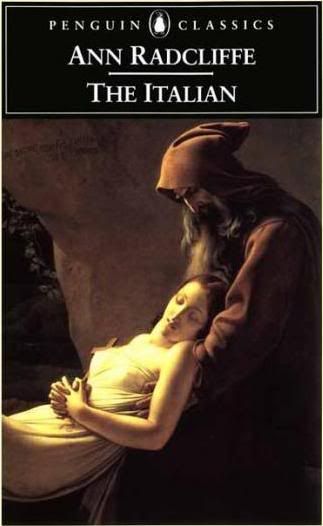
The Italian by Ann Radcliffe
Now that I've gotten that off my chest, I can focus on the book itself. You know, I had two basic impressions of Radcliffe from Austen's parody of her work in Northanger Abbey: Her books were pulpy and engaging, but overall she was a poor writer--the Dan Brown or Stephenie Meyer of her day. Both of these impressions are wrong. The Italian continuously impressed me by the quality of its language, but it fails to be engaging after the first few chapters.
Coming as I was from the rather stilted and laborious prose of Caleb Williams and Maria, Radcliffe's quick, capable prose was really refreshing. She has a particular knack for scene-setting--descriptions of towering mountain vistas, or obscure ruins, or shadowy dungeons--that supports her interest in 19th century ideas of the sublime, the idea that the soul can be enlarged and developed by the majesty of nature. Ellena, trapped in the nunnery with the help of the cruel Prioress (Catholics don't come off too well in this genre), is secretly given access by a friendly nun to a tower overlooking the tremendous beauty of the Italian landscape, which gives her the strength to go on. The passage I want to share here, however, is the one where Vivaldi is being carted off to Rome to face the Inquisition:
After quitting the Corso, it proceeded for some miles through dark and deserted streets, where only here and there a lamp, hung on high before the image of a saint, shed it's glimmering light, and where a melancholy and universal silence prevailed. At intervals, indeed, the moon, as the clouds passed away, shewed, for a moment, some of those mighty monuments of Rome's eternal name, those sacred ruins, those gigantic skeletons, which once enclosed a soul, whose energies governed a world!
I love this because 1.) I'm really fascinated by the fact that Rome, once the center of the Western world, had become nearly a ghost town for centuries, vacant except for the Holy See, and 2.) It's a good example of the kind of suspense and terror that Radcliffe tries, and only infrequently manages, to achieve.
Radcliffe believed that terror was also an agent of the sublime, and could enlarge the soul, but she contrasted it against horror, which was more explicit. Terror is only beneficial when it is ambiguous, predicated on the fear of the possible and not the shock or disgust of real violence. But this philosophy, at the extremes to which she takes it, is untenable. First of all, when there is no payoff for our apprehension, the threat diminishes. Like a 19th century Velma, Radcliffe loves to go back and explain away the sources of fear. We must know, for example, that the bloody surplice discovered in the ruined palace belonged to a character who had been shot with a stray bullet fired by a character we had forgotten about, and who was inserted just so that such an explanation can be dredged up later.
Secondly, Radcliffe has no conception that there are diminishing returns to this stuff. As if one scheming, shadowy monk wasn't enough, Radcliffe introduces a second one, and then in the final scenes where Vivaldi must go in front of the Inquisition, suddenly we're in a dark room filled with like twenty scheming, shadowy monks and it all seems a little ridiculous. Was it really necessary for Austen to parody this, when it does such a good job of parodying itself?
There are elements to The Italian that really work. The love story between Vivaldi and Ellena, devoted to each other across class barriers, is wonderfully compelling even though the characters themselves are thinly drawn. But I think that it's not a book one can love in the 21st century, when our bogeymen are made by Industrial Light and Magic.
Sunday, February 20, 2011
Rebecca by Daphne du Maurier
Last night I dreamt I went to Manderley again.Rebecca is a great example of a novel that's far, far better than it has any right to be. Reading a plot summary makes it sound like hundreds of other Gothic novels: a young girl marries a rich, older man and moves to his beautiful but unnerving estate. Once there, she comes into contact with various strange and mysterious characters and eventually uncovers a terrible secret, one that changes our perspective on everything that came before. Boilerplate, right?
But such a summary misses two vitally important elements that set Rebecca apart from other genre exercises: first, Mme. du Maurier's sparkling but never--or at least rarely--melodramatic prose. If you've read much in the Gothic genre, you know how rare that is; she knows how to underplay the watershed moments for dramatic effect, and when to ramp up her description of the mundane until it becomes almost unbearably tense.
Secondly, du Maurier is a master plotter. Chris mentioned this in his review, but Rebecca isn't a genre exercise built around a twist; rather, it's winding narrative that maintains, and maybe even increases, its power once you know exactly how everything plays out. If I were to add a third element, I'd say the characters are remarkably well-drawn, but to say much more on that, or any, point might be to spoil the novel for those of you who haven't read it.
Rebecca seems to me, in some ways, the perfect novel of its type: engrossing and easily readable without sacrificing depth or beauty. There's more here than a simple mystery or romance--Du Maurier's musings about time and loss--always organic to the narrative--are moving and powerful, but don't get in the way of the story. If you haven't, you should read Rebecca.
Also, the line quoted above: one of the greatest opening lines of all time, right?
Thursday, December 13, 2007
As I Lay Dying by William Faulkner
As I Lay Dying tells the story of Addie Bundren, her death, and the subsequent trip to her hometown where she wanted to be buried. Each chapter is told from the point of view of a different person, and the book has quite a large cast. The sons: enigmatic Cash, borderline-empathic Darl, loner Jewel, youngest child Varadman; the daughter, confusingly named Dewey Dell; Anse, the selfish, uneducated father; and an extended cast of characters encountered along the way. Even Addie takes a single chapter to speak from beyond the grave.
Spoilers Follow.
Although the family's quest to bury Addie where she requested initially seems like a selfless act, some of the family members have ulterior motives for wanting to make the trip to the big(ger) city. Anse is already looking for a new wife and Dewey Dell is looking for a way to kill the baby no one knows she's carrying.
The tone of the entire book is pitch black and macabre, full of distasteful and distubring bits. Vardaman, drilling holes in the casket so his dead mother can “breathe”, drives a spike too far into the casket and into her face. Cash's leg is broken, so Anse encases it in cement, creating a makeshift oven in which it is eventually essentially baked alive. Dewey Dell is duped into a “Treatment” for her pregnancy that's essentially rape. Anse finds a new wife a day afer burying his old one. Not to mention that about halfway through the book, Addie Bundren's body begins to rot and smell so badly that the Bundren's are nearly arrested.
I read some analysis of this book after I finished it, and a lot of folks read it as a sort of black comedy. It's not an impossible viewpoint to adopt, but it requires a darker eye for humor than I have. I found the story mostly disturbing, but I also found that the initially confusing style added quite a lot to the narrative. We don't know if we can trust the narrators, and even if we could, their stories are delivered in a stream of conciousness style that is reinterpreted everytime a new character shares his viewpoint.
Overall, As I Lay Dying was a very good book, and I'm unsure if it made me want to read more of Faulkner's work or stay away from it. Faulkner reportedly wrote As I Lay Dying insix weeks and claims he didn't change a word. He is also quoted as saying that he wanted to write one book that his reputation could stand or fall upon. The book is a fish.
Edit: When I googled for this cover, the entire first page was the metalcore band As I Lay Dying. Lame. guys.