Showing posts with label thriller. Show all posts

Sunday, June 23, 2013

The Geneva Option by Adam Lebor

Yael Azoulay is a fixer for the UN Secretary General. She is not the kind of fixer whose primary tool is a gun. She relies on her wits, her intuition, and her ability to negotiate with anyone, whether warlords, genocidal dictators, and unscrupulous businessmen. When she is sent to the eastern Congo to negotiate with a Hutu warlord, something goes wrong, and she realizes that she's in serious danger, a danger with roots that snake there way back to the United Nations Headquarters.

Lebor writes action as well as just about any author I have read, and he sets scene quickly and vividly, sometimes with little more than a sentence or a phrase. One such sentence read, "Yael was drenched in seconds as the wet gusts hit her." This came in the middle of a fist-and-foot-fight between Yael and her captor in a car, shortly after the passenger-side windows shattered. At its core, the sentence is pretty basic, but it provides readers with a vivid setting for this scene in a mere eleven words. Brevity is hard to do.

Lebor includes a near perfect amount of detail in his writing, enough to immerse readers in a city, in a culture, or in an ornate 19th century building, but still well short of the overly-detailed writing of authors like Tom Clancy.

Although the preponderance of characters in The Geneva Option are fictitious, Lebor lends some verisimilitude to his international thriller, by referencing real-life events, situations, and in some instances even political figures. This, no doubt, stems from Lebor's investigative journalism background.

Although I really enjoyed The Geneva Option, I have one slight caveat. While I liked Lebor's Yael Azoulay character, there were a number of instances where it was obvious that this strong female lead was the creation of a male mind.

Sunday, February 20, 2011

Rebecca by Daphne du Maurier

Last night I dreamt I went to Manderley again.

Rebecca is a great example of a novel that's far, far better than it has any right to be. Reading a plot summary makes it sound like hundreds of other Gothic novels: a young girl marries a rich, older man and moves to his beautiful but unnerving estate. Once there, she comes into contact with various strange and mysterious characters and eventually uncovers a terrible secret, one that changes our perspective on everything that came before. Boilerplate, right?

But such a summary misses two vitally important elements that set Rebecca apart from other genre exercises: first, Mme. du Maurier's sparkling but never--or at least rarely--melodramatic prose. If you've read much in the Gothic genre, you know how rare that is; she knows how to underplay the watershed moments for dramatic effect, and when to ramp up her description of the mundane until it becomes almost unbearably tense.

Secondly, du Maurier is a master plotter. Chris mentioned this in his review, but Rebecca isn't a genre exercise built around a twist; rather, it's winding narrative that maintains, and maybe even increases, its power once you know exactly how everything plays out. If I were to add a third element, I'd say the characters are remarkably well-drawn, but to say much more on that, or any, point might be to spoil the novel for those of you who haven't read it.

Rebecca seems to me, in some ways, the perfect novel of its type: engrossing and easily readable without sacrificing depth or beauty. There's more here than a simple mystery or romance--Du Maurier's musings about time and loss--always organic to the narrative--are moving and powerful, but don't get in the way of the story. If you haven't, you should read Rebecca.

Also, the line quoted above: one of the greatest opening lines of all time, right?

Wednesday, June 16, 2010

The Talented Mr. Ripley by Patricia Highsmith

"Marge, you must understand that I don't love you," Tom said into the mirror in Dickie's voice, with Dickie's higher pitch on the emphasized words, with the little growl in his throat at the end of the phrase that could be pleasant or unpleasant, intimate or cool, according to Dickie's mood. "Marge, stop it!" Tom turned suddenly and made a grab in the air as if he were seizing Marge's throat. He shook her, twisted her, while she sank lower and lower, until at last he left her, limp, on the floor. He was panting. He wiped his forehead the way Dickie did, reached for a handkerchief and, not finding any, got one from Dickie's top drawer, then resumed in front of the mirror. Even his parted lips looked like Dickie's lips when he was out of breath frm swimming, drawn down a little from his lower teeth. "You know why I had to do that " he said, still breathlessly, addressing Marge, though he watched himself in the mirror. "You were interfering between Tom and me--No, not that! But there is a bond between us!"

Warning: Spoilers within.

Tom Ripley's talents are unusual: They involve a little skill at mimicking, an ability to forge signatures, and a keen sense of observation. When The Talented Mr. Ripley opens, they are going to poor use: Tom is living in New York doing tax work, embarrassed by his apartment an his poverty, running a small scam in which he writes to artists charging them for nonexistent back taxes. When the father of a minor acquaintance, Dickie Greenleaf, mistakes him for one of Dickie's close friends and asks him to travel to Italy to beg Dickie to return home, Tom welcomes it as an opportunity to escape the mediocrity of his existence.

But when Tom arrives, he isn't particularly interested in retrieving Dickie. In fact, he becomes enamored of Dickie's lifestyle: his leisure, his jetsetting, his style. He desperately wants to be liked by Dickie, but Dickie is a class-A dick: Selfish, aloof, dismissive of Tom and of his own companion Marge, whose adoration he returns with diffidence. Eventually, Tom, in a moment of severe frustration, decides that he could be a much better Dickie than Dickie himself, and murders him.

This is Tom's M.O.: He despises himself and his own background. It isn't about money; he doesn't even cash the checks that he collects from his tax scheme. It's about stepping out of the cage that is Tom Ripley and entering into the freedom that is Dickie Greenleaf. So easily does Tom do this that he is interviewed twice by the same police officer, once as Dickie, and once as himself, and raises no eyebrows.

A friend of mine likened this book to Dexter, and I think that's especially apt. Not only in the sense that Tom is a murderer, and that we sympathize with him because his victims are especially noxious, but because the thrust of its plot is predicated on the elaborate tricks that Tom has to play to fool Marge, Dickie's father, and the Italian police. His ruse requires another murder and another cover-up, and soon Dickie's disappearance is plastered all over the Italian newspapers. Like the best episodes of Dexter, The Talented Mr. Ripley always asks the question, "How could he possibly get out of this one?"

One thing I especially liked about it is that Highsmith avoids the sort of identity crisis that characterizes a lot of Dexter. Tom feels no guilt about slipping into Dickie's identity, about absconding with his clothes and possessions and becoming him. He challenges us as a character because he is a completely amoral being--unlike Dexter, with his rigid ethical code--and yet we cheer for him, and hate Dickie. Fifty-five years after The Talented Mr. Ripley, in our celebrity obsessed culture, I think it's easy to see why--certainly there are some people out there whose wealth and lifestyle we think we could use a lot better.

Saturday, January 23, 2010

Under the Dome by Stephen King

Since Jim just wrote a very good and mostly spoiler free review of Under the Dome a week or so ago, I'm going to refer you to his review for the normal things like a plot summary. Most of this review is going to be taken up with my thoughts on the themes brought out in the story, there will be spoilers.

Under the Dome is, I believe, King's longest single novel, beating out The Stand by just a few pages, and it was solid. Fast-moving, exciting, even a little touching at times. If you've read King before, the things you love and hate about his writing are all here: heroic children, religious overtones, lots of folksy dialectical dialog, a large cast of idiosyncratic characters, a psychic child or two, and people getting killed in awful ways. It's a good book, but the most interesting things occur below the surface.

I SPOIL THE ENTIRE ENDING BELOW. HOVER OVER THE TEXT TO SEE IT.

After all human efforts fail to raise or destroy the dome, it's discovered that the force that created it is--drum roll--not of this world. That might not not be so strange on its face, since King has explored extraterrestrial life before, but in this case, the creatures wreaking the havoc don't appear to be extraterrestrial so much as supernatural. The antagonists--vague eyeless, leathery creatures--have more in common with Lovecraft's elder gods than with aliens or with the concept of an Old Testamental Abrahamic God, as King seems to indicate in his other novels. The creatures as described in terms of children massacring an anthill, incapable of feeling guilt or sorrow for what they do. Their ways are inexplicable and unexplained: the dome itself, in the end, appears to have been nothing more than some deistic prank, a giant lens placed over a town full of ants. It's interesting that King never attempts to answer the questions that would seem to be the thematic core of the work, except to say that there are no answers. Sometimes, the book leans toward God working in mysterious ways, but ultimately it goes a step further: the alien children, in this universe, are God, and nothing we do can induce guilt. We can only hope for pity.

As a result, I thought the story was a little bit of a downer. It's not really humanistic--nearly everyone in Chester's Mill is dead by the end of the book, and those that are saved are saved mostly by sheer luck, nor is it optimistic about any sort of supernatural intervention. The only ones who care about us are us, and there's nothing we can really do.

Sunday, April 19, 2009

Red by Jack Ketchum

Major Spoilers Follow.


Perhaps best-known for the bleak semi-true crime story The Girl Net Door, Jack Ketchum has a reputation for being an extreme horror novelist. I picked up Red to see if his reputation was deserved and, while his other books are probably more extreme, Red was more of a morality tale than anything.


Avery Ludlow is a sixty-seven year-old widower who's had a tough life. His wife Mary and youngest son Tim are dead, gruesomely killed by his eldest, Billy in a fit of drunken rage. He runs an old general store that barely sustains him, but besides the store has nothing in his life except Red, an old dog who has himself seen better days. One morning while out fishing, three boys approach him, demanding his money. When he has nothing to give them, they shoot and kill Red just to be cruel, and walk off laughing. The rest of the book has Ludlow following the boys and trying to extract first an apology and then, when that fails, justice.


Because of Ketchum's reputation, I thought I knew where the story was headed from the outset. Old man with nothing to lose takes bloody and over-the-top revenge on the family who wronged him. I spent the middle section of the book watching Ludlow stymied at every turn, and waiting for the moment when his fuse finally disappeared inside his cherry bomb, but the moment doesn't come. While Ludlow does eventually take more drastic measures than, say, I did when my dog was poisoned by next door neighbor, he never picks off the family members one at a time, never tortures the maid, never burns down McCormack's house. The slow burn in this story is even slower, and even when pushed into more extreme action in the finale, Ludlow feels reads like a man possessed. His actions and reactions seem realistic and even, in context, slightly understated for a man in his position.


Of course, the story does end in bloody recompense for the boys and their family, and justice is served, but none of it comes directly by Ludlow's hand. That's where the morality of the story lies: The family is eventually undone, not by Ludlow's machinations, but by their own greed, paranoia, and bloodlust. Blood begets blood, or something like that. Red was a taut, pulpy little thriller, and I just wish I'd read it before I nailed my neighbor's cat to her barn door.

Tuesday, December 9, 2008

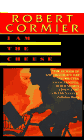
I Am the Cheese by Robert Cormier

Spoilers.


I Am the Cheese may be the best thriller I've read in years. Whether this is a strong compliment because it's officially a YA novel, or faint praise because I don't read many thrillers, I'm not sure. Regardless, IATC gripped me from the second chapter and I finished it just a couple hours later.


The story, already summarized nicely by Chris and Carlton, follows the events surrounding Adam, a young man whose family is an inductee into the witness protection program. The narrative of the book is split, with about half consisting of transcripts of taped interviews and half chronicling Adam's bicycle journey from his home to Rutterberg, Vermont to see his father in the hospital. Things are not as they seem, however, and the final section of the book (along with a couple pages of government paperwork to clarify) turns everything on its head. For a YA book, the ending is somewhat ambiguous. At first glance, it appears that Adam's journey has been entirely fabricated in his mind, probably to deal with the trauma of losing his parents, but Cormier leaves open a couple other possibilities as well. It is possible that Adam is reliving something that actually happened at one time, and it seems equally possible that Adam is just mental and none of the book's events happened at all. It's never made explicit, and somehow that makes the last chapter even more chilling.


After reading The Chocolate War and I Am the Cheese, I'm impressed with Cormier's books. I'm planning to read a couple more of them, although I'm curious if they all hold to the nihilistic worldview presented in the books I've read. I'll touch more on the specifics in my review of The Chocolate War.


Also, I'm pretty sure this is the worst cover this book has ever had.

Friday, November 28, 2008

The Homing by Jeffrey Campbell

I couldn't find a thing about this book anywhere online, and I can't find my copy of the book to get the author's name off of (edit: found it). Even this cover image is my rough Photoshopped approximation of the cover. I guess that means The Homing is either a lost classic or a piece of junk better off forgotten.

I bought this book (at Goodwill, .69) for two reasons. 1) The premise, a small town in upstate New York being taken over by a malevolent hospital, sounded interesting in a pulpy, cheap kind of way. 2) The name of the town is Chilton. An inside joke for the loyal 50Bers.

So, a retired cop, Darryl, visits his estranged daughter, Claire, in Chilton. They are estranged because she left college and a promising career as a doctor to marry a man (Phil), and move to Chilton to be his loyal housewife. Ever since the move, Claire hasn't seemed quite like herself. Darryl's first night in Claire and Phil's house is one of the only genuinely creepy bits in the whole novel, but it does manage to create an atmosphere where nothing is overtly wrong but nothing is quite right either.

Unfortunately, the book can't quite decide what it wants to be, so it jumps from atmospheric pulp to weak-sauce thriller to weird old-people romance to government conspiracy and back again over and over and over. By the time it ends (with Darryl being brainwashed into a permanent citizen of Chilton, for those interested), it's kind of numbing and really dull.

Also, the hospital mentioned in the back of the book? Two, three pages, max. I don't even remember what it was for. I would say making the fake cover was more fun than the book.

Tuesday, February 12, 2008

The Lodger by Marie Belloc Lowndes

This was on the "Employee Recommended" shelf at the bookstore I frequent. The same person who vouched for this book had, along with a whole host of others, recommended The Man Who Was Thursday. I thought that it might be worth giving a chance. From Molly's brief description, it sounded like a taut mystery set in early-20th-Century London.

The book opens on a destitute couple. Mr. and Mrs. Bunting have been slowly selling off their furniture and other belongings to remain just above financial ruin. They belong to the serving class, and had run a boarding house for many years, but recently had fallen on bad times. A young police officer, Chandler, checks up on them and helps them out when he can. He is the son of one of Bunting's old friends.

As things seem to be coming to their worst, a lodger arrives, a peculiar man, who wants to rent two rooms and pays quite a lot for both. It is at the same time that horrible murders start taking place in London. Gruesome murders, in which only women are targeted, by a man known as The Avenger. It is not long before Mrs. Bunting begins to suspect their lodger of being The Avenger, but does not know what to do. After all, turning him in would mean certain financial ruin for her and her husband yet again. The casual visits from young Chandler become fraught with tension. And Mrs. Bunting becomes more and more posessive of the lodger, insisting that she be the only one that attend to his needs.

This really was not a murder mystery, as I expected it to be. From the beginning, it is pretty clear who the murderer is. The Lodger is a psychological thriller. With the evidence that The Avenger is in her house becoming clearer and clearer, Mrs. Bunting spirals into a state of near hysteria, trying to keep it together and keep her secret may just be too much for her. A well-written, interesting, quick read.

Thursday, November 29, 2007

No Country for Old Men by Cormac McCarthy

THAT is no country for old men. The young
In one another's arms, birds in the trees
- Those dying generations - at their song,
The salmon-falls, the mackerel-crowded seas,
Fish, flesh, or fowl, commend all summer long
Whatever is begotten, born, and dies.
Caught in that sensual music all neglect
Monuments of unageing intellect.

--Sailing to Byzantium, Wm. Butler Yeats

I told Nathan I wouldn't see the Coen Brothers' film No Country for Old Men until I had read the book, which I did in a couple of days during my vacation to Cancun. It didn't take long at all, maybe two or three total hours, but a lot of that has to do with McCarthy's unique style. No Country contains a lot of paratactical sentences with very few quotation marks ("Chigurh did this and did this and did this and did this and did this"). The result is stark, much starker than The Road, which was comparatively intricate and detailed, and gives No Country a style which I have not seen successfully replicated in any novel. But also it makes the reading go very fast, sometimes to the point where I would read a page in thirty seconds and then realize that my brain had not had enough time to absorb what I had read, and I would have to go on and read it again.

In No Country for Old Men, we get the story of Llewellyn Moss, a rather ordinary young Texan with a wife named Carla Jean who happens to chance upon the result of a drug deal gone wrong while hunting in the desert. There are bodies everywhere, and abandoned vehicles, and a big bag of cocaine and a shitload of cash in a suitcase. Moss, in a rather nonplussed way, takes the money, but this sets of a chain of events in which Moss is hunted down by a cold and ruthless professional killer named Anton Chigurh who uses an air-powered steergun (it shoots out a tab which punctures a cow's skull and then pulls it back in lightning-quick) to kill his victims. Chigurh is the kind of villain that thiller writers try to create every time they write a thriller but rarely succeed: emotionless, austere, living both simultaneously outside of the law and in accordance to a strict interior moral code. The italicized monologues of aging Sheriff Bell, who relates his own horror at the deterioration of the county which he protects, are woven throughout.

In fact, No Country is a thriller through and through, but avoids the platitudes that so often come together to make good triumph over evil before the credits roll: the plucky hero cannot out-clever the professional killer; he doesn't play some cheap psychological trick (I'm looking at you, Vincent D'Onofrio) that goads the killer into violating his own methodicalness or let his guard down. The most important death and ostensibly the book's climax happens "off-screen;" what traditional thriller would be content with not allowing the reader/viewer to see that moment? And most importantly, there is no intimation that, even if Moss is able to beat Chigurh--which I will not say if he does or not--that this would mean anything, because even Chigurh, as fascinating and unique as he is, is simply a cog in a faceless, evil, all-consuming machine. The insinuation of the title is that even if you can prevent single crimes and tragedies, you cannot prevent humankind from succumbing more and more to its primeval urges; that is why Bell becomes so alienated and disillusioned. If The Road is a book about the way that humankind carries hope when hope makes no sense, No Country for Old Men is a book that screams, "Hope is lost," and in that way might even be more depressing.

I did like this book, but after The Road it was a little disappointing. I think I will read Blood Meridian, a more traditional Western.

Wednesday, January 24, 2007

The Man Who Was Thursday by G.K. Chesterton

I am going to give away the big sort-of secret in this book, because I believe that it is a.) crucial to explaining the plot, and b.) quite obvious, quite early.

The Man Who Was Thursday is about a man named Gabriel Syme, who is a poet recruited by the London police into an undercover unit designed to combat intellectual threats to the government, specifically "anarchists," by which Chesterton means not quite what we would mean, but a wide-ranging group of intellectuals whose ideologies are closest to nihilism. Through Syme's cleverness, he successfully masquerades as an anarchist and is elected to the worldwide council of anarchists, of which there are seven, each named after a day of the week. Syme is Thursday, and the group is led by the intimidating and mysterious Sunday. If you think the fact that anarchists have an organization is funny, well, that's the sort of humor you're getting with this book.

Thing is, as the book develops, you find out one by one that all six of the "Sabbatarians," excluding Sunday, are policemen in the same unit tracking each other. I think that's a really funny twist, and it's certainly a funny book. When Syme's fellow anarchists explain why the former Thursday must be replaced, this is what they say:

As you know, his death was as self-denying as his life, for he died through his faith in a hygenic mixture of chalk and water as a substitute for milk, which beverage he regarded as barbaric, and involving cruelty to the cow.

These sorts of nihilistic and existentialist philosophies are the butt of Thursday's extended joke. Chesterton "claimed afterwards that he wrote this book as an unusual affirmation that goodness and right were at the heart of every aspect of the world," according to Wikipedia--at the heart of the book is an affirmation of the great order of God that rules over chaos. "Chaos is dull," Syme says, trying to argue with an anarchist and fellow poet that order and lawfulness are the most poetic things in the universe.

This book is only around 150 pages, but it's packed very tightly with a lot of ideas. Despite its philosophizing, its humor makes much of it a very light book, and some of the more "adventurous" scenes would make an awfully good film--there's even a car chase. But the book's final chapters, in which Syme seems to exit the reality of London and enter the fantastic and surreal world of Sunday's grand estate, and where the book's overt Christian themes are the most evident, that are the most impressive.

I would like to film this book, casting Cary Elwes as Gabriel Syme. If you are a movie producer, please e-mail me.